• 검색 결과가 없습니다.

Clinical Prognostic Factors in 86 Chinese Patients with Primary Myelodysplastic Syndromes and Trisomy 8: A Single Institution Experience

N/A
N/A
Protected

Academic year: 2022

Share "Clinical Prognostic Factors in 86 Chinese Patients with Primary Myelodysplastic Syndromes and Trisomy 8: A Single Institution Experience"

Copied!
7
0
0

로드 중.... (전체 텍스트 보기)

전체 글

(1)

INTRODUCTION

Myelodysplastic syndrome (MDS) is a group of malignant clon- al diseases originating from hematopoietic stem cells and characterized by pathophysiological changes in dysplasia and ineffective hematopoiesis of clonal hematopoietic stem cells.

Its clinical manifestations include cytopenia of one or more lineages, dysplasia of cells in bone marrow and peripheral blood, and an obvious tendency to transform into acute leuke- mia, particularly in more advanced forms of MDS.

1-4

The over- all survival (OS) and risk of leukemic transformation in such patients are highly variable.

5-9

The International Prognostic Scoring System (IPSS) has widely been used as the golden prognostic classification with primary MDS.

10

Recently, the newer prognostic system Revised IPSS (IPSS- R) was proposed.

8

Both systems indicate that cytogenetics is an independent prognostic factor of MDS concerning OS and acute myeloid leukemia (AML) transformation.

9,10

Trisomy 8 (tr8 or +8) is the most common chromosomal gain in MDS, which is present in 5% of all MDS patients in Western countries.

11

However, it accounts for about 30–35% in Chinese patients with abnormal karyotype and represents 14–20% of MDS patients in Western countries.

12-14

Although tr8 as sole

Clinical Prognostic Factors in 86 Chinese Patients with Primary Myelodysplastic Syndromes and Trisomy 8: A Single Institution Experience

Qing-Fang Yue

1

, Lei Chen

2

, Xiao-Mei She

2

, Bin Hu

2

, Yu Hu

2

, Ping Zou

2

, and Xin-Yue Liu

2

1

Department of Medical Oncology, ShaanXi Provincial People’s Hospital, Xi’an, Shaanxi, P.R. China;

2
Department of Hematology, Union Hospital, Tongji Medical College of Huazhong University of Science and Technology, Wuhan, Hubei, P.R. China.

Purpose: The objective was to determine the characteristics and prognostic factors of 86 Chinese patients with trisomy 8 aberra- tions and compare the prognostic value of International Prognostic System (IPSS) and Revised IPSS (IPSS-R) in this cohort.

Materials and Methods: A total of 86 cases diagnosed with primary myelodysplastic syndromes (MDS) with isolated tr8 or with tr8 and other additional cytogenetic aberrations diagnosed and treated at the Union Hospital, Tongji Medical College of Huazhong University of Science and Technology between July 2002 and March 2013 were reviewed.

Results: The median survival of the entire group was 23.0 months, and acute myeloid leukemia (AML) developed in 43% (37/86) patients within the follow up time. The univariate analysis revealed that overall survival (OS) was correlated with age, thrombocy- topenia, absolute neutrophil count, marrow blasts, cytogenetic status and red blood cell transfusion at diagnosis, and the multi- variate analysis revealed that age, marrow blasts, cytogenetic status and transfusion dependence were independent parameters for the OS. The cytogenetic complexity and marrow blasts had the strongest impact on the AML transformation by multivariate analysis. Comparing the two prognostic systems, both two systems could successfully discriminate risk groups for survival. IPSS- R was more refined than IPSS for predicting OS, but had no advantage in predicting the risk of AML development.

Conclusion: This study confirmed the influence of clinical factors on the prognosis of 86 Chinese MDS patients with trisomy 8. In addition, IPSS-R can further refine prognostic discrimination in the IPSS risk categories.

Key Words: Myelodysplastic syndromes, trisomy 8, prognosis, cytogenetic aberrations Yonsei Med J 2016 Mar;57(2):358-364

http://dx.doi.org/10.3349/ymj.2016.57.2.358 pISSN: 0513-5796 · eISSN: 1976-2437

Received: June 9, 2014 Revised: December 1, 2014 Accepted: January 8, 2015

Corresponding author: Dr. Xin-Yue Liu, Department of Hematology, Union Hospi- tal, Tongji Medical College of Huazhong University of Science and Technology, No 1277, JieFang Avenue, Wuhan 430022, Hubei, P.R. China.

Tel: 86-27-85726415, Fax: 86-27-85726576, E-mail: [email protected]

•The authors have no financial conflicts of interest.

© Copyright: Yonsei University College of Medicine 2016

This is an Open Access article distributed under the terms of the Creative Com- mons Attribution Non-Commercial License (http://creativecommons.org/licenses/

by-nc/3.0) which permits unrestricted non-commercial use, distribution, and repro-

duction in any medium, provided the original work is properly cited.

(2)

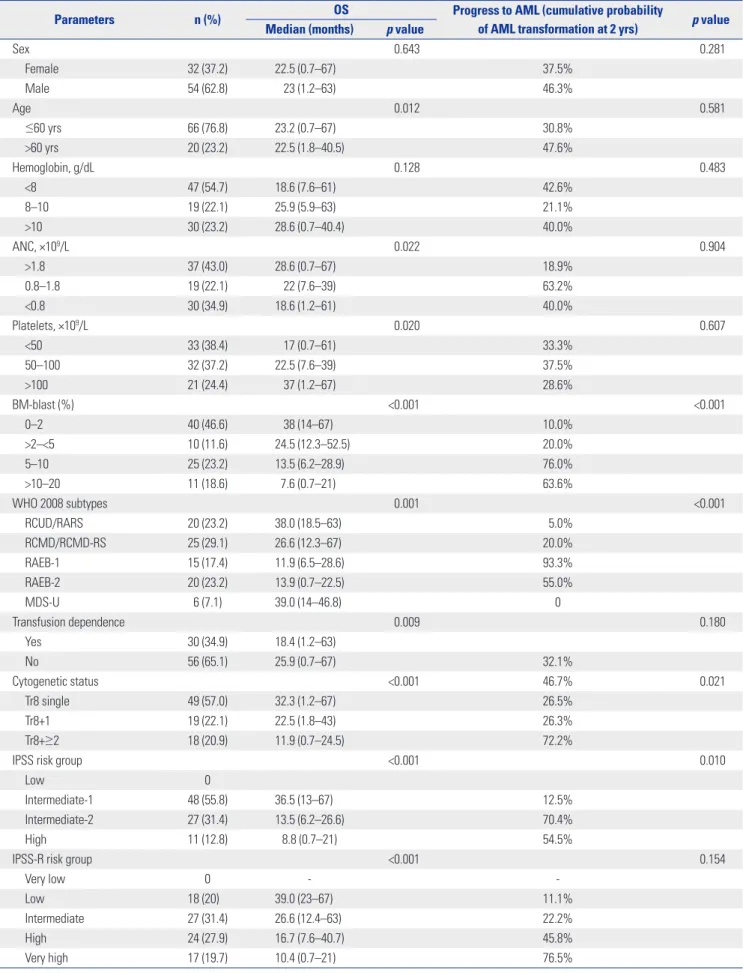
Table 1. Univariate Analysis of Prognostic Parameters for OS and AML Progression

Parameters n (%) OS Progress to AML (cumulative probability

of AML transformation at 2 yrs) p value Median (months) p value

Sex 0.643 0.281

Female 32 (37.2) 22.5 (0.7–67) 37.5%

Male 54 (62.8) 23 (1.2–63) 46.3%

Age 0.012 0.581

≤60 yrs 66 (76.8) 23.2 (0.7–67) 30.8%

>60 yrs 20 (23.2) 22.5 (1.8–40.5) 47.6%

Hemoglobin, g/dL 0.128 0.483

<8 47 (54.7) 18.6 (7.6–61) 42.6%

8–10 19 (22.1) 25.9 (5.9–63) 21.1%

>10 30 (23.2) 28.6 (0.7–40.4) 40.0%

ANC, ×10

9

/L 0.022 0.904

>1.8 37 (43.0) 28.6 (0.7–67) 18.9%

0.8–1.8 19 (22.1) 22 (7.6–39) 63.2%

<0.8 30 (34.9) 18.6 (1.2–61) 40.0%

Platelets, ×10

9

/L 0.020 0.607

<50 33 (38.4) 17 (0.7–61) 33.3%

50–100 32 (37.2) 22.5 (7.6–39) 37.5%

>100 21 (24.4) 37 (1.2–67) 28.6%

BM-blast (%) <0.001 <0.001

0–2 40 (46.6) 38 (14–67) 10.0%

>2–<5 10 (11.6) 24.5 (12.3–52.5) 20.0%

5–10 25 (23.2) 13.5 (6.2–28.9) 76.0%

>10–20 11 (18.6) 7.6 (0.7–21) 63.6%

WHO 2008 subtypes 0.001 <0.001

RCUD/RARS 20 (23.2) 38.0 (18.5–63) 5.0%

RCMD/RCMD-RS 25 (29.1) 26.6 (12.3–67) 20.0%

RAEB-1 15 (17.4) 11.9 (6.5–28.6) 93.3%

RAEB-2 20 (23.2) 13.9 (0.7–22.5) 55.0%

MDS-U 6 (7.1) 39.0 (14–46.8) 0

Transfusion dependence 0.009 0.180

Yes 30 (34.9) 18.4 (1.2–63)

No 56 (65.1) 25.9 (0.7–67) 32.1%

Cytogenetic status <0.001 46.7% 0.021

Tr8 single 49 (57.0) 32.3 (1.2–67) 26.5%

Tr8+1 19 (22.1) 22.5 (1.8–43) 26.3%

Tr8+≥2 18 (20.9) 11.9 (0.7–24.5) 72.2%

IPSS risk group <0.001 0.010

Low 0

Intermediate-1 48 (55.8) 36.5 (13–67) 12.5%

Intermediate-2 27 (31.4) 13.5 (6.2–26.6) 70.4%

High 11 (12.8) 8.8 (0.7–21) 54.5%

IPSS-R risk group <0.001 0.154

Very low 0 - -

Low 18 (20) 39.0 (23–67) 11.1%

Intermediate 27 (31.4) 26.6 (12.4–63) 22.2%

High 24 (27.9) 16.7 (7.6–40.7) 45.8%

Very high 17 (19.7) 10.4 (0.7–21) 76.5%

(3)

anomaly is categorized as intermediate IPSS cytogenetic sub- group, the outcome varies greatly both in terms of OS and risk of evolution to AML.

5,15,16

Furthermore, patients with trisomy 8 are more likely to improve hematologically with immunosup- pressive treatment (IST) compared with patients with other forms of MDS.

17

Recently, the optimal therapies for the triso- my 8 patients have been investigated.

18

Thus, the analysis of further prognostic parameters for OS and AML transforma- tion in large series of MDS patients with trisomy 8 is of impor- tance. There are few studies that have systematically analyzed the clinical prognostic factors of primary MDS with tr8 in Chi- nese patients.

12,13,15

In this study, we aimed to assess clinical features and identify prognostic factors in Chinese primary MDS with tr8 anomaly, and compare the prognostic value of IPSS and IPSS-R in this group by our single institution cohort.

MATERIALS AND METHODS

Patients

We retrospectively analyzed 86 (23%) patients with MDS from a series of 374 cases diagnosed and followed up in our institu- tion between July 2002 and March 2013. A total of 86 cases di- agnosed with MDS with isolated tr8 or with tr8 and other ad- ditional cytogenetic aberrations were enrolled for the study.

The diagnosis of the patients were reviewed, and reclassified according to World Health Organization (WHO) classification of 2008,

16

and the exact date of diagnosis with bone marrow ex- amination and cytogenetic assessment had to be documented.

Exact WHO type, medullary blast count, differential count, bl- ood cell counts, karyotype, and transfusion requirement were documented. Transfusion dependency means that at least 4 units of red blood cell (RBC) transfusions had to be adminis- tered within 8 weeks, which was defined as described by Mal- covati, et al.

19

As a result, 86 patients had met the criteria and were enrolled. The studies had been approved by ethics com- mittees of participating institutions and conducted in accor- dance with the Declaration of Helsinki. All participants had given informed consent.

Cytogenetics

All the bone marrow chromosome studies were performed by following chromosome-banding procedures, and at least 20 metaphases were analyzed. Abnormal clones were described in accordance with the 2006 International System for Human Cytogenetic Nomenclature (ISCN),

20

and aberrations were counted following the International Working Group on MDS Cytogenetics (IWGMC) consensus guidelines.

21

Fluorescence in situ hybridization (FISH) analysis was performed on short- term cultured bone marrow. Sample preparations and hybrid- izations using commercially available probes were performed according to manufacturer’s recommendations (Vysis, Down- ers Grove, IL, USA). Systematic screening for del(5q), del(7q)/

-7, +8, del(20q), and -Y was performed on each case. A mini- mum of 500 interphase cells were analyzed. If the cells with abnormal signal were less than 5%, 1000 inter-phase cells were screened. Normal control values were previously established by using five normal samples of bone marrow donors and 15 bone marrow samples of iron deficiency anemia patients with normal karyotype. Using the method of x±258 standard devia- tions (99% confidence interval), the cut-off level for normal range values was established for each probe as follows: del (5q)<0.5%; del(7q)/-7<0.2%; +8<0.5%; del(20q)<1%; and -Y<5%.

Long-term clinical follow-up

According to WHO classification, all patients were adminis- tered with supportive care. Patients were followed up with re- peated examinations, including bone marrow aspirate, cytoge- netics and molecular genetics, every 6 months or whenever any change in their clinical condition occurred. Follow-up was completed by the end of March 2013.

Statistical analysis

For the analysis of survival and AML development, patients who were still alive were censored at the date of last observa- tion. Survival time was counted from diagnosis. OS was de- fined as the time from diagnosis to death or date of last follow- up. The time to AML transformation was defined as time to Table 1. Univariate Analysis of Prognostic Parameters for OS and AML Progression (Continued)

Parameters n (%) OS Progress to AML (cumulative probability

of AML transformation at 2 yrs) p value Median (months) p value

WPSS risk group <0.001 0.106

Very low 0 - -

Low 0 - -

Intermediate 34 (39.5) 38.9 (13.9–67) 8.8%

High 28 (32.6) 16.7 (5.9–36.5) 32.1%

Very high 24 (27.9) 12.3 (0.7–28.6) 41.7%

ANC, absolute neutrophil count; WHO, World Health Organization; RCUD, refractory cytopenia with unlineage dysplasia; RCMD, refractory cytopenia with multi-

lineage dysplasia; RARS, refractory anemia with ring sideroblasts; RAEB, refractory anemia with excess blasts; MDS-U, myelodysplastic syndromes unclassifi-

able; tr8, +8, trisomy 8; IPSS, International Prognostic Scoring System; IPSS-R, Revised IPSS; WPSS, WHO Classification-Based Scoring System; OS, overall sur-

vival; AML, acute myeloid leukemia; BM, bone marrow.

(4)

bone marrow blast increase to 20%, according to the WHO classification.

22

OS was analyzed with the Kaplan-Meier meth- od and followed by the log-rank.

23

All univariate tests were two tailed and p value ≤0.05 was considered as significant. Fi- nally, Cox proportional hazards multivariate model was used to define the OS and to assess the relevant prognostic vari- ables.

24

For multivariate analysis, a p value ≤0.05 was consid- ered significant. All analyses were performed using SPSS soft- ware (version 18.0; SPSS Inc., Chicago, IL, USA).

RESULTS

Patients’ hematological characteristics

The 86 patients with trisomy 8 abnormality were analyzed as a whole. Fifty-four patients were male (62.8%) and 32 were fe- male (37.2%), with median age of 48.5 years (range of 21–79).

The median hemoglobin level, absolute neutrophil count (ANC) and platelet count were 76.5 g/L (range of 42–134), 1.5×10

9

/L (range of 0.08–10.1), and 64.5×10

9

/L (range of 7–297), respec- tively. The median proportion of bone marrow blasts was 3%

(range of 0–18) (Table 1). According to the IPSS, therefore,

76.8% had hemoglobin level <100 g/L, 54.7% had ANC

<1.8×10

9

/L and 55.8% had a platelet count <100×10

9

/L. At the time of diagnosis, 35% patients regularly needed RBC transfu- sion. In total, 49 (57.0%) patients had a single trisomy 8 abnor- mality, while 19 (22.1%) had one additional aberration and 18 (20.9%) had more than three aberrations (complex karyotype including tr8). According to the 2008 WHO classification, the patients were classified as 19 cases of RCUD, 1 case of RARS, 25 cases of RCMD, 15 cases of RAEB1, 20 cases of RAEB2, and 6 cases of MDS-U.

OS

The median follow-up time was 22 months. The median OS for our study group was 23.0 months. Univariate analysis by log- rank test was done to screen the parameters potentially associ- ated with the time of survival (Table 1). Age above 60 years old, marrow blasts, cytogenetic complexity, ANC, platelet count (<50×10

9

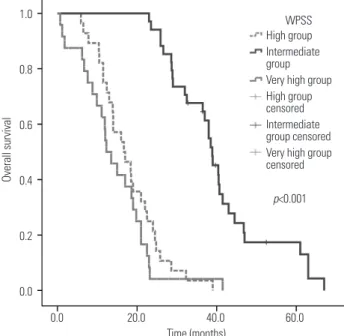
/L) and transfusion dependency at diagnosis were associated with a worse prognosis. Then, we further assessed the WHO Classification-Based Scoring System (WPSS) for the OS, and found that the intermediate group vs. high and very high group has significant difference (Fig. 1). In the multivari- ate analysis, age, marrow blasts, cytogenetic status and the need of RBC transfusion at diagnosis were independent pa- rameters for the time of survival (Table 2). For the cytogenetic status, we found a difference in the time of survival between the karyotype complexity groups: the median time for the groups (tr8, tr8+1, and tr8+≥2) was 32.3, 22.5, and 11.9 months, respectively, with the difference being statistically significant between tr8 and tr8+1 or tr8+≥2 (p<0.05) or between tr8+1 and tr8+≥2 (p<0.05) (Fig. 2).

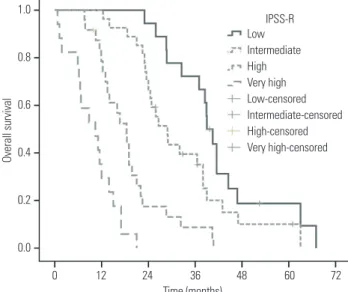
It was found that both IPSS and IPSS-R could successfully predict the OS (p<0.05), however, the IPSS has the advantage for predicting the AML transformation risk (p<0.05) than the IPSS-R (p=0.154). In the IPSS groups, there was no significant difference in the OS between intermediate-2 risk group and high risk groups (p=0.535) (Fig. 3). When the prognosis risk scores were recalculated according to the IPSS-R; 37.5% (18 cases) intermediate-1 from the IPSS group was redistributed into the IPSS-R low-risk group, 18.8% (9 cases) was into high- risk group; 48% (13 cases) intermediate-2 from the IPSS was put into the IPSS-R high-risk group, 30% (8 cases) intermedi- ate-2 was put into very high-risk group, and 81.8% (9 cases) Fig. 1. Survival according to WPSS. WPSS, World Health Organization

Classification-Based Scoring System.

1.0

0.8

0.6

0.4

0.2

0.0

Time (months)

p<0.001

0.0 20.0 40.0 60.0

Overall survival

WPSS High group Intermediate group Very high group High group censored Intermediate group censored Very high group censored

Table 2. Cox Model for OS

Coefficient Expo (coefficient) 95% CI p value

Age -0.810 0.445 0.80–0.25 0.007

ANC 0.237 1.267 1.70–0.95 0.111

Thrombocytopenia -0.026 0.974 1.39–0.68 0.885

BM-blasts 0.995 2.704 3.62–2.02 <0.001

Transfusion dependency 0.666 1.947 3.51–1.08 0.026

Cytogenetics (tr8+1 and tr8+≥2 vs. tr8) 1.233 3.43 5.95–1.98 <0.001

ANC, absolute neutrophil count; CI, confidence interval; BM, bone marrow; OS, overall survival.

(5)

from high group was put into very high-risk group. Conse- quently, the IPSS-R refined the risk groups than IPSS for OS.

AML transformation

During the entire follow time, there were 37 (43%) of the 86 patients progressed to AML. Then, we explored the influence of parameters on the risk of AML progression by univariate analysis, and found that cytogenetic status and marrow blasts

>5% were significantly (p<0.05) associated with the increased risk of the AML transformation. In the multivariate analysis, the cytogenetic complexity and the count of bone marrow blasts were identified to be the independent risk factors for AML evolution (Table 3).

DISCUSSION

MDS is characterized by highly clinical heterogeneous behav- ior, and numerous studies have suggested that the Asian MDS patients are different from those in Western countries.

25-28

The median age in our cohort was younger (48.5 years old) than the reported cases in the Western countries (72 years old). The incidence of the MDS with the tr8 abnormality is different be- tween the Western and the Asian. In China, trisomy 8 is the most frequent karyotypic abnormality.

13,14,29-31

Furthermore, the clinical characteristic and prognostic factors of Asian MDS patients are different from Western patients.

26,32

Therefore, we considered that the prognostic parameters of this group may

be different between the Westerners and Chinese.

As for the significance of clinical parameters for the OS and AML development in the present study, age, low platelet, and degree of ANC had an impact on OS but not on AML transfor- mation. The significantly bad prognosis of low platelet count had been described in MDS patients.

31

However, hemoglobin level had no significance (p>0.05) for OS. Transfusion depen- dency, a confounding factor, could reflect the more objective parameter of severity of anemia and had impact on the sur- vival (p<0.05), but not on the AML evolution. In the MDS pa- tients a small scale of study showed that red cells transfusion at diagnosis and the intensity may be an important indepen- dent prognostic factor.

33

In most Chinese patients, the transfu- sion threshold for RBC was lower than 60 g/L, and the patients with Hb concentrations greater than 70 g/L had no symptoms related to anemia and did not require red cell transfusion. On the other hand, the threshold for RBC transfusion in the west- erns countries is lower than 80 g/L. Therefore, the prognostic value of concentration threshold of 80 g/L may possibly ex- plain the difference of the Hb for the prognosis of survival. We further assessed the WPSS for OS, and found that high and very high groups had significance for OS (p<0.001). This find- ing needs to be confirmed by more studies. In the present study, multivariate analysis showed that the patient with mar- row blasts ≥5% combining the trisomy 8 abnormalities had poorer prognosis on OS (p<0.05) and AML evolution (p<0.05) than the patient with <5% marrow blasts, in accordance with the findings by Saumell, et al.

34

Table 3. Cox Model for AML Progression

Coefficient Expo (coefficient) 95% CI p value

BM-blasts 1.060 2.886 6.18–1.92 <0.001

Cytogenetics (tr8+1and tr8+≥2 vs. tr8) 1.128 3.091 6.64–1.44 0.004

AML, acute myeloid leukemia; CI, confidence interval; tr8, +8, trisomy 8; BM, bone marrow.

Fig. 2. Survival according to cytogenetic complexity. tr8, +8, trisomy 8;

WPSS, World Health Organization Classification-Based Scoring Sys- tem.

1.0 0.8 0.6 0.4 0.2 0.0

Time (months)

p<0.001

0 12 24 36 48 60 72

Overall survival

tr8 tr8+1 tr8+ ≥2 tr8-censored tr8+1-censored tr8+≥2-censored

Fig. 3. Overall survival according to IPSS-R. IPSS-R, Revised Interna- tional Prognostic System; WPSS, World Health Organization Classifica- tion-Based Scoring System.

1.0

0.8

0.6

0.4

0.2

0.0

Time (months)

0 12 24 36 48 60 72

Overall survival

IPSS-R

Low

Intermediate

High

Very high

Low-censored

Intermediate-censored

High-censored

Very high-censored

(6)

The new proposals for cytogenetic categorization, like the previous IPSS classification, have regarded isolated trisomy 8 as an intermediate risk prognosis to MDS. The median OS re- ported for patients with single trisomy 8 ranged between 11 and 25 months, and for the patients in the intermediate IPSS subgroup between 23 and 32 months.

5,6,10,35

Our results are in accordance with the results reported by Saumell, et al.;

34

in our study the median OS for patients with single trisomy 8 was 32.3 months. We found that the complexity of additional aberrations had impact on OS; the single tr8 between tr8+1 aberration (p=0.003), tr8+1 aberration between tr8+≥2 aberra- tions (p=0.001), and the median OS for tr8+1 and tr8+≥2 were 22.5 and 11.9 months respectively. This phenomenon was dif- ferent from the results by Haase, et al.,

35

who showed that tr8 plus one additional anomaly had a better prognosis and were classified into good-prognostic cytogenetic subgroup. How- ever, our data demonstrated that there was statistical differ- ence in median survival between the two subgroups. Similar- ly, the progression to AML risk increased with the complexity of the cytogenetic abnormalities, but the result must be con- firmed with multicenter studies.

Compared with the IPSS, IPSS-R defined 16 specific abnor- malities better, grouped into five different risk groups, and classified a number of uncommon cytogenetic subsets in ac- cordance with its sophisticated stratification.

9

In addition, re- cent evidence suggests that the prognostic significance of poor cytogenetics has been underestimated in the IPSS, while the defect has been improved in the IPSS-R prognostic mod- els.

36

We applied the IPSS-R to an independent group of 86 Chinese MDS patients with tr8 alterations, and evaluated the predictive power of the two systems for the OS and the risk of AML transformation. Two systems both could successfully dis- criminate risk groups for survival. The same cohort of patient distribution into risk groups varied according to the scoring systems: IPSS-R was more specific than IPSS for discriminat- ing survival risk groups, but had no advantage in the prognosis for the risk of the AML transformation in this cohort. This re- sult can be explained by the limits of the small number of en- rolled patients, and need to be confirmed by more multicenter researches.

In summary, the results of this retrospective study confirmed the impact of the number of additional aberration on MDS patients with tr8, and first assessed the importance of clinical parameters for the outcomes. This series may be useful for the design of more clinical trials in Chinese MDS patients with tr8.

ACKNOWLEDGEMENTS

In this study morphology examination by Xiao-Mei She and Lei Chen; data collection by Lei Chen, Bin Hu, and Qing-Fang Yue; analysis data by Qing-Fang Yue and Lei Chen; drafting of the manuscript by Qing-Fang Yue; critical revision of the man- uscript for important intellectual content by Yu Hu, Ping Zou,

and Xin-Yue Liu.

REFERENCES

1. Greenberg PL, Young NS, Gattermann N. Myelodysplastic syn- dromes. Hematology Am Soc Hematol Educ Program 2002:136-61.

2. Nimer SD. Myelodysplastic syndromes. Blood 2008;111:4841-51.

3. Nolte F, Hofmann WK. Myelodysplastic syndromes: molecular pathogenesis and genomic changes. Ann Hematol 2008;87:777-95.

4. Mufti GJ, Bennett JM, Goasguen J, Bain BJ, Baumann I, Brunning R, et al. Diagnosis and classification of myelodysplastic syndrome: In- ternational Working Group on Morphology of myelodysplastic syndrome (IWGM-MDS) consensus proposals for the definition and enumeration of myeloblasts and ring sideroblasts. Haemato- logica 2008;93:1712-7.

5. Solé F, Luño E, Sanzo C, Espinet B, Sanz GF, Cervera J, et al. Identifi- cation of novel cytogenetic markers with prognostic significance in a series of 968 patients with primary myelodysplastic syndromes.

Haematologica 2005;90:1168-78.

6. Bernasconi P, Klersy C, Boni M, Cavigliano PM, Calatroni S, Giardi- ni I, et al. World Health Organization classification in combination with cytogenetic markers improves the prognostic stratification of patients with de novo primary myelodysplastic syndromes. Br J Haematol 2007;137:193-205.

7. Malcovati L, Germing U, Kuendgen A, Della Porta MG, Pascutto C, Invernizzi R, et al. Time-dependent prognostic scoring system for predicting survival and leukemic evolution in myelodysplastic syn- dromes. J Clin Oncol 2007;25:3503-10.

8. Greenberg PL, Tuechler H, Schanz J, Sanz G, Garcia-Manero G, Solé F, et al. Revised international prognostic scoring system for myelodysplastic syndromes. Blood 2012;120:2454-65.

9. Germing U, Kündgen A. Prognostic scoring systems in MDS. Leuk Res 2012;36:1463-9.

10. Greenberg P, Cox C, LeBeau MM, Fenaux P, Morel P, Sanz G, et al.

International scoring system for evaluating prognosis in myelo- dysplastic syndromes. Blood 1997;89:2079-88.

11. Paulsson K, Johansson B. Trisomy 8 as the sole chromosomal aber- ration in acute myeloid leukemia and myelodysplastic syndromes.

Pathol Biol (Paris) 2007;55:37-48.

12. Irons RD, Wang X, Gross SA, Bao L, Ryder J, Chen Y, et al. Preva- lence of MDS subtypes in Shanghai, China: a comparison of the World Health Organization and French American British classifi- cations. Leuk Res 2006;30:769-75.

13. Qu S, Xu Z, Zhang Y, Qin T, Zhang T, Cui R, et al. Impacts of cyto- genetic categories in the Revised International Prognostic Scoring System on the prognosis of primary myelodysplastic syndromes:

results of a single-center study. Leuk Lymphoma 2012;53:940-6.

14. Xiao Y, Wei J, Chen Y, Zhang K, Zhou J, Zhang Y. Trisomy 8 is the most frequent cytogenetic abnormality in de novo myelodysplas- tic syndrome in China. Onkologie 2012;35:100-6.

15. Ma Y, Wang X, Xu X, Lin G. Prognostic value of trisomy 8 in pri- mary myelodysplastic syndrome. Intern Med J 2010;40:697-703.

16. Cazzola M, Della Porta MG, Travaglino E, Malcovati L. Classifica- tion and prognostic evaluation of myelodysplastic syndromes.

Semin Oncol 2011;38:627-34.

17. Sloand EM, Mainwaring L, Fuhrer M, Ramkissoon S, Risitano AM, Keyvanafar K, et al. Preferential suppression of trisomy 8 compared with normal hematopoietic cell growth by autologous lymphocytes in patients with trisomy 8 myelodysplastic syndrome. Blood 2005;106:841-51.

18. Olnes MJ, Shenoy A, Weinstein B, Pfannes L, Loeliger K, Tucker Z,

et al. Directed therapy for patients with myelodysplastic syndromes

(7)

(MDS) by suppression of cyclin D1 with ON 01910.Na. Leuk Res 2012;36:982-9.

19. Malcovati L, Della Porta MG, Strupp C, Ambaglio I, Kuendgen A, Nachtkamp K, et al. Impact of the degree of anemia on the out- come of patients with myelodysplastic syndrome and its integra- tion into the WHO classification-based Prognostic Scoring System (WPSS). Haematologica 2011;96:1433-40.

20. Gonzalez Garcia JR, Meza-Espinoza JP. Use of the International System for Human Cytogenetic Nomenclature (ISCN). Blood 2006;108:3952-3.

21. Chun K, Hagemeijer A, Iqbal A, Slovak ML. Implementation of standardized international karyotype scoring practices is needed to provide uniform and systematic evaluation for patients with my- elodysplastic syndrome using IPSS criteria: An International Work- ing Group on MDS Cytogenetics Study. Leuk Res 2010;34:160-5.

22. Vardiman JW, Thiele J, Arber DA, Brunning RD, Borowitz MJ, Por- wit A, et al. The 2008 revision of the World Health Organization (WHO) classification of myeloid neoplasms and acute leukemia:

rationale and important changes. Blood 2009;114:937-51.

23. Wellner JA. On an exponential bound for the Kaplan-Meier esti- mator. Lifetime Data Anal 2007;13:481-96.

24. Gill RD. Multistate life-tables and regression models. Math Popul Stud 1992;3:259-76.

25. Pozdnyakova O, Miron PM, Tang G, Walter O, Raza A, Woda B, et al. Cytogenetic abnormalities in a series of 1,029 patients with pri- mary myelodysplastic syndromes: a report from the US with a fo- cus on some undefined single chromosomal abnormalities. Can- cer 2008;113:3331-40.

26. Matsuda A, Germing U, Jinnai I, Misumi M, Kuendgen A, Knipp S, et al. Difference in clinical features between Japanese and German patients with refractory anemia in myelodysplastic syndromes.

Blood 2005;106:2633-40.

27. Lee JJ, Kim HJ, Chung IJ, Kim JS, Sohn SK, Kim BS, et al. Compari- sons of prognostic scoring systems for myelodysplastic syndromes:

a Korean multicenter study. Leuk Res 1999;23:425-32.

28. Kuendgen A, Matsuda A, Germing U. Differences in epidemiolo-

gy of MDS between Western and Eastern countries: ethnic differ- ences or environmental influence? Leuk Res 2007;31:103-4.

29. Chen B, Zhao WL, Jin J, Xue YQ, Cheng X, Chen XT, et al. Clinical and cytogenetic features of 508 Chinese patients with myelodys- plastic syndrome and comparison with those in Western countries.

Leukemia 2005;19:767-75.

30. Li L, Liu XP, Nie L, Yu MH, Zhang Y, Qin TJ, et al. Unique cytogenet- ic features of primary myelodysplastic syndromes in Chinese pa- tients. Leuk Res 2009;33:1194-8.

31. Al Ameri A, Jabbour E, Garcia-Manero G, O’Brien S, Faderl S, Rav- andi F, et al. Significance of thrombocytopenia in myelodysplastic syndromes: associations and prognostic implications. Clin Lym- phoma Myeloma Leuk 2011;11:237-41.

32. Lee JH, Lee JH, Shin YR, Lee JS, Kim WK, Chi HS, et al. Application of different prognostic scoring systems and comparison of the FAB and WHO classifications in Korean patients with myelodysplastic syndrome. Leukemia 2003;17:305-13.

33. Pereira A, Nomdedeu M, Aguilar JL, Belkaid M, Carrió A, Cobo F, et al. Transfusion intensity, not the cumulative red blood cell transfu- sion burden, determines the prognosis of patients with myelodys- plastic syndrome on chronic transfusion support. Am J Hematol 2011;86:245-50.

34. Saumell S, Florensa L, Luño E, Sanzo C, Cañizo C, Hernández JM, et al. Prognostic value of trisomy 8 as a single anomaly and the in- fluence of additional cytogenetic aberrations in primary myelo- dysplastic syndromes. Br J Haematol 2012;159:311-21.

35. Haase D, Germing U, Schanz J, Pfeilstöcker M, Nösslinger T, Hil- debrandt B, et al. New insights into the prognostic impact of the karyotype in MDS and correlation with subtypes: evidence from a core dataset of 2124 patients. Blood 2007;110:4385-95.

36. Schanz J, Steidl C, Fonatsch C, Pfeilstöcker M, Nösslinger T,

Tuechler H, et al. Coalesced multicentric analysis of 2,351 patients

with myelodysplastic syndromes indicates an underestimation of

poor-risk cytogenetics of myelodysplastic syndromes in the inter-

national prognostic scoring system. J Clin Oncol 2011;29:1963-70.

수치

Table 1. Univariate Analysis of Prognostic Parameters for OS and AML Progression
Table 2. Cox Model for OS
Fig. 2. Survival according to cytogenetic complexity. tr8, +8, trisomy 8;

참조

관련 문서

The purpose of this study was to investigate how obese middle-aged women performed jumping diet exercise for 8 weeks to determine how they affected body composition and risk

This research further enriches the previous research on the influencing factors of employee organizational commitment and OCB, which help Chinese companies

period was prolonged unavoidably, (3) by explaining the risk factors associated with the failure to patients honestly, and subsequently performing

Among the sub-factors, confidence, The factors of setting, team harmony, image and will power were higher in the group with national representative

Objective: The purpose of this study was to analyze recent trend in incidence of basal cell carcinoma and squamous cell carcinoma in patients from the Gwangju City

The purpose of this study was to identify the frequency and related factors of advanced airway management for patients with cardiac arrest by the

The purpose of the achievement standard in the Chinese letters area was more focused on understanding and appreciation of the actual work than on the form

The purpose of this study is to determine customer satisfaction and repurchase intentions based on various characteristics when Korean Chinese consumers actually