Clinical Experiences of Incidental Prostate Cancer after Transurethral Resection of Prostate (TURP) According to Initial
Treatment: A Study of a Korean High Volume Center
Dong Hoon Lee,
1Doo Yong Chung,
2Kwang-suk Lee,
2In Kyong Kim,
2Koon Ho Rha,
2Young Deuk Choi,
2Byung Ha Chung,
2Sung Joon Hong,
2and Jang Hwan Kim
21Department of Urology, Research Institute for Convergence of Biomedical Science and Technology, Pusan National University Yangsan Hospital, Pusan National University School of Medicine, Yangsan;
2Department of Urology, Urological Science Institute, Yonsei University College of Medicine, Seoul, Korea.
Received: February 21, 2013 Revised: April 13, 2013 Accepted: April 15, 2013
Corresponding author: Dr. Jang Hwan Kim, Department of Urology,
Yonsei University College of Medicine, 50 Yonsei-ro, Seodaemun-gu, Seoul 120-752, Korea.
Tel: 82-2-2228-2319, Fax: 82-2-312-2538 E-mail: [email protected]
∙ The authors have no financial conflicts of interest.
© Copyright:
Yonsei University College of Medicine 2014 This is an Open Access article distributed under the terms of the Creative Commons Attribution Non- Commercial License (http://creativecommons.org/
licenses/by-nc/3.0) which permits unrestricted non- commercial use, distribution, and reproduction in any medium, provided the original work is properly cited.
Purpose: These are the clinical experiences of Korean incidental prostate cancer patients detected by transurethral resection of the prostate according to initial treat- ment: active surveillance (AS), radical prostatectomy (RP) and hormone therapy (HT). Materials and Methods: We retrospectively reviewed the records of 156 in- cidental prostate cancer patients between 2001 and 2012. The clinicopathologic outcomes were reviewed and follow-up results were obtained. Results: Among 156 patients, 97 (62.2%) had T1a and 59 (37.8%) had T1b. Forty-six (29.5%) received AS, 67 (42.9%) underwent RP, 34 (21.8%) received HT, 4 (2.6%) received radio- therapy, and 5 (3.2%) chose watchful waiting. Of 46 patients on AS, prostate-spe- cific antigen (PSA) progression occurred in 12 (26.1%) patients. Among them, 3 patients refused treatment despite PSA progression. Five patients, who underwent RP as an intervention, all had organ-confined Gleason score ≤6 disease. In 67 pa- tients who underwent RP, 50 (74.6%) patients had insignificant prostate cancer and 8 (11.9%) patients showed unfavorable features. During follow-up, biochemical re- currence occurred in 2 patients. Among 34 patients who received HT, 3 (8.8%) pa- tients had PSA progression. Among 156 patients, 6 patients died due to other causes during follow-up. There were no patients who died due to prostate cancer. Conclu- sion: The clinical outcomes of incidental prostate cancer were satisfactory regard- less of the initial treatment. However, according to recent researches and guidelines, immediate definite therapy should be avoided without a careful assessment. We also believe that improved clinical staging is needed for these patients.
Key Words: Incidental prostate cancer, radical prostatectomy, active surveillance
INTRODUCTION
Recently, incidental prostate cancer was diagnosed in less than 5% of patients who undergo benign prostatic hyperplasia-related surgery.1-3 The sub-classification for incidental prostate cancer was established in the 4th TNM staging system in 1992.
status, the proportion of insignificant prostate cancer, the proportion of unfavorable disease, and biochemical recur- rence (BCR) status. We defined insignificant prostate can- cer as organ-confined Gleason ≤6 disease with a tumor vol- ume of <0.5 cm3, and unfavorable disease as prostate cancer with ECE and/or SVI and/or a postoperative Glea- son score of ≥8. BCR was defined as a sustained increase in serum total PSA level of ≥0.2 ng/mL. In the HT group, we collected information regarding PSA progression according to the type of hormone therapy. In this group, we defined PSA progression as a sustained increase in serum total PSA levels of ≥0.4 ng/mL.
We compared the clinical and pathological characteristics of each group using the chi-square test for categorical vari- ables and ANOVA for continuous variables. All statistical analyses were performed using SPSS version 18.0 (SPSS Inc., Chicago, IL, USA).
RESULTS
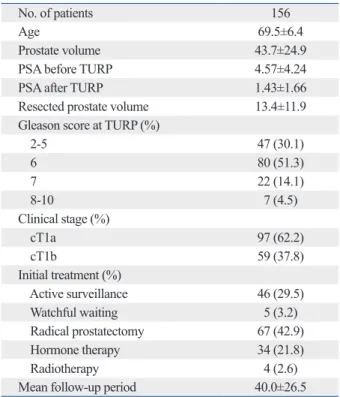
We identified 156 incidental prostate cancer patients at our institute. The baseline patient characteristics are shown in Table 1. In total, 97 (62.2%) patients were stage T1a and 59 (37.8%) were T1b. The average PSA before TURP was This classification was the result of several studies that
found that patients with incidental prostate cancer had dif- ferent oncological outcomes according to the percentage of cancer in the resected prostate after transurethral resection of the prostate (TURP); this sub-classification is still ap- plied in the present day.4,5 However, recent study reported that classification according to a volume threshold of 5% tu- mor involvement is not an independent prognostic factor for prostate cancer prognosis.6 Another study reported that no re- sidual tumor is present after radical prostatectomy (RP) in in- cidental prostate cancer patients regardless of the incidental prostate cancer stage.7 Thus, there is still a controversy re- garding which treatment is appropriate in cases of inciden- tal detection of prostate cancer.
In our institute, several incidental prostate cancer patients were followed up, and their different clinical results were analyzed according to the initial treatment modalities. Here, we present the clinical experiences of these patients and discuss which treatment was the most appropriate.
MATERIALS AND METHODS
We retrospectively reviewed the records of 156 patients who had prostate cancer, detected incidentally during TURP, be- tween 2001 and 2012. We excluded patients with positive prostate biopsy in simultaneous TURP and prostate biopsy, even if there were prostate cancer chips in the TURP speci- mens. Clinical stage was determined according to a volume threshold of 5% tumor involvement after TURP. We col- lected clinical and pathological parameters, including age, prostate-specific antigen (PSA) before/after TURP, prostate volume, resected prostate volume after TURP, Gleason score at TURP, clinical stage, and the initial treatment type.
We also collected overall survival data.
We stratified the patients into three groups according to their main initial treatment: active surveillance (AS), RP, or hormone therapy (HT). For the AS group, we collected in- formation about the period of AS, PSA progression status, intervention status during follow-up, the reason for inter- vention on AS, and the type of intervention. We defined PSA progression as a doubling of the serum total PSA level in comparison with the post-TURP PSA. In the case of the RP group, we collected information about the pathologic stage, postoperative Gleason score, extracapsular extension (ECE), seminal vesicle invasion (SVI), perineural invasion, lymphovascular invasion, tumor volume, surgical margin
Table 1. Baseline Patient Characteristics
No. of patients 156
Age 69.5±6.4
Prostate volume 43.7±24.9
PSA before TURP 4.57±4.24
PSA after TURP 1.43±1.66
Resected prostate volume 13.4±11.9
Gleason score at TURP (%)
2-5 47 (30.1)
6 80 (51.3)
7 22 (14.1)
8-10 7 (4.5)
Clinical stage (%)
cT1a 97 (62.2)
cT1b 59 (37.8)
Initial treatment (%)
Active surveillance 46 (29.5)
Watchful waiting 5 (3.2)
Radical prostatectomy 67 (42.9)
Hormone therapy 34 (21.8)
Radiotherapy 4 (2.6)
Mean follow-up period 40.0±26.5
PSA, prostate-specific antigen; TURP, transurethral resection of the pros- tate.
to initial treatment (Table 2). There were no statistical dif- ferences between initial treatment and follow-up period, PSA before TURP, prostate volume, or resected prostate vol- ume after TURP. However, the mean age of the RP group was younger than that of other groups (p<0.001). Gleason score at TURP and clinical stage were statistically different between the AS group and other groups (p=0.031 and p=
0.037, respectively).
Active surveillance group
The clinical results of the patients who received AS are shown in Table 3. In the AS group, 27 (65.2%) patients continued in the AS program, 14 (23.9%) received interventions, and 1 patients died from other causes. Twelve (26.1%) patients ex- hibited PSA progression during AS. Among these, 3 pa- tients refused to receive any treatment despite PSA progres- sion and 9 patients received treatment for PSA progression.
Finally, out of 14 patients who received intervention, 5 pa- tients were treated because of patient preference, even though there was no evidence of disease progression. Among the patients who received intervention, 5 patients under- went RP and 9 patients received HT. Among the patients who chose RP for intervention, 2 patients had insignificant prostate cancer and other 3 patients had organ-confined dis- ease with a Gleason score of ≤6.
Radical prostatectomy group
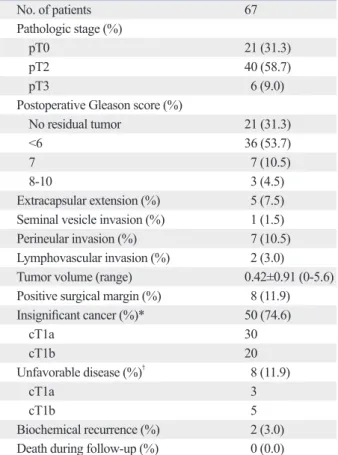
The pathologic outcomes after RP are listed in Table 4. In total, 21 of 67 (31.3%) patients had no residual prostate cancer. The average tumor volume was 0.42±0.91 (range:
4.57±4.24 ng/mL and 1.43±1.66 ng/mL after TURP.
Among them, 46 (29.5%) patients received AS, 67 (42.9%) patients underwent RP, 34 (21.8%) received HT, 4 (2.6%) received radiotherapy (RT), and 5 (3.2%) chose watchful waiting (WW). Among those who chose WW, 2 patients were of advanced age and 3 patients had other pathologi- cally proven malignancies. Four patients chose RT because they refused RP. Of these 156 incidental prostate cancer pa- tients, 6 patients died of other causes during follow-up and there were no patients who died due to prostate cancer.
We compared clinicopathologic characteristics according
Table 2. Comparison of the Clinicopathological Outcomes of Patients with Incidental Prostate Cancer According to Treatment
AS group RP group HT group p value
No. of patients 46 67 34
Age 69.9±6.4 66.2±4.7 70.9±5.7 <0.001
Mean follow-up period 41±28.1 44.4±25.5 37.0±21.3 0.325
Prostate volume 42.1±22.3 42.3±22.1 50.3±33.6 0.305
PSA before TURP 4.07±2.89 4.52±3.67 4.20±4.00 0.783
PSA after TURP 1.42±1.31 1.55±1.49 1.15±2.36 0.598
Resected prostate volume 13.4±10.5 12.8±11.6 14.1±14.3 0.886
Gleason score at TURP (%) 0.031
2-5 21 (45.7) 14 (20.9) 9 (26.5)
6 23 (50.0) 38 (56.7) 17 (50.0)
7 2 (4.3) 12 (17.9) 5 (14.7)
8-10 0 (0.0) 3 (4.5) 3 (8.8)
Clinical stage (%) 0.037
cT1a 36 (78.3) 37 (55.2) 19 (55.9)
cT1b 10 (21.7) 30 (44.8) 15 (44.1)
AS, active surveillance; RP, radical prostatectomy; HT, hormone therapy; PSA, prostate-specific antigen; TURP, transurethral resection of the prostate.
Table 3. Clinical Results of Patients with Incidental Prostate Cancer Who Received Active Surveillance
No. of patients 46
Mean PSA at the last follow-up of AS 1.61±1.35 PSA progression during AS period 12
cT1a 6
cT1b 6
Result of AS program
Maintenance of AS 28
Intervention 14
Follow-up loss 4
Death during follow-up 1
Reason for intervention
PSA progression 9
Patients preference 5
Type of intervention
RP 5
HT 9
AS, active surveillance; RP, radical prostatectomy; HT, hormone therapy;
PSA, prostate-specific antigen.
early stages and at younger ages, before patients exhibit lower urinary tract symptoms. In the pre-PSA era, there was a greater possibility that incidental prostate cancer would be locally advanced prostate cancer rather than ‘true’ inciden- tal prostate cancer, since early detection of prostate cancer by PSA screening was not available. In addition, consider- ing the PSA prostate biopsy strategy, simultaneous TURP 0-5.6). Fifty (74.6%) patients had insignificant prostate can-
cer. Among these, 30 patients were clinical stage T1a and 20 patients were clinical stage T1b. Eight (11.9%) patients had unfavorable features. Among these, 3 patients were clinical stage T1a and 5 patients were clinical stage T1b.
During follow-up, biochemical recurrence occurred in 2 pa- tients.
Hormone therapy group
Among the 34 patients who received HT, 9 (26.5%) patients received luteinizing hormone-releasing hormone agonists, 6 (17.6%) patients received anti-androgen (AA) monotherapy, and 19 (55.9%) patients received maximal androgen block- age (MAB). Three patients demonstrated PSA progression over 0.4 ng/mL. Among them, 1 patient received MAB and 2 patients received AA monotherapy. Among the HT group, 4 patients died from non-prostate cancer causes during fol- low-up (Table 5).
Overall survival of incidental prostate cancer patients Among 156 patients, a total of 6 (3.8%) patients died dur- ing follow-up. One patient on AS died due to cerebral hem- orrhage, while another on WW died due to pancreatic ma- lignancy. Among the remaining 4 patients on HT, 2 patients died due to aging, 1 patient due to liver malignancy and an- other due to congestive heart failure. During follow-up, no patients died due to prostate cancer.
DISCUSSION
Recent studies have shown that the rate of incidental pros- tate cancer discovery has decreased in the PSA era. Jones, et al.8 reported that the incidence of incidental prostate can- cer has significantly decreased in comparison to the rate from the pre-PSA era. They also reported that the most sig- nificant drop was in cases of clinical stage T1b. Andrèn, et al.9 reported similar results in a large Swedish national study cohort. Notably, the Swedish study also reported differenc- es in prostate-cancer-specific mortality. They reported that a significant proportion of men diagnosed with incidental prostate cancer during the last three decades died from their disease; however, prostate-cancer-specific mortality has de- creased over time in the PSA era.
In fact, PSA screening has led to an increase in the diag- nosis of prostate cancer by prostate biopsy. Consequently, a large proportion of prostate cancers are being diagnosed in
Table 4. Pathologic Outcomes of Patients Who Underwent Radical Prostatectomy
No. of patients 67
Pathologic stage (%)
pT0 21 (31.3)
pT2 40 (58.7)
pT3 6 (9.0)
Postoperative Gleason score (%)
No residual tumor 21 (31.3)
<6 36 (53.7)
7 7 (10.5)
8-10 3 (4.5)
Extracapsular extension (%) 5 (7.5) Seminal vesicle invasion (%) 1 (1.5)
Perineular invasion (%) 7 (10.5)
Lymphovascular invasion (%) 2 (3.0)
Tumor volume (range) 0.42±0.91 (0-5.6)
Positive surgical margin (%) 8 (11.9) Insignificant cancer (%)* 50 (74.6)
cT1a 30
cT1b 20
Unfavorable disease (%)† 8 (11.9)
cT1a 3
cT1b 5
Biochemical recurrence (%) 2 (3.0) Death during follow-up (%) 0 (0.0)
*Tumor volume <0.5 cm3, organ-confined Gleason ≤6 disease.
†Extracapsular extension and/or seminal vesicle invasion and/or postop- erative Gleason score ≥8.
Table 5. Clinical Outcomes of Patients Who Received Hor- mone Therapy
No. of patients 34
Treatment type (%)
LH-RH agonist 9 (26.5)
AA monotherapy 6 (17.6)
MAB 19 (55.9)
PSA progression (%)* 3 (8.8)
cT1a 2
cT1b 1
Death during follow-up (%) 4 (11.8) LH-RH, luteinizing hormone-releasing hormone; AA, anti-androgen; MAB, maximal androgen blockage; PSA, prostate-specific antigen.
*PSA progression defined as an increase of PSA level ≥0.4 ng/mL.
al.6 reported that a sub-classification of incidental prostate cancer was not an independent predictor of biochemical re- currence after adjustment for PSA, Gleason score, or year of surgery in patients who underwent RP. Capitanio, et al.7,16 concluded that PSA value before and after surgery and Gleason score at surgery were the only significant pre- dictors of residual cancer after RP. Other studies have shown that the current T staging system cannot be used for accurate staging of the remnant prostate after TURP, and that clinical stage T1a/T1b based on the percentage of the resected tumor volume does not represent the status of dis- ease progression.17 In the present study, we found no signif- icant evidence on RP specimens to prove that clinical stage T1b patients had a worse prognosis than T1a patients, be- cause our study cohort had a low BCR rate (3.0%). This re- sult was similar in the HT group.
In the present study, the rate of insignificant prostate can- cer, including the absence of residual prostate cancer, was higher than that in other published data.7,18 We are at a loss to explain why our study cohort had more insignificant pros- tate cancer in comparison with other studies. Nevertheless, considering that the proportion of insignificant prostate can- cer after RP is unpredictable and that there has been a wide variation shown in different studies regardless of clinical stage, RP is beginning to be an overtreatment for incidental prostate cancer in the PSA era. Accordingly, several authors have proposed steps to reduce such overtreatment. Among them, Capitanio, et al.19 emphasized the importance of communication between urologists and pathologists in inci- dental prostate cancer management. First, pathologists should exam every TURP chip. Second, cancer extent should be measured by the percentage of chips infiltrated by cancer.
They concluded that clinical and pathologic background knowledge should be shared for accurate evaluation and management.
Recently, Capitanio, et al.1,7,16 concluded that the manage- ment of incidental prostate cancer should be based on the estimated probability of clinical progression compared to the relative risk of therapy and survival of the patient. They concluded that clinical stage (T1a vs. T1b), Gleason score at diagnosis and PSA values before and after TURP are the most informative variables in clinical decisions. Rajab, et al.20 suggested that the current sub-classification for inci- dental prostate cancer results in a substantial loss of infor- mation, and that the sub-classification of incidental prostate cancer should be changed from the present two subdivi- sions to four subdivisions in order to improve prognostic and prostate biopsy are frequently performed in patients
who have a higher PSA level than 4.0 ng/mL. Diagnosis of incidental prostate cancer is not made if simultaneous TURP and prostate biopsy give a positive result, even if prostate cancer is seen in TURP chips. Thus, in the PSA era, inci- dental prostate cancer can be diagnosed at lower PSA lev- els. In our study cohort, 91 patients who were tested for PSA before TURP had levels less than 4.0 ng/mL, and the remaining 65 patients had PSA levels higher than 4.0 ng/
mL. Of these 65 patients, 12 underwent core prostate biop- sy and were found to have peripheral prostate cancer on bi- opsy. In other words, these patients were more likely to be diagnosed as cancer-free by prostate biopsy if they did not undergo TURP.
Another controversy surrounding incidental prostate can- cer concerns the choice of clinical staging used to plan pros- tate cancer treatment. Sub-classification of incidental pros- tate cancer was based on a study performed 20 years ago.
Although the characteristics of clinical stage T1a/T1b pa- tients have gradually changed over the past few decades, sub-classifications are still applied without modification.
The classical approach is to follow T1a patients with an ac- tive surveillance program and to treat T1b patients. Europe- an Association of Urology guidelines recommend active surveillance for stage T1a and radical prostatectomy for stage T1b patients with a life expectancy of more than 10 years.10
Descazeaud, et al.11 reported that 30 of 144 (21%) stage T1a patients experienced cancer progression during the AS period. They concluded that AS was appropriate for these patients in the PSA era. In the present study, 12 patients in the AS group showed PSA progression. Among these pa- tients, 6 of 36 (16.7%) stage T1a patients and 6 of 10 (60%) stage T1b patients demonstrated PSA progression. Compar- ing the proportion of those with PSA progression according to clinical stage, clinical stage T1b patients seemed to have a greater chance of PSA progression in comparison with stage T1a patients. However, incidental prostate cancer PSA progression is questionable because no consensus def- inition of progression has been developed. In addition, it is unclear whether PSA progression during AS indicates dis- ease progression in incidental prostate cancer patients. It should not be overlooked that, 5 patients in the present study, who received RP after PSA progression had organ-confined Gleason 6 disease regardless of clinical stage.
Several studies have reported that stage T1b cancer has a poorer prognosis than stage T1a.12-15 However, Magheli, et
and B prostatic cancer. Urol Clin North Am 1975;2:105-24.
5. Cantrell BB, DeKlerk DP, Eggleston JC, Boitnott JK, Walsh PC.
Pathological factors that influence prognosis in stage A prostatic cancer: the influence of extent versus grade. J Urol 1981;125:516- 6. Magheli A, Rais-Bahrami S, Carter HB, Peck HJ, Epstein JI, Gon-20.
zalgo ML. Subclassification of clinical stage T1 prostate cancer:
impact on biochemical recurrence following radical prostatecto- my. J Urol 2007;178(4 Pt 1):1277-80.
7. Capitanio U, Briganti A, Suardi N, Gallina A, Salonia A, Freschi M, et al. When should we expect no residual tumor (pT0) once we submit incidental T1a-b prostate cancers to radical prostatectomy?
Int J Urol 2011;18:148-53.
8. Jones JS, Follis HW, Johnson JR. Probability of finding T1a and T1b (incidental) prostate cancer during TURP has decreased in the PSA era. Prostate Cancer Prostatic Dis 2009;12:57-60.
9. Andrèn O, Garmo H, Mucci L, Andersson SO, Johansson JE, Fall K. Incidence and mortality of incidental prostate cancer: a Swed- ish register-based study. Br J Cancer 2009;100:170-3.
10. Heidenreich A, Bellmunt J, Bolla M, Joniau S, Mason M, Mat- veev V, et al. EAU guidelines on prostate cancer. Part 1: screening, diagnosis, and treatment of clinically localised disease. Eur Urol 2011;59:61-71.
11. Descazeaud A, Peyromaure M, Salin A, Amsellem-Ouazana D, Flam T, Viellefond A, et al. Predictive factors for progression in patients with clinical stage T1a prostate cancer in the PSA era. Eur Urol 2008;53:355-61.
12. Epstein JI, Paull G, Eggleston JC, Walsh PC. Prognosis of untreat- ed stage A1 prostatic carcinoma: a study of 94 cases with extended followup. J Urol 1986;136:837-9.
13. Paulson DF, Moul JW, Walther PJ. Radical prostatectomy for clin- ical stage T1-2N0M0 prostatic adenocarcinoma: long-term results.
J Urol 1990;144:1180-4.
14. Masue N, Deguchi T, Nakano M, Ehara H, Uno H, Takahashi Y.
Retrospective study of 101 cases with incidental prostate cancer stages T1a and T1b. Int J Urol 2005;12:1045-9.
15. Lefi M, Hellara W, Touffahi M, Fredj N, Adnene M, Saidi R, et al.
[Prostate cancer: comparative study of stage T1a and stage T1b].
Prog Urol 2007;17:1343-6.
16. Capitanio U, Scattoni V, Freschi M, Briganti A, Salonia A, Gallina A, et al. Radical prostatectomy for incidental (stage T1a-T1b) prostate cancer: analysis of predictors for residual disease and bio- chemical recurrence. Eur Urol 2008;54:118-25.
17. Adolfsson J. The management of category T1a-T1b (incidental) prostate cancer: can we predict who needs treatment? Eur Urol 2008;54:16-8.
18. Melchior S, Hadaschik B, Thüroff S, Thomas C, Gillitzer R, Thüroff J. Outcome of radical prostatectomy for incidental carci- noma of the prostate. BJU Int 2009;103:1478-81.
19. Capitanio U, Cheng L, Lopez-Beltran A, Scarpelli M, Freschi M, Montorsi F, et al. The importance of interaction between urolo- gists and pathologists in incidental prostate cancer management.
Eur Urol 2011;60:75-7.
20. Rajab R, Fisher G, Kattan MW, Foster CS, Møller H, Oliver T, et al.
An improved prognostic model for stage T1a and T1b prostate can- cer by assessments of cancer extent. Mod Pathol 2011;24:58-63.
evaluation. Based on our own experiences, we agree strong- ly with this suggestion. We believe that the concept of inci- dental prostate cancer has changed with the wide use of PSA screening. In the PSA era, incidental prostate cancer patients should be considered to be low-risk prostate cancer patients, and immediate definite therapy should be sublated for these patients. Before and post-TURP, PSA values or systematic prostate biopsy of the remaining prostate tissue should be used for proper decision-making. The use of AS for these patients over RP or HT as an initial treatment may reduce the occurrence of complications due to treatment.
The present study had several limitations. First, the fol- low-up period was short in comparison with other studies.
Second, this study was simply a review of clinical outcomes according to initial treatments. Only a few patients who had poorly differentiated incidental prostate cancer were includ- ed in the study cohort. However, our results are comparable with other recent findings, and this article is the first report of clinical outcomes according to initial treatments using a Korean cohort. Even though it was impossible to compare the clinical outcomes according to Gleason score at TURP, the decrease of patients with poorly differentiated incidental prostate cancer was similar to what has been reported by other tertiary hospitals. Despite these limitations, we be- lieve that our clinical experiences could have implications for urologists who are involved in the treatment of inciden- tal prostate cancer patients.
In conclusion, the clinical outcomes of incidental prostate cancer were satisfactory regardless of the initial treatment type. However, according to recent research and guidelines, immediate definite therapy should be avoided without a careful assessment. We also believe that improved clinical staging is needed for these patients.
REFERENCES
1. Capitanio U. Contemporary management of patients with T1a and T1b prostate cancer. Curr Opin Urol 2011;21:252-6.
2. Zigeuner RE, Lipsky K, Riedler I, Auprich M, Schips L, Salfellner M, et al. Did the rate of incidental prostate cancer change in the era of PSA testing? A retrospective study of 1127 patients. Urolo- gy 2003;62:451-5.
3. Cheng L, Bergstralh EJ, Scherer BG, Neumann RM, Blute ML, Zincke H, et al. Predictors of cancer progression in T1a prostate adenocarcinoma. Cancer 1999;85:1300-4.
4. Jewett HJ. The present status of radical prostatectomy for stages A