• 검색 결과가 없습니다.

Non-Dipper Pattern is a Determinant of the Inappropriateness of Left Ventricular Mass in Essential Hypertensive Patients

N/A
N/A
Protected

Academic year: 2022

Share "Non-Dipper Pattern is a Determinant of the Inappropriateness of Left Ventricular Mass in Essential Hypertensive Patients"

Copied!
7
0
0

로드 중.... (전체 텍스트 보기)

전체 글

(1)

191

Open Access

Non-Dipper Pattern is a Determinant of the Inappropriateness of Left Ventricular Mass in Essential Hypertensive Patients

Bae Keun Kim, MD, Young-Hyo Lim, MD, Hyung Tak Lee, MD, Jae Ung Lee, MD, Kyung Soo Kim, MD, Soon Gil Kim, MD, Jeong Hyun Kim, MD, Heon Kil Lim, MD and Jinho Shin, MD

Division of Cardiology, Department of Internal Medicine, Hanyang University College of Medicine, Seoul, Korea

ABSTRACT

Background and Objectives: Inappropriately high left ventricular mass (iLVM) is known to be related to cardiovascular prognosis. A non-dipper pattern has a greater mean left ventricular (LV) mass than the dipper pattern in hypertensive patients.

However, the appropriateness of LV mass in dipper or non-dipper patterns has not been adequately investigated. The aim of this study was to define the relationship between nocturnal dipping and the appropriateness of LV mass. Subjects and Methods:

Using the ambulatory blood pressure monitoring (ABPM) database, the data of 361 patients who underwent ABPM and echo- cardiography was analyzed retrospectively. Appropriateness of LV mass was calculated as observed/predicted ratio of LV mass (OPR) using a Korean-specified equation. Nocturnal dipping was expressed as percent fall in systolic blood pressure (BP) during the night compared to the day. Results: Daytime, nighttime and 24 hours BP in hypertensive patients was 140.4±14.8 mmHg, 143.7±15.2 mmHg and 129.4±20.0 mmHg, respectively. OPR was 106.3±19.9% and nocturnal dipping was 10.2±10.9 mmHg. In a multiple linear regression model, 24 hours systolic BP (β=0.097, p=0.043) and nocturnal dipping (β=-0.098, p=0.046) were independent determinants of OPR as well as age (β=0.130, p=0.025) and body mass index (BMI) (β=0.363, p<0.001). Odds ratio of the non-dipper pattern was 2.134 for iLVM (p=0.021) and 3.694 for obesity (p<0.001; BMI >25 kg/m

2

).

Conclusion: The non-dipper pattern is independently associated with iLVM in hypertensive patients as well as obesity. (Korean Circ J 2011;41:191-197)

KEY WORDS: Hypertension; Hypertrophy, left ventricular; Blood pressure monitoring, ambulatory.

Received: March 23, 2010 Revision Received: June 9, 2010 Accepted: August 23, 2010

Correspondence: Jinho Shin, MD, Department of Internal Medicine, Hanyang University College of Medicine, 17 Haengdang-dong, Seong- dong-gu, Seoul 133-792, Korea

Tel: 82-2-2290-8308, Fax: 82-2-2298-9183 E-mail: [email protected]

• The authors have no financial conflicts of interest.

cc
This is an Open Access article distributed under the terms of the Cre- ative Commons Attribution Non-Commercial License (http://creativecom- mons.org/licenses/by-nc/3.0) which permits unrestricted non-commer- cial use, distribution, and reproduction in any medium, provided the origi- nal work is properly cited.

Introduction

Left ventricular hypertrophy (LVH) is a strong, indepen- dent predictor of cardiovascular morbidity and mortality in hypertensive patients.

1)

Left ventricular (LV) mass is influenc- ed by hemodynamic factors, such as high blood pressure (BP) and stroke work, as well as numerous demographic and non-

hemodynamic factors.

2)

However, a number of patients exhi- bit levels of LV mass that exceed the need to sustain cardiac workload, a condition that has been defined as inappropriate- ly high left ventricular mass (iLVM).

3)

iLVM is related to a worse cardiovascular prognosis than ap- propriate LV mass (aLVM) in patients with or without LVH.

2)

The iLVM may be explained by several mechanisms. Firstly, the presence of a higher BP load in the ascending aorta can- not be explained by brachial BP derived resting stroke work.

3)

Secondly, imbalance between growth-promoting factors and growth inhibitory factors has been suggested.

4-6)

Thirdly, BP variability throughout the day might influence increased LV mass.

7)

In addition, genetic factors may be responsible for ex- aggerated or overcompensating hypertrophy to a given pres- sure load.

8)

Nonetheless, the underlying pathogenic mechanism is not fully understood.

9)

In addition to these mechanisms, the presence of a hidden

higher BP load out of the clinic or during sleep which cannot

be explained by office BP deserves attention, since non-dipper

(2)

or reverse white coat effects are common clinical problems.

Hypertensive patients with non-dipper patterns in noctur- nal BP have heavier LV mass than those with dipper patterns.

Patients with non-dipper patterns are also at a higher risk of cardiac and extracardiac morbidity.

10)11)

Regarding poor prog- nosis in non-dipper patterns however, it is unclear whether there are other mechanisms such as growth or genetic factors that simply hide BP overload during sleep. Likewise, regard- ing the heavier LV mass in non-dipper patterns, it is also un- clear whether heavier LV mass is due to simply hidden BP ov- erload during sleep or due to other mechanisms related to the non-dipper pattern.

To better understand the mechanisms of iLVM, we hypoth- esized that nocturnal dipping is one of the factors determining inappropriateness of LV mass in hypertensive patients.

Subjects and Methods

Study population and study design

In a retrospective cross-sectional design, data from 361 pa- tients visiting the Cardiology Center at Hanyang University Hospital, Seoul, Korea from January 1st, 2006 to June 30th, 2010 were analyzed. Among 1,297 patients who underwent ambu- latory blood pressure monitoring (ABPM) and echocardiog- raphy within 1 week interval for the evaluation of BP before or after anti-hypertensive medication, 361 patient datasets were acquired by applying exclusion criteria. The clinical data were incomplete and as follows; age <45 years, patients with pre- vious history of stroke, acute myocardial infarction, patients with chronic renal insufficiency (serum creatinine >1.4 mg/

dL in female, >1.5 mg/dL in male), any regional wall motion abnormalities, grade II or more valvular regurgitation, any val- vular stenosis, M-mode interrogation angle >10 degrees and cardiomyopathy based on the echocardiographic findings.

Height, weight, clinical BP and heart rate were measured dur- ing the study period before ABPM and echocardiography were performed. The study protocol was approved by the Institu- tional Review Board (IRB) of Hanyang University Medical Center at Seoul. An informed consent process from each pa- tient regarding the process of the examination and use of the data was made exempt by the IRB.

Blood pressure determination

Clinic BP was measured using a mercury sphygmomano- meter as the average of at least 3 measurements by a physician or qualified nurse. ABPM was recorded during a routine day by a TM-2430 device (A&D, Saitama, Japan). The device was applied to the non-dominant arm and was applied for 24 hours. BP was measured every 15 minutes during the daytime and every 30 minutes at nighttime, which was between 10 PM and 6 AM. The patients were instructed to maintain their usu- al activities during the monitoring process and to stay calm

when sensing the cuff inflation. Sleep and wake time were re- corded individually according to the patient’s self-reported data.

Nocturnal BP was defined by the narrow fixed interval me- thod from midnight to 5 AM as nocturnal systolic/diastolic mean BP. Daytime BP was defined by mean systolic/diastolic BP between 8 AM and 9 PM. Twenty-four hour BP was defin- ed by the following equation, (nocturnal BP×actual sleep in- terval+daytime BP×awake interval)/24. Nocturnal systolic BP (NSBP) fall (mmHg) was defined as the absolute decrease in NSBP compared to daytime systolic BP. Nocturnal dipping (%) was defined by percent decrease in NSBP compared to day- time systolic BP. When nocturnal dipping was less than 10%, it was defined as a non-dipper pattern. The definition of hyper- tension was 24-hour systolic BP ≥125 mmHg or on antihyper- tensive medication excluding the white-coat hypertension. Ac- cording to this definition, 309 of the patients were hyperten- sive out of the total 361 patients.

Echocardiography

Two dimensional and guided M-mode echocardiograms were performed on each subject by a single sonographer with a commercially available machine (iE33; Philips medical sys- tem, Andover, MA, USA) using a 1-5 MHz transducer. M- mode tracings were recorded on strip-chart paper at 50 mm/s.

Measurements of interventricular septal thickness, posterior wall thickness, and LV dimensions were performed at or just below the mitral valve tips, by the leading edge-to-leading edge method, according to the American Society of Echocar- diography recommendations.

12)

LV mass was calculated by the following equation, {1.04×(IVSd+LVDd+PWTd)

3

-LVDd

3

0.8+0.6,

13)

where IVSd is diastolic interventricular septum, LVDd is diastolic left ventricular dimension, and PWTd is dia- stolic posterior wall thickness. We adopted the LV mass index by the height to highlight the effect of weight and set the cut- off value {mean+ 2 standard deviation (SD)} for LVH as 54 g/m

2.7

for both genders. LV end-systolic, end-diastolic, and stro- ke volumes were calculated with the use of Teichholz’s method.

Appropriateness of left ventricular mass

Appropriateness of LV mass (aLVM) was expressed as the observed/predicted ratio of the LV mass (OPR). The predicted LV mass was calculated as previously described.

14)

Briefly, the LV mass was predicted by the following equation acquired in subjects with normal body weight and BP: 54.9+7.62×height (m

2.7

)+0.6×stroke work (g-m/beat)-13.2×gender (male=1, fe- male=2) (constant=54.9±14.7 g, adjusted R

2

=0.576, SEE=

21.67, p=0.001). Gender effect was adjusted by the equation

of appropriateness of LV mass. Stroke work refers to the

work done by the ventricle to eject stroke volume into the

aorta as a single-beat index of cardiac workload. It was calcu-

lated by the equation, stroke volume×(MEP-EDP), where MEP

is mean ejection pressure and EDP is LV end-diastolic pres-

(3)

sure.

15)

In our study, using a coefficient representing the rela- tionship between systolic BP and (MEP-EDP), stroke work is calculated as stroke volume×systolic BP×0.0144.

16)

The cut- off value between the iLVM and aLVM groups was 130% or higher for both genders.

14)

Statistical analysis

Data were expressed as frequencies and percentages for qu- alitative variables and as the mean±SD for quantitative vari- ables. Differences in study variables between hypertensive and normotensive patients were assessed with the Pearson χ

2

for qualitative variables and the Student’s t-test was performed.

Pearson’s correlation and Spearman’s correlation coefficients were calculated. Multiple regression analyses were used to identify significant determinants for OPR or iLVM. Anti-hy- pertensive drug treatment was included in the multiple logi- stic regression analysis.

ANCOVA was used to adjust the result of comparing sub- jects with inappropriately high or adequate LV mass for age, body mass index (BMI), 24 hours BP. Odds ratio of indepen- dent variables were calculated by multiple logistic regression analysis. The values of 2-tailed p<0.05 were considered sta- tistically significant. Data were analyzed using the Statistical Package for the Social Sciences (SPSS) 17.0 software (SPSS Inc., Chicago, IL, USA).

Results

General characteristics of the subjects

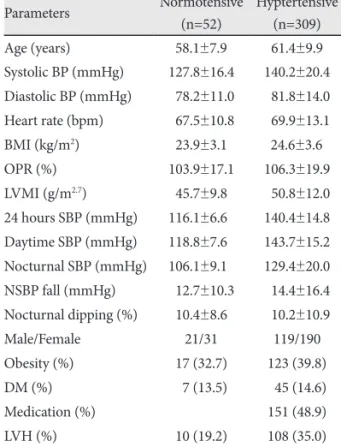
General characteristics of the normotensive subjects ver- sus hypertensive patients are listed in Table 1. Among the 361 patients of the study population, 52 (14.4%), classified as nor- motensive, were white-coat hypertension patients and 309 (85.6%) were classified as hypertensive patients. Among the 309 hypertensive patients, 151 (48.9%) were on antihyperten- sive treatment and 45 (14.6%) had diabetes mellitus (DM).

In a comparison of general characteristics between hyperten- sive patients and normotensive subjects, the average age of the hypertensive patients was older (58.1±7.9 vs. 51.5±14.4 years, p=0.02). Clinical BP, 24 hours ambulatory BP and BMI

were higher in hypertensive patients.

Correlations between observed/predicted ratio and 24 hours ambulatory blood pressure profile

Among general parameters, age, BMI, DM and antihyper- tensive medication showed a correlation with OPR in hyper- tensive patients. Twenty four hours systolic BP was positively associated with OPR, in contrast, clinical systolic BP was not, which suggested the white-coat effect. Nocturnal dipping sh- owed an inverse relationship with OPR suggesting a protec- Table 1. Clinical characteristics of normotensive and hypertensive subjects

Parameters Normotensive

(n=52)

Hyptertensive

(n=309) p

Age (years) 58.1±7.90 61.4±9.9 0.008

Systolic BP (mmHg) 127.8±16.4 140.2±20.4 <0.001 Diastolic BP (mmHg) 078.2±11.0 081.8±14.0 0.044 Heart rate (bpm) 067.5±10.8 069.9±13.1 0.216 BMI (kg/m

2

) 23.9±3.1 24.6±3.600 0.160

OPR (%) 103.9±17.1 106.3±19.9 0.070

LVMI (g/m

2.7

) 45.7±9.8 050.8±12.0 0.004 24 hours SBP (mmHg) 116.1±6.60 140.4±14.8 <0.001 Daytime SBP (mmHg) 118.8±7.60 143.7±15.2 <0.001 Nocturnal SBP (mmHg) 106.1±9.10 129.4±20.0 <0.001 NSBP fall (mmHg) 012.7±10.3 014.4±16.4 0.342 Nocturnal dipping (%) 10.4±8.6 010.2±10.9 0.646

Male/Female 21/31 119/190 0.798

Obesity (%) 17 (32.7) 123 (39.8) 0.322

DM (%) 07 (13.5) 045 (14.6) 0.835

Medication (%) 151 (48.9) <0.001

LVH (%) 10 (19.2) 108 (35.0) 0.013

iLVM (%) 06 (11.5) 053 (17.2) 0.262

Non-dipper (%) 27 (51.9) 157 (50.8) 0.882 Data are reported as mean±SD. BP: blood pressure, BMI: body mass index, OPR: observed/predicted ratio of LV mass, LVMI: left ven- tricular mass index, SBP: systolic BP, LVH (LVMI ≥54.0 g/m

2.7

): left ventricular hypertrophy, NSBP: Nocturnal SBP, DM: diabetes mel- litus, Medication: Antihypertensive medication, iLVM: inappropri- ate high LV mass, Obesity: BMI >25 kg/m

2

Table 2. Pearson and Spearman correlation test between OPR and 24 hours ambulatory blood pressure profile in patients (n=361)

Parameters Clinic SBP 24 hours SBP Nocturnal SBP Nocturnal dipping LVMI OPR

Age -0.129* -0.094

-0.199

-0.232

-0.190

-0.204

Female -0.004 -0.048 -0.004 -0.053 -0.024 -0.071

BMI -0.018 -0.086 -0.067 -0.001 -0.492

-0.394

DM -0.018 -0.002 -0.098 -0.182

-0.119* -0.180

Medication -0.036 -0.136

-0.137

-0.089 -0.194

-0.145

LVMI -0.090 -0.253

-0.266

-0.125* -0.692

OPR -0.354

-0.153

-0.214

-0.161

-0.692

*p<0.05,

p<0.001. SBP: systolic blood pressure, BMI: body mass index, OPR: observed/predicted ratio of LV mass, DM: diabetes mellitus,

LVMI: left ventricular mass index, Medication: Antihypertensive medication

(4)

tive relationship (Table 2).

Multiple linear regression analysis for inappropriate increased LV mass (observed/predicted ratio)

In a multiple linear regression analysis for OPR of LV mass in all patients, age (β=0.130, p=0.025), BMI (β=0.363, p<

0.001), 24 hours systolic BP (β=0.097, p=0.043) and noctur- nal dipping (β=-0.098, p=0.046) were statistically significant parameters (Table 3). Gender was not statistically significant (p=0.115).

Multiple logistic regression analysis

for inappropriately high left ventricular mass

In all patients, odds ratio by the multiple logistic regression analysis for iLVM were 3.694 {95% confidence interval (CI):

1.963-6.758, p<0.001} for obesity, and 2.192 (95% CI: 1.151- 4.177, p=0.017) for the non-dipper pattern (Table 4). Howev- er, high 24 hours systolic BP was not statistically significant for iLVM.

In hypertensive patients, the odds ratio by the multiple lo- gistic regression analysis for iLVM were 2.255 (95% CI: 1.132- 4.493, p=0.021) for age, 3.430 (95% CI: 1.781-6.604, p<0.001) for obesity, and 2.149 (95% CI: 1.087-4.249, p=0.028) for the non-dipper pattern (Table 5).

Comparsion between appropriate left ventricular mass and inappropriately high left ventricular mass group

When adjusted by age, BMI and 24 hours ssystolic BP, noc- turnal dipping (10.8±10.6 vs. 5.7±9.9, p=0.011) was signifi- cantly different between the aLVM and iLVM group in all pa- tients (Fig. 1). In the hypertensive group, nocturnal dipping (10.7±11.0 vs. 5.7±10.0, p=0.024) was significantly different between the aLVM and iLVM group (Table 6) (Fig. 2)

Discussion

This study was performed for a further understanding of the mechanism of iLVM. Nocturnal dipping as a factor relat- ed to OPR was the main interest. The comparison between the dipper and non-dipper group is out of the scope of this study. The main result of our study is that nocturnal dipping is an independent factor determining OPR in essential hyper- tensive patients. Nocturnal dipping is significantly lower in the iLVM group in hypertensive patients.

Prediction of LV mass routinely preclude gender difference, body size, and the effect of stroke work because these factors

Table 3. Multiple linear regression for OPR of LV mass in all pa- tients (n=361)

Parameters β p

Age 0.130 0.025

Female 0.075 0.115

BMI 0.363 <0.001

DM -0.077 0.123

Medication 0.025 0.614

24 hours SBP 0.097 0.043

Nocturnal dipping -0.098 0.046

Dependent variable: observed/predicted ratio of LV mass. SBP: sys- tolic blood pressure, BMI: body mass index, DM: diabetes melli- tus, Medication: Antihypertensive medication, OPR: observed/pre- dicted ratio, LV: left ventricular

Table 4. Multiple logistic regression for iLVM in all patients (n=361)

Parameters Odds ratio p

Age 2.487 0.006

Female 1.633 0.141

Obesity 3.642 <0.001

DM 1.459 0.328

Medication 1.505 0.200

High 24 hours SBP 1.340 0.345

Non-dipper 2.192 0.017

Dependent variable: inappropriately high left ventricular mass. SBP:

systolic blood pressure, BMI: body mass index, OPR: observed/pre- dicted ratio of LV mass, DM: diabetes mellitus, HTN: hypertension, iLVM: inappropriately high left ventricular mass

Table 5. Multiple logistic regression for iLVM in hypertensive pa- tients (n=309)

Parameters Odds ratio p

Age 2.255 0.021

Female 1.151 0.151

Obesity 3.430 <0.001

DM 1.867 0.123

Medication 1.389 0.343

High 24 hours SBP 1.248 0.500

Non-dipper 2.149 0.028

Dependent variable: inappropriately high left ventricular mass. SBP:

systolic blood pressure, OPR: observed/predicted ratio of LV mass, DM: diabetes mellitus, iLVM: inappropriately high left ventricular mass

Fig. 1. Adjusted Nocturnal dipping by age, BMI and 24 hours systo- lic BP between aLVM (n=302) vs. iLVM (n=59) patients. In all pati- ents, nocturnal dipping (10.8±10.6 vs. 5.7±9.9, p=0.011) was signi- ficantly different in the iLVM group vs. the aLVM group. SBP: sys- tolic blood pressure, BMI: body mass index, aLVM: appropriate left ventricular mass, iLVM: inappropriately high left ventricular mass.

12 10 8 6 4 2 0

p=0.011

N oc tu na l d ip pi ng (% )

aLVM (n=302) iLVM (n=59)

(5)

are included in the prediction equation derived from subjects with normal body weight and normal BP.

16)

If it is measured in patients with a white-coat effect, predicted LV mass is over- estimated so that OPR tends to be underestimated or low. On the contrary, OPR in patients with masked clinic BP tends to be higher.

Besides measurement issues, it is well known that combi-

nation of high BP and obesity biologically has a synergistic effect on the LVH.

17)

This suggests that ambulatory BP pro- vides a stronger relationship with LV mass increase than that observed in normotensive patients without obesity. Firstly, a stronger association between iLVM and BP might results from accurate BP measurement by ABPM mainly excluding the white-coat and reverse white-coat effect. Secondly, the intrinsic relationship between BP and OPR may be stronger in essential hypertension than in normotensive subjects. Th- irdly, the synergistic effect of obesity and BP may amplify the relationship between BP and OPR.

A previous study showed that iLVM was associated with hi- gher ambulatory BP in hypertensive patients.

18)

In this study, patients with iLVM had lower 24 hours systolic BP suggest- ing that the white-coat effect was exposed by ABPM. This st- udy revealed that 24 hours systolic BP and OPR had a weak independent relationship (β=0.097, p=0.043) in the multiple linear regression model, including age, BMI, and nocturnal dipping. Also, the 24 hours systolic BP was not an indepen- dent factor determining iLVM in multiple logistic regression an- alysis. This finding suggests that white-coat or reverse white- coat effects were not high enough for the ABPM to expose the measurement problem. To further understand this issue, OPR defined by the equation using ambulatory BP will be helpful.

In addition, a direct study of the relationship between white- coat or reverse white-coat effects and iLVM seems to be nec- essary.

This study showed that obesity is an important determinant of iLVM in hypertension patients. Using multiple regression analysis, obesity was the strongest determinant of OPR or iLVM. Obesity seems to play a major role to induce inappro- priately or excessively high LV mass, which is beyond the pro- portional increase to BP elevation. There have been numerous studies for the mechanisms of obesity related to LV hyper- trophy.

19)

In this study, effect of age itself on OPR or iLVM is just com- parable to the 24 hours systolic BP effects or nocturnal dip- ping. It is also much less than the obesity factor. If ageing it- self could induce LVH, bypassing the mechanisms of obesity or systolic BP as well as partly including arterial stiffness, then this would clarify some of the controversy that surrounds this phenomena. This finding is consistent with the previous study that the effect of ageing itself is not known to be significant in subjects with normal BP and BMI.

16)

The result of this st- udy suggests that the main mechanisms of ageing in regard to inappropriateness of LV mass are mainly composed of obe- sity, systolic BP, and potentially a non-dipper pattern.

Regarding the mechanisms of nocturnal dipping contrib- uting to OPR, it is less likely that decreased nocturnal dipping contributes to higher OPR as a hidden nocturnal hemody- namic overload because it is independent of 24 hours ambu- latory systolic BP. In this study, nocturnal dipping was signifi- Table 6. Comparison between aLVM and iLVM in hypertensive

patients

Parameters aLVM

(n=256)

iLVM

(n=53) p

Age (years) 60.5±9.5 065.7±10.6 0.001

Systolic BP (mmHg) 142.4±20.3 129.4±17.6 <0.001 Diastolic BP (mmHg) 081.9±14.7 081.1±10.0 0.782 Heart rate (bpm) 070.4±12.5 067.3±15.5 0.060 BMI (kg/m

2

) 24.3±3.5 26.2±3.8 <0.001

OPR (%) 102.6±14.1 141.3±10.2 <0.001

LVMI (g/m

2.7

) 048.2±10.5 063.5±11.0 <0.001 24 hours SBP (mmHg) 139.8±14.1 143.1±17.9 0.259 Daytime SBP (mmHg) 143.5±14.6 144.7±17.9 0.018 Nocturnal SBP (mmHg) 127.8±18.9 136.6±23.3 0.022 NSBP fall (mmHg) 015.7±16.6 008.0±14.1 0.017 Nocturnal dipping (%) 010.7±11.0 005.7±10.0 0.024

Male/Female 104/152 15/38 0.116

Medication (%) 118 (46.1) 33 (62.3) 0.281

Obesity (%) 088 (34.4) 35 (66.0) 0.032

DM (%) 029 (11.3) 16 (30.2) 0.017

LVH (%) 065 (25.4) 43 (81.1) <0.001

Non-dipper (%) 120 (46.9) 37 (69.8) 0.013 Data are reported as mean±SD and adjusted by age, BMI, 24 hours SBP. BP: blood pressure, BMI: body mass index, OPR: observed/

predicted ratio of LV mass, LVMI: left ventricular mass index, SBP: systolic BP, LVH (LVMI ≥54.0 g/m

2.7

): left ventricular hypertro- phy, Medication: Antihypertensive medication, NSBP: Nocturnal SBP, DM: diabetes mellitus, aLVM: appropriate LV mass, iLVM: in- appropriate high LV mass, Obesity: BMI >25 kg/m

2

Fig. 2. Adjusted nocturnal dipping by age, BMI and 24 hours systol- ic BP in hypertensive aLVM (n=256) vs. iLVM (n=53) patients. In the hypertensive patients, nocturnal dipping (10.7±11.0 vs. 5.7±10.0, p=

0.024) was significantly different in iLVM vs. aLVM groups. SBP: sys- tolic blood pressure, BMI: body mass index, aLVM: appropriate left ventricular mass, iLVM: inappropriately high left ventricular mass.

12 10 8 6 4 2 0

p=0.024

N oc tu na l d ip pi ng (% )

aLVM (n=256) iLVM (n=53)

(6)

cantly different between iLVM and aLVM group in all pa- tients and in hypertensive patients. These findings suggest that nocturnal dipping may influence the appropriateness of LV mass by its own non-hemodynamic or intrinsic effect.

It has been a controversy if the main mechanism of non-dip- per as a poor prognostic marker for cardiovascular events is related to the nocturnal hypertension or its intrinsic effect.

A previous study showed that non-dippers have autonomic dysfunction through the night and that non-dipper patterns were more commonly found among individuals with renal diseases, DM, sleep apnea and secondary hypertension.

20)

These findings suggest that non-hemodynamic factors are important in manipulating nocturnal dipping. Therefore, the non-dipper pattern itself might be an explanation to the re- sults of this study. However, the reproducibility of the classi- fication of dipper and non-dipper patterns based on single ABPM is not reliable enough to be widely accepted.

21)

In this study, anti-hypertensive drug therapy was not an in- dependent factor determining iLVM. The effects of anti-hy- pertensive drugs such as the lowering of BP and regression of LVH in proportion have been widely reported.

22)

However, the effect of anti-hypertensive drug classes on nocturnal BP has not been established. Timing of treatment is reported to have an influence on nocturnal BP fall in one study.

23)

On the other hand, a recent large-scale registry study on Spanish sub- jects showed that nocturnal dipping patterns were not asso- ciated with the timing of treatment.

24)

It is not clear whether anti-hypertensive drugs have an influence on the relationship between nocturnal BP and target organ damage. Moreover, cli- nical consequences associated with the treatment of noctur- nal BP have not yet been studied. To identify the beyond BP effect or the effect of nocturnal BP on OPR or iLVM accord- ing to the classes of anti-hypertensive drugs, further studies using a larger number of subjects are needed.

There are limitations in our study. First, the details of anti- hypertensive treatment were not surveyed in our study due to small sample size and incomplete data of antihypertensive treatment. Therefore, we could not adequately assess the spe- cific influence of antihypertensive treatment on the noctur- nal BP and appropriateness of LV mass. Second, the patients with clinical cardiovascular diseases were excluded in this study. Non-dipper patterns are dominant among patients with renal disease and severe cardiovascular disease which may also have an effect on nocturnal BP patterns and LV mass.

20)

Our results cannot be applied to these complicated patients.

In conclusion, nocturnal dipping of the circadian rhythm of BP in addition to age, BMI, and 24 hours systolic BP de- termine OPR in essential hypertension patients. This sup- ports that nocturnal dipping has an intrinsic or non-hemo- dynamic role on inappropriate LV hypertrophy which is in- dependent of 24 hours BP.

REFERENCES

1) Koren MJ, Devereux RB, Casale PN, Savage DD, Laragh JH. Rela- tion of left ventricular mass and geometry to morbidity and mortality in uncomplicated essential hypertension. Ann Intern Med 1991;114:

345-52.

2) Celentano A, Palmieri V, Esposito ND, et al. Inappropriate left ven- tricular mass in normotensive and hypertensive patients. Am J Cardi- ol 2001;87:361-3, A10.

3) de Simone G, Verdecchia P, Pede S, Gorini M, Maggioni AP. Progno- sis of inappropriate left ventricular mass in hypertension: the MAVI study. Hypertension 2002;40:470-6.

4) Ikeda M, Kohno M, Yasunari K, et al. Natriuretic peptide family as a novel antimigration factor of vascular smooth muscle cells. Arterio- scler Thromb Vasc Biol 1997;17:731-6.

5) Inoue M, Kanda T, Arai M, et al. Impaired expression of brain natri- uretic peptide gene in diabetic rats with myocardial infarction. Exp Clin Endocrinol Diabetes 1998;106:484-8.

6) Chen HH, Burnett JC. Natriuretic peptides in the pathophysiology of congestive heart failure. Curr Cardiol Rep 2000;2:198-205.

7) Mancia G, Zanchetti A, Agabiti-Rosei E, et al. Ambulatory blood pres- sure is superior to clinic blood pressure in predicting treatment-in- duced regression of left ventricular hypertrophy. SAMPLE study gr- oup. Study on ambulatory monitoring of blood pressure and lisinopril evaluation. Circulation 1997;95:1464-70.

8) Ikeda T, Matsuda K, Itoh H, et al. Plasma levels of brain and atrial na- triuretic peptides elevate in proportion to left ventricular end-systolic wall stress in patients with aortic stenosis. Am Heart J 1997;133:

307-14.

9) Devereux RB, Roman MJ, de Simone G, et al. Relations of left ven- tricular mass to demographic and hemodynamic variables in Ameri- can Indians: the Strong Heart study. Circulation 1997;96:1416-23.

10) Rim S. Blood pressure variation and cardiovascular risks. Korean Circ J 2008;38:131-4.

11) O’Brien E, Asmar R, Beilin L, et al. Practice guidelines of the Euro- pean Society of Hypertension for clinic, ambulatory and self blood pressure measurement. J Hypertens 2005;23:697-701.

12) Lim YH, Lee JU, Kim KS, et al. Association between inappropriate- ness of left ventricular mass and left ventricular diastolic dysfunction:

a study using the tissue doppler parameter, e/e’. Korean Circ J 2009;

39:138-44.

13) Devereux RB, Alonso DR, Lutas EM, et al. Echocardiographic as- sessment of left ventricular hypertrophy: comparison to necropsy find- ings. Am J Cardiol 1986;57:450-8.

14) Shin J, Kim KS, Kim SG, et al. Influences of body size and cardiac workload on the left ventricular mass in healthy Korean adults with nor- mal body weight and blood pressure. Korean Circ J 2005;35:335-40.

15) Glower DD, Spratt JA, Snow ND, et al. Linearity of the Frank-Star- ling relationship in the intact heart: the concept of preload recruitable stroke work. Circulation 1985;71:994-1009.

16) de Simone G, Devereux RB, Kimball TR, et al. Interaction between body size and cardiac workload: influence on left ventricular mass dur- ing body growth and adulthood. Hypertension 1998;31:1077-82.

17) de Simone G, Devereux RB, Roman MJ, Alderman MH, Laragh JH.

Relation of obesity and gender to left ventricular hypertrophy in nor- motensive and hypertensive adults. Hypertension 1994;23:600-6.

18) Palmieri V, de Simone G, Roman MJ, Schwartz JE, Pickering TG, Devereux RB. Ambulatory blood pressure and metabolic abnormali- ties in hypertensive subjects with inappropriately high left ventricular mass. Hypertension 1999;34:1032-40.

19) Poirier P, Giles TD, Bray GA, et al. Obesity and cardiovascular dis- ease: Pathophysiology, evaluation, and effect of weight loss: an update of the 1997 American Heart Association Scientific Statement on Obe- sity and Heart Disease from the Obesity Committee of the Council on Nutrition, Physical Activity, and Metabolism. Circulation 2006;113:

898-918.

20) Routledge F, McFetridge-Durdle J, Dean C. Night-time blood pres-

(7)

sure patterns and target organ damage: a review. Can J Cardiol 2007;

23:132-8.

21) Parati G, Staessen JA. Day-night blood pressure variations: mecha- nisms, reproducibility and clinical relevance. J Hypertens 2007;25:

2377-80.

22) Krauser DG, Devereux RB. Ventricular hypertrophy and hyperten- sion: prognostic elements and implications for management. Herz 2006;31:305-16.

23) Hermida RC, Ayala DE, Mojon A, Fernandez JR. Effects of time of antihypertensive treatment on ambulatory blood pressure and clinical characteristics of subjects with resistant hypertension. Am J Hyper- tens 2010;23:432-9.

24) de la Sierra A, Redon J, Banegas JR, et al. Prevalence and factors

associated with circadian blood pressure patterns in hypertensive

patients. Hypertension 2009;53:466-72.

수치

Table 2. Pearson and Spearman correlation test between OPR and 24 hours ambulatory blood pressure profile in patients (n=361)
Fig. 1. Adjusted Nocturnal dipping by age, BMI and 24 hours systo- systo-lic BP between aLVM (n=302) vs
Fig. 2. Adjusted nocturnal dipping by age, BMI and 24 hours systol- systol-ic BP in hypertensive aLVM (n=256) vs

참조

관련 문서

First, when examining the differences in body composition between judo specialists and active sports participants, the BMI index and body fat mass were lower

A study on the relationship between body mass index and the food habits of college students. Keilins respiratory chain concept and its

- flux of solute mass, that is, the mass of a solute crossing a unit area per unit time in a given direction, is proportional to the gradient of solute concentration

 mutual exclusion and complementary  application similar to IR.  sensitive to local environment and

• The fundamental relation between the forces acting on a rigid body in plane motion and the acceleration of its mass center and the angular acceleration of the body

A homogeneous disk of mass m and radius r is mounted on the vertical shaft AB as shown Determine the directions of the angular momentum of the disc about the mass

~ a model in which the entire resistance to diffusion from the liquid surface to the main gas stream is assumed to occur in a stagnant or laminar film of constant thickness

▪ The total current in bulk solution is given by.. 4.3 MIXED MIGRATION AND DIFFUSION NEAR AN ACTIVE ELECTRODE. 2)