https://doi.org/10.5468/ogs.2018.61.4.453 pISSN 2287-8572 · eISSN 2287-8580
Introduction
In Korea, the proportion of pregnant women with advanced maternal age (35 years and older) is increasing [1]. The risk of aneuploidy of chromosomes 21, 18, and 13 has increased along with this increase in maternal age [2]. Traditionally, invasive prenatal diagnosis was offered based on maternal age alone. However, the detection rate of trisomy 21 based on maternal age alone is poor, and invasive prenatal diagno- sis may cause pregnancy loss [3]. With the development of
Change in rates of prenatal tests for chromosomal abnormality over a 12-year period in women of advanced maternal age
Soo Min Kim
1, Hyun Hee Kim
1, You Jung Han
1, June Seek Choi
1, Hyun Mee Ryu
1, Seongwoo Yang
2, Min Hyoung Kim
11Department of Obstetrics and Gynecology, Cheil General Hospital and Women's Healthcare Center, Dankook University College of Medicine;
2Institute of Health and Environment, Seoul National University, Seoul, Korea
Objective
In 2007, the American College of Obstetricians and Gynecologists (ACOG) recommended that all pregnant women be offered screening or diagnostic tests for chromosomal abnormalities regardless of their age. Noninvasive prenatal testing (NIPT) for common chromosomal aneuploidies was introduced as a screening test in case of high-risk pregnancies. We assessed the rates of prenatal tests in women aged 35 years and older.
Methods
A retrospective study was conducted to compare the rates of amniocentesis, chorionic villus sampling (CVS), serum screening, and NIPT from January 2005 through March 2017 in women aged 35 years and older. We divided the initial 12 months after NIPT introduction into 4-month intervals, beginning in April 2016 through March 2017.
Results
The rates of amniocentesis were 56% before the ACOG statement, 38% between the ACOG statement and NIPT introduction, and 10% after NIPT introduction (P=0.001). The rates of CVS during the same periods were 0.5%, 2.1%, and 4.3% (P=0.016), respectively. The rates of serum screening were 44.2%, 61.3%, and 55.1% (P=0.049), respectively.
During the 3 quarters after NIPT introduction, the rates of amniocentesis were 16.2%, 12.3%, and 7.3% (P=0.002), respectively; the rates of serum screening were 62%, 54%, and 46% (P=0.03), respectively; and the rates of NIPT were 19.9%, 30.3%, and 39.5% (P=0.007), respectively. The rates of CVS over the same periods were not significantly different.
Conclusion
The ACOG statement and NIPT introduction significantly decreased the rate of amniocentesis in women of advanced maternal age. NIPT also reduced the rate of serum screening.
Keywords: Noninvasive prenatal testing; Prenatal diagnosis; Maternal age
Received: 2017.08.25. Revised: 2017.10.23. Accepted: 2017.11.14.
Corresponding author: Min Hyoung Kim
Department of Obstetrics and Gynecology, Cheil General Hospital and Women's Healthcare Center, Dankook University College of Medicine, Seoul, Korea
E-mail: [email protected]
https://orcid.org/0000-0002-5510-8049
Articles published in Obstet Gynecol Sci are open-access, distributed under the terms of the Creative Commons Attribution Non-Commercial License (http://creativecommons.
org/licenses/by-nc/3.0/) which permits unrestricted non-commercial use, distribution, and reproduction in any medium, provided the original work is properly cited.
Copyright © 2018 Korean Society of Obstetrics and Gynecology
second-trimester serum screening and the more efficient first- trimester serum screening tests, the American College of Ob- stetricians and Gynecologists (ACOG) recommended in 2007 that all pregnant women be offered screening and invasive di- agnostic testing for aneuploidy regardless of their age [4]. This statement brought about a change in the mode of counseling by health-care providers in prenatal care, and influenced the rates of serum screening and invasive prenatal diagnosis [5,6].
A more accurate noninvasive prenatal testing (NIPT) that uses cell-free fetal DNA in maternal blood has been conduct- ed as a screening test for chromosomal aneuploidy in high- risk pregnancies since 2011 [7]. The sensitivity of NIPT for tri- somy 21 is >99%, and the false-positive rate is very low (<1%) in high-risk pregnancies [8]. In 2016, ACOG replaced practice bulletin number 77 of January 2007 and recommended that all women should be offered the option of aneuploidy screen- ing, including NIPT or diagnostic testing, ideally at the first prenatal visit [9]. After the introduction of NIPT for aneuploidy screening, the rate of uptake of NIPT started to increase rap- idly [10]. Several years after NIPT introduction in other coun- tries, institutions in Korea began using NIPT in clinical practice.
Both the ACOG statement and the advent of NIPT have af- fected other prenatal screening tests such as first-trimester screening and invasive tests including chorionic villus sampling (CVS) and amniocentesis. However, the rates of prenatal test- ing in pregnant women in Korea have not yet been reported.
In this study, we evaluated the rates of prenatal testing includ- ing serum screening, invasive diagnosis, and NIPT in pregnant women aged 35 years and older, during the 12-year period that included the release of the January 2007 ACOG state- ment and the introduction of NIPT.
Materials and methods
We conducted a retrospective study to assess the rate of prenatal testing, comprising serum screening (triplet test, quadruple test, or integrated test), CVS, amniocentesis, and NIPT, at a single institution. The data on the number of each prenatal test performed per year in women aged 35 years and older at delivery were extracted from our database for the period from January 2005 through March 2017. Clinical data at delivery have been recorded in a database at our insti- tution since 2005. NIPT was introduced into clinical practice in April 2016. The study period thus included 2 years before
the January 2007 ACOG statement and 1 year after the in- troduction of NIPT. We included only singleton pregnancies in women who had first-trimester ultrasound screening with nuchal translucency (NT), and at least one of the following tests: serum screening, CVS, amniocentesis, or NIPT. We ex- cluded women who did not have a first-trimester NT scan, as our institution is a referral center for women who may have other indications for invasive prenatal diagnosis in addition to advanced maternal age.
Counseling for aneuploidy screening is started in early preg- nancy, either before or on the day of the first-trimester ultra- sound for NT. Before the introduction of NIPT, most pregnant women were counseled by maternal–fetal specialists. After the introduction of NIPT, clinicians started to discuss all tests for aneuploidy, including integrated test, quadruple test, NIPT, CVS, and amniocentesis. In women who selected NIPT, ge- netic counselors discussed the risks, benefits, and limitations of screening and diagnostic tests, and obtained informed consent for NIPT. NIPT was used as a first-tier screening test for common aneuploidies, or as a second-tier test in women whose fetus had increased NT in the first trimester, in women judged as having high-risk pregnancies with the serum screening test, or in women with soft markers in the second- trimester ultrasound.
We analyzed the yearly rate of amniocentesis and CVS in the 12-year period from January 2005 to April 2017, and the monthly rates of serum screening, amniocentesis, CVS, and NIPT after the introduction of NIPT. The study was divided into 3 periods: before the ACOG statement, between the ACOG statement and NIPT introduction, and after NIPT introduction.
The 12 months after NIPT introduction were again divided into 3 equal quarters: first quarter, April through July 2016;
second quarter, August through November 2016; and third quarter, December 2016 through March 2017. We compared the mean rate of all 4 tests between the studied periods. We additionally evaluated the indications for amniocentesis and CVS of whole singleton pregnancies during the same study period.
The average rates of all 4 tests between the periods were compared using one-way analysis of variance. All data are represented as percentages (%), and a value of P<0.05 was considered statistically significant. Statistical analysis was performed using SAS version 9.4 (SAS Institute, Cary, NC, USA). The Institutional Review Board (IRB) of our institution reviewed this study and waived the requirement for IRB ap-
proval because we used only database-extracted material for the analysis.
Results
A total of 11,712 serum screening tests, 7,818 amniocente- ses, 417 CVS tests, and 514 NIPTs were performed during the 12-year period in 20,250 women with singleton pregnancies aged 35 years and older.
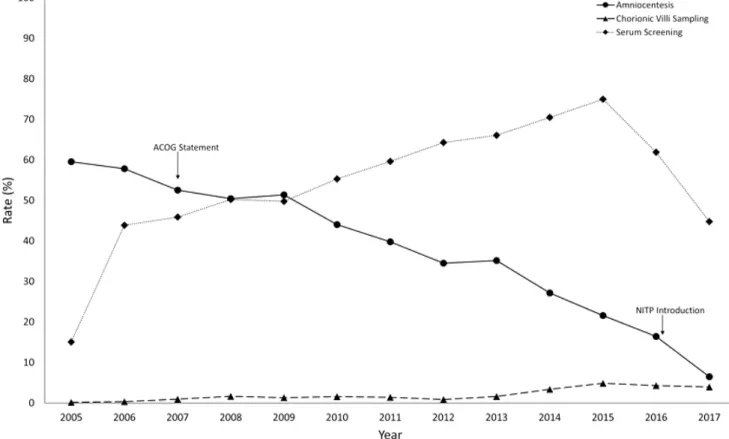
The yearly rates for serum screening, amniocentesis, and CVS are shown in Fig. 1. The mean rate of amniocentesis in women aged 35 years and older before the January 2007 ACOG statement was almost 60%. It decreased gradually af- ter the ACOG statement, reaching 6.5% in 2017 after the in- troduction of NIPT in April 2016. The rate of serum screening was lower than that of amniocentesis until 2009; however, from 2010, it increased above the rate of amniocentesis. The yearly rate of CVS was <1% at the beginning of the study
period and increased to 5% just before NIPT introduction, de- creasing slightly to around 4% after NIPT introduction.
The monthly rates of serum screening, amniocentesis, CVS, and NIPT during the 12 months after the introduction of NIPT are shown in Fig. 2. The rate of serum screening in the first month was 76%, decreasing to 47.9% in the last month of the study period. The rate of amniocentesis was 18.8% in the first month after NIPT introduction and decreased to 6.3%
by the last month. In contrast, the rate of NIPT was 4.5% in the first month and increased to 38.9% in the last month.
The rate of CVS was similar during the 12-month period after NIPT introduction.
The mean rates of amniocentesis and CVS in the 3 peri- ods—before the January 2007 ACOG statement, between the ACOG statement and the April 2016 NIPT introduction, and after NIPT introduction—are shown in Fig. 3. The mean rate of amniocentesis was 56% before the ACOG statement, 38% between the ACOG statement and NIPT introduction, and 10% after NIPT introduction (P=0.001) (Fig. 3A). After
Fig. 1. Rates of amniocentesis, chorionic villus sampling, and serum screening in singleton pregnant women aged 35 years and older over a 12-year period including the release of the 2007 American College of Obstetricians and Gynecologists statement and the 2016 noninva- sive prenatal test introduction. ACOG, American College of Obstetricians and Gynecologists; NIPT, noninvasive prenatal test.
the release of the ACOG statement, there was a decrease in the rate of amniocentesis of 32.1% from the baseline rate before the ACOG statement. The rate of amniocentesis de- creased by 82.1% after the introduction of NIPT. The mean rates of CVS during the 3 periods were 0.5%, 2.1%, and 4.3%, respectively (P=0.016) (Fig. 3B). Those of serum screen- ing were 44.2%, 61.3%, and 55.1%, respectively (P=0.049).
The indications for amniocentesis and CVS of singleton pregnancies between the 3 periods—before the January 2007 ACOG statement, between the ACOG statement and the April 2016 NIPT introduction, and after NIPT introduction—
are shown in Table 1. In amniocentesis, advanced maternal age was the most common indication during the 3 periods.
The frequency of advanced maternal age as an indication for amniocentesis was around 60%, although the rate slightly decreased after NIPT introduction (56.1%). For CVS, abnormal ultrasound findings including increased fetal NT at the first trimester were the most common indication during the 3 pe- riods. Advanced maternal age was the second most common indication for CVS, and the frequency of advanced maternal age was around 25%.
Finally, we assessed the mean rate of amniocentesis and
NIPT during 3 quarters after the April 2016 introduction of NIPT. The mean rate of amniocentesis was significantly decreased from the baseline in the first quarter. The rate of amniocentesis was 16.2% in the first quarter, 12.3% in the second quarter, and 7.3% in the third quarter (P=0.002) (Fig. 4A). From the baseline rate in the first quarter, the rate of amniocentesis was decreased by 54.9%. The mean rate of NIPT was 19.9% in the first quarter, 30.3% in the second quarter, and 39.5% in the third quarter (P=0.007) (Fig. 4D).
The rates of serum screening after NIPT were 62%, 54%, and 46%, respectively (P=0.03).
Discussion
We found that amniocentesis was the most commonly per- formed test for chromosomal abnormalities in women aged 35 years and older before the January 2007 ACOG statement.
The rate of amniocentesis decreased gradually after the re- lease of the ACOG statement, and the rate of serum screen- ing increased above the rate of amniocentesis from 2010. Al- though the introduction of NIPT slightly decreased the rate of Fig. 2. Rates of amniocentesis, chorionic villus sampling, serum screening, and noninvasive prenatal test in singleton pregnant women aged 35 years and older during the 12 months after the 2016 noninvasive prenatal test introduction. NIPT, noninvasive prenatal test.
serum screening, the serum screening has remained the most common test for chromosomal abnormalities in high-risk pregnancies. NIPT further decreased the rate of amniocentesis to 10%.
In our study, there was a 32.1% decrease in the mean rate of amniocentesis and a 38.7% increase in serum screening since the 2007 ACOG statement. Darnes et al. [6] reported a 19.6% decrease in prenatal diagnostic testing after the 2007 ACOG statement. Their study included patients screened up to 2 years after the ACOG statement, whereas our study evaluated the mean rate in a 9-year period from 2007 to 2016. Thus, the decrease in amniocentesis in this study is
greater than that reported by Darnes et al. [6] Although the ACOG statement about screening for aneuploidy regardless of maternal age was introduced in 2007, all clinicians at our institution did not immediately began to offer invasive testing based on maternal age. Over time, the proportion of clini- cians at our institution who offered screening or diagnostic tests regardless of maternal age increased gradually, and the rate of amniocentesis decreased. Rose et al. [11] tracked the first-trimester screening method between 2005 and 2011, and amniocentesis from 2001 to 2011. The rate of the first- trimester screening method increased from 12.7% to 44.2%
in patients aged 35 years and older, and there was a 65.1%
Rate of amniocentesis (%)Rate of serum screening (%) Rate of CVS (%)
Before ACOG (01/2005-12/2006)
Before ACOG (01/2005-12/2006)
Before ACOG (01/2005-12/2006) a)
a)
a)
a), b) 60
50
40
30
20
10
0
80
70
60
50
40
30
5
4
3
2
1
0 ACOG to NIPT
(01/2007-03/2016)
ACOG to NIPT (01/2007-03/2016)
ACOG to NIPT (01/2007-03/2016) After NIPT
(04/2016-03/2017)
After NIPT (04/2016-03/2017)
After NIPT (04/2016-03/2017)
Fig. 3. Rates of the different prenatal tests among the 3 periods of before the 2007 American College of Obstetricians and Gyne- cologists statement, between the American College of Obstetri- cians and Gynecologists statement and noninvasive prenatal test introduction, and after the 2016 noninvasive prenatal test intro- duction. The mean rates of amniocentesis are shown in (A), cho- rionic villus sampling in (B), and serum screening in (C). Data are represented as % ±standard deviation. ACOG, American College of Obstetricians and Gynecologists; NIPT, noninvasive prenatal test; CVS, chorionic villus sampling. a)Significantly different from before the American College of Obstetricians and Gynecologists statement (P<0.05); b)Significantly different from the period be- tween the American College of Obstetricians and Gynecologists statement and chorionic villus sampling introduction (P<0.05).
A B
C
decrease in genetic amniocentesis during their study period.
Although the study periods and methods of serum screening in our study differed from those of other studies, we identi- fied the same trends of continuous decrease in amniocentesis and increase in serum screening during the study period.
However, the rate of amniocentesis remained high at 21.6% in this study in 2015 before the 2016 NIPT introduc- tion. The factors that affect the decision to undergo amnio- centesis in women of advanced maternal age, despite being judged as having “low-risk” pregnancies based on results of serum screening, are all related to age [12]. NIPT is a highly sensitive and specific test for common aneuploidies in high- risk pregnancies, and can also influence the uptake of invasive prenatal diagnosis and serum screening.
In our study, NIPT further decreased the rate of amniocen- tesis to 7.3% in the third quarter after NIPT introduction and decreased the rate of serum screening. We evaluated the rates of all prenatal tests during the 1 year period after the introduction of NIPT. Friel et al. [13] reported that invasive genetic testing was not significantly different for women referred at <14 weeks gestation; however, it decreased the first-trimester screening. Other studies reported a decrease in invasive procedures over a short period (8–9 months) after NIPT introduction [14,15]. Larion et al. [10] reported that NIPT
became the predominant first-trimester method by the sec- ond quarter after its introduction, increasing by 55.0% over a 16-month period. In their study, NIPT was rapidly adopted by high-risk patients, and significantly decreased the alternative prenatal screening and diagnostic test in a short time. The uptake of NIPT among women with high-risk pregnancies in our study increased rapidly; however, the serum screening test was still the predominant method, although the rate of serum screening decreased after NIPT introduction.
This study has other limitations in addition to the retrospec- tive design. We did not evaluate the uptake rate of each test as a primary test for chromosomal aneuploidy, and focused instead on the change in the rate of each test for chromo- somal aneuploidy in women of advanced maternal age. We evaluated the indications for amniocentesis and CVS in whole singleton pregnancies during the same study period. We identified that advanced maternal age was the still most com- mon indication for amniocentesis although the frequency of advanced maternal age slightly decreased after NIPT introduc- tion. In contrast to amniocentesis, abnormal findings includ- ing increased NT at the first trimester were the most common indications for CVS. We assumed that the increased rate of CVS in this study was due to referrals from other hospitals owing to abnormal results of first-trimester screening tests Table 1. Indications for amniocentesis and chorionic villus sampling in singleton pregnancies between 3 periods: before the January 2007 American College of Obstetricians and Gynecologists statement, between the 2007 American College of Obstetricians and Gynecologists statement and April 2016 noninvasive prenatal test introduction, and after noninvasive prenatal test introduction
Indications Amniocentesis CVS
Before ACOG ACOG–NIPT After NIPT Before ACOG ACOG–NIPT After NIPT Advanced maternal age 2,067 (61.7) 7,395 (67.6) 219 (56.1) 11 (29.7) 200 (24.2) 34 (26.1) Screening positive for maternal serum
markers 802 (23.9) 2,355 (21.5) 116 (29.7) 3 (8.11) 30 (3.6) 3 (2.3)
Abnormal US findings including IFNT at 1st trimester
308 (9.1) 1,346 (12.3) 40 (10.2) 25 (67.5) 648 (78.4) 87 (66.9)
Abnormal US findings at 2nd trimester 170 (5.0) 495 (4.5) 38 (9.7) - - -
History of fetal anomalies 98 (2.9) 263 (2.4) 9 (2.3) 4 (10.8) 34 (4.1) 2 (1.5)
Parental chromosomal abnormality 19 (0.5) 63 (0.5) 8 (2.0) 4 (10.8) 20 (2.4) 1 (0.7)
Screening positive on NIPT - - 6 (1.5) - - 3 (2.3)
Others 117 (3.5) 301 (2.6) 21 (5.6) - 1 (0.1) 2 (1.5)
Total 3,350 10,926 390 37 826 130
Values are presented as number (%). Multiple choices are included. Increased fetal nuchal translucency was diagnosed according to the previ- ously reported criteria of >95th percentile level of nuchal translucency.
CVS, chorionic villus sampling; ACOG, American College of Obstetricians and Gynecologists; NIPT, noninvasive prenatal test; US, ultrasound;
IFNT, increased fetal nuchal translucency.
such as ultrasound and serum screening. The first-trimester screening for chromosomal aneuploidy was more generalized during the study period, and it might have contributed to the increased use of CVS. The rate of abnormal results of serum screening as an indication for amniocentesis was around 25%. Although it would have been possible to include some women who received multiple tests such as serum screening, NIPT, and invasive diagnosis, the results of decreased invasive
diagnosis and increased NIPT might not have changed ir- respective of whether we excluded those women who had other reasons for invasive diagnosis besides advanced mater- nal age. We also could not evaluate the detailed clinical char- acteristics of the study population.
In conclusion, this is the first study to report the rates of prenatal tests in women aged 35 years and older over a long period including the release of the 2007 ACOG statement
Rate of amniocentesis (%)Rate of serum screening (%) Rate of NIPT (%)Rate of CVS (%)
1st quarter
1st quarter 1st quarter
1st quarter 2nd quarter
2nd quarter 2nd quarter
2nd quarter 3rd quarter
3rd quarter 3rd quarter
3rd quarter a), b)
a)
a) 17.5
15.0
12.5
10.0
7.5
70
60
50
40
30
20
10 7
6
5
4
3
Fig. 4. Rates of the different prenatal tests in the 3 quarters during 1 year after the April 2016 noninvasive prenatal test introduction. The mean rates of amniocentesis are shown in (A), chorionic villus sampling in (B), serum screening in (C), and noninvasive prenatal test in (D).
Data represented as % ±standard deviation. NIPT, noninvasive prenatal test; CVS, chorionic villus sampling. a)Significantly different from the first quarter after noninvasive prenatal test (P<0.05); b)Significantly different from the second quarter after noninvasive prenatal test (P<0.05).
A B
C D
and the introduction of NIPT in Korea. We identified that the ACOG statement and NIPT both decreased the rate of inva- sive testing. In contrast to the decrease in invasive testing, the rate of NIPT in high-risk pregnancies increased rapidly in a short time. However, the serum screening test is still the predominant screening method for common chromosomal abnormalities. NIPT has the benefit of preventing pregnancy loss by decreasing unnecessary invasive diagnosis; however, its cost-effectiveness remains to be evaluated.
Acknowledgements
This research was supported by a grant from the Korea Health Technology R & D Project through the Korea Health Indus- try Development Institute (KHIDI), funded by the Ministry of Health & Welfare, Republic of Korea (grant No. HC15C1336).
Conflict of interest
No potential conflict of interest relevant to this article was re- ported.
References
1. Statistics Korea. Planned report, change in birth in Seoul for the past 10 years [Internet]. Daejeon (KR): Statistics Korea; c2017 [cited 2017 Jan 2]. Available from: http://
kostat.go.kr/office/giro/rogi_nw/2.
2. Jeong SO, Han YJ, Lee SW, Kwak DW, Chung JH, Ahn HK, et al. Observed frequency of fetal trisomy between 16 and 24 gestational weeks in pregnant women older than 34 years at delivery. J Genet Med 2016;12:92-5.
3. Kim YJ, Lee JE, Kim SH, Shim SS, Cha DH. Maternal age-specific rates of fetal chromosomal abnormalities in Korean pregnant women of advanced maternal age.
Obstet Gynecol Sci 2013;56:160-6.
4. ACOG Committee on Practice Bulletins. ACOG Practice Bulletin No. 77: screening for fetal chromosomal abnor- malities. Obstet Gynecol 2007;109:217-27.
5. Driscoll DA, Morgan MA, Schulkin J. Screening for Down syndrome: changing practice of obstetricians. Am J Obstet Gynecol 2009;200:459.e1-9.
6. Darnes DR, Hashmi S, Monga M, Sullivan C, Vidaeff A, Berens P, et al. First-trimester screening and its impact on uptake of diagnostic testing. Prenat Diagn 2011.31:892-6.
7. Palomaki GE, Kloza EM, Lambert-Messerlian GM, Haddow JE, Neveux LM, Ehrich M, et al. DNA sequencing of ma- ternal plasma to detect Down syndrome: an international clinical validation study. Genet Med 2011;13:913-20.
8. Norton ME, Brar H, Weiss J, Karimi A, Laurent LC, Caughey AB, et al. Non-Invasive Chromosomal Evalu- ation (NICE) Study: results of a multicenter prospective cohort study for detection of fetal trisomy 21 and tri- somy 18. Am J Obstet Gynecol 2012;207:137.e1-8.
9. Committee on Practice Bulletins-Obstetrics, Committee on Genetics, and the Society for Maternal-Fetal Medi- cine. ACOG practice bulletin No. 163: screening for fetal aneuploidy. Obstet Gynecol 2016;127:e123-37.
10. Larion S, Warsof SL, Romary L, Mlynarczyk M, Peleg D, Abuhamad AZ. Uptake of noninvasive prenatal testing at a large academic referral center. Am J Obstet Gynecol 2014;211:651.e1-7.
11. Rose NC, Lagrave D, Hafen B, Jackson M. The impact of utilization of early aneuploidy screening on amniocente- ses available for training in obstetrics and fetal medicine.
Prenat Diagn 2013;33:242-4.
12. Grinshpun-Cohen J, Miron-Shatz T, Ries-Levavi L, Pras E. Factors that affect the decision to undergo am- niocentesis in women with normal Down syndrome screening results: it is all about the age. Health Expect 2015;18:2306-17.
13. Friel LA, Czerwinski JL, Singletary CN. The impact of noninvasive prenatal testing on the practice of maternal- fetal medicine. Am J Perinatol 2014;31:759-64.
14. Pettit KE, Hull AD, Korty L, Jones MC, Pretorius DH. The utilization of circulating cell-free fetal DNA testing and decrease in invasive diagnostic procedures: an institu- tional experience. J Perinatol 2014;34:750-3.
15. Beamon CJ, Hardisty EE, Harris SC, Vora NL. A single center's experience with noninvasive prenatal testing.
Genet Med 2014;16:681-7.