
A Review of Wet Chemical Etching of Glasses in Hydrofluoric Acid based Solution for Thin Film Silicon Solar Cell Application
8
0
0
전체 글
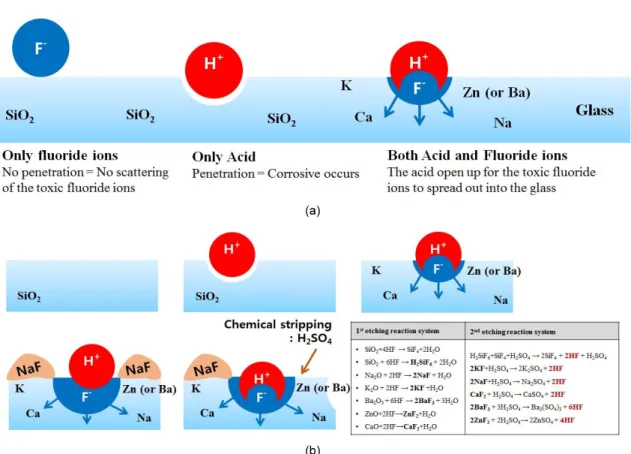
(2) 76. H.S. Park et al. / Current Photovoltaic Research 5(3) 75-82 (2017). etchant types and hard mask layers discussed. Finally, application. of tetragonal SiO4 units connected at all four corners to four. and conclusion described.. other SiO4 units by covalent siloxane bonds12). It is necessary to break these bridging oxygen bonds to break down the network. 2. The etch mechanism, etch rate, and glass. and release silicon from the glass. HF, dissolved in water, is a weak acid and its solutions containing, H+, F- and HF2- ions and. types regarding random etching of glass. un-dissociated HF molecules13). The dissolution of glassy SiO2. by wet chemical. is a heterogeneous reaction, which makes it difficult to study the mechanism governing the dissolution process. However, the. 2.1 The etching reaction; HF, HF/HCl, and HF/H2SO4. breaking of all the chemical bonds, which results in eq. (1), will. (mechanism). require several reaction steps. At first, glass reacts with HF. For the etching of glasses, only hydrofluoric acid or other HF. forming silicon tetra-fluoride and water and SiF4 reacts with HF. containing aqueous solutions used. The chemical reaction. to form H2SiF6, which is not soluble in HF solutions.. regarded as the following9): SiO2 + 6HF → 2H2O + H2SiF6. By adding to buffer acid agent such as HCl, HNO3, H3PO4 and H2SO4 to HF solution, the concentration of the more (1). reactive HF ion in the etchant is lowered, following equation (2) and (3)14).. This equation is a simplification of the reactions during the heterogeneous SiO2 dissolution as shown in Fig. 1 (a). HF is made up of the corrosive hydrogen ion (H+) and the toxic. H ・F K HF . (2). HF ・F K HF . (3). fluoride (F-), thereby acting in two ways (see picture above). The acid corrodes the glass surface and thus allows the toxic fluoride ion to penetrate the glass. Once in the glass, the fluoride ion binds themselves among others calcium and thus disturb the. K1 = 6.74×10⁻⁴ mol/l, K2 = 0.26 mol/l. other chemical components of the glass10,11). Glassy SiO2 consists. (a). (b) Fig. 1. A schematic of glass etch mechanism based on (a) HF, and (b) HF/H2SO4.
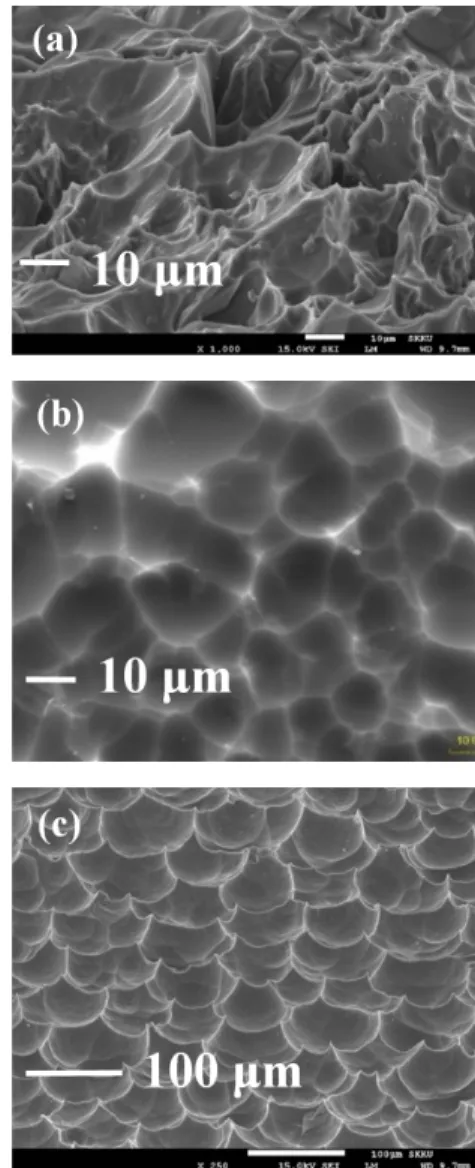
(3) H.S. Park et al. / Current Photovoltaic Research 5(3) 75-82 (2017). 77. Only in etchants containing both HF and concentrated H2SO4. rate8,15,17-19). Fluorine absorption complexes have observed at. were the etch rates higher than for HF/HCl or HF/HNO3 etchants,. hydrated SiO2 surfaces in gaseous HF. It changed into a surface. an effect which described to the formation of active fluorine-. group such Si-F or Si-O-SiF3. The absorption of HF and HF2-. containing HSO3F acid. For further detailed information, the. increases the electronic density on the bridging oxygen more. role of buffer acid etchant from HCl to H2SO4 presented as shown in Table 1. A higher HF concentration generates the by-product H2SiF6 in the first reaction, and then the regeneration of the HF occurs after the second reaction with the H2SO4 during the etching process. The HF concentration continually maintained along with the sulfuric-acid changes, and this then continues with the increasing of the activation energy. The addition of H2SO4 is, therefore, effective for the increasing of the etch rate and the surface roughness. The HF-H2SO4 etching systems, an effect that ascribed to the formation of the strong fluorine-containing HSO3F acid15). From the etching of the surface, these surfaces are less smooth than the mechanically polished ones, meaning that it is possible to transform ground surfaces into optically transparent surfaces as shown in Fig. 1 (b). As mentioned above, the etch mechanism of HCl to HF is slightly different. Initially, the HF solution etches the glass and insoluble byproduct deposited on top of the glass surface. As the time goes on progressed, the size of insoluble byproducts becomes larger and accumulates to interfere with etching on the glass. However, HCl (other oxide series) releases impurities in HF-HCl mixed solutions [ref 16, JNN 2016 Park et al.]. Thus, it can be seen that the similar shape as the crater surface appears as shown in Fig. 2 (b). The etch rate of agitation of the solution is related to the adsorption or chemisorption on the siloxane bonds at the glass surface dominating the dissolution process. The etching mechanism, in particular, the role of the various fluorine-containing species, has studied in more detailed by many researchers for the etching. Fig. 2. A SEM images of etched surface as a function of etching solution (a) HF, (b) HF+HCl, and (c) HF+H2SO4. Table 1. The role of buffer acid etchant Etchant. The role of buffer acid etchant. HF. 1) Involved in the etch rate of glass: fluorine containing species 2) Insoluble products generation as masking layers on glass substrate during etching: textured surface becomes rough and non-uniformities. HCl. 1) Significantly reduced roughness of side wall : preventing the formation of alkaline earth fluorides with low solubility on the surface, the etching rate of HF+HCl etchant was not sufficiently stable & can transform insoluble products to become soluble.. HNO3. 1) Faster longitudinal etching rate : Due to the strong oxidability of HNO3 which facilitates the reaction between HF and glass. H3PO4. Lower etching rate. H2SO4. 1) HF+H2SO4 etchants: the formation of the strong fluorine-containing HSO3F acid. By etching the surface, these surfaces are less smooth than mechanically polished ones; it is possible to transform ground surfaces into optically transparent surfaces..
(4) 78. H.S. Park et al. / Current Photovoltaic Research 5(3) 75-82 (2017). basic, so more H+ ions are adsorbed, which leads to more. products when etching of glass. Etched shape related size or. siloxane bonds being broken per time units, for example a kind. depth is presenting after etching to large cracks formation by the. of catalytic effect. Determination of the etching rate is then the. products. Fig. 3 shows that the growth of product increased and. destruction of the siloxane bond by the plus action of the. this surface morphology is gradually changed into a verge as the. adsorbed species.. etching process. This process indicates a size-up of fluorine +. The catalytic action of H ions on breaking siloxane bonds also occurs in the dissolution of glasses in acidic and weakly alkaline solution18). Methods for the decision of the etch rate of glasses are several ways as follows: The weight loss of dispersed powders, partially masking the surface of a glass body, e.g. a disk, by photoresist or wax. The etch rate for the glass is measured by monitoring the depth of the recessed etched region after etching of glass. It is slightly affected by agitation of the etchant from the rotation, stirring or ultrasonic.19). 2.2 The surface morphology, etch rate, and the glass types for etching of glass Glass etching process not only removes surface products, but. (a). it also changed the surface morphology of the glass depending on the etching solution. When polished, the surface has slightly etched the surface roughens and verge-like structures. The experiment carried out to confirm the light trapping structure by varying the type of glass as shown in Fig. 2. Here, HF solution of ~50% was used as the glass etch solution and etch time is 10 min. The Corning Eagle XG glass showed a smooth surface, while super-white glass had a severely rough surface and observed the texturing size of the tens to hundreds of μm. Although the same HF solution used, it showed the surface properties depending on the type of glass and related to the chemical composition of the glass. We investigated three kinds of glasses such as Corning Eagle. (b). XG, soda lime, super white to understand for the etching of glass. This table shows the chemical composition, optical properties and thermal resistance of glass as a representative three kinds of glasses. Silicon dioxide (SiO2) constitute more than fifty percent of total glass composition as shown in Table 1 and it included in calcium oxide (CaO) or sodium dioxide (Na2O) or aluminum oxide (Al2O3) according to the kinds of glasses20). In the case of optical properties, the transmittance is around 92% at the wavelength of 500 nm and around 8% for the reflectance. Corning Eagle XG glass is superior to the different things in quality for the thermal resistance of more 600oC. However, Corning Eagle XG glass cost per units was more expensive than other glass because of less dopant component in the glass. It shows that this formation is related to the presence of some. (c) Fig. 3. Top view images of product size formed on a glass substrate by the etching treatment in, (a) 30 min, (b) 60 min and (c) 90 min, respectively.
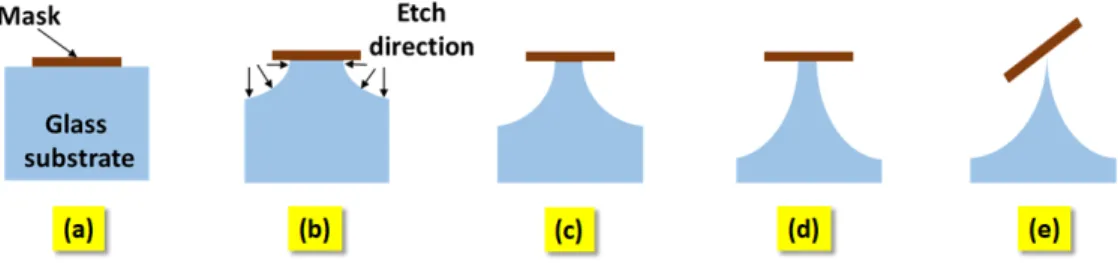
(5) H.S. Park et al. / Current Photovoltaic Research 5(3) 75-82 (2017). products on the glass surface and a diffusion of fluorine species, which is related to the etching rate. Therefore, we have a conclusion that fluorine products play a crucial role in the macrocrack formation with random-etching without masking layers. Based on the facts mentioned above, it affects the glass texturing depending on the type of glass, composition ratio of the etching solution, temperature, and agitation. Fig. 4 shows that etch rates investigated according to various glass types, and HF 25% (volume ratio of DI:HF = 1:1) was fixed. The graph shows that the etch rate of the SiO2-based glass (Fused natural silica) substrate having a low impurity content lowered even though it is the same solution. It contained less impurities of the glass substrate, which reported in previous research groups21,22).. 79. 3. Investigation of periodic textured glass morphology 3.1 Glass etching and hard mask layer types So far, we have briefly discussed the random etching surface using wet chemical etchant. To solve this problem as per the previous subchapter, we are going to talk about wet etching with periodical pattern mask. It is a well-constructed periodic etched shape as referred in23). The Periodically patterned shape has various light trapping structures such as high aspect ratio, square type, honeycomb, hemisphere as shown in Fig. 7. We should take into consideration such as masking materials, adhesion between substrate and masking layers, masking layer height, and size, spacing, and shape of the pattern to have an optimized light trapping structure. It is related to make the light trapping structure on a glass substrate having mask pattern and etching solution. Fig. 5 presents the glass etching step (before etching ~ etch-4) for isotropic etching. This is possible for making a high aspect ratio structure according to specific etching step. It is crucial factor such as the concentration, time, and solution ratio of the etching for high aspect ratio structure, but they also depend on the characteristics of the mask layer material. We investigated regarding the effect on the hard mask material as shown in Fig. 6 to improve the light trapping structure with the periodic pattern17). The photoresist (PR) is used as the most commonly. Fig. 4. Etching rate comparison of various glass types in HF etchant solutions. used masking material in wet chemical etching. When the concentration of HF increases or deeper etch performed, it is. Fig. 5. A glass etching step using periodic pattern hard mask (a) before the etching, (b) etch-1, (c) etch-2, (d) etch-3, and (e) etch-4. Fig. 6. A microscope images of micro etched surface based on various hard mask material.
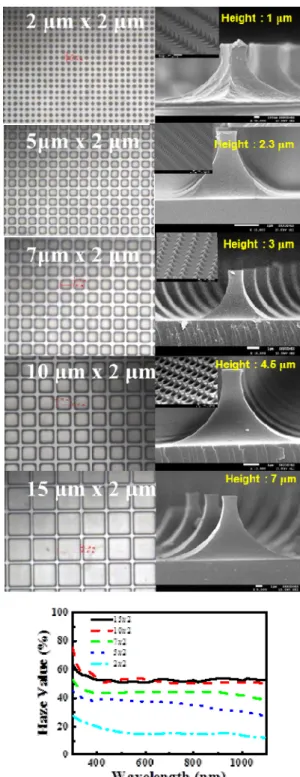
(6) 80. H.S. Park et al. / Current Photovoltaic Research 5(3) 75-82 (2017). Fig. 7. Investigation of etching effect using hard mask materials (Al, PR, a-Si, and SiNx). easy to be penetrated by HF acid between the glass and PR. Metal is widely used to serve as the masking layer. For the Comparison to a photoresist, the HF molecules get absorbed inside the inherent pinholes and cause the enhanced defects on the glass surface. The Al–glass adhesion was still too weak to prevent the lateral HF penetration for long-time etch. The siliconbased thin film is another well-known inert material to HF, it shows excellent adhesion with the glass substrate, and more importantly, the surface of the silicon-based material is hydrophobic14) which highly prevents the formation of surface pin holes and notching effect during the HF etch. This property implies that this masking material could be a good candidate for deeply fused silica etches. One of the process steps is checking for hardening the photoresist (PR)/HMDS solution, and the other is maintaining the etchant temperature during the etching. Masking layers are not only PR/HMDS but also different materials such as hydrogenated intrinsic amorphous silicon layer (i-a-Si:H) or silicon nitride (SiNx) by PECVD, metal mask like Al or Cr by the thermal evaporator (or sputtering), a thermal oxide (SiOx). All of masking materials excepting for PR/HMDS layers need to remove Metal or (SiNx or i-a-Si: H) with RIE or wet etching right after hard baking. However, and PR/sub-layers on the glass have excellent etching characteristics like a high aspect ratio, isotropic etching, selectivity and fast etching without a new process (RIE process).. 3.2 Wet etching parameters and light trapping structure Fig. 8 shows the light trapping structure for Etch-3 at different mask pattern from (2×2) to (15×2), which are based on wet etching. It consists of 2 types such as randomly textured surface without a pattern and periodically textured surface with the pattern. The textured surface used to be captured the light are based on the crystalline silicon (c-Si) solar cell as a substrate and thin film silicon solar cell as superstrate or substrate as well. In. Fig. 8. A SEM images of light trapping structure (etch-3) and haze value with periodic mask pattern variation.
(7) H.S. Park et al. / Current Photovoltaic Research 5(3) 75-82 (2017). 81. the mask pattern, the spacing is fixed at 2 μm, and the size. Technology Evaluation and Planning (KETEP) granted. gradually increases. As the size increases, the etching height. financial resource from the Ministry of Trade, Industry &. gradually increases. The increase in the etching height serves to. Energy, Republic of Korea (No. 20153010012090). capture the incident light and increase the light scattering effect. In this way, the haze ratio can be determined using a haze meter or integral sphere to determine the light scattering effect. The haze ratio value according to the mask pattern change is. References. shown in Fig. 8. As shown in the figure, the mask pattern of (10×2) or more maintained an average haze ratio of 50% or more. 1. A. Shah, M. Vanecek, J. Meier, F. Meillaud, J. Guillet, D. Fischer, C. Droz, X. Niquille, S. Fay, E. Vallat-Sauvain, V. T. -Daudrix, and. to the long wavelength region. However, using the same. J. Bailat, “Basic Efficiency Limits, Recent Experiments Results. structure as in the figure, the haze ratio is more than 60%. This. and Novel Light-Trapping in a-Si:H, μc-Si:H and Micromorph. requires careful examination of various parameters such as. Tandem Solar Cells”, J. Non-Cryst. Solids 639, (2004) 338.. height, spacing, and shape of the structure.. 2. M. Jacoby, “The future of low-cost solar cells”, Chem. Eng. News. 4. Application and Conclusion. 3. O. Isabella, J. Krč, and M. Zeman, “Modulated surface textures for. 94 (18), (2016) 30. enhanced light trapping in thin-film silicon solar cells”, Appl. Phys. Lett. 97, (2010) 10110.. Based on HF containing a solution, we used as a device. 4. X. Yan, S. Venkataraj, and A. G. Aberle, “Modulated surface. application such as MEMS, biotechnology and photovoltaic. texturing of Aluminum-Doped Zinc Oxide (AZ)) Transparent. based on HF glass etching to better the life. In this section, we. Conductive Oxides for Thin-Film Silicon Solar Cells”, Energy Procedia 33, (2013) 157.. have discussed the brief applications and concluded in our work.. 5. W. Zhang, U. W. Paetzold, M. Meier, A. Gordijn, J. Hüpkes, and. Glass etching process regarding the purpose of thin film solar. T. Merdzhanova, “Thin-film Silicon Solar Cells on Dry Etched. cell applied satisfactorily when the textured glass surface is free. Textured Glass”, Energy Procedia 44, (2014) 151.. from contaminants. The etching key point necessary to clean a. 6. R. Sahin and I. Kabacelik, “Nanostructuring of ITO thin films. glass surface depends strongly on the etching solution and. through femtosecond laser ablation”, Appl. Phys. A 122, (2016). concentration for the light trapping structure. This changed by alternating short time etching of glass substrate with HF/H2SO4 without etching mask. Transforming smooth surface into optical light trapping morphology is possible. Although the reaction mechanism did not understood at this moment, we are available for the use of an industry if having satisfactory experiment results. HF solutions considered dangerous together with insoluble products. Therefore, it is of great im-. 314. 7. F. M. Ezz-Eldin, T. D. Abd-Elaziz, and N. A. Elalaily, “Effect of dilute HF solutions on chemical, optical, and mechanical properties of soda-lime-silica glass”, J. Mater. Sci. 45, (2010) 5937. 8. A. B. Burg, in “Fluorine chemistry”, Vol. 1, edited by J. H. Simons (Academic Press, New York, USA, 1950) p. 180. 9. D.J. Monk, D.S. Soane, and R.T. Howe, Solid-State Sensor and Actuator Workshop, “A diffusion/chemical reaction model for HF etching of LPCVD phosphosilicate glass sacrificial layers”, (1992) 5th Technical Digest, IEEE Hilton Head Island, SC, USA.. portance to reduce the quality of the etchants used during the. 10. H. Zhu, M. Holl, T. Ray, S. Bhushan, and D. R Meldrum, “Cha-. work and to develop methods to apply for the solar cell devices.. racterization of deep wet etching of fused silica glass for single cell. For this work, it is replaced by dry etching on behalf of the wet. and optical sensor deposition”, J. Micromech. Microeng. 19, (2009). etching to reduce the insoluble products. However, strong points of wet etching process are still better than that of dry etching because of a simple process, cost efficient and well-controlled the surface structures. Therefore, we will be interesting to see how the wet etching glass will be resolved.. 065013. 11. H. Nielsen and D. Hackleman, “Some Illumination on the Mechanism of SiO2 Etching in HF solutions”, J. Electrochem, Soc.; Solid-State Sci. and Techno. 130, (1983) 708. 12. A. Mitra and J. D. Rimstidt, “Solubility and dissolution rate of silica in acid fluoride solutions”, Geochimica et Cosmochimica Act 73, (2009) 7045.. Acknowledgment. 13. C. Iliescu, “Wet etching of glass for MEMS application”, Romanian J. Inform. Sci. Techno. 9 (4), (2006) 285. 14. G. A. C. M. Spierings, “Wet chemical etching of silicate glasses in. This work was supported by the ‘New & Renewable Energy. hydrofluoric acid based solutions”, J. Mater. Sci. 28, (1993) 6261.. Core Technology Program’ of the Korea Institute of Energy. 15. G. A. C. M. Spierings and J. Van Dijk, “The dissolution of Na2O-.
(8) 82. H.S. Park et al. / Current Photovoltaic Research 5(3) 75-82 (2017). MgO-CaO-SiO2 glass in aqueous HF solutions”, J. Mater. Sci. 22, (1987) 1869. 16. H. S. Park, S.-H. Nam, M. H. Shin, M. K. Ju, Y.-J. Lee, J.-H Yu, J.. 20. H. S. Park, J.-S. Jeong, M. H. Shin, S. B. Kim, and J. Yi, “Current status of light trapping in module cover glass for PV module,” Current Photovolt Research 4 (3), (2016) 119.. H. Jung, S. B. Kim, S. H. Ahn, J.-H. Boo, and J. Yi, “Method for. 21. H. Kikuyama, M. Waki, I. Kawanabe, M. Miyashita, T. Yabune,. Fabricating Textured High-Haze ZnO:Al Transparent Conduction. and N. Miki, J. Takano, and T. Ohmi, “Etching Rate and Mechanism. Oxide Films on Chemically Etched Glass Substrates”, J. Nanosci.. of Doped Oxide in Buffered Hydrogen Fluoride Solution”, J.. Nanotechno. 16, (2016) 4886.. Electrochem. Soc. 139 (8), (1992) 2239.. 17. K. Tsujino, S. Imai, C. -L. Lee, M. Matsumura, and S. Mizushima,. 22. J. Liu, N. I. Nemchuk, D. G. Ast, and J. G. Couillard, “Etch rate and. “Local wet etching of glasses by acidification utilizing electro-. surface morphology of plasma etched glass and glass-ceramic. chemistry”, J. Micromech. Microeng. 18, (2008) 115023.. substrates”, J. Non-Cryst Sol. 342, (2004) 110.. 18. C. Iliescu, J. Jing, Francis E.H. Tay, J. Miao, and T. Sun, “Strategies. 23. S. J. Bong, S. H. Ahn, Le H. T. Anh, S. B. Kim, H. S. Park, C. H.. in deep wet etching of Pyrex glass”, Surf. Coat. Techno. 198,. Shin, J. J. Park, Y. -J. Lee, and J. Yi, “Effective Light Trapping. (2005) 314.. in Thin Film Silicon Solar Cells with Nano- and Microscale. 19. A. J. Muscat, A. G. Thorsness, and G. M. Miranda, “Characterization of residues formed by anhydrous hydrogen fluoride etching of doped oxides”, J. Vac. Sci. Technol. A 19 (4), (2001) 1854.. Structures on Glass Substrate”, J. Nanosci. Nanotechnol. 16, (2016) 4978..
(9)
수치

+2
관련 문서
