In Silico Analysis and Molecular Docking Comparison of Mosquito Oviposition Pheromone and Beta-asarone on the Mosquito Odorant Binding Protein-1
Dong-Chan Kim*
Department of Biomedical Laboratory Science, Gimcheon University, Gimcheon 39528, Korea Received January 3, 2018 /Revised January 27, 2018 /Accepted January 29, 2018
Beta-asarone is the well-known active ingredient of Rhizoma acori graminei. In this study, we inves- tigated and compared the binding affinity of mosquito oviposition pheromone (MOP; (5R,6S)-6-ace- toxy-5-hexadecanolide) and beta-asarone on the A domain of the mosquito odorant binding protein 1 (CquiOBP1) by in silico computational docking studies. The three-dimensional crystallographic struc- ture of CquiOBP1 was obtained from the PDB database (PDB ID: 3OGN). In silico computational auto- docking analysis was performed using PyRx, Autodock Vina, Discovery Studio Version 4.5, and the NX-QuickPharm option based on scoring functions. The beta-asarone showed optimum binding affin- ity (docking energy) with CquiOBP1 as -6.40 kcal/mol as compared to the MOP (-6.00 kcal/mol).
Among the interacting amino acids (LEU76, LEU80, ALA88, MET89, HIS111, TRP114, and TYR122), tryptophan 114 in the CquiOBP1 active site significantly interacted with both MOP and beta-asarone.
Amino acids substitution (mutation) from non-polar groups to the polar (or charged) groups of the CquiOBP1 dramatically changed the X, Y, Z grid position and binding affinity of both ligands. These results significantly indicated that beta-asarone could be a more potent ligand to the CquiOBP1 than MOP. Therefore, the extract of Rhizoma acori graminei or beta-asarone can be applied to the fields of insecticidal and repellant biomaterial development.
Key words : Autodock, beta-asarone, binding affinity, mosquito, odorant binding protein
*Corresponding author
*Tel : +82-54-420-4041, Fax : +82-54-420-4461
*E-mail : [email protected]
This is an Open-Access article distributed under the terms of the Creative Commons Attribution Non-Commercial License (http://creativecommons.org/licenses/by-nc/3.0) which permits unrestricted non-commercial use, distribution, and reproduction
Journal of Life Science 2018 Vol. 28. No. 2. 195~200 DOI : https://doi.org/10.5352/JLS.2018.28.2.195
서 론
모기(Mosquito)는 사람에게 질병을 유발하는 대표적인 해 충의 하나로서 사람과 가축을 흡혈할 뿐만 아니라 뇌염(ence- phalitis), 황열병(yellow fever), 댕기열병(dengue fever), 그리 고 말라리아(malaria) 등 많은 질병을 매개하여 사람들의 생명 에 위협이 되고 있다[9]. 모기의 흡혈은 여름철 야외 활동을 불편하게 하고, 숙면 방해를 통한 피로 누적 등 인체 스트레스 (stress)원으로 직·간접적 큰 피해를 일으킨다. 모기를 방제하 기 위하여 오래전부터 살충제를 사용하였으나, 인체에 대한 독성 유발 및 독성 물질 체내 잔류 등 다양한 부작용이 야기되 었다. 그러므로 인간 건강에 미치는 악영향을 최소화시키면서 동시에 모기의 접근을 방지할 수 있는 천연물을 원료로 한 다양한 모기 기피제 연구 개발이 지속되고 있다[10].
2016년 7월경에 미국 NBC방송과 영국 신문 데일리메일 등 의 언론 보도에 따르면, 브라질 오스왈도 크루즈 파운데이션 (OCF)의 과학자들은 북동부 헤시피시(市) 일원에서 잡은 열대
집모기(Culex quinquefasciatus)에서 지카 바이러스(zika virus) 가 검출됐다고 발표했다. 지카 바이러스 감염증은, 지카 바이 러스를 보유한 모기에 물려 생기는 감염성 질환이다. 모기에 물린지 2~14일(잠복기) 지나서 갑작스런 발열, 발진, 관절통, 근육통, 결막염, 두통이 나타날 수 있으며 치사율이 매우 높다.
그러나 적절한 예방약이나 치료제가 없기 때문에, 더욱 두려 운 질환이라고 할 수 있다[11]. 열대집모기에서 발현하는 후각 단백질 종류 가운데 하나인 odorant binding protein (OBP)1 을 CquiOBP1이라고 부르며 이 단백질에 결합하는 oviposi- tion pheromone 리간드 가운데 하나인 (5R,6S)-6-acetoxy-5- hexadecanolide (이하 MOP로 명명)가 보고 된 바 있다[8].
석창포(Acori Ggraminei Rhizoma)는 다년생 초본식물로 석창 포의 유효 성분들로는 석창포에 가장 많이 함유된 베타아사론 (beta-asarone)을 비롯하여 유제놀(eugenol), 아사리알데히드 (asarylaldehyde) 등이 있다[2]. 석창포의 약리작용은 진정작 용, 항경련 작용, 소화액 분비 촉진 및 장관 평활근 이완작용, 항치매효과, 항비만효과, 항스트레스 효능 등이 보고되었다 [3]. 석창포의 대표 유효 성분인 beta-asarone은 벼멸구(Nila-
parvata lugens)와 배추좀나방(Plutella xylostella)에 대해서 살충력을 지니고 있는 것으로 밝혀졌다[5]. 또한 beta-asarone이 과량 함유된 석창포 추출물의 경우 모기기피 효능이 뛰어난 것으로 보고 되었다[6].
이와 같은 기존 연구 보고들을 바탕으로 하여, 본 연구에서
A
B
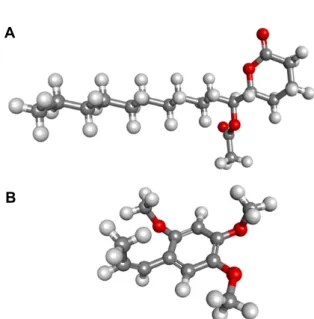
Fig. 1. 3D chemical structure of the mosquito odorant-binding protein ligand MOP (A) and beta-asarone (B).
(Fig. 1A)와 beta-asarone (Fig. 1B)의 모기후각단백질 CquiOBP1 활성부위에 대한 결합친화도를 약리학적 비교 분석을 실시하 였다.
재료 및 방법
HPLC 분석조건
석창포(대구 약령시에서 구매) 70% 에탄올 추출물[6] 중 be- ta-asarone함량은 HPLC (Alliance e2695, Waters, USA)를 사 용하였으며, YMC-Pack Pro C18 RS column (4.6×250 mm, 5 μm)을 30℃로 유지하여 분석하였다. 이동상은 0.1% acetic acid:acetonitrile (50:50)로 하고, 유량은 1.0 ml/min, 주입량은 10 μl로 하여 210 nm에서 검출하였다. Empower 2 software를 이용하여 external standard method에 의해 정량하였다.
In silico molecular docking 분석
In silico molecular docking 비교 분석을 위해 사용한 soft- ware는 기존 선행 연구의 방법을 바탕으로, 2차원, 3차원 구조 분석에 Autodock Vina (http://pyrx.sourceforge.net/home) [12]와 Discovery Studio 4.5 (DS4.5) version [7], NX-Quick Pharm program [4]을 활용하였다. MOP와 beta-asarone 성분 이 결합하는 타깃 단백질 CquiOBP1의 3차원 구조는 http://
www.rcsb.org에 등록되어있는 3D 구조(PDB ID: 3OGN) 를 활용하였다[8]. CquiOBP1 활성 부위에 결합하는 리간드 MOP 의 X,Y,Z Centroid Grid 값은 DS 4.5에서 X=2.856727, Y=
29.903091, Z=9.723091으로 확인되었으며 이 X,Y,Z Grid 지표 를 기준점으로하여 최외각 Dimension(Å)은 X=52.094, Y=
57,122, Z=51.980 범위 내에서 MOP와 beta-asarone의 Cqui OBP1에 대한 Virtual affinity profiling을 적용하였다. MOP
(Pubchem CID : 205992), beta-asarone (Pubchem CID : 5281758)의 3D 화학구조는 Pubchem Compound에서 제공 하 는 3D 구조를 바탕으로 실험에 활용하였다. 구체적으로 vir- tual affinity profiling은 Autodock Vina PyRx software를 활 용하여 binding affinity를 비교 분석하였으며, molecular dy- namics 상호작용 분석, CquiOBP1 단백질의 특정 아미노산의 치환 및 리간드와 CquiOBP1 결합의 종류, 결합 residue visu- alization은 DS4.5, NX-QuickPharm program을 활용하였다.
통계 처리
본 연구의 자료 분석은 SPSS (Statistical Package for the Social Science) WIN 18.0 프로그램 이용하였으며, 반복 실험 을 통하여 얻은 모든 분석값은 Mean ± SEM (Standard Error of Mean)으로 나타내었고, 분석된 실험 데이터는 t-test를 실시 하여 유의성을 검증하였으며 통계적 유의성 판정을 위한 유의 수준은 p<0.05은 *로, p<0.01은 **로 표시하였다.
결과 및 고찰
Lee 등이 보고한 추출 방법[6]에 따라 수득한 석창포 추출물 내의 beta-asarone의 함량을 HPLC로 분석한 결과 석창포 추 출물 1 ml 당 3.19 mg에 상당한 량으로 함량 분석되었다. MOP 와 beta-asarone의 CquiOBP1에 대한 molecular docking (Fig.
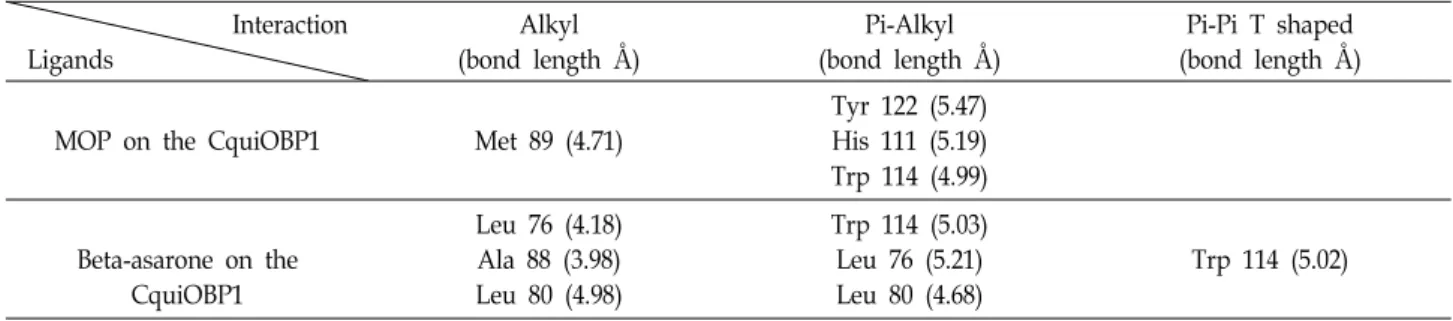
2A) 비교 분석을 진행하였을 때, MOP의 CquiOBP1 단백질의 domain A 활성 부위(active site)에 대한 3D molecular dock- ing pattern은 Fig. 2C와 같았으며, 2D molecular docking pat- tern은 Fig. 2D와 같이 분석되었다. Beta-asarone의 CquiOBP1 활성 부위에 대한 3D pattern은 Fig. 2E와 같으며, 2D pattern 은 Fig. 2F와 같이 분석되었다. MOP는 CquiOBP1 domain A 활성부위에 위치하는 4개의 아미노산(MET89, HIS111, TRP 114, TYR122)과 상호 작용을 하였으며(Fig. 2C, Fig. 2D) 그 중 MET89과는 Alkyl 결합을, 나머지 HIS111, TRP114, TYR 122아미노산들과는 Pi-Alkyl 결합을 하였다. 즉, MOP는 CquiOBP1 활성부위와 2개의 결합 종류와 4개의 상호작용 조 합을 나타냈다(Table 1). Beta-asarone 또한 MOP와 마찬가지 로 CquiOBP1 활성 부위에 존재하는 4개의 아미노산(LEU76, LEU80, ALA88, TRP114)과 상호작용을 하였으나(Fig. 2E, Fig.
2F), beta-asarone의 경우는 특이하게도 총 3 가지의 결합 종류
(Alkyl 결합: LEU76, LEU80, ALA88 / Pi-Alkyl 결합: LEU76,
LEU80, TRP114 / Pi-Pi T shaped: TRP114)와 7개의 상호작용
조합이 도출되었다(Table 1). 이러한 실험 결과는 beta-asarone
이 MOP에 비하여 CquiOBP1와의 상호작용에 있어서 상대적
으로 유리한 결합 조건을 가지고 있음을 시사하고 있다. 여기
서 특별히 CquiOBP1 활성 부위 Domain A에 존재하는 TRP
114 아미노산의 경우, MOP 및 beta-asarone과 공히 상호작용
하는 것으로 분석되었다(Fig. 2B). 이는 Mao 등의 NMR 구조
A
B
C
D
E
F
Fig. 2. (A) Three dimensional molecular docking pattern and binding position of the MOP (yellow color) and the beta-asarone (blue color) on the OBP1 for Culex quinquefasciatus (CquiOBP1) (grey ribbon). (B) Amino acid sequence of CquiOBP1 A domain. Red colored amino-acids interact only with the MOP and purple colored amino-acids interact only with the be- ta-asarone. Green colored tryptophan interacts with both MOP and beta-asarone. In silico molecular docking pattern of the MOP (yellow color stick) and beta-asarone (blue color stick) with the CquiOBP1 active site. Three dimensional (C and E) and two dimensional (D and F) patterns.
Table 1. List of the interacting amino acids and patterns of the MOP and beta-asarone on the CquiOBP1 active site Interaction
Ligands
Alkyl (bond length Å)
Pi-Alkyl (bond length Å)
Pi-Pi T shaped (bond length Å)
MOP on the CquiOBP1 Met 89 (4.71)
Tyr 122 (5.47) His 111 (5.19) Trp 114 (4.99)
Beta-asarone on the CquiOBP1
Leu 76 (4.18) Ala 88 (3.98) Leu 80 (4.98)
Trp 114 (5.03) Leu 76 (5.21) Leu 80 (4.68)
Trp 114 (5.02)
분석 실험에서도 MOP와 CquiOBP1 간의 상호작용에 TRP114 가 관여 하는 것으로 보고된 바 있기에[8] 리간드와 CquiOBP1 상호작용에 있어서 TRP114가 매우 중요한 역할을 하는 아미 노산으로 작용하는 것으로 볼 수 있다.
PyRx autodock vina로 분석된 MOP의 CquiOBP1에 대한 binding mode 가운데 최대 결합 친화도(binding affinity)는 -6.00 kcal/mol, 평균 결합친화도는 -5.68 kcal/mol로 나타났 다(Table 2). 반면, beta-asarone과 CquiOBP1 간의 최대 결합 친화도는 -6.40 kcal/mol, 평균 결합친화도는 -5.73 kcal/mol
로 나타났으며, 두 종류 리간드의 결합 친화도 값을 비교한
결과 대조군인 MOP보다 beta-asarone이 CquiOBP1 활성 부
위에 대하여 상대적으로 우수한 결합 친화도를 나타내었다
(Table 2). 이는 beta-asarone이 기존 리간드 보다 CquiOBP1
활성 부위에 훨씬 더 안정적으로 결합 할 수 있다는 약리학적
상호작용의 가능성을 제시해 주며 동시에 beta-asarone이
MOP보다 상대적으로 우수하게 OBP 활성을 조절 할 수 있는
것으로 사료된다.
Table 2. Binding affinity of the MOP and beta-asarone on the wild type and mutated CquiOBP1 active site Max binding affinity
(kcal/mol)
Average binding affinity (kcal/mol)
SEM
(n = # of binding mode) MOP on the CquiOBP1
MOP on the mutated CquiOBP1 Beta-asarone on the CquiOBP1
Beta-asarone on the mutated CquiOBP1
-6.00 -5.70 -6.40*
-5.70**
-5.68 -5.29 -5.73 -4.65
±0.29(n=8)
±0.26(n=7)
±0.71(n=8)
±0.57(n=8)
*p<0.05, **p<0.01.
A
B
C
D
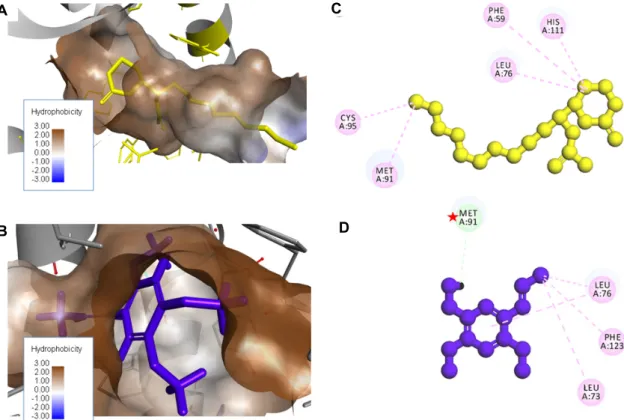
Fig. 3. Hydrophobicity surface patterns (brown color) of the MOP (A) and beta-asarone (B) on the CquiOBP1 active site. 2D molecular docking pattern of the MOP (C) and beta-asarone (D) on the amino acid substituted (mutated) CquiOBP1 protein A domain.
Green dot line and red star represent hydrogen bonding between the beta-asarone and CquiOBP1.
ta-asarone간 상호 결합의 종류는 소수성 결합(hydrophobic interaction)으로 분석되었다(Fig. 3A and Fig. 3B) 후각 단백질 에 결합하거나 활성을 자극하는 물질들은 화학적으로 방향족 고리 구조(aromatic ring)를 가지고 있기 때문에 타깃 단백질 과의 소수성 결합을 선호하는 것으로 판단된다. 본 실험에서 MOP와 beta-asarone간 상호작용 하는 것으로 분석된 Cqui OBP1 단백질 활성부위의 아미노산들 가운데 무극성(non-po- lar) 아미노산들을 전기화학적 성질이 전혀 다른 극성, 산성, 또는 염기성 아미노산으로 치환(L76E, L80E, M89Q, W114H) 시킨 후, 리간드와 CquiOBP1 단백질간의 상호작용 패턴의 변 화 여부를 조사하였다. MOP는 동일하게 CquiOBP1 단백질과 Alkyl 결합과 Pi-Alkyl 결합을 하였으나(Fig. 3C), beta-asar- one의 경우 Pi-Pi T shaped 결합 대신 MET91과 새로운 수소결
합을 형성하였다(Fig. 3D). 이에 더하여, 활성 부위 아미노산을 치환하기 전 MOP의 X, Y, Z grid는 X=2.856727, Y=29.903091, Z=9.723091에서 X=6.592225, Y=37.027270, Z=5.260054로, beta- asarone의 X, Y, Z 또한 X=-1.003881, Y=26.302420, Z=7.218398 로 큰 변화가 유도되었다. 이는 CquiOBP1 단백질 활성 부위의 아미노산의 전기적 성질이 변화되면서 리간드의 단백질 활성 부위에 대한 기존에 결합 형성이 어려워졌다는 것으로 사료된다.
유해 곤충이 인간의 삶에 끼치는 악영향은 매우 크며 매년
해충으로 인하여 발생하는 사업적 손실, 그리고 모기 같은 인
수 공통 흡혈 곤충이 유발하는 전염병으로 인해 발생되는 피
해는 결코 가볍게 볼 사안이 아니다. 이러한 유해 곤충의 섭식
행동은 후각에서 비롯된다. 그러므로 곤충의 후각을 제어하는
물질을 원료로 하며 효율이 높고 안전한 퇴충제(insect re-
pellent)개발이 활발히 요구되고 있다[1]. 무엇보다 곤충 후각 에 특이적으로 작용하면서 인간에게 끼치는 악영향을 최소화 할 수 있는 퇴충제용 신물질 탐색이 절실히 요구된다.
본 연구를 통하여, 석창포 추출물에 함유된 대표 효능 성분 beta-asarone의 열대집모기에서 발견되는 CquiOBP1 단백질 활성 부위에 대한 약리학적 작용 기작을 상세히 규명하였으 며, 기존 연구에 보고 된 CquiOBP1 단백질에 결합하는 MOP 리간드의 결합 유형에 대한 NMR 구조분석 결과와의 비교를 통해 in silico molecular docking 분석 결과값의 신뢰성을 추 가적으로 확인할 수 있었다. 결론적으로, 석창포 추출물을 비 롯하여 석창포에 최다 함유된 효능 성분 beta-asarone이 향후 모기를 친환경적으로 제어하기 위한 식의약 및 생활용품 소재 로서 매우 효율적으로 활용될 수 있을 것으로 기대된다.
감사의 글
본 연구는 김천대학교 교내 연구과제(과제번호 gc16065)로 수행되었습니다. 그리고 본 연구 진행에 도움을 준 이윤호 박 사님과 한방생명자원연구센터의 유영은 선생님께 감사함을 전합니다.
References
1. Chen, H. P., Zheng, L. S., Yang, K., Lei, N., Geng, Z. F., Ma, P., Cai, Q., Du, S. S. and Deng, Z. W. 2015. Insecticidal and repellant activities of polyacetylenes and lactones de- rived from Atractylodes lancea rhizomes. Chem. Biodivers 12, 593-598.
2. Irie, Y. and Keung, W. M. 2003. Rhizoma acori graminei and its active principles protect PC-12 cells from the toxic effect of amyloid-beta peptide. Brain Res. 963, 282-289.
3. Jung, K. Y., Kho, B. H. and Song, I. B. 1999. The Bibiograph- ical investigation of effect of acorus gramineus soland. J.
Sasang Const. Med. 11, 242-251.
4. Kim, D. C. 2017. Identification of quercetin as a potential band 3 protein antioxidant using ektacytometry and in silico molecular docking technology. Int. J. Appl. Eng. Res. 12, 8812-8816.
5. Lee, H. K., Park, C. and Ahn, Y. J. 2002. Insecticidal activities of asarones identified in Acorus gramineus rhizome against Nilaparvata lugens (Homoptera: Delphacidae) and Plutella xylostella (Lepidoptera: Yponomeutoidae). Appl. Ento. Zool.
37, 459-464.
6. Lee, S. H., Jung, J. K., Park, S. H., Kim, M. S., Han, Y. S., Seo, J. M. and Kim, I. S. 2011. Repellent activity of the ex- tracts of acorus gramineus against mosquito (Culex pipinens pallens). Kor. J. Environ. Agri. 30, 76-81.
7. Lim, S., Othman, R., Yusof, R. and Heh, C. 2017. Rational drug discovery of HCV helicase inhibitor: Improved dock- ing accuracy with multiple seedings of Autodock Vina and in situ minimization. Curr. Comput. Aided Drug Des. 13, 160- 169.
8. Mao, Y., Xu, X., Xu, W., Ishida, Y., Leal, W. S., Ames, J.
B. and Clardy, J. 2010. Crystal and solution structures of an odorant-binding protein from the southern house mos- quito complexed with an oviposition pheromone. Proc. Natl.
Acad. Sci. USA. 107, 19102-19107.
9. Mirzaian, E., Durham, M. J., Hess, K. and Goad, J. A. 2010.
Mosquito-borne illnesses in travelers: a review of risk and prevention. Pharmacotherapy 30, 1031-1043.
10. Misni, N., Nor, Z. M. and Ahmad, R. 2017. Repellent effect of microencapsulated essential oil in lotion formulation against mosquito bites. J. Vector. Borne Dis. 54, 44-53.
11. Pyzocha, N. J., Chinchen, S. E. and Maurer, D. M. 2017. Zany Over Zika Virus: An Overview of Diagnosis and Treatment Modalities. Curr. Sports. Med. Rep. 16, 109-113.
12. Trott, O. and Olson, A. J. 2010. AutoDock Vina: improving the speed and accuracy of docking with a new scoring func- tion, efficient optimization, and multithreading. J. Comput.
Chem. 31, 455-461.
초록:In Silico 분자결합 분석방법을 활용한 MOP와 베타아사론의 열대집모기 후각단백질 활성 부위에 대한 결합 친화도 비교 분석
김동찬*
(김천대학교 임상병리학과)