ABSTRACT Clay-coated rice seeds (clay-coated seeds A and B) were directly sown on dry paddy and their growth and yield were compared with the normal drill-sown seeds on dry flat paddy. In clay-coated seeds, germination was 1 day earlier and the emergence rate was higher up to 5%
than that of normal drill-sown seeds. But the apparent number of seedling stand per m
2was lower than that of normal drill-sown seeds, which is due to the smaller amount of seeding in clay-coated seeds. At the early growth stage, the plant height of clay-coated seeds A was taller than that of drill-sown seeds, while the plant height of clay-coated seeds B was 0.7 cm shorter than that of drill-sown seeds.
At the late growth stage, however, the difference was in- significant in both cases. The maximum tillering stage was 10 days earlier in drill-sown seeds. Lodging index was the lowest in clay-coated seeds B and there was no difference between clay-coated seeds A and drill-sown seeds. The ratio of stem base weight, culm diameter and culm wall thickness were higher in clay-coated seeds, while the lower internodes (4th, 5th and 6th) length was shorter in clay- coated seeds than in drill-sown seeds. In clay-coated seeds, the number of panicle per m
2was smaller, while the num- ber of spikelet per panicle was a little larger than in drill-sown seeds. The rate of ripened grain and brown rice 1,000 grain weight were lower in the clay-coated seeds, thus the yield was 98~99% level of drill-sown seeds. Consi- dering that the amount of seeding in clay-coated seeds was two-thirds of that in drill-sown seeds, it is expected that clay coating method could become an additional technique for direct seeding cultivation.
Keywords : rice, clay-coated rice seed, direct seeding, yield
Two major types of rice cultivation methods are in use - transplanting and direct seeding. Transplanting cultivation
includes hand transplanting and machine transplanting, and direct seeding cultivation includes direct seeding on dry paddy and direct seeding on flooded paddy (Kim et al., 1994; RDA, 1993).
The number of people engaged in agriculture was drasti- cally diminished because rural dwellers moved to metropolis from the late 1980’s. Besides, rural area became an aging society and female labor forces engaged in agriculture are increasing so fast. Thus, addressing labor deficiency problem is very urgent. Part of such efforts involves machine tran- splanting of 10 day-old seedling which contributed greatly in saving labor an it occupied nearly half of Korean paddy area in 1993 (RDA, 1993). After UR agreement, it is in- evitable to open agricultural market abroad. Therefore, ad- vanced labor-saving rice cultivation technology is necessary for minimizing the production cost. Ever since, direct seed- ing cultivation was developed by academic and research in- stitutes from 1985. As direct seeding cultivation system was established, the area of direct seeding rapidly increased. In addition, various types of direct seeding cultivation such as rotary scattering on flat field, ridged direct drill seeding and ridged direct broadcasting were developed as methods for direct seeding on dry paddy (Kim et al., 1992). However, direct seeding of rice has more problems to be solved than transplanting because transplanting has been originally de- veloped from direct seeding method on paddy. The typical problem of direct seeding is that seeds complete their growth on the same place where the seeds were sown. The number of tillers generally increased due to the increase of low- position tillers, so panicle number was easily secured. But the percentage of productive tillers decreased due to over- growth, and roots were mostly positioned in surface soil (RDA, 1993). Many researches have performed researches to solve this problem. In the research about lodging, it is
Growth and Yield Variation of Clay-coated Rice Seeds in Direct Seeding Culture on Dry Paddy
Weon-Young Choi, Hong-Kyu Park, Bon-IL Ku, Young-Jun Mo, Min-Gyu Choi, Sang-Su Kim, and Chung-Kon Kim
†Honam Aricultural Research Institute, NICS, RDA, Iksan 570-080, Korea
292
†
Corresponding author: (Phone) +82-63-840-2106
(E-mail) [email protected] <Received March 19, 2008>
necessary to improve the variety of which roots are heavier and positioned in subsoil in order to support above-ground plant (Terashima et al., 1992, 1994). And it is important to improve the variety with fewer tillers and heavy panicles which have shorter growth period, low germination tem- perature and excellent elongation at early growth stage, and variety which has short culm and erect plant type (Park et al., 1992). This study was performed to investigate the growth and yield when clay-coated rice seeds were directly sown on dry paddy and to confirm applicable results which could to be used in the field condition.
MATERIALS AND METHODS
The tested variety was Dongjinbyeo. Clay-coated seeds A was composed of 90% of clay, 10% of sand and 5~7 rice seeds, and clay-coated seeds B was composed 90% of clay, 8% of sand, 2% of organic matter and 5~7 rice seeds. The growth and yield of clay-coated seeds were compared with drill-sown seeds on dry flat paddy. In order to make clay- coated seeds, above-mentioned soil and seeds compound was compressed with thin board, so the size and the weight of the compound containing 5~7 rice seeds becomes 1.5×1.5×
0.7 cm and 1g when finally manufactured.
In drill seeding on dry flat paddy, rice seeds were disin- fected for 24 hours on April 24th and dried in the shade.
Seeding was performed with six-row drill seeding machine attached on the tractor on May 1st. Seeding depth was 3 cm, interrow spacing was 30 cm and seeding amount per 10a was 6 kg. In cultivation with clay-coated seeds, spacing drill was performed by hand. Seeding depth was 3 cm, interrow spacing was 30 cm, intrarow spacing was 15cm and seeding amount per 10a was 3.9 kg.
Fertilizer rate was 16 kg of nitrogen, 9 kg of phosphoric acid and 11 kg of potassium per 10a. Split application rate
of nitrogen was 40:30:30 at basal, tillering stage and panicle initiation stage. Phosphoric acid was wholly applied as basal fertilization and split application rate of potassium was 70:30 at basal and panicle initiation stage.
For weed control, 300 ml of Butachlor EC per 10a was applied 3 days after seeding, and 3 kg of Dimepiperate +Bensulfuron-methyl GR per 10a was used in flooded con- dition at 2 leaf stage.
The survey of lodging related traits was performed 20 days after heading, and weight of culm breakdown was performed at middle position of 4th internode by culm breakdown tester (TS-2).
Experimental plot was arranged in randomized block design with 3 replications. And agronomic traits such as growth and yield were investigated following the experi- mental & survey manual of RDA (RDA, 1995).
RESULTS AND DISCUSSION
Germination days and seedling stand
Germination days, required for seeds to sprout after sow- ing, are 23 days in drill seeding on dry flat paddy, which is 1 day longer than those of clay-coated seeds A and B.
The number of seedling stand per m
2was 119 in drill seeding on dry flat paddy, 86 in clay-coated seeds A and 79 in clay-coated seeds B. The percentage of seedling stand of clay-coated seeds A was 5% higher than that of drill seeding on dry flat paddy, but the percentage of seedling stand of clay-coated seeds B was the same as that of drill seeding on dry flat paddy. This is due to the difference between the amount of seeding which is 6 kg per 10a in drill seeding on dry flat paddy, while 3.9 kg per 10a in clay-coated seeds.
Table 1. Difference of germination days and seedling stand under different treatment of rice.
Treatment Days from seeding to
emergence
No. of seedling stand per m
2Percentage of establishment (%)
Fertilizer + soil + seeds (A) 22 86 65a
Fertilizer + soil + organic matter + seeds (B) 22 79 60a
Drill seeding on dry flat paddy (Control) 23 119 60a
†
Means followed by a common letter are not significantly different at 5% level by Duncan’s multiple range test.
The variation in plant height and the number of tillers
Table 2 shows the variation in plant height at early growth stage. The plant height of clay-coated seeds A was 1.5 cm higher than that of drill seeding on dry flat paddy, but that of clay-coated seeds B was 0.7 cm shorter on June 1st. As the growth advanced, the plant height of clay-coated seeds A was finally 1cm higher than that of drill seeding on dry flat paddy and clay-coated seeds B.
Table 3 shows the variation in the number of tillers at the early growth stage. The maximum tillering stage in drill seeding on dry flat paddy was June 30th due to more seed- ling stand and larger number of tillers at early growth stage, and those of clay-coated seeds A and B were July 11th. But final tiller numbers were the same as the order of seedling
stand, while percentage of productive tillers were higher in clay-coated seeds.
Lodging related traits
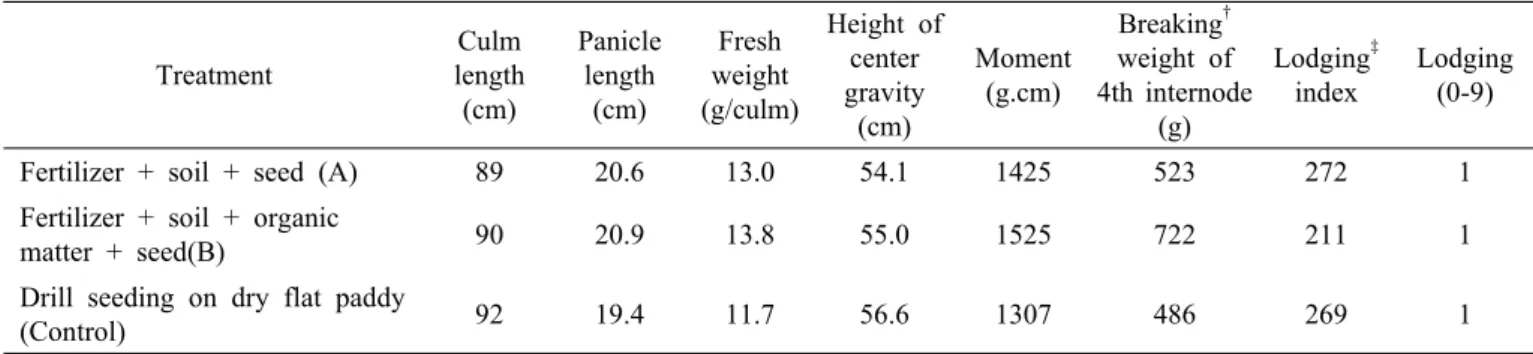
Table 4 shows lodging related traits and lodging index.
Culm length of drill seeding on dry flat paddy was 92 cm, and those of clay-coated seeds were 2~3 cm shorter. But panicle length of clay-coated seeds were 1.2~1.5 cm longer than that of drill seeding on dry flat paddy.
The point of central weight was lower in clay-coated seeds which had shorter culm length, and lodging moment was higher in clay-coated seeds due to the heavier fresh weight.
The weight of culm breakdown at 4th internode was higher in order of clay-coated seeds B, clay-coated seeds A and drill seeding on dry flat paddy. The lodging index was higher
Table 2. Changes in plant height under different treatments of rice.
Treatment June 1 June 15 June 30 July 11 July 27 Aug. 29
--- cm ---
Fertilizer + soil + seed (A) 9.7 23.4 35.8 47.1 70.6 116
Fertilizer + soil + organic matter + seed (B) 7.5 21.3 33.8 45.9 66.2 115
Drill seeding on dry flat paddy (Control) 8.2 23.0 36.1 49.7 68.7 115
Table 3. Changes in number of tillers per m
2under different treatments of rice.
Treatment June 1 June 15 June 30 July 11 July 27 Aug. 29
--- number of tillers per m
2---
Fertilizer + soil + seed (A) 86 185 436 449 355 324
Fertilizer + soil + organic matter + seed (B) 79 132 399 452 330 291
Drill seeding on dry flat paddy (Control) 119 207 601 545 410 340
Table 4. Changes in lodging related traits and lodging index as affected by different treatments of rice at 20 days after heading.
Treatment
Culm length (cm)
Panicle length
(cm)
Fresh weight (g/culm)
Height of center gravity (cm)
Moment (g.cm)
Breaking
†weight of 4th internode
(g)
Lodging
‡index
Lodging (0-9)
Fertilizer + soil + seed (A) 89 20.6 13.0 54.1 1425 523 272 1
Fertilizer + soil + organic
matter + seed(B) 90 20.9 13.8 55.0 1525 722 211 1
Drill seeding on dry flat paddy
(Control) 92 19.4 11.7 56.6 1307 486 269 1
†
Included leaf sheath
‡
(Culm length + Panicle length) × F.W. ×100
Breaking weight of 4th internode
in order of clay-coated seeds A, drill seeding on dry flat paddy and clay-coated seeds B. Lodging index was 1 in all treatments.
Lodging resistance of culm
Table 5 shows the traits of culm which are related to lodging. The ratio of base culm weight was 9.7% in drill seeding on dry flat paddy, while 10.3%~10.4% in clay- coated seeds, which indicates stronger upholding power of clay-coated seeds. Culm diameter of the 4th internode was thicker in clay-coated seeds with the values of 3.52 mm in drill seeding on dry flat paddy, 3.91 mm in clay-coated seeds A and 4.11 mm in clay-coated seeds B. Similar tendency was found in culm diameter of the 5th internode. Culm wall thickness of the 4th internode was the highest in clay-coated seeds B with the values of 0.63 mm in drill seeding on dry flat paddy, 0.68 mm in clay-coated seeds A and 0.81 mm in clay-coated seeds B. Culm wall thickness of the 5th internode did not show significant difference. This result is similar to the report of Pinthus (1973) which demonstrated different forms of rice culm according to cultivation methods and planting densities.
Internode length
Table 6 shows internode length in each treatment. The length of lower internodes, which has high relevance to lodging, was shorter in clay-coated seeds than in drill seed- ing on dry flat paddy showing 0.5~1.1 cm shorter values in the 4th internode, 0.9 cm shorter in the 5th internode and 0.5 cm shorter in the 6th internode. Shorter internode length in clay-coated seeds seems to contribute to the higher lodg- ing moment and heavier breakdown weight which is shown in table 4. Matsushima (1980) reported similar tendency that lodging occurs less as lower culm becomes shorter.
Yield components and yield
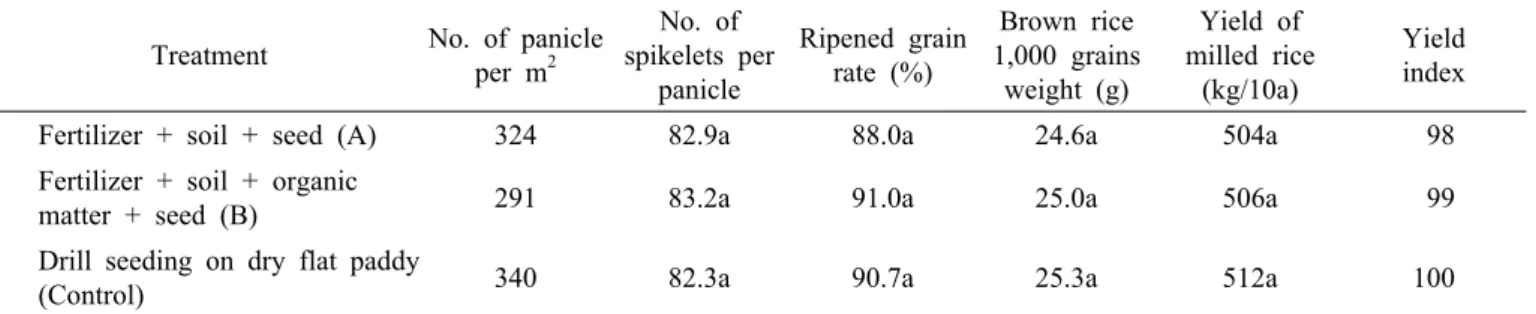
Table 7 shows yield components and yield in each treat- ment. The number of panicle per m
2in drill seeding on dry flat paddy was 340, which was 16~49 more than that of clay-coated seeds, while the number of spikelet per panicle in clay-coated seeds was 0.6~0.9 more than that of drill seeding on dry flat paddy. Ripened grain rate in clay-coated seeds A was lower than that of drill seeding on dry flat paddy, whereas clay-coated seeds B had higher ripened grain rate than that of drill seeding on dry flat paddy. Brown rice 1,000 grain weight was a little lower in clay-coated seeds,
Table 5. Difference in culm diameter and culm wall thickness under different treatments of rice at 20 days after heading.
Treatment
Ratio of base
†culm weight
(%)
Culm diameter Culm wall thickness
4th internode (mm)
5th internode (mm)
4th internode (mm)
5th internode (mm)
Fertilizer + soil + seed (A) 10.4a 3.91a 4.20ab 0.68b 0.80a
Fertilizer + soil + organic
matter + seed (B) 10.3a 4.11a 4.59a 0.81a 0.73a
Drill seeding on dry flat
paddy (Control) 9.7a 3.52b 3.85b 0.63b 0.76a
†
Culm weight of 10 cm from base ×100 Total fresh weight of a tiller
a