Bioremediation of Diesel-Contaminated Soils by Natural Attenuation, Biostimulation and Bioaugmentation Employing Rhodococcus sp. EH831
Lee, Eun-Hee, Yeon-Sil Kang, and Kyung-Suk Cho*
Department of Environmental Science and Engineering, Ewha Womans University, Seoul 120-750, Korea
Received: February 23, 2011 / Revised: March 14, 2011 / Accepted: March 15, 2011
Three bioremediation methods, natural attenuation (NA), biostimulation (BS) and bioaugmentation (BA) were applied to remediate diesel-contaminated soil, with their remediation efficiencies and soil microbial activities compared both with and without surfactant (Tween 80). BA treatment employing Rhodococcus sp. EH831 was the most effective for the remediation of diesel-contaminated soil at initial remediation stage. On the addi- tion of surfactant, no significant effect on the remediation performance was observed. A negative correlation was found between the dehydrogenase activity (DHA) and residual concentration of total petroleum hydrocar- bons (TPHs) at below 20,000 mg-TPHs ·kg-dry soil-1, as follows: DHA (µg-TPF(Triphenylformazan)·g-dry soil-1 d-1) = -0.02 × TPHs concentration (mg-TPHs ·kg-dry soil-1) + 425.76 (2500≤ TPHs concentration
≤ 20000, p < 0.01).
Key words: Natural attenuation, biostimulation, bioaugmentation, Rhodococcus sp., soil contamination
Introduction
Petroleum hydrocarbons (PHs) are widely used chemicals, but are hazardous pollutants in soils and waters [21, 26, 32]. Pollution caused by PHs is often induced by leakages from ground or underground storage tanks, spillage during transportation, wastes generated in the production of various goods, abolition of chemicals or from landfills [24]. Among PHs, diesel, which is composed by alkanes and aromatic compounds, has been widely used in various industries.
Due to its relatively high mobility, the possibility of contamination of surface waters and groundwaters as well as soils is high [8].
It is important to eliminate these pollutants because PHs are significantly harmful to human health [17]. There are 3 kinds of bioremediation technique (natural attenuation, NA; biostimulation, BS; and bioaugmentation, BA) for the purification of PHs-contaminated soils [4]. These techniques are suitable for the removal PHs from contaminated sites since they are cost effective and environmental-friendly
methods. They have the advantages of being able to be applied to large areas and completely degrade the pollutants completely [4]. Furthermore, few secondary pollutants, which have adverse effects on ecosystems and human health, remain on and/or in soils and waters after the application of the bioremediation process [26].
To achieve effective bioremediation, it is important for the microorganisms adapt to the target environment because their activity directly affects the remediation efficiency [7].
For example, if inoculated microbes are not acclimatized to the target soils they could lose their intrinsic degradation activity [31]. Therefore, NA or BS occasionally show higher remediation efficiencies than BA treatment, according to environmental conditions, such as pollutants, soil types, pH and so on [4, 7]. Bento et al. [4] applied NA, BS, and BA treatments to two different kinds of soil. They reported BA treatment showed superior treatment efficiency for total petroleum hydrocarbons (TPHs) of long beach soil, California, but NA treatment was better than BA treatment of Hong Kong soil. Many previous studies on bioremediation of PHs in soil have reported that their slow transfer from the soil matrix to the aqueous phase is often the rate- limiting step in the process [3, 18, 34]. This phenomenon is referred to as limited bioavailability [33]. To enhance
*Corresponding author
Tel: +82-2-3277-2393, Fax: +82-2-3277-3275 E-mail: [email protected]
remediation efficiency, surfactants were used to increase bioavailability. Mulligan et al. [23] reported the addition of surfactants could enhance remediation efficiencies in soil.
In soil bioremediation, the health of the soil ecosystem has to be considered along with the remediation efficiency.
Since soil microbial activities and community diversities are critical indicators of the ecological health of soils [2], it is important to evaluate the dynamics of the whole microbial community rather than just pollutants-degrading microbes [1]. The microbial community structure, diversity and enzymatic activities are severely stressed by pollutants [16].
Subsequently, microbial communities can be continuously altered by various pollutants and external substances during remediation. Therefore, continuous monitoring of the microbial performance is essential for maintaining a sound soil ecosystem as well as for achieving successful bio- remediation.
In this study, NA, BS and BA treatments were applied to remediate diesel-contaminated soil, with their remediation efficiencies compared both with and without surfactant.
Consequently, the relationships between microbial activity and TPHs concentrations were determined by evaluating the microbial activity during the bioremediation processes, with the relationships of these properties with the residual TPH concentration also evaluated.
Materials and Methods
Preculture of Rhodococcus sp. EH831 for BA Treatment
Rhodococcus sp. EH831 (KCCP-10657P) was used as an inoculated microorganism for the BA treatment, which was isolated from an oil-contaminated soil [13]. Rhodococcus sp. EH831 was able to utilize many recalcitrant hydrocarbons as well as diesel [11]. EH831 was cultivated as follows: 2.5 ml pre-culture of EH831 in LB medium was inoculated into a 500 ml Erlenmeyer flask, containing 100 ml of Bushnell Hass medium (BH), and supplemented with diesel, as sole carbon and energy sources, to give a final con- centration of 20,000 mg·L-1. The flask was incubated at 30°C and 120 rpm. The BH medium was composed of MgSO4·7H2O 0.049 g·L-1, CaCl2·2H2O 0.0256 g·L-1, KH2PO4 1.00 g·L-1, NK4NO3 1.00 g·L-1, Na2HPO4·12H2O 6.00 g·L-1 and FeCl3·6H2O 0.0833 g·L-1. Before inoculated into the BA, 100 ml of the EH831 broth was centrifuged at 8,900 × g (Supra21K, Hanil, Incheon, Korea) for 10 min,
with the harvested cells then washed twice with distilled water to remove the residual medium. The washed cells were resuspended in BH medium at 1.75 × 10⁵ CFU·ml-1.
Experimental Conditions for NA, BS, and BA Treatments
To simulate oil contaminant soils, 5 kg of garden soil from Ewha Womans University, South Korea, was sampled and sieved with a 2 mm sieve, and then mixed thoroughly with 5 kg of granite soil (1:1, w/w) to enhance air permeability. The total 10 kg of soil was contaminated with diesel to give a final concentration of 30,000 mg·kg-dry soil-1. The diesel-contaminated soil was aged at 20°C, without light for a week, and manually mixed once a day during the aging process. The final pH of the soil was approximately 5.0. 200 g of the diesel-contaminated soil was put into each of 30 plastic pots (120×80×73 mm, phytohealth 310120, SPL Life Sciences, Kyunggi-do, Korea).
The pots were covered with plastic caps allowing gas exchange. Surfactant (Tween 80, Duksan Pure Chemical Co., Ltd, Gyunggi-do, Korea) was supplemented to 15 pots to a final concentration of 100 mg-surfactant·kg-dry soil-1. To compare the soil remediation efficiencies of the NA, BS and BA treatments, 6 sets of experimental conditions were designed: NA treatment without surfactant (NA-w/o S); NA treatment with surfactant (NA-w/ S); BS treatment without surfactant (BS-w/o S); BS treatment with surfactant (BS-w/ S); BA treatment without surfactant (BA-w/o S);
BA treatment with surfactant (BA-w/ S). To simulate the NA treatment, 10 ml of distilled water was supplied to each pot once a week to prevent of dryness during the re- mediation process. For the BS, 10 ml of the BH medium was supplied once a week to prevent exhaustion of nutrients and dryness. For the BA, 10 ml of the EH831 cell suspen- sion (1.75 × 10⁵ CFU·ml-1) was inoculated into each pot at the beginning of the test, with 10 ml of the BH medium supplied once a week. Diesel, Tween80, EH831, and nutrients were mixed thoroughly by hand to disperse homogeneously.
Water content was maintained between 8 to 16% in all conditions.
Five pots for each set of experimental conditions were prepared, and then incubated at 20°C in a growth chamber (VISION Scientific, Gyunggi-do, Korea). After 7, 17, 23, 38 and 46th day, the entire soil content from a pot for each set of experimental conditions was taken out, and then mixed homogeneously for the analyses of the TPHs
concentration and microbial activity.
Analysis of residual TPHs concentration
Five grams of wet soil was added to 5 ml of acetone :hexane (1:1, v/v) and vortexed for 1 min. After 30 min of shaking and 30 min of standing, the upper layer of the solvent was carefully separated to analyze residual TPHs concentration. Concentration of residual TPHs was deter- mined using a gas chromatograph ed by gas chromatography (GC, HP 5890 II plus, Hewlett-Packard, USA), equipped with a flame ionization detector (FID) and HP-5 capillary column (30 m × 0.32 mm × 0.25 µm film thickness) [11].
The GC operating conditions were set up as follows: oven temperature 45°C ramped to 100°C (5°C/min), and then to 320°C (8°C/min); 5 min holding; injector temperature 280°C; detector temperature 250°C.
A standard TPHs curve was prepared using 0 - 20,000 mg·L-1 of diesel in hexane and acetone (1:1, v/v). The minimum detection limit of TPHs concentration was 150 mg·L-1. To calculate TPHs concentration in soil sample as mg-TPHs per kg dry-soil (mg-TPHs·kg dry-soil-1), water content of the soil was determined [12]. Each 2 g of wet- soil was dried at 105°C in an oven for 24 h, and its water content was then determined. All analyses were repeated 5 times.
Analysis of dehydrogenase activity
The soil microbial activity was evaluated by measuring dehydrogenase, which was determined using a modified Tabatabai method [28]. Three grams of wet-soil was sampled and added to a 20 ml test tube containing 0.03 g of CaCO3.
One ml of a 3% (v/v) solution of 2, 3, 5-triphenyltetrazolium chloride (TTC, Kanto Chemical Co., Inc, Tokyo, Japan) and 2.5 ml of distilled water were added to the test tube and incubated at 30°C in the dark for 24 h. After incubation, 100 ml of methanol was added to the extract. The intensity of the reddish color was measured using a spectrophotometer (Agilent 8453, Agilent Technologies, Santa Clara, USA) at 485 nm, with methanol used as the blank.
Results and Discussion
Comparison of diesel degradation
Changes in the residual TPHs of the soil samples treated using NA, BS or BA with/without surfactant are showed in Fig. 1. In the NA-w/o S, 10 and 49.6% of the initial diesel concentrations were removed at the 7th and 17th days, respectively, but only slight diesel removal was observed after 17 days (Fig. 1A). In the BS-w/o S, the removal efficiencies of diesel were 23.6 and 59.7% at the 7th and 17th days, respectively. As with the NA-w/o S, little further removal of diesel in the BS-w/o S was observed after 17 days (Fig. 1A). In the BA-w/o S, the degradability of diesel was relatively high, at 63.4% within 7 days, compared with the other treatments (Fig. 1A), however, from the 17 day onwards the diesel degradability in BA is only slightly higher than that in BS.
When the NA and BS treatments were supplemented with surfactant, the initial diesel removal efficiencies within 7 days were higher than those without surfactant. These patterns were clear in the NA without surfactant, with approximately 90% of the diesel remaining until the 7th
Fig. 1. Degradation of total petroleum hydrocarbons (TPHs) with different bioremediation methods, without (A) and with (B) sur- factant addition. Symbols: ●○, natural attenuation; ▼ ▽, biostimulation; ■ □, bioaugmentation. Closed symbols, without surfactant;
open symbols, with surfactant.
day; whereas, 56.8% remained in the test with surfactant (Fig. 1). The diesel removal efficiencies after 7 days were slightly higher than those without surfactant, irrespective of the remediation method (Fig. 1A & 1B). The addition of surfactant seemed to enhance the availability of the diesel for microbes; subsequently, TPHs degradation could be improved. The critical problem for TPHs degradation is their low solubility, which is one of critical limiting factors in the bioremediation process [5, 10, 30]. The addition of surfactants or biosurfactant-producing microorganisms has been widely used to solve this problem [14]. Torres et al.
[30] reported an optimal concentration of Tween 80 of 20 mg·kg-1 for the degradation of diesel. Prak and Pritchard [25] reported that the rate of PAH degradation could be increased or decreased by the supplementation of surfactant according to the PAH composition. Lai et al. [10] compared the TPHs removal efficiencies in oil-contaminated soils using synthetic surfactants (Tween 80 and Triton-X 100) and biosurfactants (rhamnolipids and surfactin). They reported that the addition of the synthetic surfactants was more effective than biosurfactants.
Generally, TPHs in soils can be lost due to abiotic processes, such as volatilization, as well as due to the biotic activity of microorganisms [20]. Abiotic loss of TPHs loss has been shown to be less than 10% of total TPHs at 25°C within the first 30 days [22]. Based on this result, it can be considered that the reduction of TPHs in the NA and BS treatments was caused by the biological activity of the indigenous microorganisms (Fig. 1). Because diesel- degrading microorganisms are known to be ubiquitous, it is possible to degrade TPHs in NA and BS treatments without any artificial inoculation [8]. Considering diesel (TPHs) was the only carbon source, the continuous supply of essential nutrients, such as N and P, is necessary to maintain the bioactivity. In this study, the removal of diesel was achieved until the 17th day in the NA treatments with and without surfactant, which may have been caused by the lack of N and P.
In this study, the BA treatment gave the best diesel degradation performance (Fig. 1). In general, BA treatment is very useful for bioremediation of recalcitrant compounds, which could not be bioremediated by indigenous micro- organisms. BA treatment is also suitable when the microbial population community in the soil has insufficiently developed [8]. However, BA can cause many serious problems due to the introduction of exotic species into soils. Microorganisms
introduced into new environments struggle at finding their niche for survival; consequently, predicting the results of bioaugmentation is difficult [7]. In detail, an introduced single species has a tendency to use limited compounds, and had low survival rates due to predation, parasitism and competition with indigenous species in the limited en- vironment. Therefore, some investigations have reported insignificant remediation effects compared with local microbial and commercially introduced species for bio- remediation [1, 4, 8]. Some investigations have demonstrated the application of indigenous microorganisms for bio- remediation to be more effective than using introduced microorganisms. Bento et al. [4] reported that indigenous species could degrade diesel better than introduced species because they were physiologically suitable for that region.
In addition, Gallego et al. [8] compared the degradation of diesel using NA, BS, and BA treatments in a bioreactor, and reported that BS showed distinct diesel degradation [8]. Tongarun et al. [29] also reported that BS treatment was more efficient than NA for the degradation of 4- chloroaniline (4CA). Unlike previous results, in this study, the BA treatment, employing Rhodococcus sp. EH831, was found to be the most effective treatment for the remediation of diesel-contaminated soil. Because the EH831 had been isolated from petroleum-contaminated soil in South Korea, this bacterium could display its activity for remediating the diesel-contaminated soil used in this study.
Comparison of microbial activity
Dehydrogenase is involved in respiration as an intracellular enzyme, and occurs in most living cells of microbes [15].
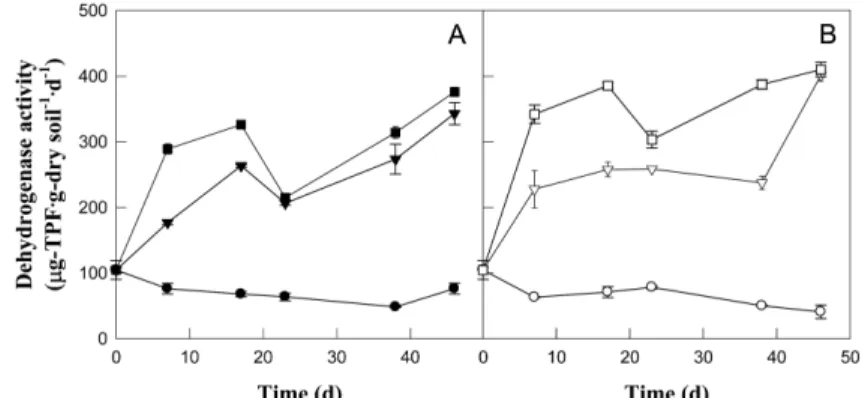
The dehydrogenase activity (DHA) was used to measure the soil microbial activity as an indicator for the total oxidation activity [6, 9]. Fig. 2 shows the DHA changes in diesel-contaminated soils treated with the NA, BS, and BA.
DHA was little changed during the NA treatment, irrespective of surfactant supplementation, but increased with time with both BS and BA. DHA was significantly decreased with both BS and BA treatments on the 23rd day due to low water content, and could be recovered by supplementing with water (data not shown). Mamilov and Dilly [19]
reported that the availability of water was related to the microbial activity, and Stres et al. [27] reported that low soil moisture decreased the microbial activity by reducing the diffusion of soluble substrates.
Fig. 3 shows the relationship between the residual TPHs
concentration and DHA in soil, which was found to be inversely proportional below 20,000 mg-TPHs·kg-dry soil-1. The correlation can be expressed as follows: DHA (µg- TPF(Triphenylformazan)·g-dry soil-1 d-1) = -0.02 × TPHs concentration (mg-TPHs·kg-dry soil-1) + 425.76 (2500≤ TPHs concentration≤ 20000) (p < 0.01). Margesin et al.
[22] measured the hydrolytic enzyme activities, such as fluorescein diacetate (FDA) hydrolysis and lipase activity, as methods for determining microbial activities; however, they found no relationship between the TPHs concentration and FDA, hydrolysis or lipase activity (hydrolytic enzyme activities). Subsequently, they reported that the lipolytic activities were positively related to the initial TPHs loading [20]. The relationships between TPHs concentrations and soil enzyme activity can be considered multifarious because
the soil enzyme activity showed different responses to pollutants according to the soil enzyme properties [15].
Conclusions
NA, BS and BA are representative biotechniques that can be used for the remediation of contaminated soil.
Although some comparative studies on their remediating performance have been reported, this is still a controversial issue. In this study, NA, BS, and BA treatments were applied for the remediation of diesel-contaminated soil, with their performance, including TPHs removability, microbial activity and bacterial community structure, compared. The BA treatment showed the highest TPHs degradation efficiency, and followed by BS and then NA.
DHA, a representative index for soil microbial activity, was also higher in the BS and BA-treated soils than the NA- treated soil. DHA was negatively correlated with the residual TPHs concentrations in all of the soil samples. The supplementation of the surfactant, Tween 80, into contaminated soils affected neither the TPHs removability nor the microbial properties.
Acknowledgements
This research was supported by the Basic Science Research Program through the National Research Foundation of Korea (NRF), funded by the Ministry of Education, Science and Technology (MEST) (NRL program, R0A- 2008-000-20044-0). It was also supported through the Advanced Environmental Biotechnology Research Center at Pohang University of Science and Technology (2009- Fig. 2. Alteration of the dehydrogenase activity (DHA) with different bioremediation methods, without (A) and with surfactant (B).
Symbols: ●○, natural attenuation; ▼ ▽, biostimulation; ■ □, bioaugmentation. Closed symbols, without surfactant; open symbols, with surfactant.
Fig. 3. Relationship between total petroleum hydrocarbons (TPHs) and the dehydrogenase activity (DHA). Symbols: ●○, natural attenuation; ▼ ▽, biostimulation; ■ □, bioaugmentation.
Closed symbols, without surfactant; open symbols, with surfactant.
0079504) and the Basic Research Program (R01-2005-000- 10268-0) by the NRF, MEST.
R
EFERENCES1. Baek, K.-H., B.-D. Yoon, B.-H. Kim, D.-H. Cho, I.-S. Lee, H.-M. Oh, and H.-S. Kim. 2007. Monitoring of microbial diversity and activity during bioremediation of crude oil-con- taminated soil with different treatments. J. Microbiol. Bio- technol. 17: 67-73.
2. Bastida, F., A. Zsolnay, T. Hernández, and C. Carcía. 2008.
Review: Past, present and future of soil quality indices: A biological perspective. Geoderma. 147: 159-171.
3. Beck, A. J. and K. C. Jones. 1995. Limitations to the in situ remediation of soils contaminated with organic chemicals in relation to the potential to achieve clean-up criteria. In: Van den Brink, W. J., Bosman, R., Arendt, F. (eds) Contaminated soil ‘95. Kluwer, Dordrecht, The Netherland, pp. 327-336.
4. Bento, F. M., A. O. Camargo, B. C. Okeke, and W. T. Fran- kenberger. 2005. Comparative bioremediation of soils con- taminated with diesel oil by natural attenuation, biostimulation, and bioaugmentation. Bioresour. Technol. 96: 1049-1055.
5. Christofi, N. and I. B. Ivshina. 2002. A reviwe: Microbial surfactants and their use in field studies of soil remediation.
J. Appl. Microbiol. 93: 915-929.
6. Chu, H., X. Lin, T. Fujii, S. Morimoto, K. Yagi, J. Hu, and J.
Zhang. 2007. Soil microbial biomass, dehydrogenase activ- ity, bacterial community structure in response to long-term fertilizer management. Soil Biol. Biochem. 39: 2971-2976.
7. Devinny, J. and S. H. Chang. 2000. Bioaugmentation for soil bioremediation, In: Wise, D. L., Trantolo, D. J. (eds) Biore- mediation of contaminated soils, Marcel Dekker, New York, pp. 465-488.
8. Gallego, J. L. R., J. Lpredo, J. F. Llamas, F. Vazquez, and J.
Sanchez. 2001. Bioremediation of diesel-contaminated soils:
Evaluation of potential in situ techniques by study of bacte- rial degradation. Biodegradation 12: 325-335.
9. Huang, H., S. Zhang, N. Wu, L. Luo, and P. Christie. 2009.
Influence of Glomus etunicatum/Zea mays mycorrhiza on atrazine degradation, soil phosphatase and dehydrogenase activities, and soil microbial community structure. Soil Biol.
Biochem. 41: 726-734.
10. Lai, C.-C., Y.-C. Huang, Y.-H. Wei, and J.-C. Chang. 2009.
Biosurfactant-enhanced removal of total petroleum hydrocar- bons from contaminated soil. J. Hazard. Mater. 167: 609- 614.
11. Lee, E.-H., J. Kim, K. S. Cho, Y. G. Ahn, and G. S. Hwang.
2010. Degradation of hexane and other recalcitrant hydrocar- bons by a novel isolate, Rhodococcus sp. EH831. Environ.
Sci. Pollut. Res. 17: 64-77.
12. Lee, E.-H., S. H. Lee, and K. S. Cho. 2011. Bacterial diver- sity dynamics in a long-term petroleum-contaminated soil. J.
Environ. Sci. Health Part A. 46: 281-290.
13. Lee, E.-H., H. W. Ryu, and K. S. Cho. 2009. Removal of
benzene and toluene in polyurethane biofilter immobilized with Rhodococcus sp. EH831 under transient loading. Biore- sour. Technol. 100: 5656-5663.
14. Lee, M., M. K. Kim, I. Singleton, M. Goodfellow, and S. T.
Lee. 2006. Enhanced biodegradation of diesel oil by a newly identified Rhodococcus baikonurensis EN3 in the presence of mycolic acid. J. Appl. Microbiol. 100: 325-333.
15. Li, H., Y. Zhang, I. Kravchenko, H. Xu, and C. G. Zhang.
2007. Dynamic changes in microbial activity and commu- nity structure during biodegradation of petroleum com- pounds: A laboratory experiment. J. Environ. Sci. 19: 1003- 1013.
16. Li, H., Y. Zhang, C. G. Zhang, and G. X. Chen. 2005. Effect of petroleum-containing wastewater irrigation on bacterial diversities and enzymatic activities in a paddy soil irrigation area. J. Environ. Qual. 34: 1073-1080.
17. Lu, M., Z. Zhang, S. Sun, Q. Wang, and W. Zhong. 2009.
Enhanced degradation of bioremediation residues in petro- leum-contaminated soil using a two-liquid-phase bioslurry reactor. Chemosphere 77: 161-168.
18. Luthy, R. G., D. A. Dzombak, C. A. Peters, S. B. Roy, A.
Ramaswami, D. V. Nakles, and B. R. Nott. 1994. Remediat- ing tar-contaminated soils at manufactured gas plant sites.
Environ. Sci. Technol. 28: A266–A276.
19. Mamilov, A. S. and O. M. Dilly. 2007. Microbial character- istics during the initial stages of litter decomposition in for- est and adjacent cropland soil. Ecol. Eng. 31: 147-153.
20. Margesin, R., M. Hämmerle, and D. Tscherko. 2007. Micro- bial activity and community composition during bioremedia- tion of diesel-oil-contaminated soil: Effects of hydrocarbon contamination, fertilizers, and incubation time. Microb. Ecol.
53: 259-269.
21. Margesin, R., D. Labbe, F. Schinner, C. W. Greer, and L. G.
Whyte. 2003. Characterization of hydrocarbon-degrading microbial populations in contaminated and pristine alpine soils. Appl. Environ. Microbiol. 69: 3085-3092.
22. Margesin, R. and F. Schinner. 1997. Laboratory bioremedia- tion experiments with soil from a diesel-oil contaminated site-significant role of cold-adapted microorganisms and fer- tilizers. J. Chem. Tech. Biotechnol. 70: 92-98.
23. Mulligan, C. N., R. N. Yong, and B. F. Gibbs. 2001. Surfac- tant-enhanced remediation of contaminated soil: a review.
Eng. Geol. 60: 371-380.
24. Paria, S. 2008. Surfactant-enhanced remediation of organic contaminated soil and water. Adv. Colloid Interface Sci. 138:
24-58.
25. Prak, D. J. L. and P. H. Pritchard. 2002. Degradation of poly- cyclic aromatic hydrocarbons dissolved in Tween 80 surfac- tant solutions by Sphingomonas paucimobilis EPA 50. Can.
J. Microbiol. 48: 151-158.
26. Sarkar, D., M. Ferguson, R. Datta, and S. Birnbaum. 2005.
Bioremediation of petroleum hydrocarbons in contaminated soils: Comparison of biosolids addition, carbon supplementa- tion, and monitored natural attenuation. Environ. Pollut. 136:
187-195.
27. Stres, B., T. Danev i , L. Pal, M. M. Fuka, L. Resman, S.
Leskovec, J. Hacin, D. Stopar, I. Mahne, and I. Mandic- Mulec. 2008. Influence of temperature and soil water con- tent on bacterial, archaeal and denitrifying microbial commu- nities in drained fen grassland soil microcosms. FEMS Microbiol. Ecol. 66: 110-122.
28. Tabatabai, M. A. 1982. Soil enzymes. In: Page, A. L., Miller, R. H., Keeney, R. (eds), Methods of Soil Analysis, Part 2 - Chemical and Microbiological Properties, pp. 903-947.
29. Tongarun, R., E. Luepromchai, and A. S. Vangnai. 2007.
Natural attenuation, biostimulation, and bioaugmentation in 4-Chloroaniline-contaminated soil. Curr. Microbiol. 56: 182- 188.
30. Toress, L. G., N. Rojas, G. Bautista, and R. Iturbe. 2005.
Effect of temperature, and surfactant’s HLB and dose over the TPH-diesel biodegradation process in aged soil. Process Biochem. 40: 3296-3302.
31. Ueno, A., Y. Ito, Y. Yamamoto, I. Yumoto, and H. Okuyama.
2006. Bacterial community changes in diesel-oil-contami- nated soil microcosms biostimulated with Luria-Bertani medium or bioaugmented with a petroleum-degrading bacte- rium Pseudomonas aeruginosa strain WatG. J. Basic Micro- biol. 46: 310-317.
32. Vázquez, S., B. Nogales, L. Ruberto, E. Hernández, J. Christie -Oleza, A. Lo Balbo, R. Bosch, J. Lalucat, and W. Mac Cormack. 2009. Bacterial community dynamics during bioremediation of diesel oil-contaminated Antarctic soil.
Microb. Ecol. 57: 598-610.
33. Volkering, F., A. M. Breure, and W. H. Rulkens. 1998.
Microbiological aspects of surfactant use for biological soil remediation. Biodegradation 8: 401-417.
34. Würdemann, H., N. C. Lund, and G. Gudehus. 1995. Assess- ment of a biological in situ remediation. In: Hinchee, R. E., Miller, R.N., Johnson, P. C. (eds) In situ aeration: air sparg- ing, bioventing, and related remediation processes. Battelle Press, Columbus, USA, pp. 237-247.
국문초록
Natural attenuation, biostimulation 및 Rhodococcus sp. EH831을 이용한 bioaugmentation에 의한 디젤 오염 토양의 정화
이은희·강연실·조경숙*
이화여자대학교 환경공학과
3가지 종류의 생물정화법인 natural attenuation (NA), biostimulation (BS) 및 bioaugmentation (BA) 방법을 디젤 로 오염된 토양을 정화하기 위해 적용하여, 각 방법에 의한 정화효율과 미생물 활성을 계면활성제 첨가 유무(Tween 80)에 따라 비교하였다. 토양 정화 초기 단계에서는 Rhodococcus sp. EH831을 접종원으로 이용하는 BA 방법에 의 한 토양 정화효율이 가장 좋았다. 3가지 생물정화방법 모두에서 계면활성제 첨가는 토양 정화효율에 영향을 미치지 않았다. 토양의 탈수소활성(DHA)과 잔류 총석유계탄화수소(TPHs) 농도는 음의 상관관계를 보였다: DHA (µg-TPF·g -dry soil-1 d-1) = -0.02× TPHs concentration (mg-TPHs·kg-dry soil-1) + 425.76 (2500≤ TPHs concentration ≤ 20000, p < 0.01).
cc