건물 에너지 저감을 위한 에너지 관리 체계 연구
강현준*․박재현*․박종태*․김천석**
A Study on Energy Management System for Energy Saving in Building
Hyun-Jun Kang
*․Jae-Hyun Park
*․Jong-Tae Park
*․Chun-Suk Kim
**요 약
본 논문은 건물 에너지 저감을 위하여 이기종 인터페이스를 통합한 스마트 게이트웨이, 웹서버 그리고 건물 에 너지 관리 시스템 구현방법에 대하여 기술하였으며 제안된 시스템은 건물 내의 에너지 저감을 위하여 서비스 모 델과 운영 알고리즘을 적용하여 최대전력과 전력사용량 감축방법을 소개한다.
ABSTRACT
In this paper, We described the implementation of the Smart Gateway for heterogeneous interface integrated, Web Server and Building Energy Management System(: BEMS). The proposed system introduces the reduction of peak power and electric power usage with service model and operating algorithm for energy saving in building.
키워드
BEMS, Peak Power, Electric Power Usage, Smart Gateway, 건물 에너지 관리 시스템, 최대 전력, 전력 사용량, 스마트 게이트웨이
* 한전KDN 전력IT연구원([email protected]) ([email protected]) ([email protected])
** 교신저자 (corresponding author) : 전남대학교 전자통신공학과([email protected])
접수일자 : 2015. 06. 08 심사(수정)일자 : 2015. 07. 13 게재확정일자 : 2015. 07. 23
Ⅰ. Introduction
Domestic electric power consumption is expected to increase the fastest by an annual average of 2.5% compared to 0.9% in final energy consumption from 205.9Mtoe in 2011 to 254.1Mtoe in 2035[1-3].
Building energy consumption occupied by one-third of global energy consumption, the main cause of the growth is an increase of lighting, heating and cooling, and appliances. Energy saving value of the potential electric reduction index in building will be occupied a large proportion compared to the transportation and industries[4-8].
Given the domestic energy supply and demand on the management side, the improvement of energy efficiency and electric power reduction assistance system is required for energy saving in building. In particular, energy efficiency measures in existing buildings account for 97% of the total building is incomplete situation[9-10].
One of the most effective approaches for improving
the energy efficiency is Energy Management
System(EMS) installation with convergence of ICT
technology and engineering technique, so the
necessity of introduction EMS is on the
increase[11-13].
In this paper, we propose to how to integrate interface of lighting, heating and cooling, cabinet panel and electric appliance and implement energy management system that has a function of real-time electric power usage analysis, device control, statistical information extraction, consumption pattern analysis in building.
Ⅱ. Building Energy Management System
2.1 BEMS
Building Energy Management System(BEMS) is system for deriving an optimal energy consumption by the integration and management of energy equipment in building using ICT technology.
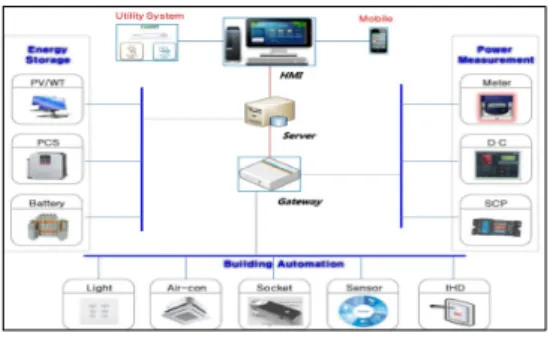
The Fig. 1 shows conventional BEMS configuration components are gateway of heterogeneous device interface, BEMS server of data collection and management, Human Machine Interface(HMI) of system operation.
Load management points in building can be classified as production equipment such as Energy Storage System(ESS) and consumption equipment such as Building Automation System(BAS).
Fig. 1 System configuration diagram
2.2 Smart Gateway
Gateway is installed as a separate system units in individually by traditional energy management practices and server system transmits and receives data from gateways.
A large number of gateways have the weakness of install space limitation, Install cost increase and massive traffic induction.
Ultimately, BEMS needs to integrate gateway for building energy management and have a function of interlocking. Also, it require establishment of operating policy when the communication network disconnection.
This paper proposes implementation of smart gateway to integrate heterogeneous devices and convert protocol. Smart gateway have compatible with interface of RS-232, RS-485, Power Line Communication(PLC), Ethernet, ZigBee and Wi-Fi as shown in Fig. 2.
Fig. 2 Smart gateway
Smart gateway have a Web Server of device status concentration, on/off control and scheduling function as an example Fig. 3.
Maybe, it can be operated by stand-alone when ethernet network is disconnected.
To solve the security problem, the proposed BEMS using a ARIA encryption algorithm of 128bit between server system and smart gateway.
Fig. 3 Web server of smart gateway
2.3 BEMS Server
BEMS server have a function of heterogeneous data collection, status data monitoring and control command transmit.
Development environment consists of a Linux Ubuntu OS, MySQL DB, Apache Tomcat Was Server and data packet structure consist of 5byte header, 2byte tail, nbyte Data.
Data processing methods of BEMS server are classified into periodic polling and event driven.
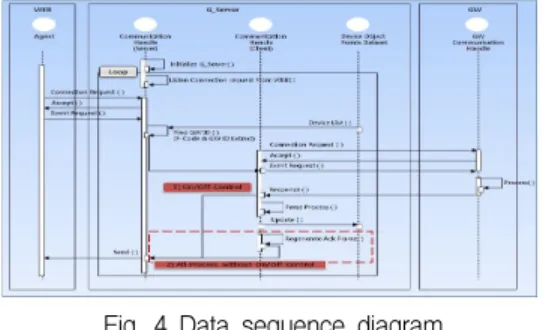
The Fig. 4 shows the data sequence between BEMS server and gateway.
First, periodic polling method is set period of polling and collect data from server to gateway. the others, event driven method is transmit event and store in the DB from gateway to server.
Fig. 4 Data sequence diagram
HMI of BEMS is classified into building zone management, control management, system set and reporting management for status monitoring, control, configuration and energy pattern analysis as shown in Fig. 5.
Fig. 5 Operating HMI of BEMS
Ⅲ. The proposed System Model
3.1 Demonstration Site
Demonstration site is selected contract power 400kW and a five-story building with heterogeneous electric appliances for energy saving research by low-cost investment.
3.2 System Model
Communication interfaces of the proposed system model include PLC, Serial, Ethernet, ZigBee and Wi-Fi as Table 1.
Smart socket using narrow band PLC, lighting switch, smart plug and multi sensor using ZigBee, Smart Cabinet Panel(SCP), BAS and Demand Controller(DC) using RS-485 and air-conditioner using ethernet of ModBus TCP for energy management system construction and analysis of effect.
Comm. Description Equipment
PLC 5.4kbps Smart Socket
Serial RS-485 BAS, SCP, DC Ethernet ModBus TCP System Air-Con
ZigBee 2.4GHz Socket, Plug, Sensor Wi-Fi 802.11.b/g/n Mobile
Table 1. The proposal system communication interface
Test-bed of the proposal system is installed in demonstration site with devices of DC for real-time peak power monitoring, air-con repeater for indoor device management, SCP module for distribution cabinet panel power measuring, smart switch for lighting management, BAS module, socket, plug and sensor for building automation.
The Fig. 6 shows the construction of the
proposed System Model.
Fig. 6 The proposed system model
3.3 Operation Algorithm
Five operating algorithm is implemented to save the energy in building.
1) Schedule algorithm for time/date schedule set and continued execution
2) Peak algorithm for previous peak monitoring and next peak prediction
3) Power set algorithm for target power usage set
4) Pricing algorithm for interlocking electric charges
5) Direct Load Control(DLC) algorithm for Demand Response(DR) stage by stage. All the algorithm can be given priority when set to overlap.
Ⅳ. Analysis of Effect
The Effective evaluation of the proposal system with respect to energy saving value performed by analyze power usage statistics data of KEPCO iSMART system from a period of 12 months before system installation(in 2013) to a period of 12 months after system installation(in 2014). Electric charges are excluded because of price change in annually.
4.1 Analysis of Peak Power
Peak power management during 15 minute units is important to reduce basic rate of electric charges
in building because electric charges will be calculated the maximum price at one max peak power of a number of peak powers by one year included during from December to February or from July to September.
The Fig. 7 shows the result of the peak power in 2013 and in 2014.
Fig. 7 The peak power comparison(2013 vs 2014)
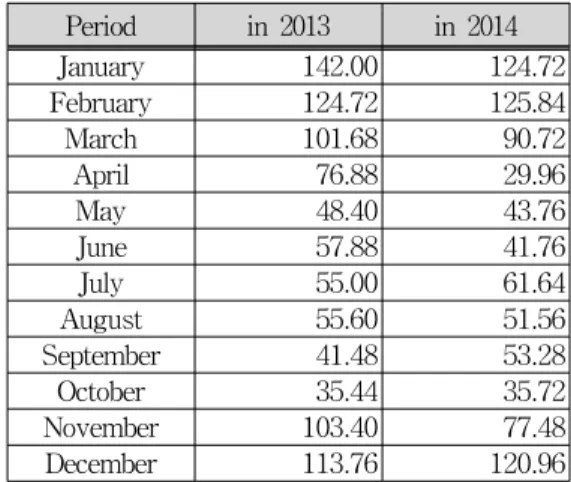
Analysis of peak power-cut effect about the proposed system is achieved 11.2% efficiency with 126kW in 2014 after system installation compared to 142kW in 2013 before system installation as shown in Table 2.
Period in 2013 in 2014
January 142.00 124.72
February 124.72 125.84
March 101.68 90.72
April 76.88 29.96
May 48.40 43.76
June 57.88 41.76
July 55.00 61.64
August 55.60 51.56
September 41.48 53.28
October 35.44 35.72
November 103.40 77.48
December 113.76 120.96
Table 2. The peak power statistics
4.2 Analysis of Power Usage
The Fig. 8 shows the result of the power usage
in 2013 and in 2014.
Fig. 8 The power usage comparison(2013 vs 2014)
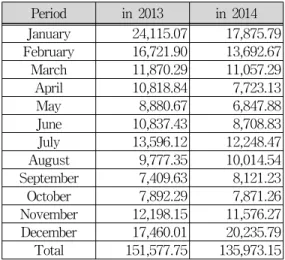
Analysis of electric power usage-cut effect about the proposed system is achieved 10.3% efficiency with 135,973kWh in 2014 after system installation compared to 151,578kWh in 2013 before system installation as shown in Table 3.
Period in 2013 in 2014
January 24,115.07 17,875.79 February 16,721.90 13,692.67
March 11,870.29 11,057.29
April 10,818.84 7,723.13
May 8,880.67 6,847.88
June 10,837.43 8,708.83
July 13,596.12 12,248.47
August 9,777.35 10,014.54
September 7,409.63 8,121.23
October 7,892.29 7,871.26
November 12,198.15 11,576.27 December 17,460.01 20,235.79 Total 151,577.75 135,973.15
Table 3. The power usage statistics
Ⅴ. Conclusion
Maximum peak power and electric power usage value management is significant to energy saving in building.
In order to achieve this, smart gateway with integrated interface and BEMS server with operating algorithm introduced. The results of energy saving effect is achieved 11.2% in
maximum peak and 10.3% in electric power usage.
The Research and Development(R&D) and pilot project of the building, factory, campus are being actively promoted. Even though reservation rate of electric power is not lack currently in 2015.
Although it is not covered in this paper, if renewable energy, ESS and Electric Vehicle(EV) operation technology is introduced in building, the effect of energy saving is maximum.
The more R&D will be needed to increase the efficiency of equipment and reinforce pre-verification of EMS introduction in the view of economics in the future.
감사의 글
본 논문은 한국전자통신학회 2015년 봄철국제학술대 회 우수논문으로 선정되었습니다.
References
[1] Ministry of Trade, Industry and Energy, “The second energy basic plan,” Press Report, Jan.
2014, pp. 1-7.
[2] H. Lee, H. Lee, and H. Shin, “A Study on Ubiquitous Sensor Network Technologies,” J.
of the Korea Institute of Electronic Communication Sciences, vol. 4, no. 1, 2009, pp. 68-74.
[3] C. Ryu, and C. Park, “A Novel Clustering Method with Time Interval for Context Inference based on the Multi-sensor Data Fusion,” J. of the Korea Institute of Electronic Communication Sciences, vol. 8, no. 3, 2013, pp.
397-402.
[4] G. Yoon, “Trends and implications of The world energy efficiency,” Energy Focus, vol.
12, no. 1, 2015, pp. 44-66.
[5] J. Koo, “Power economics review,” Kepco Economy and Management Research Institute, no.
12, Apr. 2015, pp. 2-6.
[6] K. Pak, “Implement of a Watt-Hour Meter
Monitoring System using Powerline
Communication,” J. of the Korea Institute of
Electronic Communication Sciences, vol. 8, no. 8,
2013, pp. 1143-1148.
[7] Y. Ko, “A Study on Design Methodology of the Advanced Home Automation System,” J.
of the Korea Institute of Electronic Communication Sciences, vol. 8, no. 12, 2013, pp. 1857-1864.
[8] H. Kang, J. Park, J. Park, and D. Kang, “A study on integrated gateway for interface and building energy management method,” Conf.
of the Korean Institute of electrical engineers, May. 2013.
[9] J. Kim, and J. Heo, “Building energy management policy and technology trends,” J.
of National IT industry promotion agency, no 1655, July. 2014, pp. 2-11.
[10] M. Son, and Y. Kim, “A Study on Hierarchical Communication Method for Energy Efficiency in Sensor Network Environment,” J. of the Korea Institute of Electronic Communication Sciences, vol. 9, no. 8, 2014, pp. 889-898.
[11] S. Lee, “Building energy management industry promotion plan”, Policy Issue Paper, Korea Energy Economics Institute, Nov. 2013, pp.
1-3.
[12] K. Nam, “A Study on the Office Management Service Platform based on M2M/IoT,” J. of the Korea Institute of Electronic Communication Sciences, vol. 9, no. 12, 2014, pp. 1405-1414.
[13] J. Jang, K. Lee, and Y. Kim, “Design and Implementation of Standby Power Control Module based on Low Power Active RFID,” J.
of the Korea Institute of Electronic Communication Sciences, vol. 10, no. 4, 2015, pp. 491-498.
저자 소개
강현준(Hyun-jun Kang)
2001년 군산대학교 정보통신공학과 졸업(공학사)
2007년 한국산업기술대학교 대학원 전자공학과 졸업(공학석사)
2015년 전남대학교 대학원 전자통신공학과 박사과정 2004년 ∼현재 한전KDN 전력IT연구원 과장
※ 관심분야 : 스마트그리드, 정보통신
박재현(Jae-hyun Park)
1993년 ∼현재 한전KDN 전력IT연 구원 판매IT연구팀장
※ 관심분야 : 판매IT, EV 충전인 프라
박종태(Jong-tae Park)
1996년 인천대학교 전자공학과 졸 업(공학사)
2010년 헬싱키대학교 대학원 경영 학과 졸업(경영학석사)
2015년 전남대학교 대학원 정보보안학과 박사과정 1996년 ∼현재 한전KDN 전력IT연구원 선임연구원
※ 관심분야 : 판매IT, 정보보안
김천석(Chun-suk Kim)