논문 2011-6-23
중인터페이스를 가진 이동 IP 라우터를 이용한 해안 지역 통신 서비스 방안
Scheme for Communication Service in Coastal Area Using Mobile IP Router with Multiple Interfaces
박천관*
Chun-Kwan Park
요 약 최근 연안지역에 선박 통항량
,
다양한 양식업,
어로,
그리고 레저 활동이 증가하고 있어,
이에 따라 안전한 항 해 통신 정보를 위한 다양한 통신 서비스가 요구되어 왔다.
본 논문은 다중 인터페이스를 가진 이동IP
라우터를 이용 한 해안 지역에서 통신 서비스 지원 방안에 관한 것이다.
이를 위하여,
이 시스템은 선박에게 다양한 통신 서비스를 제공할 수 있는WiBro, HSDPA,
그리고WLAN
와 같은 무선 인터페이스를 가지고 있어,
해안을 따라서 설치된 무선망 을 통하여 선박에게 다양한 정보통신 서비스를 실시간으로 제공할 수 있다.
따라서 이 시스템은 공인된 끊김 없는 정 보 통신 서비스를 제공할 수 있는 인프라를 제공할 수 있다.
Abstract These days as there are growing the number of vessel sailing, diverse aquaculture industries, fishing works, and leisure activities in coastal area, the diverse communication services have been required for secure voyage information. This paper addresses the scheme for costal area service using mobile IP router with multiple interfaces. For this, this system has the wireless interfaces, such as WiBro, HSDPA, and WLAN that can provides vessels with divers communication services, and can provide the vessels with the diverse information communication services in real-time through wireless communication network installed in costal area. So this can provide the infrastructure that supplies the authorized seamless information communication services.
Key Words : Multihoming, NEMO, Maritime, WiBro, HSDPA
*종신회원, 국립목포해양대학교 접수일자 2011.11.22, 수정완료 2011.12.10 게재확정일자 2011.12.16
Ⅰ. Introduction
These days there are the growing number of activities in coastal area, such as vessel sailing, diverse aquaculture industries, fishing, and leisure activities.
With the development of new vessel transportation system, the voyage and communication equipments have been accommodating into vessel, and then the newest communication technologies between ships, and
between ship and shore, have been developed and accommodated into vessel.
To secure vessel's safety and provide the related supplementary services, it is necessary to exchange information efficiently between ships and between ship and shore. So it is important to install the standardized voyage and communication equipments and the infrastructure, and develop the diverse applications.
And it is necessary to develop the software that can
analyze information and provide the results to the
integrated voyage and communication equipments, and
the marine situation recognition, and then develop the communication infrastructure for the efficient information exchange. So it is necessary to provide the infrastructure for the authorized seamless information exchange between ships, between ship and shore, and between persons concerned in land institutes.
it is necessary to introduce the land wireless communication networks, such as WiBro, CDMA, HSDPA, and TRS, which can provide the diverse communication services in coastal area. Especially, through the diverse functions using wireless communication network technologies in coastal area, it is necessary to prepare the service expansion in future.
This paper addresses the scheme for communication service in coastal area service using mobile IP router with multiple interfaces. For this, this system has land wireless communication interfaces that can provides vessels with the divers communication services. This can provide the diverse multimedia information by using newest technologies, such as WiBro, HSDPA, and WiFi.
This paper is organized as the follows. Section Ⅱ discusses GMDSS in marine communication network and wireless communication technologies. Section Ⅲ addresses the configuration of coastal communication network and the protocol of mobile IP router for coastal area communication. Section Ⅳ provides test scheme for mobile router in coastal area. Section Ⅴi gives some insight in the future prospect of this field and concludes this paper.
Ⅱ. Marine communication network
Maritime communication network consists of diverse parts, such as within ship, between ships, and between ship and shore. So it can be done through HF, satellite and wireless networks and then provide a comprehensive, world-wide communications solution for adverse vessels, such as cargo ships, fishing ships, boats, passenger ship, cruise ship, and yachts
[1][2][3]. Maritime communication network has used technologies for
mainly the long distance communication using HF and satellite. Those technologies relies on mainly the voice communication. Recently, vessels starts to use the land wireless communication technologies, such as WiBro, HSDPA, CDMA, and WiFi to provide the diverse communication services in coastal area. So in the future, the rapid growth of a radio wave will continue to develope the maritime communication diversly.
GMDSS (Global Maritime Distress and Safety System) is the international radio safety system mandated by the IMO (International Maritime Organization) for ship at sea. In late 1990, it was enforced base on the system that integrates the diverse communication equipments into one to improve the emergency communications for the world's shipping industries. These days IMO has established E-Navigation policy to install ITS(Intelligent Transport System) that can accommodate data and multimedia information using the communication network like AIS(Automatic Identification System). Figure 1 shows GMDSS Concept.
Fig. 1. GMDSS Concept[5][6]
그림 1. GMDSS 개념[5][6]
GMDSS defines four sea areas based on the location
and capability of shore based communications facilities
in <table 1>. As maritime communication has to allow
all vessels in the world to communicate with one in any
location in the world, The more distance the ship goes
across the sea from costal area, the more diverse
communication equipments the ship needs. IMO
classifies the sea into A1, A2, A3, and A4 like <table
1>. A1 and A2 are the coastal area of each country.
And the diverse vessels, such as fishing ships, boats, passenger ship, cruise ship, and yachts, sail along those areas. A3 and A3 are an ocean. In those areas, the international vessels voyage sea far from land. the vessels use the maritime communication equipments using HF bandwidth and satellite. the satellite communication has high reliability, but it's cost is very high. HF signal is greatly influenced by the air signal propagation condition. the radio wave is also influenced by many factors, such as sunspots, solar flares, and the time of day. So communication equipments has low reliability because of natural factors.
Table 1. Coverage of maritime communication network
표 1. 해양 통신망의 범위
Area Description Equipments
A1
Within VHF range of Coast stations fitted with DSC (Digital Selective Calling)
VHF, VHF DSC, VHF SOC exclusive receiver, satellite EPIRB
A2
Within MF range of Coast Stations fitted with DSC (Excluding A1)
A1, MF, MF DSC, MF DSC exclusive receiver, NAVTEX receiver, RADAR Transponder, Two-Way VHF
A3
Within the area covered by INMARST Satellite System (Excluding A1 and A2)
A1, MHF NBDP, MHF DSC, MHF DSC exclusive receiver, NAVTEX receiver, RADAR Transponder, Two-Way VHF, INMARSAT Type C
A4
Polar Regions (above 70o N and below 70o S)(Excluding A1, A2, and A3)
same as A3
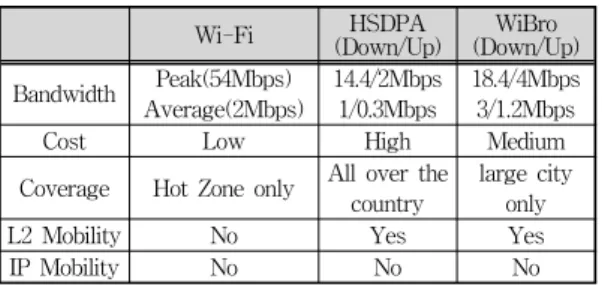
Table 2 shows wireless Internet services. These are Internet access services which WiBro, HSDPA, and Wi-Fi can be used commercially.
Wi-Fi HSDPA
(Down/Up) WiBro (Down/Up) Bandwidth Peak(54Mbps)
Average(2Mbps)
14.4/2Mbps 1/0.3Mbps
18.4/4Mbps 3/1.2Mbps
Cost Low High Medium
Coverage Hot Zone only All over the country
large city only
L2 Mobility No Yes Yes
IP Mobility No No No
Table 2. Wireless Internet Service 표 2. 무선 인터넷 서비스
Wi-Fi rate is 54Mbps, but actually it is 2Mbps.
HSDPA Maximum Speed is 14Mbps(downstream)/
2Mbps(upstream), but actually it is 1Mbps(downstream) /0.3Mbps(upstream). WiBro can be used only in the metropolitan area. it's rete is 18Mbps(downstream) /4Mbps(upstream), but actually it is 3Mbps(downstream) /1.2Mbps(upstream). HSDPA and WiBro provides layer 2 mobility, but doesn't provide IP mobility. Layer 2 mobility has to provide IP mobility for the seamless IP services. Mobile terminal uses the same IP address through IP mobility.
Ⅲ. Coastal Communication Network using mobile IP Router
Maritime communication has used HF, satellite and wireless networks. In coastal area, it is necessary to introduce the land wireless communication networks, such as WiBro, HSDPA, CDMA, TRS, and WiFi, which can provide the diverse communication services. As these have the limitation for communication coverage like <table 2>, it can't cover all area of sea. But it is possible to apply these in coastal area (A1, A2) by using their advantages, such as high bandwidth, real-time communication, and verified services in land.
Figure 2 shows the communication network for coastal area. This uses the mobile routers having the diverse uplink/downlink interfaces.
Fig. 2. Communication network in costal area 그림 2. 해안지역 통신망
The base stations for wireless communication
networks installed along with costal area can be used efficiently. In the case of wireless mesh network, if the normal communication were not done because of link failure or traffic congestion which are often occurred in sea, the automatic network recovery technology has to be introduced to find the optimum new path in the current network configuration. So mobile router has to have the many kind of communication modules, such as Wibro, HSDPA, CDMA, WiFi, and satellite.
In this network, mobile router has the diverse functions, such as Internet connection function, multihoming function, network mobility, and load balancing function. Of many wireless services, WiBro and HSDPA are high-speed wireless Internet services, and allow to connect Internet while moving. Mobile router allows WLAN terminals to connect to Internet through WiBro or HSDPA service by interworking with WiBro or HSDPA base station. So it has Wibro, HSDPA, and WLAN interfaces for upstream, and WLAN and Ethernet interfaces for downstream.
Mobile router can provides multihoming technology that selects the stable path and transfers the traffics through that path by supporting both WiBro and HSDPA simultaneously. In the case of the handover situation, mobile router guarantee that all terminals can receive the seamless services through NEMO(Network Mobility) technology. So it can guarantee service stabilization and mobility.
Fig. 3. Mobile router in costal 그림 3. 해안지역에서 이동 라우터
Figure 4 shows the protocol stack for mobile IP router necessary for coastal area. In this stack, this is the protocol that includes network mobility, multihoming, policy routing, energy control, and security. Cross layer manages QoS(Quality of Service), energy control for saving energy, and security over all levels.
Fig. 4. Mobile Router Protocol Stack 그림 4. 이동 라우터 프로토콜 스택
Ⅳ. Test Scheme for mobile router in Coastal Area
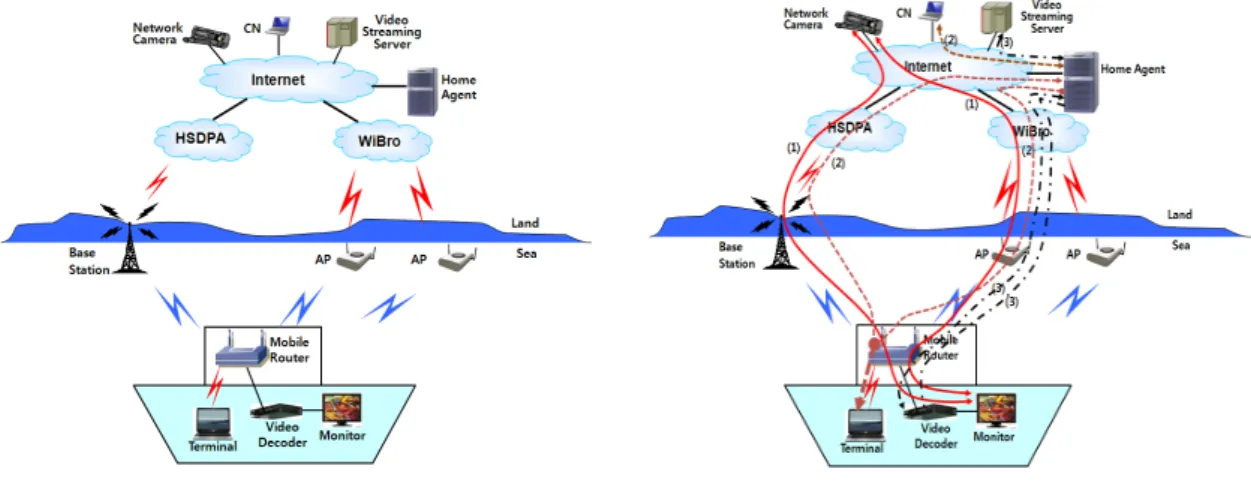
Figure 5 shows the test scheme for mobile router in costal. As mobile router has the diverse functions, such as multihoming, network mobility. it is necessary to perform these functions in coastal area. Multihoming can be used to support the many functions, such as multilink configuration, protection of link failure, and load sharing.
Fig. 5. Test Network Configuration 그림 5. 시험망 구성
In this figure, (1) shows multilink using both WiBro and HSDPA links. if there is failure on the current active link, the active link is switched to other link for continuous service. And the dynamic load sharing function can be done through these multilink configuration. For load sharing, HA(Home Agent) can apply the filtering policy to downstream traffics based on traffics and link state. And mobile router also can apply the filtering policy to upstream traffics. (2) Mobile router allocates the bandwidth dynamically using both WiBro and HSDPA links. So it can adjust the bandwidth according to the situation. (3) Mobile router can expand the bandwidth using tunnel technology. HA has to have many functions, such as the traffic distribution, dynamic bandwidth allocation, the function to accommodate and manage the mobile routers, and the function to manage the virtual interface like tunnel.
Figure 6~9 shows FTP test results for mobile router.
FTP protocol is used to test the performance of mobile router. Figure 6 is FTP performance for delay. This shows that FTP bandwidth is sensitive to delay because the more delay there is on link, the less data can be transferred on that link.
Figure 7 is FTP performance for loss. This shows that if the data loss exceeds about 1%, FTP bandwidth is declined greatly, but if the loss in ACK (Acknowledgement) packet is within about 10%, it has no effect on FTP bandwidth.
Figure 8 is FTP performance for duplicated packets.
if the duplicated packets exceeds about 2%, FTP bandwidth is declined greatly, but if the duplicated ACK packets have no effect on FTP bandwidth. As the duplicated packets are generated by the retransmission of packet. it has an effect on FTP performance.
Figure 9 is FTP performance for delay when bandwidth is 4Mbps. There are data losses because the 4Mbps bandwidth is enough to transfer TCP traffics. In this case, the delay and link bandwidth have an effect on FTP performance. This must be window size.
Fig. 6. FTP Performance for delay 그림 6. 지연시간에 대한 FTP 성능
Fig. 7. FTP Performance for loss 그림 7. 손실에 대한 FTP 성능
Fig. 8. FTP Performance for Duplicated packets 그림 8. 중복된 패킷에 대한 FTP 성능
Fig. 9. FTP Performance for delay(bandwidth : 4Mbps)
그림 9. 지연시간에 대한 FTP 성능(4Mbps 대역폭)
![Fig. 1. GMDSS Concept [5][6]](https://thumb-ap.123doks.com/thumbv2/123dokinfo/5413473.423432/2.799.418.711.578.814/fig-gmdss-concept.webp)