*준회원, YJsystem 소프트웨어
**준회원, 한국전파진흥협회
***정회원, 광운대학교 전파공학과(교신저자) 접수일자 2010.6.07 수정일자 2010.10.10 게재확정일자 2010.12.15
논문 2010-6-5
다중전송률 다중반송파 DS/CDMA 시스템을 위한 비상관기의 성능
Performance of Decorrelator for Multirate Multicarrier DS/CDMA System
이석현*, 이소영**, 김진영***
Seok-Hyun Lee, So-Young Lee, Jin-Young Kim
요 약 본 논문은 다중전송률 다중사용자 다중반송파 DS/CDMA 시스템에 대한 역상관 검출기의 특성을 분석하고, 주파수 선택 레일레이 페이딩 체널에서 시뮬레이션하였다. 비트 오류 확률에 대한 성능을 단일 전송률 MC-DS/CDMA 시스템과 비교하였다. 다중전송률 송신구조로써 가변확산길이가 MC-DS/CDMA 시스템에 사용되었다. 시뮬레이션 결 과, 다중전송률 MC-DS/CDMA의 역상관기는 단일 전송률 시스템에 비하여 높은 BER 성능을 나타내었다.
Abstract In this paper, a performance of a decorrelating detector for a multirate MC(multi-carrier) DS/CDMA system is analyzed and simulated in a frequency selective Rayleigh fading channel. The performance is compared with that of single rate MC-DS/CDMA system in term of bit error probability. Variable Spreading Length (VSL) is employed for MC-DS/CDMA system as multirate transmission scheme. From simulation result, it is shown that Decorrelator for multirate MC-DS/CDMA achieves high BER performance as well as that of single rate case.
Key Words : Decorrelator, Multicode(MC) access, Multicarrier DS/CDMA, Variable spreading length(VSL), OFDM
Ⅰ. Introduction
4G wireless communication system may support various service such as data, voice and video. To transmit these various service, multirate transmission and large bandwidth are required[1].
Multicarrier DS/CDMA which is a combination of OFDM and CDMA scheme is expected to support 4G communication system[1]. The entire bandwidth of the
multicarrier CDMA system is divided into equi-width frequency bands. And then each carrier frequency which is orthogonal each other in term of frequency domain is modulated by spreading sequence with a chip duration which is times as long as that of a single-carrier CDMA system.
By combing decorrelating detector and multicarrier DS/CDMA system, the complexity of decorrelating detector is reduced. And also the robustness to partial narrow band interference since a multicarrier system has a narrowband interference suppression effect[2-4]. The multirate signals cause MAI to the other user due to their different signal energy services. To support a
multimedia service, multirate system is essential requirement. There are two widely used multirate system strategies such as multicode access (MC) and variable spreading length(VSL) access. In this paper a VSL scheme is employed by several spreading codes to distinguish each user with constant chip rate.
In this paper, decorrelating detector for multirate multicarrier DS/CDMA system with VSL algorithm is analyzed and simulated in frequency selective Rayleigh fading channel. By using VSL algorithm to multicarrier DS/CDMA decorrelating detector, we can support multirate transmission to multicarrier DS/CDMA system. And also maintain the complexity of the conventional multicarrier DS/CDMA decorrelator. This paper is organized as follows. In section Ⅱ, system model and channel model are analyzed. In section Ⅲ, performance analysis is described. In section Ⅳ, numerical and simulation results are presented. Finally, we conclude in section Ⅴ.
Ⅱ. System Model
In this section, the proposed transmitter, receiver and channel model are described. And in this paper, users are considered and Synchronous multicarrier DS/CDMA system and BPSK data modulated transmission are assumed.
1. Transmitter Model
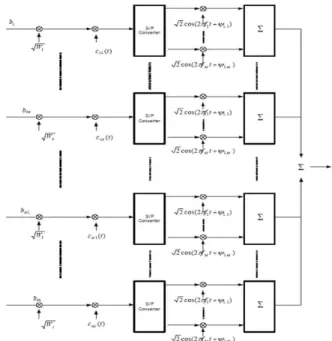
The fig. 1 shows a block diagram of a proposed transmitter. The two rate, high and low, BPSK-modulated signals of low rate user, , and
high rate user, , are spreaded by different length of spreading code, , , each other.
그림 1. 제안된 다중전송률 다중사용자 다중반송파 DS/CDMA 검출 송신기 블록도
Fig. 1. Block diagram of the proposed multirate multiuser multicarrier DS/CDMA detector transmitter.
The chip rate of the low rate data is denoted and the chip rate of the high rate data is denoted . It is assumed that the high rate is 2 times of the low rate.
And is assumed. So each user has a same rate, different signature waveform. After spreading, each spread signal is serial to parallel converted. And the signals are modulated by multicarrier. And then are transmitted. The transmitted signal is given by
cos
cos (1)
where is total number of users, is total number of the low rate users, and are transmit power of low rate user, high rate user. So low rate carrier frequency is modulated by a spreading sequency with chip rate . And the low high rate carrier frequency is modulated by a spreading
sequency with the chip duration which is times as long as that of a single carrier system.
2. Channel Model
In this paper, a slow frequency selective Rayleigh fading channel model is used. We denote that its delay spread, the chip duration of proposed detector and the chip duration of the conventional single carrier decorrelating detector are , and ′ ( · ′).
For the conventional single carrier decorrelating detector, the frequency selective fading channel for the
user can be represented as a tapped delay line. The number of resolvable paths in hat model is given by
⌊′⌋ , (2)
where ⌊⌋ is the integer part of . The complex lowpass equivalent impulse response of the channel of the user is given by
′ , (3)
where and are modeled as zero-mean complex valued stationary Gaussian random variable and uniform random variable over .
For proposed detector, the coherence bandwidth of the channel model is given by
∆≈
, (4)
Providing that the number of subband multicarrier,
, meets the following condition,
· ′
≤ , (5)
Each subband of the proposed detector has no
selectivity, and besides, if bandwidth of each subband is larger than the coherence bandwidth, all sub-bands are subject to independent fading[1].
Then, the complex lowpass equivalent impulse response of the subcarrier channel of user is given by
⋯. (6)
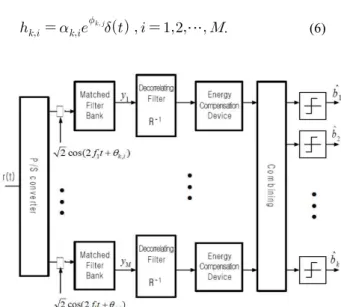
그림 2. 제안된 다중사용자 검출 수신기 블록도
Fig. 2. Block diagram of the proposed multiuser detector receiver.
where and are i.i.d Rayleigh random variable with a unit second moment and i.i.d uniform random variable over .
3. Receiver Model
The received signal is given by
cos
cos .
(7)
where , , is AWGN with a variance and double-sided power spectral density of
, and is partial narrow-band interference with a p.s.d (power spectral
density) of .
Fig. 2 shows a block diagram of the proposed receiver. The received signal is parallel to serial converted and then coherently demodulated for each carrier and passes through the matched filter bank. Its outputs are decorrelated by decorrelating filter. And each decorrelated signals are processed at the energy compensation device.
Ⅲ. Performance Simulation
To analyze a performance of the proposed detector in term of BER (Bit error rate), followings are assumed.
1) perfect carrier, code and bit synchronization.
2)
is integer where is the bit interval of the low rate user and is the bit interval of high rate user.
According to VLS access, in the interval , each high rate user is equivalent to "virtual low rate users"at the receiver. The other words, when the received signals which have difference spreading code length (low and high) are despread each other at the receiver, the high rate user who has M times bit rate of the low rate user’'s one can be considered as M virtual low rate users. Therefore, the spreading sequences for the m th virtual user of high rate user can be represented by
for ≤ ≤
, (8)
The total number of the user can be represented as
, (9)
where is a number of the low rate users and
is a number of the high rate users. The matched filter out put for subband carrier branch is given by following matrix form,
, (10)
where
(11)
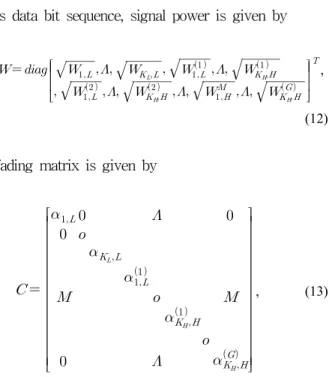
is data bit sequence, signal power is given by
,
(12)
fading matrix is given by
, (13)
the cross correlation matrix of normalized signature waveform is given by,
(14)
where, and is Gaussian zero-mean vector with covariance matrix equal to
.
The matched filter outputs pass through the decorrelating filter to reduce MAI by matrix inversion.
The output of the decorrelating filter for the ith subband carrier branch, it is assumed that " user"
can mean either high rate user data or low rate user data, is given by
, (15)
where the noise vector is Gaussian zero-mean with covariance matrix .
From [1], the probability of the the user is obtained as
∞
, (16) where
∞
. From [1], and the p.d..f of is given by
, (17)
where, is i.i.d Rayleigh random variable and
is the moment-generating function of ,
. (18)
Ⅳ. Simulation
In this section, for simulation example, the number of low rate users are and high rate users are
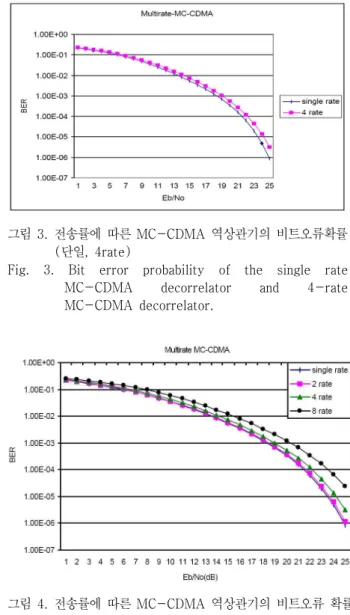
. In fig. 3, BER of the proposed detector and the conventional single rate decorrelating detector are compared under a frequency selective Rayleigh fading channel. The proposed multirate decorrelating detector
as a equivalent performance to conventional single rate decorrelating dtector.
It verify that the proposed decorrelating detector can be used at multirate transmission systems. In this simulation, a 4 rate user who has a 4 times spreading code as fast as basic rate user has 4 virtual users.
그림 3. 전송률에 따른 MC-CDMA 역상관기의 비트오류확률 (단일, 4rate)
Fig. 3. Bit error probability of the single rate MC-CDMA decorrelator and 4-rate MC-CDMA decorrelator.
그림 4. 전송률에 따른 MC-CDMA 역상관기의 비트오류 확률 (단일, 2rate, 4rate, 8rate)
Fig. 4. Bit error probability of the single rate 2-rate 4-rate and 8-rate MC-CDMA decorrelator.
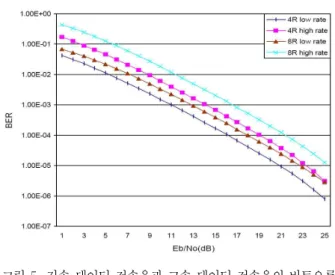
In fig. 4, BER of proposed decorrelating detectors which have difference rates each other is compared. By increasing the number of virtual users, the performance of the system is decreased. In other words, the system performance is depend on a gap of rate between low
rate data and high rate data.
그림 5. 저속 데이터 전송율과 고속 데이터 전송율의 비트오류 확률
Fig. 5. Bit error probability of low rate data and high rate data.
In fig. 5, BER of low rate data and high rate data is compared under the same rate and same the number of users. The high rate users data have more bad influence than low rate users data when they are transmitted simultaneously.
Ⅴ. Conclusions
The new multirate decorrelating detector combining multicarrier CDMA was proposed and analyzed in term of BER performance in a frequency selective Rayleigh fading channel. The proposed multirate decorrelating detector has equivalent system performance to single rate decorrelating detector. So, the proposed decorrelating detector can be considered as promising a multirate multi users detection scheme. But when the gap of the rate between low rate data and high rate data is increased, there is a problem which the complexity of the decorrelating detector also increased.
The one of the future works of this research can solve this problem.
References
[1] W. Choi, C. Lee, and J. Y. Kim, "Multiuser detection with multicarrier transmission for a DS/CDMA system in a multipath fading channel"in Proc. of IEEE PIMRC '2000, vol. 1, pp. 124-128, Sep. 2000.
[2] S. Moshavi, "Multi-user detection for DS/CDMA communications," IEEE Commun.
Mag., vol. 34, no.10, pp.124-136, Oct. 1996.
[3] S. Kondo and L.B. Milstein, "Performance of multicarrier DS CDMA systems," IEEE Trans.
Commun., vol.44, no.2, 1996, pp.238-246.
[4] J. Y. Kim and J. H. Lee, "Performance of a multirate DS/CDMA system with multiuser detection," IEEE MoMuC '97, Seoul, Korea, Sep. 1997, pp.138-142.
[5] S. Verdu, Multiuser Detection, 1st ed., Cambridge University Press, 1998.
[6] S. Verdu, "Minimum Probability of Error for Asynchronous Gaussian Multiple-Access Channels,"IEEE Trans. Inform. Theory, vol. 32, no. 1, pp. 85-96, Jan. 1986.
[7] R. Lupas and S. Verdu, "Near-far resistance of multiuser detectors in asynchronous channel,"
IEEE Trans. Commun., vol. 38, no. 4, pp.
496-508, Apr. 1990.
[8] U. Fawer and B. Aazhang, "A multiuser receiver for code division multiple access communications over multipath channels,"IEEE Trans. Commun., vol. 43, no. 2, pp. 1556-1565, Feb./Mar./Apr. 1995.
[9] M. K. Varanasi and B. Aazhang, "Multistage detection in asynchronous code division multiple access communications," IEEE Trans.
Commun., vol. 38, no. 4, pp. 509-519, Apr. 1990.
[10] T. Ottosson and A. Svensson, "Multi-rate schemes in DS/CDMA systems," in Proc. of IEEE VTC , vol. 2, pp. 1006-1010, Chicago, IL, U.S.A., July 1995.
[11] S. Kondo and L. B. Milstein, "On the use of
※“이 논문은 2010년도 정부(교육과학기술부)의 재원으로 한국연구재단의 지원을 받아 수행된 기초연구사업 연구임”(No. 2010-0022629)
저자 소개 이 석 현(준회원)
∙2001년 서울산업대학교 전자공학부 학 사 졸업
∙2004년 광운대학교 전파공학과 석사졸 업
∙2010년 현재 YJsystem 선임연구원
<주관심분야 :이동무선통신, 임베디드 시스템, 단말기 S/W 개발>
이 소 영(준회원)
∙2004년 광운대학교 전자공학부 학 사 졸업.
∙2010년 광운대학교 전파공학과 공 학석사
∙2010년 7월~현재 한국전파진흥협회
<주관심분야 : 이동무선통신, 인지라 디오, 협력통신>
김 진 영(정회원)
∙1998년 서울대학교 전자공학과 공학박 사
∙2000년 미국 Princeton University, Research Associate
∙2001년 SK 텔레콤 네트워크연구원 책 임연구원
∙2009년 미국 M.I.T 공대 Visiting Scientist
∙2010년 현재 광운대학교 전파공학과 교수
<주관심분야 : 디지털통신, 무선통신, 채널부호화>
multicarrier direct sequence spread spectrum systems," in Proc. of IEEE MILCOM 93, pp.
52-56, Boston, MA, Oct. 1993.
[12] M. Juntti, "System concept comparisons for multirate CDMA with multiuser detection," in Proc. of IEEE VTC, vol. 1, pp. 36-40, 1998.