1. INTRODUCTION
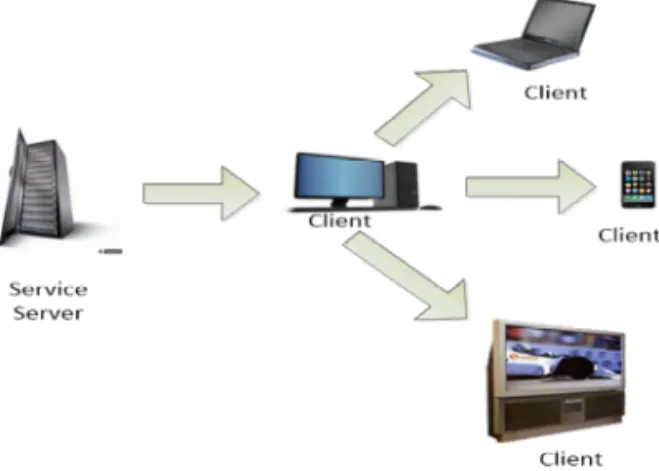
N-screen is an emerging technology and de- mand of future to support multimedia multicasting, content sharing, content mobility, media scal- ability, media synchronization, and seamless mobi- lity. P2P streaming technology is mainly used as the technology that uses service network effi- ciently, and adaptive streaming technology is mainly used as the technology that ensures seam- less video streaming. As shown in Fig. 1, P2P streaming is not the technology that receives serv- ice content from server, but the technology that re- ceives service content from close client. P2P streaming technology has the disadvantage that it
uses the resource of user’s device and network, but it has the advantage that provides a better quality of service by reducing the server load and network costs. In addition, because the most P2P streaming technology measures user’s resource in advance, users do not interfere with the use of their devices [1-2].
The WiMedia Alliance has specified a Distribut- ed Medium Access Control (D-MAC) protocol based on UWB for High-Rate WPANs [3-4]. The WiMedia D-MAC supports a distributed MAC approach. In contrast to IEEE 802.15.3, D-MAC makes all devices have the same functionality, and networks are self-organized and provide devices with functions such as access to the medium,
Distributed Medium Access Control for N-Screen Multicast Services in Home Networks
Kyeong Hur
†ABSTRACT
N-screen is an emerging technology to support multimedia multicasting, content sharing and content mobility. N-screen service providers should obtain the technology that provides the highest quality content seamlessly. Distributed nature of WiMedia distributed-MAC protocol can provide full mobility support, and achieves seamless medium access method in contrast to IEEE 802.15.3. So, in this paper, WiMedia distributed-MAC protocol is adopted and an asynchronous multicast transmission (AMT) technology is proposed to enhance performance of seamless N-screen wireless service based on distributed-MAC.
The ACK frame transmissions are not required for multicast transmissions. By using this property in AMT, if a device is a multicast receiver, its reserved time slots can be reserved by the other devices with 1-hop distance. Furthermore, each N-screen device broadcasts and shares the information including an order in asynchronous traffic reservations to reduce conflicts in determining the transmission order of asynchronous N-screen packets. Therefore, AMT scheme expands the number of time slots available and throughputs for multicast and asynchronous traffic reservations when comparing with the distributed-MAC standard system. N-screen communications based on distributed-MAC with the proposed AMT shows a new framework for realizing N-screen wireless service with the full content mobility.
Key words: Home Networks, Distributed MAC, N-screen, Multicast
※ Corresponding Author : Kyeong Hur, Address: (407- 753) Gyesan-Dong San 59-12, 45 Gyodae-Gil, Gyeyang- Gu, Incheon, Korea, TEL : +82-31-470-6292, FAX : +82-31-470-6299, E-mail : [email protected]
Receipt date : Oct. 12, 2015, Revision date : Nov. 10, 2015 Approval date : Nov. 25, 2015
†