반도체디스플레이기술학회지 제14권 제3호(2015년 9월)
Journal of the Semiconductor & Display Technology, Vol. 14, No. 3. September 2015.
23
Micro-crack Detection in Heterogeneously Textured Surface of Polycrystalline Solar Cell
JinSeok Ko, JaeYeol Rheem, Ki-Won Oh and Kang-Sun Choi
††
School of Electrical, Electronics, and Communication Engineering Korea University of Technology and Education.
ABSTRACT
A seam carving based micro-crack detection method is proposed which aims at detecting the micro-crack regions in heterogeneously textured surface of polycrystalline solar cells. By calculating the seam which is a connected path of low energy pixels in the image, the micro-crack regions can be detected. Experimental results show that the proposed seam carving based micro-crack detection method has superior efficiency in detecting the micro-crack without background noise pixels and the algorithm's computation time is less than the conventional algorithm.
Key Words : Solar cell, micro-crack detection
1. Introduction
Square wafers of polycrystalline solar cells are pre- ferred to round single-crystal wafers since polycrys- talline cells produce less waste of space or material due to their square shape. However, in order to obtain such square shape, polycrystalline solar cells made from silicon material are melted and poured into a mold. As the material cools, it crystallizes in an imperfect manner, forming random crystal bounda- ries as shown in Fig. 1. Polycrystalline solar cells have multiple heterogeneous grains of random shapes, sizes, and variations in direction and color on the surface. The white vertical and horizontal lines indicate finger patterns for electrical contacts.
In solar cell manufacturing field, “micro-crack” is one of critical category of defects. The micro-cracks occurring during solar cells and solar modules manu- facturing process lead to high recovery cost and reduction in production yield. This is the reason why micro-cracks should be detected automatically for production yield improvement and cost reduction.
However, the heterogeneous textured pattern of a polycrystalline solar cell makes the micro-crack
detection task extremely difficult [1]. Fig. 2 shows examples of micro-cracks on polycrystalline solar cells. The micro-crack has relatively lower intensity values than normal neighborhood. However, micro- crack decision based on only intensity values is easily failed as shown in the right image where the intensity values of the micro-crack on the vertical finger pat- tern is even higher than those of other normal regions.
In order to detect micro-cracks on the heterogene-
†E-mail : [email protected]
Fig. 1. Multi-grain solar cell surface images.
24 JinSeok Ko, JaeYeol Rheem, Ki-Won Oh and Kang-Sun Choi
반도체디스플레이기술학회지 제14권 제3호, 2015
ously textured surfaces, filtering-based approaches have been presented in the literature [1-5].
Tsai et al. introduced the anisotropic diffusion based micro-crack detection scheme, in which aniso- tropic model takes both gray-level and gradient as features to adjust the diffusion coefficients [1]. This is because the micro-crack has both low gray-levels and high gradients in the sensed image. The micro-crack regions will generate high diffusion coefficients, then it smoothes the suspected micro-crack regions and preserves the original gray-levels of the faultless regions. The micro-crack can be enhanced by sub- tracting the diffused image from the original image, then binarization by thresholding can segment the micro-crack regions.
The micro-crack in polycrystalline solar cell can occur in all directions. However, Tsai et al. diffusion model uses four neighbors in the north, south, east and west directions. It reflects the four neighbors' pixel information, but it cannot reflect the diagonal pixel information. Thus, in our previous study, we applied an extended kernel and fuzzy reasoning to anisotropic diffusion model [2-5]. However, these conventional algorithms cannot fully detect diagonal micro-cracks and noise pixels in the faultless region still remain after segmentation process [1-5].
In this paper, we presents a seam carving based micro-crack detection method for heterogeneously textured surface of solar cells, which successfully solve the problems occurring in the filtering-based approaches.
We define a novel energy function integrating two image features characterizing micro-cracks, such as
gray-level and gradient. Since the energy function can allow micro-cracks to be prominent, an optimal seam searched for by utilizing a dynamic programming is a candidate for a micro-crack. Compared to the con- ventional algorithms, the proposed algorithm shows superior efficiency in detecting the micro-cracks without noise pixels. In addition, the proposed algo- rithm’s computation time is much less than the con- ventional algorithms.
2. Proposed Algorithm
The seam carving algorithm was first introduced by Avidan and Shamir [6] and has been widely used for image retargeting [6-8]. A seam is a connected path of low energy pixels crossing the input image from top to bottom, or from left to right. Since the seam can be regarded as the least noticeable part in the image, a perceptually pleasing image of a smaller res- olution can be obtained by iteratively removing the seam from the image. In the seam carving algorithm, an energy function is used for indicating the impor- tance of pixels.
In the proposed seam carving based micro-crack detection method, both the gray-level and gradient are used together for calculating pixel energy. The micro-crack has both low gray-levels and high gradi- ents, while defect-free regions has only either low gray-levels or high gradients [1]. The polycrystalline solar cell consists of multiple grains, and thus, these features are essential for calculating energy. If the energy function uses only either gray-level or gradi- ent, the calculated energy has low discriminative power between the micro-crack and faultless back- ground. Therefore, we propose an energy function defined as follows:
(1)
where I is an m × n gray image, K is a regulariza- tion parameter and denotes gradient magnitude
. (2)
To detect micro-crack of vertical direction, the ver- e I ( ) I K
I
∇ --- +
=
I
∇ I
∇ ∂
∂x ---I ∂
∂y ---I +
= Fig. 2. Examples of micro-cracks on polycrystalline solar
cells.
Micro-crack Detection in Heterogeneously Textured Surface of Polycrystalline Solar Cell 25
Journal of KSDT Vol. 14, No. 3, 2015
tical seam s
xis defined as follows:
such that (3)
Therefore, pixels on vertical seam s are denoted
by The energy of a
seam is defined as E(s) = E(I
s) = and we look for the optimal seam s* that minimizes the seam energy:
(4)
The optimal seam can be found using dynamic pro- gramming. The first step is to traverse the image from top to bottom and compute the cumulative minimum energy M for all possible connected seams for each entry (i, j):
M( i, j) = e(i, j) + min (M(i−1, j−1),
M(i−1, j), M(i−1, j+1)). (5)
At the end of this process, the minimum value of the last row in M will indicate the end of the minimal connected vertical seam. Hence, in the second step we backtrack from this minimum entry on M to find the path of the optimal seam. The seam carving method backtracks the minimum energy M and this manner does not occur any noise pixel in faultless background. The process for detecting horizontal micro-crack is similar, and thus, the proposed method iterates 2 times.
Our approach to detect micro-crack in solar cell is to segment pixels in low-energy levels. To segment micro-crack, we look for both vertical and horizontal optimal seams because the micro-crack can occur in all directions. In order to segment micro-crack regions, we use the following equation.
(6)
where O is a micro-crack segmented image and T is a segmentation threshold.
3. Experimental Results
We use 27 micro-crack images of polycrystalline solar cells by a front LED illumination and a DALSA 4M15 area camera with a sensor size of 2048 × 2048.
The threshold T is determined by the calculated seams of both defective and defect-free images and T is set to 65. Regularization parameter K is set to 200 by experiment.
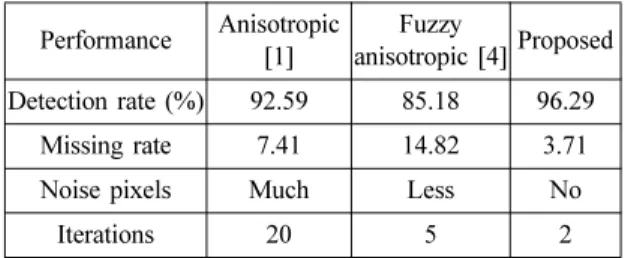
For the performance evaluation of the conventional and the proposed methods, we compare the detection rate and missing rate. Table 1 shows the results of micro-crack detection performances. The detection rate of the proposed method is of 96.26% and the missing rate is of 3.71%. This detection and missing results are superior to the anisotropic diffusion [1]
and improved anisotropic diffusion [4] based meth- ods. In addition, the proposed method is iterated 2 times for an input image to detect seams both vertical and horizontal directions. However, the number of iterations in conventional methods are 20 times and 5 times for the best detecting performances. This means that the proposed method's computation time is less than the conventional methods.
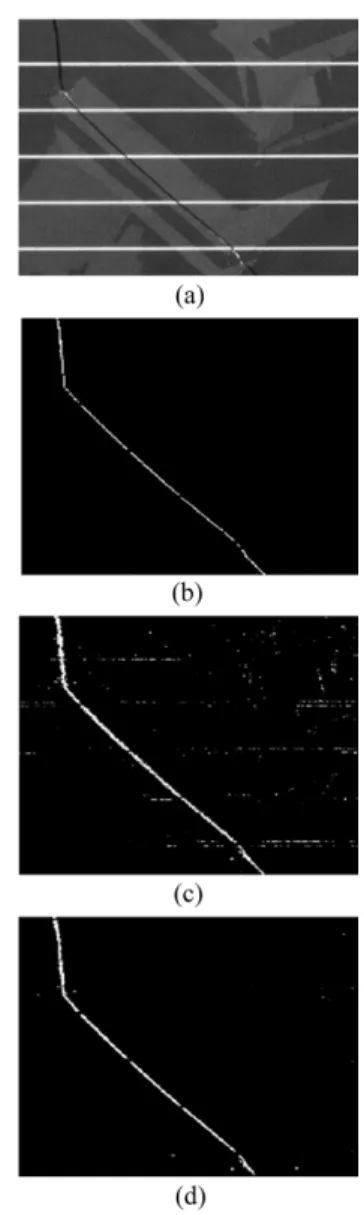
Figure 3 depicts the micro-crack detection results by the proposed method and conventional methods.
Fig. 3(a) shows the micro-crack of diagonal direction, Fig. 3(b) shows the result of proposed method. The results of conventional methods are shown in Figs.
3(c) and 3(d). In Fig. 3(b), there is only segmented micro-crack without noise pixel. In contrast, there are noise pixels in faultless backgrounds in Figs. 3(c) and 3(d). These noise pixels in faultless background can increase a false acceptance rate and this is why the proposed method is superior to the than the con- ventional methods.
s
x{ } s
ix i 1n=x i ( ) i , { }
i 1n=,
= =
i x i , ( ) x i 1 – ( – ) ≤ 1.
∀
I
s= { } Is
ix i 1n== { Ix i ( ) i , }
i 1n=,
Σ
i 1n=e I s ( ( )
i)
s*=arg minE s ( )
=arg min Σ
s i 1n=e I s ( ( )
i).
s
O i, j ( ) 255, if M i j ( )<T, , 0 otherwise. ,
⎩ ⎨
= ⎧
Table 1. Micro-crack detection performance.
Performance Anisotropic [1]
Fuzzy
anisotropic [4] Proposed Detection rate (%) 92.59 85.18 96.29
Missing rate 7.41 14.82 3.71
Noise pixels Much Less No
Iterations 20 5 2
26 JinSeok Ko, JaeYeol Rheem, Ki-Won Oh and Kang-Sun Choi
반도체디스플레이기술학회지 제14권 제3호, 2015