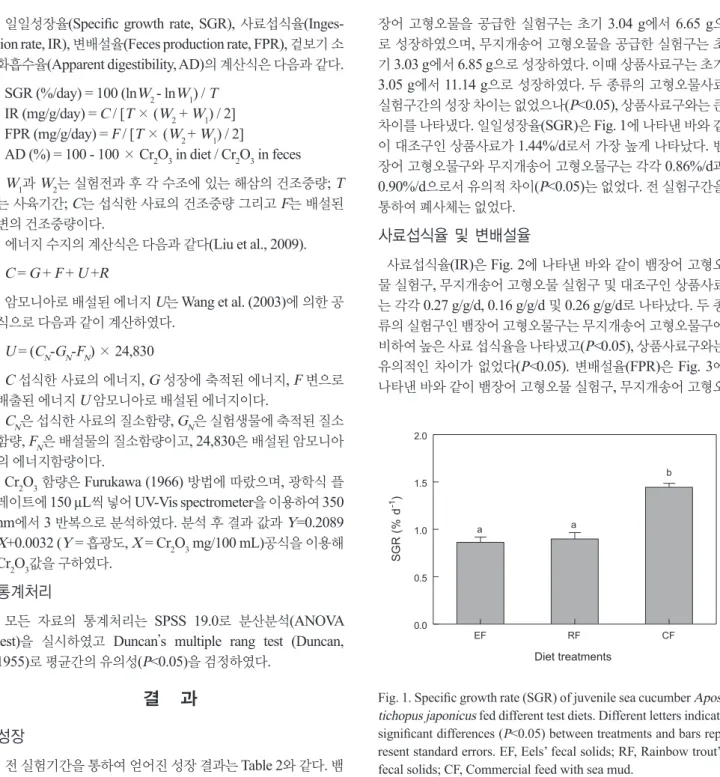
한수지 49(2), 168-175, 2016
168
Copyright © 2016 The Korean Society of Fisheries and Aquatic Science pISSN:0374-8111, eISSN:2287-8815 Korean J Fish Aquat Sci 49(2),168-175,2016
Original Article
서 론
해삼
(Apostichopus japonicus)
은바다의인삼으로불리며기 능성극피동물로서우리나라를비롯한중국과일본등동양권 에서큰시장을형성하고있는양식생물이다(Park et al., 2015).
해양수산부에서는수출
10
대전략품종의하나로선정하였으 며,
일부광역자치단체에서도미래양식전략대상종으로선정 하고대량생산을위한투자계획을밝히고있다(Kang et al., 2012).
해삼의 식성은 퇴적물식자
(Deposit feeder)
로 알려져 있으 며사니질속에함유되어있는동식물쇄설을포함한유기물 질과무기입자를먹이로섭식한다(Moriarty, 1982; Ramofafia
et al., 1997; Roberts et al., 2000; Michio et al., 2003; Kang et al., 2012).
또한해삼은가리비(Chlamys farreri, Argopecten irradians, Patinopecten yessoensis),
굴(Carssostrea gigas),
홍 합(Perna canaliculus)
의배설물을 섭이하여정상적인성장을 한다는연구가발표되었다(Ahlgren, 1998; Yuan et al., 2006;
Paltzat et al., 2008; Zamora and Jeffs, 2011; Slater et al.,
2009).
이러한해삼의식성을활용하여다영양입체양식(Inte-
grated Multi-Trophic Aquaculture, IMTA)
의여과생물로서이 용되고있다(Kang et al., 2003; Zamora and Jeffs, 2011; Nel- son et al., 2012; Hannah et al., 2013). IMTA
에서배출된저층 배설물로상품크기까지성장시키고있다(Yokoyama, 2013; Yu et al., 2014).
나아가해삼의이러한퇴적물식자의식성을이용육상어류양식장 고형오물을 공급한 해삼(Apostichopus japonicus)의 성장과 에너지 수지
Feng Jin·정우철·최종국·Anisuzzaman Md·김경덕
1·최병대·강석중*
경상대학교 해양식품생명의학과, 1국립수산과학원 사료연구센터
Effect of Fish Farm Fecal Solid Diets on the Growth and Energy Budget of Juvenile Sea Cucumber Apostichopus japonicus
Feng Jin, U-Cheol Jeong, Jong- Kuk Choi, Anisuzzaman Md, Kyoung-Duck Kim
1
, Byeong-Dae Choi and Seok-Joong Kang*Department of Seafood and Aquaculture Science, Gyeongsang National University, Tongyeong 53064, Korea
1
Aquafeed Research Center, National Institute of Fisheries Science, Pohang 37517, Korea
We conducted a 90-day feeding experiment to evaluate the growth and energy budget of the sea cucumber Aposticho- pus japonicus . Sea cucumbers with a mean initial wet body weight of 3.03±0.06 g were fed one of the following three diets: an eel fecal solid diet, rainbow trout fecal solid diet, or a commercial diet at a water temperature of 17±1°C and salinity of 32±1 psu. The results suggested that the diets affected the final body weight, specific growth rate (SGR), food ingestion, feces production ratio, and hence the growth and energy budget of the sea cucumbers. Sea cucumbers fed the eel and rainbow trout fecal solid diets showed poorer energy absorption, assimilation, and growth than those fed the commercial diet. The sea cucumbers fed the commercial diet had a significantly higher SGR and proportion of energy used for growth than those fed the other two diets. Sea cucumbers fed the rainbow trout fecal solid diet showed a comparatively higher ingestion rate and feces production ratio than those fed the commercial diet. The eel and rainbow trout fecal solid diets, therefore, were not suitable for sea cucumbers in intensive cultivation. Our find- ings will facilitate further development of more appropriate diets for culture of sea cucumber.
Key words: Fecal solids, Sea cucumber, Energy budget, Apositichopus japonicus , Recirculating aquaculture system
This is an Open Access article distributed under the terms of the Creative Commons Attribution Non-Commercial Licens (http://creativecommons.org/licenses/by-nc/3.0/) which permits unrestricted non-commercial use, distribution, and reproduction in any medium, provided the original work is properly cited.
http://dx.doi.org/10.5657/KFAS.2016.0168 Korean J Fish Aquat Sci 49(2) 168-175, April 2016
Received 24 March 2016; Revised 11 April 2016; Accepted 12 April 2016
*Corresponding author: Tel: +82. 55. 772. 9154 Fax: +82. 55. 648. 3089
E-mail address: [email protected]
하여육상어류양식장의고형오물을처리하려는시도가행해지 고있다
. Jeong et al. (2016)
의연구결과에의하면육상고형오 물의이화학적성질로서사료내잔류중금속과항생물질의안 정성을밝혔으며,
이를해삼에게공급했을때이들을효율적으 로이용할수있는소화흡수율을밝히고있다.
고형오물을사료 자원으로활용하기위한발효방법을제시하기도하였다(Kang et al., 2004).
따라서본연구는육상양식장에서배출된고형오 물을해삼에게공급했을때해삼의성장과에너지수지차원에 서이용가능성을확인하고자하였다.
재료 및 방법
실험해삼
실험에 사용한 해삼
(Apostichopus japonicus)
은 경남 통영 시산양면에위치하고있는해삼종묘생산업체에서분양받아 경상대학교어류양식및사료실험실의배양장으로운반하여1,000 L
수조에수용하였다.
이때의실험환경은수온17±1℃,
염분32±1 psu,
용존산소5.0-7.2 mg/L
에서인공배합사료를 공급하면서5
주간예비사육을하였다.
실험사료의 제조
실험에사용한실험구사료는뱀장어
(Anguila japonica)
양어 장에서배출된고형오물과무지개송어(Oncorhynchus mykiss)
양어장에서배출된고형오물로하였으며,
대조구사료는중국 에서수입한해삼사료와갯벌1:1
로혼합하여사용하였다.
이 혼합비율은해삼양식장에서일반으로널리사용하고있는비 율을기준으로하였다.
고형오물의채취는충청북도충주시금 가면오석리에소재하고있는뱀장어양어장과인근의무지개 송어양어장의배설물침전조에축적된고형오물을각각채취 하여실험실로운반하였다.
실험사료의제조는채집한고형오 물을건조기(KDNavien ODS-2511F, Korea)
에서65℃
로건조 시키고건조물은 볼밀(Seojin SJB-250A, Korea)
을이용하여45 µm
될때까지충분히분쇄시켰다.
이분쇄된고형오물입자에
Cr
2O
30.5%
와Cellulose sodium alginate 0.5%
를완전하게 섞어반죽한후,
펠렛제조기(Dongwen EP-C220, Korea)
로펠 렛형태로압출성형하였다.
성형된고형오물을65℃
에서건조 시킨후,
다시분쇄시켜표준체(200SMP, 150 Endecotts, UK)
로입자크기가
90-120 µm
인크럼블사료를만들어실험사료 로하였다.
대조구의상품사료도실험사료와동일한제조공정 을거쳤다.
실험사료의일반성분은Table 1
에나타낸바와같다. 실험디자인
예비사육을 거친 해삼을
24
시간 절식시킨 후 평균 체중3.03±0.06 g
인개체를90
마리선별하여9
개의직사각형아 크릴수조(45×60×50 cm,
수량80 L)
에각각10
마리씩무작 위로분배하여3
개의실험구를설정하였다.
각실험구마다각 각다른실험사료를공급하여총3
개실험구를3
회반복으로실 험을수행하였다.
사육관리
실험기간동안
pH 7.8-8.2,
광주기는12L:12D
으로하였다.
사 육수의순환율은5
회전/
일였다.
사료공급량은해삼체중의5%
를
1
회/
일로오후5
시에공급하였으며전체사육실험기간은90
일이었다.
시료 채취와 계산
해삼의 초기체중은 실험개시와 동시에
10
마리를 채집하여65℃
에서건조시킨후생체중량과건조중량을측정하여초기 샘플로하였다.
변과잔여사료의시료채취는사료를공급하기 전에사이펀을이용하여수조바닥에있는잔여사료와변을채 집하였으며,
이를증류수로세척하여65℃
에서건조시킨후무 게를측정하였다.
해삼의최종체중은사육실험이종료되었을 때,
실험해삼을48
시간절식시킨후초기샘플과동일한방법으 로체중을측정하였다.
사료와배설물그리고실험생물의에너 지함량은열량분석기(Bomb Calorimeter, parr-6200, USA)
로 측정하였으며,
질소함량은원소분석기(Vario EL III, Elemen- tar, Dormund, Germany)
로분석하였다.
일반성분은
AOAC (1995)
방법에따라서조단백질은Kjel- dahl
법으로분석하였으며,
조지방은Bligh and Dyer (1959)
방 법에준하여Choloroform
과Methanol
을2:1
비율로혼합한용 액으로추출하였다.
수분은상압가열건조법으로105℃
의건조 기(Dongwon, dry oven, Korea)
에서6
시간동안건조후측정 하였으며,
조회분은직접회화법으로600℃
회화로에서4
시간 동안태운후정량하였다.
탄수화물함량은시료의수분,
단백 질,
지질및회분의함량을뺀값으로하였다.
Table 1. Proximate composition experimental diets
Treatments Ingredient (%)
Dry matter Protein Crude lipid Ash Carbohydrate
EF 98.92±0.02 a 10.01±0.86a 1.14±0.02 a 85.8±0.32c 3.05±0.06a
RF 98.68±0.18 a 20.50±0.86a 3.29±0.10b 70.9±0.42b 5.31±0.08a
CF 98.71±0.53 a 10.79±0.42a 1.71±0.02a 50.1±0.46a 37.40±0.47b
Data (mean±SE) were calculated on a dry matter basis. Data with different letters in the same column means significant difference among different diet treatments (P<0.05). EF, Eels’ fecal solids; RF, Rainbow trout’s fecal solids; CF, Commercial feed with sea mud.
Feng Jin
ㆍ
정우철ㆍ
최종국ㆍ
Anisuzzaman Mdㆍ
김경덕ㆍ
최병대ㆍ
강석중170
일일성장율
(Specific growth rate, SGR),
사료섭식율(Inges- tion rate, IR),
변배설율(Feces production rate, FPR),
겉보기소 화흡수율(Apparent digestibility, AD)
의계산식은다음과같다.
SGR (%/day) = 100 (lnW
2- lnW
1) / T IR (mg/g/day) = C / [T × (W
2+ W
1) / 2]
FPR (mg/g/day) = F / [T × (W
2+ W
1) / 2]
AD (%) = 100 - 100 × Cr
2O
3in diet / Cr
2O
3in feces W
1과W
2는실험전과후각수조에있는해삼의건조중량; T
는사육기간; C
는섭식한사료의건조중량그리고F
는배설된 변의건조중량이다.
에너지수지의계산식은다음과같다
(Liu et al., 2009).
C = G + F + U +R
암모니아로배설된에너지
U
는Wang et al. (2003)
에의한공 식으로다음과같이계산하였다.
U = (C
N-G
N-F
N) × 24,830
C
섭식한사료의에너지, G
성장에축적된에너지, F
변으로 배출된에너지U
암모니아로배설된에너지이다.
C
N은섭식한사료의질소함량, G
N은실험생물에축적된질소 함량, F
N은배설물의질소함량이고, 24,830
은배설된암모니아 의에너지함량이다.
Cr
2O
3함량은Furukawa (1966)
방법에따랐으며,
광학식플 레이트에150 µL
씩넣어UV-Vis spectrometer
을이용하여350 nm
에서3
반복으로분석하였다.
분석후결과값과Y=0.2089 X+0.0032 (Y =
흡광도, X = Cr
2O
3mg/100 mL)
공식을이용해Cr
2O
3값을구하였다.
통계처리
모든 자료의 통계처리는
SPSS 19.0
로 분산분석(ANOVA test)
을 실시하였고Duncan’s multiple rang test (Duncan, 1955)
로평균간의유의성(P<0.05)
을검정하였다.
결 과
성장
전실험기간을통하여얻어진성장결과는
Table 2
와같다.
뱀장어고형오물을공급한실험구는초기
3.04 g
에서6.65 g
으 로성장하였으며,
무지개송어고형오물을공급한실험구는초 기3.03 g
에서6.85 g
으로성장하였다.
이때상품사료구는초기3.05 g
에서11.14 g
으로성장하였다.
두종류의고형오물사료 실험구간의성장차이는없었으나(P<0.05),
상품사료구와는큰 차이를나타냈다.
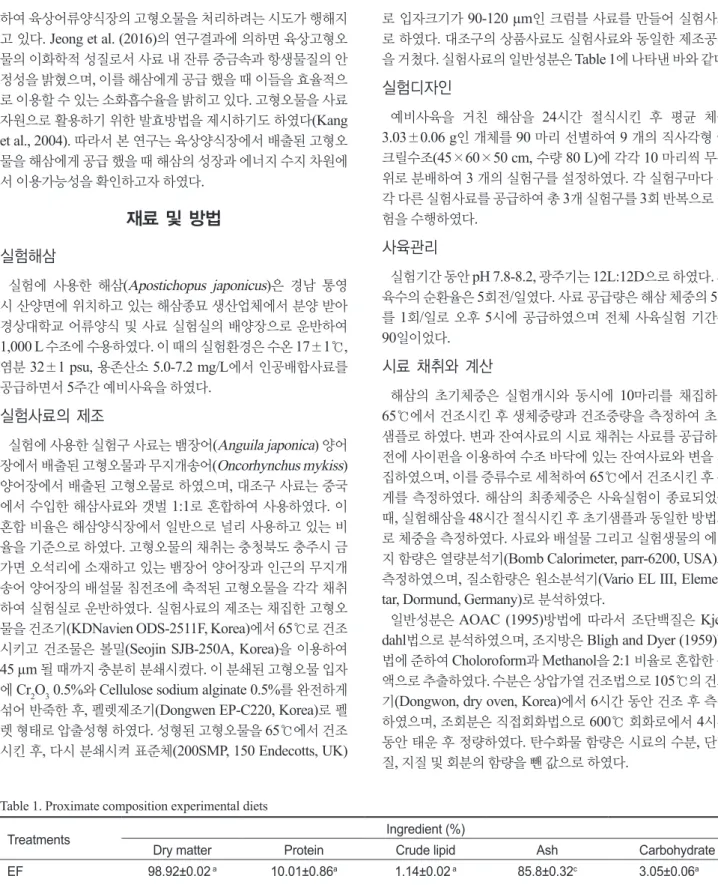
일일성장율(SGR)
은Fig. 1
에나타낸바와같 이대조구인상품사료가1.44%/d
로서가장높게나타났다.
뱀 장어고형오물구와무지개송어고형오물구는각각0.86%/d
과0.90%/d
으로서유의적차이(P<0.05)
는없었다.
전실험구간을 통하여폐사체는없었다.
사료섭식율 및 변배설율
사료섭식율
(IR)
은Fig. 2
에나타낸바와같이뱀장어고형오 물실험구,
무지개송어고형오물실험구및대조구인상품사료 는각각0.27 g/g/d, 0.16 g/g/d
및0.26 g/g/d
로나타났다.
두종 류의실험구인뱀장어고형오물구는무지개송어고형오물구에 비하여높은사료섭식율을나타냈고(P<0.05),
상품사료구와는 유의적인 차이가없었다(P<0.05).
변배설율(FPR)
은Fig. 3
에 나타낸바와같이뱀장어고형오물실험구,
무지개송어고형오Table 2. Initial and final weight of juvenile sea cucumber Apostichopus japonicus in different treatments
Treatments Wet weight (g) Dry weight (g)
Initial Final Initial Final
EF 3.04±0.02a 6.65±0.32a 0.23±0.01a 0.50±0.03a
RF 3.03±0.01a 6.85±0.42a 0.23±0.00a 0.51±0.32a
CF 3.05±0.02a 11.14±0.46b 0.23±0.00a 0.84±0.36b
Data (mean ± SE) with different letters in the same column means significant difference among different diet treatments (P<0.05). EF, Eels’
fecal solids; RF, Rainbow trout’s fecal solids; CF, Commercial feed with sea mud.
Fig. 1. Specific growth rate (SGR) of juvenile sea cucumber Apos- tichopus japonicus fed different test diets. Different letters indicate significant differences (P<0.05) between treatments and bars rep- resent standard errors. EF, Eels’ fecal solids; RF, Rainbow trout’s fecal solids; CF, Commercial feed with sea mud.
EF RF CF
0.0 0.5 1.0 1.5 2.0
a a
b
Diet treatments SGR (% d
-1)
EF RF CF
0.0 0.1 0.2 0.3 0.4 0.5
b
a
b
Diet treatments IR (g g
-1d
-1)
EF RF CF
0.0 0.1 0.2 0.3 0.4 0.5
a
b b
Diet treatments FP R (g g
-1d
-1)
EF RF CF
0 5 10 15 20 25
a a
b
Diet treatments
AD (% )
육상어류양식장 고형오물을 공급한 해삼의 성장과 에너지 수지
171
물실험구및대조구인상품사료는각각
0.23 g/g/d, 0.13 g/g/d
및0.23 g/g/d
로나타났다.
실험구인뱀장어고형오물구는무 지개송어고형오물구에비하여높은사료변배설율을나타냈 고(P<0.05),
상품사료구와는유의적인차이가없었다(P<0.05).
겉보기소화율
겉보기소화흡율
(AD)
은Fig. 4
에나타낸바와같다.
뱀장어고 형오물실험구,
무지개송어고형오물실험구및대조구인상품 사료는각각15.57%, 15.31%
및17.25%
로나타났다.
두종류 의고형오물사료실험구간의차이는없었으나(P<0.05),
상품사 료구와는큰차이를나타냈다.
에너지수지
전사육기간을통한에너지수지는
Table 3
에나타낸바와같 다.
섭식에너지(C)
는 뱀장어고형오물구,
무지개송어고형오 물구및상품사료구에서는각각1.22 KJ/g/g, 1.52 KJ/g/g
및1.24 KJ/g/g
으로나타났다.
실험구인뱀장어고형오물구는무Fig. 4. Apparent digestibility (AD) of juvenile sea cucumber Apos- tichopus japonicus fed different test diets. Different letters indicate significant differences (P<0.05) between treatments and bars rep- resent standard errors. EF, Eels’ fecal solids; RF, Rainbow trout’s fecal solids; CF, Commercial feed with sea mud.
EF RF CF
0.0 0.5
1.0 a a
Diet treatments SGR (% d
-1)
EF RF CF
0.0 0.1 0.2 0.3 0.4 0.5
b
a
b
Diet treatments IR (g g
-1d
-1)
EF RF CF
0.0 0.1 0.2 0.3 0.4 0.5
a
b b
Diet treatments FP R (g g
-1d
-1)
EF RF CF
0 5 10 15 20 25
a a
b
Diet treatments
AD (% )
Fig. 3. Feces production rates (FPR) of juvenile sea cucumber Apostichopus japonicus fed different test diets. Different letters indicate significant differences (P<0.05) between treatments and bars represent standard errors. EF, Eels’ fecal solids; RF, Rainbow trout’s fecal solids; CF, Commercial feed with sea mud.
EF RF CF
0.0 0.5 1.0 1.5 2.0
a a
b
Diet treatments SGR (% d
-1)
EF RF CF
0.0 0.1 0.2 0.3 0.4 0.5
b
a
b
Diet treatments IR (g g
-1d
-1)
EF RF CF
0.0 0.1 0.2 0.3 0.4 0.5
a
b b
Diet treatments FP R (g g
-1d
-1)
EF RF CF
0 5 10 15 20 25
a a
b
Diet treatments
AD (% )
Fig 2. Ingestion rates (IR) of juvenile sea cucumber Apostichopus japonicus fed different test diets. Different letters indicate signifi- cant differences (P<0.05) between treatments and bars represent standard errors. EF, Eels’ fecal solids; RF, Rainbow trout’s fecal solids; CF, Commercial feed with sea mud.
EF RF CF
0.0 0.5 1.0 1.5 2.0
a a
b
Diet treatments SGR (% d
-1)
EF RF CF
0.0 0.1 0.2 0.3 0.4 0.5
b
a
b
Diet treatments IR (g g
-1d
-1)
EF RF CF
0.0 0.1 0.2 0.3 0.4 0.5
a
b b
Diet treatments FP R (g g
-1d
-1)
EF RF CF
0 5 10 15 20 25
a a
b
Diet treatments
AD (% )
Table 3. Energy budget of juvenile sea cucumber Apostichopus japonicus fed the test diets (mean ± SE)
Treatments Energy parameters
C (KJ/g/d) G (%) F (%) U (%) R (%)
EF 1.22±0.04a 9.05±0.24 b 53.31±1.03b 3.14±0.07b 34.50±0.06 b
RF 1.52±0.07b 5.57±0.13a 60.30±0.92c 2.78±0.06b 31.35±0.17 a
CF 1.24±0.05a 9.33±0.16b 45.53±0.47a 1.13±0.08a 39.95±0.43 c
Data with different letters in the same column means significant difference among different diet treatments (P<0.05). EF, Eels’ fecal solids;
RF, Rainbow trout’s fecal solids; CF, Commercial feed with sea mud. C: Ingested; G: energy deposited as growth; F: energy lost in feces;
U: energy lost in excretion; R: energy lost in respiration.
Feng Jin
ㆍ
정우철ㆍ
최종국ㆍ
Anisuzzaman Mdㆍ
김경덕ㆍ
최병대ㆍ
강석중172
지개송어고형오물구에비하여유의한차이로낮게나타났으 나
(P<0.05),
대조구인상품사료와는유의차가없었다(P<0.05).
성장에너지
(G)
는뱀장어고형오물구,
무지개송어고형오물 구및상품사료구에서는각각섭식에너지(C)
의9.05%, 5.57%
및
9.33%
로 나타나 모든 실험구에서 유의차를 나타냈다(P<0.05).
뱀장어고형오물구는무지개송어고형오물구에비하여높게나타났으나
(P<0.05),
대조구인 상품사료보다는낮으며
(P<0.05),
무지개송어고형오물구는대조구인상품사료구보다낮게나타났다
(P<0.05).
변으로 배출된 에너지
(F)
는 뱀장어 고형오물구,
무지개송 어 고형오물구 및 상품사료구에서는 각각 섭식에너지(C)
의53.31%, 60.30%
및45.53%
로나타나모든실험구에서유의 차를나타냈다(P<0.05).
뱀장어고형오물구는무지개송어고형 오물구에비하여낮게나타났으나(P<0.05),
대조구인상품사료 보다는높게나타났으며(P<0.05),
무지개송어고형오물구는대 조구인상품사료구보다높게나타났다(P<0.05).
암모니아로배 출된에너지(U)
는뱀장어고형오물구,
무지개송어고형오물구 및상품사료구에서는각각섭식에너지(C)
의3.14%, 2.78%,
및1.13%
로나타났다.
실험구인뱀장어고형오물구는무지개송어고형오물구에비하여유의적차이가없었으나
(P<0.05),
대조구 인상품사료보다높게나타났다(P<0.05).
대사에너지
(R)
는뱀장어고형오물구,
무지개송어고형오물구 및상품사료구에서는각각섭식에너지(C)
의34.50%, 31.35%,
및
39.95%
로 나타나 모든 실험구에서 유의차를 나타냈다(P<0.05).
뱀장어고형오물구는무지개송어고형오물구에비하여높게나타났으나
(P<0.05),
대조구인 상품사료보다는낮으며
(P<0.05),
무지개송어고형오물구는대조구인상품사료구보다낮게나타났다
(P<0.05).
고 찰
육상양식장에서배출된두종류의고형오물을단독으로해삼 에게공급했을때
90
일간의사육기간을통하여평균체중3 g
크기의해삼이
6 g
크기로성장하여성장배수2
를나타내어육상고형오물을단독공급만으로도폐사하는개체가없이정상적 으로성장함을알수있었다
.
그러나그성장의정도는대조구인 상품사료를공급한체중11 g
에비하여낮은약60%
수준을나 타냈다.
성장부진의원인으로여러가지요인을생각할수있 다.
먼저영양소측면에서고찰해보면뱀장어고형오물구와상 품사료구는단백질함량이동일한10%
였는데도불구하고성 장및일일성장율(Fig. 1)
에서많은차이를나타내고있다.
심지 어무지개송어고형오물구는단백질함량이두배나높은20%
수준을함유하고있는데도불구하고상품구에비하여성장이 저조하였다
.
이는해삼과같은퇴적물식자인양식생물의경우 에는사료가치의판단기준으로단백질외의요인에대해서 도검토하는것이중요하다.
첫째,
탄수화물조성을보면뱀장 어고형오물구와무지개송어고형오물구의탄수화물함량은각각
3.0%
와5.3%
로서상품사료구의37.4%
에비하여현저히부 족하다.
해삼은어류와는달리사료원으로서대형해조류분말 을다량으로사용해야함에도불구하고(Yingst, 1976; Hamel and Mercier, 1998; Zhou et al., 2006; Liu et al., 2010; Slater et al., 2011; Xia et al., 2012; Wu et al., 2015),
단백질위주의 양어사료에서유래하는고형오물에는탄수화물부족현상이이 러한결과를초래한것으로사료된다.
둘째,
회분의조성을보 면뱀장어고형오물구와무지개송어고형오물구는각각85.8%
와
70.9%
로서상품사료구50%
에비하여회분함량이너무높다
.
퇴적물식자인해삼의사료원으로갯벌의중요성에대하여 많은연구가되어있다(Liu et al., 2009; Moore et al., 1995; Xu, 1999; Dar and Ahmad, 2006; Shi et al., 2015).
그러나뱀장어 고형오물구와무지개송어고형오물구의과다한회분함량이해 삼의성장부진과관련있는것으로사료된다.
셋째로,
단백질 측면에서보면사료단백질은해삼의성장에중요한영향을미 치는영양소로알려져있다(Wang et al., 2007; Liu et al., 2009;
Seo and Lee, 2011; Bao et al., 2014; Shi et al., 2013).
두종류 의고형오물은단백질함량10%
와20%
인데반하여상품사료는
10%
수준이다.
이는단백질함량20%
인해삼사료와갯벌을
1:1
로혼합하였기때문에절반수준인10%
였다.
이러한낮 은단백질수준이었으나,
일일성장율1.44%
로서높은성장율 을나타냈다.
단백질수준과성장관계를보면기존의연구(Seo and Lee, 2011; Zhu et al., 2005)
는최적단백질수준을18-24%
를제시하였으나
,
그뒤연구(Bai et al., 2016)
에서는11%
수준으로제시하고있다
.
본연구에서10%
수준에서정상적으로성장한점에서는이와유사한결과를나타냈다
.
다른 양식생물의 고형오물을 이용한 연구로서
Yuan et al.
(2006)
은 이매패류 굴(Crassostrea gigas)
과 가리비(Chlamys
farreri)
의분을건조하여해삼의사료로시도한결과마이너스성장을나타냈는데그이유는
65℃
에서36
시간의건조과정에 서습상태의이매패류변이갖고있는유용성분인박테리아,
비 타민,
지방산의파괴로그원인을제시하고있으나,
본연구에 서도동일한방법으로건조과정을거쳤음에도불구하고일일 성장율이뱀장어고형오물구와무지개송어고형오물구에서는 각각0.86%
와0.90%
를나타내어다른결과를나타냈다. Shi et
al. (2015)
의연구에의하면사료에첨가되는갯벌의입자크기가해삼의성장에중요한역할을한다고하였으며
,
미세한입 자일수록빠른성장이빠르다고하였다. Yuan et al. (2006)
은180-200 µm
크기의큰입자를실험에적용하였지만,
본연구에서는
45-50 µm
의미세입자로구성되었기때문에이러한차이를나타낸것으로사료된다
.
해삼의섭식율은단백질수준혹은에너지함량또는뻘의입 자크기가다름에따라달라지고
(Shi et al., 2013),
먹이가풍부 한계절에식욕조절을통하여섭식율을감소시킨다(Hudson et
al., 2004)
고하였다.
본실험에서는Fig. 2
에나타낸바와같이 사료섭식율(IR)
은단백질함량이높은실험구(Table 1)
와는역관계를나타냈다
.
이러한겨과는McBride et al. (1998) (Del et al., 2004; Yuan et al., 2006; Shi et al., 2013; Bai et al., 2016)
의 연구와유사한경향을나타냈다.
겉보기소화율
(AD)
는15-20%
수준으로나타났다.
이는섭취한사료의
80-85%
는변으로 배출되어버리고 어류소화율이90%
수준인점(Barrows et al., 2007)
을감안하면월등히낮은 수준이다.
이는Xia et al. (2012)
의연구와도동일한수준이다.
이러한현상은해삼의식성이퇴적물식자에기인된것으로사 료된다.
에너지수지는양식생물이사료를섭취한후성장과배 출의관계를종합적으로설명할수가있어서양식생물의소화 생리를이해하는데있어대단히유용하다(Kaushik and Teles,
1985).
해삼류가 단백질유래의에너지를효율적으로이용하지못하고탄수화물로부터유래하는에너지를효율적으로이 용하는생리적특성을가지고있다
(Slater et al., 2011, Xia et
al., 2015).
따라서뱀장어고형오물구에서는탄수화물의비율이단지
3%
에불과하기때문에사료탄수화물로부터유래하는 에너지를얻을수없었기때문인것으로사료된다.
무지개송어 고형오물구는실험구중에서가장많은에너지섭취하였으나,
성장에너지로는가장저조한5.57%
만을성장에기여하고나머지
63.08%
를변과암모니아로배출하였다.
그러나대조구상품사료는섭취한에너지를성장에
13.21%
축적하고변과암모니아로의배출은
46.84%
였다.
고형오물의특성상어류가잘소화시키지못하고남은불소화물로구성되었기때문에
(Reid et al., 2010; Orr et al., 2014)
이러한차이를나타내낼뿐만아니라해 삼은저작기관이없고장내소화효소도활성이낮으며소화과정 은미생물의작용에크게의존하므로(Zhang et al., 2010; Zhao et al., 2012; Wang et al., 2015)
이러한요인들이복합적으로연 관되어서일어난현상으로생각된다.
사 사
이논문은
2015
년도해양수산부재원으로한국해양과학기술진흥원의지원을받아수행된연구임
(
수산실용화기술개발사 업의육상순환양식시스템에서배출된고형오물의해삼사료자 원화)
References
Ahlgren MO. 1998. Consumption and assimilation of salmon net pen fouling debris by the red sea cucumber Paras-
tichopus californicus: implications for polyculture. J World
Aquacult Soc 29, 133-139.AOAC (Association of Official Analytical Chemists). 1995 Of- ficial Methods of Analysis, vol. 4(16th ed.)Association of Official Analytical Chemists, Arlington, VA, U.S.A., 1-45.
Bai Y, Zhang L, Xia S, Liu S, Ru X, Xu Q, Zhang T and Yang H.
2016. Effects of dietary protein levels on the growth, energy budget, and physiological and immunological performance
of green, white and purple color morphs of sea cucumber,
Apostichopus japonicus. Aquaculture 450, 375-382. http://
dx.doi.org/10.1016/j.aquaculture.2015.08.021.
Bao J, Jiang H, Tian X and Dong S. 2014. Growth and energy budgets of green and red type sea cucumbers Apostichopus
japonicus (Selenka) under different light colors. Aquacul-
ture 418, 139-143. http://dx.doi.org/10.1016/j.aquacul- ture.2013.10.015.Barrows F, Gaylord T, Stone D and Smith C. 2007. Effect of protein source and nutrient density on growth efficiency, histology and plasma amino acid concentration of rainbow trout (Oncorhynchus mykiss Walbaum). Aquacult Res 38, 1747-1758.
Bligh EG and Dyer WJ. 1959. A rapid method of total lipid ex- traction and purification. Can J Biochem Physiol 37, 911- 917.
Dar MA and Ahmad HO. 2006. The feeding selectivity and eco- logical role of shallow water holothurians in the Red Sea.
SPC Beche-de-mer Information Bull 24, 11-21.
Del MOV, Kelly MS and Burnell G. 2004. How diet influences energy partitioning in the regular echinoid Psammechinus
miliaris; constructing an energy budget. J Exp Mar Biol
Ecol 304, 159-181.Duncan DB. 1955. Multiple range and multiple F tests. Biomet- rics 11, 1-42.
Furukawa A. 1966. On the acid digestion method for the de- termination of chromic oxide as an index substance in the study of digestibility of fish feed. Nippon Suisan Gakkaishi 32, 502-506.
Hamel J and Mercier A. 1998. Diet and feeding behaviour of the sea cucumber Cucumaria frondosa in the St. Lawrence estuary, eastern Canada. Can J Zool 76, 1194-1198.
Hannah L, Pearce CM and Cross SF. 2013. Growth and survival of California sea cucumbers (Parastichopus californicus) cultivated with sablefish (Anoplopoma fimbria) at an inte- grated multi-trophic aquaculture site. Aquaculture 406–407, 34-42. http://dx.doi.org/10.1016/j.aquaculture.2013.04.022.
Hudson IR, Wigham BD and Tyler PA. 2004. The feeding be- haviour of a deep-sea holothurian, Stichopus tremulus (Gun- nerus) based on in situ observations and experiments using remotely operated vehicle. J Exp Mar Biol Ecol 301, 75-91.
http://dx.doi.org/10.1016/j.jmarsys.2005.02.004.
Kang JC, Jee JH, Song SY, Moon SW, Kang JW, Lee YD and Kim SJ. 2004. Effects of oral administration with fermented product from sewage in land-based seawater fish farm on haematological factors of olive flounder, Paralichthys oliva-
ceus. J Fish Pathol 17, 57-66.
Kang KH, Kwon JY and Kim YM. 2003. A beneficial coculture:
charm abalone Haliotis discus hannai and sea cucumber
Stichopus japonicus. Aquaculture 216, 87-93. http://dx.doi.
org/10.1016/S0044-8486(02)00203-X.
Kang SJ, Kang SW, Kang JH, Jung UC, Choi BD and Han JC.
Feng Jin
ㆍ
정우철ㆍ
최종국ㆍ
Anisuzzaman Mdㆍ
김경덕ㆍ
최병대ㆍ
강석중174
2012. Sea cucumber aquaculture technology. Aqua info., Seoul, Korea, 32-36.
Kaushik SJ and Teles AO. 1985. Effect of digestible energy on nitrogen and energy balance in rainbow trout. Aquaculture 50, 89-101.
Liu Y, Dong S, Tian X, Wang F and Gao Q. 2010. The effect of different macroalgae on the growth of sea cucumbers (Apos-
tichopus japonicus Selenka). Aquacult Res 41, e881-e885.
Liu Y, Dong S, Tian X, Wang F and Gao Q. 2009. Effects of dietary sea mud and yellow soil on growth and energy bud- get of the sea cucumber Apostichopus japonicus (Selen- ka). Aquaculture 286, 266-270. http://dx.doi.org/10.1016/
S0269-7491(02)00338-X.
McBride S, Lawrence J, Lawrence A and Mulligan T. 1998. The effect of protein concentration in prepared feeds on growth, feeding rate, total organic absorption, and gross assimilation efficiency of the sea urchin Strongylocentrotus franciscanus.
J Shellfish Res 17, 1563-1570.
Michio K, Kengo K, Yasunori K, Hitoshi M, Takayuki Y, Hideaki Y and Hiroshi S. 2003. Effects of deposit feeder
Stichopus japonicus on algal bloom and organic matter con-
tents of bottom sediments of the enclosed sea. Mar Pollut Bull 47, 118-125.Moore H, Manship B and Roberts D. 1995. Gut structure and digestive strategies in three species of abyssal holothurians.
Echinoderm Res 111-119.
Moriarty D. 1982. Feeding of Holothuria atra and Stichopus
chloronotus on bacteria, organic carbon and organic nitro-
gen in sediments of the Great Barrier Reef. Mar Freshwater Res 33, 255-263.Naylor RL, Goldburg RJ, Primavera JH, Kautsky N, Beveridge MC, Clay J, Folke C, Lubchenco J, Mooney H and Troell M. 2000. Effect of aquaculture on world fish supplies. Na- ture 405, 1017-1024.
Nelson EJ, MacDonald BA and Robinson SMC. 2012. The ab- sorption efficiency of the suspension-feeding sea cucumber,
Cucumaria frondosa , and its potential as an extractive in-
tegrated multi-trophic aquaculture (IMTA) species. Aqua- culture 370, 19-25. http://dx.doi.org/10.1016/j.aquacul- ture.2012.09.029.Orr LC, Curtis DL, Cross SF, Gurney-Smith H, Shanks A and Pearce CM. 2014. Ingestion rate, absorption efficiency, oxy- gen consumption, and fecal production in green sea urchins (Strongylocentrotus droebachiensis) fed waste from sable- fish (Anoplopoma fimbria) culture. Aquaculture 422, 184- 192. http://dx.doi.org/10.1016/j.aquaculture.2013.11.030.
Paltzat DL, Pearce CM, Barnes PA and McKinley RS. 2008.
Growth and production of California sea cucumbers (Parastichopus californicus Stimpson) co-cultured with suspended Pacific oysters (Crassostrea gigas Thunberg).
Aquaculture 275, 124-137. http://dx.doi.org/10.1016/j.aqua- culture.2007.12.014.
Park SJ, Hong SG, Yoon IH and Lovatelli A. 2015. Chapter 23 - Apostichopus japonicus: “Dolgi Haesam” in the Republic of Korea (South Korea). Dev Aquacult Fish Sci 39, 423-431.
Pyeun JH and Ro JI. 1984. Studies on Lipids in Fresh Water Fishes; Study on Lipid Components of Carp, Cyprinus car-
pio. Korean J Fish Aquat Sci 17, 260-261.
Ramofafia C, Foyle TP and Bell JD. 1997. Growth of juvenile
Actinopyga mauritiana (Holothuroidea) in captivity. Aqua-
culture 152, 119-128. http://dx.doi.org/10.1016/S0044- 8486(96)01525-6.Reid GK, Liutkus M, Bennett A, Robinson SMC, MacDonald B and Page F. 2010. Absorption efficiency of blue mussels (Mytilus edulis and M. trossulus) feeding on Atlantic salmon (Salmo salar) feed and fecal particulates: Implications for integrated multi-trophic aquaculture. Aquaculture 299, 165- 169. http://dx.doi.org/10.1016/j.aquaculture.2009.12.002.
Roberts D, Gebruk A, Levin V and Manship B. 2003. Feeding and digestive strategies in deposit-feeding holothurians.
Oceanogr Mar Biol Annu Rev 38, 257-262.
Seo J and Lee S. 2011. Optimum dietary protein and lipid levels for growth of juvenile sea cucumber Apostichopus japoni-
cus. Aquacult Nutr 17, 56-61.
Shi C, Dong S, Wang F, Gao Q and Tian X. 2013. Effects of four fresh microalgae in diet on growth and energy budget of juvenile sea cucumber Apostichopus japonicus (Selenka).
Aquaculture 416–417, 296-301. http://dx.doi.org/10.1016/j.
aquaculture.2013.09.050.
Shi C, Dong S, Wang F, Gao Q and Tian X. 2015. Effects of the sizes of mud or sand particles in feed on growth and energy budgets of young sea cucumber (Apostichopus japonicus).
Aquaculture 440, 6-11. http://dx.doi.org/10.1016/j.aquacul- ture.2015.01.028.
Slater MJ, Jeffs AG and Carton AG. 2009. The use of the waste from green-lipped mussels as a food source for juvenile sea cucumber, Australostichopus mollis. Aquaculture 292, 219- 224.
Slater MJ, Lassudrie M and Jeffs AG. 2011. Method for deter- mining apparent digestibility of carbohydrate and protein sources for artificial diets for juvenile sea cucumber, Austra-
lostichopus mollis. J World Aquacult Soc 42, 714-725.
Wang F, Dong S, Huang G, Wu L, Tian X and Ma S. 2003. The effect of light color on the growth of Chinese shrimp Fenne-
ropenaeus chinensis. Aquaculture 228, 351-360.
Wang J, Jiang X, Zhao L, Su J and Sun P. 2007. Effects of di- etary protein sources on growth in juvenile sea cucumber (Apostichopus japonicus). Feed Rev 10, 9-13.
Wang J, Zhao L, Liu J, Wang H and Xiao S. 2015. Effect of potential probiotic Rhodotorula benthica D30 on the growth performance, digestive enzyme activity and immunity in juvenile sea cucumber Apostichopus japonicus. Fish Shell- fish Immunol 43, 330-336. http://dx.doi.org/10.1016/j.fsi.
2014.12.028.