구성원의 지각된 행복감과 혁신행동 간의 관계
The Relationship between Perceived Occupational Well-Being and Innovative Behavior in the Workplace
차윤석 동아대학교 경영학과
Yunsuk Cha([email protected])
요약
주요 경영관련 저널에서는 매년 ‘일하고 싶은 회사(100 best companies to work for)’를 발표해 오고 있 다. 여기에 선정된 회사들은 높은 기업성과 뿐만 아니라 다양한 형태의 복지프로그램 제공과 구성원들의 높은 직무만족, 조직몰입, 일-가정 균형 인식, 및 긍정적 정서를 높일 수 있는 프로그램을 제공하는 특징을 갖고 있다. 이는 조직 구성원들은 이러한 프로그램을 통해 직무만족, 조직몰입, 일-가정 균형에서 오는 안정 감과 행복감을 느끼며, 이는 삶에 대한 전반적 만족 및 긍정적 정서로 나타나기 때문이다. 최근 기업들은 조직 구성원들의 심리적 안정과 긍정적 사고가 개인 및 조직의 성과를 향상시킨다는 믿음으로 많은 노력을 해오고 있다. 본 연구에서는 구성원이 지각하는 행복감과 혁신행동 간의 관계에서 일-가정 촉진의 조절효 과를 검증하였다. 이를 위해 IT, 서비스, 제조업 등 총 11 개 기업의 직원들을 대상으로 설문조사를 실시하 여 실증 분석하였다. 분석결과는 다음과 같다. 첫째, 직장 행복감이 혁신행동에 긍정적인 영향을 미치는 것 으로 나타났다. 둘째, 직장 행복감과 혁신행동 간의 관계에 있어 일-가정 촉진 및 가정-일 촉진의 조절효과 가 통계적으로 유의한 결과가 나타났다. 결론 부분에 이 연구의 시사점과 한계점, 그리고 향후 연구 방향을 제시하였다.
■ 중심어 :∣직장 행복감∣혁신행동∣일-가정 촉진∣가정-일 촉진∣
Abstract
Major business journals have been annually announced ‘100 best companies to work for’. These companies have some characteristics having not only high organization performance but also various benefit programs such as job satisfaction, organization commitment, work-family balance and positive psychology. When people have job satisfaction, organization commitment, and happiness, it will increase the positive psychology of people. Therefore, in this study, we examined the moderating effect of work-family facilitation between occupational well-being and innovative behavior. For the empirical analysis, the survey was executed on employees of 11 companies in IT, Service, and Manufacturing business field. The analysis result is as follows.
First, occupational well-being gives positive(+) influence on innovative behavior. Second, the control effect of work-family facilitation in the relationship between occupational well-being and innovative behavior was significant according to statistics. The conclusion states the implications and limitations of this study, and suggests directions on future studies.
■ keyword :∣Occupational Well-Being∣Innovative Behavior∣Work-Family Facilitation∣Family-Work Facilitation∣
* 본 논문은 동아대학교 교내연구비 지원에 의하여 연구되었음 접수일자 : 2018년 01월 15일
수정일자 : 2018년 01월 29일
심사완료일 : 2018년 01월 29일
교신저자 : 차윤석, e-mail : [email protected]
I. Introduction
Today, in contrast to the past, there is a lot of interest in the concept of happiness despite out physical abundance and developed scientific skills[1].
Based on the development, changes in society, and changes in the economic situation, the extent to which occupation has taken over modern life has become greater. Recently, there are more scholars conducting research by including happiness in studies of life.
Occupational well-being is a term that has begun to appear in the research about happiness along with subjective well-being or psychological well-being in the positive psychology area, which has developed over the last decade[2].
As occupational well-being increases, there are more opportunities to study the psychological experience about the work of members. Accordingly, more positive emotions are shown. In this way, psychological status and emotion with regard to a member’s own work serve as important variables for studying innovative behavior.
According to the result of related st studies, innovation has been giving active influence to continuous and long-term development along with connectivity[4]. Occupational well-being has an important influence on work performance and innovative behavior[3]. This is a fact that is acknowledged in the academia, but there is disagreement in the research results regarding the relationship between the two elements. According to many research results, if occupational well-being is high, it is helpful to improve the innovative work performance of the members[5]. In contrast, several other research results state that if occupational well-being is low, employees have a higher possibility of achieving excellent and innovative work performance[6]. We can say that members with high
occupational well-being do not have to invest too much effort to achieve innovative goal. In contrast to this situation, as an example, members with low occupational well-being feel they are not appropriate for the work environment and begin to discover decisive and inappropriate weaknesses to work environment to put more effort in improvement. Here the employee will do the their best to compose work plans that can be executed by being more cautious about each detail of the current work environment while letting go of the irrational reasoning methods[7]. Therefore, this research aims to explore the relationship between innovation and occupational well-being. The study will also focus on how the relationships between the two elements affect the adjustments to the work-family facilitation[8].
Ⅱ. Theoretical Background and Hypothesis
1. Occupational Well-being
Work in the modern society has been recognized as a very important part of human life. With industrialization and modernization, an increasing number of people started to get jobs[8]. Also, a person’s working hours take up more than half their overall activity hours[9]. A job is not simply finishing some kind of task or work, but it is also maintaining a good relationship with colleagues and bosses, following rules, performing to the requisite standards, overcoming stress, and taking responsibility[10].
People are always stressed when creating labor power at the same time as they are working.
However, work can provide people with satisfaction associated with daily consumption and economic income. At the same time, work can satisfy the desire of wanting to be respected through relationships with others[1]. A job can bring satisfaction to an individual
Main Variable Representative
Scholar Definition
Job
Satisfaction Locke (1976) Satisfied or enjoying due to work experience or the work itself
Flow Csikszent- mihalyi(1988)
Psychological flow status experienced when completely
focusing on something Work
Engagement Kahn (1990) When an individual participates sincerely to work Positive
Emotion
Van Katwyk et al.(2000)
Status of having positive emotion about work
Thriving Spreitzer et al.
(2005)
Psychological status of experiencing vitality and learning
at work
Author
(Year) Concept of Innovative Behavior Keyword
Kanter (1988)
Established of supporter union by considering new ideas and composing search of for ways of
resolution and classification of issues. Next is fulfilling and completing ideas through the composition of rules or models
on innovation.
Search and create ideas,
acquire supporters, and
fulfill ideas.
and it can also satisfy the desire of self-realization.
This is how occupational well-being differs from daily happiness[9].
According to the suggestion of positive organizational scholarship (POS), researchers have been applying happiness in specific directions.
Different studies have investigated the concept of occupational well-being. The term “occupational well-being” has been actively researched in relation to happiness concepts such as subjective happiness and psychological happiness. This has occurred in the area of positive psychology for the last 10 years.
Therefore scholars also use psychological well-being concepts in studies on the work place, work place well-being, psychological well-being at work, employee happiness, and psychological well-being of people in organizations[11].
When applying the concept of happiness derived from existing studies on happiness to the workplace, happiness can be largely classified into two types.
Examples of purposeful perspective and sensible perspectives are shown in [Table 1]. Sensible perspective includes positive emotion and satisfaction about serving one’s duty. Purposeful perspectives include the meaning of learning, happiness, and self-realization, and they correspond to flow, work engagement and thriving[12]. Warr (1988)[13] defined occupational well-being by combining subjective happiness and psychological happiness. He thought this was an evaluation based on the overall standard, position, and own career of members.
Table 1. Concept regarding Occupation and Happiness
Source: Samsung Economic Research Institute (2013), p.23
2. Innovative Behavior
Innovative behavior is a pioneering integration of serial non-continuous activities[14] and is also the process of developing new ideas or products. This process is connected to expressions of interaction between situational properties and psychological or characteristic properties of individuals[15]. It also includes individual innovative behavior and group innovative behavior. This study mostly focuses on individual innovative behavior. Research on the concept of individual innovative behavior is ongoing.
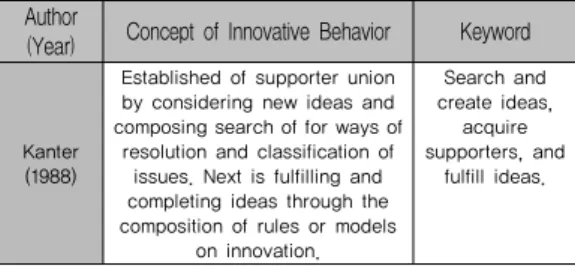
Most scholars define the process of individual innovative behavior. Representative scholars include Kanter et al. (1988)[16]. Examples are shown on [Table 2]. This study developed the concepts of ideas, supporters, and idea execution after analyzing the concept of innovative behavior. Scott and Bruce’s (1994)[18] definition of innovative behavior was adopted, which includes the main terms mentioned above through advanced research.
Table 2. Concept of Innovative Behavior
Farr (1990)
Behavior of introducing innovative ideas in the process of giving change such as work processing methods, process, and procedures to increase an individual’s work performance
result.
Introduce and apply idea and
increase performance
result.
Scott &
Bruce (1994)
Argue that behavior of raising performance of organization and
performance of work performance of individual through ideas acquired from other colleagues or new ideas can be induced from problem
solving process.
Create ideas, acquire supporters, apply ideas.
Amabile (1996)
A method of an individual working, a method of creating
some kind of value, process, and resolution.
Derive method, resolution
method`
Woodamn
(2010)
Create and introduce ideas (from self or from another), meaning the executio.n of realization or
new ideas
Create ideas, introduce ideas,
execute ideas.
Organized by author
Thus, it can be argued that the behaviors of raising organizational performance and work performance of individuals can be induced through ideas acquired from other colleagues or new ideas in problem solving processes.
3. Work-Family Facilitation
The concept of explaining positive application between work and family is called work-family facilitation. This means raising the overall efficiency when an individual participates in role domain (work or family) to acquire resources (such as positive emotion, flow, or efficiency)[18].
Just like work-family disputes, work –family facilitation ias based on two criteria. One is these work to family facilitation (WFF), which is a role at work that affects the role of family. Another is the family to work facilitation (FWF), which is the role of the family affecting the role of work. The resource corresponding to the domain of work facilitating family life is called WFF. Similarly, when family resources raise work efficiency, it is known as FWF.
In 1990, Weat and Farr[17] argued for the
classification of work-family relationships into six types. This study created a model based on this 6-fold classification. Work-family facilitation was classified into developmental facilitation, emotional facilitation, and psychological asset facilitation.
Family-work facilitation was classified into developmental facilitation, emotional facilitation, and efficient facilitation. Based on this classification, a measurement scale with relatively high measurement reliability was developed.
4. Relationship between Occupational Well-Being and Innovative Behavior
The relationship between occupational well-being and innovative behavior can be explained based on the expansion-establishment theory. The expansion-establishment theory claims that positive emotions affect an individual’s growth and development in a good way, and it also explains long-term application values. Positive emotion involves having two core values. Temporary expansion function plays the role of expanding the immediate thoughts and behaviors of an individuals.
Long-term establishment function refers to the establishment of an individual’s body, recognition, and social resources[19]. Accordingly, extemporaneous skills and creativity of a person can be developed from positive emotions through the expansion- establishment theory. This means that the status of the body of a person feeling positive emotion is good and that stabilization and comfortableness automatically appear. This helps people think about issues from various perspectives while expressing their own thoughts, It allows people to surpass their limitations, and also raises the innovation and autonomy in the individual[20]. Therefore, a happy person shows more autonomy in their work in an organizational mood and learns to focus and express
interest actively[21]. This kind of person can also autonomously suggest more innovative activities autonomously for the organization and the department[22].
Hypothesis 1: Occupational well-being will have a positive (+) effect on innovative behavior.
5. Moderating Effect of Work-Family Facilitation
Work-family facilitation is acquiring resources by participating in the relevant role domain (work or family) and then raising overall efficiency by participating in other role activities[23]. From the perspective of the E-R model, work-family facilitation raises the quality of life of its members and also influences their happiness of members[23]. A person with high occupational well-being learns to focus and express interest actively and autonomously in the work they a perform in the organizational mood[21]. This kind of person also autonomously suggests more innovative ideas autonomously for the department or organization[22].
Hypothesis 2-1: Work-family facilitation moderates the relationship between occupational well-being and innovative behavior.
Hypothesis 2-2: Family-Work facilitation moderates the relationship between occupational well-being and innovative behavior.
Figure 1. Research Model
Ⅲ. Research Method
1. Research Method
To verify the hypotheses and the research model, this model collected data using the survey method.
The survey was conducted on employees working in companies in Busan. A total of 240 surveys were distributed. Thirty surveys were not collected and 12 surveys were not responded to sincerely. Thus, a total of 198 surveys were used for the final analysis.
2. Measurement Tool and Analysis Method
This study used the surveys of Grzwacz and Bass(2003)[24], and Scott and Bruce(1994)[18] to measure work-family facilitation, occupational well-being, and innovative behavior. The responses were on a 7-point Liker scale.To identify the population/social characteristics of the subjects being investigated, technical statistical analysis was conducted. Hierarchical regression analysis was conducted to verify the research hypotheses.
Ⅳ. Research Result
1. Measurement Tool’s Validity and Reliability
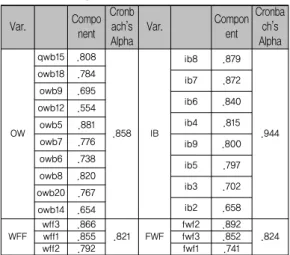
As a result of verifying the validity and reliability of the variables used in this study, the results all showed high reliability of above .80. The factor analysis showed that occupational well-being (independent variable), work-family facilitation (moderating variable), and innovative behavior (dependant variable), all had mutually independent structures. This is shown in [Table 3].2. Correlation Analysis
The mean value and standard deviation for each variable were found through descriptive statistical analysis. Occupational well-being’s mean value was 4.73, innovative behavior’s mean value was 4.66, and work-family facilitation and family-work facilitation’s mean values were 3.85 and 5.27, respectively. With regard to the coefficient of correlation, occupational well-being showed a positive (+) correlation of r=.57 (p=.00), r=.45 (p=.00), r=.39 (p=.00) corresponding to innovative behavior, work-family facilitation, and family-work facilitation, respectively. Also, the absolute value of the correlation was small when there was no issue of multicollinearity between variables[24].
Table 3. Descriptive statistics and Correlation
M SD 1 2 3
OW 4.73 .78
IB 4.66 .96 .57**
WFF 3.85 1.33 .45** .45**
FWF 5.27 1.20 .39** .29** .44**
*p<.05 **p<.01 ***p<.001 1. OW: Occupational well-being 2. IB: Innovative Behavior 3. WFF: Work-Family Facilitation 4. FWF: Family-Work Facilitation
Table 4. Measurement Model’s Validity/Liability Analysis Result
Var. Compo
nent Cronb ach’s Alpha
Var. Compon
ent Cronba
ch’s Alpha
OW
qwb15 .808
.858 IB
ib8 .879
.944 owb18 .784
ib7 .872 owb9 .695
ib6 .840 owb12 .554
ib4 .815 owb5 .881
owb7 .776 ib9 .800
owb6 .738
ib5 .797 owb8 .820
ib3 .702 owb20 .767
ib2 .658 owb14 .654
WFF
wff3 .866
.821 FWF
fwf2 .892 .824
wff1 .855 fwf3 .852
wff2 .792 fwf1 .741
3. Hypothesis Verification
To verify Hypothesis 1 regarding the relationship between occupational well-being (independent variable) and innovative behavior (dependent variable), hierarchical regression analysis was conducted. The results are shown in [Table 4]. Hypothesis 1 (occupational well-being will have a positive effect on innovative behavior) was supported by showing a statistically positive (+) direction statistically (β=.539, p<.000).
To verify the hypothesis that work-family facilitation will apply as a moderating variable between occupational well-being and the innovative behavior, the moderating variable and independent variables were input into the first stage of the hierarchical regression analysis, while the multiplication of the occupational well-being and work-family facilitation variables was input in the second stage.
Table 5. Hierarchical Regression Analysis Result on Innovative Behavior
Dependant Variable
Innovative Behavior
Dependant
Variable Innovative Behavior
1st Control
Var.
Women -.049
1st Contro
l Var.
Women -.014 Divorc
ed -.046 Divorced -.091
Dual-I
ncome .061 Dual-Inc
ome .041
Age .164 Age .109
Indepen dent Var.
OW .539*
**Indepe ndent
Var.
OW .355
***R²(F) .274 12.946
***
R²(F) .274 10.794
***2nd WFF x
OW .523
***2nd
FWF x OW
.531
***△R² (△F)
.28 (11.97
***)
△R² (△F)
.29 (12.66
***) +p<.10 *p<.05 **p<.01 ***p<.001 a: standard coefficient β
When verifying the moderatingl effect by composing correlation variables, one must be cautious of the issue of multicollinearity. To remove the
multicollinearity issue, this study centralized the average of raw materials as suggested by Cronbach(1987)[25] and Jaccard, Turrisi, and Wan(1990)[36], multiplied the variable, and then derived the correlation. [Table 3] shows the class regression analysis including correlation items.
As shown in [Table 5], Hypothesis 2-1 (for work-family facilitation, occupational well-being will control the influence on innovative behavior) showed significance in standard (p<.001). Hypothesis 2-2 (for family-work facilitation, occupational well-being will control the influence to innovative behavior) showed significant result according to statistics. Thus, Hypothesis 2 was partially supported where occupational well-being controls the influence on innovative behavior in work-family facilitation (family-work facilitation).
Ⅴ. Conclusion and Proposal
The summary of the empirical analysis result of this research is as follows. First, occupational well-being is directly proportional to innovative behavior. Thus, occupational well-being has a positive (+) influence on innovative behavior. This result corresponds to advanced studies. Thus, higher occupational well-being can facilitate innovative behavior by expanding the recognition range and thinking related to work. Members with high occupational well-being are believed to be placed in a free work environment. This facilitates their innovative behavior and facilitates depth of the deepness of the relative values and meaning.
Second, in the relationship between occupational well-being and innovative behavior, work-family facilitation has a moderatingl effect. This means that work-family facilitation and occupational well-being
allows members of an organization to execute endless innovative behaviors to yield performance and results.
This study noted the need to include elements such as organizational support, motivation, and sociality.
The element of occupational well-being is sociality, which is the most important element of social exchange. An organization must provide opportunities for members to participate in social exchange and must strengthen the social exchange abilities. Because humans are social animals, people experience satisfaction, affiliation, and courage through exchange by searching for opportunity of social exchanges. Communication is an essential element of exchange and improves the mood of the company by raising efficiency, making information exchange smooth, and creating horizontal and vertical relationships. A good company environment increases member affiliation and also makes the mood for participating sincere. Through activities, members work together to create a good company environment and acquire more information to help create innovative behavior.
While this research has scholastic and practical implications, it also has limitations. First, this study used a total of 198 samples. This, while it achieved the statistical standard, was not a large number of samples. Future empirical studies should use more samples should be used. Second, there were too many items in the survey and the door-to-door method was not used. Also, some participants did not sincerely participate in the survey sincerely when the researcher was not watching. Third, the survey respondents were office workers in the Busan. This research utilized a cross-sectional design research.
Thus, it is important to analyze data from other members of the same generation. Work-family facilitation and occupational well-being mentioned in this research are still in the nascent stages. Literary
studies and theoretical studies on these two variables are the same. Future studies should deepen from this study by studying occupational well-being and work-family relationship with other cultural backgrounds.
참 고 문 헌
[1] R. Zhang, “The Research on the Relationship between Work Welling and Organizational Citizenship Behavior,” Psychology Development, Vol.7, No.2, pp.78-91, 2013.
[2] I. T. Robertson and J. Flint-Taylor, Leadership,
psychological well-being and organizational outcomes, In S. Cartwright & C. L. Cooper
(Eds.), The Oxford Handbook of Organizational Well-Being Oxford, Oxford University Press, 2009.[3] Z. L. Peng, H. L. Wang, and F. Guo, “The effect mergent leader plays on group emotion and employee innovative behavior,” Studies in Science of Science, Vol.29, No.3, pp.471-480, 2011.
[4] H. Nystrom, Organizational innovation, In M. A.
West & J. L. Farr(Eds.) Innovation and creativity at work, pp.143-161, New York: John
& Sons Ltd. 1990.
[5] B. M. Staw, R. I. Sutton, and L. H. Pelled,
“Employee positive emotion and favorable outcomes at the workplace,” Organization Science, Vol.5, pp.51-71, 1994.
[6] J. Zhou and M. George, “When job dissatisfaction leads to creativity: encouraging the expression of voice,” Academy of Management Journal, Vol.44, No.4, pp.682-696, 2001.
[7] L. L. Martin and P. Stoner, Mood as input: What
we think about how we feel determines how we think. In L. L. Martin & A. Tesser (Eds.), Striving and feeling: Interactions among goals, affect, and self-regulation, pp.279-301, Hillsdale, NJ: Erlbaum, 1996.
[8] Y. Yan, “Effect of Perceived Organizational Support and Proactive Personality on Organizational Commitment of Returned Knowledge Workers, the Mediation Role of Reentry Adjustment,” Psychology Development, Vol.5, No.6, pp.555-564, 2012.
[9] Y. J. Miao, “An Overview of Happiness in the Workplace,” Economic Management, Vol.9, pp.179-186, 2009.
[10] I. T. Robertson and J. Flint-Taylor,
“Leadership, psychological well-being and organizational outcomes,” In S. Cartwright & C.
L. Cooper (Eds.), The Oxford Handbook of Organizational Well-Being Oxford, Oxford University Press. 2009.
[11] D. D. Feng, C, Q. Lu, and O. L. Siu, “Job Insecurity, Well-Being, and Job Performance,”
The Role of General Self-Efficacy, Vol.40, No.4, pp.448-455, 2006.
[12] 예지은, 진현, 서의정, 김명진, 류지성, 직장인의 행복에 관한 연구, SERI연구보고서, 2013.
[13] P. B. Warr, “The measurement of well-being and other aspects of mental health,” Journal of Occupational Psychology, Vol.63, No.3, pp.193-210, 1990.
[14] R. G. Schoreder, A. H. Van de Ven, G. D.
Scudder, and D. Polley, Managing innovation and change processes: Findings from the Minnesota innovation research program, 2002.
[15] C. T. Tsai, S. S. Ting, and C. F. Kao, “Need for cognition, brainstorming and individual creativity,” Chinese Journal of Psychology, Vol.3, No.2, pp.107-117, 1989.
[16] R. M. Kanter, “When a thousand flowers bloom: structural, collective, and social conditions for innovation in organization,”
Research in organizational Behavior, Vol.10, No.1, pp.169-211, 1988.
[17] M. A. West and J. L. Farr, “Innovation at Work,” In West, M. A. & Farr, J. L.(Eds.), Innovation and Creativity at Work, New York, Wiley, 1990.
[18] S. G. Scott and R. A. Bruce, “Determinants of innovation behavior: A path model of individual innovation in the workplace,” Academy of Management Journal, Vol.37, No.3, pp.580-607, 1994.
[19] O. Janssen, “Fairness perceptions as a moderator in the curvilinear relationships between job demands, and job performance and job satisfaction,” Academy of Management Journal, Vol.44, No.5, pp.1039-1050, 2000.
[20] A. M. Isen, “Positive affect and decision making,” In M. Lewis & J. M. Jones(Eds.), Handbook of Emotions, New York: Guilford Press, pp.417-435, 2000.
[21] M. Csikszentmihalyi, “Living Well: The Psychology of Everyday Life,” London:
Weidenfeld & Nicholson, 1997.
[22] T. S. Batemans and D. W. Organ, “Job Satisfaction and the Good Soldier: The Relationship Between Affect and Employee citizenship,” Academy of Management Journal, Vol.26, No.4, pp.587-595, 1983.
[23] S.J.Wayne, L.M.Shore, W.H. Bommer, and L. E. Tetrick, “The Role of Fair Treatment and Rewards in Perceptions of Organizational Support and Leader-member Exchange,” Journal of Applied Psychology, Vol.87, pp.590-598, 2004.
[24] J. G. Grzywacz and B. L. Bass, “Work, family, and mental health: Testing different models of
work-family fit,” Journal of Marriage and Family, Vol.65, No.1, pp.248-262, 2003.
[25] L. Cronbach, “Statistical Tests for Moderator Variables: Flaws in Analysis Recently Proposed," Psychological Bulletin, Vol.102, pp.414-417, 1987.
저 자 소 개
차 윤 석(Yunsuk Cha) 정회원
▪2012년 2월 : 서울대학교 대학원 (경영학박사)
▪2012년 9월 ∼ 현재 : 동아대학교 경영학과 교수
<관심분야> : 성과관리, 리더십