Research Articles Open Access
31
벼 담수직파재배에서 사마귀풀과 자귀풀 경합에 따른 수량감소 예측
조승현1*·이기권1·송영은1·이덕렬1·정종성1·송영주1·전재철2·문병철3
1
전라북도 농업기술원,
2전북대학교 농업생명과학대학,
3국립농업과학원
Prediction of Rice Yield Loss by Aneilema keisak and
Aeschynomene indica Competition in Flooded Direct-Seeded Rice
Seung-Hyun Cho1*, Ki-Kwon Lee1, Young-Eun Song1, Deok-Ryeol Lee1, Jong-Sung Jeung1, Young-Ju Song1, Jae-Chul Chun2 and Byeong-Chul Moon3
1
413 Jeollabukdo Agricultural Research and Extension Services, Iksan 570-704, Korea
2
College of Agriculture and Life Science, Chonbuk National University, Chonju 561-756, Korea
3
National Academy of Agricultural Science, RDA, Suwon 441-707, Korea
ABSTRACT. This study was conducted to make the rice yield prediction model system as affected by densities of Aneilema keisak and Aeschynomene indica and to determine their economic threshold levels in flooded direct-seeded rice. When the density of A. keisak was 8 plants per m
2, the yield of rice reduced to 8% and as the density increased up to 96 plants per m
2, the reduced rate of rice yield reached to 45% and in A. indica, the reduced rate of rice yield were 20 and 77%, respectively. The rice yield loss models of A. keisak and A. indica were predicted as Y=553.2 kg (1+0.00913X), R
2=0.912
**and Y=567.9 kg/(1+0.04434X), R
2= 0.961
**, respectively. Economic threshold levels calculated using cousens' equation were 3.0 plants per m
2in A. keisak and 0.6 plants per m
2in A. indica.
Key words: Aeschynomene indica, Aneilema keisak, Flooded direct-seeded rice
서 론
벼 직파재배는 쌀 생산비를 가장 효율적으로 절감할 수 있는 재배방법으로 담수직파와 건답직파로 구별하여 재배 되고 있으며 그 중 담수표면산파는 파종작업이 용이하여 농가에서 가장 선호하고 있다. 직파재배는 이앙재배와는 달리 논잡초의 발생량이 많고 잡초 발생시기의 폭이 넓어 잡초군락에 큰 변화를 가져와 벼 재배상 관리문제 뿐만 아니라 쌀수량에도 영향을 미쳐 감수는 물론 미질에도 나 쁜 영향을 미친다(Kim, 1992). 따라서 직파재배에 있어서 잡초방제는 필수적이며 잡초들의 경합특성을 파악하는 것 은 적절한 방제수단의 강구에 앞서 이루어져야 할 선결 과제이다.
작물과 잡초와의 경합은 동일 환경속에서 필요한 광, 수
분, 양분을 경쟁적으로 흡수함으로써 일어나며 잡초의 발 생은 벼 품종, 시비량 및 시비방법, 물관리, 제초방법, 토 양관리, 작부체계 등 재배환경에 의해 크게 영향을 받고 작물과 잡초와의 경합력은 여러 요인 가운데 발생밀도가 가장 큰 것으로 알려져 있다(Kim and Moody, 1980). 작 물이 재배되고 있는 포장에서의 잡초 발생은 한정된 면적 내에 식물체의 밀도가 증가되는 것을 의미한다. 따라서 가 장 높은 수량을 낼 수 있도록 설계된 작물 재식 밀도 환 경 내에 잡초의 존재는 필연적으로 작물의 평균 수량을 감소시키게 된다.
농경지에서 잡초의 발생은 필연적으로 수량 감소를 초 래하므로 잡초 발생종류나 발생양상에 따른 사전 피해를 수학적인 모델식을 통해서 미리 판단하여 제초제 처리나 방법 등에 대해 합리적인 의사결정을 유도하기 위한 노력 이 다양하게 시도되었고(Cousens, 1985; Kropff and Spitters, 1991; Kropff et al., 1995; Berti and Sattin, 1996) 이러한 모델들 가운데서 잡초의 밀도와 작물의 수량감소를 연계 시킨 Rectangular hyperbolic 모델(Cousens, 1985)을 이용 하여 다양한 작물에 대한 수량 감소를 예측한 결과들이
*Corresponding author; Seung-Hyun Cho Tel: +82-63-290-6124, Fax: +82-63-290-6120 E-mail: [email protected]
Received : November 5, 2012, Revised : November 14, 2012,
Accepted : November 21, 2012
보고 되었다(Kim et al., 2002; Cowan et al., 1998; Lindquist et al., 1996). 이와 관련하여 국내에서도 이앙재배에서 피 등 12초종, 건답직파재배에서 피 등 2초종, 담수직파재배에 서 피 등 8초종에 대해서 밀도를 이용하여 벼에 대한 수 량감소를 예측한 결과들이 보고 되었으나(Cho et. al., 2006a;
Cho et. al., 2006b; Kim et. al., 2011; Kwon et. al., 2006;
Kwon et. al., 2007; Kwon et. al., 2008; Kwon et. al., 2009; Kwon et. al., 2011; Lee et. al., 2006; Song et. al., 2006; Won et. al., 2010) 담수직파재배에서 사마귀풀과 자 귀풀 발생밀도에 의한 벼 수량감소를 예측한 결과는 보고 되지 않았다.
한편 사마귀풀은 전남북 지방의 담수직파 논에서 발생 빈도가 가장 높은 잡초이며(Im et. al., 2002; 2003) 방제 가 미흡하여 발생이 심한 논은 벼 경수 및 이삭당 영화수 감소에 따른 수량감소가 크며(Moon et. al., 1996) 자귀풀 또한 벼에 대해 양분, 수분, 공간, 광 등에 의한 경합해를 줄 뿐만 아니라 수확시까지 남아있을 경우 수확작업에도 큰 지장을 초래하는 잡초로(Kyoung et. al., 2002) 이러한 문제잡초의 친환경적 잡초관리를 위해서는 발생밀도에 따 른 정확한 수량예측이 무엇보다도 중요하다.
따라서 본 연구는 담수직파재배에서 사마귀풀과 자귀풀 경합밀도에 따른 벼 수량감소 정도를 예측하고 제초제 사 용여부를 결정하기 위한 경제적 방제수준을 설정함으로써 저투입, 친환경적인 정밀 잡초관리 체계를 확립하기 위한 기초 자료를 얻고자 수행하였다.
재료 및 방법
본 시험은 2009년에 전라북도 농업기술원 벼 시험포장 에서 동진1호를 시험품종으로 하여 수행하였다. 5월10일 에 최아된 종자를 ha당 40 kg 수준으로 담수된 상태에서 손으로 산파하였다. 시비는 질소-인산-칼리=90-45-57 kg ha
-1수준으로 처리하였으며 질소는 기비-분얼비-수비를 각각 40- 30-30% 비율로 분시하였다. 인산은 전량기비로 사용하였 으며 칼리는 기비와 수비를 70-30% 비율로 분시하였다.
초종별 경합밀도는 사마귀풀(Aneilema keisak), 자귀풀 (Aeschynomene indica) 모두 m
2당 0, 1, 8, 24, 48, 96본을 인위적으로 조성하였다. 시험구 배치는 난괴법 3반복으로 수행하였으며 벼의 생육은 파종 후 30일, 50일, 70일에 조 사하였다. 벼의 생육, 수량 및 수량구성요소는 농업과학기 술 연구조사 분석기준에 준하여 조사하였다.
초종별 경합밀도에 따른 벼 수량 예측모델(1)은 다음의 Rectangular hyperbolic model (Cousens, 1985)과 통계프로 그램인 Genstat 5.0 (Oxford university, 1993)을 이용하였 으며, 는 1/β로 환산하였다.
Y = Y
0/ 1 + βX (1) (Y : 벼수량, Y
0: 잡초 무발생구 벼수량, β : 잡초경합력, 1/ β : 50% 수량감소를 유발하는 잡초밀도)
초종별 경제적 방제수준(2)은 벼 수량 예측모델과 다음 의 식(Cousens, 1987)을 이용하여 산출하였다.
Economic Threshold = Ch + Ca / YPLK (2) (Ch: 제초제 비용, Ca: 제초제 처리비용, Y: 완전방제시 예측 쌀수량,
P: 가격/쌀1 kg, L: 잡초 1본당 수량감소율, K: 제초제 방제효과)
결과 및 고찰
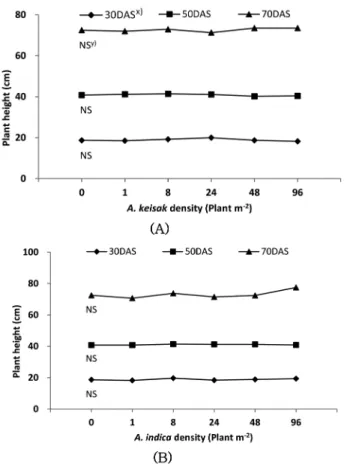
벼 생육에 끼치는 사마귀풀과 자귀풀 경합밀도의 영향 사마귀풀과 자귀풀 경합밀도에 따른 벼의 생육을 보면, 벼의 초장은 두 초종 모두 조사시기에 관계없이 경합밀도 간에 유의적인 차가 인정되지 않아 경합밀도가 높아도 벼 의 초장에는 영향을 미치지 않았다(Fig. 1). 이는 이앙 및 담수직파재배에서 초종별로 경합밀도가 증가하여도 벼의
Fig. 1. Plant height of rice as affected by different densities of
Aneilema keisak (A) and Aeschynomene indica (B) in flooded
direct-seeded rice (
xDAS : Days after seeding,
yNS : Not
significantly different).
초장에는 영항을 미치지 않았다는 보고(Cho et. al., 2006a;
Cho et. al., 2006b; Kim et. al., 2011; Kwon et. al., 2006;
Kwon et. al., 2007; Kwon et. al., 2008; Kwon et. al., 2009; Kwon et. al., 2011; Lee et. al., 2006; Song et. al., 2006; Won et. al., 2010) 와 일치하였다. 벼의 경수는 사마 귀풀과 자귀풀 모두 파종 후 30일에서 경합밀도 간에 유 의적인 차가 인정되지 않아 경합해가 나타나지 않았다. 그 러나 사마귀풀의 경우 파종 후 50일에서는 m
2당 경합밀 도가 96본 이상에서부터, 파종 후 70일에서는 48본 이상 에서부터 유의적으로 감소되었고, 자귀풀의 경우 파종 후 50 일과 70일 모두 m
2당 경합밀도가 48본 이상에서부터 유 의적으로 감소되어 초종별로 벼 생육일수가 경과할수록 경합피해는 크게 나타나는 경향이었다(Fig. 2). 또한 사마 귀풀의 경우 m
2당 경합밀도가 24본, 48본, 96본일 때 파 종 후 50일에서는 4%, 10%, 12%, 파종 후 70일에서는 9%, 17%, 20%가 각각 감소되었고, 자귀풀의 경우 m
2당 경합 밀도가 24본, 48본, 96본일 때 파종 후 50일에서는 9%, 12%, 16%, 파종 후 70일에서는 13%, 19%, 23%가 각각 감소되어 경합밀도가 증가할수록 경수에 대한 경합피해는 크게 나타났다. 한편 초종별로는 자귀풀이 사마귀풀보다 경수 감소 폭이 크게 나타났는데 자귀풀이 사마귀풀에 비 하여 경수에 대한 경합피해가 크게 나타난 원인은 생육초 기부터 초장이 커서 광이나 공간경합이 클 뿐 아니라 동 일 양분에 대한 경합도 커서 벼에 미치는 영향이 컸기 때 문으로 판단된다. 한편 이앙재배에서 잡초경합에 따른 벼 의 경수는 이앙 후 60일에 사마귀풀의 경우 경합밀도가 m
2당 4~192본일 때 7~10%정도, 자귀풀의 경우 m
2당 8~96 본일 때 6~15%정도 감소되었으며(Lee, 2006; Moon et. al., 2006) 건답직파재배에서는 파종 후 70일에 사마귀풀은 경 합밀도가 m
2당 5~100본일 때 4~34%정도 감소되었다고 보 고(Cho et. al., 2006a)하여 동일한 잡초종의 동일 경합밀 도라도 재배양식 간에 차이가 있었다.
Fig. 2. Tiller of rice as affected by different densities of Aneilema keisak (A) and Aeschynomene indica (B) in flooded direct-seeded rice (
xDAS : Days after seeding,
yDMRT : Means followed by the same letter with a column are not significantly different at P < 0.05,
zNS : Not significantly different).
Table 1. Yield components of rice as affected by different densities of weed species in flooded direct-seeded rice.
Weed species Weed density (Plant m
-2) Panicles (No. m
-2) Spikelets per panicle (No.) Ripened grain (%) 1000 grains (g)
Aneilema keisak
0 1 8 24 48 96
432
ax)427
a408
ab396
ab362
b345
b110
NSy)114 109 105 103 102
93.8
ab94.8
a93.2
ab91.4
bc90.7
bc89.4
c20.9
a21.0
a20.8
a20.7
a20.1
b19.8
bAeschynomene indica
0 1 8 24 48 96
432
a429
a394
ab342
bc322
c301
c110
a109
a106
a99
ab94
b90
b93.8
ab92.5
a87.9
b80.6
c75.1
d68.6
e20.9
a20.9
a19.3
b18.5
bc17.9
cd17.2
dx
DMRT : Means followed by the same letter with a column are not significantly different at P<0.05.
y
NS : Not significantly different
벼의 수량 및 수량구성요소에 끼치는 사마귀풀과 자귀풀 경합밀도의 영향
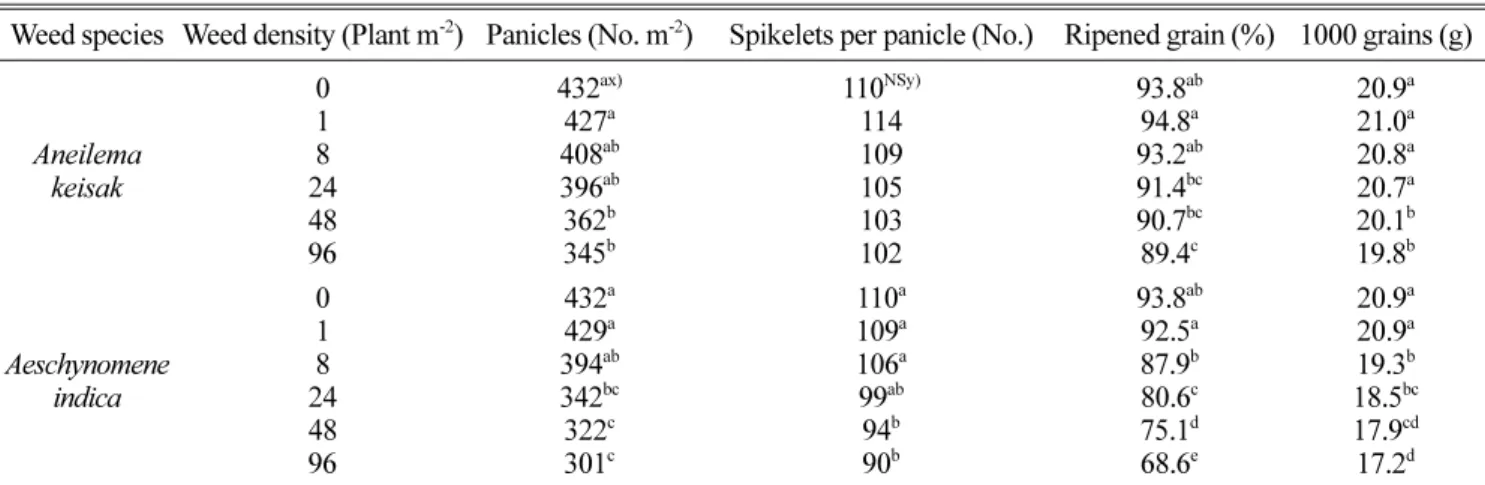
사마귀풀과 자귀풀 경합밀도가 벼의 수량구성요소에 끼 치는 영향은 Table 1에서와 같이, 사마귀풀은 m
2당 경합 밀도가 수수와 현미천립중은 48본 이상에서부터, 등숙비 율은 24본 이상에서부터 유의적으로 감소되었고 수당립수 는 경합밀도 간에 유의적인 차는 인정되지 않았지만 경합 밀도가 증가할수록 감소되는 경향이었으며 자귀풀은 m
2당 경합밀도가 수수는 24본 이상에서부터, 수당립수는 48본 이상에서부터, 등숙비율과 현미천립중은 8본 이상에서부 터 유의적으로 감소되었다. 한편 경합밀도가 m
2당 1~96본 일 때 수량구성요소별 감소정도를 보면, 사마귀풀의 경우 무경합구에 비해 수수는 1~20%, 수당립수는 0~7%, 그리 고 등숙비율과 현미천립중은 0~5%가 감소되어 수량에 미 치는 요인 중 수수>수당립수>등숙비율, 현미천립중 순으 로, 자귀풀의 경우 수수는 1~31%, 수당립수는 1~19%, 등 숙비율은 2~27%, 현미천립중은 0~18%가 감소되어 수수
>등숙비율>수당립수>현미천립중 순으로 영향이 크게 나 타났다. 따라서 초종에 관계없이 경합밀도가 증가함에 따 라 벼의 수량구성요소들 중 수수, 수당립수, 등숙비율 등
이 벼의 수량감소에 가장 크게 영향을 미치는 것으로 나 타났다. Cho et. al. (2006a)은 건답직파재배에서 사마귀풀 은 m
2당 경합밀도가 수수와 등숙비율은 25본 이상에서부 터, 수당립수는 75본 이상에서부터, 천립중은 50본 이상에 서부터 유의적으로 감소되어 수수가 수량에 가장 크게 영 향을 미쳤다고 보고하여 본 시험의 결과와 유사한 경향이었다.
쌀수량은 Fig. 3에서와 같이 m
2당 경합밀도가 사마귀풀 은 24본 이상에서부터, 자귀풀은 8본 이상에서부터 유의 적으로 감소되었다. 또한 무경합구에 비하여 경합밀도가 m
2당 1~96본일 때 사마귀풀은 1~45%, 자귀풀은 3~77%가 감소되어 초종별로는 자귀풀이 사마귀풀보다 감소정도가 크게 나타났다. 사마귀풀은 이앙재배에서 경합밀도가 m
2당 4본에서 6%, 24본에서 16%, 96본에서 24%정도의 수 량이 감소되었으며(Lee, 2006), 건답직파 재배에서 m
2당
Fig. 3. Yield of rice as affected by different densities of Aneilema keisak (A) and Aeschynomene indica (B) in flooded direct-seeded rice (
xDMRT : Means followed by the same letter with a column are not significantly different at P < 0.05).
Table 2. Rice yield in weed-free plot (Y
0) and the competitiveness represented by parameter β, whose reciprocal 1/β is a weed density reducing rice yield by 50% in flooded direct-seeded rice.
Weed species Parameter estimate
R
2Y
0(kg 10a
-1) β
Aneilema keisak Aeschynomene indica
553.2 567.9
0.00913 0.04434
0.912 0.961
Fig. 4. Predicting yield of rice as affected by different densities
of Aneilema keisak (A) and Aeschynomene indica (B)
competition.
경합밀도가 10본 이상에서부터 유의적으로 감소되었고, 경 합밀도가 m
2당 1~96본일 때 5~68%가 감소되었다고 보고 (Cho et. al., 2006a)하여 앞에서 언급하였듯이 동일 초종 이더라도 재배양식에 따라 수량에 미치는 영향이 다르게 나타났다. 한편 Moon et. al.(2006)과 Xiang et. al.(2008)은 초장이 큰 잡초인 자귀풀이나 미국가막사리 및 미국좀부 처꽃의 경우 초장이 작은 잡초들에 비해 벼의 수수와 수 당립수의 감소율이 높아 이들 잡초에 의한 수량 감소 폭 도 각각 73, 75, 21%로 매우 크다고 하였다.
사마귀풀과 자귀풀 경합밀도에 따른 벼 수량 예측모델 및 경제적 방제수준
사마귀풀과 자귀풀 경합밀도에 따른 쌀수량을 수량예측 모델인 Rectangular hyperbolic model(Cousens, 1987)에 적용 하여 비선형 회귀분석을 실시한 결과, 모델계수인 Y
0( 잡초 무발생구 벼수량)와 β(잡초경합력), 1/β(50% 수량감소를 유 발하는 잡초밀도)이 산출되었으며(Table 2) 이에 따른 수 량 예측모델은 Fig. 4에서와 같이 사마귀풀에서는 Y=
553.2 kg/(1+0.00913X)(R
2=0.912)이었고 자귀풀에서는 Y=
567.9 kg/ (1+0.04434X)(R
2=0.961)이었다. 잡초 경합력인 β 는 사마귀풀에서 0.00913, 자귀풀에서 0.04434로 벼와 초 종간 경합력은 자귀풀이 사마귀풀보다 높게 나타났다. 50%
수량감소를 유발하는 잡초밀도인 1/β은 m
2당 사마귀풀은 110본, 자귀풀은 23본으로 추정되었다. 사마귀풀의 경합력 은 이앙재배에서 0.001891이었고(Lee, 2006) 건답직파재배 에서는 0.01681이라고 보고(Cho et. al., 2006a)하여 담수 직파 재배에서는 경합력이 이앙재배에 비하여 약 4.8배정 도 크게 나타났지만 건답직파 재배에 비해서는 약 1.8배 정도 작게 나타났으며 Moon et. al. (2006)은 이앙재배에 서 자귀풀의 경합력은 0.0371이었다고 보고하여 담수직파 재배에서 자귀풀의 경합력은 이앙재배에서보다 약 1.2배 정도 크게 나타났다.
제초제 사용여부 결정을 위하여 산출한 사마귀풀과 자
귀풀의 경제적 방제수준은 Table 3에서와 같다. 각 초종들 의 수량 예측모델을 이용하여 잡초 무발생구 벼 수량과 잡초 1본당 수량감소 비율을 계산하여 Cousens(1987)의 식에 적용한 결과, 초종별 경제적 방제수준은 m
2당 사마 귀풀에서는 3.0본, 자귀풀에서는 0.6본으로 산출되어 사마 귀풀보다 자귀풀이 경합해가 커 경제적 방제수준이 낮게 나타났다. 사마귀풀의 경제적 방제수준은 이앙재배의 경 우 m
2당 12.9본, 건답직파재배의 경우 m
2당 2.4본이라고 보고(Cho et. al., 2006a; Lee, 2006)하여 동일 초종이더라 도 재배양식에 따라 경제적 방제수준이 다르게 나타났으 며 Moon et. al. (2006)은 이앙재배에서 자귀풀의 경제적 방제수준은 m
2당 0.7본이라고 보고하여 본 시험의 결과와 큰 차이가 없었는데 이는 자귀풀이 재배양식에 관계없이 생육초기부터 벼에 비해 초장이 커 광이나 공간견합에 유 리하고 양분 경합력도 컸기 때문으로 생각된다.
요 약
담수직파재배에서 사마귀풀과 자귀풀 경합밀도에 따른 벼 수량감소 정도를 예측하고 제초제 사용여부 결정을 위 한 경제적 방제수준을 설정하여 저투입, 친환경적인 정밀 잡초관리 체계를 확립하고자 시험을 수행하여 얻어진 결 과는 다음과 같다. 쌀수량 감소정도는 사마귀풀의 경우 경 합밀도가 m
2당 8본일 때 8%, 96본일 때 45% 이었고 자 귀풀의 경우 m
2당 8본일 때 20%, 96본일 때 77% 이었다.
벼와 잡초의 경합에 따른 쌀수량 예측모델은 사마귀풀의 경우 Y=553.2 kg/(1+0.00913X) R
2=0.912 이었고 자귀풀의 경우 Y=567.9 kg/(1+0.04434X) R
2=0.961 이었다. 초종별 경 제적 방제수준은 사마귀풀의 경우 m
2당 3.0본 이었고, 자 귀풀의 경우 m
2당 0.6본 이었다.
주요어: 자귀풀, 사마귀풀, 담수직파 Table 3. Economic threshold level of weed species calculated using cousens
,equation in flooded direct-seeded rice.
Variable name Aneilema keisak Aeschynomene indica Herbicide cost (Won, Ch)
Herbicide treatment cost (Won, Ca) Weed free crop yield (kg 10a
-1, Y) Crop price/milled rice 1 kg (Won, P) Yield loss rate/weed (L)
Herbicide efficacy (K)
15,028 9,936 553.2 1,738 0.009047
0.95
15,028 9,936 567.9 1,738 0.042457
0.95
Economic threshold
a)(plant m
-2) 3.0 0.6
a