Received October 29, 2015, Revised November 30, 2015, Accepted November 30, 2015 Corresponding author: Chang Woo Han
School of Korean Medicine, Pusan National University, 49, Busandaehak-ro, Yangsan 50612, Korea Tel: +82-55-360-5957, Fax: +82-50-4181-6118, E-mail: [email protected]
This work was supported by clinical research grant from Pusan National University Hospital 2015.
CCThis is an open access article distributed under the terms of the Creative Commons Attribution Non-Commercial License (http://creativecommons.org/licenses/ by-nc/4.0) which permits unrestricted non-commercial use, distribution, and reproduction in any medium, provided the original work is properly cited.
보르테조밉으로 유발된 말초신경병증에 대한 장기간의 침치료 증례 보고
김소연1,2ㆍ최준용1,2ㆍ윤영주1,2ㆍ박성하1,2ㆍ한창우1,2
1부산대학교 한의학전문대학원, 2부산대학교한방병원 한방내과
A Case Report of Long-term Acupuncture Treatment in Bortezomib Induced Peripheral Neuropathy
So Yeon Kim1,2, Jun Yong Choi1,2, Young Ju Yun1,2, Seong Ha Park1,2, Chang Woo Han1,2
1School of Korean Medicine, Pusan National University,
2Department of Internal Medicine, Pusan National University Korean Medicine Hospital
Objectives : We present a successful administration of acupuncture in alleviating persistant peripheral neuropathy due to bortezomib, a potent therapeutic agent of mutlple myeloma. Methods : A patient, experiencing numbness, coldness, tingling and weakness in her feet and hands after bortezomib treatment, was administered acupuncture for 32 weeks, 3 times/week for first 4 weeks and 2 times/week the last 28 weeks, in bilateral acupuncture points, ST36, ST40, EX-LE10, LI11, TE5, and EX-UE9.
Responses were assessed at the end of every 4 weeks with Eastern Cooperative Oncology Group(ECOG) grading system, National Cancer Institute - Common Toxicity Criteria(NCIC-CTC) v4.0, Numeric Rating Scale(NRS) 0-10, and Neuropathy Pain Scale (NPS).
Results : ECOG was improved from 2 to 1, NCIC-CTC from 2 to 1, NRS from 8 to 1, and NPS from 41 to 5 through 32 weeks of acupuncture treatment. Conclusions : It is conceivable that acupuncture can be a help to relieve bortezomib induced peripheral neuropathy.
Key words : acupuncture, bortezomib, peripheral neuropathy, multiple myeloma
서 론
다발성 골수종(multiple myeloma)은 전체 악성 종양의 4% 정 도를 차지하는 형질세포(plasma cell) 기원 종양이다1). Bortezomib 은 다발성 골수종에 많이 사용되는 효과적인 치료제의 하나지만, 부작용으로 심각한 말초신경병증(peripheral neuropathy)을 유발 하는 단점이 알려져 있다2). 말초신경병증은 투약자의 약 80%에서 발생하고2), 투약을 종료하면 일반적으로 평균 1.5∼4개월 사이에
호전되지만, 일부 환자에서는 수년 이상 지속되기도 한다3). Bortezomib 에 의해 유발된 말초신경병증은 주로 감각 신경을 침범하여, 감작 스런 통증, 저림이나 둔함, 통각 과민, 이상통증 등이 유발된다2). 발목관절 및 손목관절 이하의 말단 부위에서 잘 나타나고, 손보다 는 발에서 뚜렷하며, 통증 점수가 평균 7.8/10 정도로 표현되는 강 력한 통증이 나타난다4). 일부 환자에서는 건반사가 감소하고, 고유 감각(proprioception) 및 운동 신경 이상이 동반되기도 한다2). Bortezomib에 의한 말초신경병증의 치료에는 마약제(narcotics),
항우울제, 항경련제, 또는 비타민제 등이 사용되고 있으나, 이러한 약물들은 일시적 완화만을 목적으로 하며, 한편으로는 진정 (sedation), 구강건조증, 변비 등의 부작용을 유발하여, 효과적인 다른 치료법에 대한 임상적 필요성이 높은 실정이다2).
국내외 논문 검색 결과 bortezomib에 의한 말초신경병증 환자를 대상으로 침치료를 시행한 기존 연구로는 단일 증례 보고 2건5,6), 연속 증례보고 1건7), 단일군 연구(single-arm study) 1건8)으로 총 4건의 논문이 발표된 바 있으며, 4개의 연구 모두에서 양호한 치료 경과 보고하여 침치료가 효과적인 치료법으로 활용될 수 있음을 시사하였다. 그러나, 수개월 이상 지속되는 질환의 특징에 비하여, 4건의 기존 보고에서는 수 주 이내의 관찰 초기에 침치료가 집중되 어져 있었고, 총 치료 횟수도 최대 15회를 넘지 않았다. 또한, 4건 모두 해외에서 이루어진 연구로서 국내에서는 아직 관련 보고가 없었다. 이에 저자는 bortezomib에 의한 말초신경병증 환자 1례를 대상으로 약 8개월 간 주 2회 이상 규칙적 치료를 시행하며 경과 기록 중 뚜렷한 임상적 호전을 관찰하여 이에 보고하는 바이다.
증 례
1. 환자 병력
환자는 69세의 여성으로, 평소 별다른 과거력은 없었으며, 약 1년 8개월전 건강검진 상 발견된 단백뇨로 인하여 신장내과 및 혈 액종양내과에서 관련 진료 및 검사 시행 후 다발성 골수종(multiple myeloma)으로 진단 받았다. 항암화학요법으로 mephalan 및 prednisolone과 함께 bortezomib을 투약 받았고, 6주 간격으로 9주기(6 week/cycle×9 cycles)에 걸친 치료를 완료하였으며, 완 전 관해(complete response) 되었다.
손발저림은 항암화학요법 2주기 8일차(치료 시작으로부터 8주 차)에 발생하여, 치료 기간 중 점점 악화되었다. 손발저림이 발생한 후 gabapentin, pyridoxine hydrochloride, mecobalamin, ami- triptyline 복용하였고, 통증이 심한 기간에는 hydromorphone hydrochloride 또는 oxycodone hydrochloride 복용하였으나, 복 용한 약물들에 의해 증상이 뚜렷하게 개선되지는 않았다고 하였다.
항암치료가 종료된 이후에도 증상은 지속되었으며, 항암치료 후 약 5개월 간 gabapentin, pyridoxine hydrochloride, mecobalamin 유지하며 경과 관찰하였으나 증상 개선되지 않아 침치료 원하여 내원하였다.
2. 치료 방법
말초신경병증 개선을 위해 복용하고 있던 gabapentin(100 mg 3회/일), pyridoxine hydrochloride(50 mg 3회/일), mecobalamin (500 μg 3회/일)는 유지하면서, 침치료를 함께 시행하였다. 침치 료는 면허취득 및 임상경험이 10년 이상 경과한 한의사에 의해 지 속적으로 시행되었다. 혈위(acupuncture point)는 족삼리(ST36), 풍륭(ST40), 팔풍(EX-LE10), 곡지(LI11), 외관(TE5), 팔사(EX- UE9) 를 선택하였고, 모두 양측에 취혈하였다. 침은 0.20×40 mm 규격 의 일회용 멸균침(한국, 동방침구제작소)을 관침법을 이용하여 시 술하였다. 깊이는 부위에 따라 0.5∼2 cm 정도의 깊이로 자입하였 고, 자입 중 득기가 유발되면(뻐근하거나 찌릿한 느낌 등을 표현하 도록 함), 20분간 유침 후 발침하였다. 별도의 수기법은 사용하지 않았다. 첫 4주 동안은 주 3회 시행하였으며, 5주차부터 종료 시까 지 주 2회 시행하였다.
3. 치료 경과
환자의 활동 능력 정도(performance status)는 Eastern Coo- perative Oncology Group(ECOG) grading system9)으로 평가하 였다. 신경병증(neurotoxicity)의 정도는 National Cancer Institute- Common Toxicity Criteria(NCIC-CTC) v4.010)으로 평가하였다.
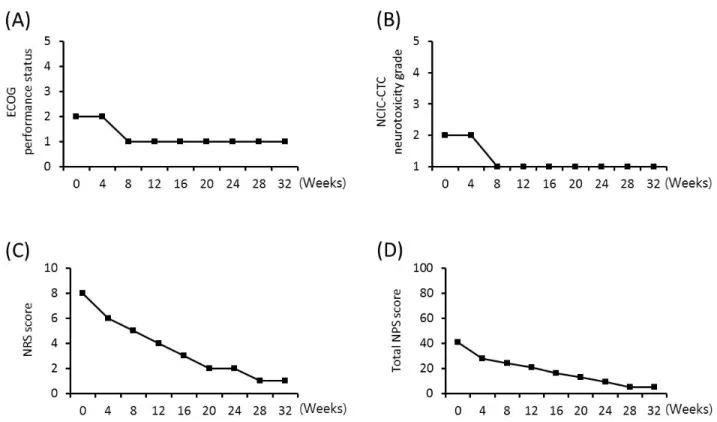
환자의 자각적 불편감 정도는 Numeric Rating Scale(NRS) 0-1011), Neuropathy Pain Scale(NPS)12)로 평가하였다. 평가는 4주 간격으 로 시행하였으며, 주관적인 증상의 표현이나 침치료 후 이상 증상 은 매번 내원 시 확인하였다. 치료 기간 중 각 평가 지표들의 변화 는 Fig. 1에 요약하였다.
내원 당시 팔과 다리에 저림, 시림, 통증이 있고, 손끝이 무디며, 발바닥은 감각이 떨어져 있다고 하였다. 단추를 채우거나, 젓가락 질 같은 정밀한 동작이 다소 불편하고, 걷기가 힘들며, 온몸에 힘이 없다고 하였다. 증상은 손(손목관절 이하)과 발(발목관절 이하)에서 뚜렷하였고, 특히 손에 비하여 발에서 뚜렷하였다. 양측 아킬레스 건 반사가 저하되어 있었다. ECOG grade 2, NCIC-CTC v4.0 grade 2, NRS 8, NPS 41로 평가되었다.
첫 4주간 주3회 침치료를 시행하였다. 첫 4주 후 저림이 조금 감소하고, 손발이 약간 따듯해지는 것 같다고 표현하였다(처음과 비교하여 NRS 8에서 6으로 감소). 5주차부터는 주2회 침치료를 시행하였다. 8주차 평가에서는 단추를 잠그는 동작이나 젓가락질 같은 동작이 정확해지고, 주방일이나 가벼운 청소 등이 좀 더 편하 게 되었다고 표현하였다(처음과 비교하여 ECOG grade 2에서 1로 감소, NCIC-CTC v4.0 grade 2에서 1로 감소). 12주차 평가에서는 전반적인 통증이나 불편감이 반 정도로 감소한 것 같다고 표현하였
Fig. 1. Change of Peripheral Neuropathy through Acupuncture Treatment.
The severity was assessed at the end of every 4 weeks with (A) Eastern Cooperative Oncology Group(ECOG) performance status, (B) National Cancer Institute-Common Toxicity Criteria(NCIC-CTC) v4.0 neurotoxicity grade, (C) Numeric Rating Scale(NRS) 0-10, and (D) Neuropathy Pain Scale(NPS).
다(처음과 비교하여 NRS 8에서 4로 감소, NPS 41에서 21으로 감 소). 16주차에는 발바닥에 무엇인가 달라 붙어있던 것처럼 느껴지 던 증상이 없어져, 걸음걸이가 훨씬 자연스러워졌다고 표현하였다 (처음과 비교하여 NRS 8에서 3으로 감소, NPS 41에서 16으로 감 소). 치료 기간이 경과할수록 증상은 점진적으로 개선되었으나, 반 응 속도는 점점 낮아졌으며, 28주차에서는 NRS 1, NPS 5로 조금 더 증상 개선되었다. 환자가 느끼는 불편감 매우 낮아졌으나 침치 료에 의한 증상 개선이 점차 미미하게 느껴진다고 하여 32주차에 치료를 종료하였다. 말초신경병증 개선을 위해 복용하고 있던 약물 들(gabapentin, pyridoxine hydrochloride, 및 mecobalamin)은 치료 종료 시까지 종류와 용량을 동일하게 유지하였으며, 치료 기 간 중 침치료 후 출혈에 의한 자반이 수차례 발생한 것으로 제외하 면 별다른 이상 반응은 없었다(Fig. 1).
고 찰
말초신경병증을 주로 유발하는 항암제로는 platinum compounds
(cisplatin, carboplatin, and oxaliplatin), spindle poisons/
antitubulins(paclitaxel, docetaxel, ixabepilone, and vincri- stine), proteasome inhibitors(bortezomib) 등이 있다. 약물에 따 라 dorsal root ganglial neuronal cell body change, demyeli- nation과 axonal damage, axon terminal에서의 ion channels의 변화, neurotransmitters와 그 receptors의 변성, mitochondrial DNA(mtDNA) damage에 의한 mitochondrial dysfunction 등의 기전이 신경 손상에 관여하는데, bortezomib은 주로 demyelination 과 axonal damage를 유발하는 것으로 알려져 있다13).
항암제로 유발된 말초신경병증(Chemotherapy induced peri- pheral neuropathy; CIPN) 환자에 대한 침치료 임상연구로는, CIPN 환자 5명에게 침술을 시행한 연속증례보고14), 침술을 받은 CIPN 환자에 대한 후향적 조사15), CIPN 환자에서의 침술 효과 확 인을 위한 예비 연구16) 등이 보고된 바 있고, CIPN에 대한 봉독약 침17)이나 전침18)의 효능에 대한 연구도 있었다. 이들 연구들은 모 두 침치료가 항암제로 유발된 말초신경병증에 대해 일정 정도의 효과를 나타내는 것으로 보고하고 있으나, 침술의 유효성을 단정하 기는 위해서는 향후 대규모 전향적 대조군 연구가 필요할 것으로
생각되고, 또한, 항암제 마다 신경병증 유발 기전 및 임상 경과에 차이가 있으므로13), 신경병증에 대한 침치료의 효과도 유발 항암제 마다 차이가 있을 것으로 생각된다.
기존의 실험연구를 통해 알려진 바에 의하면, 말초신경병증에 대한 침의 효능은 nerves, hormones, cytokines 및 다른 mediators 들이 작용하는 매우 복잡한 기전에 의해 나타나는 것으로 추정된 다19). 침치료는 neurotrophins, nerve growth factor(NGF), gli- alderived neurotrophic factor(GDNF), brain-derived neurot- rophic factor(BDNF) 및 insulin growth factor(IGF)를 포함한 다 양한 growth factors의 변화를 유발하고, GABA-ergic, sero- toninergic, 및 adrenergic neurotransmission을 증폭하여 통증에 대한 sensory neuron의 민감도를 감소시키며, cell homeostasis에 관여하는 다양한 transcriptional factors의 발현을 조절하는 것으 로 알려져 있다19).
상기한 바와 같이, 4건의 기존 연구(단일 증례 2건, 연속 증례 1건, 단일군 연구 1건)에서 침치료가 bortezomib에 의한 말초신경 병증 환자에서 증상을 완화시켰다고 보고한 바 있다. 그러나, 국내 에서는 본 증례가 bortezomib으로 유발된 말초신경병증에 대해 침 치료를 시행하며 관찰한 최초의 보고로 판단되며, 또한 검색된 기 존 국외 연구들 중에는 본 증례에서처럼 장기간 규칙적 침치료를 시행하며 증상의 변화를 평가한 보고는 없었다. 한편, bortezomib 으로 인한 말초신경병증이 투약 종료 후 자연 호전될 수 있고, 치료 가 장기간 진행된 것을 고려하면, 관찰된 효과의 일부는 자연 경과 에 의한 것으로도 추정할 수 있다. 그러나, bortezomib으로 인한 말초신경병증이 일부 환자에서는 수년간 지속될 수 있으며, 자연 호전이 주로 초기 수개월 사이에 일어나는 것에 비하여, 본 증례에 서는 투약 종료 후 5개월간 뚜렷한 차도가 없었다. 특히, 오랜 기간 유지되었던 증상이 치료 시작 후 초기 2∼3개월에 급격히 완화된 점을 고려하면, 본 증례에서는 침치료가 증상 완화의 주요 원인이 었을 것으로 판단하는 것이 타당하다고 생각된다.
한편, 가장 합리적인 혈위과 침법을 선정하기 위하여 관련 임상 연구들을 조사하였으나, 기존 CIPN 대상 침치료 연구들에서 혈위 및 침법이 너무 다양하여20), 본 증례에서는 침치료 시 기존 연구들 에서 비교적 다빈도로 사용되었던 혈위20)를 선정하였고, 침법은 일 반적 방법을 따랐다. 향후 선혈 및 침법에 대한 한의학적 기준 설정 과 임상연구를 통한 검증이 필요할 것으로 생각된다.
결 론
Bortezomib 투약 후 수개월간 말초신경병증이 지속되었던 다발 성 골수종 환자 1명에 대하여, 32주간 지속적 침치료를 시행하며 관찰한 결과, ECOG performance status 2에서 1, NCIC-CTC neuropathy grade 2에서 1, NRS 8에서 1, NPS 41에서 5로 감소 하였다.
감사의 글
This work was supported by clinical research grant from Pusan National University Hospital 2015.
References
1. Becker N. Epidemiology of multiple myeloma. Recent Results Cancer Res. 2011 ; 183 : 25-35.
2. Argyriou AA, Iconomou G, Kalofonos HP. Bortezomib-induced peripheral neuropathy in multiple myeloma: a comprehensive review of the literature. Blood. 2008 ; 112(5) : 1593-9.
3. Cavaletti G, Jakubowiak AJ. Peripheral neuropathy during bor- tezomib treatment of multiple myeloma: a review of recent studies. Leuk Lymphoma. 2010 ; 51(7) : 1178-87.
4. Cata JP, Weng HR, Burton AW, Villareal H, Giralt S, Dougherty PM. Quantitative sensory findings in patients with bortezo- mib-induced pain. J Pain. 2007 ; 8(4) : 296-306.
5. Bao T, Zhang R, Badros A, Lao L. Acupuncture treatment for bortezomib-induced peripheral neuropathy: a case report. Pain Res Treat. 2011 ; 2011 : 920807.
6. Mandiroglu S, Cevik C, Ayli M. Acupuncture for neuropathic pain due to bortezomib in a patient with multiple myeloma.
Acupunct Med. 2014 ; 32(2) : 194-6.
7. Bao T, Medeiros M, Zhang R, Dorsey SG, Badros A. Improvement of Painful Bortezomib-Induced Peripheral Neuropathy Follo- wing Acupuncture Treatment in a Case Series of Multiple My- eloma Patients. Med Acupunct. 2012 ; 24(3) : 181-7.
8. Bao T, Goloubeva O, Pelser C, Porter N, Primrose J, Hester L, et al. A pilot study of acupuncture in treating bortezomib-induced
peripheral neuropathy in patients with multiple myeloma.
Integr Cancer Ther. 2014 ; 13(5) : 396-404.
9. Eastern Cooperative Oncology Group. ECOG Performance Status. [cited 2015 Oct 25]. Available from: http://ecog-acrin.
org/resources/ecog-performance-status
10. National Cancer Institute. Common Terminology Criteria for Adverse Events (CTCAE) v4.0. [cited 2015 Oct 25]. Available from: http://evs.nci.nih.gov/ftp1/CTCAE/CTCAE_4.03_2010-06-14_
QuickReference_5x7.pdf
11. National Institutes of Health – Warren Grant Magnuson Clinical Center. Pain Intensity Instruments. [cited 2015 Oct 25]. Available from: http://www.webcitation.org/6Ag75MDIq
12. Galer BS, Jensen MP. Development and preliminary validation of a pain measure specific to neuropathic pain: the Neuropathic Pain Scale. Neurology. 1997 ; 48(2) : 332-8.
13. Han Y, Smith MT. Pathobiology of cancer chemotherapy- in- duced peripheral neuropathy (CIPN). Front Pharmacol. 2013 ; 4 : 156.
14. Wong R, Sagar S. Acupuncture treatment for chemotherapy- in- duced peripheral neuropathy--a case series. Acupuncture in medicine. 2006 ; 24(2) : 87-91.
15. Donald GK, Tobin I, Stringer J. Evaluation of acupuncture in the
management of chemotherapy-induced peripheral neuropathy.
Acupunct Med. 2011 ; 29(3) : 230-3.
16. Schroeder S, Meyer-Hamme G, Epplee S. Acupuncture for che- motherapy-induced peripheral neuropathy (CIPN): a pilot study using neurography. Acupunct Med. 2012 ; 30(1) : 4-7.
17. Yoon J, Jeon JH, Lee YW, Cho CK, Kwon KR, Shin JE, et al. Sweet bee venom pharmacopuncture for chemotherapy-induced pe- ripheral neuropathy. J Acupunct Meridian Stud. 2012 ; 5(4) : 156-65.
18. Rostock M, Jaroslawski K, Guethlin C, Ludtke R, Schroder S, Bartsch HH. Chemotherapy-induced peripheral neuropathy in cancer patients: a four-arm randomized trial on the effective- ness of electroacupuncture. Evid Based Complement Alternat Med. 2013 ; 2013 : 349653.
19. Franconi G, Manni L, Schroder S, Marchetti P, Robinson N. A systematic review of experimental and clinical acupuncture in chemotherapy-induced peripheral neuropathy. Evid Based Complement Alternat Med. 2013 ; 2013 : 516916.
20. Han CW. Acupuncture in chemotherapy-induced peripheral neuropathy : a review. Journal of PNU Korean Medicine Hos- pital. 2014 ; 3 :1-6.