1. Introduction
Asian monsoon and ENSO cycle are two important subsystems of the global climate system. As well known, monsoon is a kind of climatic phenomenon, in which dominant wind system changes with seasons. Since East Asian summer monsoon can bring a large amount of water vapor from the Pacific Ocean and the Indian Ocean to East Asia, a large amount of
rainfall can be formed in the East Asia monsoon region (e.g., Zhu, 1934; Tu and Huang, 1944; Tao and Chen, 1987; Ding, 1994;
Huang et al., 1998). Because of the close relationship between monsoon and rainfall, East Asian monsoon variability influences economy, industry, agriculture and daily life of people in the region, especially droughts and floods caused by monsoon have brought heavy economic loss in this region including China, Korea and Japan.
Abstract
Recent advances in the studies on the interaction between Asian monsoon and ENSO cycle are reviewed in this paper. Through the recent studies, the East Asian summer monsoon circulation system and the East Asian climate system have proposed. Moreover, different responses of the (winter and summer) monsoon circulation and summer rainfall anomalies in East Asia to ENSO cycle during its different stages have been understood further. Recently, the studies on the dynamical effect of East Asian monsoon on the thermal variability of the tropical western Pacific and ENSO cycle have been greatly advanced. These studies demonstrated further that ENSO cycle originates from the tropical western Pacific, and pointed out that the dynamical effect of East Asian winter and summer monsoons on ENSO cycle may be through the atmospheric circulation and zonal wind anomalies over the tropical western Pacific, which can excite the oceanic Kelvin wave and Rossby waves in the equatorial Pacific. Besides, the scientific problems in the interaction between Asian monsoon and ENSO cycle, which should be studied further in the near future, are also pointed out in this paper.
Key words: Asian summer monsoon Asian winter monsoon the tropical western Pacific
ENSO cycle
Interaction among the East Asian Summer and Winter Monsoons, the Tropical Western Pacific and ENSO Cycle
Rong-Hui Huang, Ri-Yu Lu, Wen Chen and Ji-Rong Chen
LASG, Institute of Atmospheric Physics, Chinese Academy of Sciences, Beijing 100080, China
For example, every year of the 1980’s and 1 9 9 0’s, the flood and drought disasters caused the economic loss of about 200 billion RMB yuans, approximately 3%~6% of GDP of China, especially the extremely severe flood occurred in the summer of 1998 had caused the economic loss of about 260 RMB yuans in the Yangtze River valley (e.g., Huang et al., 1998;
Huang and Zhou, 2002).
Asian monsoon is an important component of global climate system, and it is also a huge monsoon system including East Asian and South Asian monsoon subsystems (e.g., Tao and Chen, 1987). Li and Yanai’s (1996) investigation showed that the Asian summer and winter monsoons exhibit the characteristics of annual cycle in both the wind fields and temperature fields. Chen et al. (2002) also pointed out that the East Asian summer and winter monsoons are also a phenomenon of annual cycle in both the wind fields and rainfalls. In East Asia, there are many typical weather and climate systems in different seasons, such as the Meiyu in China, the Changma in Korea and the Baiu in Japan in summer, persisting northwesterly winds and cold surges in winter. The East Asian summer monsoon is characterized as the strong southerly wind and strong rainfall in East Asia, while the winter monsoon features the strong northerly winds over East Asia, and strong cold surges can move southward along the coast of East Asia, the South China Sea to the Indo-China Peninsula (e.g., Staff members of Academia Sinica, 1957; Chen et al., 1991; Ding, 1994).
Since the intraseasonal, interannual and interdecadal variabilities of East Asian monsoon
are remarkable and can cause droughts and floods in the eastern part of China, Korea and Japan, the different time-scale variabilities of East Asian monsoon have been important scientific issues in China, Korea and Japan.
Recently, studies on these time-scale variations and their causes, especially the East Asian climate system on the interannual and intraseasonal time-scales, have been greatly advanced (e.g., Huang et al., 2003).
As another subsystems of the global climate system, ENSO cycle can be considered as the most important phenomenon in the tropical air- sea interaction. When an ENSO event occurs in the equatorial Pacific, severe climate anomalies will be caused in many regions of the world (e.g., Horel and Wallace, 1981; Rasmusson and Carpenter, 1982, 1983). Moreover, investigations have shown that ENSO cycle greatly influences South Asian monsoon (e.g., Mooley and Parthasarathy, 1983; Khandekar and Neralla, 1984). They found that a weak Asian summer monsoon tends to occur in an El Nin ˜o y e a r . Similarly, ENSO cycle also has a large impact on climate anomalies in East Asia (e.g., Fu and Teng, 1988; Huang and Wu, 1989; Huang and Zhou, 2002).
Many studies showed that ENSO phenomenon is not only an event but also a cycle (e.g., Bjercknes, 1966; McCreay, 1983;
Schopf and Suarez, 1988). Recently, the
interaction between the Asian summer and
winter monsoon cycle and ENSO cycle has
become an interesting scientific problem. The
diagnostic and modeling studies have revealed
that Asian summer monsoon activities have a
significant effect on the atmosphere/ocean
coupled system in the equatorial Pacific (e.g., Yamagata and Matsumoto, 1989; Yasunari, 1990; Yasunari and Seki, 1992). Moreover, Li (1988,1990) pointed out that the strong East Asian winter monsoon activities play an important triggering effect on El Ni n ˜o event.
As mentioned above, many valuable advances of the studies on the interaction between monsoon and ENSO have been achieved, and Webster et al. (1998) have made a systematic review. However, since the review by Webster et al. (1998) focused the Asian-Australian monsoon system and ENSO, the role of East Asian monsoon and the tropical western Pacific in the interaction between monsoon and ENSO have not been emphasized in their paper.
Therefore, in this paper, the recent studies on the interaction among the East Asian summer and winter monsoon and ENSO cycle are r e v i e w e d .
2. The East Asian Monsoon System and Its Interannual Variability
In order to understand the interaction among East Asian monsoon system, the tropical western Pacific and ENSO cycle, it is necessary to realize the components of the East Asian monsoon system and the interannual variability of this system.
2.1 The East Asian summer monsoon (EASM) circulation system
It may be considered as an important progress in the study on East Asian monsoon to realize its components. Krishnamurti (1982)
proposed the Indian monsoon circulation system.
Later on, Tao and Chen (1985) put forward the East Asian summer monsoon (EASM) circulation system. The East Asian summer monsoon circulation system includes: the monsoon trough over the South China Sea and the tropical western Pacific, the Indian SW monsoon flow, the cross-equatorial flow along the east to 100°E, the western Pacific subtropical high and the tropical easterly flow, the disturbances in mid-latitudes, the Mei-Yu frontal zones (or the Baiu in Japan and Changma in Korea), and the cold anticyclone in Australia.
2.2 Interannual variability of the EASM
The interannual variability of the EASM is remarkable. Recent studies (e.g., Huang et al.
1998; Huang and Zhou, 2002) have shown that
due to the great interannual variability of the
EASM, there is an obvious interannual
variability of the summer monsoon rainfall in
the Yangtze River valley and the Huaihe River
valley, an area between the Yangtze River and
the Huaihe River, North China and South
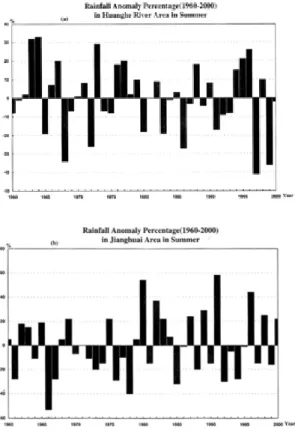
China. Figures 1(a) and (b) are the interannual
variations of summer rainfall anomaly
(percentage) in North China and the Yangtze
River and Huaihe River valley, respectively. The
interannual variations and summer monsoon
rainfall in these regions from 1978 are
emphasized because the observed data of high
cloud amount over the tropical western Pacific
are available from 1978. It may be clearly seen
from Fig. 1(b) that in the summers of 1978,
1981, 1985, 1988, 1991 and 1994, the monsoon
rainfalls were below normal and severe droughts occurred in the Yangtze River and Huaihe River valley, but in the summers of 1980, 1982, 1983, 1987, 1989, 1991, 1992, 1995, 1996, 1998 and 1999, the summer rainfalls were above normal and floods occurred there.
It may be also seen from Fig. 1(a) that the interannual variation of summer rainfall is significant in North China. After 1978, the rainfalls were below normal and severe droughts
occurred in the summers of 1979, 1980, 1981, 1983, 1985, 1986, 1987, 1989, 1991, 1992, 1997, 1999 and 2000 in this region. Compared Fig.
1(a) with Fig. 1 (b), it is clearly shown that after 1978, the flood summers frequently appeared in the Yangtze River and Huaihe River valley, but drought summers frequently appeared in North China. Thus, the interannual variations of summer rainfall in these two regions seem to be opposite. Due to this variability, drought and flood disasters frequently occur in East Asia, especially in the area from the Yangtze River valley to South Japan through South Korea.
2.3 The Quasi-Biennial Oscillation of Summer Monsoon Rainfall in China and its Surrounding R e g i o n s
The quasi-biennial oscillation of summer monsoon rainfall in the East Asian monsoon region has been widely investigated (e.g., Yasunari, 1989; Lau and Shen, 1992).
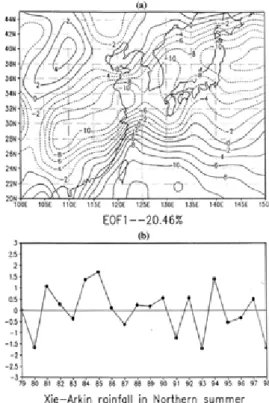
In order to reveal the regularity of interannual variations of summer monsoon rainfall in China and its surrounding regions, the Empirical Orthogonal Function (EOF) analysis method is applied to determine the dominant spatial and temporal patterns of interannual variability of summer monsoon rainfalls in China and surrounding regions. Figures 2a and b are the spatial distribution and corresponding time- coefficient series of the first component of EOF analysis (EOF1) of summer rainfall in China.
As shown in Fig. 2a, the spatial distribution of EOF1 of monsoon summer rainfalls appears a meridional triple pattern, the large-scale strong
Figure 1. Interannual variations of the summer monsoon rainfall anomalies (percen-tage) in the Yangtze Rivera and Huaihe River valley (a) and North China (b) from 1961-2000, analyzed using the dataset of daily precipitation at 598 observational stations in China.
negative rainfall anomaly signal is in the Yangtze River valley and the large-scale positive rainfall anomaly signals are in South China and North China, respectively. The corresponding time-coefficient series shown in Fig.2b obviously exhibit a prevailing quasi- biennial oscillation from the mid-1970’ s up to the late 1990’ s, but the quasi-biennial oscillation was not obvious from the 1950’ s to the mid- 1 9 7 0’s .
As metioned above, there is an obvious quasi-biennial oscillation of the summer monsoon rainfall in East China, especially in the Yangtze River and the Huaihe River valley.
The interannual variability of summer monsoon rainfall in Korea and Japan is similar to that in the Yangtze River and Huaihe River valley of China. In order to investigate the linkage between the interannual variations of summer rainfall in China and those in Korea
Figure 2. Spatial distributions (a) and corresponding time-coefficient series (b) of the first component of EOF analysis (EOF1) of the summer rainfall in China, analyzed using the dataset of monthly precipitation at 160 observational stations in China from 1951 to 1 9 9 9 .
Figure 3. Spatial distribution (a) and corresponding time-coefficient series (b) of the first component of EOF analysis (EOF1) of the summer rainfall over East Asia and the tropical western Pacific, analyzed using the dataset of monthly precipitation based on gauge observations and satellite-estimates (Xie and Akin, 1 9 9 7 )
and Japan, the dataset of precipitation analyzed by Xie and Akin (1997) for 20 summers from 1979 to 1998 (e.g., added to new data) and the EOF analysis method are used. Figures 3a and 3b are the spatial distribution and the corresponding time-coefficient series of the EOF1 of summer rainfall in China and its surrounding regions, respectively. It may be found from Fig. 3a that the spatial distribution of summer rainfall signal also exhibits a meridional triple pattern, the large-scale negative rainfall anomaly signal is in the area from Japan, Korea to the Yangtze River valley of China, and the large-scale positive rainfall anomaly signal is in the area from the tropical western Pacific, the South China Sea and South China to the Indo-China Peninsula, and another weaker positive rainfall signal is in North China. This pattern features that the large-scale rainfall signal in the Yangtze River valley of China is the same as that in Korea
and Japan and the opposite to that in the tropical western Pacific and Southeast Asia.
The investigation by Lu et al. (1995) also showed that the interannual variation of summer rainfalls in the Yangtze River and Huaihe River valley is generally similar to that in Korea. Moreover, Fig. 3b also exhibits a feature of the quasi-biennial oscillation in the interannual variations of summer rainfall in East Asia and the tropical western Pacific.
From the above-mentioned results, the interannual variations of summer rainfall in the eastern part of China, Korea and Japan exhibit the characteristic of quasi-biennial oscillation.
3. The East Asian Climate System and the Interannual Variability of EASM
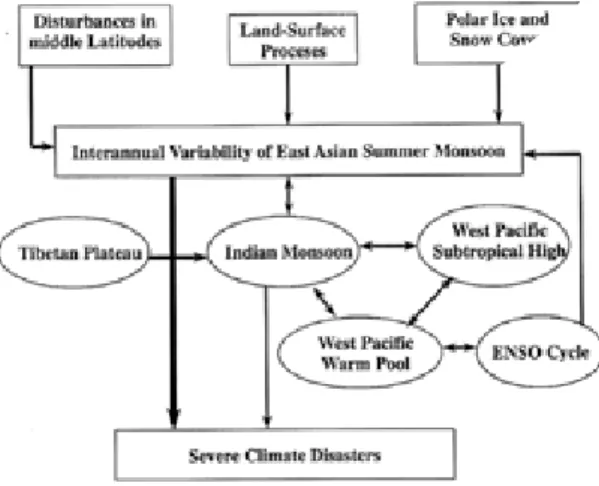
As pointed out by Huang et al. (2003), the interannual variability of the EASM is influenced by many factors shown schematically in Fig. 5. These factors include the Indian monsoon, the western Pacific subtropical high, and the disturbances in mid-latitudes in the atmosphere, the West Pacific warm pool, and ENSO in the tropical Pacific, the Tibetan Plateau, the polar ice and the Eurasian snow cover and land-surface processes etc. Huang et al. (2003) suggested that these factors can be considered as the components of a system that may be called as the East Asian climate system. This East Asian climate system suggested by Huang et al. (2003) is an extension of the East Asian monsoon circulation system proposed by Tao and Chen (1985).
Because the components of this system are complex, only the studies on the main
Figure 4. Schematic map for the components of the East Asia climate system influencing the interannual variability of the EASM.
components that affect the interannual variability of EASM will be reviewed in this s e c t i o n .
3.1 Dynamical and thermal effects of the Tibetan Plateau on the interannual variations of the Asian summer monsoon
The Tibetan Plateau has an important dynamical effect on the interannual variability of the Asian summer monsoon. Hahn and Manabe (1975) pointed out from the numerical simulations with the GFDL 9-layer GCM that due to the dynamical effect of the Tibetan Plateau, the strong southwesterly flow can extend to East Asia from the Bay of Bengal and the Indo-China Peninsula. Ye and Gao (1979) first put forward the thermal effect of the Tibetan Plateau on Asian summer monsoon. Later on, Nitta (1983), Luo and Yanai (1984), and Huang (1984, 1985) pointed out that the heating anomaly over the Tibetan Plateau has a large impact on the summer atmospheric circulation anomalies over East Asia and South Asia. Recently, Wu and Zhang (1997), Wu et al. (2002) explained the air- pumping effect of the Tibetan Plateau on the Asian summer monsoon through the sensible heating. Zhang et al. (2002) pointed out an important effect of the heating oscillation over the Tibetan Plateau on the east-west oscillation of the South Asian high, which has a significant influence on the EASM.
3.2 The thermal effect of the tropical western Pacific on the interannual variability of the EASM
The thermal state of the tropical western Pacific and the convective activities around the Philippines have an important effect on the EASM. The studies made by many scholars (e.g., Nitta, 1987; Huang and Li, 1987;
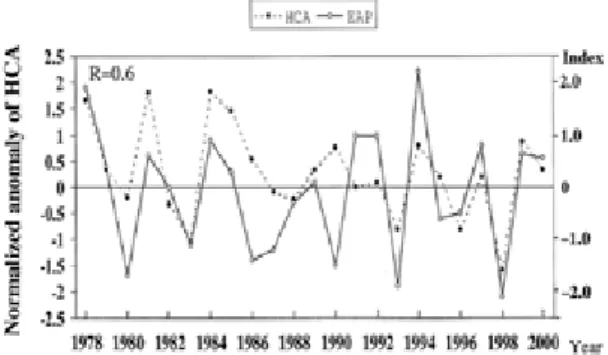
Kurihara, 1989) showed that the thermal states of the tropical west ern Pacific and the convective activities around the Philippines play an important role in the interannual variability of the EASM. Nitta (1987), Huang and Li (1987), and Huang and Sun (1992,1994) analyzed systematically the influencing process of the thermal states of the tropical western Pacific and the convective activities around the Philippines on the interannual variations of East Asian monsoon circulation anomalies from observed data and dynamical theories. Since the tropical western Pacific is a region of the highest SST in the global sea and the strong ascending branch of the Walker circulation is also over this region, the strong convergence of air and moisture leads to strong convective activities over this region. The dashed line in Figure 5 denotes the interannual variations of normalized high cloud amound anomaly averaged for summer (June-August) around the Philippines (10°- 2 0°N, 110°- 1 4 0°E ) respectively. Positive (negative) high cloud amount anomalies indicate strong (weak) convective activities. Thus, it can be seen from Fig.5 that there is an obvious quasi-biennial oscillation in the interannual variations of convective activities around the Philippines.
Huang and Li (1987, 1988) showed that due
to the forcing by the heat source caused by
strong convections around the Philippines, the
quasi-stationary planetary waves responding to
this forcing can propagate from the area around the Philippines toward the western coast of North America through East Asia and the North Pacific. They also pointed out that there is a teleconnection pattern of the summer circulation anomalies over the Northern Hemisphere, i.e., the so-called P-J oscillation (e.g., Nitta, 1987) or East Asia/Pacific teleconnection pattern (or the EAP pattern) (e.g., Huang and Li, 1987, 1986).
The quasi-biennial oscillation of convective activities around the Philippines influences the quasi-biennial oscillation of the EASM through the P-J oscillation or the EAP teleconnection, the solid line in Fig. 5 indicates the interannual variations of the EAP index measuring the strength of the EASM, which is defined by Huang and Yan (1999) according to the EAP teleconnection pattern. Fig. 5 features that the intrannual variations of the EASM is in good agreement with the interannual variations of convective activities around the Philippines. The correlation between them reaches, which exceeds the 99% confident level.
3.3 The thermal effect of the tropical western Pacific on the interannual variability of the western Pacific subtropical high
The western Pacific subtropical high is an important component of the East Asian climate system. The western Pacific subtropical high (hereafter WPSH) greatly influences the climate in East Asia. The low-level jet at the northwestern edge of WPSH transports a large amount of water vapour into East Asia.
Therefore, the position, shape and strength of
the WPSH dominate the large-scale quasi- stationary frontal zones in East Asia (e.g., Tao and Chen, 1987; Ding, 1994).
Recently, Lu (2002) defined two simple yet objective indices that describe the year-to year zonal and meridional displacements of the WPSH by averaging JJA-mean 850 hPa geopotential height anomalies over specified regions. For the WPSH zonal index, the specified region is (110~150° E, 10~30° N), the west edge of the WPSH. For the meridional index, the specified region is (120~150°E , 3 0 ~ 4 0°N), the northwest edge of the WPSH.
The interannual variations of zonal and meridional indices are independent, with the correlation coefficient between them being only -0.03 during the 20 years from 1979 to 1998.
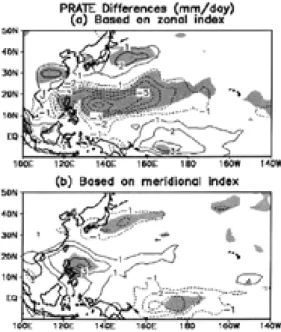
These two indices are all related to the summer rainfall anomalies in East Asia and the western North Pacific. Fig. 6a indicates that when the WPSH extends westwards, the rainfall is above normal along the Meiyu front and below normal in the tropical western
Figure 5. Interannual variations of the normalized high cloud amount around the Philippines (10-20°N, 110°- 1 4 0°E) (dashed line) and the EAP index (solid line).
Pacific. In addition, the poleward displacement of the WPSH corresponds to less rainfall along the Meiyu front and more rainfall in the tropical western Pacific (Fig. 6b) The thermal states of the tropical western Pacific and convective activities around the Philippines can greatly influence the southward or northward shift of the western Pacific subtropical high.
Huang and Sun (1992) showed that when the tropical western Pacific is in a warming state, convective activities are strong from the Indo- China Peninsula to the area around the Philippines, then the western Pacific subtropical high may shift unusually northward, On the contrary, when the tropical western Pacific is in a cooling state, convective activities are weak around the Philippines, then the western Pacific subtropical high may shift southward. Fig. 6 also suggests that the convections over the tropical western Pacific have significant influence on both zonal and meridional displacement of the WPSH, which is in agreement with previous results (e.g., Huang and Li, 1987; Kurihara, 1989; Huang and Sun, 1992; Lu, 2001; and Lu and Dong, 2001).
4. Influence of ENSO Cycle on the Summer Monsoon Rainfall in China
In addition to the above-mentioned influencing factors, ENSO cycle in the tropical Pacific is an important influencing factor on the EASM. The interannual and interannual variations of the EASM are closely associated with tropical Pacific SSTs. However, it has different impact on the summer monsoon rainfall anomalies in East Asia in different
stages of ENSO cycle (e.g., Huang and Wu, 1 9 8 9 ) .
Huang and Zhou (2002) analyzed in detail the impact of ENSO cycle on the interannual variability of the EASM during different stages of ENSO cycle. Figures 7a and 7b are the
Figure 6. Composite difference (positive minus negative indices) in JJA-mean precipitation based on gauge observations and satellite-estimates (Xie and Arkin, 1997). (a) for zonal index,and (b) for meridional index. Unit in mm/day. Zero contour is not shown and contour interval is 1. The shading illustrates the significance of the differences at 95%
level. For the zonal index, the positive index years are: 1980, 1983, 1987, 1995 and 1998, and the negative index years are: 1981,1984, 1985, 1986 and 1990. For the meridional index, the positive index years are: 1979, 1985, 1989, 1994 and 1995, and negative index years are: 1982, 1983, 1988, 1991 and 1993.
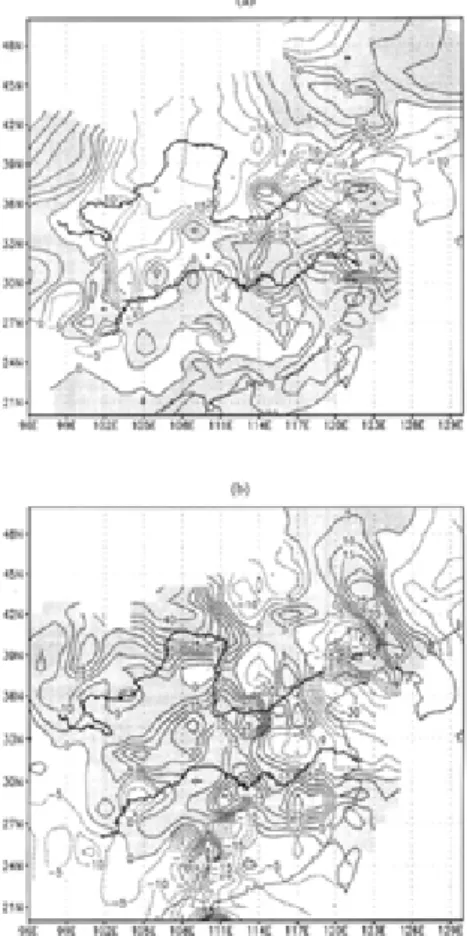
composite distributions of the monsoon rainfall anomaly percentage in China for the summers with the developing and decaying stages of El N in ˜ o events occurred in the period of 1951- 2000, respectively. Fig. 7a shows that positive rainfall anomalies are in the Huaihe River valley, and negative rainfall anomalies are
located in the Yellow River valley, North China and the area to the south of the Yangtze River, respectively. This explain that during a summer with the developing stage of ENSO event, hot and drought summer may occur in North China, but flood may be caused in the Huaihe River valley and the lower reach of the Yangtze River. However, for the summers with decaying stage of ENSO events, the composite distribution of rainfall anomalies shown in Fig.7b is opposite to that shown in Fig.7a. This shows that during the decaying stage of ENSO event, severe flood may occur in the area to the south of the Yangtze River, especially in the Dongting Lake and the Boyang Lake valleys, but drought may be caused in the Yangtze River and Huaihe River valley.
Similarly, the La Nin ˜a event also has a impact on the summer monsoon rainfall in China. During a summer with the developing stage of a La Ni n ˜a event, the positive monsoon rainfall anomalies are in the area to the south of the Yangtze River, especially in the surroundings of the Dongting Lake and Boyang Lake, and the upper reach of the Yellow River, respectively, but the negative rainfall anomalies are in South China and the Huaihe River valley, respectively. Moreover, during a summer with the decaying of a La Nin ˜a event, the positive rainfall anomalies mainly distribute in the area between the Yangtze River and the Yellow River, while the negative rainfall anomalies appear in the area to the south of the Yangtze River and in North China.
The influence of ENSO cycle on the interannual variability of summer monsoon rainfall in East Asia is closely associated with
Figure 7. Composite distributions of the summer (June-August) rainfall anomalies (percentage) for the summers with the developing stage (a) and the summers with the decaying stage (b) of El Nin˜o events, occurred in the period from 1951 to 2000, r e s p e c t i v e l y .
The shaded areas in figures indicate the positive rainfall anomalies.
the water vapor transport anomalies during different stages of ENSO cycle. The studies made by Zhang et al. (1996) and Zhang (2001) showed that the southerly wind anomalies can appear in the lower troposphere along the coast of East Asia during and after the mature phase of El Nin ˜o event, and the intensified southerly winds are favorable for the enhancement of the water vapor transport from the Bay of Bengal and the tropical western Pacific to East Asia. Thus, after the mature phase of El Nin ˜o event, strong rainfall may be caused in the Yangtze River valley, South Korea and Japan.
5. Influence of ENSO Cycle on the East Asian Monsoon Circulation
5.1 Response of the East Asian winter and summer monsoon cycle to El Ni n ˜ o e v e n t
East Asia is not only a region of the strong summer monsoon, but also a region of the strong winter monsoon. The East Asian winter and summer monsoons are a phenomenon of annual cycle. However, the interannual variability of the cycle is greatly influenced by ENSO cycle.
Chen and Graf (1998), and Chen et al.
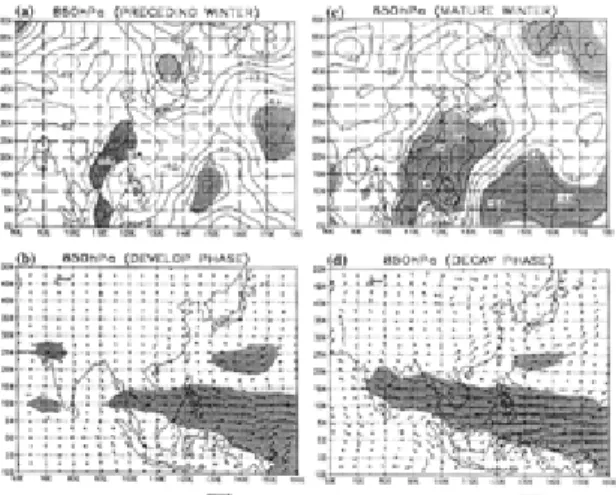
(2000) systematically studied the interannual variability of the East Asian winter monsoon (EAWM). According to the characteristics of the EAWM, Chen (2002) adopted the intensity of meridional wind representing the winter monsoon. Figure 8a is the composite distribution of the meridional wind anomalies at 850hPa for the preceding winters of the occurrence of El
N in ˜ o events. From Fig. 8a, it may be found that there are anomalous northerlies from the coastal area of China to the South China sea (SCS) thus the EAWM is strong. Fig.7b presents the composite distribution of the wind anomalies at 850hPa for the summers with the developing phase of El Ni n ˜o. Obviously, there is an anomalous cyclonic circulation over the western Pacific, which indicates a weak western Pacific subtropical high in a summer with the developing stage of El Ni n ˜ o event. As shown in Fig. 8b, anomalous northeasterlies are
Figure 8. The composite distributions of wind field anomaly at 850hPa for different phases of El Nin˜o events occurred in the period from 1958 to 1998.
(a) for the preceding winters of the occurrence of El Nin˜o events; (b) for the summers with the developing stage of El Nin˜o events; (c) for the winters with the mature phase of El Nin˜o events;
(d) for the summers with the decaying stage of El N in˜o events.
There are only the meridional wind anomalies in Figs. a and c, and the shaded areas in figures indicate the confident level over 95%.
located over the area from the Yangtze River and Huaihe River valley to the south of the Yangtze River. This indicates that the weak southwesterly monsoon flow in a summer with the developing phase of El Ni n ˜ o e v e n t . Following the developing stage, generally El N in ˜ o event can reach to its mature phase. As shown in Fig. 8c, anomalous southerlies prevail in the southeastern coastal region of China and the SCS. This shows the weak EAWM may appear in a winter with the mature phase of El N in ˜ o. In the following summer, El Nin˜o e v e n t may be in decay, as shown in Fig. 8d, there is an anomalous anticyclonic circulation over the western Pacific, which represents the strong western Pacific subtropical high. Anomalous southwesterlies occur over the region from the southern part of China to the Yangtze River valley. This can explain that the strong EASM may appear in a summer with the decaying phase of El Ni n ˜ o event.
From the above-mentioned results, it may be seen that the strong or weak East Asian monsoon may be closely associated with different stages of evolution of ENSO cycle.
5.2 Responses of the East Asian winter and summer monsoon cycle to La Ni n ˜a e v e n t
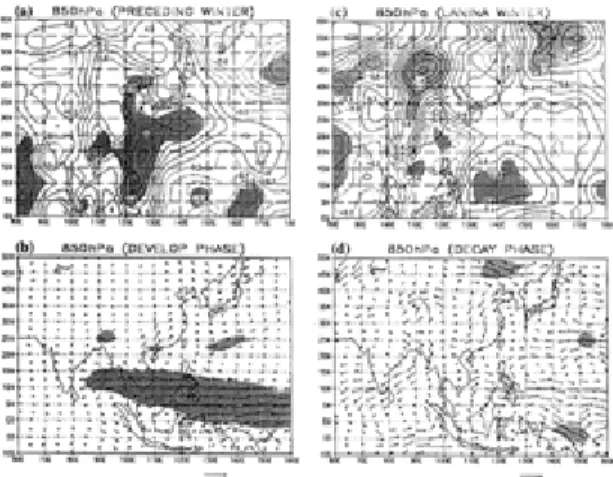
Figures 9a~9d show the composite distributions of the wind fields at 850hPa to different phases of the La Ni n ˜a events occurred in the period from 1958 to 1998, respectively.
As shown in Fig. 9a, in the preceding winter of the occurrence of La Ni n ˜a event, the southerly anomalies prevail along the coastal region of China. Thus, this can explain that in preceding winter of the occurrence of a La Nin ˜a e v e n t , the EAWM is weak. In the summer with the developing phase of a La Ni n ˜a event, as shown in Fig. 9b, there is an anomalous anticyclonic circulation over the western Pacific, which can represent the strong western Pacific subtropical high. The anomalous southwesterlies shown in Fig. 9b indicate that the southwest monsoon is strong over the eastern part of China. Thus, the strong EASM may appear over the eastern part of China during a summer with the developing stage of La Ni n ˜a event. This characteristics corresponds well to the anomalous EASM during the decaying phase of El Ni n ˜o.
Generally, La Ni n ˜a event may reach to its mature phase in the winter, as shown in Fig.
9c, there are the anomalous northerlies over the coastal region of China and the SCS. In the following summer, La Nin ˜a event may be in decay, as shown in Fig. 9d, there is an anomalous cyclonic circulation over the western Pacific. This represents that the western Pacific
Figure 9. Same as Fig.5 but for different phases of La Nin˜ a events occurred in the period from 1958 to 1998.
subtropical high is weaker. Therefore, the strong or weak East Asian monsoon is also in dependence on different stages of La Nin ˜a event. However, it is a matter worthy of note that the significance of these anomalies does not exceed the level of 95%. Therefore, the influence of La Nin ˜a event on the East Asian winter and summer monsoon cycle may be less significant as El Nin ˜o event.
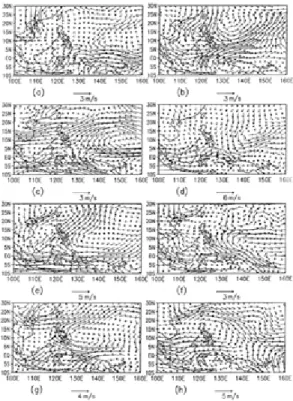
Why does ENSO cycle have an important influence on the monsoon circulation over the tropical western Pacific and East Asia? Ren and Huang (1999) suggested that it is caused by the distribution of anomalous convections associated with the SSTA in the tropical Pacific. In the mature phase of El Nin ˜ o e v e n t , the convections are enhanced over the equatorial central and eastern Pacific and weakened over the tropical western Pacific, respectively. Thus, a dipole pattern of anomalous convections can appear over the tropical Pacific, then the distribution of anomalous heat sources has also a dipole structure over the tropical Pacific. This anomalous thermal structure is favorable for the formation of a forced anticyclonic circulation over the tropical western Pacific and the South China Sea, as shown in Figures 10e~h, Thus the strong western subtropical high is located over the tropical western Pacific and the South China Sea, and the southwest monsoon is enhanced over the Yangtze River and Huaihe River valley. This may explain further that strong rainfall in the Yangtze River valley used to occur in the period with the decaying of El N in ˜o event.
6. Dynamic Effect of the East Asian Winter and Summer Monsoon Cycle on ENSO Cycle 6.1 The origin of ENSO cycle
Since El Nin ˜o event can cause the severe climate anomalies in many regions of the world, especially in the Asian-Australian monsoon
Figure 10. Distributions of the circulation anomaly fields at 850hPa over the tropical western Pacific before the developing stages (a-d) and in the mature phase (e-~h) of the El Nin˜o events occurred in the period of 1980~1998, r e s p e c t i v e l y .
(a) in the spring of 1980, (b) in the winter of 1985, (c) in the spring of 1991, (d) in the winter of 1996, (e) in the winter of 1982, (f) in the autumn of 1987, (g) in the spring of 1992, and (h) in the autumn of 1997.
regions (e.g., Webster et al., 1998), many efforts were made to understand the regularity and physical mechanism of ENSO cycle.
Bjercknes (1969) first proposed a hypothesis that El Ni n ˜ o cycle may be a result of air-sea interaction over the equatorial eastern Pacific.
However, after the implementation of TOGA experiment, scientists have gradually realized that ENSO cycle may originate from the tropical western Pacific and the physical mechanism of ENSO cycle has been studied further from the propagation of the equatorial oceanic waves or from the tropical oceanic coupling waves or from the unstable air-sea interaction, respectively (e.g., Philander, 1981;
McCreay, 1983; McCreay and Anderson, 1984;
Yamagata, 1985; Schopf and Suarez, 1988;
Chao and Zhang, 1988). These studies showed that the warm state of the West Pacific warm pool is one of the necessary conditions for the occurrence of El Ni n ˜o e v e n t .
Huang and Wu (1992) pointed out the warming state of the tropical western Pacific may provide a precondition for the occurrence of El Nin ˜o event. Recently, Li (2002), Li and Mu (2002) pointed out that the occurrence of El Nin ˜ o event is due to the eastward propagation of the warm sea water in the subsurface layer of the equatorial Pacific from the West Pacific warm pool, and at the same time, there are the westward propagations of the warm sea water in the subsurface layer of the tropical Pacific along about 10° N and 10° S from the equatorial eastern Pacific, respectively.
These propagations may provide a necessary condition of the thermal cycle of the warm pool. Moreover, Chao et al. (2002, 2003)
investigated the origin of the warm sea water in the West Pacific warm pool from the observed data of the subsurface sea- temperature. These results demonstrated further that ENSO cycle originates from the tropical western Pacific from the thermal condition of the occurrence of ENSO cycle.
The interaction between Asian monsoon and ENSO cycle is very obvious. The diagnostic and modelling studies have revealed that the variabilities of Asian monsoon activity have a significant effect on the atmosphere/ocean coupled system in the equatorial Pacific (e.g., Yamagata and Matsumoto, 1989; Yasunari, 1990; Yasunari and Seki, 1992; Ju and Slingo, 1995). These studies pointed out that a weaker (stronger) Asian summer monsoon seems to lead an anomalous state of the atmosphere/
ocean system in the tropics, which is favorable for El Nin ˜o event (or anti-El Nin˜o or La Nino event) in the equatorial eastern Pacific.
The tropical western Pacific not only provides
the necessary thermal condition for ENSO
cycle, the atmospheric circulation and zonal
wind anomalies over the region but also
provides the necessary dynamic condition for
ENSO cycle. Chang et al. (1979), and Lau and
Chang (1987) pointed out that the Asian
winter monsoon can cause the strong convective
activities over the maritime continent of Borneo
and Indonesia Li (1988, 1990) studied the
triggering effect of the anomalous EAWM on
ENSO event in the equatorial Pacific and
pointed out that the strong EAWM will
intensify the convective activities over the
equatorial western Pacific. This, in turn, may
strengthen the 30-60 day oscillation in the
atmosphere over the tropical western Pacific, and the intensified low-frequency oscillation may trigger an ENSO event. Recently, Li (1998), Li and Li (1998) studied further the process of the triggering effect of the anomalous EAWM on ENSO cycle and pointed out that the anomalous EAWM can intensify the westerly winds over the tropical western Pacific, and then can trigger the occurrence of El Ni n ˜o event. This process has been well demonstrated by Li and Mu (1998) with the numerical simulations using the air-sea coupling model.
6.2 Dynamical effect of the anomalous monsoon circulation on ENSO cycle
Huang et al. (1998), Huang and Fu (1996a, b) and Huang et al. (1998, 2001) suggested from the analyses of observed data that the anomalous circulation and zonal wind over and the tropical western Pacific may play an important role in ENSO cycle. From Figs.
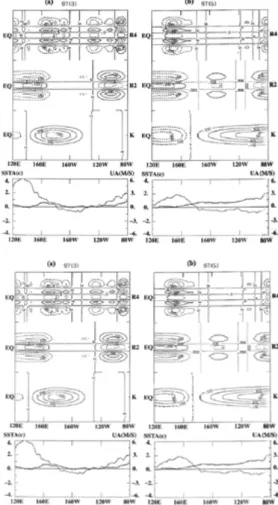
10(a)~(d), it may be seen that before the developing stage of El Nin ˜o events, there are cyclonic circulation anomalies in the lower troposphere over the tropical western Pacific, and the anomalies can cause the westerly anomalies over the Indonesia and the tropical western Pacific. Moreover, Huang et al. (1998) and Huang et al. (2001) discussed theoretically the dynamical effect of the westerly anomalies over the tropical Pacific on the formation of El N in ˜ o event with a simple tropical air-sea coupling model and the observed anomalous wind stress near the sea surface of the tropical Pacific. The theoretical result shows that this dynamical effect results from the exciting effect
Figure 11. The temporal and spatial distributions of the equatorial oceanic Kelvin wave and Rossby waves responding to the zonal wind stress anomalies near the sea surface of the equatorial Pacific (upper part) and the observed SST anomalies in the equatorial Pacific (lower part, solid line) and the observed zonal wind anomalies near the sea surface (lower part, dashed line) in March (a), May (b), July (c), and October (d), 1997, respectively
K, R2 and R4 in the upper part of figures (a)~(d) indecate the Kelvin wave, the two-order and four- order Rossby waves, respectively, and solid and dashed lines show the warm waves and the cold waves, respectively.