• 검색 결과가 없습니다.

The Relationship between Social Capital, Knowledge Sharing and Enterprise Performance: Evidence from Vietnam

N/A
N/A
Protected

Academic year: 2021

Share "The Relationship between Social Capital, Knowledge Sharing and Enterprise Performance: Evidence from Vietnam"

Copied!
11
0
0

로드 중.... (전체 텍스트 보기)

전체 글

(1)

Print ISSN: 2288-4637 / Online ISSN 2288-4645 doi:10.13106/jafeb.2021.vol8.no11.0133

The Relationship between Social Capital, Knowledge Sharing and Enterprise Performance: Evidence from Vietnam

Thanh Nhon HOANG 1 , Cong Bac TRUONG 2

Received: July 15, 2021 Revised: September 28, 2021 Accepted: October 05, 2021

Abstract

This study investigates the relationship between social capital and enterprise performance with knowledge sharing as the mediator.

By employing the data of 677 respondents collected from delivering questionnaires to small and medium-size firms in Vietnam in 2020, this study suggests a two-step approach that combines exploration factor analysis (EFA), confirmatory factor analysis (CFA), and path analysis (SEM). The empirical findings significantly support our proposed model by demonstrating that knowledge sharing mediates the connection between all three elements of social capital and enterprise performance. At the same time, the results emphasize the importance of knowledge sharing as a major benefit of social capital and a substantial driving element of both operational and financial performance.

The results show that all three social capital qualities (structural, relational, and cognitive) significantly impact both tacit and explicit knowledge sharing, while knowledge is one of the main routes connecting social capital to enterprise performance. Hence, our research model may be used in future studies to evaluate social capital, knowledge sharing, and firm performance as a new theoretical model. Our results offer a plausible explanation for how social capital improves knowledge sharing and enterprise performance.

Keywords: Social Capital, Knowledge Sharing, Enterprise Performance, SEM, Vietnam JEL Classification Code: D8, L25, M10, M21

(Mahmoudi Farahani, 2016). Social capital has emerged as a critical accelerator for companies to gain knowledge, thus improving organizational performance (Yli-Renko et al., 2001). Enterprises with a high level of social capital may gain a long-term competitive advantage. Despite the concept’s popularity, previous research has failed to demonstrate how social capital substantially systematically improves business performance (Van Wijk et al., 2008;

Maurer et al., 2011; Kim et al., 2013; Kim & Gong, 2009).

In recent years, several scholars have tried to explore this relationship and have succeeded in providing evidence of the important contribution of social capital to the performance of enterprises (Santosa et al., 2020; Ngo et al., 2020).

Previous studies have been conducted to investigate the relationship between social capital and knowledge sharing (Wei et al., 2011; Gooderham et al., 2011). Other studies have looked at how knowledge sharing affects organizational performance (Palacios-Marqués et al., 2013; De Zubielqui et al., 2019; Tran, 2021). In a few existing research related to it, social networks and knowledge sharing are considered factors that increase organizational innovation and enhance performance (Muafi, 2020) while neglecting the nexus between social capital and knowledge sharing.

1

First Author. Lecturer, Faculty of Commerce, Van Lang University, Ho Chi Minh City, Vietnam. Email: [email protected]

2
Corresponding Author. Lecturer, Faculty of Commerce, Van Lang University, Ho Chi Minh City, Vietnam [Postal Address: 45 Nguyen Khac Nhu Street, Co Giang Ward, District 1, Ho Chi Minh City, 71013, Vietnam] Email: [email protected]

© Copyright: The Author(s)

This is an Open Access article distributed under the terms of the Creative Commons Attribution Non-Commercial License (https://creativecommons.org/licenses/by-nc/4.0/) which permits unrestricted non-commercial use, distribution, and reproduction in any medium, provided the original work is properly cited.

1. Introduction

The knowledge-based view suggests that the

accumulation of value, rare, inimitable, and non-

substitutable (VRIN) knowledge is basic to an organization’s

competitive advantage. (Akhavan & Mahdi Hosseini,

2016). Organizations may use knowledge to apply their

own information with elements of human added value such

as vision, entrepreneurship, and experiences. At the same

time, social capital is an important element in successfully

implementing and managing knowledge processes. As a

result, social capital and its aspects are becoming essential

(2)

Nevertheless, studies investigating mutual relationships among social capital, knowledge sharing, and organizational performance are minimal. Therefore, our research will look at the systematic relationships between social capital, knowledge sharing, and organizational performance. We try to find the answer to the question: how do different social capital dimensions impact the tacit and explicit knowledge sharing that leads to improved organizational structure performance? The research included a survey of directors and managers in 677 small and medium-sized (SMEs) enterprises in Vietnam, which were then used to evaluate and validate a series of suggested connections in the context of an unstable environment like Vietnam. The second section involves literature reviews. The third section develops the hypothesis and conceptual model. The fourth section describes the methodology and data, including collecting techniques and creating measurement scales. The fifth section presents research results and discussion. Finally, the conclusion, limitations, and future research are reported in the sixth section.

2. Literature Review 2.1. Social Capital

There is currently no agreement on a definition of social capital theory. The original definition of social capital considers it to be a resource or knowledge that is embedded in, accessible via, and utilized through interactions among people in a social network (Nahapiet & Ghoshal, 1998).

The second definition of social capital suggests a diverse network of relationships that enable activities among people or organizations that can generate value. Coleman (1988), on the other hand, defined social capital in terms of its purpose. He defined social capital as a collection of things that may help players inside the social structure carry out certain activities. According to Putnam (2000), social capital is “features of social organization such as networks, norms, and social trust that enable coordination and cooperation for mutual benefit.” Both are considered as bonding perspectives, focusing on characteristics that provide collectivity cohesion and, as a result, make the pursuit of achieving collective objectives easier. Adler and Kwon (2002) defined social capital as “the goodwill accessible to people or organizations to overcome the lack of agreement.”

The form and substance of the actor’s social relationships are its sources. Its impacts are a result of the knowledge, influence, and solidarity it provides to the actor. As a result, we define social capital as characteristics of social people or organizations, such as network connections, norms, and trust that enable coordination and collaboration for mutual gain.

Three main dimensions of social capital prevail in the literature: structural, relational, and cognitive attributes

(Nahapiet & Ghoshal, 1998). The structural property consists of network and social relationships, the nodes of which decide who to contact and how to seek help (Granovetter, 1983). The relational characteristic reflects the degree of trust established between people due to interactions:

trust, norms, obligations, and recognition increase actors’

awareness of their shared goals (Granovetter, 1983). The cognitive attribute includes an organization’s members’

values, objectives, and shared visions (Granovetter, 1983).

2.2. Knowledge Sharing

Knowledge sharing is an activity through which knowledge, information, and expertise are exchanged among individuals, organizations, and communities. People communicate their knowledge via a variety of channels, including discussions, meetings, learning sessions, seminars, films, and other forms of communication media.

There are two types of knowledge sharing: (1) Explicit sharing and (2) Tacit sharing (Huang et al., 2011).

Explicit knowledge sharing refers to types of shared knowledge or information that have been institutionalized inside companies. Because explicit knowledge can be readily documented and transferred, practices of explicit knowledge sharing are becoming increasingly prevalent in the workplace. Management tools such as process, formal language, handbooks, and information systems will encourage workers to communicate explicit knowledge (Coakes, 2006). Face-to-face contact, on the other hand, is the main mode of tacit knowledge exchange. Individuals’

desire and ability to share what they know and utilize what they learn are critical components of tacit knowledge sharing (Lin, 2007; Endres et al., 2007; Holste & Fields, 2010). The basis of tacit knowledge exchange is the human experience (Nonaka & Takeuchi, 1995).

2.3. Enterprise Performance

For a long time, academics have looked at business performance as a method to assess an enterprise’s health.

For empirical research, the accuracy and consistency of performance measures are essential. Enterprise performance assessment has progressively expanded to include various aspects after initially relying only on financial views.

Enterprise success should be assessed in terms of financial

and operational factors, according to Venkatraman and

Ramanujam (1986). Sales growth, profits per share, and

profitability, as evaluated by return on investment, return

on sales, and return on equity, are all measures of financial

success (Taouab & Issor, 2019). On the other hand, operational

performance stresses indicators such as product quality

and productivity, as well as marketing efficacy (Demirbag

et al., 2006). Dess and Robinson (1984) recommended

(3)

that enterprises use financial and operational performance measurement indicators to accurately measure enterprise performance. Using multiple indicators allows enterprises to measure performance using more complex and informative measures and assess each indicator’s contribution to the latent variable.

3. Hypothesis Development 3.1. Cognitive Dimension and

Knowledge Sharing

Common objectives, language, and understanding in social networks are necessary because they positively impact knowledge sharing (Nonaka, 1994; Kogut & Zander, 1996). Inkpen and Tsang (2005) also proposed: “The common goals and vision serve as a means of linkage for internal network sharing and new knowledge integration.”

A shared culture of ideas, conventions, and shared values also impacted the process of transmitting and integrating information. Furthermore, it has been proposed that the cognitive component of social capital substantially increases knowledge sharing, especially complex knowledge (Wasko

& Faraj, 2005). Individuals who share cognitive schemas and objectives must have a similar background, experience, and mutual understanding to gain from socialization in converting tacit knowledge (Nonaka & Toyama, 2015). The authors suggested the following hypothesis based on this literature:

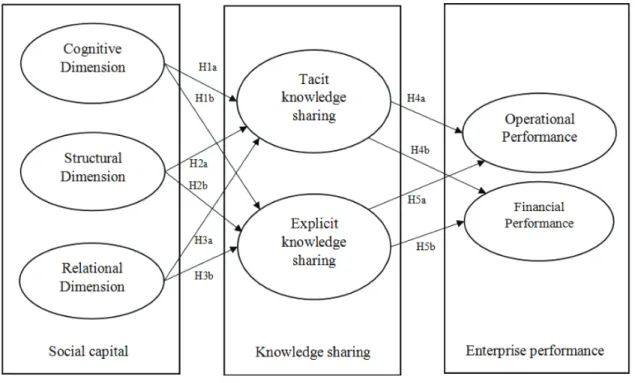
H1a: Cognitive dimension of social capital positively influences tacit knowledge sharing.

H1b: Cognitive dimension of social capital positively influences explicit knowledge sharing.

3.2. Structural Dimension and Knowledge Sharing

The structural dimension of social capital includes density, relationships, and network relevance. Its idea is based on Granovetter’s concept of “strength of weak connections”

(Granovetter, 1983). According to the idea of the “power of weak connections,” weak relationships make knowledge sharing more efficient because they enable members of an organization to gather new information or knowledge by linking unconnected people and groups in an organization.

Furthermore, social network theory suggested that social connections provide access to facilities and resources that are based on these social relationships (Coleman, 1988;

Nahapiet & Ghoshal, 1998; Putnam, 2000).

Borgatti and Cross (2003) proposed: “The process of sharing knowledge in an organization is associated with the characteristics of social network structure.” Reagans

and McEvily (2003) showed that tight connections and coherent network architecture of the structural social capital component contribute to successful knowledge exchange among network participants. As a result, the sharing of explicit and tacit knowledge is less likely to occur in the absence of a good connection (Kogut & Zander, 1996;

Szulanski, 1996; Hansen, 1999; Reagans & McEvily, 2003) An intense social network with a high frequency of contact is required in which tacit and explicit knowledge are seamlessly transmitted (Sorenson et al., 2006). Zaqout and Abbas (2012) discovered that social capital influences both tacit and explicit knowledge sharing. As a result, we propose the following hypothesis:

H2a: Structural dimension of social capital positively influences tacit knowledge sharing.

H2b: Structural dimension of social capital positively influences explicit knowledge sharing.

3.3. Relational Dimension and Knowledge Sharing

Nahapiet and Ghoshal (1998) defined social capital’s relational dimension as a “binder of relationships” in the binding strings of actors, with the key characteristics being dependability and trust. Coleman (1988) argued in the context of a social network that the impact of social capital linked with intimate connections substantially contributes to individual and group behaviors. Furthermore, Adler and Kwon (2000) describe social capital as goodwill, which has its origins in the form and content of a relationship. Tsai and Ghoshal (1998) concluded: “Trust has a great influence on resource exchange and association. At the same time, credibility is also closely associated with the two cognitive and structural dimensions”. Furthermore, the relational dimension has been conceptualized as dependent on resources (Hughes et al., 2014). It is claimed that increasing the reliance on resources via repeated encounters would enhance knowledge transfer between the entities (Hughes et al., 2014).

Furthermore, it was claimed that the viewpoint of resource dependence enables social network core players to select behavior to build excellent connections, demonstrating that trust is a crucial element in creating value. It was also thought that trusts play an important role in the coherence of interpersonal relationships and help the seamless flow of information (Inkpen & Tsang, 2005). Reliable connections are critical for sharing tacit knowledge (Collins & Hitt, 2006; Holste & Fields, 2010; Nonaka & Von Krogh, 2009).

The relational component of social capital, as represented

by credibility and trust, is essential to the density of social

networks, making it a sufficient basis of information

acquisition and assimilation (Ganguly et al., 2019).

(4)

Interpersonal trust has an implicit effect on knowledge sharing (Epstein, 2000). It was also discovered that the cohesiveness of relationships between participants significantly influences the sharing of explicit and tacit knowledge (Dhanaraj et al., 2004). Based on the above considerations, the authors suggest the following hypotheses:

H3a: Relational dimension of social capital positively influences tacit knowledge sharing.

H3b: Relational dimension of social capital positively influences explicit knowledge sharing.

3.4. Knowledge Sharing and Enterprise performance

Felin and Hesterly (2007) contended that the primary sources of competitive advantage for commercial companies are tacit and explicit knowledge. Organizations may retain information to create value, which leads to improved performance (Gao et al., 2009). The knowledge sharing, for example, may be papers and reports and training programs that react to client requirements on time and eventually contribute to enterprise success (Wang &

Wang, 2012). Ganguly et al. (2019) stated that knowledge sharing fosters competitive advantage via cost reduction and better performance. Only when companies invest in explicit knowledge sharing for knowledge use, reuse, or renewal, can the learning process for organizational growth occur. Explicit knowledge sharing enables the exchange of knowledge and information among people in an organization, encourages the creation of common ideas, and permits the systemization and reconfiguration of existing capabilities (Wang et al., 2014). Thus, explicit knowledge sharing in organizations has important influences on the culture and commitments of employees. These are essential for achieving high-level performance. Hooff and Ridder (2004) concluded: “The interaction of flow of information and codified knowledge in explicit knowledge sharing processes would significantly add values to efficiency and effectiveness in organizations” (p. 15).

In contrast to explicit knowledge, tacit knowledge seems to be more difficult to convey or codify (Polanyi, 1962). Nonaka and Takeuchi (1995) discovered that tacit knowledge occurs at a high level of human communication;

thus, individuals would struggle to convey tacit knowledge in the form of numbers and words. People’s abilities, attitudes, views, and experiences may all include tacit knowledge (Koskinen et al., 2003). Several previous research indicated that tacit knowledge enhances organizational performance significantly (Reychav & Weisberg, 2009; Allameh et al., 2014). Tacit knowledge sharing is the ultimate objective of organizational learning, and if attained, it promises to improve enterprises’ operational performance (Van Woerkom & Sanders, 2010). Following the confirmation that

tacit knowledge sharing has a beneficial effect on enterprise performance (Harlow, 2008; Wang et al., 2014; Ha &

Nguyen, 2020), the following assumptions were developed:

H4a: Tacit knowledge sharing positively affects enterprise operational performance.

H4b: Tacit knowledge sharing positively affects enterprise financial performance.

H5a: Explicit knowledge sharing positively affects enterprise operational performance.

H5b: Explicit knowledge sharing positively affects enterprise financial performance.

3.5. Conceptual Model

Based on works of literature and proposed hypotheses, the conceptual model is developed as the following (Figure 1).

4. Data and Methodology 4.1. Data

A survey of SMEs in Vietnam was carried out. The intended respondents were directors and managers, who were the study’s greatest source of information. Ultimately, 677 valid answers were obtained directly from 750 distributed surveys. All responders are between the ages of 30 and 45.

Males and females account for 58% and 42% of the total, respectively.

The questionnaire was created using established scales to guarantee content validity. However, because the survey question was mostly about Vietnam, it was translated into Vietnamese with the help of two academic subject experts who are fluent in Vietnamese and English. The questionnaire was pre-tested with ten academic experts and ten managers in meetings. The pre-test was designed to assess the content validity of the translated measures as well as if the responder comprehended the instructions, items, and scales. Everything is graded on a five-point Likert scale. On this scale, a “1”

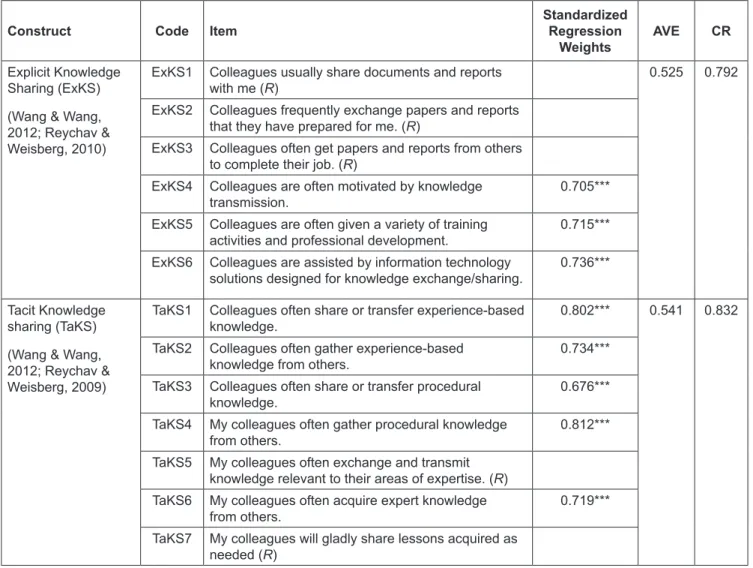
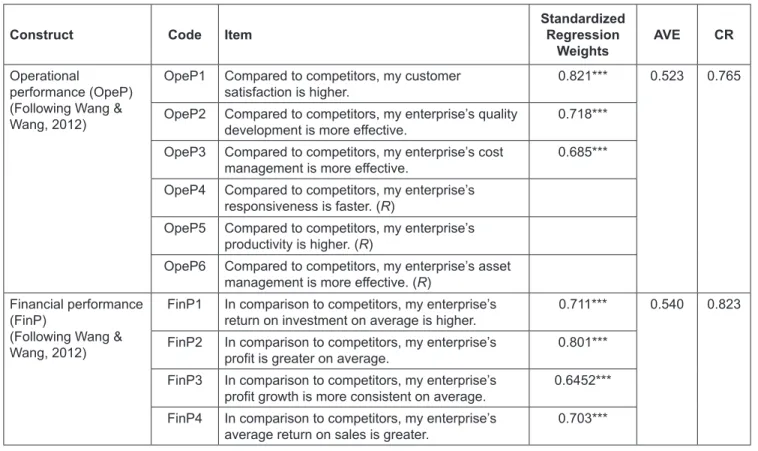
denotes “strongly disagree,” while a “5” denotes “strongly agree.” All seven construct measuring scales, including 34 variables, were modified from prior literature, as shown in Tables 1, 2, 3 below.

4.2. Methodology

Anderson and Gerbing (1988) suggested a two-step

approach using IBM AMOS 24 for structural equation

modeling (SEM) analysis. At first, the exploratory factor

analysis (EFA) and confirmatory factor analysis (CFA)

procedures were used to examine how well the conceptual

model fit the data. Throughout this process, relevant tests

were performed to determine how reliable and valid

(5)

Table 1: Social Capital Variables and Measurement

Construct Code Item Standardized

Regression

Weights AVE CR

Cognitive social capital (CoSC)

(Chow & Change, 2008)

CoSC1 Colleagues and I agree about what matters

at work. (R) 0.581 0.791

CoSC2 Colleagues and I are eager to pursue the

enterprise’s shared goals and purposes. 0.718***

CoSC3 Colleagues and I share the same vision and

objectives. 0.699***

Relational Social capital (ReSC) (Chow & Change, 2008; Nahapiet &

Ghosal, 1998)

ReSC1 I have a connection with my colleagues. 0.705*** 0.607 0.841 ReSC2 My colleagues help me overcome difficulties over

time. 0.810***

ReSC3 I will trust colleagues when I need help. 0.719***

ReSC4 I may rely upon my colleagues when in need. 0.735***

Structural Social capital (StSC) (Chow & Chang, 2008;

Nahapiet & Ghosal, 1998)

StSC1 I have a positive relationship with colleagues. 0.7111*** 0.552 0.811 StSC2 I am aware of who in my enterprise has

competencies or skills, or knowledge that will be helpful to me.

0.691***

StSC3 Colleagues know what skill or knowledge or

competency I have. 0.703***

StSC4 I am aware of what skill, knowledge, or

competency might be helpful to my colleague. 0.685***

Note: ***, ** and *Indicates significant at 1%, 5% and 10% level of significance based on t-statistics. Items removed during the validity and reliability tests are denoted by (R).

Figure 1: Conceptual Model

(6)

Table 2: Knowledge Sharing Variables and Measurement

Construct Code Item Standardized

Regression

Weights AVE CR

Explicit Knowledge Sharing (ExKS) (Wang & Wang, 2012; Reychav &

Weisberg, 2010)

ExKS1 Colleagues usually share documents and reports

with me (R) 0.525 0.792

ExKS2 Colleagues frequently exchange papers and reports that they have prepared for me. (R)

ExKS3 Colleagues often get papers and reports from others to complete their job. (R)

ExKS4 Colleagues are often motivated by knowledge

transmission. 0.705***

ExKS5 Colleagues are often given a variety of training

activities and professional development. 0.715***

ExKS6 Colleagues are assisted by information technology

solutions designed for knowledge exchange/sharing. 0.736***

Tacit Knowledge sharing (TaKS) (Wang & Wang, 2012; Reychav &

Weisberg, 2009)

TaKS1 Colleagues often share or transfer experience-based

knowledge. 0.802*** 0.541 0.832

TaKS2 Colleagues often gather experience-based

knowledge from others. 0.734***

TaKS3 Colleagues often share or transfer procedural

knowledge. 0.676***

TaKS4 My colleagues often gather procedural knowledge

from others. 0.812***

TaKS5 My colleagues often exchange and transmit knowledge relevant to their areas of expertise. (R) TaKS6 My colleagues often acquire expert knowledge

from others. 0.719***

TaKS7 My colleagues will gladly share lessons acquired as needed (R)

Note: ***, ** and *Indicates significant at 1%, 5% and 10% level of significance based on t-statistics. Items removed during the validity and reliability tests are denoted by (R).

(convergent and discriminant) the measurement model is. Second, using SEM, the author evaluates the structural model by performing a path analysis to validate a set of assumptions.

5. Results and Discussion 5.1. Results

5.1.1. The Construct Reliability and Validity Evaluation

To assess the internal consistency of the measuring scales, the author used the Cronbach alpha (α) (Hair et al., 2014) values and if the qualifying values of (α) are more than 0.6, the internal consistency is established (Hair et al., 2014).

The α of all constructs is larger than 0.6, which indicates good validity. Following that, the author utilized the EFA method to perform dimensionality assessments, as shown by the factor loading score. The EFA technique’s overarching goal is to compress the information contained in an original construct into a smaller number of new composite dimensions or components (Hair et al., 2014). In this research, out of the initial set of 34 measuring items, only 25 qualified with a factor loading score of 0.5.

5.1.2. The Convergent and Discriminant Validity Evaluation

Confirmatory factor analysis (CFA) is a statistical

technique used to verify the factor structure of a set of

observed variables. CFA allows the researcher to test the

(7)

Table 3: Enterprise Performance Variables and Measurement

Construct Code Item Standardized

Regression

Weights AVE CR

Operational performance (OpeP) (Following Wang &

Wang, 2012)

OpeP1 Compared to competitors, my customer

satisfaction is higher. 0.821*** 0.523 0.765

OpeP2 Compared to competitors, my enterprise’s quality

development is more effective. 0.718***

OpeP3 Compared to competitors, my enterprise’s cost

management is more effective. 0.685***

OpeP4 Compared to competitors, my enterprise’s responsiveness is faster. (R)

OpeP5 Compared to competitors, my enterprise’s productivity is higher. (R)

OpeP6 Compared to competitors, my enterprise’s asset management is more effective. (R)

Financial performance (FinP)

(Following Wang &

Wang, 2012)

FinP1 In comparison to competitors, my enterprise’s

return on investment on average is higher. 0.711*** 0.540 0.823 FinP2 In comparison to competitors, my enterprise’s

profit is greater on average. 0.801***

FinP3 In comparison to competitors, my enterprise’s

profit growth is more consistent on average. 0.6452***

FinP4 In comparison to competitors, my enterprise’s

average return on sales is greater. 0.703***

Note: ***, ** and *Indicates significant at 1%, 5% and 10% level of significance based on t-statistics. Items removed during the validity and reliability tests are denoted by (R).

hypothesis that a relationship between observed variables and their underlying latent constructs exists. CFA was performed using AMOS version 23 to evaluate how well the conceptual model matched the data. In terms of overall model fitness, the root means square of approximation (RMSEA) should be less than or equal to 0.08 to ensure that the data fit the model well (Hair et al., 2014). The comparative fit index (CFI) should be greater than 0.9 (Hair et al., 2014).

The test results indicate that the data set has an adequate fit (CFI = 0.964 and RMSEA = 0.038). Furthermore, the CFA method is utilized to assess convergent and discriminant validity. The authors verified all average variances extracted (AVEs) and Composite Reliabilities (CRs) and the results are shown in Tables 1, 2, and 3.

All AVEs were more than the recommended level of 0.5, and all CRs were greater than the suggested level of 0.7.

(Hair et al., 2014). As a result, convergent validity was met.

Hair et al. (2014) proposed that for the test of discriminant validity if the square root of each construct’s AVE has a greater value than the correlations with other constructs in the model, the constructs are truly distinct from one another.

The results in Table 4 show that all notions have adequate discriminant validity.

5.1.3. Results of Hypotheses Testing

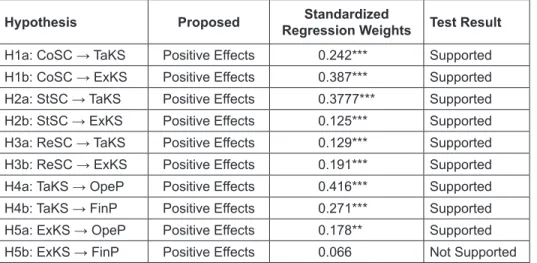
In the verification step, the author tested all hypotheses by apply Structural Equation Modelling (SEM). Table 5 below shows that H1a, H1b, H2a, H2b, H3a, and H3b represent significant effects of the cognitive, structural, and relational dimensions of social capital on tacit and explicit knowledge sharing. Similarly, H4a, H4b, and H5a also represent the significant effects of tacit and explicit knowledge sharing on operational and financial performance, respectively. However, explicit knowledge sharing does not significantly affect financial performance, so H5b is not supported.

5.2. Discussion

Although knowledge sharing is a common topic analysis,

little thought has been given to how knowledge sharing

may conceptually and practically establish a connection

(8)

Table 4: Discriminant Validity

Square Root of AVE CoSC ReSC StSC ExKS TaKS OpeP FinP

CoSC 0.762 1

ReSC 0.791 0.474 1

StSC 0.744 0.606 0.432 1

ExKS 0.703 0.493 0.419 0.535 1

TaKS 0.721 0.411 0.356 0.566 0.454 1

OpeP 0.732 0.488 0.261 0.433 0.309 0.406 1

FinP 0.735 0.342 0.306 0.262 0.234 0.263 0.321 1

Table 5: Hypothesis Test Results

Hypothesis Proposed Standardized

Regression Weights Test Result

H1a: CoSC → TaKS Positive Effects 0.242*** Supported

H1b: CoSC → ExKS Positive Effects 0.387*** Supported

H2a: StSC → TaKS Positive Effects 0.3777*** Supported

H2b: StSC → ExKS Positive Effects 0.125*** Supported

H3a: ReSC → TaKS Positive Effects 0.129*** Supported

H3b: ReSC → ExKS Positive Effects 0.191*** Supported

H4a: TaKS → OpeP Positive Effects 0.416*** Supported

H4b: TaKS → FinP Positive Effects 0.271*** Supported

H5a: ExKS → OpeP Positive Effects 0.178** Supported

H5b: ExKS → FinP Positive Effects 0.066 Not Supported

Note: ***, ** and *Indicates significant at 1%, 5% and 10% level of significance based on t-statistics.

between enterprise performance and social capital.

To address this research vacuum, the authors developed a model that describes how various aspects of social capital allow knowledge sharing, which in turn affects enterprise performance. The empirical results substantially corroborate our suggested model by showing that knowledge sharing mediates the relationship between all three aspects of social capital and enterprise performance. At the same time, the findings highlight the significance of knowledge sharing as a key advantage of social capital and a significant driving factor of both operational and financial performance. The findings indicate that all three social capital characteristics (structural, relational, and cognitive) substantially influence both tacit and explicit knowledge sharing. While social capital improves both tacit and explicit knowledge, knowledge is one of the primary pathways linking social capital to enterprise performance (Adler & Kwon, 2002;

Davenport & Prusak, 1998).

Furthermore, our findings are consistent with previous research investigating the mediating function of knowledge

sharing (Wu, 2008; Saha & Banerjee, 2015). Our study offers supporting evidence as to the necessary measures to be taken for social capital to influence enterprise performance (Van Wijk et al., 2008). That is, before identifying any performance-related outcomes linked to social capital, enterprise workers are encouraged to share the knowledge they have gained via their social capital (Ha

& Nguyen, 2020). Unlike previous studies that examined the influences of social capital on knowledge sharing with regard to network ties, trust, and shared vision (Saha &

Banerjee, 2015), or network ties, relationship quality, and social interaction on knowledge acquisition (Yli‐Renko et al., 2001), our research has conceptualized social capital concerning cognitive, relational, and structural dimensions.

We bridge the research gap by developing a model to depict

the relationships between social capital, knowledge sharing,

and enterprise performance. Furthermore, it offers a more

comprehensive definition of knowledge sharing as both

tacit and explicit and enterprise success as both financial

and operational.

(9)

Hence, our research model may be used in future studies to evaluate social capital, knowledge sharing, and firm performance as a new theoretical model. Except for one, our empirical findings supported the majority of assumptions, including explicit sharing of knowledge about a firm’s financial performance. In summary, our findings provide a reasonable explanation for how social capital promotes knowledge exchange and enterprise performance.

The function of knowledge sharing as a mediator was also confirmed. That is, social capital contributes to enterprise operational performance through both explicit and tacit knowledge sharing, as well as enterprise’s financial performance via tacit knowledge sharing.

6. Conclusion

Our research offers some intriguing insights for managers coping with social capital. First, businesses benefit from encouraging the exchange of knowledge (both tacit and explicit). Managers are urged to create an appropriate corporate culture and procedures, as well as a rewards system, to promote such sharing. Such training may help workers assimilate new knowledge and adopt best practices as well as new habits. Individuals and teams may be rewarded for better performance as a consequence of sharing. Second, since knowledge sharing moderates the impacts of social capital on enterprise performance, merely enabling important social capital-related tasks may be inadequate. It is critical that enterprise managers understand the impact of social capital on knowledge sharing and enterprise performance and invest in systems that enable knowledge sharing to be appropriately directed to achieve the desired levels of performance.

The study contains flaws that must be addressed in future research. First, although our findings are consistent with prior findings, we were unable to validate the suggested causal connections due to the use of a survey methodology.

Longitudinal designs may be utilized in future research to infer causation. Second, our research used convenience sampling to sample SMEs in Vietnam in general. Future research may employ a random sample technique and concentrate on a particular sector to enhance external validity (Cook et al., 2002) and validate our understanding. Finally, by examining the relationships between social capital, knowledge sharing, and business performance, our work adds to a large body of literature. However, contextual factors such as enterprise culture, politics, and knowledge management procedures were not considered. Further research may benefit from exploring the effects of these contextual factors.

References

Adler, P. S., & Kwon, S. W. (2002). Social capital: Prospects for a new concept. Academy of Management Review, 27(1), 17–40.

https://doi.org/10.5465/amr.2002.5922314

Akhavan, P., & Mahdi Hosseini, S. (2016). Social capital, knowledge sharing, and innovation capability: an empirical study of R&D teams in Iran. Technology Analysis & Strategic Management, 28(1), 96–113. https://doi.org/10.1080/09537325.

2015.1072622

Allameh, S. M., Pool, J. K., Jaberi, A., & Soveini, F. M. (2014).

Developing a model for examining the effect of tacit and explicit knowledge sharing on organizational performance based on the EFQM approach. Journal of Science and Technology Policy Management, 5(3), 265–280. https://doi.org/10.1108/

JSTPM-05-2014-0025

Anderson, J. C., & Gerbing, D. W. (1988). Structural equation modeling in practice: A review and recommended two-step approach. Psychological Bulletin, 103(3), 411–423. https://doi.

org/10.1037/0033-2909.103.3.411

Borgatti, S. P., & Cross, R. (2003). A relational view of information seeking and learning in social networks. Management Science, 49(4), 432–445. https://doi.org/10.1287/mnsc.49.4.432.14428 Chow, W. S., & Chan, L. S. (2008). Social network, social trust, and

shared goals in organizational knowledge sharing. Information

& Management, 45(7), 458–465. https://doi.org/10.1016/j.

im.2008.06.007

Coakes, E. (2006). Storing and sharing knowledge: Supporting the management of knowledge made explicit in transnational organizations. Learning Organization, 13(6), 579–593. https://

doi.org/10.1108/09696470610705460

Coleman, J. S. (1988). Social capital in the creation of human capital. American Journal of Sociology, 94, S95–S120. https://

doi.org/10.1086/228943

Collins, J. D., & Hitt, M. A. (2006). Leveraging tacit knowledge in alliances: The importance of using relational capabilities to build and leverage relational capital. Journal of Engineering and Technology Management, 23(3), 147–167. https://doi.

org/10.1016/j.jengtecman.2006.06.007

Cook, T. D., Campbell, D. T., & Shadish, W. (2002). Experimental and quasi-experimental designs for generalized causal inference. Boston, MA: Houghton Mifflin.

Davenport, T. H., & Prusak, L. (1998). Working knowledge: How organizations manage what they know. London, UK: Harvard Business Press.

De Zubielqui, G. C., Lindsay, N., Lindsay, W., & Jones, J. (2019).

Knowledge quality, innovation and firm performance: A study of knowledge transfer in SMEs. Small Business Economics, 53(1), 145–164. https://doi.org/10.1007/s11187-018-0046-0 Demirbag, M., Tatoglu, E., Tekinkus, M., & Zaim, S. (2006). An

analysis of the relationship between TQM implementation and organizational performance: Evidence from Turkish SMEs.

Journal of Manufacturing Technology Management, 17(6), 829–847. https://doi.org/10.1108/17410380610678828 Dess, G. G., & Robinson, R. B. (1984). Measuring organizational

performance in the absence of objective measures: The case of the privately held firm and conglomerate business unit.

Strategic Management Journal, 5(3), 265–273. https://doi.org/

10.1002/smj.4250050306

(10)

Dhanaraj, C., Lyles, M. A., Steensma, H. K., & Tihanyi, L. (2004).

Managing tacit and explicit knowledge transfer in IJVs: the role of relational embeddedness and the impact on performance.

Journal of International Business Studies, 35(5), 428–442.

https://doi.org/10.1057/palgrave.jibs.8400098

Endres, M. L., Endres, S. P., Chowdhury, S. K., & Alam, I.

(2007). Tacit knowledge sharing, self‐efficacy theory, and application to the open-source community. Journal of Know- ledge Management, 11(3), 92–103. https://doi.org/10.1108/

13673270710752135

Epstein, M. H. (2000). The behavioral and emotional rating scale:

A strength-based approach to assessment. Diagnostique, 25(3), 249–256. https://doi.org/10.1177/073724770002500304 Felin, T., & Hesterly, W. S. (2007). The knowledge-based view,

nested heterogeneity, and new value creation: Philosophical considerations on the locus of knowledge. Academy of Management Review, 32(1), 195–218. https://doi.org/10.5465/

amr.2007.23464020

Ganguly, A., Talukdar, A., & Chatterjee, D. (2019). Evaluating the role of social capital, tacit knowledge sharing, knowledge quality, and reciprocity in determining the innovation capability of an organization. Journal of Knowledge Management, 23(6), 1105–1135. https://doi.org/10.1108/JKM-03-2018-0190 Gao, W., He, X. J., & Wang, H. (2009). The impact of knowledge

integration on firm performance. Journal of International Technology and Information Management, 18(2), 239. https://

doi.org/10.1108/13673270610679354

Gooderham, P., Minbaeva, D. B., & Pedersen, T. (2011).

Governance mechanisms for the promotion of social capital for knowledge transfer in multinational corporations. Journal of Management Studies, 48(1), 123–150. https://doi.org/10.1111/

j.1467-6486.2009.00910.x

Granovetter, M. (1983). The strength of weak ties: A network theory revisited. Sociological Theory, 1, 201–233. https://doi.

org/10.2307/202051

Ha, T., & Nguyen, P. (2020). Social capital, knowledge sharing, and firm performance. Management Science Letters, 10(12), 2923–2930. https://doi.org/10.5267/j.msl.2020.4.014

Hair, J. F., Black, W. C., Babin, B. J., & Anderson, R. E. (2014).

Multivariate data analysis. Essex: Pearson Education Limited.

Hansen, M. T. (1999). The search-transfer problem: The role of weak ties in sharing knowledge across organization subunits.

Administrative Science Quarterly, 44(1), 82–111. https://doi.

org/10.2307/2667032

Harlow, H. (2008). The effect of tacit knowledge on firm performance. Journal of Knowledge Management, 12(1), 148–163. https://doi.org/10.1108/13673270810852458 Holste, J. S., & Fields, D. (2010). Trust and tacit knowledge sharing

and use. Journal of Knowledge Management, 14(1), 128–140.

https://doi.org/10.1108/13673271011015615

Hooff, B. V. D., & Ridder, J. A. D. (2004). Knowledge sharing in context: the influence of organizational commitment, communication climate and CMC use on knowledge sharing.

Journal of Knowledge Management, 8(6), 117–130. https://doi.

org/10.1108/13673270410567675

Huang, Q., Davison, R. M., & Gu, J. (2011). The impact of trust, Guanxi orientation, and face on the intention of Chinese employees and managers to engage in peer‐to‐peer tacit and explicit knowledge sharing. Information Systems Journal, 21(6), 557–577. https://doi.org/10.1111/j.1365-2575.2010.00361.x Hughes, M., Morgan, R. E., Ireland, R. D., & Hughes, P. (2014).

Social capital and learning advantages: A problem of absorptive capacity. Strategic Entrepreneurship Journal, 8(3), 214–233.

https://doi.org/10.1002/sej.1162

Inkpen, A. C., & Tsang, E. W. (2005). Social capital, networks, and knowledge transfer. Academy of Management Review, 30(1), 146–165. https://doi.org/10.5465/amr.2005.15281445

Kim, H., & Gong, Y. (2009). The roles of tacit knowledge and OCB in the relationship between group‐based pay and firm performance. Human Resource Management Journal, 19(2), 120–139. https://doi.org/10.1111/j.1748-8583.2009.00093.x Kim, T. T., Lee, G., Paek, S., & Lee, S. (2013). Social capital,

knowledge sharing and organizational performance: what structural relationship do they have in hotels?. International Journal of Contemporary Hospitality Management. https://

doi.org/10.1108/IJCHM-Jan-2012-0010

Kogut, B., & Zander, U. (1996). What do firms do? Coordination, identity, and learning. Organization Science, 7(5), 502–518.

https://doi.org/10.1287/orsc.7.5.502

Koskinen, K. U., Pihlanto, P., & Vanharanta, H. (2003). Tacit knowledge acquisition and sharing in a project work context.

International Journal of Project Management, 21(4), 281–290.

https://doi.org/10.1016/S0263-7863(02)00030-3

Lin, H. F. (2007). Effects of extrinsic and intrinsic motivation on employee knowledge sharing intentions. Journal of Information Science, 33(2), 135–149. https://doi.org/

10.1177/0165551506068174

Mahmoudi Farahani, L. (2016). The value of the sense of community and neighboring. Housing, Theory and Society, 33(3), 357–376. https://doi.org/10.1080/14036096.2016.

1155480

Maurer, I., Bartsch, V., & Ebers, M. (2011). The value of intra- organizational social capital: How it fosters knowledge transfer, innovation performance, and growth. Organization Studies, 32(2), 157–185. https://doi.org/10.1177/0170840610394301 Muafi, M. (2020). A nexus among strategic orientation, social

network, knowledge sharing, organizational innovation, and MSMEs performance. The Journal of Asian Finance, Economics, and Business, 7(6), 327–338. https://doi.

org/10.13106/jafeb.2020.vol7.no6.327

Nahapiet, J., & Ghoshal, S. (1998). Social capital, intellectual capital, and organizational advantage. Academy of Management Review, 23(2), 242–266. https://doi.org/10.5465/

amr.1998.533225

Ngo, C., Nguyen, Q. L. H. T. T., & Nguyen, P. T. (2020). Social

capital and corporate performance: Evidence from state

(11)

capital enterprises in Vietnam. The Journal of Asian Finance, Economics, and Business, 7(6), 409–416. https://doi.org/

10.13106/jafeb.2020.vol7.no6.409

Nonaka, I. (1994). A dynamic theory of organizational knowledge creation. Organization Science, 5(1), 14–37. https://doi.org/

10.14198/orsc.1114.03910

Nonaka, I., & Takeuchi, H. (1995). The knowledge-creating company: How Japanese companies create the dynamics of innovation. Oxford: Oxford University Press.

Nonaka, I., & Toyama, R. (2015). The knowledge-creating theory revisited: Knowledge creation as a synthesizing process. In: Edwards, J. S. (Ed.), The essentials of knowledge management (pp. 95–110). London: Palgrave Macmillan.

https://doi.org/10.1057/9781137552105_4

Nonaka, I., & Von Krogh, G. (2009). Tacit knowledge and knowledge conversion: Controversy and advancement in organizational knowledge creation theory. Organization Science, 20(3), 635–652. https://doi.org/10.1287/orsc.1080.0412

Palacios-Marqués, D., Peris-Ortiz, M., & Merigó, J. M. (2013). The effect of knowledge transfer on firm performance: An empirical study in knowledge-intensive industries. Management Decision, 51(5), 973–985. https://doi.org/10.1108/MD-08-2012-0562 Polanyi, M. (1962). Personal knowledge: Towards a post-critical

philosophy. New York: Harper Torchbooks.

Putnam, R. D. (2000). Bowling alone: America’s declining social capital. In: Crothers, L., & Lockhart, C. (Eds.), Culture and politics (pp. 223–234). New York: Palgrave Macmillan. https://

doi.org/10.1007/978-1-349-62397-6_12

Reagans, R., & McEvily, B. (2003). Network structure and knowledge transfer: The effects of cohesion and range.

Administrative Science Quarterly, 48(2), 240–267. https://doi.

org/10.2307/3556658

Reychav, I., & Weisberg, J. (2009). Good for workers, good for companies: How knowledge sharing benefits individual employees. Knowledge and Process Management, 16(4), 186–197. https://doi.org/10.1002/kpm.335

Saha, M., & Banerjee, S. (2015). Social capital and information sharing: Impact on firm performance. In: Bilgin, M. H., Danis, H., Demir, E., & Lau, C. K. M. (Eds.), Innovation, finance, and the economy (pp. 193–211). Cham: Springer.

Santosa, M. G. S., Supartha, W. G., Riana, I. G., & Surya, I.

(2020). Contiguity of social capital, competence, and business performance moderating by government policy. The Journal of Asian Finance, Economics, and Business, 7(9), 727–736.

https://doi.org/10.13106/jafeb.2020.vol7.no9.727

Sorenson, O., Rivkin, J. W., & Fleming, L. (2006). Complexity, networks, and knowledge flow. Research Policy, 35(7), 994–1017. https://doi.org/10.1016/j.respol.2006.05.002 Szulanski, G. (1996). Exploring internal stickiness: Impediments

to the transfer of best practice within the firm. Strategic Management Journal, 17(S2), 27–43. https://doi.org/10.1002/

smj.4250171105

Taouab, O., & Issor, Z. (2019). Firm performance: Definition and measurement models. European Scientific Journal, 15(1), 93–106. https://doi.org/10.19044/esj.2019.v15n1p93

Tran, T. K. P. (2021). The effect of knowledge sharing and innovativeness on organizational performance: An empirical study in Vietnam. The Journal of Asian Finance, Economics, and Business, 8(8), 503–511. https://doi.org/10.13106/jafeb.

2021.vol8.no8.0503

Tsai, W., & Ghoshal, S. (1998). Social capital and value creation:

The role of intrafirm networks. Academy of Management Journal, 41(4), 464–476. https://doi.org/10.5465/257085 Van Wijk, R., Jansen, J. J., & Lyles, M. A. (2008). Inter‐and intra‐

organizational knowledge transfer: a meta‐analytic review and assessment of its antecedents and consequences. Journal of Management Studies, 45(4), 830–853. https://doi.org/10.1111/

j.1467-6486.2008.00771.x

Van Woerkom, M., & Sanders, K. (2010). The romance of learning from disagreement. The effect of cohesiveness and disagreement on knowledge sharing behavior and individual performance within teams. Journal of Business and Psychology, 25(1), 139–149. https://doi.org/10.1007/s10869-009-9136-y

Venkatraman, N., & Ramanujam, V. (1986). Measurement of business performance in strategy research: A comparison of approaches. Academy of Management Review, 11(4), 801–814.

https://doi.org/10.5465/amr.1986.4283976

Wang, Z., & Wang, N. (2012). Knowledge sharing, innovation, and firm performance. Expert Systems with Applications, 39(10), 8899–8908. https://doi.org/10.1016/j.eswa.2012.02.017 Wang, Z., Wang, N., & Liang, H. (2014). Knowledge sharing,

intellectual capital, and firm performance. Management Decision, 52(2), 230–258. https://doi.org/10.1108/MD-02- 2013-0064

Wasko, M. M., & Faraj, S. (2005). Why should I share? Examining social capital and knowledge contribution in electronic networks of practices. MIS Quarterly, 29(1), 35–57. https://doi.

org/10.2307/25148667

Wei, J., Zheng, W., & Zhang, M. (2011). Social capital and knowledge transfer: A multi-level analysis. Human Relations, 64(11), 1401–1423. https://doi.org/10.1177/0018726711417025 Wu, W. P. (2008). Dimensions of social capital and firm

competitiveness improvement: The mediating role of information sharing. Journal of Management Studies, 45(1), 122–146. https://doi.org/10.1111/j.1467-6486.2007.00741.x Yli‐Renko, H., Autio, E., & Sapienza, H. J. (2001). Social capital,

knowledge acquisition, and knowledge exploitation in young technology‐based firms. Strategic Management Journal, 22(6–7), 587–613. https://doi.org/10.1002/smj.183

Zaqout, F., & Abbas, M. (2012). Towards a model for understanding the influence of the factors that stimulate university students’ engagement and performance in knowledge sharing. Library Review, 61(5), 345–361. https://

doi.org/10.1108/00242531211280478

수치

Table 1: Social Capital Variables and Measurement
Table 2: Knowledge Sharing Variables and Measurement
Table 3: Enterprise Performance Variables and Measurement
Table 5: Hypothesis Test Results

참조

관련 문서

Relationship Between English Vocabulary Knowledge and English Collocation Usage of Korean Middle

The purpose of this study is to examine the relationship between the social support and mental health of university taekwondo athletes, and clearly clas sify

Also, the design of an optimal heat sink requires a complete knowledge of all heat transfer characteristics between the heat source and the ambient air

The Effect of Shared Leadership on Voice and Knowledge Sharing Behavior: Creative Self-Efficacy and Change.. Self-Efficacy

processes and tools required to transform enterprise data into information, information into knowledge that can be used to enhance decision-making and to create actionable

전사적 지식관리 시스템(Enterprise-Wide Knowledge Management Systems).

Previous literature informs six factors (satisfaction, reputa- tion, relational capital, knowledge quality, compati- bility, personalization) as candidates influencing

To improve nursing students' CPR knowledge, self-efficacy, and performance in the future, simulation-based CPR training that provides experience which is similar