†: 이 논문은 2016년 특성화 전문대학 육성사업의 지원으로 연구되었음.
Corresponding author: Jae-Sang Byeon, Dept. of Environment & Landscape Architecture, Shingu College, Seongnam 13174, Korea, Tel.: +82-31-740-1537, E-mail: [email protected]
국가직무능력표준(NCS) 기반 조경분야 교육과정 개발
†변재상․신상현․안성로 신구대학교 환경조경과
A Methodology to Develop a Curriculum of Landscape Architecture based on National Competency Standards
Byeon, Jae-Sang․Shin, Sang-Hyun․Ahn, Seong-Ro Dept. of Environment & Landscape Architecture, Shingu College
ABSTRACT
This study began from the question, “is there a way to efficiently apply industrial demand in the university curriculum?”
Research focused on how to actively accept and respond to the era of the NCS (National Competency Standards). In order to apply NCS to individual departments of the university, industrial personnel must positively participate to form a practical-level curriculum by the NCS, which can be linked to the work and qualifications. A valid procedure for developing a curriculum based on the NCS of this study is as follows:
First, the university must select a specific classification of NCS considering the relevant industry outlook, the speciality of professors in the university, the relationship with regional industries and the prospects for future employment, and the need for industrial manpower.
Second, departments must establish a type of human resource that compromises goals for the university education and the missions of the chosen NCS. In this process, a unique competency unit of the university that can support the basic or applied subjects should be added to the task model.
Third, the task model based on the NCS should be completed through the verification of each competency unit considering the acceptance or rejection in the curriculum.
Fourth, subjects in response to each competency units within the task model should be developed while considering time and credits according to university regulations. After this, a clear subject description of how to operate and evaluate the contents of the curriculum should be created.
Fifth, a roadmap for determining the period of operating subjects for each semester or year should be built. This roadmap will become a basis for the competency achievement frame to decide upon the adoption of a Process Evaluation Qualification System.
In order for the NCS to be successfully established within the university, a consensus on the necessity of the NCS should be preceded by professors, students and staff members. Unlike a traditional curriculum by professors, the student-
oriented NCS curriculum is needed sufficient understanding and empathy for the many sacrifices and commitment of the members of the university.
Key Words: Task Model, Process Evaluation Qualification System, Task(Occupational) Competences Assessment
국문초록
산업체 수요를 대학의 교육과정 속에 효율적으로 수용해낼 수 있는 방법이 없을까? 라는 질문에서 본 연구는 시작되었 다. NCS라는 거시적인 흐름을 어떻게 하면 능동적으로 수용하고 대처할 수 있는가에 대한 방법론을 고민하고 제시한 연구이다. 대학 내 개별학과에서 NCS를 적용하기 위해서는 산업계 인사들과 함께 합리적 절차에 따라 교육과정을 개편해 야 한다. 즉, 대학에서 NCS에 대한 이해를 바탕으로 적용을 위한 타당한 절차를 따라야 할 것이며, 본 연구에서는 이러한 NCS 기반 교육과정 개발 절차를 다음과 같이 제시하였다.
첫째, 대학에서는 관련 산업 전망 및 대학 내 교수자원과 지역 산업과의 관련성이나 향후 취업전망, 산업인력수요 등을 고려하여 적용하고자 하는 NCS 세분류를 명확히 선정해야 한다. 둘째, 대학의 교육목표와 선정된 NCS 분류체계상의 세분류 목표를 절충하여 학과의 인재양성유형을 설정하고, 직무모형을 작성한다. 이 과정에서 NCS 세분류 상의 능력단위 뿐만 아니라, 학과에서 필요로 하는 NCS 기초과목과 응용과목 등에 해당하는 대학자체 능력단위를 추가하여 작성해야 한다. 셋째, NCS 세분류별 직무모형 검증 단계에서 각각의 능력단위요소에 대한 교육과정 적용 여부를 파악하여 학과의 직무모형을 완성한다. 넷째, 직무모형 내 능력단위에 대응하여 교과목을 도출하고, 학칙에 따른 시수 및 학점과 함께 해당 교과목들이 어떠한 내용을 어떠한 방식으로 운영하고 평가해야 하는지에 대한 교과목 명세서를 명확히 작성한다.
다섯째, NCS 기반 교과목들의 교육 시기에 따른 전후 관계를 파악하고, 각 학기 혹은 학년별로 교과목을 어떻게 배치하고 운영할 것인지에 대한 로드맵을 작성한다. 해당 로드맵을 통해 추후 과정평가형 자격제도의 도입 여부를 결정할 수 있는 직무능력성취도의 기본틀이 완성될 수 있다.
대학 내에서 NCS 기반 교육과정이 성공적으로 정착하기 위해서는 무엇보다도 대학 내 구성원들 즉, 교수와 학생, 직원들이 NCS의 필요성에 대하여 공감하는 것이 선행되어야 한다. 기존의 교수자 중심의 교육과정과 달리 수요자 중심의 NCS 교육과정은 처음부터 끝까지 대학 구성원들의 많은 희생과 헌신을 담보해야 가능하기 때문에, 이에 대한 적절한 보상 예컨대 과정평가형 혹은 과정이수형 국가기술자격의 부여 등이 마련되어야 할 것이다.
주제어: 직무모형, 과정평가형 자격제도, 직무능력평가
Ⅰ. 연구배경 및 목적
2016년 7월 22일 고용노동부는 자격기본법 시행령 제6조를 근거로 국가직무능력표준(National Competency Standards, 이 하 NCS)을 확정․고시했다. NCS는 산업현장에서 직무를 수행 하기 위해 필요한 지식, 기술, 소양 등을 정부가 산업별, 수준별 로 체계화한 것으로서, 이번 고시는 그동안 개발된 NCS가 법적 지위를 가지게 되었다는 것을 의미한다(Ministry of Employment and Labor, 2016). 24대 직업 분야, 847개 NCS와 이를 구성하 는 1만 599개 능력단위가 정해졌다. 정부는 NCS를 통해 산업 현장 수요에 기반한 교육훈련 혁신의 전기가 마련될 것으로 기 대하고 있다. 이는 교육․훈련․채용 등 ‘인력양성-인재채용-인 사관리’로 이어지는 고용의 전 과정에서 NSC 활용을 확산시킴 과 동시에 국가 자격 체계의 개편 동력을 확보하려는 뜻도 내
포하고 있다(http://www.assembly.go.kr). 특히 실무 중심으 로 교육․훈련 과정이 개편되는 것이 변화의 골자다. 교육훈련 의 경우, 산업현장 직무 단위와 요구능력에 맞춰 달라진다. 학 과명부터 학습내용까지 총체적인 변화가 이뤄질 것으로 예상 된다. 특히 NCS를 적극적으로 도입하고 있는 전문대학의 경우, 특성화 사업과 연계하여 2015년 79개교에서 2017년 100개교까 지 확대․적용할 계획이다. 이는 전체 전문대학 138개교의 70%
가 넘는 수준이다. 교육과학부는 NCS 도입 및 운영 대학을 중 심으로 정부의 행․재정적 지원을 받을 수 있도록 제도를 정비 하여 확대 및 안정적 정착을 정책적으로 유도하고 있다(National Assembly Budget Office, 2015). 특히 학령인구의 감소로 2018년 부터 대학입학정원이 고교 졸업자를 상회하게 될 것이며, 2025 년 이후 입학정원의 30% 이상이 미충원될 것으로 전망되는 등 대학정원 감축에 따른 구조조정이 가시화 되는 시점에서 각 대
학의 특성화 재정지원의 전제조건으로, 교육과정 내 NCS 도입 을 의무화함으로써, 교육현장에서의 능력중심교육의 실천은 대 학 존립의 필요조건이 되었다(Byeon, 2016). 또한 한국산업인 력공단도 NCS체계에 맞추어 국가자격 종목의 신설과 재설계 도 추진 중에 있다. 지식을 묻는 자격시험에서 현장능력을 묻 는 자격시험으로의 이행이 불가피하기 때문이다. NCS와 별개 로 NCS와 연계된 자격체계가 있어야만 수험생들의 스펙경쟁 부담을 줄이고, 현장중심의 인력양성, 능력중심 채용이라는 본 래 취지를 지킬 수 있다는 주장이다1). 2015년 15종목 52개 과 정에서 처음 도입된 과정평가형 자격제도2)는 2016년 30종목 129개로 확대되었으며, 2017년에는 61종목으로 확대 시행될 계 획이다(Ministry of Employment and Labor, 2016).
조경분야로 범위를 좁혀 생각해 보면 조경시공분야로 한정 하여 진행한 연구지만, Kim and Ryu(2015)는 조경분야 신입 사원들의 입사 3년 이내 이직 경험이 54.5%로 다른 분야에 비해 1.6배 정도 높다고 발표하였다. 과다한 직무량과 대인관계 및 직무적합성의 문제를 그 주된 이유로 제시하고 있다. 직무적합 성은 대학 교육에서 습득한 지식과 기술이 실제 직무와 불일치 하는데서 기인한 것으로 파악되며, 직무량 역시 대학 졸업 당 시 신입사원에게 요구되는 입직수준에서의 직무량이 대학에 서 학습되는 내용과 어긋나기 때문이다. Joo(2014)의 경우에도 대학 조경교육에 대한 실무자의 인식은 실무에서 활용할 수준 에는 못 미치는 등 다소 부정적인 것으로 나타났다. 조경교육 에 대한 실무자들의 요구로는 구체적이고 현실적인 전문지식 에 대한 요구나 인접분야에 대한 이해 등 현장에서 활용이 가 능한 내용이 주를 이루고 있었으나, 현실은 그렇지 못함을 지 적하였다. 이에 대한 대안으로 Cho(2016)는 조경교육과정의 표준화를 제안하면서, NCS의 부분적인 도입을 주장한 바 있다.
주장의 근거로는 첫째, 모호한 조경 분야의 산업적 정의가 명 쾌해지면서 직무능력의 표준과 학습모듈 개발에 따른 학습지 식과 기술이 분명히 제시되어 대학들 간의 교육과정 표준화에 대한 이견이 대부분 해소될 수 있다는 점과, 둘째, 조경교육의 목표가 조경기술자 양성에 있는 점을 감안한다면, 자격제도의 근간이 될 NCS를 교육과정에 도입함으로써, 조경의 산학협력 체계를 보다 정교하게 운영할 수 있다는 점을 강조하였다. NCS 기반 교육과정의 개발은 교육과정의 경직이나 획일화를 유발 하는 것이 아니라, 표준화를 통해 대학들간의 이견을 좁히고, 조경인력이라고 하는 최소한의 기준을 선정하고자 하는 것이 취지라고 할 수 있다. 이상의 연구는 산업 현장을 반영한 NCS 기반 교육제도의 개편과 이에 따른 자격제도의 개편이 조경에 서 간과될 수 없음을 시사하는 연구들이다.
NCS 기반 교육과정 개발의 최종 목적은 ‘교육-자격-일 연 계’를 위해 산업현장에서 필요한 직무수행능력을 기준으로 NCS 를 개발하고, 교육훈련과정과 자격기준으로 활용함으로써, 산
업계가 요구하는 인재를 양성하는데 있다. 본 연구는 NCS를 교 육훈련기관 즉, 대학 내에 객관적이고 효율적으로 적용하기 위 한 방법론을 제시하고자 진행하였다. 국가에서 개발한 NCS의 경우, 이상적인 직무수행능력을 명시하였기 때문에, 각 대학의 학생수준의 차이, 기자재와 교수들의 확보 문제, 현행 교육과정 의 시수 문제 등 세부적이고 실질적인 운영상의 문제를 고려하 지 못하고 있다. 따라서 본 연구는 연구자가 소속되어 있는 대 학에서 실제 NCS를 적용한 교육과정 개발과 운영과정을 통해, 현실적인 교육과정 속에 NCS를 적용할 수 있는 체계적인 과정 과 이를 뒷받침하는 교육과정 개발 방법론을 제시하고 공유하 고자 하는데 연구의 목적이 있다3).
Ⅱ. NCS 관련 이론 고찰
1. NCS의 추진 동향
우리나라에서도 산업현장의 변화와 요구에 부응할 수 있는 인력을 체계적으로 양성하기 위하여 1996년 교육개혁방안의 일 환으로 교육과 노동시장의 연계기능 강화를 위해 최초로 자격제 도 개편을 추진하였다. 이를 시작으로 2001년에 국무조정실을 중심으로 NCS와 NQF(National Qualification Framework)의 도입이 결정되었으며, 2002년부터 본격적으로 개발에 착수하였 다. 이후 2003년부터 2007년 사이에는 반도체 분야와 건설업, 조선업 등 일부 종목에서 NCS를 시범적으로 개발하여 교육훈 련 및 자격검정을 위한 모델을 제시하였다. 본격적인 도입기로서, 2008년부터는 자격기본법 상의 NCS 개발과 적용의 법적 근거 가 마련되었고, 향후 표준교육훈련과정의 운영 및 과정평가 인 증 즉, 자격화를 실제화하고, 확대․적용할 수 있도록 관련 인 프라 연구가 진행되었다(Byeonet al., 2015). 2013년 4월 개정 된 자격기본법 에서는 NCS에 대해서 구체적인 법적근거와 함께 과정평가형 자격제도의 발급 가능성을 밝히고 있다. 국 가기술자격법 은 2014년 4월 28일 국회에서 제안된 이후, 그 필요성이 강력하게 요구됨에 따라 원안가결의 형태로 의결되 었으며, 5월 20일 공포되어 2014년 11월 21일부터는 본격적으 로 시행되게 되었다(http://www.moleg.go.kr). 또한 2016년 1 월 개정된 국가기술자격법 제10조에서는 전공관련 교수진을 비롯하여 실험․실습 시설 및 장비, 교과 과정 및 내용, 교육․
훈련생 평가체계에 대한 기준을 충족하면 교육․훈련과정 기관 으로 인증받게 되어, 졸업생에게 과정평가형 자격제도를 부여 할 수 있게 되었다. 그러나 교육․훈련과정의 지정 방법․절차, 교육훈련생의 교육훈련과정 이수기준, 그 밖에 교육․훈련과정 의 지정․운영에 필요한 사항이 고용노동부에 관할되어 있어, 교육부에서는 이에 대한 탄력적인 운용이 어려운 상황이다. 대 학에서도 NCS 기반 교육과정 적용에 대한 명확한 지침이 없어
Figure 1. Organization system of NCS (http://www.ncs.go.kr) 제도는 가고 있으나, 현실은 머물러 있는 상황에 직면해 있다.
대학에서의 NCS 기반 교육과정 개발 방법론 정립이 필요한 시 기임을 시사하는 대목이다.
2. NCS 개발 절차 및 내용
NCS 개발4)의 기본 단위는 세분류로서, NCS 분류체계에 기 초를 두고 있다. NCS 분류체계는 2013년부터 관련 산업계와 교육계의 의견을 수렴하면서 수차례 수정 보완을 거듭하였으며, 현재도 지속적인 의견수렴을 통해 보완해 나가고 있다5). 즉, 산 업 기반을 가진 대부분의 대학 내 전공분야는 관련된 NCS 세 분류가 존재하게 되었으며, NCS 개발이 되어 있지 않다는 것은 졸업 후 진출할 수 있는 산업체가 없음을 의미하게 되었다. 조 경분야의 NCS는 2007년부터 개발되어 수년 동안 많은 시행착 오를 겪으면 다듬어져왔기 때문에, 어느 분야보다도 산업계의 의견을 적극적으로 수렴한 형태로 진화되어 왔다. 물론, 개선의 여지가 여전히 있고 수정이 필요한 것이 사실이지만, 한 번도 산업체 의견을 제대로 수렴해 본 경험이 없는 다른 전공분야보 다는 훨씬 유리한 입장에서 출발하는 것이다(Byeon, 2016). 정 부는 NCS 개발의 취지를 살리고, 현장성과 활용성을 고려하기 위해 많은 과정을 거쳤다. 하나의 NCS 개발에 산업현장전문가 7명, 교육․훈련전문가 3명, 자격 전문가 1명 등 총 11명이 참 여해 객관성과 실효성을 담보했다. 개발에 참여한 전체 민간전 문가만 11,959여명으로 이를 구체적으로 살펴보면, 산업현장 전 문가 7,315명, 교육․훈련전문가 3,333명, 자격전문가 1,093명, 소관부처 218명 등으로 워킹그룹 심의위원회도 구성해 개발된 NCS의 검증과 심의를 거쳤다. 특히 산업별로 2만 7천여개 대표 기업들이 파일럿 테스트를 거쳐 의견수렴을 하였으며, 이를 통 한 현장 적합성 검증도 이뤄졌다(Ministry of Employment and Labor, 2016).
3. 조경분야 NCS 추진 현황
NCS 개발이 본격적으로 이루어지기 시작한 2013년, 조경 분야에서는 조경관리와 조경감리가 우선적으로 개발되었다 (Human Resources Development Service of Korea, 2013)6). 중 요성 차원에서 본다면 조경설계와 조경시공이 먼저 개발되어 야 하지만, 조경설계와 조경시공은 조경(산업)기사 자격을 위 한 직무표준이 자격증 실기시험을 검증하기 위해 이미 존재하 고 있었던 것으로 분류하였다. 다만 해당 자격기준이 낙후되었 고, 시대적 수요를 반영하지 못하고 있다는 지적이 나와 2014 년에 이르러 기존의 직무표준을 보완한 조경설계, 조경시공 NCS가 새롭게 보완․개발되었다7).
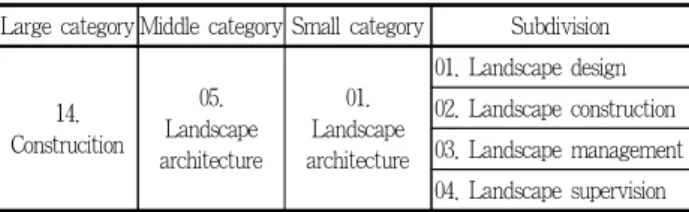
NCS 분류체계는 직무 유형을 중심으로 단계적 구성을 나타 내며, 대분류, 중분류, 소분류의 세분류로 구분된다. 우리가 ‘직
Large category Middle category Small category Subdivision
Construcition14.
05.
Landscape architecture
01.
Landscape architecture
01. Landscape design 02. Landscape construction 03. Landscape management 04. Landscape supervision Table 1. The present condition of NCS in the field of landscape
architecture
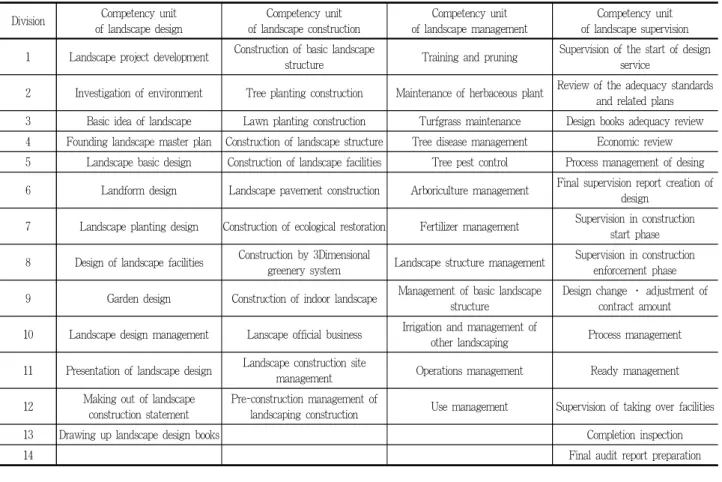
무’라고 부르는 단위는 이러한 분류체계의 세분류를 의미하며, 이를 기준으로 표준을 개발하도록 되어 있다. 조경분야 역시 건설이라는 대분류에서 산업이 분류되어 중분류, 소분류 및 4 개의 세분류로 분류된다(Table 1 참조). 조경설계, 조경시공, 조경관리 및 조경감리에 해당하는 4개의 세분류는 Table 2와 같이 업무 수행을 위한 개별 능력단위로 정의된다.
개별 직무는 능력단위요소를 포함하는 개별 능력단위의 집 합체로 구성되어 있으며(Table 2 참조), 하위단위인 능력단위 요소는 성취 여부를 판단하기 위한 수행준거와 지식․기술․태 도로 정의된다(Figure 1 참조). 또한 NCS 개발시 산업현장 직 무의 수준을 1수준부터 8수준까지 평정하여 8단계의 수준체계 에 따라 능력단위 및 능력단위요소별 수준을 제시하고 있으며, 국가기술자격에서는 이러한 수준체계와 직무내용을 근거로 자 격체계의 개편, 자격설계 등 다양한 영역에서 활용을 준비 중 에 있다.
Ⅲ. 연구내용 및 방법
1. 인재양성 유형 도출
교육과정은 한번 개발되어 적용되면 해당 학번의 학생들이 졸업하기 전까지는 바꿀 수가 없다. 교육과정 개발을 위한 신 중하고 철저한 분석이 필요한 이유이다8). 대학과 학과가 처한 현재의 위치와 상황을 객관적이고 정확하게 진단해야만, NCS 도입을 위한 명확한 처방전을 쓸 수 있다. 대학의 현재 상황과
Figure 2. The cultivating talent setting of type method for the curriculum development Division Competency unit
of landscape design Competency unit
of landscape construction Competency unit
of landscape management Competency unit of landscape supervision 1 Landscape project development Construction of basic landscape
structure Training and pruning Supervision of the start of design service
2 Investigation of environment Tree planting construction Maintenance of herbaceous plant Review of the adequacy standardsand related plans 3 Basic idea of landscape Lawn planting construction Turfgrass maintenance Design books adequacy review 4 Founding landscape master plan Construction of landscape structure Tree disease management Economic review 5 Landscape basic design Construction of landscape facilities Tree pest control Process management of desing 6 Landform design Landscape pavement construction Arboriculture management Final supervision report creation of
design 7 Landscape planting design Construction of ecological restoration Fertilizer management Supervision in construction
start phase 8 Design of landscape facilities Construction by 3Dimensional
greenery system Landscape structure management Supervision in construction enforcement phase 9 Garden design Construction of indoor landscape Management of basic landscape
structure Design change ․ adjustment of contract amount 10 Landscape design management Lanscape official business Irrigation and management of
other landscaping Process management 11 Presentation of landscape design Landscape construction site
management Operations management Ready management
12 Making out of landscape
construction statement Pre-construction management of
landscaping construction Use management Supervision of taking over facilities
13 Drawing up landscape design books Completion inspection
14 Final audit report preparation
Table 2. The competency units in each landscpae field(http://www.ncs.go.kr)
내외부 환경 분석 및 구성원들의 요구에 대한 분석이 인재양성 유형 설정을 위한 핵심적인 분석 항목이 된다(Byeon and Shin, 2009). 예컨대 학과별 취업현황에 따른 전망, 인력수요에 따른
전망, 환경변화 등에 따른 전망 등을 정확하게 분석하여 진단 해야 교육과정 개편을 위한 올바른 방향을 설정하고, 시행착오 에 따른 피해를 최소화할 수 있다. Figure 2는 인재양성 유형
Figure 3. The development procedure of NCS-based curriculum 도출을 위한 여러 분석들의 기본 틀을 제안한 것이다.
모든 분석은 기본적으로 최근 3년간의 자료를 토대로 분석 하였다. 이는 단기간의 일시적인 자료 분석에서 오는 편차를 줄이고, 누적된 경향을 파악함으로써, 교육과정 개발의 시행착 오를 줄이기 위함이다. 실제로 NCS는 5년 이내의 주기로 개발 을 하게 되어 있으므로9), 5년 이상의 장기자료에 대한 분석은 의미가 없다. 따라서 본 연구에서는 최소한의 자료 검색 기준 을 3~5년으로 확정하고, 최신의 경향을 파악하기 위한 가장 바람직한 기간으로 3년을 선택하였다.
2. NCS 기반 교육과정 개발 절차
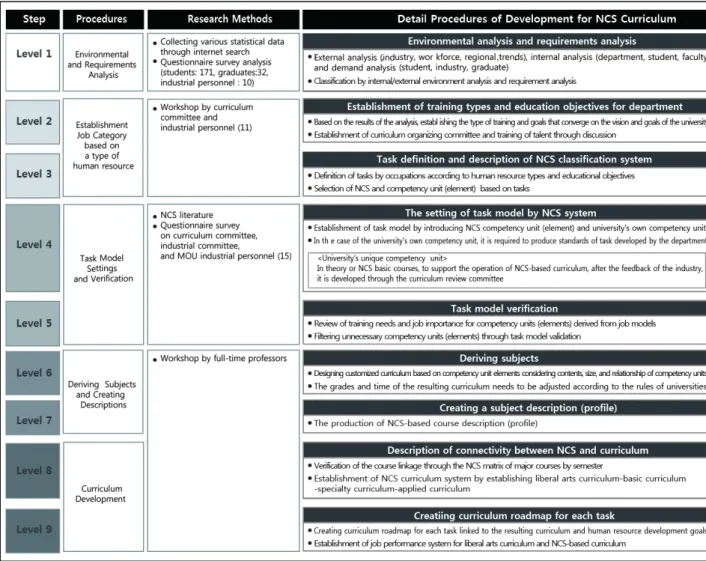
내외부 환경 및 요구사항에 대한 분석이 끝나고, 이에 대한 진단이 완료된 후에는 대학의 고유한 특성화 방향과 인재양성 목표에 부합하는 교육목표 및 교육과정 개발 논리를 확립해야 한다. Figure 3은 본 연구에서 수행한 NCS 기반 교육과정 개발 절차와 각 단계별 수행 방법을 나타낸 것이다. 각 단계별로 통
계자료 수집, 수요자 설문조사, 워크샵 및 회의 등 최대한 객관 적인 방법과 절차를 밟을 수 있도록 하였다.
이상의 절차를 준용하여 NCS 기반 교육과정을 개발하였고, 이를 적용한 교육과정을 대학 내에서 실제로 운영하였다.
Ⅳ. 결과 및 고찰
1. NCS 기반 교육과정 개발을 위한 현황 및 요구분석 1) 외부 환경분석
외부 환경분석은 산업측면과 인력측면, 지역측면에서 고찰 하였으며, 이를 종합하여 대학 내 인재양성을 위한 직무의 중 요도와 직업 전망에 대한 논리를 도출하였다. 고른 측면에서의 산업 및 인력, 지역동향고찰을 위해, 국가통계포털의 통계정보 를 비롯하여 한국산업연구원의 산업동향자료와 대한건설협회, 대한전문건설협회, 한국엔지니어링진흥협회, 한국기술사회, 산 림청, 한국산업인력공단의 Q-Net, 광역단체와 기초단체 홈페
Division Analysis contents Applying plan for human resource development
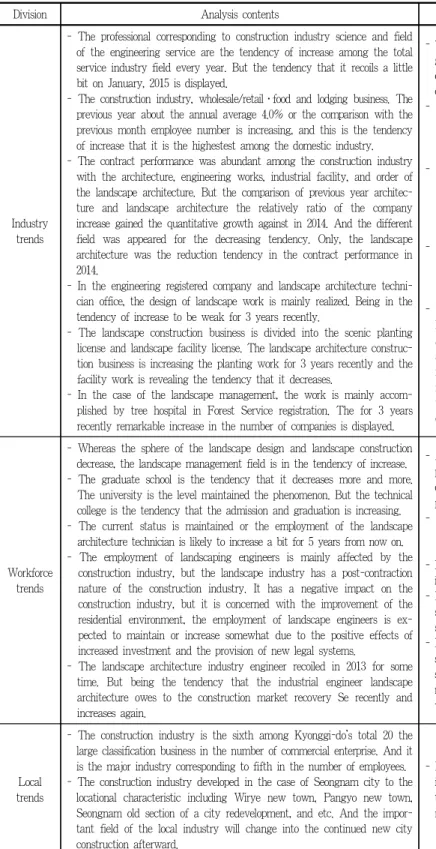
Industry trends
- The professional corresponding to construction industry science and field of the engineering service are the tendency of increase among the total service industry field every year. But the tendency that it recoils a little bit on January, 2015 is displayed.
- The construction industry, wholesale/retail․food and lodging business. The previous year about the annual average 4.0% or the comparison with the previous month employee number is increasing, and this is the tendency of increase that it is the highestest among the domestic industry.
- The contract performance was abundant among the construction industry with the architecture, engineering works, industrial facility, and order of the landscape architecture. But the comparison of previous year architec- ture and landscape architecture the relatively ratio of the company increase gained the quantitative growth against in 2014. And the different field was appeared for the decreasing tendency. Only, the landscape architecture was the reduction tendency in the contract performance in 2014.
- In the engineering registered company and landscape architecture techni- cian office, the design of landscape work is mainly realized. Being in the tendency of increase to be weak for 3 years recently.
- The landscape construction business is divided into the scenic planting license and landscape facility license. The landscape architecture construc- tion business is increasing the planting work for 3 years recently and the facility work is revealing the tendency that it decreases.
- In the case of the landscape management, the work is mainly accom- plished by tree hospital in Forest Service registration. The for 3 years recently remarkable increase in the number of companies is displayed.
- The construction industry is suitable as the cultivating talent goal among 20 large classification industries since being gra- dually in the tendency of increase according to the recovery of the domestic economical condition.
- The number of companies tends to be abundant compared with the contract performance among the construction industry in case of the landscape architecture. And this gives sug- gestions to have the form of the small business paltry soon.
- Therefore, being regarded as one of which the selection of business types of the small scale is desirable than the tech- nical college on characteristic business required for the enor- mous technical skills of the practice oriented like the land- scape architecture.
- The intensitfication of NCS course education for the land- scape design, landscape construction, and landscape mana- gement is considered, raising the course of education specific gravity of the landscape management task.
- Whereas the professional characteristic is strong because the landscape design, landscape construction and landscape man- agement field is preparing to the qualification in the con- struction fundamental law among the landscape architecture industry, because of being the duty in which there is no regulation on the qualification in case of the landscape super- vision as the job and which needs the career, the edu- cational conformity in the college falls.
Workforce trends
- Whereas the sphere of the landscape design and landscape construction decrease, the landscape management field is in the tendency of increase.
- The graduate school is the tendency that it decreases more and more.
The university is the level maintained the phenomenon. But the technical college is the tendency that the admission and graduation is increasing.
- The current status is maintained or the employment of the landscape architecture technician is likely to increase a bit for 5 years from now on.
- The employment of landscaping engineers is mainly affected by the construction industry, but the landscape industry has a post-contraction nature of the construction industry. It has a negative impact on the construction industry, but it is concerned with the improvement of the residential environment, the employment of landscape engineers is ex- pected to maintain or increase somewhat due to the positive effects of increased investment and the provision of new legal systems.
- The landscape architecture industry engineer recoiled in 2013 for some time. But being the tendency that the industrial engineer landscape architecture owes to the construction market recovery Se recently and increases again.
- As a vocational training institute, it is desirable that the ex- pansion of the field related to the landscape in the college is organized in a practical manner and the curriculum is com- posed.
- It is required to set up goal setting and curriculum re- formation for landscape design, landscape construction, land- scape management based on demand increase.
- In particular, it is required to strengthen education and train- ing of landscape management job.
- It is necessary to introduce the NCS curriculum to form and support the curriculum with the goal of qualification of land- scaping industry articles.
- It is also recommended that landscape design, landscape con- struction and landscaping management at the level of land- scape architects should be set as the main target of human resource development, and high level of landscape super- vision should be excluded.
Local trends
- The construction industry is the sixth among Kyonggi-do's total 20 the large classification business in the number of commercial enterprise. And it is the major industry corresponding to fifth in the number of employees.
- The construction industry developed in the case of Seongnam city to the locational characteristic including Wirye new town, Pangyo new town, Seongnam old section of a city redevelopment, and etc. And the impor- tant field of the local industry will change into the continued new city construction afterward.
- Because the landscape architecture in the construction industry is expected that demand for manpower will increase within the next three years, it is necessary to establish a human resource development goal.
Table 3. The comprehensive analysis of external environment 이지의 사업자 등록정보 등의 통계자료를 분석하였다. 정확한 통계수치는 지면관계상 생략하고, 이들 분석을 통해 도출한 결 론은 Table 3과 같다.
2) 내부 환경분석
내부 환경분석은 대학 내 전공분야의 취업률과 졸업생의 상 세 취업처 및 타 대학과 유사학과와의 비교 경쟁력 등에 대한
Division Analysis contents Applying plan for human resource development
Employment trends Major employment sector trends remain at a certain level Sold out in three main fields of work (landscape design, landscape con-struction, landscape management) Competitiveness with
other universities Employment rate, support ratio comparison advantage Continuously promoting, utilizing graduates and industry personnel Etc. The recent drop in grades for freshmen Lower the difficulty level of the initial courses, need to review late
placement of highly challenging subjects Table 4. The comprehensive analysis of internal environment
Division Requirements Analysis contents Applying plan for human resource development
Students
Curriculum
organization Of the 171 respondents, 87.1% of the respondents were
satisfied. It is appropriate to maintain the 2015 curriculum.
Organizing liberal arts courses
84.2% of the respondents answered that they are satis fied. In particular, the question of "choice autonomy for liberal arts courses" has become an important issue in the question of the students' support for liberal arts sub- jects.
There are 6 ‘normal' and ’dissatisfied' students in liberal arts. “Choice autonomy for liberal arts lectures" has emerged as an important issue, but because it is difficult to secure the liberal arts due to the lack of liberal arts due to the characteristics of junior colleges, it is considered difficult to apply positively in the feedback system.
Organizing major
courses 163 students(95.3%) were satisfied. It is judged that the composition of major courses in 2015 is appropriate. But conversion to NCS subject is required.
Major course view 92.4% of the respondents said that they are highlyutilized in the workplace.
Therefore, the present curriculum is judged to be very ap- propriate, and it is important to maintain the current state in the feedback system.
Hiring critical items 59.6% had the highest level of practical skills, and27.6% had personality and sincerity. This means that the education of the students in the basic skills of the profession should be treated as important.
Desired job
Landscape management was the most common area with 39.8% reflecting the external trend. Landscape design, Landscape construction did not show much difference.
In this reorganization of the curriculum, it is necessary to concentrate on these three areas when setting up the job field.
Assistance qualifications to
employment
The qualifications of landscape(industry) engineer were 73.7%, much higher than others.
It should be reflected in the course of the reflections that the curriculum should be supported by subjects that can help the landscape(industry) engineer.
Career target area
of interest 45.1% obtained the certificate of major, 30.4% com- puter literacy, and 18.7% credit management.
Although it is important to obtain a certificate of major, it is understood that the students who are most important in their hiring are aware of the necessity of computer literacy including the qualification. NCS' competency unit(element) includes computer literacy ability, so it would be expected to be met by reforming curriculum based on NCS this time.
Table 5. The comprehensive analysis of demand analysis
분석을 통해 취업성과 및 학과의 경쟁력과 교육과정에서의 참 고사항 등을 도출하였다(Table 4 참조). 해당 내용에 대한 분 석 자료는 공신력 있는 대학정보공시자료를 활용하였다.
3) 수요자 요구분석
Kim(2010)은 조경관련 교육교과목 중 조경설계교과목에 대 한 수요자 즉, 학생들의 태도와 인식을 배경으로 대학 내 교과 목의 체계적인 교육 방법론의 도입 및 평가체계에 대한 개선이 필요하다고 하였다. 수요자 요구조사는 교육과정 개발 및 평가 를 위한 개선안 마련에 있어서, 필수 사항임을 상기시켜준다.
본 연구에서도 교육의 실질적인 수요자인 산업체와 재학생, 졸 업생을 대상으로 채용 시 주요 고려사항, 필요한 직업기초능력,
관심영역, 취업목표 등에 대한 설문조사를 통해 요구분석을 실 시하였다(Table 5 참조).
재학생들은 전공실무능력에 대한 가치를 중요하게 생각하고 있는 반면, 산업체에서는 인성 및 성실성에 대한 가치를 더욱 높게 평가하고 있었다. 이는 전공실무능력에 대한 대학교육에 대한 신뢰가 부족하며, 오히려 인성이나 성실성 등에 대한 교 육을 기대하고 있는 것으로 파악된다. 채용 시 가장 중요하게 생각하는 항목으로 전공자격증 취득을 꼽았으며, 컴퓨터 활용 능력도 종합적으로 필요한 것으로, 재학생과 졸업생이 공통으 로 인지하고 있었다. 따라서 실제 조경분야 NCS 능력단위(요 소)가 컴퓨터 활용능력도 많이 포함하고 있으므로, NCS 기반 교육과정 개발에서는 해당 수요에 대한 적극적인 반영도 검토
Graduates
When working in industrial work, whether major
course helps
Of the 32 respondents, 26(81.3%) of the respondents were satisfied with the work experience of the major course curriculum.
Maintaining the current curriculum is a way to help the industry work.
Curriculum reason for complaint
There is only one respondent who is dissatisfied with the curriculum. The answer was that it was concen- trated in a specific field.
When we look at the response rate, the effect on the feed- back process is meaningless.
Industry required ability
Computer literacy and majors' work skills were the most needed, and field practice, training and problem solving skills were also needed.
It is considered that the courses that can cultivate the ability to use computers related to the major must be nec- essary when reorganizing the curriculum in the future be- cause of the feedback system. It is expected to be met by itself when the process is reorganized.
Industry
Whether the school vocational education help industrial work improvement
Most industry personnel responded that the curriculum at the school helped to improve the work capacity of the industry, but was marked as dissatisfied in three places(7.9%).
Considering the ratio, the present curriculum of the feed- back system is found to be very helpful to industrial per- sonnel.
Reason for dissatisfaction
Three industries with unsatisfactory responses have re- sponded in duplicate, with 60% in personality and cour-
tesy, and 40% in foreign language skills. It is required to organize liberal arts courses for this purpose.
Basic skills for industry needs
It was shown that information skills, problem solving abilities, interpersonal abilities were needed in order of industrial ability, followed by organization understand- ing ability and self - development ability.
In the case of reorganization of the curriculum in the fu- ture, it is considered necessary to allocate courses for prob- lem solving ability and interpersonal ability as well as cours- es that can cultivate computer literacy.
Important items
when hiring Personality and integrity, major work skills, and driv- ing power.
It is also important to have a high level of practical skills, but it is considered that personality and sincerity related to it is more important because it is a person who executes it.
Therefore, it can be said that it can not ignore composition of literature and liberal arts subject.
Lack of new
employees Driving force/aggressiveness, and ideas. It is considered that the new employees have a certain de- gree of practical skills and basic job skills.
Key competency by each landscape
field
14 in landscape design, 11 in landscape construction, and 13 in landscape management answered.
In the field of landscape design, ‘Landscape project development' and ’Landscape design management', ‘In- terior landscape construction' in Landscape Construction and ’Operational management' in Landscape Manage- ment were not important.
If there is a course that is comparable to the level set in the NCS competency unit and related to the competency unit that is said to be unimportant in reorganizing this cur- riculum, discuss whether to keep it or abolish it.
(Table 5. Continued)
해야 할 것이다. 각 세분류별 NCS 능력단위(요소)에 대한 중 요도에서 산업체 인사들은 조경설계 분야에서는 ‘조경프로젝트 개발’과 ‘조경설계관리’, 조경시공 분야에서는 ‘실내조경공사’, 조경관리 분야에서는 ‘운영관리’ 능력단위가 상대적으로 중요 하지 않다고 응답하였다.
2. 인재양성 유형 관련 직업군 선정
앞서 연구방법에서 밝힌 바와 같이, 외부환경분석의 산업동 향을 통해 직무중요도를 판단하였으며, 인력동향과 지역동향을 통해 직업전망을 예측하였다. 내부환경분석 중 취업성과와 타 대학과의 경쟁력을 통해 취업중점 분야를 선정하는데 활용하 였으며, 수요자 요구분석을 통해 대학의 비전, 학과의 비전 및 교육효과를 분석하여 인재양성목표를 선정하였다10). 조경설계
25점, 조경시공 27점, 조경관리 30점으로, 조경감리를 제외한 3 가지 직무가 인재양성목표로 선정되었다(Table 6 참조). 특히 30점에 해당하는 조경관리 직무의 경우, 중요성이 매우 부각되 고 있으므로, 교육과정 개발에 있어서 교과목 비중에 대한 주 의를 기울여야 할 것이다.
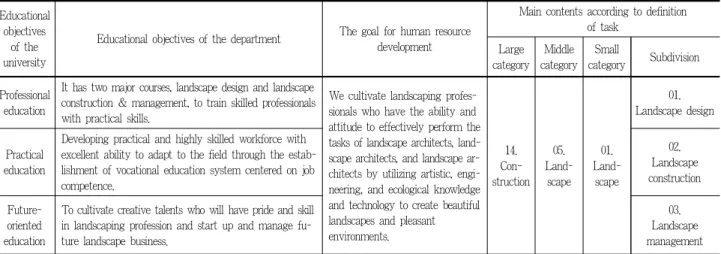
직업군과 관련된 인재양성 유형이 도출되면, NCS 기반 교육 과정 개발을 위해 대학의 교육목표와 NCS 분류체계상의 세분 류 목표를 절충하여 학과의 인재양성유형을 설정하고, 교과목 도출을 위한 직무모형을 작성할 수 있다(Table 7 참조).
3. 교육과정 개발 1) 직무모형 설정 및 검증
직무모형은 NCS 세분류 상의 능력단위와 능력단위요소에 더
Analytical factor
The analysis of external environment The analysis of internal environment
(The rate of employment) Requirement analysis
Sum Result Industry
trends Workforce trends Local
trends Selection Criteria
Occupations Job importance Job prospect Job
performanceCompetitive-
ness Vision of
university Vision of
department Educational effect
Landscape design 4 3 3 3 4 3 5 25 Selected
Landscape construction 3 4 4 4 4 4 4 27 Selected
Landscape management 5 5 3 5 4 4 4 30 Selected
Landscape supervision 4 2 1 3 2 2 2 16 Not selected
Table 6. The criteria for selection of talent type
Educational objectives
of the university
Educational objectives of the department The goal for human resource development
Main contents according to definition of task
Large category Middle
category Small
category Subdivision Professional
education
It has two major courses, landscape design and landscape construction & management, to train skilled professionals with practical skills.
We cultivate landscaping profes- sionals who have the ability and attitude to effectively perform the tasks of landscape architects, land- scape architects, and landscape ar- chitects by utilizing artistic, engi- neering, and ecological knowledge and technology to create beautiful landscapes and pleasant environments.
14.
structionCon- 05.
Land- scape
01.
Land- scape
01.
Landscape design
Practical education
Developing practical and highly skilled workforce with excellent ability to adapt to the field through the estab- lishment of vocational education system centered on job competence.
Landscape02.
construction Future-
oriented education
To cultivate creative talents who will have pride and skill in landscaping profession and start up and manage fu- ture landscape business.
Landscape03.
management Table 7. Relevance of the NCS classification system to the educational goals of universities and departments
…
Figure 4. One of the subdivisions of NCS-landscape, landscape de- sign task model
하여 학과에서 필요로 하는 NCS 기초과목과 응용과목 등에 해 당하는 대학자체능력단위를 추가하여 작성하여야 한다. Figure 4 는 조경설계라는 세분류의 직무모형 사례로서, 각 세분류별 직 무모형이 완성되면, 이를 토대로 교과목들을 도출할 수 있다.
NCS 세분류별 직무모형이 설정된 후, 검증을 위해 능력단위
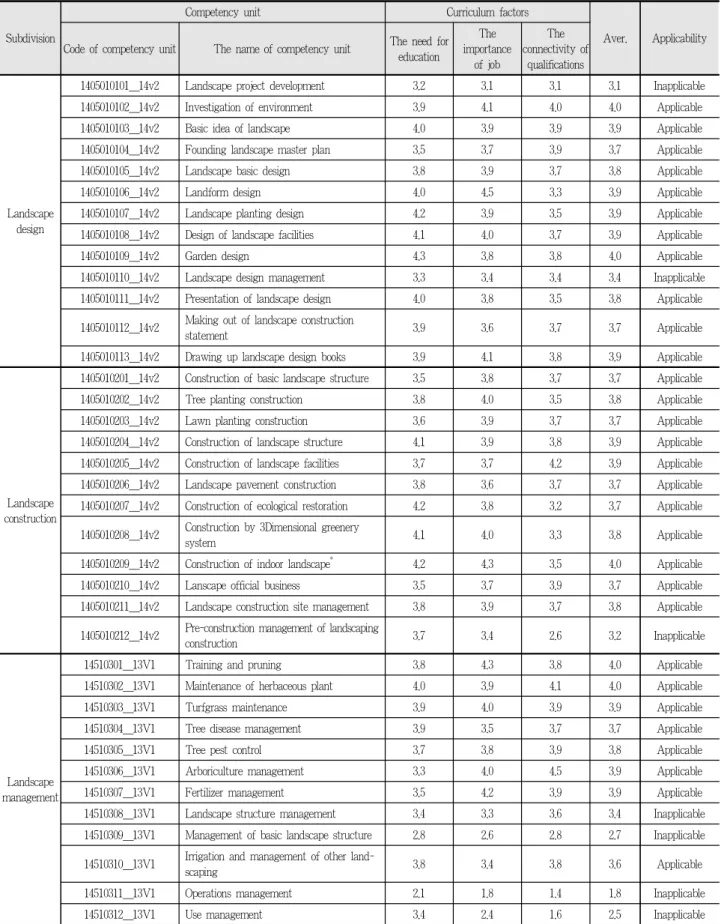
요소에 대한 교육과정 적용 여부를 조사하였다. 이를 위해 학 과 교육과정편성위원회 위원, 산학협력위원회 위원, 학과 MOU 산업체 인사 등 세분류와 관련된 위원 15명을 대상으로 설문조 사를 실시하였다. 직무모형 검증은 능력단위에 대한 교육의 필 요도, 직무의 중요도, 자격증 연계성을 검토하여 교육과정에 활 용할 능력단위를 도출하는 단계로서, 각 요소에 대한 평균값을 사용하였다. 3개의 항목을 각각 5점 척도로 조사하여 70%에 해당하는 평균 3.5점 이상 되는 능력단위를 교육과정에 활용하 기로 결정하였다(Table 8 참조).
채택된 능력단위 내에 포함되어 있는 능력단위요소를 교육 과정편성위원회 회의를 통하여 활용 여부를 결정하였다11).
2) 교과목 도출 및 교과목 명세서 작성
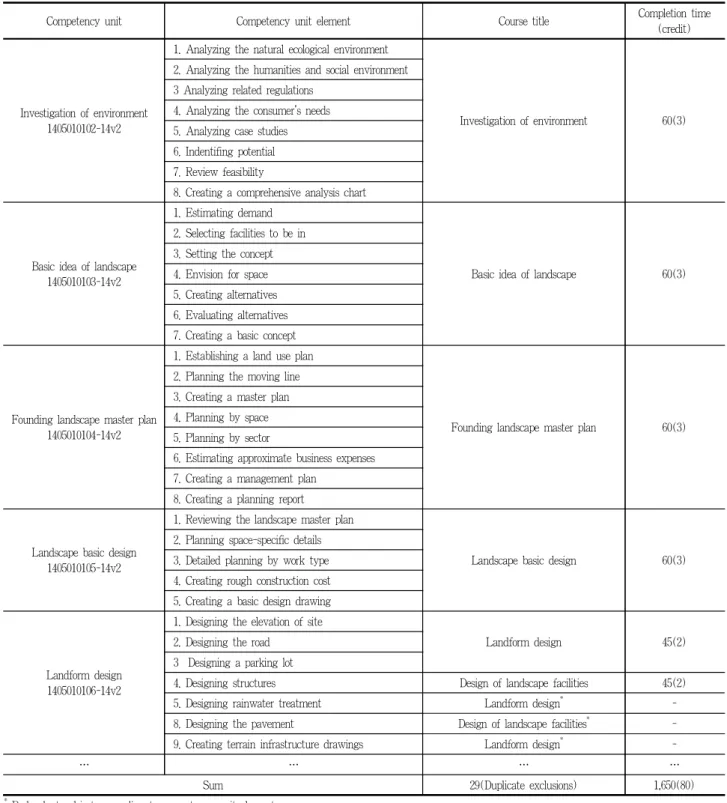
3개의 세분류를 분석하여 대학에 적합한 능력단위를 최종적 으로 선정하였다. 조경설계 13개, 능력단위 중 11개, 조경시공 12개 중 11개, 조경관리 12개 중 8개를 교육과정에 적용하여 교과목을 개발하였다. 교과목을 개발하는데 있어서는 능력단위 1개를 하나의 교과목으로 선정하는 것을 원칙으로 하였으며, 능력단위의 규모에 따라 2개 이상을 하나의 교과목으로 선정하
Subdivision
Competency unit Curriculum factors
Aver. Applicability Code of competency unit The name of competency unit The need for
education
The importance
of job
The connectivity of
qualifications
Landscape design
1405010101_14v2 Landscape project development 3.2 3.1 3.1 3.1 Inapplicable
1405010102_14v2 Investigation of environment 3.9 4.1 4.0 4.0 Applicable
1405010103_14v2 Basic idea of landscape 4.0 3.9 3.9 3.9 Applicable
1405010104_14v2 Founding landscape master plan 3.5 3.7 3.9 3.7 Applicable
1405010105_14v2 Landscape basic design 3.8 3.9 3.7 3.8 Applicable
1405010106_14v2 Landform design 4.0 4.5 3.3 3.9 Applicable
1405010107_14v2 Landscape planting design 4.2 3.9 3.5 3.9 Applicable
1405010108_14v2 Design of landscape facilities 4.1 4.0 3.7 3.9 Applicable
1405010109_14v2 Garden design 4.3 3.8 3.8 4.0 Applicable
1405010110_14v2 Landscape design management 3.3 3.4 3.4 3.4 Inapplicable
1405010111_14v2 Presentation of landscape design 4.0 3.8 3.5 3.8 Applicable
1405010112_14v2 Making out of landscape construction
statement 3.9 3.6 3.7 3.7 Applicable
1405010113_14v2 Drawing up landscape design books 3.9 4.1 3.8 3.9 Applicable
Landscape construction
1405010201_14v2 Construction of basic landscape structure 3.5 3.8 3.7 3.7 Applicable
1405010202_14v2 Tree planting construction 3.8 4.0 3.5 3.8 Applicable
1405010203_14v2 Lawn planting construction 3.6 3.9 3.7 3.7 Applicable
1405010204_14v2 Construction of landscape structure 4.1 3.9 3.8 3.9 Applicable 1405010205_14v2 Construction of landscape facilities 3.7 3.7 4.2 3.9 Applicable
1405010206_14v2 Landscape pavement construction 3.8 3.6 3.7 3.7 Applicable
1405010207_14v2 Construction of ecological restoration 4.2 3.8 3.2 3.7 Applicable 1405010208_14v2 Construction by 3Dimensional greenery
system 4.1 4.0 3.3 3.8 Applicable
1405010209_14v2 Construction of indoor landscape* 4.2 4.3 3.5 4.0 Applicable
1405010210_14v2 Lanscape official business 3.5 3.7 3.9 3.7 Applicable
1405010211_14v2 Landscape construction site management 3.8 3.9 3.7 3.8 Applicable 1405010212_14v2 Pre-construction management of landscaping
construction 3.7 3.4 2.6 3.2 Inapplicable
Landscape management
14510301_13V1 Training and pruning 3.8 4.3 3.8 4.0 Applicable
14510302_13V1 Maintenance of herbaceous plant 4.0 3.9 4.1 4.0 Applicable
14510303_13V1 Turfgrass maintenance 3.9 4.0 3.9 3.9 Applicable
14510304_13V1 Tree disease management 3.9 3.5 3.7 3.7 Applicable
14510305_13V1 Tree pest control 3.7 3.8 3.9 3.8 Applicable
14510306_13V1 Arboriculture management 3.3 4.0 4.5 3.9 Applicable
14510307_13V1 Fertilizer management 3.5 4.2 3.9 3.9 Applicable
14510308_13V1 Landscape structure management 3.4 3.3 3.6 3.4 Inapplicable
14510309_13V1 Management of basic landscape structure 2.8 2.6 2.8 2.7 Inapplicable 14510310_13V1 Irrigation and management of other land-
scaping 3.8 3.4 3.8 3.6 Applicable
14510311_13V1 Operations management 2.1 1.8 1.4 1.8 Inapplicable
14510312_13V1 Use management 3.4 2.4 1.6 2.5 Inapplicable
*In the industrial trend, it appeared unnecessary competency unit, but in this survey, they appeared high importance and included in the curriculum.
Table 8. Deriving competency unit through job model verification
Subject description
Subject title Investigation of environment
Task and competency units
The name of task The name of competency unit
(the code of competency unit) NCS learning module Lanscape design Investigation of environment(1405010102_14v2) Development
Competency unit element
&
Performance criteria
The nameof competency unit
element Performance criteria NCS applied or not
Analyzing natural ecological environment (1405010102_14v2.1)
1.1 The natural ecology environment investigation plan can be established according to the character of the task considering the investigation period, research cost, and investigation effeciency.
1.2 The natural ecology current condition of environment including the weather of the target place, topography, floodgate, vegetation, animal, soil, scene, and etc. can be investigated prior to.
…
Applied
… …
Knowledge/
skill/
attitude
The nameof competency unit
element Knowledge Skill Attitude
Analyzing natural ecological environment (1405010102_14v2.1)
◦How to use information such as statistical yearbooks and regional statistics to inform and organize
…
◦Competency to plan and operate a research plan
…
◦A fair attitude to objectively analyze the contents of the investigation and draw out shortcomings
…
… … … …
The completion division Major selection Completion time 4 Unit 3
Educational objectives Cultivate the ability which grasps the natural ecology environment of the target place and target place given condition including the society of humanity environment the problem of the target place and potentiality based on the literature investigation and field test analysis and does the feasibility study and comprehensive.
Educational content
1-1 Establish the natural ecology environment investigation plan according to the character of the task considering the investigation period, research cost, and investigation effeciency.
1-2 Investigate and analyze the plan of up and down plan related to the target place and wide area and local government and seek for the direction of the plan.
… Teaching and learning
method
Theory lecture Actual training Announcement Discussion Team
project Capstone
design Port
folio Other
O O O O
The equipment and tool
NCS competency unit reference Unused
• Computation equipment: The computer, copier, printer, scanner, camera, voice recorder, and beam projector
… -
Evaluation method
A B C D E F G H I J K L M
O O O O O O O O
A. Portfolio B. Problem solving scenario C. Descriptive type test D. Discourse type test E. Case study F. Evaluator question G. Evaluator check-list H. Appraisee check-list I. Diary/journal J. Role playing psychodrama K. Verbal announcement L. Workplace evaluation M. Other
Assessment considerations
• It should be assessed whether the content presented in the performance criteria can be successfully carried out.
• The evaluator has to evaluate the next subject.
• The capability about the investigation plan preparation
…
Educational information • Climatological data including the temperature, rainfall, direction of the wind, microclimate, and etc
• The topographic map, numeric map, land-use map, management planning, the cadastral map, and air photograph
… Figure 5. The example of NCS-based ‘environmental survey’ course description
Competency unit Competency unit element Course title Completion time (credit)
Investigation of environment 1405010102-14v2
1. Analyzing the natural ecological environment
Investigation of environment 60(3) 2. Analyzing the humanities and social environment
3 Analyzing related regulations 4. Analyzing the consumer's needs 5. Analyzing case studies 6. Indentifing potential 7. Review feasibility
8. Creating a comprehensive analysis chart
Basic idea of landscape 1405010103-14v2
1. Estimating demand
Basic idea of landscape 60(3) 2. Selecting facilities to be in
3. Setting the concept 4. Envision for space 5. Creating alternatives 6. Evaluating alternatives 7. Creating a basic concept
Founding landscape master plan 1405010104-14v2
1. Establishing a land use plan
Founding landscape master plan 60(3) 2. Planning the moving line
3. Creating a master plan 4. Planning by space 5. Planning by sector
6. Estimating approximate business expenses 7. Creating a management plan
8. Creating a planning report
Landscape basic design 1405010105-14v2
1. Reviewing the landscape master plan
Landscape basic design 60(3) 2. Planning space-specific details
3. Detailed planning by work type 4. Creating rough construction cost 5. Creating a basic design drawing
Landform design 1405010106-14v2
1. Designing the elevation of site
Landform design 45(2)
2. Designing the road 3 Designing a parking lot
4. Designing structures Design of landscape facilities 45(2)
5. Designing rainwater treatment Landform design* -
8. Designing the pavement Design of landscape facilities* -
9. Creating terrain infrastructure drawings Landform design* -
… … … …
Sum 29(Duplicate exclusions) 1,650(80)
*Redundant subjects according to competency unit element
Table 9. Deriving a course corresponding to competency unit (element) 거나, 1개의 능력단위에 속한 능력단위요소를 조합하여 2개 이 상의 교과목을 구성하기도 하였다. 이것은 대학의 수준이나, 기 존 교과와의 연관성 혹은 교수진의 구성 등 다양한 변수에 따 라 달라질 수 있으므로, 학과의 여건에 맞추어 교과목을 구성하 는 것이 바람직하다. 예컨대 ‘환경조사분석’이라는 능력단위는
‘환경조사분석’이라는 하나의 교과목으로 구성한 반면, ‘지형 기반시설 설계’ 능력단위는 규모와 수업에 필요한 실습 내용이 많기 때문에, ‘지형기반시설설계’와 ‘조경시설설계’라는 두 개의 교과로 구성하였다(Table 9 참조).
능력단위에 대응하여 도출된 교과목은 어떠한 내용을 어떠