한국정보통신학회논문지 Vol. 23, No. 10: 1228~1233, Oct. 2019
델파이와 계층분석기법을 이용한 스마트폰 잠금 알고리즘 선호도 분석
남수태1·신성윤2·진찬용3*
A Preference of Smartphone Locking Algorithms Using Delphi and AHP (Aanalytic Hierarchy Process)
Soo-Tai Nam1 · Seong-Yoon Shin2 · Chan-Yong Jin3*
1Visiting Professor, Division of Information & Electronic Commerce, Wonkwang University, Iksan, 54538, Korea
2Professor, School of Computer Information & Communication Engineering, Kunsan National University, Kunsan, 54150 Korea
3*Professor, Division of Information & Electronic Commerce, Wonkwang University, Iksan, 54538, Korea
요 약
최근 스마트폰 잠금 해제 방법에 암호화 기술을 이용한 다양한 알고리즘이 채택된 제품이 출시되고 있다. 이미 상 용화에 성공한 인간의 생체인식 기술을 통해 해결하고자 하는 방향으로 진보해 나가고 있다, 이러한 기술에는 지문 인식, 얼굴인식, 홍채인식 등이 여기에 속한다. 본 연구의 평가항목에는 지문인식, 얼굴인식, 홍채인식, 패턴인식 그 리고 패스워드 입력방식 포함하여 5가지 알고리즘이다. 이렇게 채택된 알고리즘을 기준으로 AHP 기법을 이용하여 스마트폰 사용자들이 선호하는 우선순위를 분석하였다. 스마트폰 사용자가 가장 선호하는 우선순위 1위는 지문인 식( .400)이 차지하였다. 다음으로 스마트폰 사용자가 선호하는 우선순위 2위는 패턴인식( .237)이 위치하였다. 따라 서 분석결과를 바탕으로 연구의 한계와 이론적 실무적 시사점을 제시하였다.
ABSTRACT
Recently, a variety of algorithms using encryption technology have been adopted as methods of unlocking smartphone.
It is advancing toward the direction to solve the unlocking problem through human biometrics technology, which has already succeeded in commercializing. These include finger print recognition, face recognition, and iris recognition. In this study, the evaluation items are five algorithms, including finger print recognition, face recognition, iris recognition, pattern recognition, and password input method. Based on the algorithms adopted, the AHP (analytic hierarchy process) technique was used to calculate the preferred priorities for smartphone users. Finger print recognition ( .400) was the top priority for smartphone users. Next, pattern recognition ( .237) was placed in the second priority for smartphone users. Therefore, based on the results of the analysis, the limitations of the study and theoretical implications are suggested.
키워드 : 계층분석기법, 델파이기법, 스마트폰, 잠금해제, 프라이버시
Keywords : Analytic hierarchy process, Delphi, Smartphone, Unlocking, Privacy
Received 27 June 2019, Revised 26 July 2019, Accepted 8 August 2019
* Corresponding Author Chan-Yong Jin (E-mail:[email protected], Tel:+82-63-850-6567) Professor, Division of Information & Electronic Commerce, Wonkwang University, Iksan, 54538, Korea
Open Access http://doi.org/10.6109/jkiice.2019.23.10.1228 print ISSN: 2234-4772 online ISSN: 2288-4165
Ⅰ. INTRODUCTION
Recently, smartphones are the marketplace for experimenting with new innovative technology items based on ICT (information communication technology).
Smartphones are based on ubiquity and can be used through various applications such as surfing the Internet, mobile banking, navigation, digital cameras, games, music or movies, etc. It is transformed into a smart device with convenient functions and leading innovation. Various functions of a smartphone bring the convenience and usefulness of life to smartphone users.
In addition, it is judged that the use of smart devices facilitates the acquisition of knowledge and provides convenience and enjoyment to life [1]. By the way, such convenience and usefulness are at the risk of personal privacy and personal information leakage. In order to compensate for these risks, technologies for unlocking smartphones using various encryption technologies have been developed. In order to compensate for these risks, the technology of unlocking a smartphone using various encryption techniques has been developed. However, various encryption methods also provide factors that cause inconvenience to users. As a solution to this problem, advances in related technologies have been rapidly progressing in a direction to solve the unlocking method of a smartphone through human biometrics.
These include technologies that use fingerprint recognition, face recognition, and iris recognition etc.
As new products and services emerge, from traditional industries to information communication technology industry, companies in which industry will compete fiercely for their technology to the dominate design. In particular, competition in technology standards in the information communication technology industry provides strategic importance to participating companies.
The result of this competition is recognized as an official standard in the industry and appears in the form of a dominant design. Also, based on various wired / wireless communication such as laptops, it is possible to connect to the Internet to send and receive data, and it is the
openness of apps as the most distinctive feature from existing mobile phones. In addition, the recent development of social network services has been a way for many smartphone users to freely present their opinions through social relationship network services [1]. Smartphone industry is a crystal of high technology and has a large front and rear effect. As the life cycle of products is short, new and replacement demands are continuously generated, which is a growth engine industry with great impact on information technology distribution and related parts industry. A potential buyers study of what attributes a product or service is influenced by and the choice of technology and service is a very necessary and interesting topic for researchers [2]. Companies or service providers can speed up consumer acceptance and spread of their products and services by finding, highlighting or removing concerns that are important when providing technology or services [2].
Ⅱ. PREVIOUS RESEARCH
Delphi is a way to reach consensus through the intuition of experts in the absence of generalized or standardized data and data when predicting the future.
This method is a panel research methodology states that two opinions are more accurate than one opinion [3]. It has also been devised to eliminate some distorted sources of communication that appear in committee and expert discussions and other forms of collective discussions [3]. It is used to solve a variety of problems, such as the dominance of the discussion process by a small group, the pressure to share with peer group views, and differences in personality and conflicts among participants.
Delphi technique has the usefulness of anonymity, conducting repeated surveys through feedback, and statistical processing of participant responses. Most commonly used in technology and industry forecasting, 90 (%) of technology forecasting is based on Delphi [4].
In research using Delphi method, the most important
advantage for achieving the objective is selection of experts and determination of the number of rounds. First of all, Delphi method is aimed at deriving reasonable results relying on subjective intuition. Therefore, the selection of experts is very important. In conclusion, the most appropriate approach is to select and organize experts in the field of research [5]. At this time, the survey subject should carefully consider representation, validity, professional knowledge ability, sincerity of participation and the number of participants. It is also important to determine not only the number of experts, but also how many steps the survey should be conducted.
In other words, it is very important to determine how many rounds are most reasonable to achieve consensus, the goal of Delphi technique. The number of Delphi rounds is determined by the degree to which the panel finds an agreement, so it is more flexible between 3 and 5 rounds than sticking to the principle [5].
AHP (analytic hierarchy process) is a multi-decision making tool created by Saaty (2008). It is a method of measuring using a ratio scale when qualitative or intangible criteria and quantitative or tangible criteria and a lack of information. Decompose big problem into smaller elements and handle the problem through a simple pair-wise comparison. It is a decision-making process that resolves by determining the relative importance, likelihood, and preference among the components of each layers [6]. On the other hand, the first use has been widely used by a number of countries, governments, agencies and individuals, including those used to reduce nuclear weapons between the United States and Russia [6]. And, priority determination methods include hierarchical analysis, rating methods, Delphi method, and ranking method. Therefore, the difference between the hierarchical analysis method and the existing evaluation method is as follows. Existing evaluation methods have limitations in maintaining absolute objectivity in evaluation. In addition, the credibility of the evaluation results should depend only on expert opinion. Thus, there is a possibility of distortion depending on the conversion factor and the
evaluation method, and the understanding of each element in the evaluation is different for each evaluator.
However, the AHP technique is accurate by deriving the evaluation results through pair-wise comparison and linear algebra. In addition, the reliability ratio is verified through the consistency ratio, and the sensitivity part is solved by applying the pair-wise comparison and linear algebra. Thus, applying a hierarchical structure solved the problem of independence [6,7]. The biggest advantage of AHP is that scientific preference can be calculated for a small number of respondents. Therefore, a small number of experts in the relevant field are suitable for the investigation. In other words, the use of AHP may be an important factor in selecting a group of experts in the relevant field rather than focusing on the number of valid samples and how sincerely and consistently the respondents responded [6].
When trying to solve a decision problem using AHP technique, there are usually four steps [8,9]. The first step is the process of decomposing decision problems into a hierarchical structure, which is the most important step in the application process of hierarchical analysis.
At the top of the hierarchy is the objective of the most comprehensive decision-making, and subsequent hierarchies consist of various attributes that influence the purpose of the decision. These attributes become more specific lower the hierarchy, where each element in a hierarchy must be comparable, and the bottom of hierarchy consists of several decision alternatives to choose from[10,11]. The second step is the pair-wise comparison step in the evaluation standard, which performs pair-wise comparison of the elements in the same hierarchy. In the case of multi-attribute decision making, it is difficult to determine the weight considering all the relative importance of each attribute.
In AHP technique, two attributes are selected and compared.
Ⅲ. HIERARCHY (STUDY MODEL)
This study selected 10 evaluation attributes from previous studies through expert recommendation for preference analysis on smartphones unlocking algorithms.
Among the attributes derived here, the five most widely used attributes were adopted, except for the overlapping parts and those that cannot be used as evaluation attributes. Based on this, the final stage evaluation attributes were derived as shown in Fig. 1.
Fig. 1 Research model
There are five methods adopted as the unlocking algorithms to be used for the research: [Face Recognition + Password], [Fingerprint Recognition + Password], [Pattern Recognition + Password], [Iris Recognition + Password] and [Password or Pin Number]. Result, we have completed the hierarchical diagram for applying the AHP technique to the pair-wise comparison for smartphones unlocking algorithms.
Ⅳ. ANALYSIS AND RESULTS
To achieve the purpose of this study, a survey was conducted for 16 days from October 30 to November 15, 2018. On the other hand, in research using the Delphi method, the most important advantage for achieving the objective is selection of experts and determination of the number of rounds. In addition, since the Delphi method aims to derive a reasonable result depending on the
subjective intuitive judgment of the expert, selection of the expert is very important. Therefore, it is a very desirable approach to select and organize experts in the field of research [5]. In this study, the expert questionnaire required by the Delphi questionnaire was reflected to the maximum, and the basic data were collected from the actual smartphone users. Based on this foundation, a total of 45 basic data was collected.
Here, 15 copies of the questionnaire with missing or unfaithful pairing responses were excluded. Therefore, the final analysis analyzed the preference among evaluation items based on the basic data of 30 copies.
The statistical analysis tool used here was Expert Choice 2000 Enterprise. First, reviewing the credibility of the data should be done before discussing the research results through the analysis of the data.
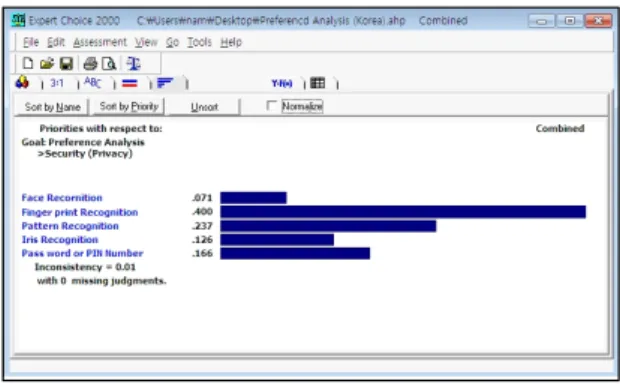
Fig. 2 Consistency ratio of the sample
Based on the survey data, the consistency ratio (CR) is the only way to determine whether respondents consistently evaluate the pair-wise comparison of control elements.
In general, if CR ≤ 0.1 or less, the pair-wise comparison performed by the decision maker is judged to have reasonable consistency. If CR ≤ 0.2, it can be allowed.
If CR > 0.2, it is judged to be inconsistent and the questionnaire is removed or removed again. Based on these criteria, Fig. 2 shows a consistency ratio CR ≤ 0.01 for the response questionnaire. Therefore, it was proved through empirical analysis which all survey participants responded consistently. Table 1 shows the final analysis results of the evaluation items for the
smartphone unlocking methods. The most preferred priority of smartphone users was [fingerprint recognition + password] ( .400). The second place was ranked [pattern recognition + password] ( .237), the third place is [password or pin number] ( .166) input method, the fourth place was [iris recognition + password] ( .126).
Next, the fifth place was ranked in order of [face recognition + password] ( .071). Korean smartphone users showed that they most prefer a finger print recognition algorithm. These results cannot be generalized, but most of them can be found in the analysis results that are different from the pattern recognition method used by most users.
Table. 1 Selected priority for algorithms
Rank Encryption methods Portion
1 Finger print recognition .400
2 Pattern recognition .237
3 Password or PIN .166
4 Iris recognition .126
5 Face recognition .071
Next, pattern recognition was the second most preferred smartphone unlocking method. Although method using most smartphone users in Korea, the second place is explained the limits of the perceived value already offered smartphones. Next, the third largest smartphone lock algorithm method said password or pin number input method was preferred. Smartphone users still confirmed the basic encryption algorithm method through empirical analysis. In addition, iris recognition and face recognition algorithm encryption methods ranked fourth and fifth as unlocking methods, indicating which they are rejecting new innovations.
Recently, new products for technology based on human biometrics have been launched, but they are still in their early step. Research based on biometrics is also in its early stage. This study is expected to be a basic foundation for related industries even if it is a study on basic biometric technology.
The meaning and implications of this study are as follows. First, various functions of a smartphone provide smartphone users with usefulness and convenience in daily life. In addition, use of a smartphone facilitates the acquisition of knowledge and provides convenience and enjoyment in daily life. However, such convenience and usefulness may be exposed to the risk of privacy and leakage of personal information. In order to compensate for these risks, the technology of unlocking a smartphone using various encryption technologies has been developed. However, various encryption technologies may be a factor causing inconvenience to users. With such a solution, advances in related technologies have been rapidly progressing in recent years in order to solve the unlocking method of a smartphone through human biometrics. These include technologies that use finger print recognition, face recognition, and iris recognition.
An interesting topic is the study of what attributes potential buyers choose when new products and services are launched. Because companies or service providers need to find and highlight attributes that are important to them when providing products and services, and identify and remove concerns. This strategy can speed up consumer acceptance and diffusion of products and services, and analysis of current customer perceptions can help predict future demand as products and services evolve. At this time, it was planned to know which biometric information technology preferred products adopted. Therefore, we believe preference rankings presented in this study can provide meaningful practical academic implications for related industries.
ACKNOWLEDGEMENT
This paper was supported by Wonkwang university in 2019
REFERENCES
[ 1 ] S. T. Nam, and C. Y. Jin, “Factors Influencing on Continuous Usage Intention of Smartphone Based on the TAM (Technology Acceptance Model),” Journal of the Korea Institute of Information and Communication Engineering, vol. 21, no. 11, pp. 2076-2082, Nov. 2017.
[ 2 ] S. T. Nam, and C. Y. Jin, “A Meta-Analysis of Relationship between Perceived Value, Risk and Behavioral Intention on E-Commerce,” Asia-Pacific Journal of Business Venturing and Entrepreneurship, vol. 11, no. 4, pp. 179-189, Aug.
2016.
[ 3 ] J. P. Martino, Technological Forecasting for Decision Making Book and Disk, Mcgraw Hill, Engineering and Technology Management Series, Oct. 1992.
[ 4 ] U. G. Gupta, and R. E. Clarke, “Theory and Applications of the Delphi Technique: A bibliography (1975-1994),”
Technological Forecasting and Social Change, vol. 53, no.
2, pp. 185-211, Oct. 1996.
[ 5 ] J. A. Kim, “A Study on the Applicability of Communitarianism for Maeul Mandelgie by the Delphi Method,” The Korea Spatial Planning Review, vol. 83, no. 1, pp. 113-127, Dec.
2014.
[ 6 ] T. L. Satty, “Decision making with the analytic hierarchy process,” Institute Journal Services Sciences, vol. 1, no. 1, pp. 83-98, Jan. 2008.
[ 7 ] S. T. Nam, C. Y. Jin, and D. G. Kim, “A Priority Analysis on Mobile Telecom Internet of Things Using the AHP (analytic hierarchy process),” Journal of the Korea Institute of Information and Communication Engineering, vol. 21, no.
6, pp. 1191-1196, Jun. 2017.
[ 8 ] J. S. Yoon, “Determining the Priority of Lifelong Education Promotion Policy in Gyeongsangnam-do through AHP Analysis,” Journal of the Korea Contents Society, vol. 13, no. 5, pp. 520-521, May. 2013.
[ 9 ] Y. J. Cho, “An Analysis on Priority of Clothing Evaluative Criteria using AHP,” Fashion and Textile Research Journal, vol. 9, no. 1, Jan. 2007.
[10] D. H. Youm, and A. Prakash, “Email Based Verification of Data Storage in Cloud Computing,” Asia-pacific Journal of Convergent Research Interchange, vol. 2, no. 2, pp. 35-41, Jun. 2016.
[11] S. D. Park, “Development of Safety Map Application for Local Residents,” Journal of the Korea Institute of Information and Communication Engineering, vol. 23, no.
3, pp. 299-304, Mar. 2019.
남수태
부산대학교
※관심분야 : MIS, E-Business, Technology Management, Big-Data, Internet of Things
신성윤
군산대학교
※관심분야 : Computer Engineering, Multimedia System
진찬용
원광대학교
※관심분야 : MIS, E-Business, Venture Start-Up, Big-Data