한국정보통신학회논문지(J. Korea Inst. Inf. Commun. Eng.) Vol. 21, No. 6 : 1191~1196 Jun. 2017
계층분석기법(AHP)을 이용한 이동통신 사물인터넷 서비스 우선순위 분석
남수태1 · 진찬용1 · 김도관2*
A Priority Analysis on Mobile Telecom Internet of Things Using the AHP (analytic hierarchy process)
Soo-Tai Nam1 · Chan-Yong Jin1 · Do-Goan Kim2*
1Div. of Information EC (Institute of Convergence and Creativity), Wonkwang University, Iksan 54538, Korea
2*College of Liberal Arts (Institute of Convergence and Creativity), Wonkwang University, Iksan 54538, Korea
요 약
최근 국내 이동통신 3사는 가정용 사물인터넷 서비스를 출시하면서 경쟁을 벌이고 있다. 대표적 출시된 서비스는 스마트홈 관련 서비스 분야이다. 그러나 이동통신 기반 사물인터넷 서비스는 초기 단계에 머물고 있으며, 지속적으 로 다양한 서비스가 출시될 것으로 예상된다. 이러한 시점에 이미 출시된 서비스를 중심으로 사물인터넷 서비스에 대한 선호도 분석을 기획하게 되었다. 계층분석기법을 적용하기 위해 1단계 요인으로는 안전, 보안, 건강, 지능 그리 고 가전으로 설계하였다. 또한 2단계 요인으로는 개념모델에서 제시된 18개 세부 서비스로 구성하였다. 분석결과 우선순위 1위는 헬스케어(23.2%)가 차지하였다. 이러한 결과는 소득 향상을 통해 건강에 대한 관심의 결과로 해석 될 수 있겠다. 결과를 바탕으로 이론적 실무적 시사점을 제시하였다.
ABSTRACT
Lately, the three mobile telecom companies in Korea are competing for the launch of Internet of Things services for using home. Typical launched services are in the smart home related fields. However, Internet of Things as mobile telecom based are at an early stage, expected that various services will be started continuously. At this point, we have been planning to analyze the preference of Internet of Things for objects based on the services already launched. In order to apply the analytic hierarchy method, the first stage factors were designed as Safety, Security, Health care, Intelligence and Home appliances. In addition, the second stage factors were organized into 18 detailed services presented in the conceptual model. As a result, Health care (23.2%) was the most preferred priority. These results can be interpreted as the result of interest in health by improving income. We presented the theoretical and practical implications of these results.
키워드 : 사물인터넷, 이동통신, 헬스케어, 안전, 보안
Key word : Internet of things, Mobile telecom, Health care, Safety, Security
Received 27 May 2017, Revised 30 May 2017, Accepted 05 June 2017
* Corresponding Author Do-Goan Kim(E-mail:[email protected], Tel:+82-063-850-6281) College of Liberal Arts, Wonkwang University, Iksan 54538, Korea
Open Access https://doi.org/10.6109/jkiice.2017.21.6.1191 print ISSN: 2234-4772 online ISSN: 2288-4165
Ⅰ. INTRODUCTION
Information communication technology (ICT) is rapidly developing, and various high performance smart devices capable of wired and wireless communication are launched. Along with this trend, Internet of Things has been emphasized as the core technology of next a generation internet. The existing internet has been utilized as a space for processing information made by people and sharing information and knowledge.
However, in the future internet represented by IoT, many things will be produced sharing new information via interaction wired wireless networks. These interactions are expected to create new levels of application services and economic value [1]. Internet of Things is a fusion technology in which things can be connected to the internet and utilized for various services.
Internet of Things can be seen to be in line with the ubiquitous concept that Mark Weiser mentioned to in 1991. Subsequently, Kevin Ashton in the MIT defined as “As three distributed environmental elements of humanity, things and services form intelligent relationships, such as sensing, networking, information processing mutual cooperatively without human explicit intervention” in 1999. As the definition of Kevin Ashton, Internet of Things is things space network, and researches have been carried out based on connectivity technology of things and sensors [2].
In other hand, three mobile telecom companies say smart home related services based on the Internet of Things are very popular. Before you enter your home, you're the smart home will detect your location and automatically launch homecoming mode service. Based on the fine dust warning report, the air cleaner knows and the boiler also operates according to the set temperature. If you want to stop the service, you can stop it on your smartphone immediately. These services correspond to services that can now be realized in reality [3.4].
Ⅱ. PREVIOUS RESEARCH
SK telecom, KT and LG U plus are rapidly evolving Internet of Things services of household. Mobile telecommunication companies are making a differen- tiation strategy for internet service for the purpose of expanding subscribers. Mobile telecommunication companies are making a strategy to differentiate their Internet of Things services for the purpose of expanding subscribers. SK telecom announced that it will sell smart home appliances such as air purifiers and dehumidifiers at stores nationwide.
Also, KT and LG U plus have started to expand their subscribers by introducing specialized home Internet of Things devices such as health care and safety. KT has launched a new service concept that combines IoT and IPTV to accelerate business of home Internet of Things devices, which is a bit late compared to its competitors.
First of all, it presented health, fitness bike and golf putting based Internet of Things. In addition, KT identified health, safety and convenience as keyword of Home IoT, and disclosed health related services first.
The health bike makes you feel like you are riding a real bicycle [3,4]. When the road appears on the screen, the pedal strength is measured. Golf putting also creates an environment similar to a real golf course.
And, SK telecom actively promotes the expansion of home IoT service products and enhances AS a convenience through cooperation with manufacturers.
SK telecom sells smart home accessories such as plugs, switches, heat sensors, and gas breakers at SK telecom sales offices nationwide. Also, we will sell 13 types of smart home devices developed in cooperation with partner companies such as Winnicks, Daewoo Winnia, Tong Yang Magic etc. at 140 SK telecom T premium stores nationwide. In this way, consumers can purchase various smart home appliances such as air purifiers, dehumidifiers, kimchi refrigerators, boilers, etc. in stores. SK telecom is a strategy of expanding subscribers by sell smart home appliances that affiliates had sold through their own distribution channel at SK
telecom stores. SK telecom explained the open platform and explains that consumers can use the products regardless of what career they register. SK telecom showed smart home integration pricing that allows these devices to be easily controlled with smartphones.
Regardless of the number of devices, services that can be used unlimited are 9,900 Won a month. Thus, when registering for each device, it can be used for 1,100 Won a month. SK telecom will expand its partner company and smart home service, and by 2020 more than 50% of domestic launched home appliances, and emphasized that SK telecom smart home service will be applied to more than 50% of the houses sold [4].
LG U plus says home security market is expected to growing increase national income due to high price and self contained housing structure. LG U plus has announced its intention to launch the home security IoT market in earnest. It is planned to develop a home security IoT service market for single family houses and residential villas, apartment lower layers, corridor apartments and single person households living alone, which are in the form of residential security environments. Actually, LG U plus intends to concentrate the benefits of being able to fully utilize the IoT Caps service, which was released in cooperation with ADT Caps and Gate Man, in the emergency situations such as theft and the status of infringement usually. LG U plus is said to enhance home security IoT service [3,4].
Ⅲ. RESEARCH METHODOLOGY
The AHP (analytic hierarchy process) method proposed by Saaty (2008) is a kind of tool for a multi decision making [5]. The problem of decision making is a method of measuring qualitative or intangible criteria as converting them into a ratio scale. Especially, it is an analytical process with disassemble big problems into small elements to solves converting with number the relative importance, possibility, and preference etc.
through simple pairwise comparisons. The AHP is a theory of measurement through pairwise comparisons and relies on the judgements of experts to derive priority scales. The AHP can be useful in deriving the weight of the evaluation criteria by utilizing the qualitative knowledge of the experts in the fields where the quantitative analysis is difficult. Priority determination methods are the analytic hierarchy process, rating methods, delphi methods, and ranking methods. The greatest advantage of the AHP is a small number of respondents can be computed in preference through a scientific method. Therefore, the survey is more appropriate a few experts rather than individuals. We cannot confirm if exactly how much people should keep the survey respondents, and commonly would be useful three or more experts in the field [6,7].
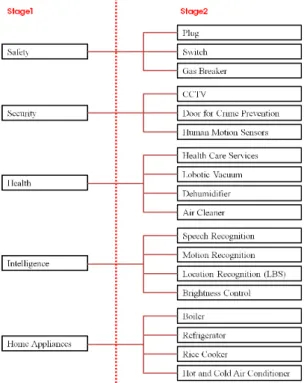
Fig. 1 The conceptual model
In this study, we conducted an evaluation, analysis showing the priority through questionnaires applying the AHP analysis method to determine what kind of
services are preferred in the Internet of Things services environment of three mobile telecom companies. In fig 1, the first stage factors in the conceptual model are classified as Safety, Security, Health, Intelligence, and Home appliances. In the second step, 18 services present in the following the conceptual model for each factor.
For the purpose of this study, we conducted a survey of 15 staff engaged in sales of mobile telecommunication companies SK telecom, KT, and LG U plus for 10 days from May 20th to May 29th. Among these, no questionnaires with missing or inadequate written pair-wises were found. Therefore, for the final priority summary, the analysis tool for multiple hierarchy used Expert Choice 2000 Enterprise.
Based on the collected raw data, it is necessary to review the reliability of the data before discussing the research results. Based on the questionnaire data, a consistent ratio (CR) is used to determine whether respondents consistently assessed in a paired comparison of control factors. Generally, if the CR value is less than 0.1, it is judged the pair-wises comparison made by the decision maker has a reasonable consistency [8]. However, if the CR value is more than 0.2, it is determined inconsistency is insufficient and the questionnaire should be incinerated.
Therefore, consistency ratio appeared in 0.02, and it was confirmed that all respondents consistently responded.
Ⅳ. RESULTS AND CONCLUSIONS
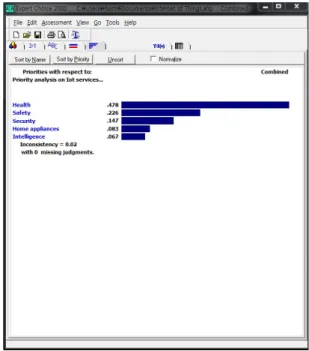
In this study, the first step evaluation factors of mobile telecommunication company based IoT services were constructed as Safety, Security, Health, Intelligence and Home appliance shown in fig 2. Next, the second step evaluation factors of mobile telecommunication company based IoT services were constructed as Plug, Switch, Gas breaker, CCTV, Door for crime prevention, Human motion sensors, Health care services, Lobotic vacuum, Dehumidifier, Air cleaner, Speech recognition, Motion recognition, Location recognition (LBS),
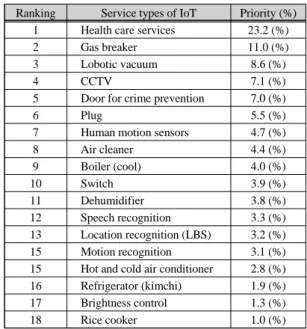
Brightness control, Boiler, Refrigerator, Rice cooker and Hot and cold air conditioner shown in fig 3, table 1.
The results of analyzing from classifying the evaluation factors of the first stage in five categories are as follows. It ranked first in Health (0.478), second in Safety (0.226), third in Security (0.147), fourth in Household appliances (0.083) and fifth in Intelligence (0.067). These results show that the IoT service based on the mobile communication company uses the health and safety related services and is the most preferred.
Fig. 2 Ranking Internet of things (Stage 1)
The results of analyzing from classifying the evaluation factors of the second stage in 18 categories are as follows. As it is, the evaluation factors of the first stage are the priority of the 5 categories of IoT services based the mobile communication companies. In fact, the second stage evaluation attributes can be said to the summary table of the most important priority shown in table 1. As a result, Health care (23.2%) was the most preferred priority. These results can be interpreted as the result of interest in health by improving income. Next, the second ranking was occupied by Gas breaker
(11.0%). Thus, the third ranking was occupied by Robot vacuum (8.6%). Subsequently, concerns about the safety of dual earner couples and lack of time for house cleaning are explained as the result of this.
Fig. 3 Ranking Internet of things (Stage 2)
Next, CCTV (7.1%), Door for crime prevention (7.0%) and Plug (5.5%) occupied the 4th and 6th respectively. In the analysis of the preference of IoT services based on the mobile communication companies, it can be seen that most of the 1th-6th are occupied by Health, Safety and Security. These facts cannot be denied by anyone because the most of IoT services users are young twenties and thirties.
By the way, factors not preferred by the analytic hierarchy process are also important. This is because we can observe the consumer's attitude to how a new product or service is accepted. The Rice cooker (1.0%) used at home was the least favored factor. In addition, Brightness control (1.3%) used at home was the next most unfavorable factor. Also, refrigerator (1.9%) for home use in IoT services based on mobile tele-
communication companies is the next most unfavorable factor.
Table. 1 Priority on IoT services based mobile telecom Ranking Service types of IoT Priority (%)
1 Health care services 23.2 (%)
2 Gas breaker 11.0 (%)
3 Lobotic vacuum 8.6 (%)
4 CCTV 7.1 (%)
5 Door for crime prevention 7.0 (%)
6 Plug 5.5 (%)
7 Human motion sensors 4.7 (%)
8 Air cleaner 4.4 (%)
9 Boiler (cool) 4.0 (%)
10 Switch 3.9 (%)
11 Dehumidifier 3.8 (%)
12 Speech recognition 3.3 (%) 13 Location recognition (LBS) 3.2 (%) 15 Motion recognition 3.1 (%) 15 Hot and cold air conditioner 2.8 (%) 16 Refrigerator (kimchi) 1.9 (%) 17 Brightness control 1.3 (%)
18 Rice cooker 1.0 (%)
Especially, observation will be necessary to observe the change of consumer acceptance attitude in the future which is not preferable as shown above. In previous studies, there were few previous researches related to the evaluation factors preference to Internet of Things services. In this study, only the ranking of preference by property of IoT services was ranked.
ACKNOWLEDGMENTS
This paper was supported by Wonkwang University in 2017.
REFERENCES
[1] G. H. Hong & D. K. Shin, “Trends on Research, Standardization, and Platform of Internet of Things,” Telco
Journal, vol. 3, no. 1, pp. 169-191, Dec. 2015.
[2] D. M. Yang, “Platform and Services of Internet of Things,”
Journal of Information Processing Systems, vol. 21, no. 2, pp. 22-29, Mar. 2016.
[3] J. B. Pyun, “Internet of Things (IoT) of Three Communication Companies,” Excellence Marketing for Customer, vol. 50, no.
4, pp. 46-53, Apr. 2016.
[4] H. S. Choi & W. S. Lee, “International Standardization Trend and Platform Technology on Internet of Things,”
Broadcasting and Media Magazine, vol 20, no. 3, pp. 8-30, Jul. 2015.
[5] T. L. Saaty, “Decision making with the analytic hierarchy process,” Institute. Journal Services Sciences, vol. 1, no. 1, pp. 83-98, Jan. 2008.
[6] S. T. Nam, C. Y. Jin & D. G. Kim, “Factors Influencing Automobile Black Box Purchase Decision,” Journal of the Korea Institute of Information and Communication Engineering, vol. 17, no. 12, pp. 2859-2864, Dec. 2013.
[7] S. T. Nam, C. Y. Jin & D. G. Kim, “Preference Analysis for Location Based Services on Smartphone Environment Using Analytic Hierarchy Process,” Journal of the Korea Institute of Information and Communication Engineering, vol. 18, no.
6, pp. 1337-1342, Jun. 2014.
[8] D. H. Kim & D. W. Kim, “A Feasibility Study on the Research Infrastructure Projects for the High-Speed Big Data Processing Devices Using AHP,” International Journal of Software Engineering and Its Applications, vol. 10, no. 4, pp.
37-46, Oct. 2016.
Soo-Tai Nam, First Author
Lecturer : Wonkwang University
※Fields of Interest : MIS, E-Business, Technology Management, Big-Data, Internet of Things
Chan-Yong Jin, Co-Author
Professor : Wonkwang University
※Fields of Interest : MIS, E-Business, Venture Start-up, Big-Data
Do-Goan Kim, Corresponding Author
Professor : Wonkwang University
※Fields of Interest : MIS, E-Biz, Big-Data Analysis