Research Report
광계II 활성 분석을 통한 마늘의 생육초기 고온 스트레스의 영향 평가
오순자1, 문경환1, 고석찬2*
1농촌진흥청 국립원예특작과학원 온난화대응농업연구소
2제주대학교 생물학과
Assessment of High Temperature Impacts on Early Growth of Garlic Plant (Allium sativum L.) through Monitoring of Photosystem II Activities
Soonja Oh
1, Kyung Hwan Moon
1, and Seok Chan Koh
2*1
Agricultural Research Institute for Climate Change, National Institute of Horticultural and Herbal Science, Jeju 690-150, Korea
2
Department of Biology, Jeju National University, Jeju 690-756, Korea
Abstract: Garlic (Allium sativum L.), one of the oldest cultivated crops, is the most widely used Allium species belonging to the family Lilliaceae. In this study, growth characteristics, photosystem II activity, and antioxidative enzyme activity were investigated in five temperatures (10-30°C) during early growth stage of garlic to determine the optimum temperature for cultivation and assess the effects of high temperature on early growth of garlic. Vegetative growth (e.g., shoot height, number of leaves) of garlic plants was greater in the temperature ranges of 15-25°C. However, dry weight (of shoot, bulb, and total plant) of garlic was significantly greater at 20°C, compared to either below or above 20°C. F
v/F
oand F
v/F
mvalues were highest at 15-20°C, and decreased above 25°C. The chlorophyll a fluorescence induction OKJIP transient was also considerably affected by high temperature; the fluorescence yields F
iand F
Pdecreased considerably above 25°C, with the increase of F
kand W
k. Activities of catalase and superoxide dismutase in leaves and peroxidase in roots were high in 20-25°C, and decreased significantly in 30°C. These results indicate that a growth temperature of 30°C inhibits early growth of garlic and that it is desirable to culture garlic plants near 20°C. Fluorescence parameters such a F
v/F
o, F
v/F
m, F
k, ET
o/CS
m, and PI
abswere significantly correlated with dry weight of whole garlic plants (p < 0.01), indicating that these fluorescence parameters can be used for early assessment of high temperature effects even though the damage to the plant is not very severe.
Additional key words: antioxidative enzyme, chlorophyll a fluorescence parameter, early growth, OKJIP transient
*Corresponding author: [email protected]
※ Received 4 May 2015; Revised 22 June 2015; Accepted 22 June 2015. 본 연구는 농촌진흥청 연구사업 “RCP시나리오를 적용한 마늘의 생육 및 생산성 분석(세부과제번호 : PJ00929205)”의 지원에 의해 이루어진 것임.
Ⓒ 2015 Korean Society for Horticultural Science
서 언
마늘(Allium sativum L.)은 백합과 파속에 속하는 인경채 소작물로 향신료자원으로 세계적으로 널리 재배되고 있다.
더군다나, 항암, 혈중 콜레스테롤 저하, 혈압 강하 등 다양한 기능성이 밝혀지면서 약용자원으로도 활용되고 있을 뿐만 아니라 세계 10대 건강식품으로 선정되어 소비량이 꾸준히 증가하고 있다. 마늘은 생육초기 일정기간의 저온기를 거친
후 고온과 장일 조건에서 인경비대가 시작되는 특성을 가지 고 있기 때문에(Bandara et al., 2000; Rahim and Fordham, 2001), 우리나라에서는 가을에 파종하여 겨울의 저온기를 거 친 후 이듬해 초여름에 수확을 하고 있다(Song et al., 2001).
마늘의 출하시기가 계절적으로 여름철에 집중되다 보니 계 절에 따라 가격차가 크고, 마늘을 수확하여 저장하는 동안 의 고온다습으로 중량 감소나 부패 등으로 인한 손실이 큰 것으로 알려져 있다(Cho and Lee, 2008). 따라서 일부 지역
에서는 출하시기를 조절하기 위하여 비닐하우스 내에서 재 배하거나 멀칭하여 조기재배를 시도하기도 한다(Hwang and Tae, 2000). 그러나 멀칭하여 재배하였을 때 조기수확이 가 능하고 수확량이 많아지는 잇점이 있지만 지온 상승으로 인 해 고온 장해나 벌마늘이 발생하는 문제점이 제기되고 있다 (Choi et al., 2009). 따라서 마늘의 안정적 생산을 위해서는 재배관리 측면에서 고온장애가 일어나지 않으면서 조기수 확이 가능한 저온기의 적정 재배온도를 규명할 필요가 있다.
한편, 온도는 식물의 생장과 발달에 있어 중요한 환경인자 이며, 생육적온을 벗어난 고온이나 저온은 작물의 생산성과 도 직결된다. 일례로서 고온은 광계II(photosystem II)와 같은 광합성기구에 직・간접적으로 손상을 줄 수 있어(Takahashi and Murata, 2008; Yoshioka et al., 2006), 고온에 노출된 작 물은 광합성량의 감소로 인해 생산량이 감소, 품질의 저하 등이 초래될 수 있다. 즉, 고온에서 틸라코이드 라멜라에서 의 광화학적 반응과 엽록체 스트로마에서 탄소대사는 고온 장해의 주요 부위이며, rubisco 활성과 캘빈회로의 주요 효 소 활성을 감소시킨다. 고온이 식물체에 미치는 악영향은 물질대사, 광합성 능력, 광화학적 효율의 저하로 나타나며, 식물의 생장은 광합성과 탄소 획득의 감소로 영향을 받는다.
더욱이 광계II 활성은 환경 스트레스에 민감하여 식물 스트 레스 분석을 위한 지표로 사용되고 있다(Ball et al., 1994;
Oh et al., 2014; Strasser and Strasser, 1995). 특히, 식물의 잎에 빛을 조사하여 방출되는 형광의 시간대별 밀도를 나타 내는 OKJIP 곡선(OKJIP transient curve)의 분석으로 광계II 에서의 에너지 흐름의 변화와 전자수용체의 환원 등 다양한 정보를 정량적으로 얻을 수 있다(Strasser et al., 2000). 그리고, 식물이 스트레스를 받으면 생체내 산소는 반응성이 높은 독 성의 활성산소종(reactive oxygen species)으로 변하며(Alscher and Hess, 1993), 이들은 강한 산화력을 가지고 있어 핵산, 단백질, 지질 등의 변성과 광합성 억제 등 심각한 생리적 장 애를 일으키고, 결국 식물체를 고사시킨다(Alscher and Hess, 1993; Asada, 1999). 고온 스트레스 하에서의 광계II 활성의 감소, 엽록체 효소의 불활성화, 엽록소 함량의 감소 또한 활 성산소종에 의한 산화적 스트레스에 의해 야기되는 것으로 알려지고 있다(Kumar et al., 2013). 그러나 스트레스에 의 해 과다하게 생성되는 활성산소종은 peroxidase, catalase, superoxide dismutase 등의 항산화효소의 작용으로 제거되 며 스트레스 하에서 식물의 생존 또는 내성과 관련이 있음 으로 항산화효소 활성의 분석은 환경 스트레스의 지표로 사 용될 수 있으며 식물의 생존 가능한 한계 범위를 파악하는
데 이용될 수 있다(Foyer et al., 1991).
따라서, 본 연구에서는 마늘의 초기생장 시 고온 스트레 스의 영향을 밝히고 적합한 재배온도 범위를 알아보기 위하 여 온도를 달리한 조건에서 재배하여 생육 특성과 광계II 활 성, 그리고 항산화효소 활성을 조사하였다.
재료 및 방법
식물재료 및 재배
본 실험에 사용한 마늘(A. sativum L.)은 한지형인 단양종 (‘Danyang’)이며, 3-4g 정도의 크기가 중간 정도인 건전한 인편을 종구로 사용하였다. 상토가 들어있는 포트에 인편을 하나씩 파종한 후, 10°C의 온도와 100μmol・m-2・s-1의 광량 으로 14h/10h 명암의 주기로 10일간 재배하여 발아시켰다.
맹아가 일정하게 나온 유식물체를 10-30°C의 범위에서 온 도를 5°C 단위로 설정한 생장상 형태의 밀폐형 시스템(Cold bank, Samwon Technique & Research Co., Korea)에서 각 온도별로 유식물 30주씩 3반복으로 재배하였다. 재배 후 15 일째에 마늘의 생육특성, 광계II 활성, 항산화효소 활성 등 을 조사하였으며, 30일째에는 마늘의 각 부위별 건중량을 조사하였다.
광계II 활성 분석
광계II 활성은 엽록소형광분석기(Plant Efficiency Analyzer, Hansatech Instrument Ltd., King’s Lynn, UK)를 이용하여 분석하였다(Strasser and Strasser, 1995). 15분간 광을 차단 하여 암적응시킨 마늘의 잎에 1,500μmol・m-2・s-1의 광량을 5초간 조사하여 OKJIP곡선을 유도하였다. Time scale은 10 μs에서 1s의 범위로 설정하고, 10μs에서 2ms까지는 1μs단위 로, 2ms에서 1s까지는 1ms 단위로 인식하도록 하였으며, 50 μs(O-단계), 300μs(K-단계), 2ms(J-단계), 30ms(I-단계), 500ms (P-단계)에서 엽록소형광 밀도를 분석하였다(Srivastava et al., 1997). OKJIP 곡선의 분석으로 기본적 형광변수(Fo, Fm, Fv/Fo, Fv/Fm)들과 광계II의 활성 상태의 반응중심의 밀도(RC/CSm), 반응중심을 통한 에너지 흐름의 변화(ABS/CSm, TRo/CSm, ETo/CSm, DIo/CSm) 등을 정량적으로 산출하여 제시하였다.
항산화효소 활성 분석
식물체의 잎과 뿌리를 1.0g씩 취하여 0.1M Tris-HCl 완충 용액(pH 8.0; 1mM phenylmethylsulfonyl fluoride, 25μM
Table 1. Effect of temperature on growth of garlic (Allium sativum) grown for 15 days under different temperature conditions.
Temperature
(°C) Shoot height
(cm) Pseudo stem diameter
(mm) Number of
leaves/plant SPAD value
10 10.0 d
z5.4 b 3.3 b 47.7 c
15 21.6 c 6.2 a 4.4 a 50.1 bc
20 27.8 b 5.8 ab 4.6 a 51.3 bc
25 34.0 a 5.9 ab 5.0 a 55.8 a
30 20.7 c 5.4 b 2.8 b 53.2 ab
z
Different letters within each column indicate significant differences among different temperature treatments by ANOVA and Duncan’s multiple test (p < 0.05).
polyvinyl-pyrrolidone, 0.1mM ethylenediamine tetraacetic acid, 0.5% Triton X-100) 10mL와 함께 얼음 위의 막자사발에서 마쇄한 후, 4°C에서 10,000×g으로 30분간 원심분리하여 얻 은 상징액을 조효소액으로 사용하였다. 전기영동은 Laemmli (1970)의 방법을 변형하여 native gel 조건에서 실시하였다.
전기영동 시료는 효소액을 동량의 시료용 완충용액(125mM Tris-HCl, pH 6.8; 0.005% bromophenol blue, 40% glycerol, 5% β-mercaptoethanol)과 혼합하여 사용하였다. 전기영동 시 superoxide dismutase(SOD)는 10% running gel을, catalase (CAT)와 peroxidase(POD)는 7.5%의 running gel을 사용하 였으며, stacking gel은 3% gel을 사용하였다. 시료를 vertical slab gel에 loading하여 stacking gel에서는 50V, running gel 에서는 100V로 전개하였다. POD 활성은 50mM potassium phosphate 완충용액(pH 7.8; 10mM H2O2)에 전기영동이 끝난 겔을 10분 동안 담근 후 염색액(1.4mM 3,3′-diaminobenzidine tetrahydrochloride)에 담가 어두운 곳에서 반응시켜 나타나는 밴드로 조사하였다(Rao et al., 1996). SOD 활성은 riboflavin/
nitro blue tetrazolium 염색 방법을 사용하여 조사하였다 (Beauchamp and Fridovich, 1971). 전기영동이 끝난 겔을 2.45mM nitro blue tetrazolium 용액에 넣어 어두운 곳에 20 분간 둔 후, 반응용액(36mM potassium phosphate, pH 7.8;
28mM TEMED, 28μM riboflavin)에 넣어 암상태에서 15분간 진탕하고, 빛을 조사하면서 5-10분간 반응시켜 나타나는 밴 드를 조사하였다. SOD isoenzyme 특성을 분석하기 위해서 는 전기영동이 끝난 겔을 3mM H2O2 또는 2mM KCN 용액 에 담가 30분간 진탕한 후 동일한 방법으로 SOD를 검출하 였다. CAT 활성은 ferricyanide 염색법을 사용하여 조사하였다 (Woodbury et al., 1971). 전기영동이 끝난 겔을 3.27mM H2O2 가 함유된 증류수에 넣어 암상태에서 10분간 반응시킨 후 반 응용액(3.7mM ferric chloride, 3mM potassium ferricyanide) 에 넣어 5-10분 후에 나타난 밴드를 조사하였다.
생육특성 및 생산성
생육조사는 각 처리당 10주를 무작위로 선발하여 지상부 길이, 엽초경, 엽수, SPAD 값 등 마늘의 생육특성과 각 부위 (지상부, 인경, 뿌리)별 건중량을 조사하였다. 지상부의 길이 는 잎을 길게 늘어뜨렸을 때 인경 바로 윗부분에서부터 잎 의 끝부분까지의 길이를 측정하였으며, 엽초경은 버니어캘 리퍼스를 이용하여 맹아엽 하단부의 직경을 측정하였다. 엽 수는 맹아엽을 제외한 주당 모든 엽수로 나타내었으며, SPAD 값은 엽록소계(SPAD-502, Minolta Co., Osaka, Japan)를 사 용하여 2번째 잎의 중앙부위를 측정하였다. 건중량은 지상 부, 인경, 뿌리로 구분하여 60°C 건조실에서 5일간 건조시 켜 측정하였다. 또한 부수적으로 60일 동안 재배하면서 잎 의 노화 여부와 녹색 상태의 엽수의 변화를 조사하였다.
통계분석
모든 통계분석은 SPSS 통계 패키지 18.0(SPSS, Chicago, IL, USA)를 이용하여 수행하였으며, Duncan의 다중검정(p
< 0.05)으로 평균치간의 차이에 대한 유의성을 검정하였다.
그리고 재배온도, 식물체의 건중량과 엽록소형광 변수들 간 의 관계는 Pearson 상관분석을 통하여 분석하였다.
결 과
마늘의 초기 생육
온도(10-30°C)를 달리하여 15일간 재배하였을 때, 지상부 길이는 25°C 조건에서 34.0cm로 가장 크게 자랐으며, 엽초 경과 엽수는 15-25°C에서 각각 5.8-6.2mm, 4.4-5.0매로 엽 초경이 더 굵고 엽수 또한 더 많았다(Table 1). SPAD값도 지상부 길이와 유사하게 25°C 조건에서 55.8로 그 이하 또 는 이상의 온도에서보다 더 높았다.
A B
C
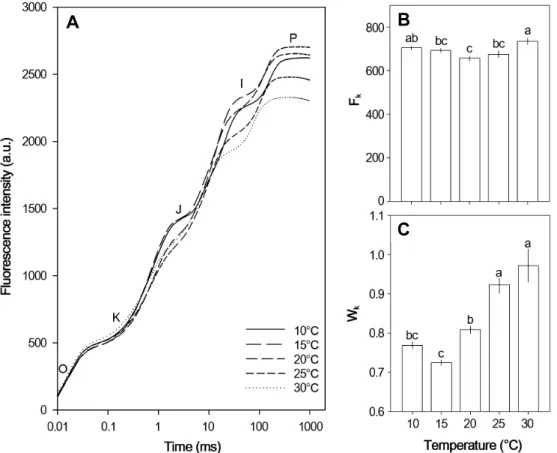
Fig. 1. Changes of chlorophyll a fluorescence OKJIP transient curves (A), the fluorescence intensity at K-step (B), the ratio of variable fluorescence at K-step to the amplitude F
J-F
O(C) in leaves of garlic (Allium sativum) grown for 15 days under different temperature conditions. O, K, J, I and P in the transient curves indicate the minimal fluorescence intensity when all P SII reaction centers (RCs) are open, the fluorescence intensity at 300-400 μs, the fluorescence intensity at 2 ms, the intensity at 30 ms, and the maximal fluorescence intensity when all PSII RCs are closed, respectively. The different letters above the bars indicate statistically significant differences among different temperature treatments by ANOVA and Duncan’s
마늘 잎의 광계II 활성OKJIP 곡선의 변화를 보면, 15-20°C 온도에서 I와 P 단계 에서의 형광밀도 Fi, Fp가 25-30°C 보다 높았다(Fig. 1A). 그 리고 K 단계에서의 형광밀도 Fk는 20°C를 전후하여 다소 감소하였으나 30°C에서 다소 높았다(Fig. 1B). Wk 값은 15°C 에서 가장 낮았으며 그보다 낮거나 높은 온도에서는 확연하 게 증가하였다(Fig. 1C).
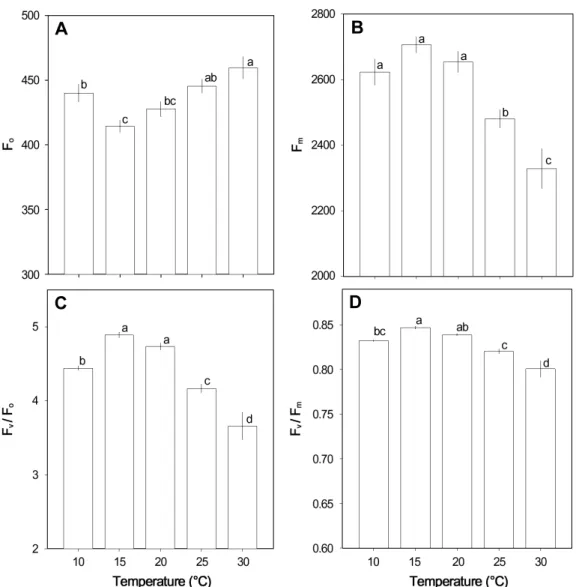
초기형광수율(Fo)은 15°C에서 가장 낮고 10°C 조건이나 20°C 이상에서는 크게 증가하였다(Fig. 2A). 최대형광수율 (Fm)은 10-20°C 조건에서는 높았으나 25°C 이상의 온도에 서는 낮았으며(Fig. 2B), 광계II의 잠재적 광합성능(Fv/Fo)과 광계II의 최대 광화학적 효율(Fv/Fm)은 15-20°C 조건에서 높 았다(Figs. 2C and 2D).
광계II의 활성 상태의 반응중심의 밀도(RC/CSm)와 에너
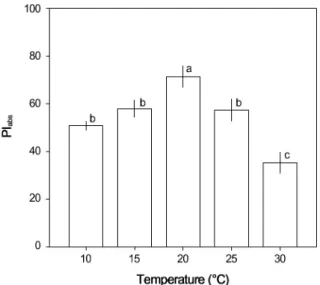
지 흐름의 변화(ABS/CSm, TRo/CSm, ETo/CSm, DIo/CSm)를 나타내는 형광변수들 중에 RC/CSm, ABS/CSm, TRo/CSm은 10-20°C에서 높고, 그 보다 온도가 높아졌을 때 점차 감소하 였다(Table 2). 그리고, ETo/CSm은 15-20°C에서 높았으며, DIo/CSm은 온도가 높아짐에 따라 점차 증가하여 30°C에서 가장 높았다. PIabs는 20°C에서 가장 높고 그 보다 온도가 낮거나 높아지면 감소하였다(Fig. 3).
마늘의 생산성
지상부 건중량은 20°C에서 가장 높았으며(Fig. 4A), 인경 과 뿌리의 건중량은 각각 20°C와 25°C에서 가장 높았으나 10-25°C 조건에서 처리 온도간에 큰 차이를 보이지는 않았 으며, 30°C에서는 크게 감소하였다(Figs. 4B and 4C). 그리 고 마늘의 전체 무게는 20-25°C에서 높았다(Fig. 4D).
A B
C D
Fig. 2. Changes of minimal fluorescence (F
o), maximal fluorescence (F
m), potential photochemical efficient of PSII (F
v/F
o) and photochemical efficiency of PSII (F
v/F
m) in leaves of garlic (Allium sativum) grown for 15 days under different temperature conditions. Different letters above bars indicate statistically significant differences among different temperature treatments by ANOVA and Duncan’s multiple test (p < 0.05). Data are means ± SE of 9-10 independent measurements.
Table 2. Quantum efficiencies and effective absorption per excited cross-section
zof PSII from leaves of garlic (Allium sativum) grown for 15 days under different temperature conditions.
Temperature (°C) RC/CS
mABS/CS
mTR
o/CS
mET
o/CS
mDI
o/CS
m10 2,171 a
y2,623 a 2,141 a 1,241 b 482 b
15 2,281 a 2,705 a 2,246 a 1,307 ab 459 d
20 2,274 a 2,653 a 2,190 a 1,389 a 462 cd
25 1,883 b 2,480 b 1,999 b 1,275 b 480 bc
30 1,490 c 2,328 c 1,825 c 1,081 c 502 a
z
RC/CS
m, density of active reaction center per cross section; ABS/CS
m, absorption flux of photons per cross section; TR
o/CS
m, trapping of electrons per cross section; ET
o/CS
m, electron flux per cross section; DI
o/CS
m, energy dissipation per cross section
y
Different letters within each column indicate significant differences among different temperature treatments by ANOVA and
Duncan’s multiple test (p < 0.05).
Fig. 3. Performance index on absorption basis (PI
abs) of leaves of garlic (Allium sativum) grown for 15 days under different temperature conditions. Different letters above the bars indicate statistically significant differences among different temperature treatments by ANOVA and Duncan’s multiple test (p < 0.05). The values of fluorescence parameters are represented as means ± SE of 7-10 independent measurements.
A B
C D
Fig. 4. Effect of temperature on aerial part dry weight (A), bulb dry weight (B), root dry weight (C), and total dry weight (D) of garlic (Allium sativum) grown for 30 days under different temperature conditions. Each value is expressed at the mean ± SE of 6-8 independent measurements. Different letters above the bars indicate statistically significant difference among
마늘의 항산화효소 활성
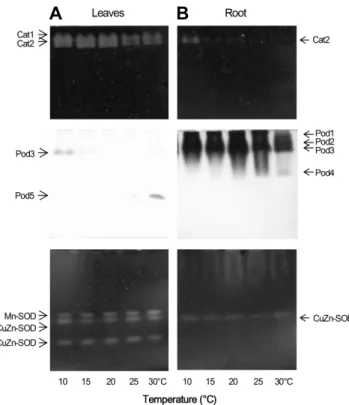
잎에서 항산화효소의 발현양상을 보면, CAT와 POD는 각각 2개의 밴드를 확인할 수 있었다. 그리고, SOD는 3개 의 밴드가 확인되었으며, 그 중 1개는 Mn-SOD이고 2개는 CuZn-SOD로 구분되었다(Fig. 5A). 잎에서 CAT 활성은 25°C 이상의 온도에서 점차 감소하였다. POD는 2개의 밴드 중에 POD3는 10°C에서, POD5는 30°C에서 미약하지만 특이적 으로 검출되었다. Mn-SOD는 20°C 이상의 온도에서 미약하 게 발현되고 CuZn-SOD1, CuZn-SOD2 또한 20°C 이상의 온도에서 그 활성이 다소 높았으나 30°C에서는 다시 감소하 는 것으로 관찰되었다. 뿌리에서 항산화효소의 발현양상을 보면, CAT는 1개의 밴드가, POD는 4개의 밴드가 확인되었 다. SOD는 1개의 밴드이며, CuZn-SOD로 구분되었다(Fig. 5B).
CAT 활성은 대체로 낮았으나 온도가 높을수록 다소 높았으 며, POD는 25°C까지 서서히 증가하나 30°C에서 감소하였 다. SOD 활성은 20°C 이상의 온도에서 미약하게 검출되었 다. 그리고, CAT와 SOD는 뿌리에서보다 잎에서 그 활성이
A B
Fig. 5. Isoenzyme pattern of catalase (CAT), peroxidase (POD), and supersoxide dismutase (SOD) in leaves and roots of garlic (Allium sativum) grown for 15 days under different temperature conditions.
Fig. 6. Changes in leaf number of garlic (Allium sativum) grown at five temperature conditions.
더 높고, POD는 잎에서보다 뿌리에서 더 높았다.
고 찰
본 연구에서 마늘은 25°C까지는 온도가 높을수록 크게 자랐으나 재배기간이 30일 이상 길어짐에 따라 고온 조건에 서 잎의 노화가 빨리 진행되고 잎 끝부분이 점차 황백화되 면서 고사하여 고온이 마늘에 스트레스로 작용함을 알 수 있었다(Table 1 and Fig. 6). 고온이 마늘의 생장에 비우호적 으로 작용한다는 사실은 광계II의 잠재적 광합성능과 최대 광 화학적 효율을 나타내는 Fv/Fo와 Fv/Fm의 변화로도 알 수 있 는데(Fig. 2), 이들 형광변수들은 15-20°C에서 높았으나 25°C 이상의 온도에서 크게 감소하였다. 이러한 결과는 25°C 이 상의 온도에서 불활성상태의 반응중심이 증가하고(Kriedemann et al., 1985) 광계II의 반응중심이 손상되고 있음을 나타낸 다(Oh et al., 2014). 이는 마늘을 30°C에서 재배하였을 때 지상부의 생장과 엽수가 크게 감소하고(Table 1), 식물의 생 산성과 관련된 지상부, 인경, 뿌리의 건중량 또한 크게 감소 하는 것으로도 알 수 있다(Fig. 4). 재배 온도에 따라 CAT와
POD의 활성 또한 확실한 차이를 보였는데(Fig. 5), CAT는 뿌리에서보다 잎에서 더 높은 활성을 보이고 25°C 이상의 온도에서 그 활성이 점차 감소하는 양상을 보였으며, POD 는 POD1, POD2, POD3가 잎에서 보다 뿌리에서 더 높은 활성을 유지하며 20-25°C에서 높고 30°C에서 크게 낮아졌 다. SOD도 역시 CAT와 마찬가지로 뿌리에서보다 잎에서 더 높은 활성을 보였는데 20-25°C에서 다소 높고 30°C에서 는 감소하였다. 이러한 결과는 20-25°C의 온도가 마늘의 초 기 생육에 우호적으로 작용하고 30°C 이상의 온도는 고온 스트레스로 작용하고 있음을 보여주고 있다(Lima et al., 2002;
Meloni et al., 2003; Shim et al., 2003). 한지형 잔디인 켄터 키 블루그래스(Poa pratensis L.)에서도 생육적온(20/15°C, 주간/야간)에서와는 달리 고온(35/30°C, 주간/야간)에 노출 되었을 때 Fv/Fm 값의 감소, 품질 저하와 함께 CAT와 SOD 등 항산화효소 활성이 감소한다(Wang and Huang, 2004).
밀(Triticum aestivum L.)의 유묘를 온도를 달리하여 배양하 였을 때에도, 잎에서 CAT와 SOD 활성이 25°C에서 보다 30°C에서는 증가하고 35°C에서는 크게 감소하는데, 이때 지상부와 뿌리의 생장과 Fv/Fm 값이 35°C에서 크게 저해되 어 고온 스트레스의 영향을 받는 것으로 보고되었다(Kumar et al., 2013). 더군다나, ascorbate, glutathione, proline 등의 비효소적 항산화물질들도 30°C에서는 증가하는데 반해 35°C 에서는 크게 감소하고, 35°C 고온과 α-tocopherol를 동시에 처리하였을 때에 항산화효소와 비효소적 항산화물질의 함 량이 대조구와 유사하면서 밀의 생장에 영향을 덜 미치는 것으로 보고되었다. 따라서 생육적온을 벗어난 높은 온도에 서는 항산화효소나 비효소적 항산화물질들이 원활하게 합 성되지 못하여 고온에 대한 대응이 원활하지 못하여 생육에
Table 3. Correlation matrix of the chlorophyll fluorescence parameters
zand growth characteristics
yof garlic (Allium sativum).
Temperature Chlorophyll fluorescence parameters
F
oF
mF
v/F
oF
v/F
mF
kW
kRC/CS
mABS/CS
mTRo/CS
mETo/CS
mDIo/CS
mPIabs Temperature 1 .414
**-.652
**-.636
**-.623
**.125 .759
**-.666
**-.652
**-.660
**-.350
*.363
*-.270 Aerial part dry weight .179 -.201 .183 .254 .247 -.309
*-.058 .165 .183 .206 .378
**-.264 .358
*Bulb dry weight -.291* -.342
*.393
**.450
**.452
**-.304
*-.416
**.420
**.393
**.417
**.391
**-.371
*.353
*Root dry weight -.257* -.387
**.446
**.525
**.507
**-.433
**-.386
**.512
**.446
**.477
**.516
**-.444
**.531
**Total dry weight -.030 -.301
*.314
*.394
**.384
**-.377
**.217 .326
*.314
*.342
*.465
**-.365
*.451
**z
Chloropyll fluorescence parameters were m easured in leaves of garlic plants grown for 15 days at five temperature conditions.
y
Growth characteristics were measured in garlic plants grown for 30 days at five temperature conditions.
도 영향을 미치고 있음을 알 수 있다. 본 연구에서 잎에서는 CAT와 SOD가, 뿌리에서는 POD가 높은 활성을 보이고 있 어 잎과 뿌리가 산화적 스트레스에 대응하는 메커니즘이 서 로 다른 것으로 보인다. 그리고, POD의 경우 미약하지만 잎 에서는 10°C 조건에서 POD3가, 30°C 조건에서는 POD5가 검출되어, 저온과 고온에서 스트레스에 대처하는 항산화 메 커니즘이 다소 다른 것으로 판단된다.
고온 스트레스의 영향은 OKJIP 곡선의 변화로도 확인할 수 있는데, 25°C 이상의 온도에서 Fi, Fp가 크게 감소하였으 며, Fk는 30°C에서, Wk값은 25°C 이상의 온도에서 확연하 게 증가하여(Fig. 1B and 1C) 고온에서 불활성 상태의 반응 중심이 많아져 전자전달이 원활하게 일어나지 않음을 알 수 있다(Srivastava et al., 1997). 밀(Tritium aestivum L.)에서도 25°C에서 생육한 잎에서는 Fk가 나타나지 않지만 37.5°C 이 상의 온도에서 Fk가 점차 증가하는 것으로 보고된 바 있다 (Lu and Zhang, 2000; Mathur et al., 2011). Fig. 1A의 OKJIP 곡선으로부터 산출된 RC/CSm은 20°C까지는 일정하나 온도 가 증가함에 따라 점차 감소하여(Table 2) 높은 온도에서 활 성상태의 반응중심의 수가 감소함을 나타내 주고 있다. 그 리고, ABS/CSm, TRo/CSm, ETo/CSm도 25°C 이상의 높은 온 도에서 점차 낮아져(Table 2) 엽면적당 흡수되는 빛에너지 양과 광계II의 반응중심에 포획되는 에너지, 전자전달로 전 해지는 에너지가 모두 감소하고 있음을 알 수 있다. 이에 반해 DIo/CSm은 온도가 높아짐에 따라 점차 증가하였으며, 특히 30°C에서 높았다(Table 2). 이는 고온에서는 흡수된 빛 에너지가 상당량 광합성에 이용되지 못하고 소실되고 있음 을 알려주고 있다. 이러한 결과는 본 연구에서 사용한 마늘 이 한지형 품종이기 때문에 기인하는 것으로 보이는데, 호 냉성 채소로 잘 알려진 배추(Brassica campestris ssp. napus var. pekinensis)를 봄철 대기온도보다 4°C 또는 7°C 더 높은
조건에서 재배하였을 때(Oh et al., 2014), 그리고 보리(Hordeum vulgare L.), 수수(Sorghum bicolor)와 밀(T. aestivum L.)을 고온에서 재배하였을 때에도 이와 유사한 결과를 나타내는 것으로 보고된 바 있어(Kalaji et al., 2011; Mathur et al., 2011; Yan et al., 2012) 저온내성 작물들에 있어서 공통적인 특성인 것으로 보인다. PIabs 또한 온도가 높아짐에 따라 점 차 감소하여 저온성 작물인 마늘이 높은 온도에 노출되었을 때 고온에 민감하여 활력이 저하되었음을 나타내 주고 있다 (Strasser et al., 2000).
마늘의 생산성을 예측하는 데 있어 식물체당 엽수 또한 중요한 요소이며, 특정 시점까지는 녹색 상태의 건전한 잎 이 증가하고 이후 점차적으로 시들면서 녹색 상태의 잎이 감소하는 양상을 보인다(Moravčević et al., 2011). 본 연구 에서도 이러한 특성을 잘 보여주고 있다(Fig. 6). 잎의 발생 시기는 온도가 높을수록 빨라졌으나 엽수는 10-25°C 범위 에서 재배하였을 때 7개 정도로 유사하였다. 그러나 30°C에 서는 엽수가 5개 이하로 가장 적었으며 잎의 발생시기 또한 가장 늦었다. 40일이 경과한 이후부터는 잎이 노랗게 변하 여 녹색 상태의 엽수가 점차 감소하였는데, 온도가 낮을수 록 노화가 진행되는 시기가 늦춰졌으며, 30°C에서는 잎이 밑으로 쳐지면서 노화가 빨리 이루어졌다. 따라서 20°C에서 재배하는 것이 마늘의 초기 지상부 영양생장과 인경의 발달 이 좋을 뿐만 아니라(Fig. 4) 잎의 발달이 비교적 빠르고 노 화가 늦게 진행되어(Fig. 6), 저온기 마늘의 재배를 위한 적 정 온도로는 20°C 전후가 적절할 것으로 판단된다. 그리고, 풋마늘로 이용하기 위해서는 30일 전후부터 50일 이내에 수 확하는 것이 바람직한 것으로 보인다(Fig. 6).
작물수확량은 온도에 의해 크게 영향을 받으며, 이는 광 계II 활성과 직접적으로 관련이 있다. 본 연구에서도 광계II 의 엽록소형광변수인 Fo, Wk는 온도와 1% 수준에서 정의
상관을, Fm, Fv/Fo, Fv/Fm, RC/CSm, ABS/CSm, TRo/CSm은 온 도와 1% 수준에서 음의 상관을 나타내었다(Table 3). 이러 한 결과는 엽록소형광 변수들이 고온 스트레스에 의한 영향 이 육안으로 관찰되기 전에 고온 스트레스의 영향을 조기에 파악하는데 유용하게 이용될 수 있음을 나타내 주고 있다.
특히, Fv/Fo, Fv/Fm, Fk, ETo/CSm, PIabs는 전체 건중량과도 의 미있는 상관을 보여, 마늘 생산성을 조기예측하는데 있어서 유용한 변수로 활용될 수 있을 것으로 보인다.
초 록
본 연구는 마늘의 초기생장에 미치는 온도의 영향을 살펴 보기 위하여 맹아가 출현된 마늘의 인편을 온도를 달리하여 재배하고, 마늘의 생육특성, 광계II 활성과 항산화효소의 발 현 양상을 살펴보았다. 마늘의 생육은 15-25°C 조건에서 양 호하여 지상부의 생장과 엽수가 빠르게 발달하였다. 특히, 지상부와 인경의 건중량과 전체 건중량이 20°C에서 가장 높 았으며, 그보다 높은 온도에서는 지상부, 인경과 뿌리의 건 중량이, 그리고 낮은 온도에서는 지상부의 건중량이 크게 감소하였다. Fv/Fo와 Fv/Fm 또한 15-20°C에서 높았으며 그 이상의 온도에서 크게 감소하였다. OKJIP 곡선의 패턴에서 도 15-20°C에서 Fi, Fp가 다소 증가하고, 25°C 이상의 온도 에서는 점차 감소하였으며, Fk와 Wk는 30°C에서 뚜렷하 게 증가하였다. 그리고, 항산화효소들 중에 잎의 catalase와 superoxide dismutase, 그리고 뿌리의 peroxidase는 20-25°C 에서 높고 30°C에서 크게 낮았다. 이러한 결과는 30°C 조 건이 마늘의 초기생장에 있어 스트레스 요인으로 작용하고 있으며, 20°C 전후에서 재배하는 것이 바람직함을 나타내 주고 있다. 그리고, Fv/Fo, Fv/Fm, Fk, ETo/CSm, PIabs 등의 엽 록소형광 변수들은 마늘의 전체 건중량과 의미있는 상관을 보여, 마늘 생산성을 사전에 예측하는데 유용한 변수로 활 용될 수 있을 것으로 보인다.
추가 주요어 : 항산화효소, 엽록소형광 변수, 초기생장, OKJIP곡선