Culinary Science & Hospitality Research. 2016;22(6):78-86.
https://cshr.jams.or.kr/ ISSN 2466‐0752 (Print)
ISSN 2466‐1023 (Online)
Influence of Informational Clues on Subjective Knowledge, Concern, and Satisfaction and Behavioral Intention toward Healthy Foods in Full-service Restaurants
Sang-Mook Lee
¶¶
School of Hospitality & Tourism Management, Kyungsung University, Busan 608-736, Korea
ABSTRACT: The purpose of current study is to verify a formulated model that explains the influence of informational clues(Nutritional label information and Mass media information) on subjective knowledge, concern, satisfaction, and behavioral intention toward healthy foods in context of full-service restaurants.
The results of present study demonstrated that all informational clues have significant influence on both knowledge and concern about health and the significant relationships were confirmed between know- ledge, concern, emotional pleasure, and behavioral intention. This study may contribute to develop mean- ingful marketing strategic for healthy foods in full-service sector, and it can be utilized as a critical study to establish an attractive business strategics to increase revenue as well as satisfy healthy foods consu- mers in full-service restaurant consumers.
Keywords: full-service restaurant, healthy food, informational clues, subjective knowledge, concern, sati- sfaction, behavioral intention
¶ Corresponding Author: Sang-Mook Lee, Dept. of Foodservice Management, Kyungsung University, 309 Suyeong-ro, Nam-gu, Busan 608-736, South Korea, Tel. +82-10-663-4474, Fax. +82-51-627-6830, E-mail: [email protected]
INTRODUCTION
Modern population faces a lot of health issues closely linked to people’s eating including obesity.
Based on this circumstance, healthy foods or healthy options in a restaurant are drawing attention and has become a critical norm of interest in both aca- demia and the foodservice industry[1,2].
Prior researches identified important factors im- pact consumers’ food choices including some tangi- ble elements such as appearance, texture, color, and some intangible elements such as knowledge, con- cern, and information of foods[3,4,5,6,7]. More spe- cifically, Healtherington[8] stated emotional clues, such as pleasure, increase during eating, and imposes an influence on consumption.
Previous studied revealed that informational sour-
ces could significantly influence improvement of
people’s healthy eating. For example, mass media,
informal informational sources, and educational ma-
terial are significant factors that linked to eating be-
haviors[9,10,11]. Even though previous studies veri-
fied numerous elements influence consumers’ food
choices, very limited studies have considered infor-
mational clues affecting customers’ concern, know-
ledge as well as future behaviors for healthy food. In
addition, little research examined the relationships
among informational clues about healthy foods,
knowledge, concern, satisfaction, and behavioral in-
tention toward healthy food choice especially in
full-service restaurant context. This study focuses on
the theoretical relationships among two major ante-
cedents for informational clues and other dependent
variables. More specifically, priority concern of cur-
rent study is to verify how the informational clues are linked to other factors including knowledge, con- cern, satisfaction, and behavioral intention. Namely, the ultimate goal of present study are to confirm the importance of informational clues of healthy foods and to assess the relationship among the informa- tional clues and other critical components such as knowledge, concern, satisfaction, and behavioral in- tention toward healthy foods. Current study can contribute to provide strategical suggestion for ma- nagers or service providers of full-service restaurants to encourage healthy foods, and provide meaningful academic reference by demonstrating the formulated theoretical model.
LITERATURE REVIEW
Informational Clue 1: Nutritional Label Information Label or symbol has been identified as an signi- ficant element which is closely related to consumers’
behavior or decision for choosing a menu in restau- rants, so food labels on menus have recognized as a critical norm in previous studies[12,13,14]. For in- stance, Horgen and Brownell[13] found messages on menus significantly have impacted on consump- tion toward healthy foods in a restaurant. In addi- tion, other studies revealed that menu symbol or la- beling have consideration as significant clue that di- rectly linked to visitors’ satisfaction in context of res- taurants[15,16]. Hence, current study proposes that the nutritional label information can influence on peoples’ people’s subjective knowledge and concern about health as well as consumers’ final decision about foods in a restaurant.
Informational Clue 2: Mass Media Information In numerous studies demonstrated that informa- tion from media is one of significant instrument that can various affect on people’s consumption[17,18].
In foodservice industry, the mass media has been considered as an powerful tool that is closely linked to consumers’ eating behaviors[19,20]. For instance, Grainger et al[19] identified that fast-food advertis- ing can influence parents’ fast-food consumption to their children positively. In addition, a current study assert mass media is a critical marketing tool to en- courage healthy foods as well as avoid unhealthy
foods[21]. Even though, the importance of mass me- dia information were demonstrated by previous scholars, the formulated relationships among infor- mation clues and other variables for healthy foods in full-service restaurant sector.
Subjective Knowledge
Previous research has identified the knowledge plays in final decision-making and it can classify sub- jective knowledge and objective knowledge[19,22, 23,24]. Brucks[22] reported that objective know- ledge can be developed the actual information or or- ganization of knowledge through person’s memory, while subjective knowledge can be identified per- son’s self-confidence or perceived level of knowledge.
Knowledge about food is also one of the important antecedents to understanding customer behavior because it can affect people’s behaviors, such as their food choices, intention to repurchase[19,24,25,26]. In prior studies, some evidence appeared to verify that consumer use their own knowledge to encourage their diets[19,27,28,29]. For example, personal know- ledge about can have a positive influence on a per- son’s self-confidence about health and consumption of a reduced-fat diet[19,24]. Hence, the perceived knowledge can be significant predictor as well as dependent variable such as consumer’s level of sat- isfaction or future behavior toward eating heal- thy foods.
Concern
Health concern has been concentrated on signi-
ficant factor that can influence on consumers’ eating
behavior[30,31,32]. Sun[7] identified that concern
about health such as worrying for calories of foods
and disease could significantly motivate people’spe-
cific food choices. Therefore, health conscious con-
sumers tend to seek foods with health and nutritional
benefits and people try to eat healthier foods and
healthy food consumption[10,33]. Previous studies
revealed that restaurant consumers, who have high-
er health consciousness, are more interested in weight
control, appearance, and disease prevention[33,34,
35,36]. The increasing interest in health is illustrated
by healthier behaviors or attitudes that are dominat-
ing restaurant selection along with visitors satisfaction,
and customers are willing to pay more money for
healthy items in a restaurant[37]. Although prior studies verified the importance of relationships be- tween health concern and consumers’ behaviors, limited study perform the model for healthy food choices in full-service restaurant.
Satisfaction
Numerous prior studies revealed that people’s sati- sfaction is a initial determinant for long-term behavi- or, and employed the norm to estimate future be- haviors in various foodservice sectors[5,38,39,40,41].
Westbrook and Oliver[42,43] said satisfaction is level of service or product overall performance, or percei- ved perception about quality through their expe- riences. In the restaurant context, satisfaction has been employed as an overall gap between consum- ers’ expec- tations and their evaluation through ex- periences after or before enjoying the service/prod- uct in a restaurant[38,41]. Therefore, this study has employed the satisfaction toward healthy foods as dependent variable of consumers’ knowledge and con- cern about health as well as significant predictor of cus- tomer behavioral intention in full-service restaurants.
Behavioral Intention
Behavioral intention has been considered as an ini- tial factor that lead to long-term business success because it represent a consumer’s belief or intention to repurchase same product or service[40,45,46,47].
Oliver[44] defined that behavioral intention crossly linked to a visitor’s intention to recommend any things to other people. In context of foodservice sector, many researchers employed the concept of behavioral intention as result construct influenced by other core variables such as knowledge[48], con- cern[33], satisfaction[40,49]. For instance, Coulson [48] performed a study to confirm relationships among food knowledge of label, attitudes, and the behavior among young consumers. Therefore, this study conducts to verify the major constructs includ- ing information clues, knowledge, concern, and sati- sfaction have influence on behavioral intention both directly and indirectly.
Hypothesis Development
Healthy foods is not new trend in foodservice in- dustry anymore, it was already considered as a criti-
cal element in both academia and industry. Therefore, better understanding of consumers’ behaviors re- lated to health or eating habits can be very valuable at this moment. Although previous studies have evaluated numerous elements that influence eating behaviors, limited literatures conducted to identify the importance of information clues especially for healthy foods in fullservice restaurant. Therefore, the current study endeavors to find significant relation- ships between information clues and knowledge and concern based on previous studies[13,19], and formulated hypothesis are following:
H1: Information clues will influence on subjective knowledge about healthy foods.
H1-1. Nutritional label information of healthy food positively influences subjective know- ledge for health.
H1-2. Mass media information of healthy food positively influences subjective knowledge for health.
H2: Information clues will influence on concern about healthy foods.
H2-1. Nutritional label information of healthy food positively influences concern for health.
H2-2. Mass media information of healthy food positively influences concern for health.
In addition, prior researches demonstrated the significant relationships among knowledge, concern, satisfaction as well as behavioral intention[7,33,37, 48]. Therefore, current study performs to confirm the relationships as perceived by healthy food consump- tions in fullservice sector, and developed the follow- ing hypothesizes.
H3: Subjective knowledge will influence on con- cern about healthy foods.
H4: Subjective knowledge will influence on cus- tomer satisfaction about healthy foods.
H5: Health concern will influence on customer satisfaction about healthy foods.
H6: Customer satisfaction will influence on be- havioral intention toward healthy foods.
METHODOLOGY
Previous studies[16,18,23,33,37,40,47,48], devel- oped a survey to establish measurements for infor- mation clues, subjective knowledge, health concern, satisfaction, and behavioral intentions. All measure- ment employed a 7-point Likert-type scale (1: strongly disagree to 7: strongly agree) for items: ‘Please in- dicate your level of agreement with the following statement.
Data and Sample
A developed self-administrated survey distributed to achieve present study’s objectives. Before distribu- ting the survey, four graduate students and three professors who are major in hospitality management checked content validity of questionnaires and final survey was modified based on the their comments.
Developed questionnaire was distributed through an online survey company to 600 full-service restaurant customers in U.S. who enjoyed healthy food(s) in fullservice restaurants. The company collected data from its panel of online respondents in all of USA.
Out of the 600 respondents, 88 respondents were removed because of missing values and disqualified data. SPSS 21.0 and AMOS 21.0 were employed for the confirmatory factor analysis and structural equa- tion modeling(SEM) to conduct the frequency analy- sis, reliability analysis and measurement model validation[53].
RESULTS
Demographic Information
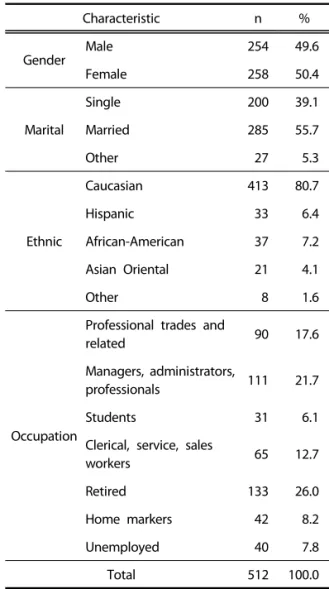
The results of participants’ socio-demographics show in Table 1. Of the total number of participants, male (49.6%) and female (50.4%) were similar ration, and the most frequently ethnic was caucasian (80.4
%). Approximately 56% of the participants were mar- ried and the most frequently occupation was retired people (26%) followed by managers, administrators, and professional group (21.7%), and professional trades and related (17.6%).
Measurement Model and Discriminant Validity Analysis
To confirm the structure of the six constructs: two information clues, subjective knowledge about heal-
Table 1. General characteristics of the subjects
Characteristic n %
Gender Male 254 49.6
Female 258 50.4
Marital
Single 200 39.1
Married 285 55.7
Other 27 5.3
Ethnic
Caucasian 413 80.7
Hispanic 33 6.4
African-American 37 7.2
Asian Oriental 21 4.1
Other 8 1.6
Occupation
Professional trades and
related 90 17.6
Managers, administrators,
professionals 111 21.7
Students 31 6.1
Clerical, service, sales
workers 65 12.7
Retired 133 26.0
Home markers 42 8.2
Unemployed 40 7.8
Total 512 100.0
thy foods, concern for health, satisfaction, and beha-
vioral intention, present study verified the reliability,
validity, and unidimensionality of the all variables
before analyzing the structural model. hypotheses
testing for current study involves all measurement
because all factor loadings were higher than the
standard level 0.4[51]. The results reported that the
ranges of Cronbach’s alpha for the six factors (0.868
to 0.941) are suitable for the appropriate level of in-
ternal consistency[51]. The ranges of composite reli-
abilities (Nutritional label information: 0.887, Mass
media information: 0.886, Subjective knowledge: 0.852,
health concern: 0.783, satisfaction: 0.946, behavioral
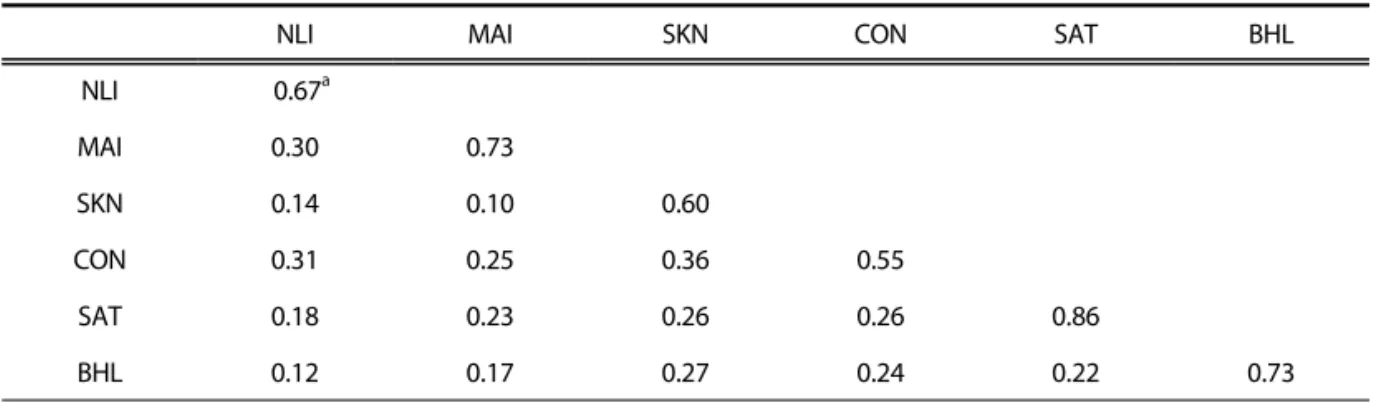
intention: 0.912) are also appropriate[52]. Discrimi-
nate validity was confirmed based on comparing the
AVE and the squared correlation factors because the
Table 2. Confirmatory factor analysis and discriminant validity
NLI MAI SKN CON SAT BHL
NLI 0.67
aMAI 0.30 0.73
SKN 0.14 0.10 0.60
CON 0.31 0.25 0.36 0.55
SAT 0.18 0.23 0.26 0.26 0.86
BHL 0.12 0.17 0.27 0.24 0.22 0.73
χ
2=533.593, d.f.=174, IFI=0.953, TLI=0.943, CFI=0.952, GFI=0.904, AGFI=0.873, RMSEA=0.064
LAI=Nutritional label information, MAI=Mass media information, SKN=Subjective knowledge, CON=Concern, SAT=
Satisfaction, BL=Behavioral loyalty, IFI=Incremental fit index, TLI=Tucker-lewis index, CFI=Comparative fit index, GFI=Goodness of fit index, AGFI=Adjusted goodness of fit index, RMSEA=Root mean square error of approximation.
Note.
aAVE is on the diagonal. Squared of paired constructs are on the off-diagonal.
*
p<0.05,
**p<0.01,
***p<0.001.
range of AVE (0.55 to 0.86) exceeds the range of squared correlations for each pair of constructs (0.12 to 0.36). In addition, formulated measurement mo- dels confirmed the reliability of the measurement pro- perties (χ
2(174)=553.593, p<0.001, NFI=0.931, IFI=0.953, TLI=0.943, CFI=0.952, and RMSEA=0.064(see Table 2).
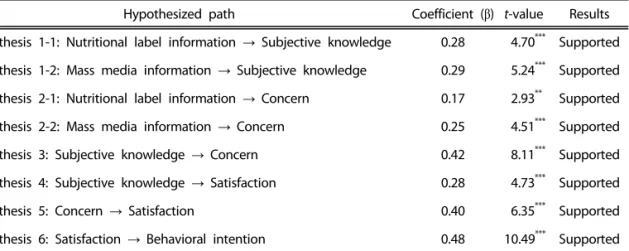
Subsequent structural equation modeling (SEM) verified the formulated model and allowed assess- ment of the eight paths with six hypotheses. The Chi-square statistic is 655.518 with 180 degrees of freedom (p<0.001, CMIN/DF=3.642), and all of indices represent that the model has satisfactory fit (NFI=
0.916, IFI=0.937, TLI=0.927, CFI=0.937, RMSEA=0.072) according to standards by Anderson and Gerbing [53]. Based on the results, all hypothesizes were con- firmed significantly. Specifically, both information clues positively influences subjective knowledge (Hy- pothesis 1-1: β=0.28 t=4.70; p<0.001; Hypothesis 1-2:
β=0.29 t=5.24; p<0.001) as well as concern for health (Hypothesis 2-1: β=0.17 t=2.93; p<0.01; Hypothesis 2-2: β=0.25 t=4.51; p<0.001). In addition, current study identified the subjective knowledge is significant predictor of health concern (Hypothesis 3: β=0.42 t=
8.11; p<0.001) and satisfaction (Hypothesis 4: β=0.28 t=4.73; p<0.001). Furthermore, health concern has positively influence on satisfaction (Hypothesis 5: β=
0.40 t=6.35; p<0.001, and the satisfaction was critical antecedent of behavioral intention (Hypothesis 6: β
=0.48 t=10.49; p<0.001). (see Table 3 & Figure 1).
Based on these results, the current study demon- strates information clues are significant elements that can influence on knowledge and concern for health positively. Similar with previous results, the subjective knowledge and health concern are critical predictors of customer satisfaction about healthy foods and satisfied consumers are willing to recom- mend or repurchase the healthy foods in the full- service restaurants.
CONTRIBUTIONS
The result of the this research contribute to un- derstanding the influence of information clues about healthy foods through label and mass media on sub- jective knowledge, health concern, and behavioral intention toward healthy foods in full-service restau- rant area. The findings identified all relationships among six variables were significant. Particularly, in addition, present study verified the importance of information clues related to healthy foods because it significantly influence on knowledge and concern.
Based on the findings, current study revealed that
consumers who are interested in any information
about healthy foods, have more subjective know-
ledge and concern for health. Furthermore, the con-
sumers are positive assessment about the full-service
restaurants and they are willing to continue to visit
the place or recommend the restaurant to others.
Table 3. Structural parameter estimates
Hypothesized path Coefficient (β) t-value Results Hypothesis 1-1: Nutritional label information → Subjective knowledge 0.28 4.70
***Supported Hypothesis 1-2: Mass media information → Subjective knowledge 0.29 5.24
***Supported Hypothesis 2-1: Nutritional label information → Concern 0.17 2.93
**Supported Hypothesis 2-2: Mass media information → Concern 0.25 4.51
***Supported Hypothesis 3: Subjective knowledge → Concern 0.42 8.11
***Supported Hypothesis 4: Subjective knowledge → Satisfaction 0.28 4.73
***Supported
Hypothesis 5: Concern → Satisfaction 0.40 6.35
***Supported
Hypothesis 6: Satisfaction → Behavioral intention 0.48 10.49
***Supported χ
2=655.518, d.f.=180, IFI=0.937, TLI=0.927, CFI=0.937, GFI=0.887, AFFI=0.855, RMSEA=0.072
*