• 검색 결과가 없습니다.

CONTACT BINARIES IN THE FIELD OF STELLAR CLUSTERS

N/A
N/A
Protected

Academic year: 2021

Share "CONTACT BINARIES IN THE FIELD OF STELLAR CLUSTERS"

Copied!
4
0
0

로드 중.... (전체 텍스트 보기)

전체 글

(1)

Publications of the Korean Astronomical Society pISSN: 1225-1534

30: 197 ∼ 200, 2015 September eISSN: 2287-6936

2015. The Korean Astronomical Society. All rights reserved. c http://dx.doi.org/10.5303/PKAS.2015.30.2.197

CONTACT BINARIES IN THE FIELD OF STELLAR CLUSTERS Liu Liang

1,2,3

, Qian Shengbang

1,2,3

, and Zhu Liying

1,2,3

1

National Astronomical Observatories/Yunnan Observatory, Chinese Academy of Sciences, P.O. Box 110, 650011 Kunming, P.R. China

2

Key Laboratory for the Structure and Evolution of Celestial Objects, Chinese Academy of Sciences, P.O. Box 110, 650011 Kunming, P.R. China

3
University of the Chinese Academy of Sciences, 19A Yuquanlu, Sijingshang Block, 100049 Beijing, China (Received November 30, 2014; Reviced May 31, 2015; Aaccepted June 30, 2015)

ABSTRACT

Several contact binary systems in four stellar clusters or their fields are reported here; NGC7789-V12, EP Cep and ES Cep in NGC188, NGC104-V95 and V710 Mon. Their multiple light curves were analyzed by the 2010 version of the W-D code, and their physical parameters were obtained.

Key words: Binaries: eclipsing— Stars: individual (NGC7789-V12, EP Cep, ES Cep, NGC104-V95, V710 Mon)— Stars: evolution

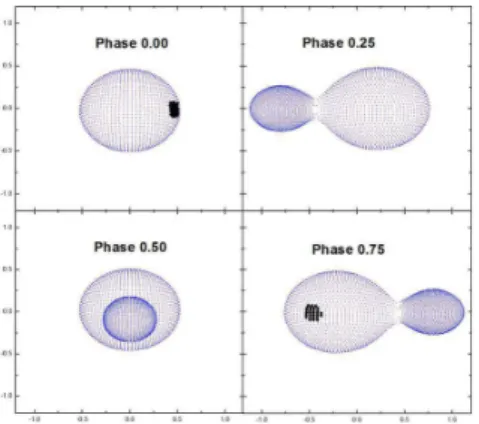
Figure 1. Geometrical structure of V12 at phases of 0.0, 0.25, 0.5, and 0.75, respectively. One dark spot on the secondary (the more massive component) is also shown in the panels.

1. BACKGROUND

Stellar clusters are good laboratories for determining the physical parameters of a contact binary system, whether the contact binary is a member or not. If it is a cluster member, obviously, the distance value of the cluster can be adopted for the binary system. Otherwise, we can use the extinction of the cluster and the color indices of the binary to estimate the binary’s distance, under a linear extinction assumption. Here we reported several contact binary systems in four stellar clusters or in their fields.

2. CONTACT BINARIES IN THE CLUSTERS

When a contact binary is in a cluster, it should have the same distance as the cluster. The absolute mag-

http://pkas.kas.org

Figure 2. Observed (dots) and fitted (lines) light curves of NGC7789-V12.

Figure 3. The relationship between q and Σ(O − C)

2

.

nitudes can be computed by this well determined dis-

tance. On the other hand, the absolute magnitudes can

also be calculated by photometric solutions with the W-

D code. The set of parameters which makes these two

distances equal should be a reasonable result. Thus,

we can estimate the physical parameters of a cluster

member contact binary without spectroscopic data. Af-

197

(2)

198 LIU LIANG, QIAN SHENGBANG, & ZHU LIYING

Figure 4. Comparison between the observed and theoretical light curves of EP and ES Cep. Left panel: the solid line represents the synthetic light curve with a dark spot on the secondary of EP Cep and the dashed line refers to the syn- thetic light curve with a dark spot on the primary of EP Cep. Right panel is the same as the left panel.

Figure 5. O-C curves of EP Cep (left) and ES Cep Per (right).

The solid lines represent the quadratic fit curves. The dashed line refers to the linear fit. Dots in the upper panels repre- sent CCD observations. All residuals are shown in the lower panels with dots (quadratic fit) and open circles (linear fit).

Figure 6. Observed light curves of V95 with errors.

ter all, spectroscopic observations are much harder than photometric observations, especially for tje very distant faint contact binaries that are typical cluster members.

We have observed the two open clusters, NGC7789 and NGC188, obtaining several light curves of contact bina- ries in them.

2.1. V12 in NGC7789

The NGC 7789 member V12 is a bright UMa-type bi- nary star with an orbital period of 0.397 days. Its first complete light curves in V, R, and I bands have been analyzed with the W-D method. The results show that V12 is a W-type intermediate-contact bi- nary (f = 43 ± 2.2%) with a mass ratio of 3.848.

The asymmetry of the light curves is explained by the presence of a dark spot on the more massive compo- nent. The possible long-term period increase at a rate of P = +2.48 ± 0.17 × 10

−6

days/year reveals a rapid mass transfer from the less massive component to the more massive one. The presence of an intermediate-contact binary in an intermediate-age open cluster may suggest that some contact binaries have a very short pre-contact

Figure 7. Observed (symbols) and theoretical (solid line, in case A) light curves of V95.

Figure 8. Comparison of light curves for the three cases. They are almost the same.

Figure 9. Geometrical structure of the high fill-out factor, ex- treme mass-ratio contact binary V95 with the changed cool spot. The spot is assumed to be on the more massive com- ponent.

Figure 10. CCD photometric light curves of V710 Mon in R and I bands taken in (top) 2007 and (bottom) in 2013.

timescale. The presence of a third body or/and stellar collision may help to shorten the pre-contact evolution.

2.2. EP Cep and ES Cep in NGC188

The NGC188 members EP Cep and ES Cep are shallow-

contact binaries (10.2%, 2.5%) with continuously de-

(3)

CONTACT BINARIES IN THE FIELD OF STELLAR CLUSTERS 199

Figure 11. The fitting residuals versus the mass ratio.

Figure 12. The (O- C) diagram of V710 Mon.

Figure 13. The Dartmouth model (Log T)-(M) isochrone di- agram, with [Fe/H] = 0.0 and [α/Fe] = 0.0. The primary component is located along the 5.34 Gyr isochrone.

creasing periods (dP/dt = −3.73 × 10

−7

d/yr, dP/dt =

−5.40×10

−8

d/yr). However, their mass ratios are quite different. EP Cep has an extremely low-mass ratio of q = 0.15, while ES Cep has a relatively high-mass ratio of q = 0.69, indicating that they lie in different evo- lutionary stages. The former is an evolved system and may be experiencing oscillations caused by the combined effect of the thermal relaxation oscillation and the vari- able angular momentum loss, while the latter is likely a newly formed contact binary via a Case A mass transfer.

3. CONTACT BINARIES IN THE FRONT OF THE CLUSTERS

When a contact binary is not in a cluster, it seems there is no connection with the cluster at all. However, we dis- covered that they can be connected via reddening. Once the contact binary and the cluster are in the same sight line, they are possibly reddened by the same matter.

Their reddening should be the same if both of them are

behind the interstellar matter, or the reddening obeys a linear law if the interstellar matter is uniformly dis- tributed. Under the linear extinction law, the reddening is proportional to the distance. The distance and red- dening of the cluster are known so that we assume the reddening of the contact binary and compute a corre- sponding distance with the law. On the other hand, we can repeat this computation with the W-D code (Wilson

& Devinney, 1971; Wilson, 1979; Wilson,1990; Wilson, 2008; Van Hamme and Wilson, 2007). We get the final results when the outcomes of the two isolated method are equal. Here we show two examples.

3.1. V95 in the Field of NGC104

Because V95 is not thought to be a member of NGC104 according to the Rucinski relationship (Rucinski, 1995) which produces uncertainty. We used three assump- tions in our solutions; V95 is a field contact binary; V95 is a field contact binary with the same reddening as NGC104; V95 is a member of NGC104. Having com- pared with the statistical result of Li et al. (2007), we excluded the latter two assumptions. The reasonable result is Case A. Cool spots were found in the BV-band light curves. We compared the size, temperature and position of these two spots, thinking that they could be a single spot. If this conclusion is true, we have captured a starspot migration where cool spot on the surface of the more massive component shifted 126 degrees along the latitude line from west to east in a year.

3.2. V710 Mon in the Field of Berkeley39

To find out the reddening of V710 Mon, we tested a series of reddenings with a step size 0.001 and found that an E(B-V) of 0.112 is the most reasonable value.

The final photometric solution shows that V710 Mon is an extreme mass ratio (0.143 - 0.183), deep (59.5 - 62.7%) contact binary system. Its period increase, a rate of dP/dt = +1.95 ± 0.06 × 10

−7

days/ year, might be due to an expanding post-main-sequence component in the system. The time scale of the orbital increase is nearly equal to the time for the post-main-sequence star to evolve into a subgiant. The age of the pri- mary is estimated to be 5.34 Gyr using the Dartmouth model isochrones (Dotter et al., 2008). This work is partly supported by Chinese Natural Science Founda- tion (Nos. 11103074, 11133007, 11325315, 10973037 and 10903026), the National Key Fundamental Research Project through grant 2007CB815406, the Yunnan Nat- ural Science Foundation (No. 2008CD157 and by West Light Foundation of the Chinese Academy.

REFERENCES

Dotter, A., Chaboyer, B., Jevremovic, D., Kostov, V., Baron, E., & Ferguson, J. W., 2008, The Dartmouth Stel- lar Evolution Database, ApJS 178, 89

Li, L. -F., Zhang, F. -H., Han, Z. -W., & Jiang, D. -K., 2007, Formation and Evolution of W Ursae Majoris Contact Bi- naries, ApJ 662, 596

Rucinski S. M., 1995, Absolute-Magnitude Calibration for

(4)

200 LIU LIANG, QIAN SHENGBANG, & ZHU LIYING W UMa-type Systems. II. Influence of Metallicity, PASP,

107, 648

Wilson, R. E., 1979, Absolute-Magnitude Calibration for W UMa-type Systems. II. Influence of Metallicity, ApJ 234, 1054

Wilson, R. E., 1990, Accuracy and Efficiency in the Binary Star Reflection Effect, ApJ 356, 613

Wilson, R. E., 2008. Eclipsing Binary Solutions in Physical Units and Direct Distance Estimation, ApJ 672, 575 Wilson, R. E. & Devinney, E. J., 1971, Realization of Ac-

curate Close-Binary Light Curves: Application to MR Cygni, ApJ 166, 605

Van Hamme, W. & Wilson, R. E., 2007, Third-Body Pa-

rameters from Whole Light and Velocity Curves, ApJ 661,

1129

수치

Figure 2. Observed (dots) and fitted (lines) light curves of NGC7789-V12.
Figure 13. The Dartmouth model (Log T)-(M) isochrone di- di-agram, with [Fe/H] = 0.0 and [α/Fe] = 0.0

참조

관련 문서

학생 본인이 농어촌 소재지 학교에서 중학교 입학 시부터 고등학교 졸업 시까지 교육과정을 이수하고 본인 및 부모가 농어촌 지역에 거주한 자. 학생 본인만

웹 표준을 지원하는 플랫폼에서 큰 수정없이 실행 가능함 패키징을 통해 다양한 기기를 위한 앱을 작성할 수 있음 네이티브 앱과

• The supply and demand curves cross at the equilibrium price and quantity.. • You can read off approximate equilibrium values

The index is calculated with the latest 5-year auction data of 400 selected Classic, Modern, and Contemporary Chinese painting artists from major auction houses..

The key issue is whether HTS can be defined as the 6th generation of violent extremism. That is, whether it will first safely settle as a locally embedded group

SigmaNEST 펀칭 파워팩 제품 관리, 자동 다이나믹™ 배 열 및 펀칭 툴 관리를 갖춘 터렛 펀칭 프로그래밍을 위한 가장 완벽하고 최적화된

A frame size error in a frame that could alter the state of the entire connection MUST be treated as a connection error (Section 5.4.1); this includes any frame carrying a

The “Asset Allocation” portfolio assumes the following weights: 25% in the S&P 500, 10% in the Russell 2000, 15% in the MSCI EAFE, 5% in the MSCI EME, 25% in the