한국표면공학회지 J. Korean Inst. Surf. Eng.
Vol. 49, No. 3, 2016.
http://dx.doi.org/10.5695/JKISE.2016.49.3.231
<연구논문>
ISSN 1225-8024(Print) ISSN 2288-8403(Online)
Acid Pickling/polishing of AZ31 Magnesium Alloy
Basit Raza Fazal
a,b, Sungmo Moon
a,b*aSurface Technology Division, Korea Institute of Materials Science, 797, Gyeongnam 51508, Korea
bAdvanced Materials Engineering, Korea University of Science and Technology, Daejeon 34113, Korea
(Received June 21, 2016 ; revised June 28, 2016 ; accepted June 29, 2016)
Abstract
This article reports a new chemical bath for preparing a mirror-like surface of AZ31 Mg alloy. In order to find an appropriate chemical polishing solution, four different acidic solutions of sulphuric acid, nitric acid, acetic acid and a specially designed mixture of nitric acid and acetic acid were investigated in view of the changes in surface appearance, roughness and dissolution rate of AZ31 Mg alloy. The surface scales on AZ31 Mg alloy were readily removed by all the acidic solutions, but a reflective surface was produced only by etching in the specially designed solution, and only after a specific etching time. The surface roughness increased with etching time in sulphuric acid, nitric acid, and acetic acid, but it lowered after a specific etching time in the specially designed mixture of nitric acid and acetic acid. Dissolution rate of the alloy in the specially designed mixture of nitric acid and acetic acid appeared to be more than twice than that in separate nitric acid or acetic acid. In this work, we recommend the mirror-like surface of AZ31 Mg alloy obtained by polishing for an optimum time in a mixture of nitric acid and acetic acid for following surface finishings, chemical conversion coating, electroplating, electrophoretic painting and anodizing treatment.
Keywords : Chemical polishing, Surface Finishing, Acid etching, A31 Mg alloy, Surface roughness
1. Introduction
For successful surface modifications and coatings on magnesium alloy, it is required to first prepare a clean surface free from surface contaminants and thick oxide scales. Magnesium and its alloys are among the most difficult metallic specimens to prepare the clean surface for since they are soft and prone to scratching, and stain readily when exposed to water [1]. Mechanical polishing is normally done on specially designed cloths to prepare the clean surface, using diamond pastes and suspensions as lubricants. Presently, only knife-abrading method has the advantage of producing cleaner and smoother surfaces than mechanical methods [2], but both mechanical polishing and knife-abrading methods
cannot be used for pre-treatment of industrial products with complicated shapes. On the other hand, chemical methods, especially, acid cleaning, could provide the best final polishing results [3]. Conven- tional magnesium etching liquids include inorganic acids such as hydrochloric acid, sulphuric acid, or nitric acid [4-6]. However, the magnesium etchant systems now in use have a variety of disadvantages and two of the major difficulties faced during etching of magnesium alloys are thick residual etching products and high surface roughness. Moreover, although there are techniques for chemical or electrochemical polishing of other metals, they are not applicable to magnesium alloys due to their different chemistries. In addition, in literature no chemical polishing technique has been reported for Mg alloys for producing a shiny surface with low surface roughness, less than 0.15 µm.
In the present work, four different acidic solutions of sulphuric acid, nitric acid, acetic acid and a specially designed mixture of nitric acid and acetic acid were used for chemical etching experiments of
*
Corresponding Author : Sungmo MoonSurface Technology Division, Korea Institute of Materials Science / Advanced Materials Engineering, Korea University of Science and Technology
Tel : +82-55-280-3549 ; Fax : +82-55-280-3570 E-mail : [email protected]
232 Basit Raza Fazal 외/한국표면공학회 49 (2016) 231-237
AZ31 Mg alloy, and changes of surface appearance, roughness and dissolution rate with immersion time in the four liquids were studied systematically to produce extremely smooth, reflective and bright surface of AZ31 Mg alloy. Concentration of the specially designed chemical polish (CP) containing nitric acid and acetic acid was chosen by a combination of concentrated individual acids for fast anodic reaction and slow diffusion of reaction products into the electrolyte.
2. Experimental
2.1 Sample preparationAZ31 Mg alloy plate (wt.%, Al 2.94, Zn 0.8, Mn 0.3, Si < 0.1, Fe < 0.005, Cu < 0.05, Ni < 0.005, and Mg balance) fabricated by POSCO was cut into 100 mm × 30 mm × 1 mm sized samples which were then masked by tape to expose four neighbouring areas with dimensions of 20mm x 15mm for the following immersion tests.
2.2 Bath composition
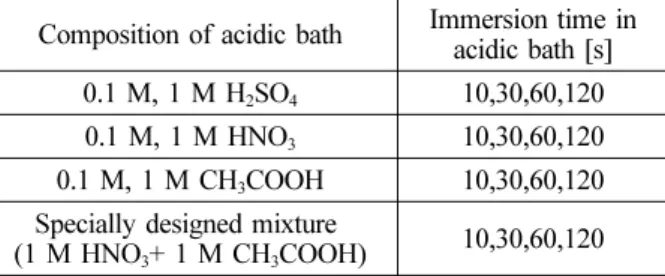
Four acidic solutions were prepared and their concentrations are given in Table 1. High concentra- tion of acetic acid was chosen for faster cleaning and the mixture of nitric acid and acetic acid was prepared to obtain clean and shiny surface of AZ31 Mg alloy. Every etching experiment was performed by using fresh solution of 100 ml.
2.3 Property evaluation
Digital photographs were taken to compare the etched morphology and hydrogen evolution behaviour with immersion time in the four different acidic baths. A Mitutoyo Surftest SJ-4400 profilometer was used to measure the surface roughness (Ra), and twelve Ra measurements were taken by scanning the tip in perpendicular direction to rolling direction, before and after chemical cleaning, and at the same areas. Weight of separate samples was measured
before and after 120s of immersion to calculate weight loss in the four diffenent baths. The samples were immersed in 1M NaOH solution for 30s at room temperature to remove surface residuals from acidic baths before measuring the weight. The samples were washed with tap water after every immersion in the chemical baths.
3. Results and discussion
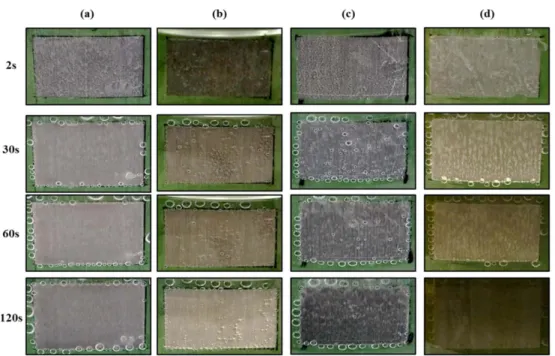
Figure 1 shows the formation behaviour of hydrogen bubbles and changes of surface appearance, observed through the etchants, on the as-received AZ31 Mg alloy surface with immersion time in four different acidic baths. The specimens were set vertically and it is seen that the gas bubbles formed on the specimen surface are moving upwards. The gas bubbles in sulfuric acid (Fig. 1(a)) initially stayed on the surface to become relatively large in size, but, after a few seconds of immersion, the initial large sized bubbles changed into extremely small bubbles generated at a very high rate. It is interesting to realize that small bubbles are combined into big bubbles at the edges.
Figure 1(b) and (c) show formation of the largest bubbles on the surface after 30 s of immersion time, indicating growth and slower detachment of the bubbles up to 30 s. The size of the bubbles became smaller with further immersion time, resulting from easier detachment of the gas bubbles from the surface. The easy detachment of the gas bubbles after 30 s is ascribed to an increased portion of the clean surface where the surface oxide scales or contaminants are completely removed. It is also recognized that extremely large sized bubbles are staying at the edges even after 2 min of etching in nitric acid and acetic acid.
The bubble stability up to 30 s depends on the contact angle of the bubble at the solid-liquid interface. The contact angle is mathematically calculated according according to Young equation:
where ᵞLG, ᵞSL, and ᵞSG are the interfacial tensions of the liquid-gas, solid-liquid, and solid-gas, interfaces.
The adhesion of gas bubbles on the surfaces has been extensively studied [7-8].
Higher adhesion between the gas bubbles and surface means a higer contact angle and more
θ
cos γSG–γSL
γLG --- Table 1. Bath composition and operating conditions for =
cleaning of AZ31.
Composition of acidic bath Immersion time in acidic bath [s]
0.1 M, 1 M H2SO4 10,30,60,120 0.1 M, 1 M HNO3 10,30,60,120 0.1 M, 1 M CH3COOH 10,30,60,120 Specially designed mixture
(1 M HNO3+ 1 M CH3COOH) 10,30,60,120
difficult detachment of gas bubbles due to high surface tension between gas bubbles and the surface.
With increasing polishing time, surface contaminants are removed which could allow gas bubbles to detach more readily owing to decreased contact angle [9-11]
A mixture of nitric acid and acetic acid shows totally different evolution behaviour of gas bubbles, as can be seen in Fig. 1(d). There were no gas bubbles attached on the surface after 30 s of immer- sion time in the mixture solution. The rate of bubble generation was evaluated based on the number and length of bubble lines in Fig. 1, and the gas evolution rate appeared to be the fastest in 1 M sulphuric acid (Fig. 1(a)), followed by the mixture of 1 M nitric acid and 4 M acetic acid (Fig. 1(d)), 4 M acetic acid (Fig. 1(c)), and slowest in 1 nitric acid Fig. 1(b).
The colour of the specimen in Fig. 1(a) appears to be a blurry grey due to extremely fast evolution of bubbles while in Fig. 1(b) more shiny metallic surface can be observed with immersion time due to efficient removal of surface scales. In Fig. 1(c) the exposed area showed the brightest surface at 30 s of etching time and became darkened with further etching time and throughout the etching the surface was covered with black etcing residuals like a typical as-received surface. The characteristic silvery white color of AZ31 Mg alloy which was obtained after
120s in nitric acid (Fig. 1(b)), was attained after only 30s in the mixture of 1 M nitric acid and 4 M acetic acid (Fig. 1(d)). It should be mentioned that the solution colour became very dark only in the mixture solution in Fig. 1(d), but the colours of other etchant solutions remained transparent even after 2 min of etching. The darkened solution coluor in Fig. 1(d) suggests an accumulation of reaction products near the specimen surface which can absorb or scatter the light.
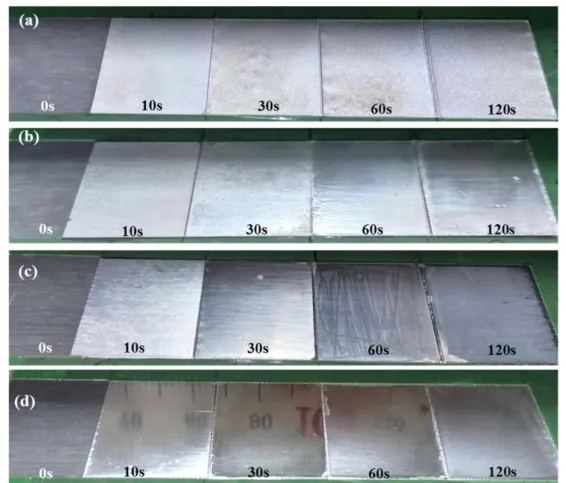
Figure 2 presents a comparison of surface appearance of as-received AZ31 Mg alloy surface with immersion time in four different acidic baths. It can be seen that Fig. 2(a) & (b) had stained surfaces after immersion in acidic baths: brown stained surface in sulfuric acid; yellowish-brown tinted surface in nitric acid. A gradual brightening of the surface with increasing immersion time was observed in nitric acid (Fig. 2(b)), while there was a gradual darkening of the surface with increasing immersion time in acetic acid (Fig. 2(c)). The darkened surface in Fig. 2(c) could be related with the formation of adhered etching products. Scratch marks in Fig. 2(c) at 60 s were made to confirm the removal or detachment of adhered etching products by mechanical means using a steel ruler. It was confirmed that the adhered etching products were removable mechanically.
In contrast, Fig. 2(d) exhibited extremely clean and Fig. 1. Digital photographs showing hydrogen evolution behaviour of as-received AZ31 Mg alloy specimen with immersion time in four different acidic baths: (a), 0.1M H2SO4; (b), 0.1M HNO3; (c), 0.1M CH3COOH; (d), 1M HNO3 + 4M CH3COOH.
234 Basit Raza Fazal 외/한국표면공학회 49 (2016) 231-237
reflective surface, as can be seen by reflected images of the scales, with no staining or residual etching products after 10 and 30s of immersion time but longer immersion time changed the reflective surface into a dull and unreflective surface.
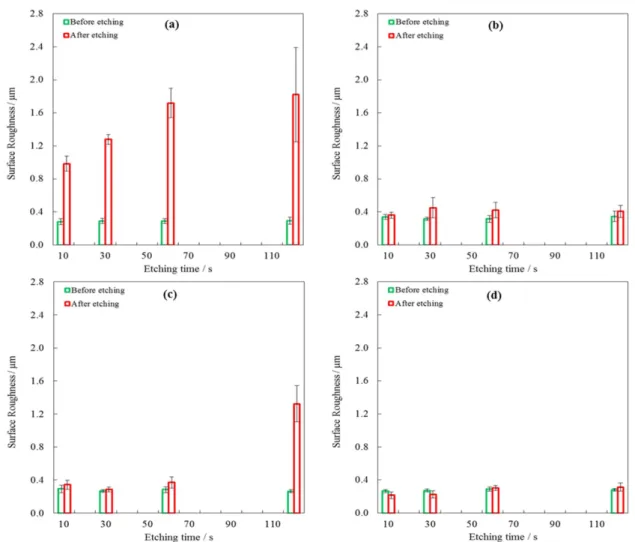
Figure 3 presents surface roughness values of as- received AZ31 Mg alloy surface with immersion time measure before and after etching experiments in four different acidic baths, and Fig. 4 gives the difference of Ra values measured before and after immersion for various durations in four acidic baths.
It can be seen from Fig. 3 (a) & Fig. 4 that surface roughness of the specimen etched in sulphuric acid bath rapidly increased to a high value of about 1.5 mm after 60 s of immersion time. Fig. 3 (b) & Fig. 4 show that the surface roughness of the specimen immersed in nitric acid bath initially increased slightly before decreasing with etching time. Fig 3 (c) & Fig. 4 show that the surface roughness of the specimen immersed in acetic acid bath initially increased slightly before decreasing and again increasing to very high values with longer immersion time. The increased surface roughness values for longer immersion time in acetic
acid seems to correspond to the presence of etching products that are already confirmed in Fig. 2(c). In contrast, Fig. 3(d) & Fig. 4 show that there was an initial decrease in surface roughness up to 30s of immersion time, compared to the values at t = 0 s, which can explain why bright and reflective surface appearance was obtained after 10 and 30s of immersion in Fig. 2. However, surface roughness slightly increased again with longer immersion time than 30 s, suggesting that there exist an optimum polishing time for AZ31 Mg alloy in the mixture of nitric acid and acetic acid.
On the basis of Fig. 2 (d), Fig. 3 (d) & Fig. 4, it can be concluded that 30 s is the optimum polishing time for as-received AZ31 Mg alloy specimen in the specially designed chemical polishing (CP) solution.
Figure 5 shows that the weight loss of AZ31 Mg alloy specimen after 120 s of immersion is greatest in sulphuric acid followed by the CP solution. It is an interesting fact that a mixture of nitric acid and acetic acid has an etching rate that is higher compared to the sum of individual etching rates in nitric acid and acetic acid. It is also interesting to note that the too Fig. 2. Digital photographs of as-received AZ31 Mg alloy specimen with immersion time in four different acidic baths: (a), 1M H2SO4; (b), 1M HNO3; (c), 4M CH3COOH; (d), 1M HNO3 + 4M CH3COOH.
Fig. 3. Surface roughness values of as-received AZ31 Mg alloy specimen measured before (green) and after (red) immersion, with immersion time in four different acidic baths: (a), 1M H2SO4; (b), 1M HNO3; (c), 4M CH3COOH; (d), 1M HNO3 + 4M CH3COOH.
Fig. 4. Difference of Ra before and after etching experiment of as-received AZ31 Mg alloy specimen with immersion time in four different acidic baths: (a), 1M H2SO4; (b), 1M HNO3; (c), 4M CH3COOH; (d), 1M HNO3 + 4M CH3COOH.
Fig. 5. Weight loss of AZ31 Mg alloy specimen during immersion for 120s in four different acidic baths: (a), 1M H2SO4; (b), 1M HNO3; (c), 4M CH3COOH; (d), 1M HNO3 + 4M CH3COOH.
236 Basit Raza Fazal 외/한국표면공학회 49 (2016) 231-237
fast etching in sulfuric acid bath could not make the AZ31 Mg alloy surface smooth.
Removal of Mg-oxides necessitates neutral or acidic pH and surface roughness of the substrates can be noticeably increased by the acidic pre-treatment [12-13].
The surface appearance, surface roughness and weight loss are all intricately related to the hydrogen evolution behaviour of AZ31 Mg alloy specimen in four different acidic baths and the rate of hydrogen evolution is related with the nature of acids; a stronger acid has a higher reactivity with the AZ31 Mg alloy specimen which means that as the anodic dissolution Mg increases, the cathodic areas grow more rapidly and hence the greater hydrogen evolution. In the absence of an externally applied potential, the high hydrogen evolution is induced by the electrochemical reactions at the AZ31 Mg alloy surface. As the exchange current density for the HER is considerably higher on most metals than on Mg [14], noble metal impurities are thought to play an important role by acting as persistent cathodic sites.
Additionally, The anodic Mg dissolution and accompanying cathodic hydrogen evolution have been shown to increase with decreasing electrolyte pH, both at open circuit and during anodic polarization [15].
An increasing concentration of acid is also believed to increase the hydrogen evolution, but this was not the case with 4 M acetic acid. Fig. 5 shows that the weight loss obtained in 4 M acetic acid is approximately four times less than that obtained in 1 M sulphuric acid. This anomaly can be explained in two ways; firstly acetic acid is a weak organic acid which does not dissociate completely, and secondly it can be seen from Fig. 2(c) that etching in acetic acid forms a superficial layer of etched products that does not detach and prevent further contact with the etching solution.
Literature has proposed that the primary reason for the increase in surface roughness with longer immersion time is the development of hydrogen bubbles, which hinder the transport of fresh solution to the AZ31 Mg alloy surface. The formation of hydrogen bubbles give rise to a phenomenon called
“micro-masking” which results in hillock formation, therefore, average roughness is influenced strongly by fluid agitation. Stirring can reduce the Ra values probably due to more efficient removal of hydrogen bubbles from the etching surface. Another method to decrease the surface roughness, as proposed in the
literature, is the addition of a suitable oxidizing agent that competes with hydrogen evolution, such as HNO3.
The increased surface roughness is a combined result of high hydrogen evolution and hydrogen bubbles staying for long periods of times on the AZ31 Mg alloy surface as hydrogen bubbles staying long enough on the surface mask it from the etching solution [16].
Removal of hydrogen bubbles by mechanical means demonstrate that the final surface morphology is greatly affected by wetting of the dissolving surface by the gas bubbles. Bubble size, contact area, and attachment time are, hence, closely related to the contact angle θ at the solid-gas-liquid interface.
Generally, a decrease in θ leads to surface with a higher degree of wettability and, therefore, to better bubble detachment [10].
It was observed that the formation and detachment of bubbles on the surface is a random process and bubble formation is distributed evenly over the whole area. However, increased surface roughness is also a result of different areas etching at a different rate.
Protruding microscopic surface irregularities are attacked more than the other lower peaks, hence simultaneous attack of higher peaks and masking of smaller peaks by hydrogen bubbles can lead to an increase in surface roughness. It is this effect of differential dissolution rates at the surface that results in increased surface roughness [16].
The surface appearance can also be improved further and bubble tracks can be avoided with gentle agitation or by ultrasonic agitation which efficiently removes hydrogen bubbles.
In the case of specially designed CP, the nitric acid acts as an oxidizer and results in a more homogenous etching, thus producing a bright surface after specific etching time. The nitric acid in the mixture also helps in removing the etching by-products from the surface which is otherwise quite difficult (Fig. 2(c)) when dealing with only acetic acid; the removal of etching products allows more contact between the newly formed cleaned surface and etching solution. The dull surface and slightly increased surface roughness for immersion times longer than optimum polishing time of 30s seem to be related with the formation of much amount of dark products floating in the solution. However, it is still unclear why and how the dark products influence the etching behaviour of AZ31 Mg alloy. Thus, further study is necessary to understand the detailed chemical etching or polishing mechanisms .
4. Conclusion
In this research works, a new chemical bath for obtaining a mirror-like surface of AZ31 Mg alloy is reported for the first time. The mirror-like surface and lowest surface roughness were achieved after 30s of immersion time in a specially designed chemical bath comprising of 1 M nitric acid and 4 M acetic acid. However, etching for more than 60s in the specially designed chemical polishing (CP) solution resulted in less-reflective surfaces with higher surface roughness values. Hydrogen evolution behaviour was also observed with time during immersion in the four different solutions and the smallest bubbles were found to form on the AZ31 Mg alloy surface in the CP bath. It was also found that the shiny metallic surfaces in the CP bath could be obtained at an intermediate etching rate which is lower than that in sulphuric acid but two times faster than the sum of individual etching rates in 1 M nitric acid and 4 M acetic acid. It is also worth mentioning that the shiny metallic surface could not be produced by other commonly used etchants for magnesium, like sulphuric acid, nitric acid and acetic acid; these etchants can only be used to remove the surface scales and contaminants. Longer immersion in sulphuric acid, nitric acid and acetic acid also lead to an increase in surface roughness.
Acknowledgement
This research was financially supported by a research grant from the general research program from Korea Institute of Materials Science (PNK4652 and POC2400).
References
[1] B.F. Gerard, Anisotropy and Voiding at High Strain Rates in a Mg Alloy Extrudate, Advanced Materials and Processes 168 (2010) 16-17.
[2] S. Moon, A Blade-Abrading Method for Surface Pretreatment of Mg Alloys, J. Korean Inst. Surf.
Eng. 48 (2015) 194-198.
[3] Investigating Microstructural Gradients and High Strain Rate Deformation Mechanisms in Industrial Magnesium Alloy Components, ProQuest, 2009.
[4] U.C. Nwaogu, C. Blawert, N. Scharnagl, W.
Dietzel, K.U. Kainer, Influence of inorganic acid pickling on the corrosion resistance of magnesium alloy AZ31 sheet, Corros. Sci. 51 (2009) 2544- 2556.
[5] U.C. Nwaogu, C. Blawert, N. Scharnagl, W.
Dietzel, K.U. Kainer, Effects of organic acid pickling on the corrosion resistance of magnesium alloy AZ31 sheet, Corros. Sci. 52 (2010) 2143- 2154.
[6] Metals Handbook, Surface Cleaning, Finishing and Coating, vol. 5, ninth ed., ASM International, USA, 1994.
[7] H. Vinke, G. Bierman, P. J. Hamersma, J. M. H.
Fortuin, Adhesion of small catalyst particles to gas bubbles: determination of small effective solid- liquid-gas contact angles, Chem. Eng. Sci. 46 (1991) 2497-2506.
[8] J. Skvarla, S. Kmet, What is the role of hydrophilic/
hydrophobic surface forces and/or polar interfacial interactions in the interaction between bubbles and minerals?, Colloid. Surf. A, 79 (1993) 89-95.
[9] T. Baum, D.J. Schiffrin, AFM study of surface finish improvement by ultrasound in the anisotropic etching of Si in KOH for micromachining appli- cations, J. Micromechanics Microengineering. 7 (1997) 338-342.
[10] T. Baum, J. Satherley, D.J. Schiffrin, Contact angle, gas bubble detachment, and surface roughness in the anisotropic dissolution of Si (100) in aqueous KOH, Langmuir. 14 (1998) 2925-2928.
[11] T. Hynninen, M.A. Gosálvez, Model for hydrogen bubbles and connection to roughness of etched surfaces, J. Chem. Phys. 129 (2008) 156101-1- 1561012.
[12] Z. Liu, W. Gao, A novel process of electroless Ni-P plating with plasma electrolytic oxidation pretreatment, Appl. Surf. Sci. 253 (2006) 2988- 2991.
[13] Z. Liu, W. Gao, Electroless nickel plating on AZ91 Mg alloy substrate, Surf. Coat. Technol. 200 (2006) 5087-5093.
[14] J. O’M. Bockris and A. K. N. Reddy, Modern Electrochemistry 2B: Electrodics in Chemistry, Engineering, Biology and Environmental Science, Springer, NY, USA (2001).
[15] L. Rossrucker, A. Samaniego, J.-P. Grote, A.M.
Mingers, C.A. Laska, N. Birbilis, G.S. Frankel, K. J. J. Mayrhofer, The pH dependence of magnesium dissolution and hydrogen evolution during anodic polarization, J. Electrochem. Soc. 162 (2015) C333- C339.
[16] W. Haiss, P. Raisch, L. Bitsch, R.J. Nichols, X.
Xia, J.J. Kelly, D.J. Schiffrin, Surface termination and hydrogen bubble adhesion on Si(100) surfaces during anisotropic dissolution in aqueous KOH, J. Electroanal. Chem. 597 (2006) 1-12.