• 검색 결과가 없습니다.

Competitive Adsorption and Subsequent Desorption of Sulfate in the Presence of Various Anions in Soils

N/A
N/A
Protected

Academic year: 2021

Share "Competitive Adsorption and Subsequent Desorption of Sulfate in the Presence of Various Anions in Soils"

Copied!
7
0
0

로드 중.... (전체 텍스트 보기)

전체 글

(1)

Competitive Adsorption and Subsequent Desorption of Sulfate in the Presence of Various Anions in Soils

Byeong-Deok Hong

1

, Kyo-seok Lee, Dong-Sung Lee, Ja-Hyun Rhie, Hui-Su Bae

2

, IL-Hwan Seo, Seung-Geun Song, and Doug-Young Chung*

Department of Bio-Environmental Chemistry, Chungnam National University, Daejeon 34134, Korea

1

National Institute of Crop Science, RDA, Wanju 55365, Korea

2

Technical Review and Quality Management Institute, Korea Rural Community, Daejeon 302-589, Korea

(Received: October 6 2016, Revised: October 22 2016, Accepted: October 25 2016)

In this experiment we investigated the influence of various anions including oxalic acid encountered as solution phase in soil on the adsorption and desorption of sulfate in Chungwon Bt soil. The effect of chloride and nitrate on the adsorption of sulfate was not significant, suggesting that sulfate was better able to compete for adsorption sites at concentrations studied, in contrast to the large reduction in the amount of chloride adsorbed in the presence of sulfate. The results of competition for sorption sites between sulfate and anion showed that the simultaneous presence of two anions in solution was effective in reduction of competing anion at a maximum value of adsorption, due to the similar adsorption mechanism for anion competition. Therefore, the variation in the buffer power of the acids will produce a change in the strength and amount of adsorption and the competitive ability.

Key words: Competitive Adsorption, Sulfate, Anion, Binary system

Adsorption isotherms of sulfate in the presence of various concentration of phosphate as a binary system on Chungwon Bt soils.

Adsorption isotherms of phosphate in the presence of various concentration of sulfate as a binary system on Chungwon Bt soils.

1)

*Corresponding author: Phone: +82428216739, Fax: +82428216731, E-mail: [email protected]

§
Acknowledgement: This study was carried out with the support of “Research Program for Agricultural Science & Technology Development

(Project No. PJ009302012013)”, National Academy of Agricultural Science, Rural Development Administration, Republic of Korea.

(2)

Introduction

Nitrogen and phosphorus are required in appreciable quantities by plants, while needs for sulfur of which deficiencies are much less pronounced than those of nutrients such as N and P are less (Samira et al., 2009). However, sulphur (S) deficiency has been recognized as a constraint to crop production all over the world over the last decade (Zhao et al., 1996; Scherer, 2009). Plants absorb sulfate as an essential nutrient from the soil solution, therefore replenishment of sulfate from organic and adsorbed sources is important in maintaining its supply to the plant (Sumner, 2000). Many soils possess little, if any, SO

42-

adsorption capacity while in others this state of S plays an important part in contribution to S requirement of crops; conserving S from excessive leaching, and in determining S distribution in soil profiles (Tabatabai, 1987).

Sulfate that may occur as water-soluble salts, adsorbed by soil colloids, or as insoluble forms that result in considerable seasonal fluctuations in the concentration of soluble sulfate in surface soils has received the most attention because of its mobility, availability to plants and microorganisms, its precipitation reactions, and because of its reactivity with positively charged surfaces in soils (Scott, 1976; Tabatabai, 1987; Zhao and Mcrath, 1994; Jeanine et al., 1997; Seth, 1998;

Scherer, 2000; Sokolova and Alekseeva, 2008; Samira et al., 2009; Förster et al., 2012; Scherer et al., 2012). Soils vary widely in their capacity to adsorb SO

42-

. Sulfate in aluminum precipitates in the subsoil appears to be available to plant roots, the effect of low molecular mass organic ligands and phosphate on the removal of sulfate from aluminum hydroxy- sulfate precipitate is particularly important (Violante, 2005).

The extent of sulfate retention by soil depends on various soil characteristics, amount of water applied, and fertilizer practices.

It was also shown that the distribution pattern of sulfate along a soil depth was independent of the amount of sulfate applied (Chao et al., 1962). The interactions of sulfate with the soil particles and organic matter influence on its availability to plants. Therefore determining the effects of other anions on the retention of sulfate is quite challenging in soil with significant anion exchange capacity.

Sulfate reaction on the soil surface undergoes a variety of reactions in the soil system during adsorption, subsequent desorption by the counter anions presented in solution within the soil. Adsorption and desorption are important in determining distribution and retention of anions remaining in soil profiles.

Sulfate is sorbed by soils less strongly than phosphate (Hasan et al., 1970; Haque and Walmsley, 1973) and more strongly than nonspecifically sorbed anions, such as chloride (Hingston et al., 1972). However, most studies for adsorption-desorption of anions in soil have treated the system as a single adsorbate system although the interaction of anions for adsorption may be caused by direct competition for sorption sites and the

influence of anion adsorption on the surface charge of the metal hydroxide (Jeanine et al., 1997).

Competition among anionic species in solution for the adsorption sites of soil surface can be of major significance in determining the effective mobility of any potentially adsorbing anionic species. Especially, the presence of organic anions competing for the sorption sites may play an important role in mobility of sulfate in soils, because of their position within the lyotropic series and because of their continuous production within the soil-root system. Several studies also demonstrate that the organic ions competing for adsorption sites with sulfate are preferentially adsorbed over sulfate by clay minerals and oxides (Martinez et al., 1998; Liu et al., 1999). Therefore, adsorption data obtained from single-adsorbate studies may be misleading. In this investigation, we observed the adsorption and desorption of sulfate influenced by competing anion species between inorganic anions or inorganic and organic anion in binary system with subsurface soil collected from Bt horizon to determine the mobility and availability of sulfate through the processes of adsorption and desorption influenced by the presence of competing anionic species encountered in soil.

Materials and Methods

Soil samples were collected from Bt horizon of a Chungwon series (clay loam, mixed, nonacid, mesic, aquic fluventic eutrudepts) at Boogang, Chungbuk Province in Korea. This soil had been used to grow crops such as soybean as a major crop and barley as a rotational crop during the winter for the past fifteen years. The soil was air-dried and ground to pass through a 2 mm sieve. Prior to the adsorption experiment, the soil samples were washed with deionized water twice to determine the amounts of chloride, nitrate, phosphate, and sulfate existed as a soil solution phase. And then, the amount of sulfate at the exchangeable sites of soils was determined by five consecutive extractions with 50 mL aliquots of cmol

(-)

L

-1

of PO

43-

P (as KH

2

PO

4

). The combined aliquots were analyzed for desorbed sulfate. The soil properties are summarized in Table 1 and 2.

For the competitive adsorption between sulfate and other

anions as the bi-solute solution and its subsequent desorption

of indigenous sulfate from soils, we selected nitrate, chloride,

phosphate, and oxalic acid. To do this, 5 g samples of soils

were mixed with 25 mL of freshly prepared solution containing

both sulfate and each competing anion such as nitrate, chloride,

phosphate, and oxalic acid as pair-wise combinations at equal

equivalent basis. Concentrations of eight pair-wise sulfate

with nitrate or chloride ranging from 0 to 30 cmol

(-)

L

-1

were

prepared. For oxalic acid and sulfate or sulfate and phosphate,

the pair-wised concentrations ranged from 0 to 20 cmol

(-)

L

-1

and 0 to 25 cmol

(-)

L

-1

respectively. The relationships between

(3)

Table 1. Chemical properties of Chungwon Bt soil used in this experiment.

pH (1:5 H

2

O)

EC (dS m

-1

)

OM (%)

CEC (cmol

c

kg

-1

)

Soil Particle distribution (%)

Soil texture

Sand Silt Clay

6.6 1.46 0.87 15.9 30.8 35.7 33.5 Clay Loam

Table 2. Amounts of exchangeable and soluble anions recovered from the Chungwon Bt soil used in this experiment.

Cl

-

NO

3-

-N PO

43-

-P SO

42-

-S

--- (cmol

(-)

kg

-1

) ---

A B Total A B Total A B Total A B Total

0.01 0.05 0.06 0.01 0.06 0.07 0.28 0.16 0.43 0.06 0.13 0.18

A: Exchangeable; B: Soluble

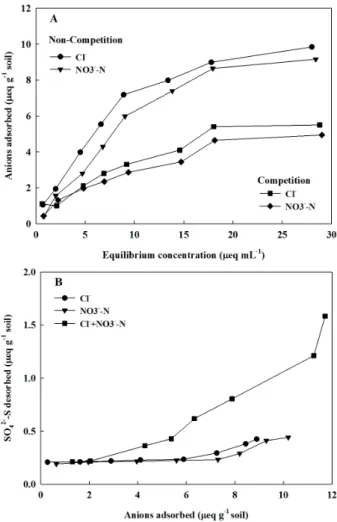
Fig. 1. Competitive adsorption of chloride and nitrate in Chungwon Bt soils as a binary and subsequent desorption of indigenous sulfate.

the amounts of each anion adsorbed from solution were determined by shaking triplicate samples overnight, and then centrifuged at 1750 rpm for 15 min. The centrifuged and filtered solution were analyzed for sulfate, chloride, nitrate, or oxalic acid remaining in solution using an ion chromatography equipped with IonPac AG4A-SC with guard column (Dionex 200D, USA). The amount of adsorbed anions were determined by difference between the initial concentration and equilibrium concentration remaining in solution.

Results and Discussion

The results for the adsorption studies between chloride and nitrate in a single and are presented in Fig. 1. The adsorption of Cl

-

by Bt horizon soil was slightly higher than that of NO

3-

when identical concentration of Cl

-

or NO

3-

was added to soil although the amount of adsorption of chloride and nitrate were gradually increased with increasing equilibrium concentra- tion up to 6.2 and 5.3 µeq g

-1

soil, respectively. This results indicated that the Bt soil had a slightly higher preference for chloride ions relative to nitrate ions as well as this difference in affinity is caused by the difference in the nature of the interactions between these two ions.

Observed and the amount of adsorption for chloride and nitrate from the mixtures However, chloride showed a slightly higher preference for adsorption sites over the equilibrium concentration ranges studied than nitrate, as observed in an individual adsorption isotherm. We assume that the sites involved in the adsorption of chloride and nitrate are only the positively charged sites on the soil surface, that is, non-specific adsorption. However, we observed that the simultaneous presence of both anions was effective in reducing the amount of maximum adsorption by approximately 43 and 35% of chloride and nitrate, respectively. Thus, chloride was moderately effective in reduction of nitrate adsorption, whereas nitrate was more effective in the reduction of chloride adsorption at a maximum value of adsorption. Although both anions compete for sorption sites and appreciably reduce the adsorption process,

the presence of one anion does not completely inhibit adsorption

of the other anion and vise versa. Both anions not only reduce

the adsorption of each other, but enhance release of a certain

portion of native sulfate. The mixture of chloride and nitrate

increased the desorption of indigenous sulfate with increasing

concentration of chloride and nitrate adsorbed. Desorption of

native sulfate was significantly increased in the presence of

the chloride and nitrate mixture. The maximum desorption of

(4)

Fig. 2. Competitive adsorption of chloride and nitrate as a binary system on Chungwon Bt soils.

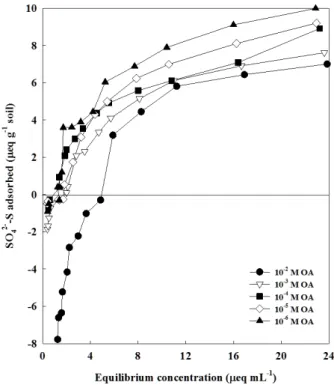
Fig. 3. Adsorption isotherms of sulfate in the presence of various concentration of oxide acid as a binary system under unadjusted pH conditions on Chungwon Bt soils.

sulfate did not occurred in the ranges of adsorption of both chloride and nitrate studied here (Fig. 1B). This can be interpreted that the increasing amount of sulfate in equilibrium solution may not only be attributed by the adsorption of both chloride and nitrate, but also OH

-

attributed to the desorption of indigenous sulfate on Chungwon Bt soil.

For this soil, sorptions of sulfate and chloride plateaued at 10.02 and 0.65 µeq g

-1

for an equilibrium solution concentration of 25 and 15 µeq mL

-1

, respectively (Fig. 2A). If we consider the total amount of sulfate adsorbed in the presence of chloride to be the sum of the initially present plus that added during the adsorption process, the total amount of adsorbed sulfate reached to 4.14 µeq g

-1

. Thus, the effect of chloride on the adsorption of sulfate was not significant, suggesting that sulfate was better able to compete for adsorption sites at concentrations studied, in contrast to the large reduction in the amount of chloride adsorbed in the presence of sulfate. However, the sum of sulfate and chloride adsorbed is slightly higher than that of sulfate or chloride adsorbed in the absence of competition, indicating that the sulfate and chloride adsorbed are only limited to the positively charged sites on the soil surface. Plots of sulfate vs. chloride adsorbed in Fig. 2B showed that the increase of chloride adsorbed is proportional to the increase of sulfate adsorbed when the amount of sulfate adsorbed was

greater than 0.8 µeq g

-1

, that is, adsorption of chloride may occur when sulfate loading approach a maximum value.

Apparently, the amount of sulfate adsorbed for the same adsorption sites in the presence of chloride is not exclusively limited to the electrostatic attraction of the positive surface charges (non-specific adsorption) on this soil as those of chloride adsorbed; whereas the decrease in the amount of chloride adsorbed on Chungwon Bt soil with increasing adsorption of sulfate indicate that chloride in the mixture with sulfate compete for the limited number of sorption sites on the surface of Chungwon Bt soil.

Fig. 3 show the effect of oxalic acid on the adsorption of

sulfate at unadjusted pH and pH 5. When sulfate was introduced

into soil in the presence of varying concentrations of oxalic

acid, the magnitudes of oxalic acid added affect the resultant

isotherms of sulfate. The adsorption isotherms of sulfate in

the presence of oxalic acid were similar to the adsorption

isotherm in the absence of oxalic acid, showing increases with

increasing equilibrium concentration of sulfate. The percent

reduction in the amount of sulfate adsorbed increased to a

greater extent with increasing order of oxalic acid added. The

maximum adsorable sulfate was approximately 9.8 µeq g

-1

in

the presence of 10-6 M, the lowest concentration added,

lower by 1 µeq g

-1

than the maximum amount of sulfate in the

absence of oxalic acid. The presence of oxalic acid on the

adsorption of sulfate was most effective at 0.01 M or greater,

showing that there was desorption of sulfate at equilibrium

concentrations of sulfate less than 4.9 µeq mL

-1

. Thus, the

adsorption of sulfate was markedly reduced by oxalic acid

(5)

Fig. 4. Adsorption isotherms of sulfate in the presence of various concentration of phosphate as a binary system on Chungwon Bt soils.

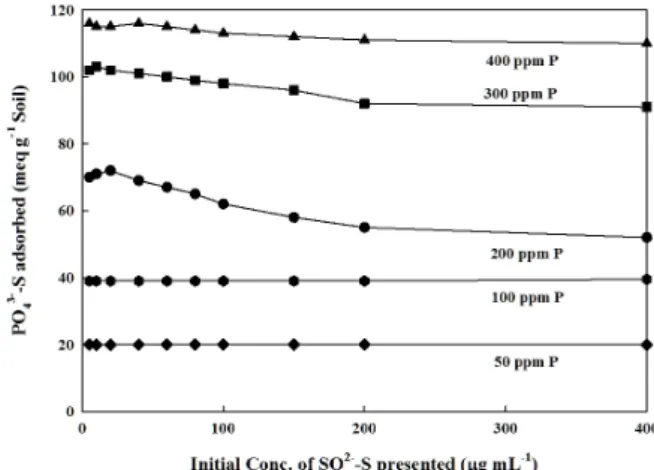
Fig. 5. Adsorption isotherms of phosphate in the presence of various concentration of sulfate as a binary system on Chungwon Bt soils.

either when the concentration of oxalic acid was 0.01 M or when the equilibrium concentration was less than 9 µeq mL

-1

. Also, higher amount of added sulfate as a mixture with oxalic acid, less sulfate was dissolved in the sulfate plus oxalic acid systems. Probably the order of sulfate addition influenced the desorption of native sulfate in sulfate plus oxalic acid system.

It is also noted that the combined amounts of sulfate and oxalic acid adsorbed in sulfate-oxalic acid system were usually higher than that of oxalic acid and sulfate adsorbed when sulfate or oxalic acid was added alone, evidently some available sorption sites for anions in the system applied could be specific for the specific anions through non-specific or specific or both adsorption mechanism. Evidently in this experiments, many of sorbing sites, which adsorbed oxalic acid, had a stronger affinity with oxalic acids than with sulfate. Consequently, it is expected in the present adsorption experiment that the amount of ionized or the total number of the probable functional groups (-COOH) responsible for binding of oxalic acid to sorption sites would relate to the amount of oxalic acid adsorbed.

And it would be preferable to relate to the amount of organic ligands actually adsorbed on the available sorption sites.

In Fig. 4 the effect of phosphate on the adsorption of sulfate by Chungwon Bt shows two distinctive zones. On the adsorption zone (lower phosphate levels), although the phosphate ions compete with sulfate ions for sorbing places and appreciably reduces the adsorption process, its presence does not completely inhibit adsorption of sulfate (right hand curve at 50 µgr mL

-1

phosphate mixed with various concentra- tions of sulfate); whereas on the desorption zone (>100 µg mL

-1

phosphate mixed with sulfate), the phosphate ions not only reduced the adsorption of sulfate, but release a certain proportion of native sulfate. Even at 50 µg mL

-1

phosphate concentration, the presence of phosphate releases the native sulfate from soil where the concentration of initially added sulfate ranged from 0 to 30 µg mL

-1

. This fact suggests that

the process involved results not only from competition but also from a concomitant exchange with specifically adsorbed sulfate from soil surface. Both anions are able to occupy binding sites by ligand exchange and anion exchange with OH

-

and previously adsorbed anions in soil systems. This assumption is inferred from the results by Nagarajah et al.

(1968, 1970) and Hingston et al. (1968, 1971) for kaolinite and oxide surfaces. sulfate was added in concentration ranging from 1 to 400 µg mL

-1

in the presence of 5 levels of phosphate concentration from 50 to 400 µg mL

-1

. The results as seen in Fig. 5 show that phosphate is very effective in decreasing the adsorption of sulfate by Chungwon soil. On the other hand, there was a drastic increase in the desorption of native sulfate when the amount of added phosphate was greater than 100 µg mL

-1

. However, Fig. 4 shows the amounts of sulfate desorbed as a function of phosphate concentration in solution. The maximum desobable sulfate occurred at 1 µg mL

-1

of sulfate and 400 µg mL

-1

of phosphate in initial solution, the lowest concentration of sulfate and the highest amount of phosphate, was approximately 15 µeq g

-1

soil, while the amount of desorbed sulfate decreased from 15 to 8 µeq g

-1

soil with increasing amount of initial addition of sulfate. Also, the amount of desorbed sulfate decreased with decreasing amount of phosphate initially added with sulfate. Phosphate is considered to be specifically adsorbed on soil surface by the formation of a surface complex through ligand exchange of phosphate with H

2

O molecules and/or OH

-

coordinate with Al

3+

and Fe

3+

or anion exchange. Thus, when sulfate and phosphate are present together, the decrease in sulfate adsorption by an adsorbant must arise from the specific adsorption of phosphate resulting from competition sulfate and phosphate for adsorption sites and the desorption of sulfate arised from the anion exchange of sulfate with phosphate. Also, the negative charges increased on the soil surface as the adsorption of phosphate increased, resting in inhibition of sulfate adsorption.

The results of phosphate adsorption in the presence of sulfate

(6)

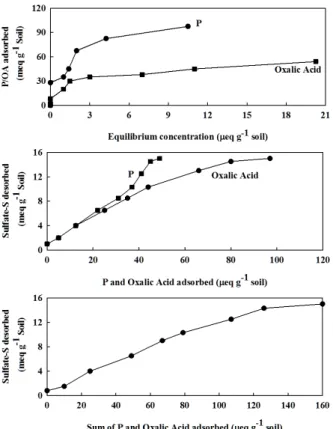
Fig. 6. Competition between phosphate and oxalic acid as a binary mixture system and the relative desorption of indigeoius sulfate on Chungwon Bt soils as a binary system. Solution pH was not adjusted.

were presented in Fig. 5. The presence of increasing concentration of sulfate in solution did not affect the adsorption of phosphate when the initial concentration of phosphate was below 100 µg mL

-1

, whereas the effectiveness of increasing amount of sulfate in reducing the adsorption of phosphate on soil surface gradually increased when the concentration of phosphate was greater than 200 µg mL

-1

in initial solution. However, the effectiveness in reducing the adsorption of phosphate decreased with increasing amount of phosphate studied here. Therefore, maximum adsorption of phosphate occurred at the highest concentration of added phosphate and the lowest concentration of sulfate added. These results indicate that the enhanced competition for available sorption sites between phosphate and sulfate as amount of sulfate is increased and that the increase in sulfate concentration increased the blocking effect of the sulfate on phosphate adsorption. It seems that phosphate ions is more efficiently adsorbed to the soil surface than sulfate.

Competitive adsorption between phosphate and oxalic acid which have a similar adsorption mechanism has been observed in the simplified method in Fig. 6. Oxalic acid was mixed in solution with phosphate at equivalent basis. In the presence of oxalic acid the adsorption of phosphate was markedly reduced by 40 µeq g

-1

soil at the maximum adsorption studied here as compared to that found in the absence of oxalic acid. Similar results obtained in the adsorption of oxalic acid, showing that

the decrease in the amount of adsorbed oxalic was approximately 19 µeq g

-1

soil. However, it is difficult to compare these results to those of adsorption in the absence of the committing anions for sorption sites because pH in the initial solution was changed such that increase in pH for oxalic acid and decrease in pH for phosphate. The effects of pH was observed by Violante et al. (1991), showing that the increase in pH decreased the adsorption of phosphate and oxalic acid and vise versa. Therefore, the reduction in the adsorption of both anions on Chungwon Bt soil can be interpreted that both competition for common sorption sire by these anions and pH in solution influenced the adsorption of both anions in this study. Especially, the amount of adsorbed phosphate may be greater than the actual amount of adsorbed phosphate on this soil due to the decrease in pH.

The ability of oxalic acid to depress phosphate sorption was calculated according to the expression of Deb and Datta (1967). The calculated efficiencies of oxalic acid and phosphate in preventing the adsorption of Phosphate and oxalic acid at maximum adsorption, respectively, were approximately 27 and 17%, but the efficiencies below the initial concentrations of 5 and 7.5 µeq mL

-1

for oxalic acid and phosphate, respectively, was 0, indicating that the all of the anions added adsorbed onto soil surface sites. From these results we assume oxalic acid is more effective in reducing the adsorption of phosphate than oxalic acid by phosphate in this study investigated.

The desorption of native sulfate increased up to 15 µeq g

-1

soil with increasing adsorption of both anions studied here, but the maximum desorption of sulfate was less than that by the same concentration of phosphate only. We interpreted that the drop in pH caused the decrease in the desorption of sulfate as the effects of pH on the adsorption of sulfate observed by Chao et al. (1963). The relationship between adsorption of both anions and desorption of sulfate was linearly increased until the amount of sulfate desorbed reached almost to the maximum obtained here. Therefore, the desorbed sulfate may compete for specific adsorption with the other two anions because the adsorption of both anions increase in negative charges on soil surfaces.

Conclusion

The results of competition for sorption sites between anions shows that competitive adsorption is influenced by factors such as solution concentration and the nature of the competing species. We observed that the simultaneous presence of two anions in solution was effective in reduction of competing anion at a maximum value of adsorption, due to the similar adsorption mechanism for anion competition.

However, the presence of one anion does not completely

inhibit adsorption of the other anion. Also, there is evidence

that selective adsorption sites occur and that in some

(7)

circumstances particular anion species may not be subject to competition. that is, anions from specific adsorption showed a preference for sorption sites than anions from non-specifically adsorbed. On the other hand, proton-donation mechanism can influence the adsorption of anions on to the hydroxylated sites of Fe/Al oxides. Therefore, the variation in the buffer power of the acids will produce a change in the strength and amount of adsorption and the competitive ability.

References

Chao, T.T., M.E. Harward, and S.C. Fang. 1962. Adsorption and desorption phenomena of sulfate ions in soils. Soil Sci.

Soc. Am. Proc. 26:234-237.

Chao, T.T., Harward, M.E., and S.C. Fang. 1963. Cationic effects on sulfate adsorption by soils. Soil Sci. Soc. Am. J.

29:35-38.

Deb, D.L. and N.P. Datta. 1967. Effect of associating anions on phosphate retention in soil: Under variable Concentration.

Plant Soil. 26:303-316.

Förster, S., G. Welp, and H.W. Scherer. 2012. Sulfur specification in bulk soil as influenced by long-term application of mineral and organic fertilizers. Plant Soil Environ. 58:316-321.

Geelhoed, J.S., T. Hiemstra, and W.H. Van Riemsdijk. 1997.

Phosphate and sulfate adsorption on goethite: Single anion and competitive adsorption. Geochim. Cosmochim. Acta. 61:

2389-2396.

Haque, I. and D. Walmsley. 1973. Adsorption and desorption of sulphate in some soils of the West Indies. Geoderma 9:269-278.

Hasan, S.M., R.L. Fox, and C.C. Boyd. 1970. Solubility and availability of sorbed sulphate in Hawaiian soils. Soil Sci.

Soc. Am. Proc. 34:897-901.

Hingston, F.J., R.J. Atkinson, A.M. Posner, and J.P. Quirk.

1968. Specific adsorption of anions on geothite. Trans. 9th.

Int. Congr. Soil Sci. 1:669-678.

Hingston, F.J., A.M. Posner, and J.P. Quirk. 1971. Competitive adsorption of negatively charged ligand on oxide surfaces.

Disc. Faraday. Soc. 52:334-342.

Hingston, F.J., A.M. Posner, and J.P. Quirk. 1972. Anion adsorption by goethite and gibbsite. 1. The role of the proton in determining adsorption envelopes. J. Soil Sci. 23:177-192.

Huang, P.M.A. Violante, J.M. Bollag, and P. Vityakon. 2005.

Sorption/Desorption of Sulfate on/from Variable Charge Minerals and Soils: Competitive Effects of Organic and Inorganic Ligands. In: Soil Abiotic and Biotic Interactions and the Impact on the Ecosystem and Human Welfare.

Science Publishers. pp. 15-221.

Insskeep, W.P. 1989. Adsorption of sulfate by kaolinite and amorphous iron oxide in the presence of organic ligands. J.

Environ. Qual. 18:379-285.

Kamprath, E.J., W.L. Nelson, and J. W. Fitts. 1956. The effect of

pH, sulfate and phosphate concentrations on the adsorption of sulfate in soils. Soil Sci. Soc. Am. Proc. 20:463-466 Lopez-Hernandez, Siergert, D.G., and J.V. Rodriguez. 1986.

Competitive adsorption of phosphate with malate and oxalate by tropical soils. Soil Sci. Soc. Am. J. 50:1460-1462.

Liu, F., J. He, C. Colombo, A. Violante. 1999. Competitive adsorption of sulfate and oxalate on goethite in the absence or presence of phosphate. Soil Sci. 164:180-189.

Marion, S.P. and A.W. Thomas. 1946. The effect of diverse anions on the pH value of maximum precipitation of aluminum hydroxide. J. Colloid. Sci. 1:221-233

Martinez, C.E., A.W. Kleinschmidt, and M.A. Tabatabai. 1998.

Sulfate adsorption by variable charge soils: effect of low- molecularweight organic acids. Biol. Fertil. Soils 26:157-163.

Nagarajah, S., A.M. Posner, and Quirk, J.P. 1968. Desorption of phosphate from kaolinite by citrate and bicarbonate. Soil Sci.

Soc. Proc. J. 32:507-510.

Nagarajah, S., A.M. Posner, and J.P. Quirk. 1970. Competitive adsorption of phosphate with polygalaturonate and the other organic anions on kaolinite and oide surfaces. Nature (London).

228:83-85.

Samira, A., M. Ben, S. Hawaa, Elferjani, Faiza A. H. Fatma, and F. Abdelnabi. 2009. Determination of available nitrate, phosphate and sulfate in soil samples. Int. J. PharmTech Res.

1:598-604.

Scherer, H.W. 2001. Sulphur in crop production. Eur. J. Agron.

14:81-111.

Scherer H.W. 2009. Sulfur in soils. J. Plant Nutr. Soil Sci.

172:326-335.

Scherer, H.W., G. Welp, and S. Förster. 2012. Sulfur fractions in particle-size separates as influenced by long-term application of mineral and organic fertilizers. Plant Soil Environ. 58:

242-248.

Scott, N.M. 1976. Sulphate contents and sorption in Scottish soils. J. Sci. Food Agic. 27:367-372.

Seth, R. 1998. Anion adsorption and desorption characteristics of a piedmont ultisol: some implications for the fate of sulfate deposition. Water Air Soil Pollut. 101:333-347.

Sokolova, T.A. and S.A. Alekseeva. 2008. Adsorption of sulfate ions by soils. Eurasian Soil Sci. 41:140-148.

Sumner, M.E. 2000. Handbook of Soil Science. CRC Press, Boca Raton, FL.

Violante, A., C. Colombom, and A. Buondononno. 1991.

Competitive desorption of phosphate and oxalate by aluminum oxides. Soil Sci. Soc. Am. J. 55:65-70.

Zhao, F., and S.P. McGrath. 1994. Extractable sulphate and organic sulphur in soils and their availability to plants. Plant Soil 164:243-250.

Zhao, F.J., M.J. Hawkesford, A.G.S. Warrilow, S.P. McGrath, and D.T. Clarkson. 1996. Response of two wheat varieties to sulfur addition and diagnosis of sulfur deficiency. Plant Soil.

181:317-327.

수치

Fig. 1. Competitive adsorption of chloride and nitrate in  Chungwon Bt soils as a binary and subsequent desorption of  indigenous sulfate.
Fig. 2. Competitive adsorption of chloride and nitrate as a  binary system on Chungwon Bt soils.
Fig. 4. Adsorption isotherms of sulfate in the presence of  various concentration of phosphate as a binary system on  Chungwon Bt soils.
Fig. 6. Competition between phosphate and oxalic acid as a  binary mixture system and the relative desorption of indigeoius sulfate on Chungwon Bt soils as a binary system

참조

관련 문서