Characteristics of Anthropogenic Soil Formed from Paddy near the River
Yeon-Kyu Sonn, Yong-Seon Zhang*, Byung-Keun Hyun, Keun-Tae Kim, and Chang-Hoon Lee Soil & Fertilizer Management Division, National Institute of Agricultural Science, RDA, Wanju 55365, Rep. of Korea
(Received: September 5 2016, Revised: September 26 2016, Accepted: September 26 2016)
Anthropogenic soil in cropland is formed in the process of subsoil reversal and the refill of soil into cropland.
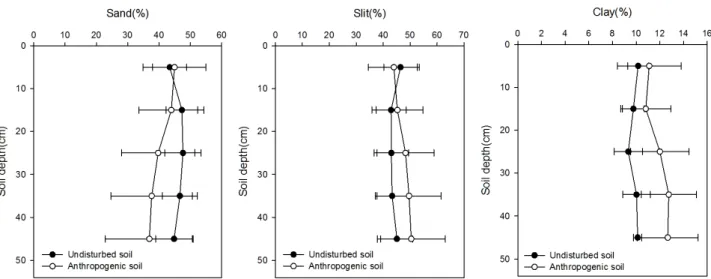
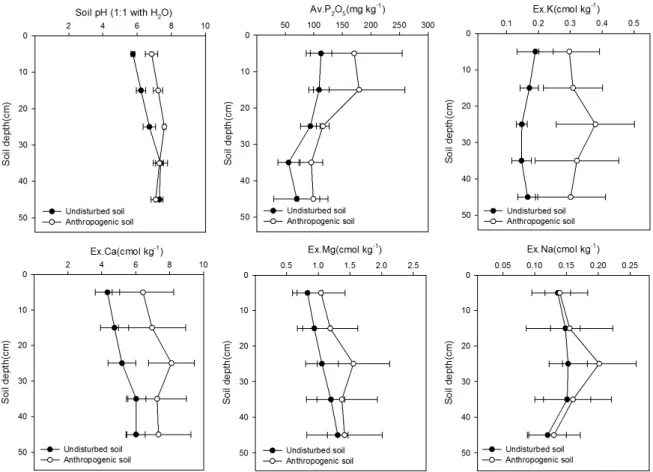
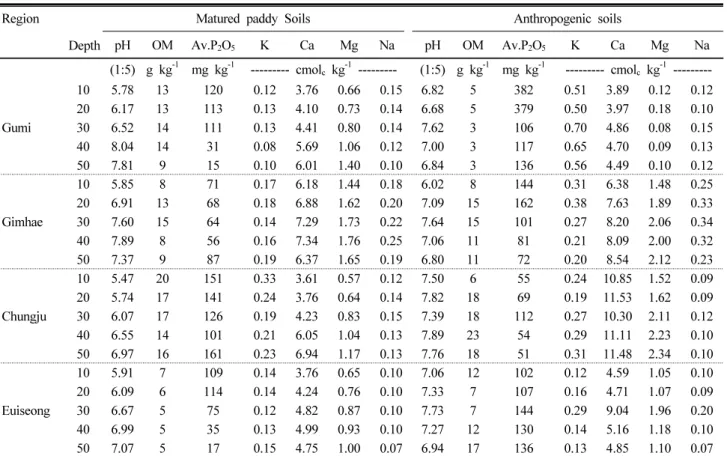
However, there was little information on the chemical properties within soil profiles in anthropogenic soil under rice paddy near the river. In this study, we investigated the chemical properties within soil profiles in the anthropogenic soil located at 4 sites in Gumi, Kimhae, Chungju, and Euiseong to compare with the natural paddy soil near the river. Among particle sizes, the sand content decreased under soil profiles but the silt and clay contents increased compared to the natural paddy soil in soil profiles. Organic matter content in topsoil of anthropogenic soil was lower than in that of natural soil, which was shown the contrary tendency within soil profiles. Also, the soil pH, available P 2 O 5 , and exchangeable cations were higher in anthropogenic soil compared to natural paddy soil at topsoil, which was maintained these tendency into soil depth. Nutrients may be equally distributed in anthropogenic soil during the process of refill in paddy soil near the river. This results indicated that anthropogenic soil would contribute to carbon sequestration, the mitigation of compaction, and reduction of fertilizer application in paddy soil. Therefore, characteristics of anthropogenic soil can be used for the soil management in cropland.
Key words: Anthropogenic soils, Particle distribution, Chemical properties, Paddy
Distribution of average chemical properties within soil profile under rice paddy in anthropogenic soils near the river.
1)
*Corresponding author: Phone: +82632382310, Fax: +82632383819, E-mail: [email protected]
§