경북남부지방에서 콩과 사료작물의 혼파와 우분의 시용이 호밀의 생산성, 사료가치 및 단위면적당
유기한우 사육능력에 미치는 영향*
1)
황보순**․최광원**․정순미**․조익환***
Effects of Mixed-Sowing of Legume and Applying of Cattle Manure on the Productivity, Feed Values and Organic Hanwoo Carrying
Capacity of Rye in Southern Area of Gyeongbuk Province
Hwangbo, Soon․Choi, Kwang-Won․Jung, Soon-Mi․Jo, Ik-Hwan
This study was conducted to investigate the effects of mixed-sowing of legume forage and applying of cattle manure on the productivity of organic rye to provide dairy farmers with safe organic feeds. Also the present study aimed to evaluate optimal applying level of cattle manure and carrying capacity of Korean native cattle (Hanwoo) per unit area. The amount of crude protein was significantly higher in the mixed-sowing of legume forage (average 760~786 kg/ha) than in the single-sowing of rye (average 353 kg/ha) (p<0.05). The mixed-sowing of forage peas and the single-sowing of rye tended to improve by increasing the level of nitrous fertilization rather than the fertilization treatment. The amount of crude protein on the rye according to the mixed-sowing of legume was significantly higher in the mixture (average 8.29~9.90%) than in the single (average 4.93%) (p<0.05). The comparison by the level of nitrogen fertilization indicated signifi- cantly high for the rye in 50 kg N/ha than in fertilization treatments (p<0.05).
Total digestible nutrients (TDN) amount in the single-sowing of rye was average 46.86% and has lower than average 49.96~50.12% of the mixed-sowing of legume, and especially the mixed-sowing of forage pea was the highest with 54.55% in 150 kg N/ha for the level of nitrogen fertilization (p<0.05). The breeding ability of annual organic livestocks per unit area according to the feed value of rye presented significantly higher ability in the mixed-sowing of legume (3.72~4.12 heads) than
* 본 논문은 농촌진흥청 연구사업(과제번호 : PJ009224022014)의 지원에 의해 이루어진 것임.
** 대구대학교 동물자원학과
*** Corresponding author, 대구대학교 동물자원학과 교수([email protected])
the single-sowing of rye (average 2.26 heads) (p<0.05). By summarizing above results, the mixed-sowing of legume is required to improve the productivity and the feed value of rye for increasing organic livestock breeding ability in southern area of Gyeongbuk regions, and the study for identifying the appropriate fertiliza- tion level using livestock excretions is further necessary.
Key words : cattle manure, feed value, forage pea, rye, sowing with legumes
Ⅰ. 서 론
전 세계적 기상이변과 바이오 에너지 생산 작물 경작지 확대로 인한 사료용 곡류 생산량 감소는 국내 축산경영비 중 높은 비중을 차지하고 있는 사료비의 폭등을 가져와 축산농가 의 부담이 크게 증가되고 있는 실정이다(KREI, 2015). 또한 국내 조사료 이용은 대부분 볏 짚을 이용하여 가축을 사육하고, 양질의 조사료 급여비율은 35% 정도로 낮은 편이며, 국내 조사료 자급율 또한 2013년 기준으로 82%에 불과하다(MAFRA, 2014a).
최근 정부에서는 조사료 생산 확대를 통해 사료용 곡물을 대처하려는 노력에 힘입어 사 료작물 재배면적이 증가하고 있으며 2017년까지 약 370 천ha까지 확대할 계획이며(MAFRA, 2013), 점차 재배지가 확대되고 있는 사료작물은 이탈리안 라이그라스, 청보리 및 호밀 등 의 동계사료작물이 큰 비중을 차지하고 있다.
동계사료작물 중 호밀은 내한성이 우수하여, 이탈리안 라이그라스와 청보리 재배가 어려 운 중부지역에서도 재배가 가능하고, 토양 적응성도 넓어 척박지에서도 생장이 우수하여 녹비용 및 조사료로 많이 재배되고 있으며, 겨울철 유휴 논을 활용하여 생산할 수 있으므 로 수확시기만 잘 조절된다면 매우 유용한 뒷그루 작물로 알려져 있다(Kim et al., 1986).
사료작물의 생산성과 사료가치 증대를 위해 가축분뇨와 같은 유기자원을 활용하거나 작 부체계에서 콩과 사료작물을 도입하는 방법이 있다(Ramesh et al., 2005; Sharma et al., 2004). 가축분뇨의 이용은 화학비료 시용시에 발생되는 토양의 산성화와 토양 미량 영양소 고갈을 방지할 수 있으며(Schechtner, 1978), 유기물 함량이 풍부하고 질소, 인산, 칼슘 등 각 종 영양분을 함유하여(Jo et al., 2008), 사료작물의 생산성이 화학비료에 대등한 수준이라고 보고한 바 있다(Jo et al, 2008, 2010).
또한, 화본과 사료작물에 헤어리베치, 사료용 완두 등과 같은 콩과 작물의 혼파는, 단백 질 함량이 높아지고 사료가치가 향상되어 조사료의 품질이 개선되며(Seo et al., 2000; Kim et al., 2004; Lee and Lee, 2006), 월동 후에는 초기생육이 빨라 잡초발생이 억제되며, 토양에 환원 시 분해속도가 빨라 후작물에 무기영양성분을 적절하게 제공할 수 있는 것으로 알려 져 있다(Lee et al., 2005).
한편, 경북지역에서 한, 육우는 총 57만7천두로 전국 17개 시도 가운데 가장 많이 사육되 고 있으며(2014년 기준), 경북에서도 경주지역이 7만8천두로 가장 많은 두수가 사육되고 있 으나(MAFRA, 2014b), 경북남부 지역에서 반추가축 사료용으로 생산되는 조사료는 턱없이 부족하여 전라도 등 타지역에서 재배되고 있는 사료작물을 높은 물류비를 부담하고 유통 되고 있으므로 조사료 자급생산을 위한 재배법 확립이 절실히 요구되고 있다.
따라서, 본 연구에서는 동계사료작물로 재배되는 호밀에 콩과 작물(헤어리베치, 사료용 완두)을 혼파 재배하고, 가축분뇨를 시용하여 호밀의 생산성과 사료가치를 평가함으로써 양질의 조사료를 확보하여 단위면적당 유기한우 사육능력을 추정하고자 실시하였다.
Ⅱ. 재료 및 방법
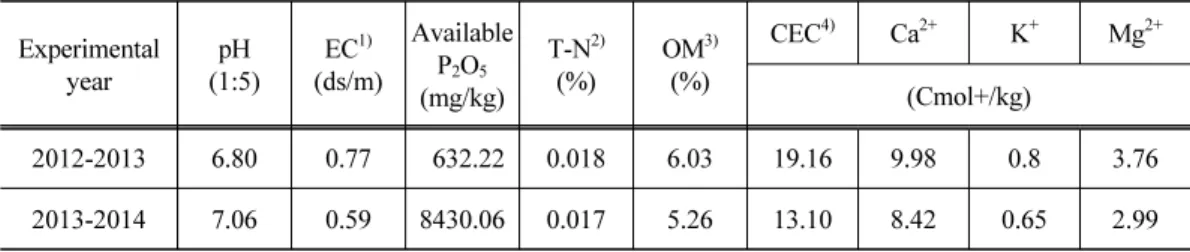
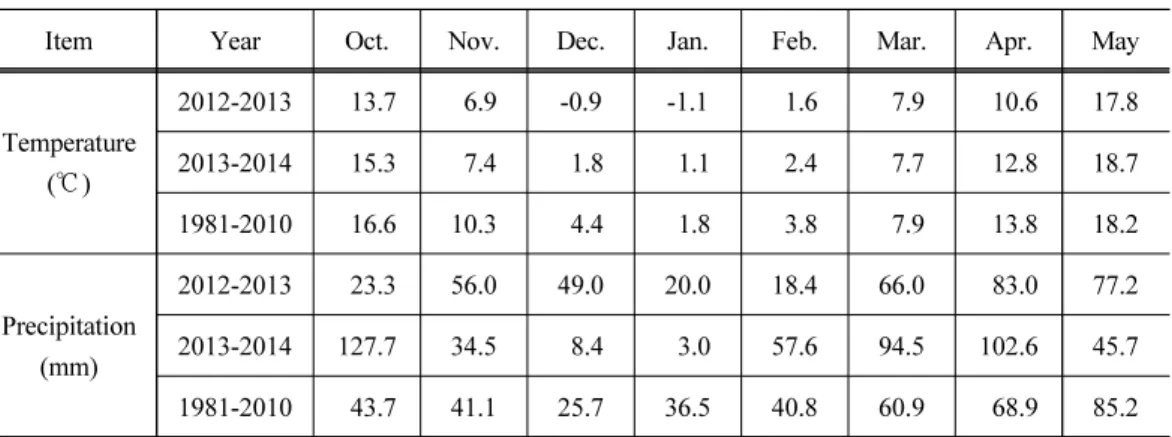
본 실험은 화본과 사료작물 호밀 “곡우”와 콩과 사료작물 헤어리베치 “Hungvillosa”와 사 료용 완두 “Ruby”를 공시하여 1차년도 시험은 2012년 10월 17일부터 2013년 5월 16일까지, 2차년도는 2013년 10월 17일부터 2014년 5월 20일까지 경상북도 경주시 안강읍에 조성된 시험포에서 수행하였다. 시험포장 토양의 이화학적 특성과 기상조건은 Table 1, 2와 같다.
시험구 배치는 주구는 호밀 단파, 호밀과 헤어리베치 혼파 및 사료용 완두 혼파이고, 세 구에는 발효우분 4수준으로 무비구, 발효우분을 질소수준으로 50, 100 kg N/ha 및 150 kg N/ha로 분할집구로 배치한 3반복이며, 파종은 산파로 파종하였고, 구당 면적은 8 ㎡(2 m ×
4 m)으로 하였다.
공시된 발효우분은 6개월 이상 발효된 것(T-N : 3.5, P2O5: 2.3, K2O : 1.4%)으로 시용은 파 종당일 1/2, 해빙기에 추비로 1/2를 시용하였고, 화학비료 및 농약은 사용하지 않았다.
사료작물의 생초 수량은 수확 당일 지상부 5 ㎝ 높이로 예취하여 측정하였고 건물함량은 각 시험구마다 500 g 정도의 시료를 채취하여 60℃ 순환열풍건조기에서 48시간 건조한 후 단위면적당 건물 수량을 산출하였다. 건조된 시료는 Wiley mill로 분쇄하여 A.O.A.C.법
Experimental year
pH (1:5)
EC
1)(ds/m)
Available P
2O
5(mg/kg) T-N
2)(%)
OM
3)(%)
CEC
4)Ca
2+K
+Mg
2+(Cmol+/kg)
2012-2013 6.80 0.77 632.22 0.018 6.03 19.16 9.98 0.8 3.76
2013-2014 7.06 0.59 8430.06 0.017 5.26 13.10 8.42 0.65 2.99
1)
EC: electrical conductivity,
2)T-N: Total nitrogen,
3)OM: Organic matter and
4)CEC: Cation exchange capacity
Table 1. Chemical characteristics of the soil at experimental site in 2012~2014
(1995)으로, Acid detergent fiber (ADF)와 Neutral detergent fiber (NDF)의 함량은 Georing과 Van Soest (1970)에 의해 분석하였다. 또한 ADF와 NDF의 함량으로부터 Total digestible nutrients (TDN; 가소화양분총량)은 Nahm (1992)과 Linn과 Martin (1989) 등의 계산식(TDN = 88.9 - (0.79 × ADF%))에 의하여 구하였다.
Table 2. Meteorological data during the growth period in 2012~2013, 2013~2014 and averages for 30years
Item Year Oct. Nov. Dec. Jan. Feb. Mar. Apr. May
Temperature ( ℃)
2012-2013 13.7 6.9 -0.9 -1.1 1.6 7.9 10.6 17.8
2013-2014 15.3 7.4 1.8 1.1 2.4 7.7 12.8 18.7
1981-2010 16.6 10.3 4.4 1.8 3.8 7.9 13.8 18.2
Precipitation (mm)
2012-2013 23.3 56.0 49.0 20.0 18.4 66.0 83.0 77.2
2013-2014 127.7 34.5 8.4 3.0 57.6 94.5 102.6 45.7
1981-2010 43.7 41.1 25.7 36.5 40.8 60.9 68.9 85.2
또한 얻어진 조단백질 함량과 TDN 함량은 건물수량과 곱하여 단위면적당 조단백질 수 량과 TDN 수량을 구하였다. 이들은 한국사양표준-한우(RDA, 2012)에 의거 한우 암소 약 450 kg이 일일 증체 400 g 목표로 하는 경우, 유기 사료 자원을 70% 급여할 시에 필요로 하는 조단백질과 TDN은 1일 각각 426.3 g과 3.479 kg을 기준으로 하여 조단백질과 TDN에 의한 단위면적당 연간 유기한우 사육능력을 평가하였다(Jo, 2003; Ryu et al., 2006).
본 실험의 결과는 SAS (2013)을 이용하여 유의성을 검정하였고, 처리 평균 간의 비교는 5% 수준의 최소 유의차검정(Least significant difference test)방법으로 하였다.
Ⅲ. 결과 및 고찰
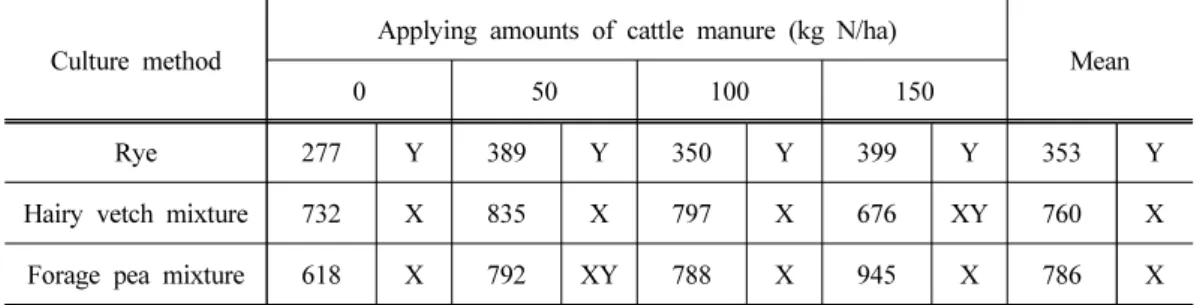
1. 호밀의 생산성콩과 사료작물의 혼파와 발효우분의 시용이 호밀의 조단백질 수량에 미치는 영향은 Table 3과 같다.
Table 3. Effects of mixed sowing with legume and applying of cattle manure on crude protein yield (kg/ha) of rye or its mixture crops
Culture method
Applying amounts of cattle manure (kg N/ha)
Mean
0 50 100 150
Rye 277 Y 389 Y 350 Y 399 Y 353 Y
Hairy vetch mixture 732 X 835 X 797 X 676 XY 760 X
Forage pea mixture 618 X 792 XY 788 X 945 X 786 X
X, Y, Z: Values with different superscripts in the same column significantly differ (p<0.05)
호밀에 콩과 사료작물인 헤어리베치와 사료용 완두 혼파에 따른 조단백질 수량은 단파 구(평균 353 kg/ha)보다 콩과 혼파구가(평균 760~786 kg/ha) 유의적으로 높게 나타났다(p<
0.05). 무비구와 질소시비 수준이 100 및 150 kg N/ha 시용구에서는 사료용 완두 혼파구가 단파구 보다 2.24~2.37배 높은 조단백질 수량을 보였으며, 질소시비 수준이 50 kg N/ha구에 서는 헤어리베치 혼파구가 단파구 보다 2.04배 높은 수량을 보였다(p<0.05). 질소시비 수준 에 따른 비교에서는 단파, 사료용 완두 혼파구는 무비구(277~618 kg/ha)에 비해 질소시비 수준이 증가할수록 높아지는(399~945 kg/ha) 경향을 보였으며, 헤어리베치 혼파구의 경우 질소시비 수준이 높을수록 조단백질 수량이 낮아지는 결과를 보였으나 유의적 차이는 나 타나지 않았다.
경북지역에서 콩과작물의 혼파와 가축분뇨의 시용에 따른 호밀의 조단백질 수량을 보면 (Oh et al., 2014), 경산시험구는 361~414 kg/ha, 경주시험구는 503~684 kg/ha, 영주시험구는 234~245 kg/ha으로 기상조건과 시험포장 토양의 이화학적 특성에 따라 차이가 있지만 우분 시용수준이 높고 콩과작물의 월동율이 높을수록 조단백질 수량이 증가한다고 보고하여, 본 시험에서 콩과 혼파구의 평균 760~786 kg/ha은 상당히 높은 수준의 수량으로 시험포장 토 양의 이화학적 특성이 우수하였고(Table 1), 시험지역인 경주가 경산과 영주보다 겨울철 기 온이 따뜻하여 콩과작물의 월동이 우수하여 조단백질 수량이 높았던 것으로 사료된다.
사료작물의 생산성은 질소비료원과 시비시기에 따라 차이가 있지만, 일반적으로 질소시 비 수준이 높을수록 건물과 조단백질 수량이 높아지며(Park et al., 2006), 척박한 토양일수 록 질소시비 수준을 높일 경우 사료작물의 생산성 향상을 기대할 수 있었다고 보고하여(Oh et al., 2014), 본 시험에서 질소시비 수준 간 차이가 나타나지 않았던 것은 시험포장이 비옥 하여 질소비료 반응이 뚜렷하게 나타나지 않았던 것으로 사료된다.
2. 호밀의 사료가치
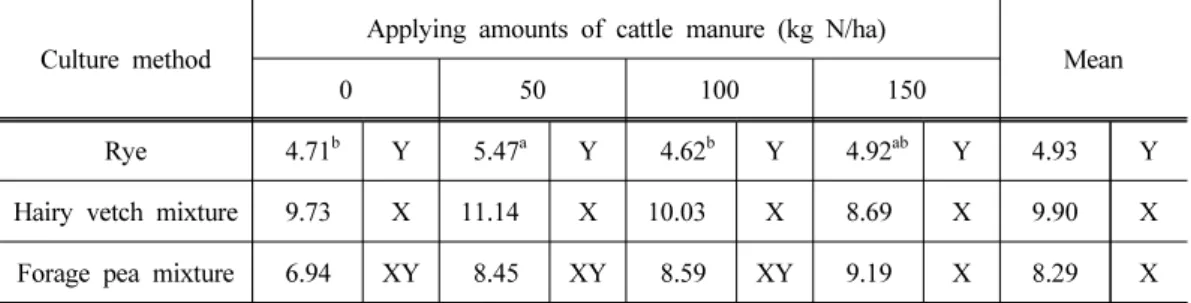
콩과 사료작물의 혼파와 발효우분의 시용이 호밀의 조단백질 함량과 TDN 함량에 미치 는 영향은 Table 4, 5와 같다.
Table 4. Effects of mixed sowing with legume and applying of cattle manure on the contents of crude protein (%) in rye or its mixture crops
Culture method
Applying amounts of cattle manure (kg N/ha)
Mean
0 50 100 150
Rye 4.71
bY 5.47
aY 4.62
bY 4.92
abY 4.93 Y
Hairy vetch mixture 9.73 X 11.14 X 10.03 X 8.69 X 9.90 X
Forage pea mixture 6.94 XY 8.45 XY 8.59 XY 9.19 X 8.29 X
a, b, c: Values with different superscripts in the same row significantly differ (p<0.05) X, Y, Z: Values with different superscripts in the same column significantly differ (p<0.05)
Table 5. Effects of mixed sowing with legume and applying of cattle manure on total digestible nutrient (%) of rye or its mixture crops
Culture method
Applying amounts of cattle manure (kg N/ha)
Mean
0 50 100 150
Rye 45.76 45.51 45.96 50.20 Y 46.86
Hairy vetch mixture 50.35 48.73 49.79 50.94 Y 49.96
Forage pea mixture 49.10 46.95 49.88 54.55 X 50.12
X, Y, Z: Values with different superscripts in the same column significantly differ (p<0.05)
호밀에 콩과 사료작물 혼파에 따른 조단백질 함량은 단파구(평균 4.93%)보다 콩과작물 혼파구(평균 8.29~9.90%)가 유의적으로 높게 나타났다(p<0.05). 무비구와 질소시비 수준이 50 및 100 kg N/ha 시용구에서는 헤어리베치 혼파구가 단파구 보다 2.04~2.17배 조단백질 함량이 높았으며, 질소시비 수준이 150 kg N/ha구에서는 사료용 완두 혼파구가 단파구 보 다 1.87배 높은 수량을 보였다(p<0.05). 질소시비 수준에 따른 비교에서는 호밀 단파구의 경 우 무비구 보다 50 kg N/ha구가 유의하게 높게 나타났으나(p<0.05), 콩과 사료작물 혼파구 에서는 질소시비 수준에 따른 차이가 나타나지 않았다.
TDN 함량은 호밀 단파구가 평균 46.86%로 콩과 사료작물 혼파구의 평균 49.96~50.12%
보다 낮은 경향이었고, 특히 질소시비 수준이 150 kg N/ha구에서는 사료용 완두 혼파구가 54.55%로 가장 높게 나타났다(p<0.05). 질소시비 수준에 따른 TDN 함량의 차이는 단․혼파 모든 구에서 나타나지 않았다.
화본과 사료작물에 콩과작물을 혼파하면, 화본과 사료작물의 단파 시 보다 건물수량(Ta 와 Faris, 1987)과 가소화 건물수량(Lee와 Lee, 2006) 및 조단백질 함량이 높아 사료가치가 향상되는 잇점이 있으며(Osman and Osman, 1982), 또한, 화본과 작물의 단백질 공급원으로 가능성이 있다(Jo, 2012). 본 시험에서도 콩과작물을 혼파로 인해 조단백질 함량이 평균 8.29~9.90%으로 단파시 보다 1.69~2.01배 높아져 호밀의 사료가치가 향상되어 기존의 보고 와 일치함을 알 수 있었다.
3. 호밀의 단위면적당 유기한우 사육능력
콩과 사료작물의 혼파와 우분의 시용이 호밀의 단위면적당 유기가축 사육능력을 나타낸 것은 Table 6과 같다.
Table 6. Effects of mixed sowing with legume and applying of cattle manure on mean carrying capacity (head/ha) for organic Hanwoo heifers (450 kg) with 400g of average daily gain fed the diets including 70% rye or its mixture crops
Culture method
Applying amounts of cattle manure(kg N/ha)
Mean
0 50 100 150
Rye 1.76 Y 2.28 Y 2.27 Y 2.73 Y 2.26 Y
Hairy vetch mixture 3.61 X 3.88 X 3.87 XY 3.52 XY 3.72 X
Forage pea mixture 3.41
bX 4.02
abX 4.07
abX 4.95
aX 4.12 X a, b, c: Values with different superscripts in the same row significantly differ (p<0.05)
X, Y, Z: Values with different superscripts in the same column significantly differ (p<0.05)
유기 한우 암소 체중 450 kg을 일당증체량 400 g 목표로 하여 호밀을 유기 사료 자원으 로 70% 급여할 시에 필요로 하는 조단백질과 TDN은 1일 각각 426.3 g과 3.479 kg을 기준으 로 하였을 때(Jo, 2003; RDA, 2012), 호밀의 사료가치에 따른 단위면적당 연간 유기가축 사 육능력은 호밀 단파구(평균 2.26두)보다 콩과 작물 혼파구가 3.72~4.12두로 유의하게 높은 사육능력을 보였다(p<0.05). 질소시비 수준이 증가할수록 호밀단파구와 헤어리베치 혼파구 에서는 무비구의 각각 1.76과 3.61두에서 2.73과 3.88두로 증가하는 경향이었고, 사료용 완 두 혼파구에서는 질소시비 수준이 150 kg N/ha구가 4.95두로 무비구의 3.41두보다 유의하게
높게 나타났다(p<0.05).
호밀에 우분시용과 콩과혼파 재배 시 연간 ha당 가축사육 능력은 2.75~3.08두로 보고하 였고(Hwangbo and Jo, 2013), 경북지역의 경우 경산시험구는 1.68~2.21두, 경주 시험구는 2.88~3.78두, 영주 시험구는 1.47~1.54두로 보고하여(Oh et al., 2014), 본 시험의 2.26~4.12두 와 비교 시 낮거나 비슷한 결과를 보여, 같은 품종의 사료작물이라도 지역에 따른 기후와 토질에 의해 그 생산성이 많은 영향이 있음을 알 수 있었다.
하지만, 단파 보다는 헤어리베치 및 사료용 완두 콩과작물 혼파 시에 가축사육 능력이 우수한 것으로 나타났는데, 이와 같은 결과는 호밀의 단파 보다 콩과 사료작물 혼파가 가 축사육능력이 높았다는 보고(Jo et al., 2010; Jo, 2012; Hwangbo and Jo, 2013; Oh et al., 2014)와 일치하여 콩과 사료작물의 혼파가 가축 사육 능력이 증가함을 알 수 있었다.
이상의 결과를 종합해 볼 때, 경북남부지역에서 유기 가축사육 능력 증대를 위한 호밀의 생산성과 사료가치 향상을 위해서는 콩과 사료작물의 혼파가 필요하며, 콩과작물 혼파와 함께 가축분뇨의 적정 시용수준 추정은 앞으로 추가 시험과 함께 조사가 더 필요하다고 사 료된다.
Ⅳ. 적 요
본 연구는 토양의 지력향상과 환경오염을 감소시키고, 안전한 유기축산물의 생산에 기여 할 수 있는 유기조사료를 효율적으로 생산하기 위해 대표적인 동계사료작물인 호밀에 콩 과 사료작물 혼파와 발효우분을 시용하여 생산성과 사료가치를 평가하고, 가축분뇨의 적정 시용수준을 구명하여 단위면적당 유기 한우의 사육 능력을 추정하고자 하였다. 조단백질 수량은 단파구(평균 353 kg/ha)보다 콩과사료작물 혼파구가(평균 760~786 kg/ha) 유의적으 로 높게 나타났다(p<0.05). 단파, 사료용 완두 혼파구는 무비구에 비해 질소시비 수준이 증 가할수록 높아지는 경향을 보였다. 호밀에 콩과 사료작물 혼파에 따른 조단백질 함량은 단 파구(평균 4.93%)보다 혼파구가(평균 8.29~9.90%) 유의적으로 높게 나타났다(p<0.05). 질소 시비 수준에 따른 비교에서는 호밀 단파구의 경우 무비구 보다 50 kg N/ha구가 유의하게 높게 나타났다(p<0.05). TDN 함량은 호밀 단파구가 평균 46.86%로 콩과 사료작물 혼파구의 평균 49.96~50.12% 보다 낮은 경향이었고, 특히 질소시비 수준이 150 kg N/ha구에서는 사료 용 완두 혼파구가 54.55%로 가장 높게 나타났다(p<0.05). 호밀의 사료가치에 따른 단위면적 당 연간 유기가축 사육능력은 단파구(평균 2.26두) 보다 콩과 작물 혼파구가 3.72~4.12두로 유의하게 높은 사육능력을 보였다(p<0.05). 이상의 결과를 종합해 볼 때, 경북남부지역에서 유기 가축사육 능력 증대를 위한 호밀의 생산성과 사료가치 향상을 위해서는 콩과 사료작 물의 혼파가 필요하며, 콩과작물 혼파와 함께 가축분뇨의 적정 시용수준 추정은 앞으로 추
가 시험과 함께 조사가 더 필요하다고 사료된다.
[Submitted, August. 6, 2015 ; Revised, August. 19, 2015 ; Accepted, September. 10, 2015]
Reference
1. AOAC. 1995. Official Methods of Analysis (16th Ed.). Association of official analytical chemists. Washington D.C.
2. Goering, H. K. and P. J. Van Soest. 1970. Forage fiber analysis. Agic. Handbook No. 379.
ARS. USDA. Washington, D. C.
3. Hwangbo, S. and I. H. Jo. 2013. Effects of applying cattle slurry and Mixed sowing with legumes on productivity, feed values and organic stock carrying capacity of winter forage crops in Gyeongbuk regions. Korean Journal of Organic Agriculture. 21(3): 451-465.
4. Jo, I. H. 2003. A Study on area types of recycling agriculture. Korean Journal of Organic Agriculture. 11(3): 91-108.
5. Jo. I. H. 2012. Evaluation of carrying capacity of Hanwoo heifers when fed whole crop barley and rye as influenced by organic fertilizer application and mixed sowing with legumes. Journal of The Korean Society of Grassland and Forage Science. 32(2): 117-124.
6. Jo, I. H., S. Hwangbo, and J. S. Lee. 2008. Effects of Applying Livestock Manure on Productivity and Organic Stock Carrying Capacity of Summer Forage Crops. Korean Journal of Organic Agriculture. 16(4): 421-434.
7. Jo, I. H., S. Hwangbo, and S. H. Lee. 2010. Effects of applying cattle slurry and mixed sowing with legumes on productivity, feed values and organic stock carrying capacity of whole crop barley and rye. Korean Journal of Organic Agriculture. 18(3): 419-432.
8. Kim, D. A., K. I. Sung, and C. H. Kwon. 1986. Effects of sowing time and seeding rate on growth characteristics, winter survival and dry matter yield of forage rye (Secale cereale L.). J. Kor. Grassl. Forage Sci. 6(3): 164-168.
9. Kim, J. D., S. G. Kim, and C. H. Kwon. 2004. Comparison of forage yield and quality of forage legume. Journal of Animal Science and Technology. 46(3): 437-442.
10. Korea Rural Economic Institute (KREI). 2015. 2015 KREI Research Report.
11. Lee, I. D. and H. S. Lee. 2006. A Comparative study on the dry matter yield and nutritive value from rye and hairy vetch seeding typers in Daejeon area. Journal of The Korean
Society of Grassland and Forage Science. 26(4): 207-214.
12. Lee, H. W., W. H. Kim, H. S. Park, H. J. Ko, and S. G. Kim. 2005. Effect of N application rate on fixation and transfer from vetch to barley in mixed stands. Journal of The Korean Society of Grassland and Forage Science. 25(1): 1-6
13. Linn, J. and N. Martin. 1989. Forage quality tests and interpretation. Univ. of Minnesota Ext. Serv. AG-FO-2637.
14. Ministry of Agriculture, Food and Rural Affairs (MAFRA). 2013. The current situation of forage increase production and supplementation policy. pp. 2-5
15. Ministry of Agriculture, Food and Rural Affairs (MAFRA). 2014a. Forage production and utilization for animal production.
16. Ministry of Agriculture, Food and Rural Affairs (MAFRA). 2014b. Main statistics in Agriculture, Livestck and Food.
17. Nahm, K. H. 1992. Practical guide to feed, forage and water analysis. Yoohan Pub. 1-70.
18. Oh, M. G., I. H. Jo, and S. Hwangbo. 2014. Effect of Mixed-Sowing of Legume and Applying of Cattle Manure on the Productivity, Feed Values and Organic Hanwoo Carrying Capacity of Rye (Secale cereale L.). Korean Journal of Organic Agriculture. 22(3): 457-468.
19. Osman, A. E. and A. M. Osman. 1982. Performance of mixture of cereal and legume forage under irrigation in the Sudan. The Journal of Agricultural Science. 98: 71-72.
20. Park, J. G., J. D. Kim, and C. H. Kwon. 2006. Effect of liquid manure source, application rate and time on agronomic characteristics and forage yield of winter rye. Journal of The Korean Society of Grassland and Forage Science. 26(4): 227-232.
21. Ramesh, P., P. K. Ghosh, K. S. Reddy, Ajay, S. Ramana, and R. S. Choudhary. 2005.
Assessment of biomass, productivity and sustainability of soybean based cropping systems at three levels of nitrogen in deep vertisols of semi-arid tropical India. Journal of Sustainable Agriculture. 26(2): 43-59.
22. RDA National Institue of Animal Science. 2012. Korean feeding standard for Hanwoo.
23. Ryu, D. K., S. I. Yun, J. S. Lee, I. H. Jo, and J. H Ahn. 2006. Standard model development of nature-circulating organic agriculture. Ministry of Agriculture and Forestry.
24. SAS. 2013. Statistical Analysis System ver. 8.01. SAS Institute Inc. Cary, NC.
25. Schechtner, G. 1978. Zur Wirksamkeit des Gullestickstoffs auf dem Grunlandin Abhangigkeit vom Dungungsregime. Die Bodenkultur, 29: 351-371.
26. Seo, J. H., H. J. Lee, I. B. Hur, S. J. Kim, C. K. Kim, and H. S. Jo. 2000. Comparisons of chemical composition and forage yield among winter green manure crops. Journal of The Korean Society of Grassland and Forage Science. 20(3): 193-198
27. Sharma, R. P., S. K. Pathak, M. Haque, and K. R. Raman. 2004. Diversification of traditional rice (Oryza sativa L.)-based cropping system for sustainable productions in South Biher alluvial plains. Indian Journal of Agronomy. 49(4): 218-222.
28. Ta, T. C. and M. A. Faris. 1987. Species variation in the fixation and transfer of N from legumes to associated grasses. Plant and Soil. 98: 265-274.