Effect of Green Manure Cultivations on Yield and Anthocyanin Content in Organic Grapevine
1)
Park, Jun-Hong*․Park, Sang-Jo**․Kwon, Oh-Heun**․
Choi, Seong-Yong**․Park, So-Deuk**
녹비작물 재배가 유기포도 수량 및 안토시아닌 함량에 미치는 영향
박준홍․박상조․권오흔․최성용․박소득
In sustainable viticulture, green manure represents a safe and non-polluting way to bring large quantities of organic matter into the soil. The cultivation of green manure crops plays an important role in soil quality and sustainability of agricul- tural system. This study was conducted to evaluate the effects of green manure fertilization on yield and quality of the Campbell Early grape variety in the organic vineyard. Hairy vetch was the more productive green manure crop, yielding higher dry materials. Average yields of grape were significantly greater in hairy vetch + rye (13.02 ton ha
-1) than nature weed (11.65 ton ha
-1), respectively. The con- centrations of total as well as individual anthocyanins were consistently higher with hairy vetch treatment compared with rye and nature weed, thus making the green manure cultivation is an environmentally friendly cultivation to increase the yield and anthocyanin contents in organic grape.
Key words : green manure, hairy vetch, rye, grape, anthocyanin
Ⅰ. Introduction
In order to optimally develop vine plants, it is necessary to have rich vine soil, since it grows on the same place for a long period of time. Traditional viticulture was linked with soil com- pactness, erosion, organic matter deprivation (Contoman, 2011) and degradation of the quality of
* Corresponding author, Gyeongsangbukdo Agricultural Research & Extension Services ([email protected])
** Gyeongsangbukdo Agricultural Research & Extension Services
perhaps the best documented. Cover crops have direct and indirect effects on the soil fertility and vine nutrition (Power and Zachariassen, 1993). Incorporation of leguminous green manure cover crops directly adds organic nitrogen to the soil (Haynes et al., 1993; Utomo et al., 1990).
After mineralization, which begins within few weeks after incorporation, this nitrogen is available for vine uptake. In contrast, non-leguminous cover crops often place competing demands on the vineyard nitrogen pool. Decomposition of high-carbon plants such as mature cereals and grasses may tie up nitrogen, making it unavailable for vines. However, still much is unknown about details, such as green manure application effect in organic vine orchard managed by cover cropping system, for successful grape production.
The object of present study was to compare the effects of different green manure crops on yield and fruit anthocyanin content of Campbell Early grapes and soil chemical properties in the organic vineyards.
Ⅱ. Materials and Methods
This study was conducted on the organic farm field at sangju, Gyeongsangbuk-do, Korea,
from October 2012 through September 2013. The experimental fields were located at 36°19 ʹ40ʺ
N latitude and 127°56 ʹ51ʺE longitude. Annual average temperature and precipitation in the study
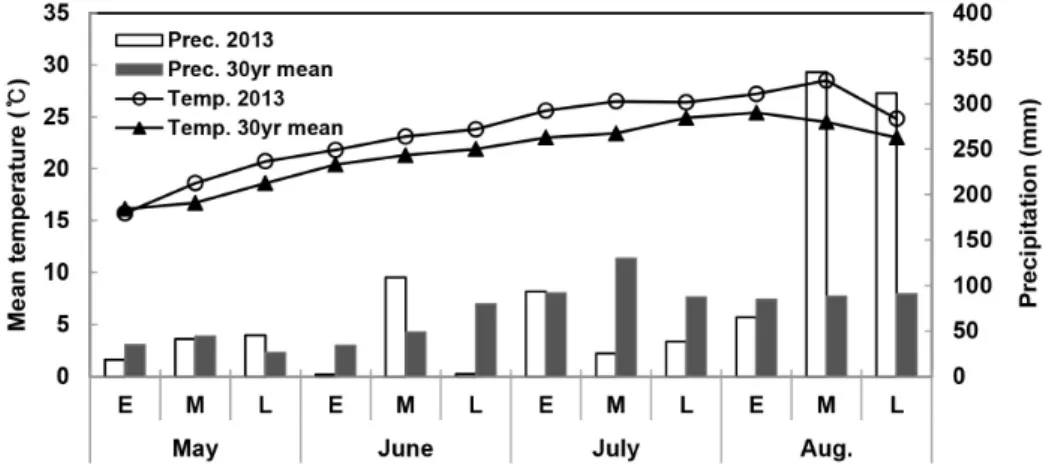
area were 11.9 ℃ and 947 mm, respectively. Precipitation and mean temperatures during grape
growing season in 2013 experimented were shown in Fig. 1. Mean temperature was higher than
those of last three decades, while precipitation was the highest in middle June and middle to late
August, especially.
Fig. 1. Precipitations and mean temperatures during grape growing seasons in 2013 (E, early; M, middle; L, late).
The size of each experimental plot was 200 m
2(20 m × 10 m) and all experiments were conducted by a randomized complete block design with three replications. The experiments were treated with hairy vetch (Vicia villosa), rye (Secale cereale), mixture of hairy vetch and rye, and natural grass as control. Hairy vetch and rye were fall-seeded at rate of 90 kg and 200 kg ha
-1, a mixture of hairy vetch and rye were drilled at the rate of 45 kg ha
-1and 100 kg ha
-1, respectively. The green manure crops were cultivated from Oct. 2012 to May 2013 and above ground of green manures was directly cut and incorporated into soil on May 15, 2013.
Chemical analysis for determination of the mineral content of each sample was conducted according to methods of soil chemical analysis (NIAST, 1988). For the determination of soil pH, air-dried soil samples were mixed with deionized water with a ratio of 1 : 5 (soil : water) and the pH of the clear supernatant was measured by pH electrode (Orion VERSA STAR, Thermo fisher scientific, US), and then, soil electric conductivity (EC) was measured by electric conductivity meter (CM-30R, DKK-TOA, Japan). Soil NO
3-N content was measured by Kjeldahl apparatus (K-314, BUCHI, Switzerland), after extracting from fresh soil sample with 2 M KCl for 30 minutes. Soil available phosphate was determined according to the method of Lancaster.
For determination of soil exchangeable cations (K, Ca, and Mg), air-dried soil samples were extracted with 1 N ammonium acetate for 30 minutes, and concentration of the extract was determined by AAS (Analyst 400, Perkin Elmer, USA).
Selected soil chemical properties in the experimental sites were 6.7 for soil pH (1:5), 0.40 dS
m
-1for electrical conductivity (EC), 38 g kg
-1for soil organic matter content, 319 mg kg
-1for
available phosphorus (P
2O
5) concentration, 0.7, 6.2 and 1.6 cmolc kg
-1for exchangeable K
+, Ca
2+When in full bloom, the leaf samples for determining mineral contents of grapevines were taken from the opposite sides of clusters. Total nitrogen was determined by Kjeldahl method and P, K, Ca and Mg were analyzed by ICP spectrometer (Optima 8300, Perkin Elmer, USA)
Soluble solids content of sample was measured by using a digital refractometer (PR-101, Atago, Japan) and titratable acidity was measured by titration to pH 8.2 with 0.1 M NaOH. It was finally converted into a percentage of malic acid equivalents.
Anthocyanins were extracted from the samples by solution (80/20 acetonitrile/0.3% phosphoric acid in water). The grape skins were then homogenized using homogenizer for 1.5minutes. The homogenized liquid was centrifuged for 10 minutes at 2,500 rpm. A 2 mL aliquot of the supernatant was pipette into a 4 mL vial along with 200 ul of concentrated hydrochloric acid.
The vial was then capped with a cap that contained a self-sealing septum to minimize loss. The extract (2 mL) was mixed with 200 ul of concentrated hydrochloric acid. The vial was capped with a cap that contained a self-sealing septum to minimize loss of liquid to evaporation during hydrolysis. The vial was then placed on a vortex mixer for 5 seconds, and placed into a chemical oven at 150 ± 2°C for 30 minutes. After 30 minutes, the vial was removed and placed into a freezer for 10 minutes at 0°C to stop the hydrolysis. The sample was filtered through a 0.45 um filter into a 2 mL vial. The analysis of anthocyanins in grape skins was carried out using a HPLC system (Waters Alliance 2695, USA) equipped with a ACQUITY UPLC BEH C18 reverse phase column (2.1 × 50 mm). The mobile phase consisted of 0.3% phosphoric acid in water (solvent A) and 100% acetonitrile (solvent B). The elution profile was monitored by UV-detection at 530 nm.
Statistical analysis was conducted using SAS software (Ver 9.2, Cary, NC, USA). The results
of each parameter in all three applications were subjected to analysis of variance, and treatment
means were compared by Duncan’s multiple range test (DMRT) at the 5% probability level.
Ⅲ. Results and Discussions
The aboveground dry matter and N accumulation by the green manure and natural weed treatments are presented in Table 2. The result showed a significant difference between dry matter and total nitrogen content. Aboveground dry matter yield by full flowering averaged 2.96, 2.24, 2.87 kg ha
-1for hairy vetch, rye and nature weed, respectively. Accumulated dry weight of hairy vetch was about twice higher than that of rye. Aboveground dry matter of hairy vetch contained the highest nitrogen content with N concentration of 3.83%. N contents of rye and nature weed were 2.02 and 1.72%, respectively. Hairy vetch green manures resulted in more dry matter and higher N accumulation than that of rye. Ebelhar et al. (1984) found that hairy vetch supplied biologically fixed N equivalent to approximately 90 to 100 kg ha
-1fertilizer annually.
Table 2. Biomass production and nitrogen accumulation by green manure crop cultivation
Treatment Fresh biomass (ton ha
-1)
Dry matter (ton ha
-1)
C/N ratio (%)
T-N (%)
Supplied nitrogen (kg ha
-1)
Hairy vetch 19.47
a2.96
a10.5
b3.83
d113
aRye 14.80
b2.24
b20.6
a2.02
c45
cHairy vetch + Rye 17.81
a2.71
a13.6
b2.98
b80
bNatural weed 18.89
a2.87
a24.6
a1.72
c49
c* Numbers followed by the same letter with a column are not significantly different (Duncan test, p<0.05).
Table 3. Soil chemical properties after grape harvest
Treatment pH
(1:5)
Organic matter (g kg
-1)
Avail.
P
2O
5(mg kg
-1)
Exch. cations (cmol
ckg
-1) EC (dS m
-1)
NO
3-N (mg kg
-1)
K Ca Mg
Hairy vetch 6.9
a43
a453
a0.86
a10.7
a1.9
a0.64
a51.2
aRye 6.8
a38
a263
b0.82
a9.2
a1.8
a0.25
b20.5
bHairy vetch + Rye 6.6
a41
a315
b0.87
a7.3
a1.5
a0.41
ab33.9
abNatural weed 6.7
a42
a305
b0.61
a9.0
a1.8
a0.23
b17.9
b* Numbers followed by the same letter with a column are not significantly different (Duncan test, p<0.05).
Table 3 shows the soil chemical properties of vineyard at 0-15 cm after grape harvest. When
compared with nature weed and rye grass, hairy vetch green manure application proved to be the
most effective application by improving the soil chemical properties such as available P
2O
5, EC
Table 4. Effect of green manure crops cultivation on leaf mineral content in grapevine
Treatment
N P
2O
5K
2O CaO MgO
--- (%)---
Hairy vetch 2.38
a0.42
a1.27
a1.39
a0.24
aRye 1.90
ab0.39
a1.20
a1.41
a0.23
aHairy vetch + Rye 2.02
ab0.38
a1.25
a1.32
a0.23
aNatural weed 1.73
b0.35
a0.95
a1.34
a0.23
a* Numbers followed by the same letter with a column are not significantly different (Duncan test, p<0.05).
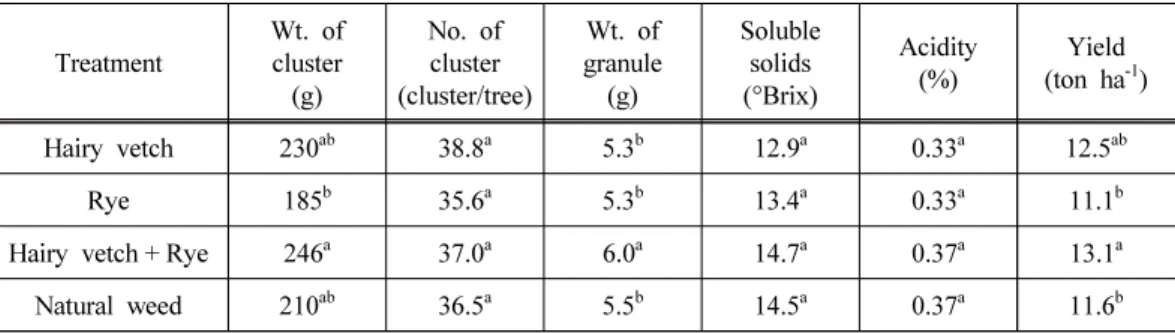
The grape yield and yield components are listed in Table 5. There were no significant differences from the green manure crop group in terms of cluster numbers, granule weight, soluble solids and acidity between the treatments. The cluster weight increased slightly in response to incorporation of hairy vetch and hairy vetch + rye compared to natural weed. It was the highest in the hairy vetch + rye treatment with 13.1 ton ha
-1yield among treatments.
Research indicates that perennial rye and other sod-type cover crops may significantly reduce vine nutrient status (Tan and Crabtree 1990). There was no significant difference in soluble solids and acidity between the treatments.
Table 5. Effect of green manure crops cultivation on grape yields
Treatment
Wt. of cluster (g)
No. of cluster (cluster/tree)
Wt. of granule
(g)
Soluble solids (°Brix)
Acidity (%)
Yield (ton ha
-1)
Hairy vetch 230
ab38.8
a5.3
b12.9
a0.33
a12.5
abRye 185
b35.6
a5.3
b13.4
a0.33
a11.1
bHairy vetch + Rye 246
a37.0
a6.0
a14.7
a0.37
a13.1
aNatural weed 210
ab36.5
a5.5
b14.5
a0.37
a11.6
b* Numbers followed by the same letter with a column are not significantly different (Duncan test, p<0.05).
Table 6 shows the anthocyanin content of grape skins with green manure application. Five anthocyanins (delphinidin, cyanidin, pelargonidin, peonidin and malvidin) were detected, cyanidin being the major component. In particular, concentrations of total as well as individual antho- cyanins were consistently higher with hairy vetch cultivation compared with nature weed.
Nitrogen supply affects the anthocyanin accumulation and degradation profile. Delphinidin and cyanidin are considered to be precursors in the biosynthetic pathway during ripening, when transformed by methylation into peonidin, petunidin and malvidin (Roggero et al. 1986). It is concluded that the anthocyanin composition of the grape berry is changed by the N supply, as was already shown for the tomato (Bongue-Bartelsman and Phillips 1995). Sato et al. (1996) suggested that a limitation of mineral nutrients delays cell metabolism, increases the phenylal- anine content in strawberry cell cultures and favours the phenolic biosynthetic pathway. Addition of phenylalanine to Vitis vinifera cell cultures stimulated anthocyanin accumulation (Krisa et al.
1999), the maximum phenylalanine accumulation in cells occurring just before the initiation of anthocyanin synthesis (Kakegawa et al. 1995). Thus moderate nitrogen application before bloom enhances anthocyanin accumulation. However excessive nitrogen can delay ripening, promote excessive vegetation, and result in reduced polyphenol concentration and color.
Table 6. Effect of green manure crops application on anthocyanin of grape skins
Treatment
Anthocyanin (mg kg
-1)
Delphinidin Cyanidin Pelargonidin Peonidin Malvidin Total
Hairy vetch 155
a938
a48
b188
b172
a1,501
aRye 105
b751
b57
a227
a166
a1,306
abHairy vetch + Rye 137
ab794
ab53
a179
b184
a1,347
abNatural weed 62
c494
c40
c139
c103
b838
b* Numbers followed by the same letter with a column are not significantly different (Duncan test, p<0.05).
Ⅳ. Conclusions
This study compared the effects of different green manure crops on yield and fruit antho-
cyanin of Campbell Early grapes and soil chemical properties in the organic vineyards. Both
green manure production and available P
2O
5, EC and NO
3-N contents were higher in hairy vetch
treatment than in rye and natural weed treatment. The grape yield was the highest in the hairy
[Submitted, February. 2, 2015; Revised, March. 5, 2015; Accepted, March. 7, 2015]
References