—153—
INTRODUCTION
Bitterlings (Cyprinidae, Acheilognathinae) are small and deep-bodied freshwater fishes which include approx- imately 60 species in the world and 14 species in Korea (Kim and Park, 2002; Nelson, 2006). They are usually found in South-Eastern Asia, China mainland, Korea, and Japan, except Rhodeus sericeus, R. amarus and R. colch- icus (Damme et al., 2007). Female bitterlings develop a long ovipositor that they use to lay their eggs in the gills of mussels through the mussel’s exhalant siphon. Males eject their sperm into the inhalant of the mussel, so that fertilization is taken within the gills of a host. However, there has been much taxonomic confusion due to a large variety of the shapes resulted from frequent hybridiza- tions of Acheilognathinae fish (Okazaki et al., 2001).
Many natural hybrids among the teleost fishes have been often occurred and discovered especially in cyprinid
fishes (Hubbs, 1955). Hybridizations between fish spec- ies frequently were discussed for reproductive isolating mechanisms and system relationships through interspecies or intergeneric external fertilizations (Trautman, 1981).
In Korea, there have been reports on the occurrence of natural hybrids in the subspecies of Pungitius sinensis (Chae and Yang, 1990), and the species of C. sinensis and C. longicorpus (Kim and Lee, 1990), Pungtungia herzi and Pseudopungtungia nigra (Kim et al., 1991), Moroco oxycephalus and M. lagowskii (Min and Yang, 1992), C.
longicorpus and Misgurnus anguilicaudatus (Hwang et al., 1995), and R. uyekii and Acheilognathus signifer (Kim et al., 2010).
The Korean bitterling A. signifer and the Hangang bit- terling R. pseudosericeus are distributed only in the Han- gang (river) of Korea and both designated as endangered wild animals in Korean (NIBR, 2011). During a survey of ichthyofauna at the Jucheongang (stream) of the Nam- hangang (river) in Korea, we collected a natural hybrid between R. pseudosericeus and A. signifer in their sym- patric area. So the aim of the present study is to report the morphological characters and analysis of mitochon-
Occurrence of a Natural Intergeneric Hybrid between Rhodeus pseudosericeus and Acheilognathus signifer (Pisces: Cyprinidae) from the Namhangang (river), Korea
By Hyeong Su Kim, Seung Woon Yun, Jae Geun Ko
1and Jong Young Park*
Department of Biological Science and Institute for Biodiversity, College of Natural Sciences, Chonbuk National University, Jeonju 561-756, Korea
1Natinoal Institute of Ecology, Seocheon 325-813, Korea
ABSTRACT A natural intergeneric hybrid between Rhodeus pseudosericeus and Acheilognathus signifer was collected in their sympatric area, the Jucheongang (stream), the Namhangang (river), Korea. Morphological characters as well as mitochondrial cytochrome b (mt-cyb) gene were investigated to confirm the natural hybrid origin. In the comparison of morphological characters, the natural hybrid appeared to have intermediate characters between two parental species in several key characters such as the band of dorsal fins, the color pattern of body, and the body spot and stripe.
Also, the collected specimen had an incomplete lateral line with a large number of pored scales. In analysis of mt-cyb gene, it revealed that the maternal species of the natural hybrid appeared to be R.
pseudosericeus due to their 100% sequence identity. Thus, such results gave convincing evidence for the occurrence of a natural intergeneric hybrid between Rhodeus pseudosericeus and Acheilognathus signifer.
Key words : Rhodeus pseudosericeus, Acheilognathus signifer, a natural hybrid, Jucheongang
*Corresponding author: Jong Young Park Tel: 82-63-270-3344 Fax: 82-63-270-3362, E-mail: [email protected]
Accepted: September 22, 2014
http://www.fishkorea.or.kr
drial cytochrome b (mt-cyb) genes of the natural hybrid for verifying the natural hybrid origin.
MATERIALS AND METHODS
1. Collection of fish specimen
A natural hybrid specimen (81.2 mm SL) was collected at the Jucheongang (stream) of the Namhangang (river), Anheung-myeon, Hoengseong-gun, Gangwon-do, Korea on April, 25, 2014. Specimens of its supposed parental species, R. pseudosericeus (n = =5), and A. signifer (n= =5) were captured at the same area where the natural hybrid was found. For the comparison of body coloration of R.
pseudosericeus, A. signifer, and the natural hybrid, we took pictures in the field shortly after capturing them.
The collected specimen was fixed in 10% formalin solu- tion and deposited at the Department of Biological Sci- ence, Chonbuk National University, Jeonju (CNUC).
2. Morphological characters
To examine the morphological characters of the collect- ed specimens, counting and measuring were done by the method of Hubbs et al. (2004), and fin rays and vertebral counts were observed by a soft-X ray photograph (Nikon SMZ-10, Japan). A total of 18 morphological characters were chosen to calculate hybrid index (Hindex) using the following formula (Nikoljukin, 1972).
Hybrid index (Hindex)= =(H-M1)/(M2-M1)
where H is the numerical value of a character of the nat- ural hybrid, while M1 and M2 are numerical values of the same character in R. pseudosericeus and A. signifer, respectively. Approach 50 of Hindex indicates interme- diate characters between two parental species. If Hindex was lower than 30, the natural hybrid was considered to resemble R. pseudosericeus while Hindex was higher than 70, the natural hybrid was considered to resemble A. signifer. In addition if Hindex was between 30 and 70, the natural hybrid was considered to be intermediate (ˇSori´c, 2004).
3. Analysis of mitochondrial cytochrome b (mt-cyb) gene
Mitochondrial DNA is haploid, located in the cyto- plasm, and is maternally inherited without recombination (Lee et al., 2009). To confirm the maternal hybrid origin mt-cyb genes were investigated. For DNA analysis a piece of pectoral fin was dissected from each specimen and stored in 100% Ethyl alcohol. Total DNA was purified with the genomic DNA Prep Kit for blood and tissue (QUIAGEN Co., USA). A segment of 1,141 bp contain- ing a complete mt-cyb gene was amplified by the poly-
merase chain reaction. A pair of primers (forward primer:
TGA CTT GAA GAA CCA CCG TTG, reverse primer:
GGA TTA CAA GAC CGA TGC TTT) was used.
PCR consisted of 1 cycle of 5 min. denaturing step at 95� C and 30 cycles of 30 sec. At 94� C, 30 sec. at 56� C, and 1 min. at 72� C. Finally 1 cycle of 7 min. extension step at 72� C. Products were purified by using the Gel ex- traction kit according to the manufacturer’s instructions (Real biotech corporation, Taipei) and sequenced suing ABI3730XL automatic sequencer (Applied Biosystems, USA).
To evaluate the phylogeny of mt-cyb gene of the natural hybrid and its supposed parental species (R. pseudoseri- ceus and A. signifer), 8 Acheilognathinae and 2 out group
Fig. 1.Photographs of Rhodeus pseudosericeus (A: 73.0 mm SL), a natural hybrid (B: 81.2 mm SL) and Acheilognathus signifer (C: 79.3 mm SL) at the Jucheongang (stream) of the Namhangang (river), An- heung-myeon, Hoengseong-gun, Gangwon-do, Korea on April, 25, 2014.
A
B
C
sequences were obtained from GenBank (http://www.
ncbi.nlm.nih.gov/genbank/). Sequences were aligned using Clustal Omega. Phylogenetic and molecular evolu- tionary analyses were performed using MEGA version 6. Phylogenetic tree was established by Maximum Like- lihood method and bootstrap phylogeny test with 1,000 replications (Tamura and Nei, 1993).
RESULTS
1. Body coloration and morphological characters
At the present area, a total of three bitterling species amounting to 427 specimens was found: 267 individuals of R. pseudosericeus (62.5%), 160 individuals of A. sig- nifer (37.4%), and only 1 individual of the natural hy- brid (0.2%). For the natural hybrid, the nuptial coloration was intermediate between those of the parental species and the body coloration was totally bluish green but not shown more deep color than those of A. signifer. Where- as, the dark spots of the body scales were similar to those of R. pseudosericeus. The central body has a stripe thin- ner than that of R. pseudosericeus. The outer membrane occupying about 1/3~1/2 of the dorsal fin has a horizon- tal yellow band like A. signifer and there were two spot- ted white lines below the yellow band as those of R. pseu- dosericeus (Fig. 1).
The results of data for 12 morphometric and 6 meristic characters with hybrid index (Hindex) are shown in Table 1. The natural hybrid was intermediated for only 1 char- acter (Hindex= =44), the number of lateral line scales (pored scales). Of the morphometric and meristic characters, the hybrid was closer to R. pseudosericeus in 3 the char- acters: the pre-ventral length, the inter-orbital width, and the number of the dorsal fin ray (Hindex= =83~100), but to A. signifer in 2 characters including pre-anal length and the number of anal fin rays (Hindex= =0~26). How- ever, some hybrid characters were outside of range.
R. pseudosericeus have an incomplete lateral line scales (2~4 pored lateral line scales) without barbels while A.
signifer had a complete lateral line scales (33~36 pored lateral line scales) with a pair of barbels. Whereas, the natural hybrid possesses an incomplete lateral line scales having 17 pored scales, which show an intermediate char- acter between the two parental species. In addition, they lack barbels.
2. Analysis of mitochondrial cytochrome b (mt-cyb) gene
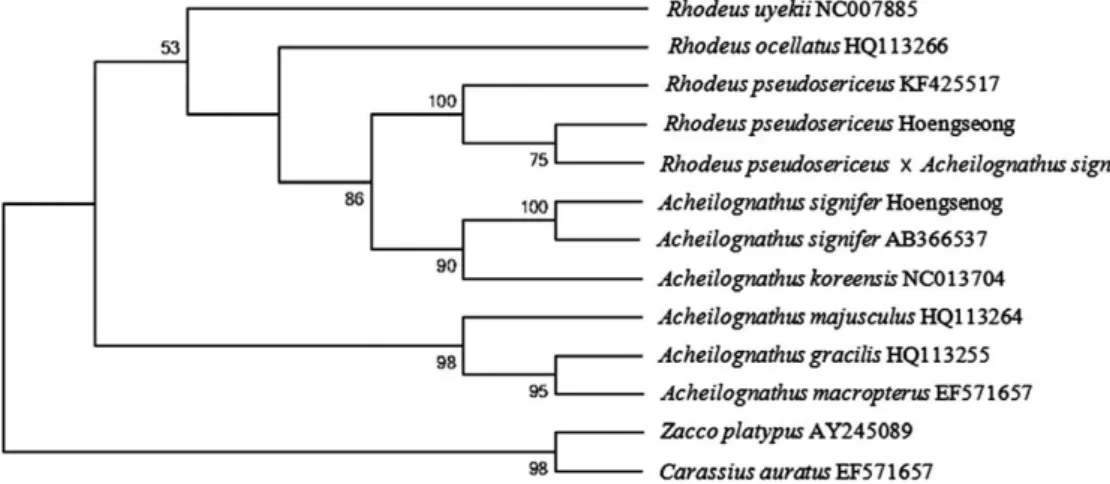
The total length of Acheilognathinae fish including the natural hybrid between R. pseudosericeus and A. signifer mt-cyb gene was 1,141 bp positions. Phylogenetic analy- sis using ML tree showed that R. pseudosericeus and A.
signifer constructed their own lineages supported by high
Table 1.Comparison of 12 morphometric and 6 meristic characters of the natural hybrid with hybrid index (Hindex) and its supposed parental species between Rhodeus pseudosericeus and Acheilognathus signifer at the Jucheongang (stream) of the Namhangang (river), Anheung-myeon, Hoengseong-gun, Gangwon-do, Korea on April, 25, 2014
R. pseudosericeus Hybrid A. signifer
(n==5) (n==1) (n==5)
Characters
CNUC 38984-38988 CNUC 38983 CNUC 38973-38977 Hindex
Range Mean±SD Mean±SD Range
Standard length (mm) 48.3~73.0 81.2 62.2~79.3
Proportions of standard length
Body depth 39.1~43.1 41.3±1.8 39.8 40.1±2.4 37.9~43.5 131
Head length 21.6~24.0 23.0±0.9 22.1 23.5±0.9 22.3~24.2 -195
Pre-dorsal length 48.8~51.3 50.3±0.9 54.0 53.0±1.5 51.3~54.5 134
Pre-ventral length 41.2~44.9 42.6±1.6 45.0 45.1±0.7 44.1~45.7 97
Pre-anal length 58.6~61.8 60.3±1.4 61.1 63.2±1.7 60.9~64.7 26
Caudal peduncle length 17.6~20.8 19.3±1.3 21.9 18.7±1.3 17.4~20.7 -421
Caudal peduncle depth 13.2~14.9 13.8±0.7 13.2 13.4±0.9 12.4~14.3 138
Proportions of head length
Caudal peduncle length 73.1~96.4 84.3±8.4 99.2 79.7±5.0 73.9~85.6 -329
Caudal peduncle depth 55.3~64.2 59.9±3.9 60.0 57.0±3.8 53.1~62.7 -6
Snout length 25.2~27.3 26.5±0.9 30.7 28.5±1.0 27.4~30.2 211
Eye diameter 31.2~37.6 33.3±2.6 27.8 32.0±1.1 30.4~33.4 416
Inter-orbital width 40.7~50.6 45.2±3.6 41.1 40.3±2.6 37.3~44.3 83
No. of dorsal fin rays 9 8 8 100
No. of anal fin rays 10 10 8~9 0
No. of lateral scales (pored scales) 30~33 (2~4) 35 (17) (32~36) 44
No. of lateral line scales 32~36
No. of vertebrae 33~34 36 33~36 200
Barbels Absent Absent Present
bootstrap value. Comparison of genetic distance was coincident with the result of the phylogenetic analysis.
Nucleotide sequence difference of mt-cyb gene was very low at A. signifer clades (0.1%~0.2%) and identical at R. pseudosericeus clades by Maximum Composite Like- lihood genetic distance calculate model. On the other hand, the natural hybrid was identical with R. pseudose- riceus lineage in mt-cyb gene sequence by ML tree and phylogenetic analysis.
DISCUSSION
By the morphological characters, the natural hybrid was identified an intergeneric hybrid between Rhodeus pseu- dosericeus and Acheilognathus signifier. And another genetic method such as mt-cyb gene indicated that the maternal species of the natural hybrid appeared to be R.
pseudosericeus due to its 100% sequence identity.
Main factors in the natural hybrid have been usually happened because of its similar spawning season, insuf- ficient spawning site, and sneaker behavior (Jansson et al., 1991). R. pseudosericeus and A. signifer are sympa- tric and have almost similar spawning periods from April to July (Personal observation). Not only two bitterlings did not seem to be different habitat preferences but also used to place their eggs in one mussel species, only Unio douglasiae sinuolatus living in the collecting site. In addi- tion, although the males defended its territory around the mussels, it was said that sneaking is a common phenom- enon under natural conditions (Back et al., 2004; Smith et al., 2004). Furthermore, there was a report that A. sig- nifer engage in an intergeneric hybridization with R. uye- kii (Kim et al., 2010). Therefore, the coexistence of the two parental species may seem to increase the possibility of hybridization.
The existence of a complete lateral line and barbels in the bitterlings, known as key intergeneric characters for Acheilognathinae fish (Kim, 1997), plays an important role in identifying them in nature. The intermediate traits of the body color patterns and two morphological charac- ters such as an incomplete lateral line scales and lacking barbels strongly supported that the collected specimen was a natural intergeneric hybrid. The results of the pre- sent study were quite similar to those found in the earlier studies in R. uyekii and A. signifer (Kim et al., 2010).
Yun (2009) had shown that A. signifer had a lower level of inter-population divergence possibility and there was no difference, based on the result of phylogenetic analy- sis in mitochondrial COI sequences and nuclear RAG1 from the Imjingang (river), the Bukhangang (river), and the Namhangang (river). Also in the present study, A. sig- nifer formed a single lineage including GenBank dataset in mt-cyb gene. By Lee et al. (2009), the natural hybrid between Cobitis tetralineata and Iksookimia longicorpa was identical with C. tetralineata in mitochondrial COI analysis and then the natural hybrid was considered with a paternal side of I. longicorpa and a maternal of C. tetr- alineata. From the present study, as the natural hybrid between R. pseudosericeus and A. signifer was identical with R. pseudosericeus lineage, it was possible that the paternal side is A. signifer and maternal side was R. pseu- dosericeus.
Hybridization was frequently occurred by the anthro- pogenic disturbances of natural spawning grounds, as well as by the habitat fragmentations including a man-made construction of reservoirs, hydroelectric power plants, and an introduction of non-native species, and other in- stallations causing drastic changes of aquatic eco-systems (Hubbs, 1955; Rhymer and Simberloff, 1996; Scribner et al., 2001; ˇSori´c, 2004). Our present study, however, still remains limited to make the hybrid origin clear from
Fig. 2. Molecular phylogenetic analysis by Maximum Likelihood method. The evolutionary history was inferred by using the Maximum Likelihood method based on the Tamura-Nei model (Tamura and Nei, 1993).
just only one hybrid specimen collected. Thus, it will need further studies through breeding experiments in the aquarium and seeking of various forms in nature.
REFERENCES
Back, H.M., H.B. Song and O.K. Kwon. 2004. Reproductive behavior of the Korean bitterling, Acheilognathus signifer (Cyprinidae; Acheilognathinae). Korean J.
Ichthyol., 16: 201-209.
Chae, B.S. and H.J. Yang. 1990. Natural hybrids between Pungitius sinensis sinensis and P. sinensis kaibarae.
Korean J. Ichthyol., 2: 88-94. (in Korean)
Damme, V.D., N. Bogutskaya, R.C. Hoffimann and C. Smith.
2007. The introduction of the European bitterling (Rhodeus amarus) to west and central Europe. Fish and Fisheries, 8: 79-106.
Hubbs, C.L. 1955. Hybridization between fish species in nature. Syst. Zool., 4: 1-20.
Hubbs, C.L., K.F. Lagler and G.R. Smith. 2004. Fishes of the great lakes region. The Univ. Michigan Press, 250 pp.
Hwang, Y.J., M.S. Ra and C.G. Choi. 1995. A natural hybrid between spinous loach, Cobitis longicorpus and cyp- rinid loach Misgurunus anguilicaudatus (Pisces, Co- bitidae). Korean J. Ichthyol., 7: 203-207. (in Korean) Jansson, H., I. Holmgren, K. Wedin and T. Andersson. 1991.
High frequency of natural hybrids between Atlantic salmon, Salmo salar L., and brown trout, S. trutta L., in a Swedish river. J. Fish Biol., 39: 343-348.
Kim, C.H., W.O. Lee, Y.J. Kang and J.M. Baek. 2010. Occur- rence of a natural intergeneric hybrid, Rhodeus uyekii x Acheilognathus signifer (Pisces; Cyprinidae) from Jojongcheon Bukhan River, Korea. Korean J. Ichth- yol., 22: 225-229. (in Korean)
Kim, I.S. 1997. Illustrated encyclopedia of fauna and flora of Korea. VoL. 37. Freshwater fishes. Ministry of Edu- cation, 629pp. (in Korean)
Kim, I.S. and J.H. Lee. 1990. Diploid-triploid hybrid com- plex of the spined loach Cobitis sinensis and C. longi- corpus (Pisces, Cobitidae). Korean J. Ichthyol., 2: 203- 210.
Kim, I.S. and J.Y. Park. 2002. Freshwater fishes of Korea.
Kyohak publishing, 466pp. (in Korean)
Kim, I.S., Y. Choi and J.H. Shim. 1991. An occurrence of intergeneric hybrid cross, Pungtungia herzi x Pseudo- pungtungia nigra from the Ungcheon River, Korea.
Korean J. Ichthyol., 3: 42-47.
Lee, I.R., H. Yang, J.H. Kim, K.Y. Kim and I.C. Bang. 2009.
Identification of a natural hybrid between the striped spine loach Cobitis tetralineata and the king spine loach Iksookimia longicorpa by analyzing mitochon- drial COI and nuclear RAG1 sequences. Korean J.
Ichthyol., 21: 287-290. (in Korean)
Min, M.S. and S.Y. Yang. 1992. A study on the natural hy- bridization between Moroco lagowskii and M. oxyce- phalus. Korean J. Zool., 35: 339-343. (in Korean) National Center for Biotechnology Information, U.S. National
Library of Medicine (April, 1, 2013). Retrieved on July, 10, 2014 from http://www.ncbi.nlm.nih.gov/
genbank.
National Institute of Biological Resources (NIBR). 2011. Red data book of endangered fishes in Korea. NIBR, 202 pp. (in Korean)
Nelson, J.S. 2006. Fishes of the world (4
thed). John Wiley and Sons, Inc., 601pp.
Nikoljukin, M.J. 1972. Distant hybridization in acipenseridae and teleostei. Moskava, 335pp.
Okazaki, M., K. Narus, A. Shima and R. Arai. 2001. Phylo- genetic relationships of bitterlings based on mitochon- drial 12S ribosomal DNA sequences. J. Fish Biol., 58:
89-106.
Rhymer, J.M. and D. Simberloff. 1996. Extinction by hybri- dization and introgression. Annu. Rev. Ecol. Syst., 27:
83-109.
Scribner, K.T., K.S. Page and M.L. Bartron. 2001. Hybridi- zation in freshwater fishes: a review of case studies and cytonuclear methods of biological inference. Rev.
Fish Biol. Fish., 10: 293-323.
Smith, C., M. Reichard, P. Jurajda and M. Przybylski. 2004.
The reproductive ecology of the European bitterling (Rhodeus sericeus). J. Zool., Lond., 262: 107-124.
ˇSori´c V.M. 2004. A natural hybrid of Leuciscus cephalus and Alburnus alburnus (Pisces, Cyprinidae) from the Ibar River (Western Serbia). Arch. Biol. Sci., Belgrade, 56:
23-32.
Tamura, K. and M. Nei. 1993. Estimation of the number of nucleotide substitutions in the control region of mito- chondrial DNA in humans and chimpanzees. Mol.
Biol. Evol., 10: 512-526.
Trautman, M.B. 1981. The fishes of Ohio. Ohio State Univ.
Press, 124pp.
Yun, E.Y. 2009. Molecular phylogenetics and population genetics of Korean bitterlings, subfamily Acheilog- nathinae. MS. Thesis, Soonchunhyang Univ., 71pp.
(in Korean)
한강납줄개 Rhodeus pseudosericeus와 묵납자루 Acheilognathus signifer (Pisces: Cyprinidae)의 속간 자연 잡종 출현
김형수∙윤승운∙고재근1∙박종영*
전북대학교 자연과학대학 생물학과, 부설 생물다양성연구소, 1국립생태원