상황버섯 추출물이 사염화탄소로 간 손상이 유발된 흰쥐에서의 면역조절 효과
안치선*·최세영*·김해란*·전윤희*·허선진*·김익희**·박금덕***·정용준***·임병우*†
*건국대학교 의료생명대학 생명과학부, **건국대학교 의과대학, ***서흥캅셀
Immunomodulatory Effects of phellinus linteus Extracts on Liver Damage Induced by Carbon Tetrachloride in Rats.
Chi-Sun An
*, Se-Young Choi
*, Hai-Lan Jin
*, Yun-Hui Jeon
*, Sun Jin Hur
*, Ick-Hee Kim
**, Geum-Duck Park
***, Young-Jun Jeoung
***, and Beong-Ou Lim
*†*College of Biomedical & Health Science, Department of Life Science, Konkuk University, Chungju 380-701, Korea.
**Department of Surgery, School of Medicine, Konkuk University
***Suheung Capsule Company.
ABSTRACT : The purpose of this study evaluated the immunoregulatory effect of
phellinus linteusethanol (PLE) extracts on liver damage on carbon tetrachloride (CCl
4) induced in rats. Four-week old Male Sprague-Dawley rats were divided into the three experimental groups randomly; Control group, CCl
4group, CCl
4+ PLE group. We found that effect of PLE on IFN-
γ, STAT1 and pSTAT1 was decrease in vivo. Several genes were demonstrated to be IL-4 inducible prior to the discovery of STAT6. IL-4, STAT6 and pSTAT6 decreased significantly lower in CCl
4+ PLE than the CCl
4group. Our data indicated that cytokine protein production were increased in CCl
4group with CCl
4+ PLE group. In our data indicate that IgA levels in MLN lymphocytes were low, while IgE was high in CCl
4+ PLE group compared with CCl
4group. Therefore, the results of this study show that PLE can be proposed to protect the liver against CCl
4-induced immunoregulatory activity in rats.
Key Words
:
Phellinus linteus, CCl4, Nitric Oxide, IL-4, IFN-γ, STAT1/STAT6서 언
간질환은환경의오염, 식생활의변화, 스트레스, 음주, 병원
체의 감염 및혈색소증과당원병 같은 대사성질환 등여러 가지 요인에의하여 발생되며만성적으로진행되면황달, 복 통, 복수, 부종 등의증상이 나타나고, 간조직내의결합조직 을구성하는아교섬유의양이증가하여간섬유화로진행된다 고 보고되어 있다 (Kim et al., 2007). 우리나라를 비롯하여 동아시아지역에서는간손상으로인한간장해에대하여천 연물을기원으로하는한약재를조합한한방제가경험적으로 널리이용되고있다 (Lee et al., 2006).
버섯은 예로부터식용 및약용으로 널리 이용되어 왔으며 버섯의항암작용, 생체기능조절및뇌졸중등성인병에대한 예방과개선효과가보고됨에따라버섯에대한관심은더욱 높아지게되었다. 그중상황버섯은분류학적으로 소나무비 늘버섯과 (Hymenochaetaceae), 진흙버섯속 (Phellinus)에속하
는백색부후균으로목질진흙버섯은항암력이매우우수한버 섯으로관심의 대상이되고있다 (Choi et al., 1996). 소화기
계통의암인위암, 식도암, 십이지장암, 결장암, 직장암을비롯
하여간암수술후화학요법을병행할때면역기능을증가시 키는것으로보고되고있다 (Sung et al., 1998).
TNF-α는 활성화된 macrophage, fibroblast 및 다른 여러 세포에서생성되는데이는종양세포에영향을미치는숙자방 어인자 및염증 매개물질로 알려져 있다 (Willeaume et al.,
1995). Nitric oxide (NO)는대식세포의내재성면역반응수행
시 유리되는 주요 면역물질로 알려져 있고 (Brune et al.,
2003), 혈관 확장조절기능 이외에도 대식세포에서 분비되는
대표적인 세포사멸 유도 독성물질이다 (Maiorana et al.,
2003; Taylor et al., 2003). IFN-γ는대식세포에서 respiratory
burst를증가시키고 NO의생산을증가시켜직접적인대식세포
의 살균력을 증가시키는 것으로 알려져 있다 (Abbas et al.,
2000). 전체적인 T 세포의발현을 Th1 반응쪽으로유도하여
†
Corresponding author: (Phone) +82-43-840-3570 (E-mail) [email protected]
Received 2009 March 12 / 1st Revised 2009 May 14 / 2nd Revised 2009 June 3 / Accepted 2009 June 11
진행시키고, 이러한 IFN-γ는세포막에 있는특이적 수용체인 IFN-γ 수용체에 결합하고 이어 세포 내 전사인자인 signal transducer and activator of transcription 1 (STAT1) 등을 활 성화시키고면역반응에필요한유전자의발현을증가시켜그 기능을 나타내는 것으로 알려져 있다 (Celada et al., 1985;
Choi et al., 2007). Th2 사이토카인인 IL-4는 IgE 의존적염
증반응에중심적인 역할을하는 것으로 알려져 있으며, IL-4
receptor α를 공유하고 signal transducer and activator of transcription 6 (STAT6)을활성화시킨다 (Howard et al., 2002).
간독성 물질인 사염화탄소 (Carbon tetrachloride, CCl4)에 의한간섬유화유도방법은가장널리사용되는방법으로서 간경변에서의 병태생리를연구하는데 많이 이용되고, 장기간
CCl4투여에 의한 실험적 간경화와 간암도 유발 할 수 있다
(Fernandez-Munoz et al., 1985; Gans et al., 1976). CCl4는 간에서 단백질 합성을 저해, K+축적의 저해, 간세포의 괴사, microsomal enzymes의억제등을통해독성을나타내는대표
적인물질로서 (Tomas et al., 1989) 급성간염, 지방간, 간경 변등간질환유발이가능하기때문에초기투여물질의효과 를밝히는데있어서실험적으로많이이용되고있다.
본연구는상황버섯추출물이사염화탄소로간손상이유도 된흰쥐에서의 NO, IL-4와 IFN-γ 발현, STAT1/STAT6 발현 량과면역글로블린생성에대한효과에대해서조사하였다.
재료 및 방법
1.
실험재료충북충주시의생약건재약재약회에서구입한상황버섯을잘 게절편하여사용하였다. 상황버섯 40 g을 70% 에탄올 800ml
에가하여 환류냉각기에서 80℃에서 3시간씩 3회 반복추출
하였다. 추출액은 여과지를 사용하여 감압 여과하고 rotary
evaporator로농축하였다. 이를 동결 건조하여사용할 때까지
−20℃에보관하였다.
2.
동물 및 식이(주) Orient에서 구입한 4주령 Sprague-Dawley (SD)계 Rat
18마리를 분양받아온도, 습도가 일정하게유지되는청정 동
물실에서일주일간적응시킨후, 실험에사용하였다. 사료및 음수는자유롭게섭취하도록하였다. 동물은난괴법에의하여
control군, CCl4군, CCl4+상황버섯추출물 (PLE)군으로나눈 후, 간 섬유화 유발을 위해 사염화탄소 (0.5㎖/㎏ 체중)를
con oil과 50 : 50의비율로희석하여주 3회피하주사하였다.
추출물은체중당(㎏) 200㎎비율로주 5회경구투여하였다.
총 4주에걸쳐실험을진행하였고, 4주뒤 rat을 ether로마취
시킨 후 희생을 통하여 혈액을 채취하고 간과 Mesenteric
Lymph Node (장간막림프절, MLN)을적출하였다.
3.
시약Carbon tetrachloride (CCl4), con oil은 Sigma (Louis, MO, USA)에서 구입하였다. Lysis buffer (T-PER® Tissue Protein Extraction Reagent)는 Thermo scientific에서 구입하 였다. 항체 TNF-α, STAT1, pSTAT1, STAT6, pSTAT6는
Cell Signaling Technology에서 IL-4, IFN-γ는 Santa Cruz Biotechnology Inc. (California, USA)에서 iNOS는 upstate biotechnology에서 구입하여 사용하였고, 그 외 일반 시약은 Sigma 제품을사용하였다.
4. Immunoblotting
을이용한cytokines
측정조직 100㎎을잘라 Lysis buffer를가한 후혼합하여 4℃, 14000 rpm, 10분간 원심 분리하여 상층액을새로운 e-tube로 옮긴다. 상층액 중일부를 bio rad protein assay방법으로단 백질을정량하고 western blot법을이용하여측정하였다.
5. Nitric oxide (NO)
생산량 측정CCl4에 의해 손상된 간과 면역기관으로부터 생성된 NO의 양은 Griess reagent system을이용하여 측정하였다. 각 조직 을 100 mM Tris-HCl buffer에넣어분쇄한 후, 원심분리하여 상층액을얻었다. 조직의상층액을 96well plate에취하고, 동 량의 Griess reagent (1% sulfanilamide + 2% phosphoric acid, 0.1% naphthylethylene diamide dihydrochloride)를첨가해 실 온에서 10분간 반응시킨후, ELISA reader로 450㎚에서흡 광도를 측정하였다. NO2의농도는 sodium nitrite (NaNO2)를 사용하여흡광도를측정한후얻은표준곡선과비교하여산출 하였다.
6. ELISA
을 이용한IgA, IgE
항체 측정Sandwich ELISA(Enzyme-linked immunosorbent assay)법
을 이용하여 측정하였다. 측정 방법은 0.05 M carbonate- bicarbonate buffer와 IgA, IgE 일차항체를 96 well plate에 분주한 후 37℃, 2시간 incubation한다. Washing buffer로 3
번 washing하고 blocking buffer를 넣어 37℃, 1시간
incubation한다. Washing buffer로 3번 washing, sample을분 주하고 37℃, 1시간 incubation한다. Washing buffer로 3번 washing, TMB를 분주하고 10~15분간 incubation후 ELISA reader로 450㎚에서측정하였다.
7.
통계처리본 연구의 실험결과는 mean±SE으로 나타내었으며, 각
group간의 통계적 유의성은 SPSS program(ver. 14.0, SPSS Inc., Chicago, IL, USA)을 이용하여 p < 0.05 수준에서 Duncan의다중비교법에의해분석하였다.
결 과
1.
실험동물의 체중증가량및 장기의무게 변화4주간실험식이를투여한흰쥐의체중증가량및장기무게
변화를 Table 1에 나타내었다. 우선 체중증가량을 보면
control군, CCl4군, CCl4+ PLE군의 실험 시작 평균체중이
334.7±11.1, 309.0±26.6, 313.0±19.3 g으로 control군은 사 육기간이 지남에 따라 유의성 있게 증가하는 것을 나타내었
고, CCl4군은시작일로부터 체중이크게 증가하는것을보였
으나일주일후부터유의차는없었다. 간중량의경우정상군
에비해약간의증가를보였다. 간중량의증가는사염화탄소 에의해 간의세포막이손상됨에따라 투과성이증가하여부 종및지방의변성으로인하여간장이비대해지기때문인것 으로 알려져 있으며 (Kim et al., 1993), 본 실험조건하에서 상황버섯추출물은간중량에는크게영향을미치지않은것 으로사료된다.
2. Immunoblotting
을이용한cytokines
측정상황버섯 추출물이 CCl4로 유도한 흰쥐의 liver에서
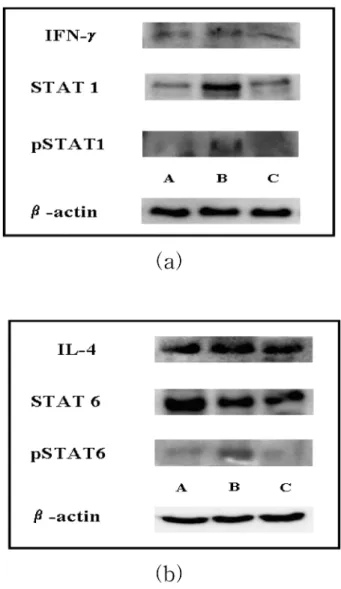
cytokine에대한 영향을 Fig. 1, 2에 나타내었다. 염증단계에
중추적 역할을 하고 있는 cytokine인 TNF-α 발현량은
control군보다 CCl4군에서높은 발현을 보였고, CCl4+ PLE군 에서발현량이감소하는것을나타내었다. Th1 임파구로의분
화를촉진시키는전사인자인 IFN-γ와 STAT1 그리고 pSTAT1
의발현은 CCl4군이 대조군에비해높은 발현을나타내었고, CCl4+ PLE군에서의발현량이약간 낮게나타났다. Th2 임파 구로의분화를 촉진시키는전사인자인 IL-4와 STAT6 그리고 Table 1. The change of weight of a rat fed PLE.
Weight (g)
Body Organ
Initial Final Liver Spleen
A 334.7±9.0 421.2±17.6a 98.4±1.1a 0.5±0.1 B 309.0±24.3 360.8±36.6b 99.1±1.9a 0.4±0.1 C 313.0±17.6 388.8±37.4a,b 11.0±1.4ab 0.5±0.1
(A) Normal group
(B) CCl
4-treated group
(C) CCl
4-treated group+
Phellinus linteusextract
(n = 6 for each group), values not sharing a common superscript letter are significantly different at p < 0.05
Fig. 1. Effect of Phellinus linteus on the TNF-α expression in Spleen. Expression of TNF-α protein was determined by western blotting. specific anti TNF-α antibodies. Actin was used as on internal control (n = 6 for each group). (A) Normal group
(B) CCl4-treated group
(C) CCl4-treated group +Phellinus linteus extract
Fig. 2. Effect of Phellinus linteus on the IFN-γ, STAT1 and pSTAT1 expression in Spleen. (a) Expression of IFN-γ, STAT1 and pSTAT1 protein was determined by western blotting.
specific anti IFN-γ, STAT1 and pSTAT1 antibodies. Actin was used as on internal control. (b) Expression of IL-4, STAT6 and pSTAT6 protein was determined by western blotting. specific anti IL-4, STAT6 and pSTAT6 antibodies.
Actin was used as on internal control (n = 6 for each group).
(A) Normal group (B) CCl4-treated group
(C) CCl4-treated group +Phellinus linteus extract
pSTAT6의발현량또한 CCl4군이대조군에비해 높은발현을 나타내었고, CCl4+ PLE군에서의 발현량이약간 낮게 나타나 같은양상을나타내었다.
3. Nitric oxide (NO)
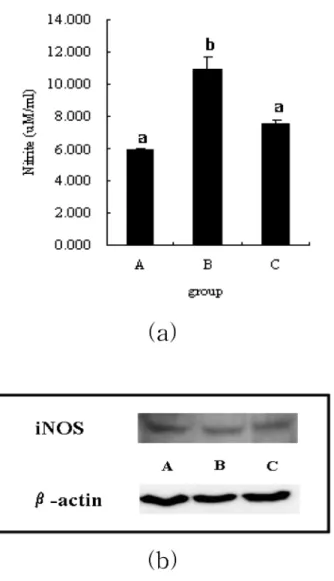
생산량 측정Liver에서의 NO2생성능과 iNOS 발현량을 확인한 결과를 Fig. 3에나타내었다. 최근 염증 유발에 중요한 역할을 하는 것으로알려진 NO 생성을알아본결과, 상황버섯추출물군에 서대조군인 CCl4군에 비해높은 NO 생성억제효과를관찰
할수있었다. 상황버섯 추출물에의한 nitrite의생성 억제와
iNOS 발현의 상관성을 알아보기 위하여 western blot으로
iNOS 단백질의발현을본결과, CCl4에의해 iNOS 단백질이 증가하였으며 CCl4+PLE군에서발현량이줄어든것을확인하
였다.
4. ELISA
을 이용한IgA, IgE
항체 측정혈청 IgA와 IgE, MLN 상층액 IgA와 IgE의생산량을 측 정한 결과는 Table 2에 나타내었다. 혈중 IgA와 IgE 생산량 모두 control군보다 대조군인 CCl4군이 높게 나타났고, CCl4+ PLE군에서는생산량이줄어든것을확인하였다. MLN
상층액 IgA와 IgE 생산량은 control군보다대조군인 CCl4군이
낮게나타났고, CCl4+ PLE군에서는생산량이늘어난것을확 인하였다.
고 찰
간의면역력을증강시키는물질을찾기위해 CCl4로독성을
유도하여 liver에서의 면역학적인효과를 보았다. T-helper 세
포는그들이생산하는 cytokine에따라조절기능을하는것과
효율성을높이는것으로분류될수있다. Th1 임파구는 IFN-
γ, IL-2, TNF-α를발현시키고, Th2 임파구는 IL-4와 IL-10을 생성한다 (Lim et al., 2007). CCl4에의하여대식세포나 임파 구가 자극되어 다량의 TNF-α가 분비되며, 분비된 TNF-α는 대식세포와호중구를활성화시켜산소기와같은산화제, 단백
질 분해효소, IL-1, IL-6, TNF-α등을 더욱 분비하게 한다
(Molloy et al., 1993). Western blot의 결과를 보았을 때 상 황버섯 추출물군이 CCl4에의해 대량으로생성된 TNF-α발 Fig. 3. Effect of Phellinus linteus on the NO production and
iNOS expression in Spleen. (a) NO production from liver was determined in culture supernatant by Griess reagent.
(b) Expression of iNOS protein was determined by western blotting. specific anti iNOS antibodies. Actin was used as on internal control. (n = 6 for each group), values not sharing a common superscript letter are significantly different at p < 0.05
(A) Normal group (B) CCl4-treated group
(C) CCl4-treated group +Phellinus linteus extract
Table 2. Effect of Phellinus linteus on the immunoglobulin A and E production in serum (a) and in MLN cultured super- natant (b).
(a)
IgA (ng/㎖) IgE (ng/㎖) A 116.593±0.044a 2.694±0.002a B 131.160±0.049b 2.900±0.004b
C 114.802±0.043a 2.207±0.005c
IgA (ng/㎖)(b) IgE (ng/㎖)
A 56.222±0.020 4.431±0.004a
B 44.988±0.019 2.537±0.001b C 52.519±0.018 4.498±0.002a
(A) Normal group (B) CCl
4-treated group
(C) CCl
4-treated group+
Phellinus linteusextract
(n = 6 for each group), values not sharing a common superscript
letter are significantly different at p < 0.05
현을감소시켰다. IFN-γ는 IL-4의생성과 IL-4수용체의발현을
억제할 뿐만 아니라 Th2 세포의 여러 작용들과 길항하고
(Yancey et al., 1980; Stadler et al., 1989), T 림프구나 대 과립성 림프구에의해 생성되는 사이토카인으로 항바이러스,
항증식, 암세포주에 대한 증식 억제 효과와 세포 융해 효과 및면역조절 기능이있어 만성골수성 백혈병, 신세포암등 의악성종양, 류마티스관절염등에사용되고있다 (Knop et al., 1990; Gresser et al., 1990). STAT1은 전사인자로 IFN
에의한세포내신호전달과정을통해활성화되는것으로알려 져있다. IFN-γ가세포막의수용체에결합하면먼저 Jak이활 성화되어 STAT1을인산화시킨다. 인산화된 STAT1은이합체 를이루어핵안으로이동하여특정유전자의촉진염기서열에 결합하여 발현을 조절한다 (Cho et al., 2005). 본 실험에서
IFN-γ, STAT1 그리고 pSTAT1의발현량을보았을때 CCl4군 이높은발현을보였고, 상황버섯추출물군에서는발현량이줄
어드는것을확인할수있었다. STAT6는 IL-4에의해활성화
되는데 이 cytokine은 감염에 의해 IL-4, IL-5, IL-10 을 분 비하는 Th2 helper T세포의분화를촉진한다. 즉 IL-4에의해 활성화된 STAT6는 IL-4의전사를촉진하고, 결국 Th2 분화가 유도된다 (Patel et al., 1996). 이에 IL-4, STAT6 그리고
pSTAT6의발현량을보았을때대조군인 CCl4군이정상군보다 발현이높게나타났고, 상황버섯추출물군에서 CCl4군에대해
낮은발현을 나타내었다. STAT1의경우 CCl4에의해 발현이
증가된것으로 보이며, STAT6의경우 대조군의발현이가장
높게나타났는데, 이러한사실로부터상황버섯추출물이 STAT
의발현을저해했다기보다는 STAT1과 STAT6의인산화를저 해하여활성화를억제시키는것으로보인다. 위의결과는지 속적인 CCl4와상황버섯추출물의투여로인해서만성적인면 역반응이일어났음을알수있다. 면역 세포및간세포등에
서 NO를생성하는 iNOS의발현은활성화물질들의혼합처
리에 의해서조절되며 (Kuo et al., 1997), 이전의 보고에따 르면 (Guarner et al., 1993; Sieber et al., 1993) 간경변증 환자에서는일반적으로 NO가증가하는것으로 알려져있다.
위의보고와비슷하게 CCl4 투여군에서 NO 생성량이증가한 것을볼수있었고, 이는상황버섯추출물이 CCl4투여군에서 과도하게생성된 NO를억제시킴으로서항염증효과를나타낼
것으로생각된다. IgA는혈중에서 IgG 다음으로높은농도로 존재하며 인간의 분비물에서도 관련되는 면역글로불린이고
(Macpherson et al., 2008), IgE는비만세포와 결합하여비만 세포가 자극 받았을 때, 여러 가지 증상과 관련된 인자들을 배출시키는데 중요한 역할을 한다 (Balzar S et al., 2007;
Lim et al., 2008). 장점막 보호를 조절하는항체로서 작용하
며, allergen의 흡수를 방해하여 알러지 반응 예방에 중요한
역할을하는 IgA 농도를종합해보면혈청중 IgA 농도는감
소를장관막임파절에서는 증가를시킴으로서장조직손장의
회복에효과가있음을알수있었다. Allergy를유발하는항체
로알려져있는 IgE의농도를보면혈청에서는상황버섯추출
물군의농도는감소를장관막 임파절에서는높게나타났는데
이는 항염증 기전에 작용한 것으로 사료된다 (Lee et al.,
2004). 이에 상황버섯추출물이 활성화되는비만세포의 활성
을억제함을알수있다.
이와 같이상황버섯은약초로서 항암효과는물론담배, 스 트레스로지친현대인의위장, 소화기계통도튼튼하게지켜주
는탁월한 버섯이라할 수있다 (Lee et al., 1999). 이번연
구를통해서상황버섯추출물이손상된간을보호해줄뿐만 아니라우리몸의 면역력강화에도영향을미치는것을 확인 하였다.
감사의 글
본연구는정부 (교육인적자원부)의재원으로한국학술진흥
재단 (F00082), 지식경제부지원지역혁신센터사업 (건국대학교 바이오식·의약연구센터), 건국대학교의료생명대학일반대 학원 응용생명과학과 두뇌한국사업팀의 지원에 의해 수행된 것으로이에감사드립니다.
LITERATURE CITED
Abbas AK, Lichtman AH and Pober JS.
(2000). Cellular and Molecular Immunology. 4
thed. Philadelphia. WB Saunders.
Philadelphia, USA.
Balzar S, Strand M, Rhodes D and Wenzel SE.
(2007). IgE expression pattern in lung: Relation to systemic IgE and asthma phenotype. Journal of Allergy and Clinical Immunology.
119:855-862.
Brune B, Zhou J and von Knethen A.
(2003). Nitric oxide, oxidative stress, and apoptosis. Kidney International, Supplement. 84:S22-24.
Celada A, Allen R, Esparza I, Gray PW and Schreiber RD.
(1985). Demonstration and partial characterization of the interferon gamma receptor on human monoclonal phagocytes.
Journal of Clinical Investigation. 76:2196-2205.
Cho HJ, Lee JI and Jung IM.
(2005). Identification of BACE1 promoter sequence and its regulation by STAT1. Dementia and Neurocognitive Disorders. 4:28-34.
Choi JH, Ha TH and Rho YD.
(1996). Studies on the main factors affecting the mycelial growth of
Phellinus linteus. Korean Society of Mycology. 24:214-222.
Choi SY, Lee KC, Jeoung YJ and Lim BO.
(2007). In-vitro anti- inflammatory activity of
Rubus coreanusMiq. on nitric oxide, interferon-
γ, cycloxygenase-2, and tumor necrosis factor-a production in the macrophage like cell line rAW 264.7 activated by lipopoly-sccharide. Korean Journal of Medicinal Crop Science. 15:324-328.
Fernandez-Munoz D, Caramelo C, Santos JC, Blanchart A, Hernando L and Lopez-Novoa JM.
(1985). Systemic and
splanchnic hemodynamic disturbances in conscious rats with experimental liver cirrhosis without ascites. American Journal of Physiology. 249:316-320.
Gans JH, Korson R and Herman J.
(1976). Enhancement by phenobarbital of some effects of carbon tetrachliride on mouse liver. Biochemical Pharmacology. 25:557-61.
Gresser I.
(1990). Biologic effects of interferons. Journal of Investigative Dermatology. 95:66-71.
Guarner C, Soriano G, Tomas A, Bulbena O, Novella MT., Balanzo J, Villardell F, Mourelle M and Moncada S.
(1993).
Increased serum nitrite and nitrate levels in patients with cirrhosis. relationship to endotoxemia. Journal of Hepatology.
18:1139-1143.
Howard TD, Koppleman GH, Xu J, Zheng SL, Postma DS, Meyers DA and Bleecker ER.
(2002). IL-4RA and IL-13 in a Dutch population with asthma. The American Society of Human Geneyics 70:230-236.
Kim SY, Kim HP, Lee MK and Byun SJ.
(1993). The effect of betaine on the CCl4-induced hepatotoxicity in rats. Yakhak Hoeji. 37:538-541.
Knop J.
(1990). Immunologic effect of interferon. Journal of Investigative Dermatology. 95:72-74.
Kuo PC, Abe KY and Schroeder RA.
(1997). Oxidative stress increase hepatocyte iNOS gene transcription and promoter activity. Biochemical and Biophysical Research Communi- cations. 234:289-292.
Lee HD.
(1999). In Korean medicinal mushroom pictrial book.
Kyohaksa, Seoul, p. 576-580.
Lee KW, Nam BH, Jo WS, Oh SJ, Kang EY, Choi YJ, Lee JY, Cheon SC, Jeong MH and Lee JD.
(2006). Collection, classification, and hepatic effect of native
Cordyceps militaris. Korean Society of Mycology. 34:7-13.
Lee SH, Lim BO and Choue RW.
(2004). Immunoregulatory effects of water extracts of
Scutellariae radixin DSS-induced inflammatory bowel disease animal model. The Korean Nutrition Society. 37:431-439.
Lim BO, Jeong YJ, Park MH, Kim JD, Hwang SJ and Yu BP.
(2007). Immunoregulatory effects of saengshik on DSS-induced inflamma- tory bowel disease in mouse model system. Journal of the Korean Society of Food Science and Nutrition. 36:32-42.
Lim BO, Park PJ, Choi WS and Kim JD.
(2008).
Scutellariabaicalensis
modulates cytokine production, T cell population and immuno-globulin level by mesenteric lymph node lymphocytes in experimental mice with colitis. Korean Journal of Medicinal Crop Science. 16:100-105.
Maiorana A, O'Driscoll G, Taylor R and Green D.
(2003).
Exercise and the nitric oxide vasodilator system. Journal of Sports Science of Medicine. 33:1013-1035.
Molloy RG, Riordain MO, Holzheimer R, Nestor M, Collins K, Mannick JA and Rodrick ML.
(1993). Mechanism of increased tumor necrosis factor production after thermal injury.
Journal of Immunology. 151:2142-2149.
Sieber CC, Lopez-Talavera JC and Groszmann RJ.
(1993).
Role of nitric oxide in the in vitro splachnic vascular hyporeactivity in ascitic cirrhotic rats. Gastronterology. 104:
1750-1754.
Stadler R, Mayer-da-Silva A, Bratzke B, Garbe C and Orfanos C.
(1989). Interferon in dermatology. Journal of the American Academy Dermatology. 20:650-656.
Sung JM, Ryu YB and Cha DR.
(1998). Mushrooms. Gyohak press, Seoul. p. 593.
Taylor EL, Megson IL, Haslett C and Rossi AG.
(2003). Nitric oxide : a key regulator of myeloid inflammatory cell apoptosis.
Cell Death & Differentiation. 10:418-430.
Tomas BD and Mariani ME.
(1989). Comparison of metabolic effect of carbon tetrachloride and 1,2-dichrooethane added in vitro to slice of rat liver. Toxicology in Vitro. 3:159-168.
Macpherson AJ, McCoy KD, Johansen F-E and randtzaeg PB.
(2008). The immune geography of IgA induction and func- tion. Mucosal Immunology. 1:11-22.
Willeaume V, Kruys V, Mijatovic T and Huez G.
(1995). Tumor necrosis factor-alpha production induced by viruses and by lipopolysaccharides in macrophages: similarities and differences.
Journal of Inflammation. 46:1-12.
Yancey KB and Smith JG.
(1980). Interferon : Status in treatment of skin disease. Journal of the American Academy of Dermatology. 3:585-95.
Yun SH, Kim DH, Lee SK, Kim JH, Seo YM, Kang MJ, Jeon TW and Jeong TC.