Korean Journal of Microbiology (2018) Vol. 54, No. 4, pp. 445-447 pISSN 0440-2413
DOI https://doi.org/10.7845/kjm.2018.8064 eISSN 2383-9902
Copyright ⓒ 2018, The Microbiological Society of Korea
Draft genome sequence of oligosaccharide producing Leuconostoc lactis CCK940 isolated from kimchi in Korea
Sulhee Lee and Young-Seo Park*
Department of Food Science and Biotechnology, Gachon University, Seongnam 13120, Republic of Korea
올리고당을 생산하는 Leuconostoc lactis CCK940 균주의 유전체 염기서열
이설희 ・ 박영서*
가천대학교 식품생물공학과
(Received September 7, 2018; Revised October 3, 2018; Accepted October 5, 2018)
*For correspondence. E-mail: [email protected];
Tel.: +82-31-750-5378; Fax: +82-31-750-5389
Leuconostoc lactis CCK940, which was isolated from kimchi obtained from a Korean traditional market, produced an oligo- saccharide with a degree of polymerization of more than 4. In this study, the draft genome sequence of L. lactis CCK940 was reported by using PacBio 20 kb platform. The genome of this strain was sequenced and the genome assembly revealed 2 contigs. The genome was 1,741,511 base pairs in size with a G + C content of 43.33%, containing 1,698 coding sequences, 12 rRNA genes, and 68 tRNA genes. L. lactis CCK940 contained genes encoding glycosyltransferase, sucrose phosphorylase, maltose phosphorylase, and β-galactosidase which could syn- thesize oligosaccharide.
Keywords: Leuconostoc lactis, genome sequence, lactic acid bacteria, oligosaccharide, PacBio
The genus Leuconostoc was first described by van Tieghem (1878), and its type species is Leuconostoc mesenteroides. The Leuconostoc species are Gram-positive, non-motile, and catalase- negative microorganisms with spherical morphology. A recent study reported 14 species of Leuconostoc―L. mesenteroides, L.
lactis, L. citreum, L. kimchi, L. pseudomesenteroides, L. car- nosum, L. gelidum, L. fallax, L. gasicomitatum, L. garlicum, L.
inhae, L. palmae, L. miyukkimchii, and L. holzafelii (Hemme,
2012). L. argentinum has been reclassified as a later synonym of L. lactis because of their high relatedness (Vancanneyt et al., 2006). The genome size varies between 1.6 Mb and 2.1 Mb, consisting of 30 to 98 contigs (> 100 base pairs [bp] in size), and coding sequences from 1,774 to 2,205 bp (Hemme, 2012).
Additionally, the G + C content of the DNA ranges from 36 to 43% (Hemme, 2012).
L. lactis CCK940, which was isolated from kimchi obtained in Gangwon-do, South Korea (37°20 ' N, 127°56 ' E), produced oligosaccharide via an acceptor-donor reaction using sucrose as a donor molecule and maltose as an acceptor molecule (Lee and Park, 2017). Despite the health beneficial role of oligosaccharide produced by L. lactis, few studies have examined with L. lactis at the genome level. Thus, a genome sequence of L. lactis CCK940 was determined and its genomic features of the oligosaccharide production in this strain that was related to carbohydrate properties was analyzed.
The strain was cultured in MRS medium at 37°C for 24 h,
and genomic DNA was extracted using an AccuPrep
®Genomic
DNA Extraction kit (Bioneer). The genomic DNA of L. lactis
CCK940 was sequenced by ChunLab, Inc. using the PacBio 20
kb platform. The PacBio reads were assembled using PacBio
SMRT analysis pipeline version 2.3.0, and gene expectation
was analyzed using CLgenomics 1.55 software (ChunLab, Inc.).
446
∙Lee and Park
미생물학회지 제54권 제4호
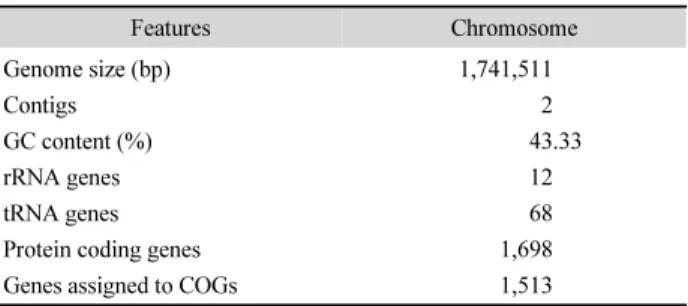
Table 1.
General genomic features of L. lactis CCK940
Features Chromosome
Genome size (bp) Contigs GC content (%) rRNA genes tRNA genes Protein coding genes Genes assigned to COGs
1,741,511 2 43.33 12 68 1,698 1,513
The PacBio platform provided 337.1 × coverage of the genome, which was assembled de novo into 2 contigs. When chimera test was carried out using Pintail 1.1 program (Ashelford et al., 2005), it was confirmed that there was no sequence con- tamination with closely related strains. Gene prediction and the basic annotation for the assembled genome were performed using the NCBI Prokaryotic Genome Annotation Pipeline (PGAP).
Coding sequences (CDSs) were detected using GenMarkS+
(Besemer et al., 2001). Functional gene annotations of the genome were performed against various databases, including the clusters of orthologous groups (COG) (Tatusov et al., 2000) and NCBI reference sequence (RefSeq) (O'Leary et al., 2016).
Genome sequences of seven strains belonging to L. lactis were obtained from the EzGenome database (https://www.
ezbiocloud.net/) and compared with that of L. lactis CCK940 (Table 1). The genome of L. lactis CCK940 was 1,741,511 bp in size with a G + C content of 43.33%. The number of protein-coding genes, ribosomal RNA, and transfer RNA genes were 1,698, 12, and 68, respectively. The genome consisted of 353 genes involved in information storage and processing, 266 genes for cellular processes, and 498 genes for cell metabolism, while the functions of 396 genes were not identified. L. lactis EFEL005 has 143 ORFs in R (general function prediction only) (Moon et al., 2015), while L. lactis CCK940 does not have any ORF in R. Additionally, 21 CRISPR spacers were predicted by CRISPRfiner (Grissa et al., 2007), and the direct repeats were GTACTCGAACTCATTAAAATGACAGACATCTGAAGC (36 bp). L. lactis CCK940 contained several genes capable of synthesizing oligosaccharides such as genes encoding β- galactosidase (EC 3.2.1.23), sucrose phosphorylase (EC 2.4.1.7), and maltose phosphorylase (EC 2.4.1.8), which belonged to the GH1, GH13, and GH65 families, respectively. These enzymes, which belong to glucosyltransferase, can produce oligosaccharides
of which degree of polymerization is 3 to 9 via an acceptor- donor reaction. Therefore, one of genes encoding these glu- cosyltransferases would be responsible for the production of oligosaccharide from L. lactis CCK940.
L. lactis CCK940 was deposited in Korean Culture Center of Microorganisms (Seoul, Korea) under the deposit number of KFCC11724P.
Nucleotide sequence accession number
This whole-genome shotgun sequencing project has been deposited in GenBank under the accession number NZ_NQLF 00000000 for Leuconostoc lactis CCK940.
적 요
한국의 전통시장에서 구입한 김치에서 분리된 Leuconostoc lactis CCK940 은 sucrose와 maltose를 이용하여 중합도가 4 이상인 올리고당을 생산하였다. L. lactis CCK940의 유전체는 1,741,511 bp의 2개 contig로 구성된 염색체로 조합되었으며 G + C의 비율은 43.33%로 나타났다. 염색체 DNA에서 1,698개 의 코딩 유전자, 12개의 rRNA, 68개의 tRNA 유전자가 확인되 었다. L. lactis CCK940은 올리고당을 생산할 수 있는 sucrose phosphorylase, maltose phosphorylase, β-galactosidase 등의 glucosyltransferase 생합성 유전자들을 지니고 있었다.
Acknowledgements
This study was supported by Korea Institute of Planning and Evaluation for Technology in Food, Agriculture, Forestry and Fisheries (IPET) through the High Value-added Food Technology Development Program, funded by the Ministry of Agriculture, Food and Rural Affairs (MAFRA) (Grant number: 316051- 03-2-HD020).
References