설악산 계류의 고도별 저서성 대형무척추동물의 분포특성
손세환ᆞ김진영ᆞ조재익ᆞ공동수†
경기대학교 생명과학과
Altitudinal Distribution Aspect of Benthic Macroinvertebrates in a Mountain Stream of Seoraksan
Se-Hwan Son⋅Jin young Kim⋅Jae Ick Jo⋅Dongsoo Kong†
Department of Life Science, Kyonggi University
(Received 27 May 2011, Revised 31 August 2011, Accepted 2 September 2011)
Abstract
This study was performed to find out the distribution aspect of benthic macroinvertebrates according to altitude in a mountain stream (a main stream: Buk stream, a tributary: Hangye stream) of Seoraksan. The survey was conducted from August to November in 2010. All survey sites were very sound because the mountain was being maintained as a protection area of the national park. Water quality and the composition of substrata were similar in all sites. Benthic macroinvertebrates of 3 phyla, 4 classes, 9 orders and 84 species occurred in the stream. Along with the decline of altitude, shredders of the functional feeding groups (FFGs) decreased, while collector filterers increased. In particular, collector filterers increased sharply at the altitude of 600 ~ 500 m (S.E.L.). Benthic macroinvertebrates showed low similarity between the uppermost site and the lower sites.
Altitude appeared to be a significant factor that influence the structure and distribution of benthic macroinvertebrate community.
keywords : Altitudinal distribution, Benthic macroinvertebrate, Functional feeding group, Mountain stream
1. 서 론1)
설악산은 행정구역상 강원도 인제군, 양양군, 속초시에 걸쳐있고, 백두대간의 중심부에 있으며, 북쪽으로는 향로봉 (1,293 m)과 금강산, 남쪽으로는 점봉산(點鳳山:1,424 m)과 오대산(1,563 m)을 마주한다. 북천은 용대교에서 발원하여 강원도 북면 인북천으로 합류하는 유로연장 30.2 km에 이 르는 하천이며, 한계천은 강원도 인제군 북면 대승폭포에서 발원하여 북천과 합류하는 유로연장 16.6 km의 지류이다.
이들 하천은 유량이 풍부하고 유속이 빠르며 별다른 오염 원이 없는 청정수역이다. 또한 큰 바위와 암석 등으로 이 루어진 하상구조에 작은 폭포와 웅덩이가 있어 용존산소량 이 풍부한 곳이다.
또한 주변식생으로 인해 수온이 낮고 수서곤충의 먹이가 풍부한 전형적인 산간 계류로서 강도래목 유충을 비롯한 수서곤충의 서식에 매우 적합한 수생태계(Gaufin, 1973;
Hynes, 1979; Ra, 1987; Surdick and Gaufin, 1978)를 이루 고 있다.
담수생태계(Freshwater Ecosystem)의 먹이사슬을 구성하 는 생물 중 저서성 대형무척추동물(Benthic Macroinverte- brates)은 담수생태계에서 가장 다양하고 풍부한 무리일 뿐
†To whom correspondence should be addressed.
만 아니라 영양단계(Trophic Level)에서 저차 소비자(1차 또는 2차 소비자가 대부분)로서의 역할을 하기 때문에 생 태계의 구성원으로서 중요하다(Hynes, 1970; Ward, 1992;
William and Feltmate, 1992).
이들은 또한 담수 생태계의 다양한 환경요인과 서식처에 따라 적응방식이 다양하고 수환경에 대하여 민감하게 반응 하는 종이 많으므로 지표종으로 이용되는 등 응용연구에도 좋은 재료가 된다(Dudgeon, 1994, 1995; Boon, 1988;
Minshall, 1988; Reice and Wolemberg, 1993; Rosenberg and Resh, 1993).
현재까지 우리나라에서 고도에 따른 저서성 대형무척추 동물에 대한 연구로는 나철호 등(1991)의 지리산 뱀사골 강도래목 유충의 계절 및 고도에 따른 분포, 이성진 등 (1995)의 무늬하루살이와 동양하루살이의 고도에 따른 분 포, Park 등(1997)이 치악산 계류의 수서곤충에 대한 고도 분포가 있다. 이러한 연구는 주로 특정 분류군에 국한된 것이었다. 본 연구는 저서성 대형무척추동물 전체 군집의 고도에 따른 분포양상 및 섭식기능군의 변화를 파악하였다 는 점에서 선행 연구와 차별화된다.
또한 최근 기후변화로 인한 기온 증가는 하천의 수온 증 가로 이어지고 이는 생물군집의 변화를 초래할 수 있다. 이 에 대한 국내의 연구가 어류를 중심으로 일부 진행되고 있 지만(정남일 등, 2011), 저서성 대형무척추동물 군집에 대한
Fig. 1. The location of the survey sites.
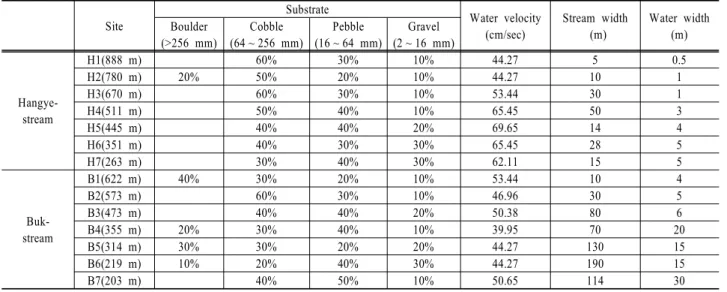
Table 1. Physical environment of the survey sites Site
Substrate
Water velocity (cm/sec)
Stream width (m)
Water width Boulder (m)
(>256 mm)
Cobble (64 ~ 256 mm)
Pebble (16 ~ 64 mm)
Gravel (2 ~ 16 mm)
Hangye- stream
H1(888 m) 60% 30% 10% 44.27 5 0.5
H2(780 m) 20% 50% 20% 10% 44.27 10 1
H3(670 m) 60% 30% 10% 53.44 30 1
H4(511 m) 50% 40% 10% 65.45 50 3
H5(445 m) 40% 40% 20% 69.65 14 4
H6(351 m) 40% 30% 30% 65.45 28 5
H7(263 m) 30% 40% 30% 62.11 15 5
Buk- stream
B1(622 m) 40% 30% 20% 10% 53.44 10 4
B2(573 m) 60% 30% 10% 46.96 30 5
B3(473 m) 40% 40% 20% 50.38 80 6
B4(355 m) 20% 30% 40% 10% 39.95 70 20
B5(314 m) 30% 30% 20% 20% 44.27 130 15
B6(219 m) 10% 20% 40% 30% 44.27 190 15
B7(203 m) 40% 50% 10% 50.65 114 30
연구는 수행된 바 없다. 상위고도에 위치한 계류하천의 냉 수성 저서성 대형무척추동물은 수온이 증가될 경우 가장 취약한 생물군이다. 따라서 저서성 대형무척추동물 군집내 각 종의 고도별 분포를 파악하는 것은 향후 기후변화에 대 한 생물모니터링에 있어서도 중요한 사항이 될 수 있다.
2. 연구방법
2.1. 조사지점 및 조사기간
조사기간은 2010년 8월에서 11월까지였으며, 조사지점은 강원도 인제군 북면 용대리 및 한계리에 위치한 북천과 한 계천의 고도별로 총 14개 지점이었다(Fig. 1).
2.2. 물리적 서식환경
하상(substrate)구조는 각 조사지점에서 크기별 조사 후 백분율로 표시하였다(Wentworth, 1922).
수심(water depth)은 채집시 각 채집 지점마다 길이 0.6 m의 쇠자를 이용하여 측정하였으며, 유속(water velocity)은 쇠자를 하천의 유하 방향과 직각방향으로 세워 물이 부딪 혀 올라오는 높이와 수심을 측정할 때 얻어진 값 사이의 높이 차를 측정하여 산출하였다(Craig, 1987).
Craig method : (1)
: Water velocity (cm/s)
: Force due to gravity (cm/s2)
: Water height when ruler parallel to the flow (cm)
: Water height when ruler right angle to the flow (cm)
Table 2. Taxonomic list of benthic macroinvertebrates from survey sites
Species number Species name Altitude (m) Frequency
(%)* Highest Lowest
Order Tricladida Family Planariidae
1 Dugesia sp. 780 203 21.4
Order Archioligocheata Family Tubificidae
2 Limnodrilus gotoi 670 203 28.6
Order Decapoda Family Cambaridae
3 Cambaroides similis 888 888 7.1
Order Ephemeroptera Family Siphlonuridae
4 Siphlonurus chankae 351 351 7.1
Family Ameletidae
5 Ameletus costalis 780 573 28.6
Family Baetidae
6 Acentrella sibirica 314 203 28.6
7 Baetiella tuberculata 351 263 14.3
8 Baetis fuscatus 573 351 21.4
하폭(Stream width)과 수폭(Water width)은 거리측정기 (Bushnell 600)를 사용하여 측정하였다.
각 조사지점은 고도가 낮아짐에 따라 하폭과 수폭, 유속 은 증가하는 반면, 하상의 구조는 대부분 호박돌과 자갈로 이루어져 큰 차이가 없었다(Table 1).
2.3. 조사방법
Surber net (30×30 cm)로 정량 채집하였으며 그 외에 저 서성 대형무척추동물의 서식이 가능한 미소서식처에서 휴 대용 뜰채를 이용하여 정성 채집하였다.
네트에 걸러진 채집물은 플라스틱 병에 넣어 현장에서 Ethyl alcohol 95%에 고정하고, 실험실로 운반하여 생물시 료를 골라 낸 후 80% Ethyl alcohol에 보존하였다.
각 분류군 중 수서곤충은 McCafferty (1981), Merritt and Cummins (1984, 1996), Kawai (1985), Peckarsky 등(1990) 및 원두희 등(2005), 윤일병(1988, 1995) 등을 참고로 하여 동정하였다.
특히 곤충류 중 꼬마하루살이류는 배연재 등(2003)을 참 고하고, 깔따구류는 Wiederholm (1983)을 이용하여 외부형 태, 특히 체장, 체색, mouth part 형태, abdominal tuble의 유무, 강모의 형태 등의 특징을 고려하여 과 수준(family level)에서 동정하였다.
갑각류 및 환형동물류 등은 岡田要(1965a, 1965b, 1965c), Brinkhurst and Cook (1974), Peckarsky 등(1990) 및 Pennak (1989)을 참고하여 동정하였다. 동정된 학명의 체계 및 국 명은 한국곤충명집(한국곤충학회, 1994)과 한국동물명집(한 국동물분류학회, 1997)에 따랐다.
군집구조는 다음과 같은 지수로 평가하였다.
우점도지수
(2)
McNaughton (1967)
N : 총개체수, N1+ N2 : 제 1, 2우점종의 개체수
종풍부도지수 ln
Margalef (1958) (3)
S : 출현종수, lnN : 각 종이 차지하는 개체수
다양도지수 ′
log,
Shannon-Weaver (1949) (4) Ni : i 종의 개체수, pi = i 번째에 속하는 개체수의 비율
균등도지수 log
′
Pielou (1975) (5)
섭식기능군(Functional Feeding Group; FFG)은 Merritt- cummins (Merritt and Cummins, 1996)와 노태호(2002)의 체계를 기준으로 썰어먹는 무리(Shredders: Sh), 긁어먹는 무리(Scrapers: Sc), 잡아먹는 무리(Predators: Pr), 걸러먹는 무리(Collector filterers: CF), 주워 먹는 무리(Collector gatherers:
CG)로 구분하였다.
유사도 분석은 전 조사지점에서 저서성대형무척추동물상 을 근거로 한 유사도는 Jaccard (1908)의 유사도지수를 이 용하여 NTSYSpc 2.0 프로그램에서 산출하였고, 산출된 유 사도를 기준으로 각 지점별 유사거리를 UPGMA(비가중치 평균연결법)로 clustering하였다.
계층적 군집분석은 SPSS(한글 ver. 12.0)를 이용하여 실 시하였다.
Table 2. Taxonomic list of benthic macroinvertebrates from survey sites (continued)
Species number Species name Altitude (m) Frequency
(%)* Highest Lowest
9 Baetis silvaticus 888 351 42.9
10 Baetis ursinus 314 314 7.1
11 Nigrobaetis bacillus 473 473 7.1
Family Heptageniidae
12 Cinygmula grandifolia 511 219 35.7
13 Ecdyonurus bajkovae 314 203 21.4
14 Ecdyonurus dracon 670 670 7.1
15 Ecdyonurus kibunensis 780 445 50.0
16 Ecdyonurus levis 314 219 14.3
17 Epeorus pellucidus 670 203 71.4
18 Heptagenia kihada 888 573 35.7
19 Rhithrogena na 573 203 57.1
Family Leptophlebiidae
20 Paraleptophlebia chocorata 780 355 35.7
Family Ephemerellidae
21 Cincticostella levanidovae 780 203 78.6
22 Cincticostella tshernovae 511 203 64.3
23 Drunella aculea 780 203 71.4
24 Ephemerella kozhovi 263 263 7.1
25 Serratella setigera 203 203 7.1
26 Uracanthella rufa 473 203 42.9
Order Odonata Family Gomphidae
27 Davidius lunatus 263 219 14.3
Order Plecoptera
Family Taeniopterygidae
28 Taenionema KUc 780 351 64.3
Family Nemouridae
29 Amphinemura coreana 780 445 42.9
30 Nemoura KUa 780 780 7.1
31 Nemoura KUb 473 355 14.3
32 Nemoura tau 888 351 21.4
Family Capniidae
33 Capnia KUa 888 263 50.0
Family Leuctridae
34 Rhopalopsole mahunkai 780 780 7.1
Family Peltoperlidae
35 Yoraperla KUa 888 573 21.4
Family Perlodidae
36 Megarcys ochracea 780 445 14.3
37 Stavsolus KUa 888 203 85.7
Family Perlidae
38 Kamimuria coreana 780 314 57.1
39 Oyamia nigribasis 355 355 7.1
40 Paragnetina flavotincta 355 355 7.1
Family Chloroperlidae
41 Sweltsa nikkoensis 888 351 64.3
Order Coleoptera Family Dytiscidae
42 Hydaticus satoi 888 780 14.3
43 Laccophilius sp. 888 888 7.1
44 Rhantus pulverosus 573 573 7.1
Family Psephenidae
45 Psephenoides KUa 203 203 7.1
Order Diptera Family Tipulidae
46 Antocha KUa 780 203 42.9
Table 2. Taxonomic list of benthic macroinvertebrates from survey sites (continued)
Species number Species name Altitude (m) Frequency
(%)* Highest Lowest
47 Dicranota KUa 888 888 7.1
48 Hexatoma KUa 888 203 71.4
49 Tipula KUb 351 263 14.3
Family Simuliidae
50 Simulium sp. 473 203 42.9
Family Ceratopogonidae
51 Ceratopogonidae sp. 573 351 28.6
Family Chironomidae
52 Chironomidae sp. 1 888 203 71.4
53 Chironomidae sp. 3 351 203 21.4
54 Tanypodinae sp. 670 670 7.1
Family Blepharoceridae
55 Bibiocephala KUa 511 263 28.6
Order Trichoptera
Family Rhyacophilidae
56 Rhyacophila articulata 888 351 64.3
57 Rhyacophila brevicephala 511 219 50.0
58 Rhyacophila clemens 780 445 42.9
59 Rhyacophila KUa 888 473 28.6
60 Rhyacophila KUb 670 351 28.6
61 Rhyacophila kuramana 473 314 14.3
62 Rhyacophila narvae 670 314 28.6
63 Rhyacophila nigrocephala 670 203 57.1
64 Rhyacophila retracta 670 203 57.1
65 Rhyacophila shikotsuensis 670 473 14.3
66 Rhyacophila yamanakensis 314 263 14.3
Family Hydrobiosidae
67 Apsilochorema KUa 888 263 42.9
Family Glossosomatidae
68 Glossosoma KUa 670 203 57.1
Family Philopotamidae
69 Wormaldia KUa 473 445 14.3
Family Stenopsychidae
70 Stenopsyche bergeri 670 203 64.3
71 Stenopsyche marmorata 445 203 50.0
Family Arctopsychidae
72 Arctopsyche ladogensis 780 780 7.1
Family Hydropsychidae
73 Cheumatopsyche brevilineata 780 203 35.7
74 Cheumatopsyche KUb 203 203 7.1
75 Diplectrona KUa 445 445 7.1
76 Hydropsyche kozhantschikovi 355 203 42.9
77 Hydropsyche orientalis 780 203 85.7
78 Hydropsyche valvata 314 203 21.4
Family Polycentropodidae
79 Plectrocnemia KUa 780 573 14.3
Family Psychomyiidae
80 Psychomyia KUa 219 203 14.3
Family Limnephilidae
81 Hydatophylax nigrovittatus 888 219 42.9
82 Notopsyche KUa 780 670 14.3
Family Goeridae
83 Goera japonica 670 263 21.4
Family Lepidostomatidae
84 Lepidostoma KUb 780 355 50.0
*Frequency: (occurring sites/all survey sites) × 100
(a) Number of species (b) Number of individual Fig. 2. Number of species and abundance composition of each higher taxa in the survey sites.
(a) Number of species (b) Number of individual
Fig. 3. Number of species and abundance composition of taxa according to altitude.
3. 결과 및 고찰
3.1. 종구성
조사지점에서 출현한 저서성 대형무척추동물은 총 3문 4 강 9목 37과 84종으로 나타났고(Table 2), 날도래목이 총 29종(34.5%)으로 가장 많은 종수를 보였으며, 하루살이목 23종(27.4%), 강도래목 14종(16.7%), 파리목 10종(11.9%), 딱정벌레목 4종(4.8%), 환형동물문 및 편형동물문, 갑각강, 잠자리목, 톡토기목이 1종(1.2%)의 순으로 나타났다. 이 중 수서곤충류는 총 81종(96.4%)으로 전체 종수의 대부분을 차지하는 것으로 나타났다(Fig. 2).
개체수현존량은 날도래목이 330.0 개체/m2(41.6%)로 가장 많은 개체수 현존량을 보였으며, 다음 순으로 하루살이목이 237.5 개체/m2(30.0%), 강도래목이 137.7 개체/m2(17.4%), 파리목이 81.7 개체/m2(10.3%), 환형동물문이 3.8 개체/m2 (0.5%), 편형동물문이 0.8 개체/m2(0.1%), 딱정벌레목이 0.6 개체/m2(0.1%)로 나타났다.
중하류 하천에서 저서성 대형무척추동물 종구성은 일반 적으로 하루살이목이 가장 높았던 것(박영준 등, 2010; 배 연재 등, 2003)과 달리 본 조사에서는 날도래목의 종구성비 와 개체수 구성비가 가장 높았다.
3.2. EPT 분석
EPT(Ephemeroptera, Plecoptera, Tricoptera) 분류군을 분
석한 결과 북천과 한계천에서 종수 및 개체수의 구성비 모 두 고도가 낮아질수록 강도래목이 감소하는 경향을 보였으 며, 하루살이목과 날도래목은 증가하는 경향을 보였다(Fig. 3).
강도래목의 개체수 구성비는 해발 800 m 이상에서는 약 80%, 해발 800 ~ 300 m 구간에서는 40 ~ 20%, 해발 200 m 내외에서는 5% 이하로 감소하였다.
3.3. 군집분석
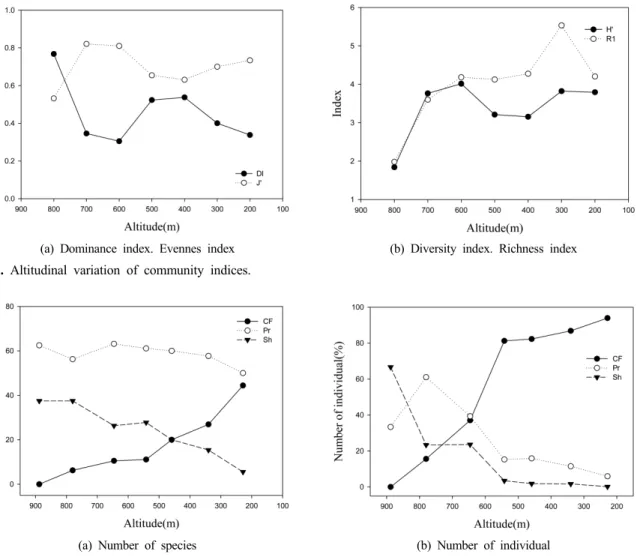
군집분석 결과 우점도지수(DI)는 고도가 낮아질수록 감소 하는 경향을 보였으며, 다양도지수(H')와 풍부도지수(R1)는 우점도지수와 반대로 증가하는 경향을 보였고 균등도지수 (J')는 고도에 따라 큰 차이를 보이지 않았다(Fig. 4).
3.4. 섭식기능군 분석
일반적으로 상류에서는 낙엽 및 식물의 잔사물과 같은 굵은 유기물질이 많으며, 이를 이용하는 썰어먹는 무리 (Sh), 긁어먹는 무리(Sc), 주워먹는 무리(CG)의 비율이 높다 (Horne and Goldman, 1994). 중·하류에서는 미세 입상 유기 물질(Fine Particulate Organic Matter : 0.5 μm ~ 1.0 mm)이 증가하므로(Allan, 1995) 이를 이용하는 걸러먹는 무리(CF) 와 주워먹는 무리의 비율이 높아진다. 반면 잡아먹는 무리 (Pr)는 고도에 따른 차이가 적은데 이는 상류에서 하류로 내려가면서 해당군의 생태학적 지위를 다른 종이 대체하기 때문이다(Horne and Goldman, 1994).
(a) Dominance index. Evennes index (b) Diversity index. Richness index Fig. 4. Altitudinal variation of community indices.
(a) Number of species (b) Number of individual
Fig. 5. Altitudinal variation of each functional feeding group (Sh: Shredder, Pr: Predator, CF: Collector filterer).
기존의 연구결과와 같이 본 지역에서도 섭식기능군별로 고도가 낮아질수록 썰어먹는 무리(Sh)의 종수 및 개체수구 성비가 감소하는 경향을 보였으며, 걸러먹는 무리(CF)는 반 대로 증가하는 경향을 보였다(Fig. 5). 특히 해발 600 ~ 500 m 고도를 경계로 두 기능군의 개체수 현존량이 크게 반전 하는 양상을 보였다. 한편 잡아먹는 무리(Pr)는 고도가 낮 아질수록 개체수 구성비는 감소하지만 종수 구성비는 크게 감소하지 않았는데, 이는 상류에서 잡아먹는 무리의 대부분 을 차지하는 강도래류의 생태학적 지위를 하류에서 같은 섭식지위를 가진 날도래류와 파리류의 일부 종이 대치하기 때문인 것으로 판단된다.
3.5. 유사도 분석
각 조사지점의 유사도 분석결과 북천의 B1지점과 B2지 점, 한계천의 H1지점은 각 수계의 최상류지역으로 같은 수 계의 지점들과 매우 낮은 유사도를 보였다(Fig. 6). 이는 최 상류 지점들이 수폭이 좁고 유량변화가 심하며 작은 강우 에도 교란이 쉽게 일어나는 특성을 가지고 있기 때문에 수 폭 및 유량이 유지되는 하류지점들에 비하여 출현하는 종 에 차이가 있는 것으로 보인다. 해발고도 약 500 m 이상에 위치한 H2 ~ 4지점과 B3지점이 포함되는 유사군과 해발고
Fig. 6. Clusters of survey sites based on the frequency of benthic macroinvertebrates.
도 500 m 이하에 위치한 H5 ~ 7지점과 B4 ~ 7지점이 포함 되는 유사군으로 크게 나누어졌다. 또한 같은 수계의 하천 이 아닌 고도에 따라 구분되는 특징을 보이는데, 이는 고
Fig. 7. Clusters of benthic macroinvertebrates based on their frequency.
도가 저서성 대형무척추동물의 군집구조 형성 및 분포구역 을 결정하는 중요한 요소임을 의미한다.
3.6. 계층적 군집분석
각 생물종의 계층적 군집분석은 총 7개 그룹으로 분류되 었다. A그룹은 해발고도 약 500 m 이하에서만 출현하였고, C그룹은 해발고도 약 500 m 이상에서만 출현하였다. B그 룹은 고도와 상관성이 낮게 나타났으며 상위고도에서 하위 고도까지 광역적으로 넓게 분포하는 종들이었다(Fig. 7). 이 중 C그룹은 피라미하루살이(Ameletus costalis), 햇님하루살 이(Heptagenia kihada), 넓은가슴강도래 KUa(Yoraperla KUa), 물날도래 KUa(Rhyacophila KUa), 가재(Cambaroides similis), 참납작하루살이(Ecdyonurus dracon), 꼬마강도래(Rho- palopsole mahunkai), 곰줄날도래(Arctopsyche ladogensis)로 나타났으며, 이를 토대로 중・하류 하천에 서식하는 생물군 집에 대한 비교군으로서 활용가치가 높을 것으로 판단된다.
4. 결 론
본 연구는 설악산지역의 계류인 북천과 한계천을 대상으 로 고도에 따른 저서성 대형무척추동물의 분포양상을 파악 한 것으로 그 결과는 다음과 같다.
1) 조사결과 총 3문 4강 9목 37과 84종이 출현하였으며 날
도래목이 종수 및 개체수 구성비에서 가장 높은 구성비 를 보였다.
2) 하루살이목과 날도래목은 고도가 낮아질수록 증가하였 으며 강도래목은 감소하는 것으로 나타났다.
3) 우점도 지수는 최상류지점에서 가장 높고 고도가 낮아 질수록 감소하였다. 다양도지수와 풍부도 지수는 고도가 낮아질수록 증가하였다.
4) 섭식기능군 중 썰어먹는 무리는 고도가 낮아질수록 감 소하였으며 걸러먹는 무리는 증가하였으며, 대체로 해발 고도 600 ~ 500 m를 경계로 두 기능군의 개체수가 크게 반전되는 것으로 나타났다.
5) 조사지점의 저서성 대형무척추동물을 이용한 지점별 유사 도분석과 각 생물종의 계층적 군집분석결과 해발고도 약 500 m를 기준으로 구분되는 경향을 보였다. 이로 보아 저서성 대형무척추동물의 군집구조와 분포는 하천의 수 계보다는 고도의 지역 차이로 구분되는 것으로 판단된다.
사 사
이 논문은 2010년 한강수계관리위원회의 환경기초조사사 업 중 하나인 “기후변화가 수생태계에 미치는 영향과 대응 전략” 연구과제 중 일부에 의해 수행되었으며, 이에 감사드 립니다.
참고문헌
나철호, 조영관, 김종선(1991). 지리산 뱀사골 강도래목 유 충의 계절 및 고도에 따른 분포. 한국하천호수학회지, 24(2), pp. 69-76.
노태호(2002). 유수생태계 내 핵심적 기능 단위인 섭식기능
군의 분류 밑 생태적 중요성. 한국자연보전협회 연구보 고서, 21, pp. 68-93.
박영준, 임헌명, 김기동, 조용호, 남상호, 권오석(2010). 왕피 천 저서성 대형무척추동물의 섭식기능군을 이용한 군집 분석. 한국환경생태학회지, 24(5), pp. 556-565.
배연재, 원두희, 황득휘, 진영헌, 황정미(2003). 경기도 가평
천의 하순에 따른 수서곤충 군집조성과 섭식기능군. 한
국하천호수학회지, 36(1), pp. 21-28.
원두희, 권순직, 전영철(2005). 한국의 수서곤충, (주)생태조사단.
윤일병(1988). 한국동식물도감, 제30권, 동물편(수서곤충류), 문교부.
윤일병(1995). 수서곤충검색도설, 정행사, 서울.
이성진, 윤일병, 배연재(1995). 무늬하루살이와 동양하루살
이의 고도에 따른 분포(하루살이과: 하루살이과). 한국곤
충학회지, 25(3), pp. 201-208.
정남일, 박배경, 김경현(2011). 수온 증가가 한강 수계의 어 류 서식지에 미치는 영향. 수질보전 한국물환경학회지, 27(3), pp. 314-321.
한국곤충학회(1994). 한국곤충명집, 한국곤충학회 건국대 출
판부.
한국동물분류학회(1997). 한국동물명집, 아카데미서적.
岡田要(1965a). 신일본동물도감(상), 북륭관. pp. 679.
岡田要(1965b). 신일본동물도감(중), 북륭관. pp. 803.
岡田要(1965c). 신일본동물도감(하), 북륭관. pp. 763.
Allan, J. D. (1995). Stream Ecology. Structure and Function of Running Waters, Chapman & Hall, Landon.
Boon, P. J. (1988). The impact of river regulation on invertebrate communities in the U.K. Regulated Rivers:
Research and Management, 2(3), pp. 389-409.
Brinkhurst, R. O. and Cook, D. G. (1974). Aquatic Earthworms (Annelida: Oligochaeta). Pollution Ecology of Freshwater Invertebrates, C. W. Jr. Harst and S. L. H. Fuller (eds.), Academic Press, New York, pp. 143-156.
Craig, D. A. (1987). Some of what you should know about water. Bull. North Am. Benthol. Soc., 4(2), pp. 178-182.
Dudgeon, D. (1994). Functional assessment of the effects of increased sediments loads resulting from riparian-zone modification of a Hong Kong stream. Verh. Internat. Verein.
Limnol, 25, pp. 1790-1792.
Dudgeon, D. (1995). Environmental ipacts of increased sediment loads caused by channelization: A case study of biomoni- toring in a small river in Hong Kong. Asian J. Environ- mental Management, 3(1), pp. 69-77.
Gaufin, A. R. (1973). Use of aquatic invertebrates in the assessment of water quality. Bio. Meth. for the Assess. Water Qual. ASTM. STP 528, Amer. Soc. Testing and Mater, pp.
96-116.
Horne, A. J. and Goldman, C. R. (1994). Limnology, 2nd ed.
McGraw-Hill, Inc. pp. 375-378.
Hynes, H. B. N. (1970). The ecology of running waters.
Liverpool Univ. Press, Liverpool, U. K.
Hynes, H. B. N. (1979). The ecology of running waters.
Liverpool Univ. Press, Publ, pp. 1-55.
Jaccard, P. (1908). Nouvelles recherches sur la distribution florale. Bul. Soc. Vaudoise Sci. Nat., 44, pp. 223-70.
Kawai, T. (1985). An Illustrated Book of Aquatic Insects of Japan, 東海大學出版會.
Margalef, R. (1958). Temporal succession and spatial heterogenity in natural phytoplankton. In perspectives in marine biology. Univ. of Califonia Press, pp. 323-349.
McCafferty, W. P. (1981). Aquatic Entomology, Jones and Bartlett, Boston, pp. 448.
McNaughton, S. J. (1967). Relationship among functional properties of California Grassland. Nature, 216, pp. 168-169.
Merritt, R. W. and Cummins, K. W. (1984). An Introduction to the Aquatic Insects of North America. 2nd ed. Kendall/Hunt Publ. Co. Dubuque, Iowa.
Merritt, R. W. and Cummins, K. W. (1996). An Introduction to the Aquatic Insects of North America. 3rd ed. Kendall/Hunt Publ. Co.
Minshall, G. W. (1988). Stream ecosystem theory: a global perspective. J. N. Benthol. Soc., 7(4), pp. 263-288.
Park, S. J., Park, S. Y., Kim, J. S., and Bae, Y. J. (1997).
Altitudinal distribution of ephemeroptera, plecoptera, and trichoptera in a mountain stream of chiaksan. Entomological Research Bulletin, 23, pp. 37-42.
Peckarsky, B. L., Fraissinet, P. R., Penton, M. A., and Conklin, Jr. D. J. (1990). Freshwater Macroinvertebrates of North- eastern North America. Connell Univ. Press, Ithaca and London. pp. 442.
Pennak, R. W. (1989). Fresh-water Invertebrates of the Unite States, 3rd ed. John Wiley & Sons, Inc.
Pielou, E. C. (1975). Ecological Diversity, John Wiley and Sons, New York.
Ra, C. H. (1987). Taxonomic and ecological studies of Plecoptera nymph in the Somjin, Yongsan and Tamjin River System. Chonbuk Nay. Univ. Ph. D. Thesis. pp. 1-109.
Reice, S. R. and Wohlemberg, M. (1993). Monitoring freshwater benthic macroinvertebrates and benthic processes: measures for assessment of ecosystem health. pp. 287-305 In: D. M.
Rosenberg and V. H. Resh (eds.), Freshwater Biomonitoring and Benthic Macroinvertebrates. Chapman & Hall, New York.
Rosenberg, D. M. and Resh, V. H. (1993). Freshwater Biomonitoring and Benthic Macroinvertebrates, Chapman and Hall, New York, pp. 488.
Shannon, C. E. and Weaver, W. (1949). The Matehematical Theory of Communication. University of Illinois Press, Urbana.
Surdick, R. F. and Gaufin, A. R. (1978). Environmental Requirements and Pollution Tolerance of Plecoptera.
EPA-600/4-7-062, Cincinnati, Ohio. USA, pp. 1-417.
Ward, J. V. (1992). Aquatic Insect Ecology, John Wiley & Sons, New York.
Wentworth, C. K. (1922). A scale of grade and class terms for clastic sediments. The Journal of Geology, 30, pp. 377-392.
Wiederholm, T. (1983). Chironomidae of the Holarctic Region Keys and Diagnose. Part I - Larvae. Ent. Scand. Suppl., 19.
Willams, D. D. and Feltmate, B. W. (1992). Aquatic Insects. C・
A・B.