ISSN 2288-1069 (Online)
http://dx.doi.org/10.12925/jkocs.2019.36.3.748
복합생균제가 산란계의 생산성, 계란품질 및 악취저감에 미치는 영향
신종서․엄경환
✝․이정윤․최윤서․박희진․이혜선․박병성
✝ 강원대학교 동물생명과학대학(2019년 8월 5일 접수: 2019년 9월 18일 수정: 2019년 9월 21일 채택)
Effect of a probiotic mixture on egg quality and egg production in laying hens
J-S Shin․K-H Um✝․J-Y Lee․Y-S Choi․H-J Park․H-S Lee․B-S Park✝
College of Animal Life Sciences, Kangwon National University,
Chuncheon, Gangwondo, 200-701, Republic of Korea
(Received August 5, 2019; Revised September 18, 2019; Accepted September 21, 2019)
요 약 : 본 연구는 계란 생산성, 계란품질 및 악취저감에 관한
Bacillus subtillus
,Streptomyces galilaeus
및Sphingobacteriaceae
로 구성된 복합생균제(PM, probiotic mixture)의 효과를 조사하였다.산란계 Hy-Line Brown 240수를 4처리구로 구분하여 6주 동안 사육하였다. 처리구는 복합생균제를 함 유하지 않은 대조구(CON, control), 일반생균제(CP3, commercial probiotics 0.3%), 복합생균제 3(PM3, 복합생균제 0.3%), 복합생균제 5(PM5, 복합생균제 0.5%)로 구분하였다. 산란율, 계란 호우유니 트, 난각두께, 난각강도, 난황색 및 농후난백 높이는 PM3, PM5가 CON 및 CP3에 비해서 높았다. 계 분으로부터 암모니아,
E. coli
, 총호기성균, Coliform,Salmonella
균수는 CON>CP3>PM3>PM5 순서로 증가하였다. 본 결과는B. subtillus
,S. galilaeus
및Sphingobacteriaceae
로 구성된 복합생균제 0.3%가 산란율, 계란품질 개선 및 분에서 암모니아 발생을 낮추어 양계장 악취저감 효과를 갖는다는 점을 보여 준다.주제어 : 산란계, 복합 생균제, 계란생산성, 계란품질, 분 암모니아
Abstract : The objective of the present study was to evaluate effects of probiotic mixture (PM) including
Bacillus subtillus
,Streptomyces galilaeus
andSphingobacteriaceae
on egg production, egg quality, and eliminating odor in laying hens. A total of 240 Hy-Line Brown laying hens (50 wks of age) were divided into four treatment groups (60 replicates of birds, each) in completely randomized design. Groups were assigned to four experimental diets: CON (a basal diet of no PM additive as control), basal diet supplemented with either CP3 (0.3% commercial probiotics), PM3
✝
Corresponding author
(E-mail: [email protected]; [email protected])
(0.3% PM), or PM5 (0.5% PM 0.5). Data of egg production and egg quality were obtained during 6 weeks of experimental period. Egg production, Haugh unit, shell thickness, breaking strength, yolk color, and albumin high were significantly increased in CP3 and PM3 compared to those in CON and CP3. Ammonia levels and numbers of
E. coli
, total aerobic bacteria, Coliform, andSalmonella
in feces were significantly increased in order of CON>CP3>PM3>PM5. The present study indicates that addition of 0.3% probiotic mixture includingB. subtillus
,S. galilaeus
andSphingobacteriaceae
to diets may improve egg production, egg quality, and eliminate fecal ammonia of laying hens.Keywords : Laying hens, probiotic mixture, egg production, egg quality, fecal ammonia
1. 서 론
가축사료용 항생제 사용이 금지되면서 생균제 가 널리 사용되고 있다. 생균제는 동물의 소화관 특히, 산란계의 맹장 내 미생물의 균형을 개선시 키고 숙주동물에게 유익한 효과를 제공하는 살아 있는 미생물 사료첨가제이다[1,2]. 생균제로 사용 되는 미생물은 에너지원으로 탄수화물을 이용하 여 젖산을 생성하기 때문에 맹장 내 pH를 낮추 고
Lactobacillus
에 의한 영양대사를 자극함과 동 시에E. coli
와 같은 유해세균의 증식을 억제한다 [3]. 생균제는 유기산, 박테리오신 등 항균물질을 생산해 동물의 소화관에서 항균작용, 면역반응을 활성화하여 성장을 촉진하고 생산성을 개선한다[4-7]. 가축에 사용되는 생균제로는
Lactobacillus, Bacillus,
Yeast,Saccharomyces, Clostridium, Aspergillus
등이 있으며 최근에는 균주를 두 가지 이상 혼합한 복합생균제가 상용 화되고 있다[8-10].산란계 사료에
L. acidophilus
를 이용한 생균제 가 산란율 증가, 사료효율 및 난황 콜레스테롤을 낮추는 것으로 알려져 있다[11]. 산란계에게Streptococcus faecium
의 생균제가 산란율과 계 란품질을 향상시키며L. acidophilus
와L.
paracasei
의 복합생균제가 산란율 및 사료효율, 난중을 개선하는 것으로 알려졌다[11].양계장으로부터 발생하는 암모니아 등의 악취 문제가 심각한 민원을 일으켜서 사회적 문제로 대두되었다. 생균제는 조류의 소화관에서 질소 이 용률을 증가시킴으로써 분을 통한 암모니아 발생 량을 감소시켜 양계장 악취를 저감하는 효과가 있다[1,3,8,12]. 산란계 생산성, 계란품질 개선 및 악취저감을 위한 단일 생균제의 사용은 일반화되
었으나
B subtillus
,S. galilaeus
및Sphingobacteriaceae
을 포함하는 복합생균제(PM, probiotic mixture)의 효과는 알려지지 않았다.본 연구는
B. subtillus
,S. galilaeus
및Sphingobacteriaceae
로 구성된 복합생균제의 급여 가 산란율, 계란 품질, 양계장 악취 저감효과 및 그 작용 메카니즘을 조사하였다.2. 실 험
2.1. 복합생균제 제조
지렁이 분변토로부터 분리된
B. subtillus
,S.
galilaeus
및Sphingobacteriaceae
를 2%, 그리고 지렁이 분변토 98%를 혼합하여 복합생균제를 제 조하였다(대한민국 특허출원번호 0092670). 각각 의 균주는 제품 1 g당 최소 3.5×10⁸ colony forming unit (cfu/제품 g)를 포함하였다.2.2. 실험설계 및 사양관리
실험동물에 대한 과학적인 절차는 NRC[13]에 서 제시된 과학적이고 윤리적인 절차에 의해 진 행했으며 강원대학교 동물실험위원회(IACUC, Institutional Animal Care and Use Committee of Kangwon National University)의 승인(승인번 호: KW-151117-1)을 받았다. 50주령의 갈색계 열 산란계(Hy-Lline Brown) 240마리를 은관농 장(경기도 안성 소재)으로부터 구입하여 강원대학 교 동물사육장 철제 3단 산란케이지에서 1주일의 적응기를 거친 후 6주 동안 사육하였다. 4개의 처리구로 구분하여 각 처리구 당 60마리씩 완전 임의 배치 후 케이지 당 한 마리씩 사용하였다.
처리구는 복합생균제를 함유하지 않은 대조구
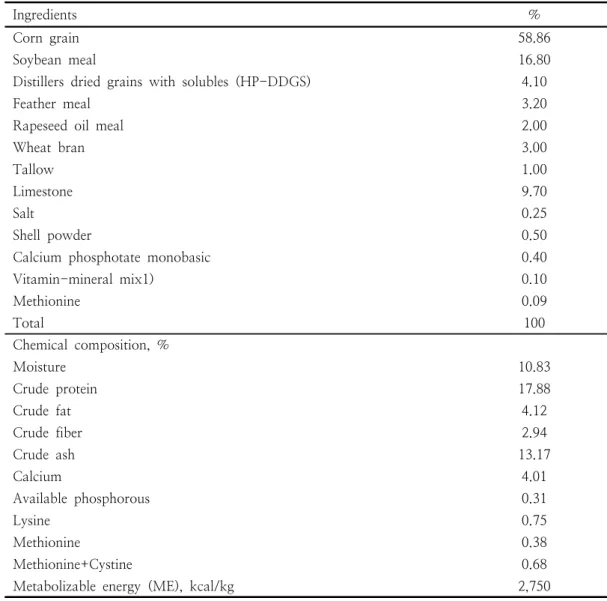
Ingredients %
Corn grain 58.86
Soybean meal 16.80
Distillers dried grains with solubles (HP-DDGS) 4.10
Feather meal 3.20
Rapeseed oil meal 2.00
Wheat bran 3.00
Tallow 1.00
Limestone 9.70
Salt 0.25
Shell powder 0.50
Calcium phosphotate monobasic 0.40
Vitamin-mineral mix1) 0.10
Methionine 0.09
Total 100
Chemical composition, %
Moisture 10.83
Crude protein 17.88
Crude fat 4.12
Crude fiber 2.94
Crude ash 13.17
Calcium 4.01
Available phosphorous 0.31
Lysine 0.75
Methionine 0.38
Methionine+Cystine 0.68
Metabolizable energy (ME), kcal/kg 2,750
1)Supplement/kg of diet: vit. A, 10,000 KIU; vit. D3, 3,500 KIU; vit. E, 15.0 KIU; vit. K3, 2,000 mg; vit. B1, 1,500 mg; vit. B2, 5,000 mg; vit. B6, 3,000 mg; vit. B12, 20 mg; niacin, 25,000 mg; pantothenic acid, 6,000 mg; folic acid, 500 mg; biotin, 50 mg; Cu, 9,000 mg; I, 1,500 mg; Mn, 80,000 mg; Zn, 80,000 mg; Se, 250 mg; Fe, 50,000 mg; Co, 100 mg.
Table 1. Ingredient and chemical composition of experimental diets (CON, control), 일반생균제(CP3, commercial
probiotics 0.3%), 복합생균제 3(PM3, 복합생균 제 0.3%), 복합생균제 5(PM5, 복합생균제 0.5%) 로 구분하였다. 일반 생균제는 PRIMALAC (
L.
acidophilus
3.3×10¹⁰,L. casei
3.3x10¹⁰,Bifidobacterim bifidum
3.3x10¹⁰cfu/g)을 사용하 였다. 물과 실험사료는 자유 급여 하였으며 18시간 (08:30-24:30) 점등을 실시하였다.
2.3. 실험사료
실험사료는 NRC[14]에 의해서 권장된 영양소 요구량을 충족할 수 있도록 조단백질과 대사에너 지 함량을 각각 17.00%와 2,750 kcal/kg로써 조 절하여 배합하였다(Table 1).
Items Groups1)
CON CP3 PM3 PM5
Egg production, % 81.67±5.01c2) 89.33±4.23b 91.67±3.64a 92.00±2.78a Feed intake,
g/head/day 102.9±6.81b 144.6±4.05a 144.7±5.01a 147.8±6.55a
1)CON (control), CP3 (commercial probiotics 0.3%), PM3 (probiotic mixture 0.3%), PM5 (probiotic mixture 0.5%). 2)Mean values±standard error. a,b,cP<0.05.
Table 2. Laying performance of hens fed dietary probiotic mixture during 51 to 56 weeks 2.4. 조사항목
2.4.1. 계란 생산성
실험사료를 공급한 후 30일째부터 생산한 계란 을 매일 오전 12시에 수집하여 생산성을 평가하 였다. 사료섭취량은 2주마다 조사하여 사료요구 율을 계산하였다.
2.4.2. 계란의 품질
실험사료를 공급한 후 30일째부터 생산한 계란 을 수집하여 10일에 1회씩 계란품질평가를 측정 후 평균값으로 나타냈다. 호우유니트(Haugh unit, HU)는 난백의 높이와 난중을 측정하여 아 래의 공식을 이용하여 계산하였다.
Haugh unit : 100 log (H+7.57—1.7W0.37) H : Albumin height (mm), W : Egg weight (g)
난황색은 로슈의 난황색 부채(Roche egg color fan, 독일)를 이용하여 측정하였다. 난각두께 및 파란강도는 계란품질 측정기계(FHK, Co., Japan) 를 이용하였다. 난각두께는 호우유니트와 난황색 측정에 사용한 계란에서 난각의 둔단부, 중간부, 첨단부를 각각 4회씩 측정하여 평균값으로 나타 내었다[15].
2.4.3. 분 암모니아
실험사료를 섭취 후 배설된 신선한 계분 1,000 g을 polycarbonate 상자(폭 20*직경 20*높이 15 cm)에 담아서 비닐로 뚜껑을 하여 25℃ 실온에 서 0(개시), 1, 3, 5일 동안 보관하였다. 발생하는 암모니아 농도를 계분이 담긴 상자로부터 5 cm 높이에서 Gas sampling pump GV-100S (Gastec, Japan)를 이용하여 측정하였다.
2.4.4. 분 미생물
계분에서 유해 세균수의 변화를 조사하기 위하 여 암모니아를 측정하기 전과 측정 후 계분 1 g 을 멸균 된 생리식염수(phosphorus buffered saline; PBS 0.1 M, pH 7.0)와 혼합해서 10배 희석(1:9, wt/vol) 하였다. Anaerobic chamber (5% hydrogen, 5% CO2, balanced nitrogen)에 서 혐기상태로써 10-2-10-7까지 희석하였다. 멸균 된 평판 선택배지에 희석 시료를 각각 100 µL씩 분주하였다. 균주(배지)는
Salmonella
(SS agar, Difco);E. coli
(McConkey purple agar, Difco); Coliform (Violet red bile agar, Difco);총호기성균 (Nutrient agar, Difco)을 37℃에서 24-48시간 배양하였다. 미생물 집락수는 분 g 당 균수(cfu, colony forming unit/계분 g)로써 상용 로그를 취하여 제시하였다[16].
2.4.5. 통계분석
얻어진 모든 자료에 대한 통계적 분석은 SPSS/Windows 21.0 (statistical package for the social science, SPSS Inc., Chicago, IL, USA)을 이용하였다. 각 처리구에서 나타난 평균값에 대하 여 일원배치 분산분석(one-way ANOVA)을 실 시한 후 던칸의 다중검정법으로 95% 신뢰수준에 서 자료의 통계적인 유의차(p<0.05)를 검증하였 다.
3. 결과 및 고찰
3.1. 계란 생산성
복합생균제를 급여한 이후 계란 생산성 변화는 Table 2에 제시하였다. 산란율은 PM3, PM5>CP3>CON 순서대로 유의하게 높았으나 (p<0.05) PM3, PM5 사이의 차이는 없었다. 사
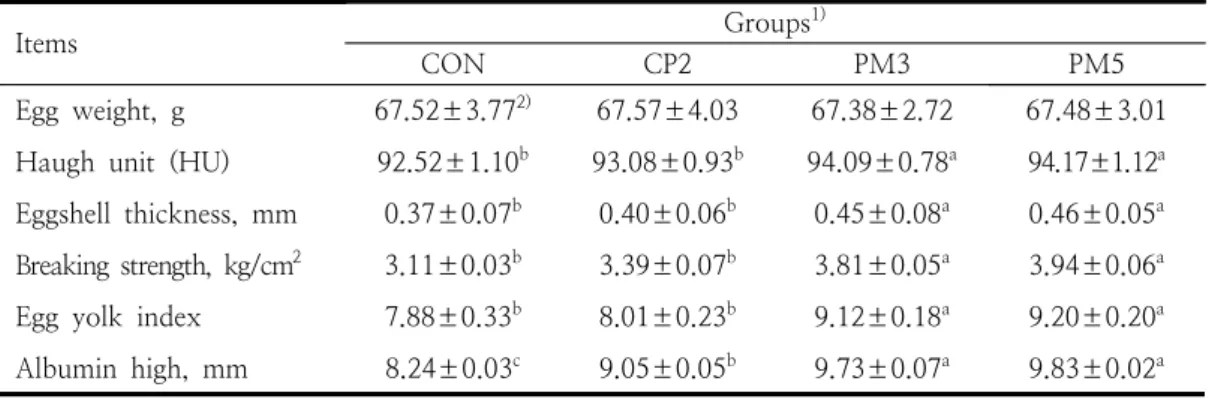
Items Groups1)
CON CP2 PM3 PM5
Egg weight, g 67.52±3.772) 67.57±4.03 67.38±2.72 67.48±3.01 Haugh unit (HU) 92.52±1.10b 93.08±0.93b 94.09±0.78a 94.17±1.12a Eggshell thickness, mm 0.37±0.07b 0.40±0.06b 0.45±0.08a 0.46±0.05a Breaking strength, kg/cm2 3.11±0.03b 3.39±0.07b 3.81±0.05a 3.94±0.06a Egg yolk index 7.88±0.33b 8.01±0.23b 9.12±0.18a 9.20±0.20a Albumin high, mm 8.24±0.03c 9.05±0.05b 9.73±0.07a 9.83±0.02a
1)CON (control), CP3 (commercial probiotics 0.3%), PM3 (probiotic mixture 0.3%), PM5 (probiotic mixture 0.5%). 2)Mean values±standard error. a,b,cP<0.05.
Table 3. Egg quality in hens fed dietary probiotic mixture during 51 to 56 weeks 료섭취량은 PM3, PM5, CP3가 CON에 비해서
유의하게 높았으나(p<0.05) CP3, PM3, PM5 사 이의 차이는 없었다. 산란계에서 생균제 및 유용 미생물(EM, effective microorganism)의 급여가 맹장 내 미생물 균형에 의해 산란율을 개선하는 것으로 알려졌다[17,18]. 산란계 사료 kg당 500 mg의
B. subtilis
culture 첨가는 대조군, 항생제 첨가군, 1000, 1500 mg 첨가군과 비교하였을 때, 산란율, 사료섭취량 및 사료요구율이 개선되 었으나 그 이상의 생균제 첨가 수준에서는 산란 계의 생산성을 향상시키지 않았다[22]. 산란계 사 료 내 서로 다른 수준의 EM (Lactobacilli sp., Rhodopseudomonas sp., Saccharomyces sp.
) 처 리 효과를 비교한 결과, 대조군, EM1, 2 처리군 에 비하여 EM3 처리군에서 계란 생산성이 증가 하였다[23]. 결과는 산란계에게 복합생균제를 0.3% 수준으로 공급해주면 산란율을 크게 높일 수 있다는 점을 나타낸다. 이는 상기 제시한 문 헌적 근거[17,18]와 비슷하며 복합생균제가 지닌 맹장 내 유익한 미생물의 성장촉진 및 유해한 미 생물의 성장억제를 통한 미생물 균형, 면역능력 개선 및 영양소의 소화흡수 촉진 메커니즘으로 볼 수 있다[17-23].3.2. 계란 품질평가
산란계에서 복합생균제를 급여 후 조사한 난 중, 호우유니트, 난각두께, 파란강도, 난황지수 및 농후난백 높이의 변화는 Table 3과 같다. 난중은 각 처리구 사이에 차이가 나타나지 않았다. 호우 유니트, 난각두께, 파란강도 및 농후난백 높이는
PM3, PM5가 CON, CP3에 비해서 유의하게 증 가하였으나(p<0.05) PM3, PM5 사이 및 CON, CP3 사이의 차이는 없었다. 난황지수는 PM3, PM5>CP3>CON 순서로 유의하게 높았으나 (p<0.05) PM3, PM5 사이의 차이는 나타나지 않 았다. 생균제를 산란계에게 급여하면 조류의 소화 관 맹장에서 미생물 균형이 유지되어 칼슘의 흡 수이용률이 증가함으로써 난각두께를 개선할 수 있다[17, 18]. 산란계 사료 kg당 500 mg의
B.
subtilis
culture 첨가는 대조군, 항생제 첨가군, 1000, 1500 mg 첨가군에 비하여 계란품질, 난각 두께, 난황색 및 호우유닛이 증가하였으나 그 이 상의 생균제 첨가는 계란품질을 개선시키지 않는 것으로 보고되었다[17]. 산란계 사료 내 서로 다 른 수준의 EM (Lactobacilli sp.,
Rhodopseudomonas sp., Saccharomyces sp.
) 처 리 효과를 비교한 결과, 대조군, EM1, 2 처리군 에 비하여 EM3 처리군에서 난중, 난각두께, 난 황 지수 및 호우유닛의 값이 증가하였다[18]. 결 과는 계란품질을 개선하기 위한 영양전략으로서 복합생균제 0.3%의 급여가 우수한 것으로 볼 수 있다. 이는 상기 제시한 문헌적 근거[17,18] 및 생균제가 난중에 영향을 주지 않았다는 결과와 맥락을 같이한다[24]. 호우유니트, 난각두께, 난각 강도 및 난황색은 계란품질을 결정하는 데 중요 한 요소이다. 웰빙시대 소비자 기호도와 관련하여 계란의 상품적인 가치를 높이는데 있어서 내부와 외부의 품질이 우수해야 하는데 특히, 호우유니트 는 내부 품질의 척도가 된다. 로슈의 난황 칼러 팬에 의하면 난황색의 등급은 1-14로 분류되는Days Groups1)
CON CP3 PM3 PM5
Initial 1.83±0.53a2) 1.33±0.47a 0.67±0.55b 0.67±0.72b 1 day 13.67±2.23a 11.00±2.17b 10.00±3.15b 9.67±4.03b 3 days 260.3±18.70a 123.3±22.03b 126.0±26.71b 63.33±7.83c 5 days 275.7±43.72a 203.3±38.09b 163.3±23.17c 86.67±11.77d
1)CON (control), CP3 (commercial probiotics 0.3%), PM3 (probiotic mixture 0.3%), PM5 (probiotic mixture 0.5%). 2)Mean values±standard error. a,b,c,dP<0.05.
Table 4. Fecal ammonia emission from hens dietary probiotic mixture during 51 to 56 weeks
Groups1)
CON CP3 PM3 PM5
E. coli
Before 6.89±0.77a2) 6.38±0.81b 5.98±0.56c 5.37±0.42d After 8.16±0.65a 7.89±0.49b 7.74±0.28c 7.46±0.22d Total aerobic bacteria Before 7.86±0.63a 7.44±0.70b 6.56±0.52c 6.36±0.48d After 9.11±0.50a 8.22±0.61b 7.97±0.33c 7.49±0.29d Coliforms Before 6.77±0.66a 6.04±0.51b 5.50±0.46c 5.33±0.39c After 7.12±0.63a 6.82±0.51b 6.53±0.47c 6.10±0.61d
Salmonella
Before 4.78±0.53a 4.59±0.42b 4.33±0.18c 4.06±0.20d After 6.88±0.53a 6.51±0.33b 6.16±0.71c 5.86±0.30d
1)CON (control), CP3 (commercial probiotics 0.3%), PM3 (probiotic mixture 0.3%), PM5 (probiotic mixture 0.5%). 2)Mean values±standard error. a,b,c,dP<0.05.
Table 5. Fecal bacteria counts from hens fed dietary probiotic mixture during 51 to 56 weeks 데 본 실험에서 조사한 모든 처리구 계란의 난황
색 등급은 7.88-9.20 범위로 나타났다[15].
3.3. 분 암모니아
복합생균제를 급여한 후 계분을 채취하여 25℃
에서 5일간 방치하면서 암모니아 농도 발생을 조 사한 결과는 Table 4에서 보는 바와 같다. 계분 내 암모니아 가스 발생량은 개시 일 CON, CP3>PM3, PM5, 1일차 CON>CP3, PM3, PM5, 3일차 CON>CP3, PM3>PM5, 5일차 CON>CP3>PM3>PM5 순서로 유의하게 감소하 였다(p<0.05). 신선한 계분을 5일간 방치했을 때 암모니아는 CON과 비교할 때 CP3, PM3, PM5 에서 각각 26.56, 40.55, 68.56% 낮아졌다. 생균 제는 urease를 분비하는 유해 미생물의 성장과 증식을 억제함으로써 계분 중의 질소화합물 분해
를 차단하여 암모니아 발생을 줄이는 것으로 보 고되었다[25]. 결과는 복합생균제 급여가 계분으 로부터 발생하는 암모니아를 현저하게 낮출 수 있다는 사실을 관찰하였다. 이는 상기 제시한 문 헌적 근거[25] 및 Table 5의 생균제를 급여한 계 분에서 유해세균 증식이 낮았던 점은 암모니아 발생량을 낮추는데 기여하였을 것으로 볼 수 있 다.
3.4. 분 미생물
복합생균제를 급여한 산란계로부터 수집한 계 분을 25℃에서 5일간 방치 후 측정한 미생물 변 화는 Table 5와 같다. 신선한 계분으로부터 암모 니아 측정 전
E. coli
, 총호기성균, Coliform,Salmonella
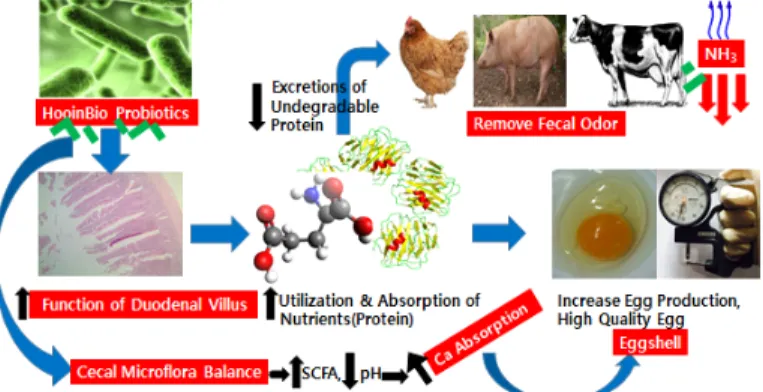
균수는 CON>CP3>PM3>PM5 순서 로 유의하게 낮았다(p<0.05). 5일간 방치 후 계분Fig. 1. Action mechanism of a probiotic mixture on improving of egg quality, egg production and reduction of malodor in laying hens.
으로부터
E. coli
, 총호기성균, Coliform,Salmonella
균수는 CON>CP3>PM3>PM5 순서 로 유의하게 낮았다(p<0.05). 생균제는 영양소와 장 점막의 부착 부위에 대하여 유해세균과 경쟁 하고 있기 때문에 유해세균의 증식을 낮춤과 동 시에 유해세균을 억제하는 박테리오신을 분비하 고 각종 유기산과 기타 미생물에 대한 기질을 생 성한다. 생균제의 발효로부터 생성된 대부분의 유 기산은 젖산과 초산이다. 이러한 모든 기질은 장 관 내 유해세균의 증식을 억제할 수 있다[26,27].결과는 복합생균제를 급여한 계분에서 양계장 악 취의 주 원인으로 알려진 암모니아를 발생시키는 유해세균 수의 증식이 억제된다는 사실을 관찰하 였다. 복합생균제를 급여한 조류의 분에서 유해 세균수가 낮았던 점은 생균제가 맹장에서 짧은
사슬지방산의 생성으로 맹장 내 미생물 균형을 유지해줌과 동시에 유해 세균의 장 점막에 대한 부착 방지 메커니즘으로 볼 수 있다[26-28]. 복 합생균제를 섭취한 동물의 분에서 유해한 세균수 가 낮아진 점은 맹장 세균 숲에서 유익한 미생물 수가 높아져서 강력한 경쟁적 제어작용을 나타냈 을 것으로 생각할 수 있다[28, 31].
3.5. 복합생균제의 계란품질 개선 및 악취저감 기전
본 연구결과 얻어진 복합생균제의 계란품질 개 선 및 악취저감 메커니즘은 Fig. 1과 같이 요약할 수 있다. 동물이 복합생균제를 섭취하면 소장 융 모의 기능 활성화를 경유하여 단백질의 생체 내 흡수이용률을 높여주고[12, 32], 미생물의 작용이
활성화되면서 칼슘의 흡수이용률이 증가되고 산 란율, 계란품질 및 난각두께를 개선한다[4, 21, 33]. 소장에서 가수분해 효소에 의하여 분해되지 않은 미분해 단백질의 계분을 통하여 배설되는 양을 줄여줌으로써 악취의 근원인 암모니아 발생 을 원천적으로 차단해준다[25, 34, 35]. 조류의 맹장에서 짧은 사슬지방산의 생성으로 pH를 낮 춰서 유익한 미생물의 성장을 자극해주고 유해세 균의 장 점막 부착 방지를 통한 유해세균의 증식 을 억제한다[1, 2, 3, 36]. 유해세균 수의 감소 는 계분에서 활성능력이 낮아지고 미분해단백질 을 분해하는 능력이 떨어지기 때문에 발생하는 암모니아 농도를 낮추고 악취의 발생을 억제한다 [19, 37].
4. 결 론
산란계에서
B. subtillus
,S. galilaeus
및Sphingobacteriaceae
를 포함하는 복합생균제(PM, probiotic mixture)가 산란능력, 계란품질 및 악 취저감에 미치는 효과 및 그 작용 메커니즘을 조 사하였다. 산란계는 복합생균제를 함유하지 않은 대조구(CON, control), 일반생균제(CP3, commercial probiotics 0.3%), 복합생균제 3(PM3, 복합생균제 0.3%), 복합생균제 5(PM5, 복합생균제 0.5%)로 구분하여 6 주간 사육하였다.산란율은 PM3, PM5>CP3>CON 순서대로 높았 다. 호우유니트, 난각두께, 파란강도 및 농후난백 높이는 PM3, PM5 가 CON, CP3 에 비해서 증
가하였다. 계분으로부터 암모니아 발생은
CON>CP3>PM3>PM5 순서로 감소하였고
E.
coli
, 총호기성균, Coliform,Salmonella
균수는 CON>CP3>PM3>PM5 순서로 높았다. 결론적으 로, 본 연구를 통해B. subtillus
,S. galilaeus
및Sphingobacteriaceae
로 구성된 복합생균제 0.3%가 산란계의 생산성, 계란품질 개선 및 악취저감 에 효과적이며 이는 소장 융모의 활성화, 맹장 내 유익한 미생물의 성장 자극 및 유해세균의 증 식 억제를 경유하는 메커니즘을 새롭게 밝혀냈다.
References
1. A. C. Ouwehand, S. Salminen, E. Isolauri,
“Probiotics: an overview of beneficial
effects”,
Antonie van Leeuwenhoek
, Vol.82, pp. 279-289, (2002).2. F. W. Edens, “An alternative for antibiotic se in poultry: probiotics”,
Brazilian Journal of Poultry Science
, Vol.5, No.2 pp. 75-97, (2003).3. G. R. Ross, C. Gusils, R. Oliszewski, S.
C. De Holgado, S. N. González, “Effects of probiotic administration in swine”,
J.
Biosci. Bioengin
, Vol.109, No.6 pp.545-549, (2010).
4. T. Balevi, U. S. Ucan, B. Coşun, V.
Kurtoğu, I. S. Cetingül, “Effect of dietary probiotic on performance and humoral immune response in layer hens”,
Brit.
Poult. Sci
, Vol.42, No.4 pp. 456-461, (2001).5. C. Toms, F. Powrie, “Control of intestinal inflammation by regulatory T cells”,
Microbes Infection
, Vol.3, No.11 pp.929-935, (2001).
6. Å. Sullivan, C. E. Nord, “Probiotics and gastrointestinal diseases”,
J. Int. Med
, Vol.257, No.1 pp. 78-92, (2005).7. S. E. Higgins, J. P. Higgins, A. D.
Wolfenden, S. N. Henderson, A.
Torres-Rodriguez, G. Tellez, B. Hargis,
“Evaluation of a Lactobacillus-based probiotic culture for the reduction of Salmonella enteritidis in neonatal broiler chicks”,
Poult. Sci
, Vol.87, No.1 pp.27-31, (2008).
8. J. S. Kim, S. L. Ingale, Y. W. Kim, K. H.
Kim, S. Sen, M. H. Ryu, J. D. Lohakare, I. K. Kwon, B. J. Chae, “Effect of supplementation of multi-microbe probiotic product on growth performance, apparent digestibility, cecal microbiota and small intestinal morphology of broilers”,
J.
Anim. Physiol. Anim. Nutr
, Vol.96, No.4 pp. 618-626, (2012).9. S. Forssten, M. Evans, D. Wilson, A. C.
Ouwehand, “Influence of a probiotic mixture on antibiotic induced microbiota disturbances”,
World J. Gastroenterol
, Vol.20, No.33 pp. 11878–11885, (2014).10. D. H. Nguyen, C. M. Nyachoti, I. H.
Kim, “Evaluation of effect of probiotics mixture supplementation on growth performance, nutrient digestibility, faecal bacterial enumeration, and noxious gas emission in weaning pigs”,
Italian J. Anim.
Sci
, Vol.18, No.1 pp. 466-473, (2019).11. S. M. Kabir, “The role of probiotics in the poultry industry”.
Int. J. Molecul. Sci
, Vol.10, No.8 pp. 3531-3546, (2009) 12. H. H. Giang, T. Q. Viet, B. Ogle, J. E.Lindberg, “Effects of different probiotic complexes of lactic acid bacteria on growth performance and gut environment of weaned piglets”,
Livestock Sci
, Vol.133, No.1-3 pp. 182-184, (2010).13. NRC,
Guide for the care and use of laboratory animals
. Eighth Ed. The national academies press. Washington D.C.USA. (2011a).
14. NRC.
Nutrients requirements of poultry
. 9th rev. National Academy Press, Washington DC, (2001b).15. S. O. Park, B. S. Park, “Effects of dietary inuloprebiotics on egg production and on the microbial ecology and blood lipid profile of laying hens”,
J. Life Sci
, Vol.22, No.7 pp. 880-888, (2012).16. S. O. Park, J. Hwangbo, B. S. Park, H. C.
Choi, “Effects of inverse lighting and extreme heat diet on short chain fatty acid and blood lipid profile in extreme heat stress-exposed broilers”,
J. Korean Oil Chemists Society
, Vol.30, No.3 pp.400-410, (2013)
17. C. L. Xu, C. Ji, Q. Ma, K. Hao, Z. Y.
Jin, K. Li, “Effects of a dried Bacillus subtilis culture on egg quality”,
Poult. Sci
, Vol.85, No.2 pp. 364-368, (2006).18. M. Gnanadesigan, S. Isabella, P. Saritha, L. Ramkumar, N. Manivannan, R.
Ravishankar, “Quality evaluation of egg composition and productivity of layers in EM (Effective Microorganisms) treatments:
A field report”,
Egyptian J. Basic Appl.
Sci
, Vol.1, No.3-4 pp. 161-166, (2014).19. L. V. Hooper, J. I. Gordon, “Commensal host-bacterial relationships in the gut”,
Science
, Vol.292, No.5519 pp. 1115-1118, (2001).20. H. Tlaskalová-Hogenová, R. Štěpánková, T. Hudcovic, L. Tučková, B. Cukrowska, R. Lodinová-Žádnıková, H. Kozáková, P. Rossmann, J. Bártová, D. Sokol, D. P.
Funda, D. Borovská, Z. ˇReháková, J.
Šinkora, J. Hofman, P. Drastich, A.
Kokešová, “Commensal bacteria (normal microflora), mucosal immunity and chronic inflammatory and autoimmune diseases”,
Immun. Letters
, Vol.93, No.2-3 pp.97-108, (2004).
21. C. Alexopoulos, I. E. Georgoulakis, A.
Tzivara, S. K. Kritas, A. Siochu, S. C Kyriakis, “Field evaluation of the efficacy of a probiotic containing Bacillus licheniformis and Bacillus subtilis spores, on the health status and performance of sows and their litters”,
J. Anim. Physiol.
Anim. Nutr
, Vol.88, No.11-12 pp.381-392, (2004).
22. H. M. Jayaprakasha, Y. C. Yoon, H. D.
Paik, “Probiotic Functional Dairy Foods and Health Claims”,
Food Sci. Biotech
, Vol.14, No.4 pp. 523-528, (2005).23. M. Aalaei, A. Khatibjoo, M. Zaghari, K.
Taherpour, M. Soltani, “Comparison of single-and multi-strain probiotics effects on broiler breeder performance, egg production, egg quality and hatchability”,
Brit. Poult. Sci
, Vol.59, No.5 pp. 531-538, (2018).24. Y. C. Chen, T. C. Chen, “Effects of commercial probiotic or prebiotic supplementation on production, size and quality of hens egg”,
Poult. Sci
, Vol.82, No.1 pp.330-(2003).25. V. Garcia, P. Catala-Gregori, F. Hernandez, M. D. Megias, J. Madrid, “Effect of formic acid and plant extracts on growth, nutrient digestibility, intestine mucosa morphology, and meat yield of broilers”,
J.
Appl. Poult. Res
, Vol.16, No.4 pp.555-562, (2007).
26. R. D. Rolfe, “The role of probiotic cultures in the control of gastrointestinal health”,
J. Nutr
, Vol.130, No.2 pp.396S-402S, (2000).
27. W. F. Zhang, D. F. Li, W. Q. Lu, G. F.
Yi, “Effects of isomalto-oligosaccharides on broiler performance and intestinal microflora”,
Poult. Sci
, Vol.82, No.4 pp.657-663(2003).
28. S. Devaraj, S. Vega‐López, N. Kaul, F.
Schönlau, P. Rohdewald, I. Jialal,
“Supplementation with a pine bark extract rich in polyphenols increases plasma antioxidant capacity and alters the plasma lipoprotein profile”,
Lipids
, Vol.37, No.10 pp. 931-934, (2002).29. E. Tako, R. P. Glahn, R. M. Welch, X.
Lei, K. Yasuda, D. D. Miller, “Dietary inulin affects the expression of intestinal enterocyte iron transporters, receptors and storage protein and alters the microbiota in the pig intestine”,
Brit. J. Nutr
, Vol.99, No.3 pp. 472-480, (2008).30. B. S. Park, “Bifidogenic effects of inuloprebiotics in broiler chickens”,
J. Life Sci
, Vol.18, No.12 pp. 1693-1699, (2008).31. J. Ahn, I. U. Grün, A. Mustapha, “Effects of plant extracts on microbial growth, color change, and lipid oxidation in cooked beef”,
Food microbiology
, Vol.24, No.1 pp. 7-14, (2007).32. C. Forte, G. Acuti, E. Manuali, P.
Casagrande Proietti, S. Pavone, M.
Trabalza-Marinucci, L. Moscati, A.
Onofri, C. Lorenzetti, M. P. Franciosini,
“Effects of two different probiotics on microflora, morphology, and morphometry of gut in organic laying hens”,
Poult. Sci
, Vol.95, No.11 pp. 2528–2535, (2013).33. M. Rodrigues, P. C. Pozza, M. S. S.
Pozza, M. Possamai, L. D. G. Bruno, E.
Richart, M. O. Wochner, J. M. Pereira Júnior, “Effects of inulin and a probiotic mixture on nutrient digestibility and nitrogen balance in piglets”,
Arch. Zootec,
Vol.62, No.238 pp. 255-264, (2013).34. W. Yanbo, X. Zirong, “Effect of probiotics for common carp (Cyprinus carpio) based on growth performance and digestive enzyme activities”,
Anim. Feed Sci. Technol
, Vol.127, No.3-4 pp.283-292, (2006).
35. H. H. Giang, T. Q. Viet, B. Ogle, J. E.
Lindberg, “Effects of supplementation of probiotics on the performance, nutrient digestibility and faecal microflora in growing-finishing pigs”.
AAJAS
, Vol.24, No.5 pp. 655-661, (2011).36. P. A. Adhikari, W. K. Kim, “Overview of prebiotics and probiotics: focus on performance, gut health and immunity–a review”,
Annals Anim. Sci
, Vol.17, No.4 pp. 949.966, (2017).37. J. J. Mallo, J. Rioperez, P. Honrubia, “The addition of Enterococcus faecium to diet improves piglet's intestinal microbiota and performance”,