• 검색 결과가 없습니다.

A Case of Pleural Hydatid Cyst Mimicking Malignancy in a Non-Endemic Country

N/A
N/A
Protected

Academic year: 2021

Share "A Case of Pleural Hydatid Cyst Mimicking Malignancy in a Non-Endemic Country"

Copied!
4
0
0

로드 중.... (전체 텍스트 보기)

전체 글

(1)

338

DOI: 10.4046/trd.2011.70.4.338

ISSN: 1738-3536(Print)/2005-6184(Online) Tuberc Respir Dis 2011;70:338-341

CopyrightⒸ2011. The Korean Academy of Tuberculosis and Respiratory Diseases. All rights reserved.

A Case of Pleural Hydatid Cyst Mimicking Malignancy in a Non- Endemic Country

Se Joong Kim, M.D., Ph.D.

1

, Ki Hwan Jung, M.D.

1

, Won-Min Jo, M.D., Ph.D.

2

, Young Sik Kim, M.D., Ph.D.

3

, Chol Shin, M.D., Ph.D.

1

, Je Hyeong Kim, M.D., Ph.D.

1

1

Division of Pulmonary, Sleep and Critical Care Medicine, Department of Internal Medicine, Departments of

2

Thoracic and Cardiovascular Surgery,

3

Pathology, Korea University Ansan Hospital, Ansan, Korea

Hydatid disease is caused by the larval stage of taenia Echinococcus, which endemic in the Mediterranean region.

Recently, the prevalence of the disease has increased worldwide due to an increase in the frequency of travel and immigration. As the infested larvae migrate through the bloodstream, the final destination is most commonly the liver or lungs; direct pleural invasion is very rare. A 50-year-old diabetic Korean man presented with an incidentally noted 2 cm right pleural nodule. On follow up imaging after three months, its size had increased.

To confirm the diagnosis of the lesion, surgical excision was performed. Histopathological examination showed the diagnosis of a hydatid cyst. The patient had no history of overseas travel, but lives in an urban area where many foreign workers from endemic countries reside. This is the first reported case of primary pleural hydatid disease in a non-endemic country.

Key Words: Echinococcosis; Pleura; Taenia

Address for correspondence: Je Hyeong Kim, M.D., Ph.D.

Division of Pulmonary, Sleep and Critical Care Medicine, Department of Internal Medicine, Korea University Ansan Hospital, 516, Gojan 1-dong, Danwon-gu, Ansan 425-707, Korea

Phone: 82-31-412-5950, Fax: 82-31-413-5950 E-mail: [email protected]

Received: Nov. 4, 2010 Accepted: Dec. 10, 2010

Introduction

Hydatid disease or echinococcosis, is mainly caused by the larval stage of taenia Echinococcus granulosus

1

. It is prevalent in sheep raising areas in the Mediterra- nean region, South America, Australia, New Zealand, Russia and China

2

. Recently, the disease has been emerging in Europe and North America, due to in- creased travel and immigration

1

. Humans are accidental intermediary hosts in the biological life cycle of taenia Echinococcus granulosus . The taenia's eggs frequently infest by direct contact with dogs and sheep

3

. After en- teric digestion, the liver and the lungs are most com- monly affected via the bloodstream in adults

3

. Pleural

involvement of hydatid disease can occur, and usually follows the rupture of a pulmonary or hepatic hydatid cyst into the pleural space

4

. However, primary pleural involvement by a slowly enlarging cyst is very rare.

Herein, a case of primary pleural hydatid cyst infestation was diagnosed by video-assisted thoracoscopic surgery in a patient that presented with a slow growing pleural nodule.

Case Report

A 50-year-old man without any significant past medi- cal history presented with a 2 cm nodular lesion in the right lower lateral lung field noted on a plain chest radiography. The nodule was detected during the evalu- ation of diabetes mellitus when the patient presented with diabetic retinopathy. The patient had denied any exposure to asbestos, overseas travel and respiratory symptoms including cough, sputum, dyspnea, hemopt- ysis, fever and chest pain. There was no history of in- gestion of freshwater crabs, or raw beef. Physical ex- amination revealed normal breath sounds and no focal

Case Report

(2)

Tuberculosis and Respiratory Diseases Vol. 70. No. 4, Apr. 2011

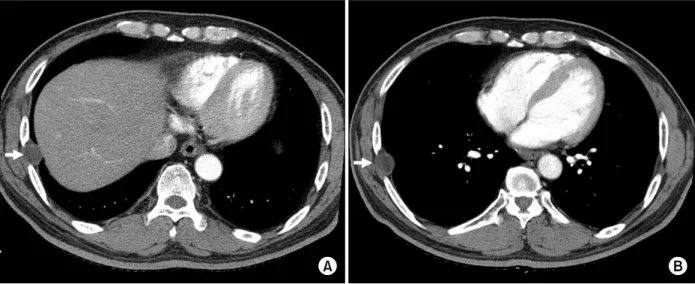
339 Figure 1. Chest computed tomography scan shows a 2.2×1.9 cm well demarcated pleural based nodule (A, arrow) between the lateral arc of the right seventh and eighth ribs with internal fat density, increasing the size about 4 mm after three months (B, arrow).

Figure 2. Histopathological examination shows the laminated cyst wall (arrow) of Echinococcus with fibrosis in the pleura (A, H&E stain, ×12.5) and the germinal layer (arrow) of Echinococcus (B, H&E stain, ×400).

chest wall tenderness. Laboratory test results showed a high HbA1c of 9.5%, but no leukocytosis or eosino- philia was observed. High sensitivity C-reactive protein, carcinoembryonic antigen (CEA), CA 19-9, and AFP were all within normal range. The test for human im- munodeficiency virus (HIV) was negative. Abdominal sonography showed only mild fatty liver without any cysts or masses in the liver or spleen. A plain chest ra- diography showed a 2 cm nodular lesion in the right lower lateral lung field. The chest computed tomog-

raphy (CT) scan showed a 2.2×1.9 cm well demarcated pleural based nodule between the lateral arc of the right seventh and eighth ribs with internal fat density (Figure 1A), suggesting the possibility of a benign pleural tumor such as a lipoma. On the follow up chest CT scan, three months later, the size of the pleural nodule increased about 4 mm and there was still an internal fat density (Figure 1B). A liposarcoma was suspected and video as- sisted thoracoscopic surgical excision was performed.

At the 8th intercostal space, round cystic nodule was

(3)

SJ Kim et al: A case of pleural hydatid cyst

340

found with adhering to pleura. A 2.7×2.5×0.7 cm sized pleural cystic nodule was extirpated. Histopatho- logical examination showed a hydatid cyst ( Echinococ- cosis ) between the visceral and parietal pleura with fib- rosis (Figure 2). The patient was discharged five days after the operation without complications. There was no evidence of disease recurrence by chest CT scan during the 18 months of follow up.

Discussion

Adult Echinococcus granulosus lives in the intestinal tract of infested dogs. Its eggs are excreted in the dog's feces and swallowed by intermediate hosts, such as sheep, cattle, goats, and humans. Once a human has been infested with the taenia eggs, gastric and enteric digestion facilitates the release of larvae, which pene- trate the intestinal wall until they reach a small vessel system. Passing through the bloodstream, they arrive at the organ where they can settle and transform into small cysts that increase in size by 2 to 3 cm per year

5

. The usual locations are the liver and lungs; intrathoracic but extrapulmonary locations like the pleura, diaphragm, mediastinum, pericardium, and chest wall are un- common

6

. Pleural hydatid cysts can develop chiefly as a result of liver or lung cyst rupture into the pleural space with complications of pneumothorax, pleural ef- fusion or empyema

1

. However, a hydatid cyst located primarily in the pleural space, as observed in this case, is very rare. Only about 15% of larvae succeed in pass- ing through the hepatic and pulmonary capillary barrier to reach the systemic circulation

7

. Hydatid cysts con- sequently can be found in any tissue but more vascular- ized tissues have a greater chance of implantation.

Because pleural membranes have only small blood ca- pillary networks, it is difficult for the cysts to reach the pleural space through the bloodstream

6

. It is uncommon even in an endemic country that hydatid disease directly invading the pleura without hepatic or pulmonary involvement. This is the first report of primary pleural hydatid disease in a non-endemic country.

About 90% of patients with hydatid disease present

with a variety of symptoms including cough, chest pain, hemoptysis, malaise, fever and even expectoration of cystic materials

2

. The patient presented here was asymptomatic and diagnosed incidentally on a plain chest radiography during the work up for diabetes mellitus. The diagnosis of hydatid disease still depends on radiography

8

. Hydatid cysts in the liver or lungs are diagnosed easily but intrathoracic extrapulmonary cases may have atypical radiological presentation

6

. In this case, the lesion was presumed to be a neoplasm of the pleura. Laboratory tests can complement the clinical and radiological investigations. Blood testing is usually negative for eosinophilia in cases with intrathoracic hy- datid disease

8

. Immunological tests such as IgG ELISA, indirect hemagglutination assay, and the hydatid antigen dot immunobinding assay can be helpful, but the sensi- tivity is only around 60%

9

. A combination of two or more tests and radiology imaging should be used for an accurate diagnosis.

Surgery is the treatment of choice; cystectomy and capitonnage are the standard procedures

10

. During sur- gery, spillage of hydatic fluid must be rigorously avoid- ed because of the risk of anaphylaxis and disease re- currence

11

. Postoperative morbidity and mortality are low, from 1 to 2%

8

. In this case, the hydatid cyst was completely removed without any spillage of hydatic fluid. There was no recurrence detected over 18 months of follow up by chest CT scan.

International population movement is an integral component of the globalization of infectious diseases in- cluding viruses

12

, bacteria

13

, and parasites

14

. Some para- sitic diseases are slowly spreading globally with global warming and are a public health concern

14

. The patient presented here lives in Ansan city, for 12 years and has no history of overseas travel. Ansan city is an industrial city of 750,000 residents with more than 1,000 factories and more than 35,000 foreign workers who came from China (25,000 persons), Vietnam (2,500 persons), Philippine (1,500 persons), Russia (700 persons), Iran (50 persons), and Israel (10 persons) (http://stat.iansan.

net). Among them, a considerable number came from

hydatid disease endemic countries such as China,

(4)

Tuberculosis and Respiratory Diseases Vol. 70. No. 4, Apr. 2011

341 Russia, Iran, and Israel. The patient works on con-

struction along with many foreign colleagues, and has occasionally contacted with wild dogs in the field of construction. It was assumed that the infested foreign workers entered Korea. Their sputum containing hyda- tid cysts were expectorated and accidentally ingested by dogs. The contaminated food or water with dog's stool was eaten by the patient. In Korea, the prevalence sur- vey of parasites in dog revealed no echinococcus

15

. Echinococcus seemed to be not naturalized in Korea.

Although hydatid disease is rare in developed countries, greater population mobility and migration may increase the frequency of this disease. In the differential diag- nosis of pleural disease, pleural hydatid disease should be included even if there is no overseas travel history.

References

1. Turgut AT, Altinok T, Topçu S, Koşar U. Local compli- cations of hydatid disease involving thoracic cavity:

imaging findings. Eur J Radiol 2009;70:49-56.

2. Tor M, Atasalihi A, Altuntas N, Sulu E, Senol T, Kir A, et al. Review of cases with cystic hydatid lung disease in a tertiary referral hospital located in an endemic re- gion: a 10 years' experience. Respiration 2000;67:539- 42.

3. Ramos G, Orduña A, García-Yuste M. Hydatid cyst of the lung: diagnosis and treatment. World J Surg 2001;

25:46-57.

4. Ozyurtkan MO, Koçyiğit S, Cakmak M, Ozsoy IE, Balci AE. Case report: secondary pleural hydatidosis.

Turkiye Parazitol Derg 2009;33:177-8.

5. Kireşi DA, Karabacakoğlu A, Odev K, Karaköse S.

Uncommon locations of hydatid cysts. Acta Radiol 2003;44:622-36.

6. Gursoy S, Ucvet A, Tozum H, Erbaycu AE, Kul C, Basok O. Primary intrathoracic extrapulmonary hydatid cysts: analysis of 14 patients with a rare clinical entity.

Tex Heart Inst J 2009;36:230-3.

7. Rakower J, Milwidsk H. Hydatid pleural disease. Am Rev Respir Dis 1964;90:623-31.

8. Kilani T, El Hammami S. Pulmonary hydatid and other lung parasitic infections. Curr Opin Pulm Med 2002;8:

218-23.

9. Olut AI, Erguven S, Emri S, Ozunlu H, Akay H.

Diagnostic value of a dot immunobinding assay for hu- man pulmonary hydatidosis. Korean J Parasitol 2005;

43:15-18.

10. Doğan R, Yüksel M, Cetin G, Süzer K, Alp M, Kaya S, et al. Surgical treatment of hydatid cysts of the lung:

report on 1055 patients. Thorax 1989;44:192-9.

11. al Karawi MA, Mohamed AR, el Tayeb BO, Yasawy MI.

Unintentional percutaneous aspiration of a pleural hy- datid cyst. Thorax 1991;46:859-60.

12. Khan K, Arino J, Hu W, Raposo P, Sears J, Calderon F, et al. Spread of a novel influenza A (H1N1) virus via global airline transportation. N Engl J Med 2009;

361:212-4.

13. MacPherson DW, Gushulak BD, Baine WB, Bala S, Gubbins PO, Holtom P, et al. Population mobility, globalization, and antimicrobial drug resistance. Emerg Infect Dis 2009;15:1727-32.

14. Laaksonen S, Solismaa M, Kortet R, Kuusela J, Oksanen A. Vectors and transmission dynamics for Setaria tun- dra (Filarioidea; Onchocercidae), a parasite of reindeer in Finland. Parasit Vectors 2009;2:3.

15. Chai JY. Recent trends of parasitic diseases in Korea.

Infect Chemother 2007;39 Suppl 2:S156-S172.

수치

Figure 2. Histopathological examination shows the laminated cyst wall (arrow) of  Echinococcus with fibrosis in the pleura (A,  H&E  stain,  ×12.5)  and  the  germinal  layer  (arrow)  of  Echinococcus  (B,  H&E  stain,  ×400).

참조

관련 문서