• 검색 결과가 없습니다.

Clinical Nursing Instructors' Teaching Efficacy and Nursing Students' Clinical Practice Satisfaction

N/A
N/A
Protected

Academic year: 2021

Share "Clinical Nursing Instructors' Teaching Efficacy and Nursing Students' Clinical Practice Satisfaction"

Copied!
10
0
0

로드 중.... (전체 텍스트 보기)

전체 글

(1)

1. Introduction

Nursing is a professional job based on clinical practice, and learning in the clinical environment

is essential to nursing education. Clinical practice in the hospital is gradually becoming more important in producing desirable nurses[1]. The

*Corresponding Author : Eunju Seo([email protected]) Received January 12, 2021

Accepted February 20, 2021

Revised February 3, 2021 Published February 28, 2021

Clinical Nursing Instructors’ Teaching Efficacy and Nursing Students’ Clinical Practice Satisfaction

Inhee Park

1

, Eunju Seo

2*

1

Professor, Dept. of Nursing Science, Shinsung University

2*

Professor, Dept. of Nursing Science, Paichai University

임상실습지도자의 교수효능감과 간호대학생의 임상실습 만족도

박인희

1

, 서은주

2*

1

신성대학교 간호학과 교수,

2

배재대학교 간호학과 교수

Abstract To determine clinical nursing instructors' teaching efficacy, students' clinical practice satisfaction, and confirm between correlation, and develop a plan for operating nursing education efficiently for clinical practice. Clinical practice could create an optimal learning situation. We applied CNITEs and CPS to measure clinical nursing instructor teaching efficacy and clinical practice satisfaction. The differences in teaching efficacy by the general characteristics were measured and analyzed; the higher the level of the participants' education, position, clinical career, and clinical teaching career, the higher their teaching efficacy. The higher the age at clinical practice, the higher the clinical efficacy of clinical practitioners with clinical career and higher education level students were more satisfied with the practice subject and nursing instruction than other categories. Therefore, in order to increase the satisfaction of nursing students' practice in the clinical field, we hope to improve various things that can be used not only teaching efficacy but also in clinical practice satisfaction.

Key Words : Nursing, Clinical practice, Teaching efficacy, Nursing student, Clinical practice satisfaction 요 약 임상실습이 최적의 학습상황이 될 수 있도록 임상실습지도자의 교수효능감과 간호대학생의 임상실습 만족도를 파악 하고 이들의 관계를 확인해 보다 나은 임상실습을 위해 효율적인 간호교육의 운영방안을 융복합적 차원에서 모색하고자 수 행하였다. 임상실습지도자의 교수효능감과 간호대학생의 임상실습 만족도를 알아보기 위한 서술적 조사연구이다. 일반적 특 성에 따른 교수효능감의 차이를 측정하여 분석한 결과 연구대상자의 학력, 직급, 임상경력, 임상지도경력이 높을수록 교수효 능감이 높게 나타났다. 교수효능감의 평균평점은 3.77±0.89 이며, 하위요인 중에서는 임상술기지도효능감이 3.97±0.93으 로 가장 높았다. 간호학생이 임상실습 만족도를 측정하여 분석한 결과 연구대상자의 임상실습 만족도는 최대 5점 중 평균평 점은 3.69±0.46이며, 하위요인을 살펴보면, 실습교과 3.98±0.60로 가장 높았다. 임상실습지도자의 교수효능감과 간호대 학생의 임상실습 만족도는 통계적으로 유의하지 않았다(r=0.13, p=.749). 임상실습현장에서 고연령, 풍부한 임상경력, 높은 교육수준을 가진 임상실습지도자의 교수효능감이 높았다. 학생들은 실습만족도 중 교과운영과 실습지도에 대한 만족도가 높았다. 간호학생들의 실습만족도를 높이기 위해서 임상현장에서는 교수효능감 뿐 아니라 실습만족도를 높일 수 있는 여러 요인들을 함께 개선해 나가길 바란다.

키워드 : 간호학, 임상실습, 교수효능감, 간호대학생, 임상실습 만족도

(2)

goal of clinical practice can be reviewed in two domains: cognitive and psychomotor. The cognitive domain involves learning objective setting, problem-solving ability, responsibility, chances to contact patient, and instruction appropriate for the clinical environment whereas the psychomotor domain contains a provision of chances for observation, strategies to motivating clinical practice, practical experience for obtaining clinical skills, provision of chances for experience, encouragement of critical thinking, and participation in integrated nursing activities[2].

With this goal, it can be said that the key to nursing education is to enable nursing students to integrate and apply theories and nursing skills in clinical practice and generate nursing knowledge[2].

Therefore, such core competencies essential to healthcare providers as patient-centered nursing, grounded practical nursing, teamwork, improvement in nursing quality, and safety and education are developed through clinical practice, where clinical nursing instructors need to help nursing students deliver such performance. Since clinical nursing instruction and supervision for nursing students are mostly performed by clinical nursing instructors, skilled clinical nursing instructors' roles are very important[3].

Clinical nursing instructors in South Korea are those working at clinical practice institutions. As nurse managers or nurses full of practical experiences with a bachelor's degree or higher education and at least three years of clinical career, they teach nursing work to students and facilitate their adaptation to clinical practice in the unit of nursing [4]. For practical nursing education, they require teaching competence, clinical nursing skills, educational evaluation, provision of safe practice, and communicative proficiency. As a preceptor for nursing students, they help the students obtain clinical performance competence appropriate for an educational goal, demonstrate

clinical skills and clinical judgment, and perform their roles with enthusiasm for nursing[5].

Nursing students' obtaining of clinical performance competence through clinical practice is associated with clinical nursing instructors' capability, interpersonal relationships, and satisfaction with clinical practice; of these, satisfaction with clinical practice had the strongest impact[6]. This is because the more satisfied nursing students are with clinical practice, the more willing they are to participate actively in clinical practice. Clinical practice satisfaction refers to emotional responses found in diverse aspects, including nursing students' clinical practice subjects, practice contents, nursing instruction, practice environment, practice hours, and practice evaluation[7] and is associated with such external factors as clinical nursing instructors and practice contents[8] and nursing students' internal factors[9]. Of these, a clinical nursing instructor affecting students' clinical practice satisfaction is the most important factor for the development of a good clinical education environment and needs to be a good role model in desirable mutual relationships with staff, patients, and students[10]. For nursing students' effective clinical practice, it is necessary to induce them to participate positively, develop and improve clinical nursing instructors' qualification and ability, which are important factors also related to clinical performance competence, devise a method to improve clinical practice satisfaction, and render clinical practice more efficient.

Instructors' attitudes, beliefs, values, and

qualifications may have positive or negative

effects on students because they can affect the

courses and methods of teaching. Therefore,

clinical nursing instructors need to have teaching

efficacy, which is the belief that their own

teaching behavior can have the most consistent

and continuous impact on students' academic

(3)

achievement, as well as the belief that they can be influential as an educator.

Because teaching efficacy is a variable having consistent and continuous effects on students' achievement, research on teaching efficacy can predict the effectiveness of instructors' teaching behavior, as well as education’s qualitative improvement. These predictions can be used as basic data to help with effective teaching activity.

The higher the teaching efficacy professors have, the better they are at using a good teaching method, at managing class matters, at promoting students' motives and self-esteem, and at improving students' academic achievement[11].

On the basis of these results, it is necessary to induce and encourage clinical nursing instructor to grow and develop in a strategic way and make an institutional device by which they can improve their pride or efficacy as a clinical nursing instructor.

An evaluation of professors' successful behaviors[12] showed that professors gave a higher evaluation than students. It is therefore necessary to reflect the results of the evaluation performed by the students in pursuit of a more objective evaluation of teaching variables. To reflect them, consideration can be given to the measurements of students' satisfaction with professors because it makes determining if a professor's teaching qualification has satisfied students' needs possible and helps evaluate teaching variables objectively[13]. From this perspective, an attempt is made to measure clinical nursing instructors' teaching efficacy and determine students' clinical practice satisfaction.

It is necessary to reflect the situational specificity of clinical practice sites with the aim of measuring clinical nursing instructors' teaching efficacy. The Clinical Nursing Instructor Teaching Efficacy scale (CNITEs) developed by Park and Suh (2018), taking into account the situational

specificity of clinical practice sites, is composed of such areas as student instruction, teaching improvement, application of teaching and learning, interpersonal relationships and communication, clinical judgment, and clinical skill instruction.

If CNITEs is used to measure teaching efficacy as an index to determine the capability required by clinical nursing instructors and if chances are given to develop teaching efficacy in the weak areas by determining teaching efficacy in terms of the demographic characteristics and clinical practice satisfaction of nursing students, basic data for clinical practice instruction design, as well as for programs related to nursing education, will be given.

2. Study Aim

The study aim is to determine clinical nursing instructors' teaching efficacy and nursing students' clinical practice satisfaction and provide basic data for effective practice.

The specific objectives are as follows:

First is to determine clinical nursing instructors' teaching efficacy.

Second is to determine variation in clinical nursing instructors' teaching efficacy by their general characteristics and the sub-category of the measuring instruments.

Third is to determine nursing students' clinical practice satisfaction.

Fourth is to determine the correlation between clinical nursing instructors' teaching efficacy and nursing students' clinical practice satisfaction.

3. Methods 3.1 Research design

This is descriptive research aimed at

determining clinical nursing instructors' teaching

efficacy and nursing students' clinical practice

satisfaction.

(4)

3.2 Project setting, Population and sample This study was conducted among clinical nursing instructors at clinical practice institutions in South Korea, selected through convenience sampling, and among nursing students given clinical training by them, with 122 subjects required for the independent t-test in G-power (v3.17) with two-sided test, medium-level effect size of .45, significance level of .05, and testability of .80. The data from 62 clinical nursing instructors and 87 nursing students were finally analyzed[14].

1) Subjects for teaching efficacy

They were nurses who teach of clinical practice to nursing student in clinical practice hospital.

2) Subjects for clinical practice satisfaction They were second and third grade in the department of nursing as participants who had completed clinical practice with the guidance of a clinical nursing instructor.

3.3 Survey tool

3.3.1 Clinical Nursing Instructor Teaching Efficacy scale (CNITEs)

This study applied CNITEs developed by Park and Suh (2018) with the consent of its author.

This scale is composed of 42 items—12 concerning student instruction, 9 concerning teaching improvement, 7 concerning application of teaching and learning, 7 concerning interpersonal relationships and communication, 4 concerning clinical judgment, and 3 concerning clinical skill instruction—in six sub-category.

Each item was rated on the five-point Likert scale with the total score ranging from 42 to 210, the higher the score, the higher the teaching efficacy of a clinical nursing instructor.

It also had Cronbach`s alpha coefficient estimated at at .99 in this study.

3.3.2 Clinical practice satisfaction

The adaptation of the clinical practice satisfaction scale developed by Cho and Kang (1984) was used to measure clinical practice satisfaction. It is composed of six sub-areas—

practice subject (3 items), practice contents (6), nursing instruction (9), practice environment (7), practice hours (3), and practice evaluation (3)—

on the five-point scale: 1 totally disagree, 2 somewhat disagree, 3 average, 4 somewhat agree, and 5 totally agree. It had Cronbach’s α coefficient estimated at .91.

3.4 Data collection and ethical consideration The Ministry of health and Welfare approved the study and corroborated its ethical considerations(P01-201901-21-012). All participants were informed that they could withdraw from the study any time they wanted, that the study would cause no harm to them, that it would be kept confidential, and that neither the data nor personal information would be used for any purpose other than that of the study and were asked to give a written informed consent before starting the survey.

3.5 Data analysis

The collected data were analyzed using an SPSS WIN 22.0 program according to the goal of the questions as follows:

1) Respondents' general characteristics were presented frequency, and mean and standard deviation.

2) Independent t-test and one-way ANOVA were performed for variation in clinical nursing instructors' teaching efficacy by their general characteristics and by the sub-category, with post-hoc test (LSD) carried out to confirm inter-group differences.

3) The mean and standard deviation and t-test

were used to determine students' clinical practice

satisfaction.

(5)

4) Correlation analysis was performed to determine the correlation between clinical nursing instructors' teaching efficacy and nursing students' clinical practice satisfaction.

4. Results

Character-

istics Categories n(%) Teaching efficacy

Mean±SD Mean±SD t or F p

Gender Female 62(100%)

Male 0(0%)

Age 35.35±8.02

One's place employment of

University

hospital 11(17.7) 3.86±0.90 1.199 .309 General

hospital 38(61.3) 3.65±0.92 Specialized

hospital 13(21.0) 4.08±0.75 Education

level Bachelor 41(66.1) 3.49±0.75 -3.901 .000

***

≥Master 21(33.9) 4.33±0.90 Position

Staff nurse

a

33(53.2) 3.23±0.64 31.422 .000

***

Charge

nurse

b

17(27.4) 4.06±0.76

a<b<c

≥Head

nurse

c

12(19.4) 4.85±0.33 Clinical

career (yr)

≤10yr

a

33(22.1) 3.14±0.65 50.564 .000

***

11~20yr

b

20(13.4) 4.33±0.46

a<b<c

≥21yr

c

9(64.4) 4.88±0.25 Clinical

teaching career

≤10yr

a

34(22.8) 3.19±0.67 33.981 .000

***

11~20yr

b

15(10.1) 4.50±0.39

a<b,c

≥21yr

c

13(67.1) 4.47±0.69

Table 1. Clinical nursing instructor’s teaching efficacy of general characteristics (N=62)

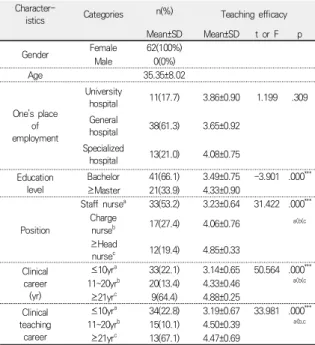
4.1 Participants’ general characteristics The participants' general characteristics are as follows: The clinical nursing instructors were aged 35.35 years on average, 41 of them (66.1%) had a bachelor's degree and 21 (33.9%) had a master's degree or higher education. 38 (61.3%) worked at general hospitals, 33 (53.2%) were staff nurses, 17 (27.4%) charge nurses, and 12 (19.4%) nurse managers or at higher positions(Table 1).

The nursing students were aged 24.30 years on average; 71 of them (81.6%) were female and 16 (18.4%) were male. 36 (41.4%) were third grade and 51 (58.6%) were second grade(Table 2).

Table 2. Nursing student’s clinical practice satisfaction of general characteristics (N=87)

Characteristics Categories n(%) Clinical practice satisfaction Mean±SD t or F p

Gender Female 71(81.6) 3.69±0.43 -.109 .914

Male 16(18.4) 3.70±0.58

Age 24.3±4.20

Grade 2nd 36(41.4) 3.65±0.45 -.708 .481

3rd 51(58.6) 3.72±0.47

One's place of employment

University

hospital 9(10.3) 3.71±0.35 1.489 .231 General

hospital 54(62.1) 3.75±0.45 Specialized

hospital 24(27.6) 3.56±0.50

4.2 Clinical nursing instructors’ teaching efficacy of general characteristics

The results of measuring and analyzing the differences in teaching efficacy by the general characteristics are as presented in Table 1. The higher the education and position and the longer the clinical career and clinical teaching career, the higher the teaching efficacy. In other words, those who had a master's degree or higher education rather than the university graduates (F=-3.901, p=.000), who were at a higher position (F=31.422, p=.000) and who had longer clinical career (F=50.564, p=.000) showed higher teaching efficacy. No significant difference was found in teaching efficacy by the size of the hospital at which they were employed such as university hospitals, general hospitals, and specialized hospitals (F=1.199, p=.309). They scored an average of 3.77±0.89 for teaching efficacy in general. The score for specialized hospitals was highest (4.08±0.75), followed by university hospitals (3.86±0.90) and general hospitals (3.65±0.92)(Table 1).

The analysis of teaching efficacy in terms of

the sub-category in CNITEs obtained the results

as presented in Table 2. They scored highest for

clinical skill instruction (3.97±0.93), followed by

student instruction (3.85±0.87), clinical judgment

(6)

(3.83±0.97), interpersonal relationship and communication (3.79±0.93), application of teaching and learning (3.67±0.98), and teaching improvement (3.64±0.92)(Table 3).

Table 3. The mean of sub-areas of clinical nursing instructors' teaching efficacy (N=62)

Teaching efficacy factor Mean±SD

Student instruction 3.85±0.87

Teaching improvement 3.64±0.92

Application of teaching and learning 3.67±0.98 Interpersonal relationship & communication 3.79±0.93

Clinical judgement 3.83±0.97

Clinical skill instruction 3.97±0.93 Total teaching efficacy 3.77±0.89

4.3 Nursing students’ clinical practice satisfaction The results of measuring and analyzing nursing students' clinical practice satisfaction are presented in Table 3. They scored an average of 3.69±0.46 out of 5 for clinical practice satisfaction. Of the sub-category, the score for practice subjects was highest (3.98±0.60), followed by nursing instruction (3.70±0.59), practice evaluation (3.69±0.46), practice hours (3.66±0.66), practice environment (3.62±0.84), and practice contents (3.57±0.46)(Table4).

Table 4. Students’ clinical practice satisfaction (N=87)

clinical practice satisfaction Mean±SD

Subject satisfaction 3.98±0.60

Contents satisfaction 3.57±0.46

Instruction satisfaction 3.70±0.59 Environment satisfaction 3.62±0.84

Practice hours 3.66±0.66

Practice evaluation 3.69±0.46

Total satisfaction 3.69±0.46

4.4 Correlation between clinical nursing instructors’

teaching efficacy and nursing students’ clinical practice satisfaction

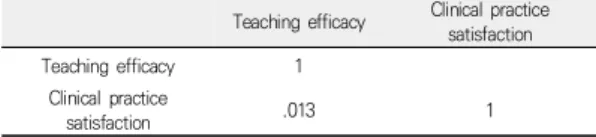
Pearson’s correlation coefficient was used to determine the correlation between clinical nursing instructors' teaching efficacy and nursing students' clinical practice satisfaction, and the results are presented in Table 4.

Clinical nursing instructors' teaching efficacy and nursing students' clinical practice satisfaction were not statistically significant. (r=0.13, p=.749)(Table 5).

Table 5. Correlation between teaching efficacy and satisfaction with clinical practice (N=149)

  Teaching efficacy Clinical practice satisfaction

Teaching efficacy 1

Clinical practice

satisfaction .013 1

5. Discussion

Quality nursing education based on clinical practice is important for nursing student who would become professional nurse. This study aim was to confirm clinical nursing instructors' teaching efficacy and students' clinical practice satisfaction. This study conducted the variation in clinical nursing instructors' teaching efficacy by their general characteristics, by the sub-category in CNITEs, and clinical training satisfaction among the nursing students trained by them.

In terms of the general characteristics, the older and the higher the education level and position, and the longer the clinical career and teaching career, the higher the teaching efficacy of the subject. Because nurse managers serve principally as a field trainer responsible for clinical training[8], it is presumed that the older and the more educated the managers are, the higher the teaching efficacy they have. In addition, the longer the clinical career and career in clinical nursing instruction of a person, the higher one’s teaching efficacy and the longer one’s clinical career enables one to be skilled in nursing[12,13] and to confidently teach nursing skills in clinical practice.

The factors for nurses' teaching efficacy in

clinical training were relationships with a clinical

instructor, job satisfaction and that the older, the

(7)

longer the career they had, and the higher the position they had, the higher their teaching efficacy[16]. The older the clinical nursing instructors were, the higher the position they had; the longer the career as a preceptor they had and the more likely they were to hope to be a preceptor, the higher their teaching efficacy was, which affected the clinical training environment, enabling students to be trained in a comfortable environment[17]. As for residents in charge of clinical training at medical school, the more time they spent participating in clinical training, the higher the teaching efficacy they had and the better at controlling leadership and instructional strategies they became[18]. The more likely they were to be satisfied with participation in student education and to think that students knew the goal of training, the higher the teaching efficacy, which exerted an impact on confidence in major-related knowledge, as well as on leaderships for students.

The only general characteristic making no difference in teaching efficacy was the size of the hospital at which they were employed. For the size, the hospitals were divided into university, general, and specialized hospitals. Teaching efficacy differed by a diversity of experiences and careers, as well as by technical skills rather than by the size of workplace. It is necessary to identify the characteristics related to clinical nursing instructors' teaching efficacy by expanding the distribution of the subjects in terms of the variation in the general characteristics, such as the size of hospital.

An attempt was made to investigate teaching efficacy in terms of such sub-category in CNITEs as student instruction, teaching improvement, application of teaching and learning, interpersonal relationships and communication, clinical judgment, and clinical skill instruction. As for the sub-factors in CNITEs, the factor of student

instruction is mainly composed of items concerning student evaluation competence, self-control as an instructor, and student performance evaluation and includes belief in the method of guiding clinical training efficiently; that of teaching improvement contains items concerning self-development for clinical nursing instruction, preparation for and coping with clinical training, and belief in the possibility of teaching instruction methods; that of application of teaching and learning belongs to the area of teaching methods and contains individualized nursing instruction, teaching the combination of theory and practice, teaching methods based on a clinical situation, specific knowhow in guiding clinical training, and guidance for clinical data analysis; that of interpersonal relationships and communication is composed of intimacy, enthusiasm, and tolerance in the process of communication with others during nursing instruction and self-reflection following nursing instruction; that of clinical judgment is composed of items concerning the ability to coping with risky situations, the ability to determine situations, and cases requiring clinical judgment; and that of clinical skill instruction contains belief in the possibility of allowing students to experience skill instruction personally[4]. As for each of these factors, the older and the higher the education level and position of a person, and the longer the clinical career, the higher teaching efficacy.

Inexperienced nurses can transfer what they have

learned from textbooks to skilled knowhow in

professional practice. Restrictions are placed on

the attempt to interpret and analyze information

from patients constantly, or to make clinical

reasoning about every change with time, even

during the course of treatment to recognize and

identify patients' problems and manage them

more effectively. The more the clinical

experiences, the more the skillfulness in

(8)

systematic knowledge based on the knowledge accumulated through the experiences.

If these experienced nurses take charge of clinical nursing instruction for nursing students, they can make more exchanges with students and give personal clinical skill instruction more effectively[19]. It is therefore necessary to designate experienced nurses as field nurses qualified with leadership through qualification training related to clinical nursing education and allow them to assume full charge of clinical training so that they can give personal nursing instruction.

Students’ clinical training satisfaction was also investigated to reflect the objective evaluation of clinical nursing instructors' teaching variables.

While the characteristics of clinical nursing instructors' work in shift prevent nursing students from having the same instructor during the period of training, making it impossible to make an absolute comparison of clinical nursing instructors' teaching efficacy and nursing instruction satisfaction[20].

Correlation between clinical nursing instructors' teaching efficacy and nursing students' clinical practice satisfaction was determined and was found to be statistically insignificant. This implies that students' clinical training satisfaction has such sub-factors as training subject satisfaction, training content satisfaction, clinical nursing instruction satisfaction, training environment satisfaction, training hour satisfaction, and training evaluation satisfaction and that clinical nursing instructors' teaching efficacy has no significant.

If teaching efficacy serves as a quality of successful teaching, the results of successful clinical training management by high-efficacy teachers would be reflected in students' satisfaction with teaching. However, clinical training is characterized by a situation in which a student is trained by several clinical nursing instructors, instead of getting one-to-one training,

in a single hospital, and this factor seems to have been reflected in the results. In practice, clinical trainees can hardly be trained by only one clinical nursing instructor because instructors work on shifts. Therefore, it appears that giving guidelines regarding clinical nursing instructors' exchange or teaching activities and education related to teaching activities can affect trainees' satisfaction with clinical nursing instruction.

Further research should be conducted on this issue. This study is significant in that it has determined the association between teaching efficacy related to instructors' capabilities and clinical training satisfaction, while previous studies confined variables related to nursing students' clinical training satisfaction to their inner aspects, such as emotional labor, clinical training stress, and critical thinking propensity[7,8]. However, as clinical training is characterized by a situation in which several students are trained by several clinical nursing instructors, it had limitations in determining the immediate correlation. Further research should be conducted on clinical nursing instructors' teaching efficacy and training satisfaction in one-to-one clinical training areas, such as community training and special part training.

It is expected that clinical nursing instructors' teaching efficacy will be used as an index by which instructors can create continuous self-development and efforts in teaching students and, on this basis, improve the quality of their clinical nursing instruction through role modeling, as well as through effective communication with students. However, this study surveyed one university in South Korea. Further research is needed for generalization.

6. Conclusion

The higher age at clinical practice, the higher

clinical efficacy of clinical practitioners with

(9)

clinical career and higher education level. In addition, students were more satisfied with the practice subject and nursing instruction than other categories. However, clinical nursing instructors' teaching efficacy failed to make a great contribution to higher students’ clinical practice satisfaction. Therefore, in order to improve the satisfaction of nursing students’

practice, it is necessary to improve various factors that can enhance the satisfaction of the practice as well as the teaching efficacy in the clinical field.

Consequently, it is expected to lay the ground for higher quality of clinical training as the basis for producing capable nurses required by clinical field.

REFERENCES

[1] N. C. Kaphagawan & U. Useh. (2013). Analysis of nursing students learning experiences in clinical practice: Literature review. Studies on Ethno-Medicine, 7(3), 181-185.

DOI: 10.1080/09735070.2013.11886459

[2] M. Gagné et al. (2015). The Multidimensional Work Motivation Scale: Validation evidence in seven languages and nine countries. European Journal of Work and Organizational Psychology, 24(2), 178-196.

DOI: 10.1080/1359432X.2013.877892

[3] C. Delany & E. Molloy. (2009). Clinical Education in the Health Professions : Churchill Livingstone Australi: Elsevier Health Sciences.

[4] I. Park & Y. O. Suh. (2018). Development of Teaching Efficacy Scale to Evaluate Clinical Nursing Instructors. Korean Journal of Adult Nursing, 30(1), 18-29.

DOI: 10.7475/kjan.2018.30.1.18

[5] N. Masruroh & A. D. Kurnia. (2018) Perception of Senior Nursing Student toward Clinical Preceptor’s Performance: Clinical Evaluation. International Journal of Caring Sciences, 11(3), 1731-1735.

[6] H. Admi, Y. Moshe-Eilon, D. Sharon & M. Mann.

(2018). Nursing students' stress and satisfaction in clinical practice along different stages: A cross-sectional study. Nurse education today, 68, 86-92.

DOI: 10.1016/j.nedt.2018.05.027

[7] K. J. Cho & H. S. Kang. (1984). A Study on Self-Concept and Satisfaction of Clinical Practice.

The Journal of Nurses Academic Society, 14(2), 63-74.

[8] J. D. Lee & C. S. Lee (2006). The Effects of Preceptorship on Nursing Students` Critical Thinking Propensity, Clinical Competency and Satisfaction of Clinical Practice. Journal of Korean Academy of Nursing Administration, 12(3), 434-443.

[9] J. J. Yang. (2009). The influencing factors on clinical competence of nursing students. The Journal of Korean Academic Society of Nursing Education, 15(2), 159-65.

DOI: 10.5977/JKASNE.2009.15.2.159

[10] L. L. Hsu, S. I. Hsieh, H. W. Chiu & Y. L. Chen. (2014).

Clinical teaching competence inventory for nursing preceptors: Instrument development and testing.

Contemporary Nurse. A Journal for the Australian Nursing Profession, 46(2), 214-224.

DOI: 10.5172/conu.2014.46.2.214

[11] P. Ashton, R. Webb & N. Doda. (1983). A study of teacher's sense of efficacy (Final report to the National Institute of Education, Executive Summary).

Gainesville: University of Florida.

[12] B. Happell. (2009). A model of preceptorship in nursing: reflecting the complex functions of the role.

Nursing Education Perspectives (National League for Nursing), 30(6), 372-376.

[13] L. Croxon & C. Maginnis. (2009). Evaluation of clinical teaching models for nursing practice. Nurse Education in Practice, 9(4), 236-243.

DOI: 10.1016/j.nepr.2008.06.004

[14] J. Cohen. (2013). Statistical power analysis for the behavioral sciences. Academic pres, 25-26 [15] S. Ko & E. Choi. (2017). Effect of team

debriefing in simulation-based cardiac arrest emergency nursing education. Korean Journal of Adult Nursing , 29(6), 667-676.

DOI: 10.7475/kjan.2017.29.6.667

[16] E. Kim. (2016). Teaching Efficacy on the Clinical Education in Nurses. Master’s dissertation.

Soonchunhyang University, Asan.

[17] Y. W. Lin, Y. C. Chen & Y. H. Kao. (2012). Effect of Self-Evaluation on Teaching Efficacy in Clinical Nursing Preceptors: An Example of a Medical Center in Northern Taiwan. Journal of Nursing & Healthcare Research, 8(1), 70-79.

[18] H. S. Yu. (2015). Relationship among Stress of

Clinical Practice, Practice Satisfaction and Clinical

Competence in Nursing Students. Journal of the

(10)

Korean Data Analysis Society, 17(2), 1129-1144.

[19] M. N. Elizabeth Kamolo BScN KRCHN & R. N.

Rachael Vernon, (2017). A Critical Review of Preceptor Development for Nurses Working with Undergraduate Nursing Students. International Journal Of Caring Sciences, 10(2), 1089-1100.

[20] S. H. Kim & E. K. Kim. (2015). The Influence of Teacher Efficacy upon Middle School Students.

Korean Education Inquiry, 33(3), 47-66.

박 인 희(Inhee Park) [정회원]

․ 2006년 2월 : 경희대학교 간호학과 (학사)

․ 2014년 2월 : 순천향대학교 일반대학원 간호학과(간호학 석사)

․ 2017년 2월 : 순천향대학교 일반대학원 간호학과(간호학 박사)

․ 2003년 3월 ~ 현재 : 신성대학교 간호학과 교수

․ 관심분야 : 아동간호, 간호교육, 시뮬레이션 교육

․ E-Mail : [email protected]

서 은 주(Eunju Seo) [정회원]

․ 2007년 2월 : 을지대학교 간호대학 (학사)

․ 2012년 2월 : 을지대학교 간호대학 (석사)

․ 2017년 2월 : 을지대학교 간호대학 (박사)

․ 2019년 9월 ~ 현재 : 배재대학교 간호학과 교수

․ 관심분야 : 간호관리, 환자안전, 스트레스

․ E-Mail : [email protected]

수치

Table 2. Nursing student’s clinical practice satisfaction  of  general  characteristics     (N=87)
Table 3. The mean of sub-areas of clinical nursing  instructors'  teaching  efficacy       (N=62)

참조

관련 문서

In this study, 1st and 2nd pilot studies was accomplished for revising evaluation standards and as a result, the procedure for implementing mathematics

The Effect of Shared Leadership on Voice and Knowledge Sharing Behavior: Creative Self-Efficacy and Change.. Self-Efficacy

Purpose: The present study was conducted to understand nursing students’ self-esteem, problem-solving ability, professionalism, and career identity, and to

Objective: The purpose of this study was to investigate the effect of clinical practice satisfaction on professional self-concept among dental hygiene students.. Methods:

A clinical and radiographic evaluation of fixed partial dentures (FPDs) prepared by dental school students: a retrospective study.. A retrospective analysis

Clinical and histomorph ometric evaluation of extraction sockets treated with an autologous bone marro w graft... Barone A, Aldini NN, Fini M, Giardino R, Calvo Guirado

Therefore, in order to improve student satisfaction and the quality of public education service, public education institutes should design education programs

Evaluation of prevalance and clinical impact for unknown origin hypereosinophilia patients.. By