비만치료에 있어서 중도탈락과 감량 후 체중유지에 영향을 주는 인자들에 대한 고찰
김서영, 박영재, 박영배 경희대학교 한의과대학 진단 ․ 생기능의학과학교실 Original Article
Review on predictors of dropout and weight loss maintenance in weight loss interventions
Seo-Young Kim, Young-Jae Park, Young-Bae Park
Department of Biofunctional Medicine & Diagnostics, College of Oriental Medicine, Kyung Hee University Objectives: Dropout and weight regain are common problems in most obesity treatments. The purpose of this study was to review previously published study results of the predictive factors associated with dropout during weight loss treatment and weight loss maintenance after successful weight loss.
Methods: Authors searched for the articles related to dropout and weight loss maintenance, published from 2007 to 2016 found on Pubmed, Scopus, RISS, and KISS. A total of 19 articles were finally selected. From the study results, unchangeable and changeable predictors were extracted, and these predictors were examined according to dropout and weight loss maintenance categories.
Results: The unchangeable predictors of dropout were younger age, lower education level and female, whereas the changeable predictors of dropout were lower initial weight loss, symptoms of depression and body dissatisfaction. The strongest factor for predicting the dropout was initial weight loss. The unchangeable predictors of weight loss maintenance were old age, male and family history of obesity, whereas the changeable predictors of weight loss maintenance were regular exercise, dietary restraint, self-weighing and low depressive symptoms. Initial weight loss, depressive symptoms, body image, dietary restraint, physical activity, weight loss expectation and social support were considered to be dominant factors for weight loss treatments.
Conclusions: Our review results suggest that unchangeable and changeable predictors of dropout and weight loss maintenance should be carefully examined during treatments of obesity.
Key Words : Dropout, Weight loss maintenance, Obesity treatment, Predictors, Factors
⋅Received:27 June 2016 ⋅Revised:28 September 2016 ⋅Accepted:29 September 2016
⋅Correspondence to:박영배(Young-Bae Park) 경희대학교 한의과대학 진단생기능의학과학교실
Tel:+82-2-958-9195, Fax:+82-2-958-8035, E-mail:[email protected]
최근 서구화된 생활 방식 , 고칼로리 식습관과 운 동부족 등 전반적인 신체활동량의 감소로 인해 전 세계적으로 비만과 과체중의 유병률은 증가하는 추 세이다
1)2). 우리나라에서도 꾸준히 증가하여 2014년
도 국민건강영양조사에 따르면 , 만 19세 이상 체질 량지수 25㎏/㎡이상인 비만인구가 1998년 26.0%에 서 2001년 29.2%, 2007년 31.7%로 증가한 후 최근 7년간 31~32% 수준을 유지하고 있다
3).
비만은 제 2형 당뇨병, 고혈압, 관상동맥 심장질
환, 관절염, 간 및 담낭질환, 특정 암의 발병률을
서 론높이며 , 이로 인한 사망률을 증가 시킨다
4)5). 비만 환자에서 체중감량 효과에 대해서는 많은 연구들 이 나와 있는데 , 1.5㎏의 체중감량으로 총 콜레스 테롤이 22.0 mg/dl, 저밀도 지단백-콜레스테롤이 22.1 mg/dl 감소하였고
6), 2-5%의 체중감량으로도 수축기 혈압을 감소시킴으로써 심혈관 질환의 위 험성이 감소되는 결과를 보였으며
8), 3㎏ 이상 체중 을 감량한 지방성 간질환 환자의 86%에서 ALT치 가 정상범위 내로 감소하였다
9).
체중감량이 질병의 위험요소들을 개선시킬 수 있음에도
6)7), 체중감량 프로그램을 성공적으로 완수 하고 , 감량한 체중을 장기적으로 유지하는 경우는 드물다 . 비만치료 프로그램의 중도 탈락률은 평균 37%로
10)체중감량시도에서 흔하게 발생하는 문제 이며
13), 체중감량에 성공한 후에도 약 1/3에서 1년 이내에 , 나머지는 3-5년 사이에 원래의 체중을 회 복하게 된다
11)12).
이에 본 연구에서는 10년간 보고된 국내외 논문 들을 대상으로 , 비만치료 시 중도탈락 및 체중감량 후 감량체중 유지에 영향을 주는 요인을 분석하였 다 . 그 후 중도탈락 및 체중유지 요인들을 다시 가 변 요인과 불변 요인으로 나누어 분석하였다 . 이를 통해 , 가변요인은 비만 치료 및 치료 후 감량체중 유지 시 적극적으로 활용함으로써 치료 효과를 높 이고 , 불변요인은 개인 특성에 따른 적절한 치료 기간과 감량 목표를 제시함으로써 개인의 특성에 맞는 효과적인 맞춤형 비만 치료 프로그램의 개발 을 위한 기초자료로 활용될 수 있을 것이다 .
연구방법
국내논문은 한국교육학술정보원에서 제공하는 RISS, KISS에서, 해외논문은 PubMed, Scopus에서 검색 하였다 . 검색 기간은 2007년부터 2016년 현재까지 최근 10년간의 기간을 설정하여 검색하였고, 검색 어는 ‘비만치료 요인’, ‘비만치료 인자’, ‘비만치료 효과 ’, ‘체중감량 요인’, ‘체중감량 인자’, ‘체중감량 효과 ’, ‘obesity treatment factor(s)’, ‘obesity treatment
predictor(s)’, ‘weight loss factor(s)’, ‘weight loss predictor(s)’를 사용하였다.
검색 필드 (search field)를 전체 분야(All field)로 설정하여 검색했을 때 , RISS에서 2,067개, KISS에 서 47개, PubMed에서 14,449개, Scopus에서 105,213 개가 검색되었다 . 주제와 직접 관련된 논문을 효과 적으로 수집하기 위하여 , 주 검색어(‘비만치료’, ‘체 중감량 ’, ‘obesity treatment’, ‘weight loss’)는 Title 로 검색하고 , 세부 검색어(‘요인’, ‘인자’, ‘효과’,
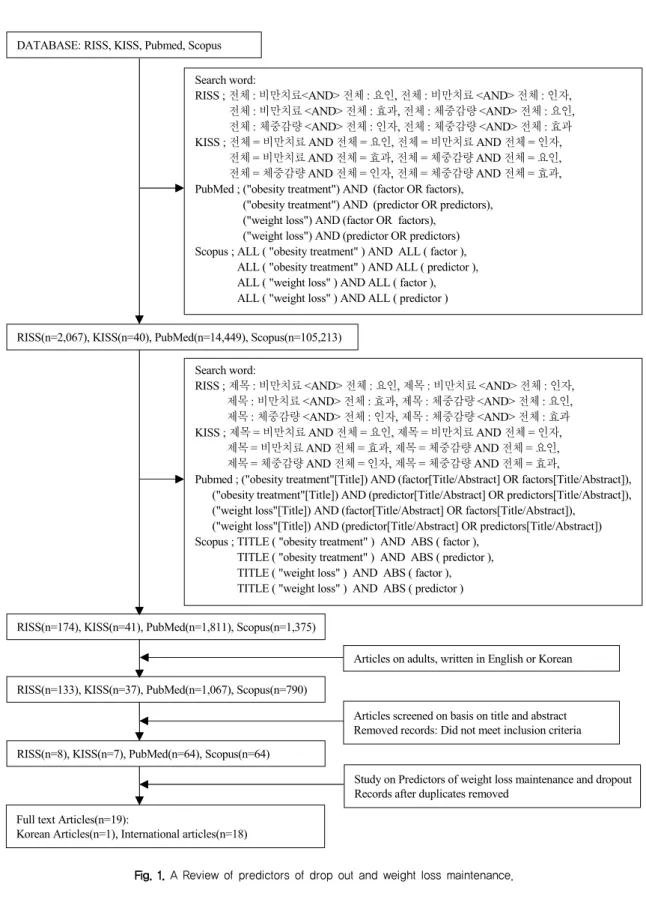
‘factor(s)’, ‘predictor(s)’)는 국내논문은 All field로 하되 , 해외논문은 Title/abstract 또는 abstract으로 범위를 좁혀 다시 검색하였다 . 검색된 국내논문 215편과 해외논문 3,186편 중 영어 또는 한국어가 아닌 논문을 제외하고 , 연구 대상을 성인으로 제한 한 다음 , 초록 및 본문을 검토하여 비만 치료에 영 향을 주는 요인을 주제로 한 논문을 검색하였으며 , 그 중 중도탈락과 감량 후 체중유지에 관련된 논 문을 선별한 결과 얻어진 총 19편의 국내외 논문 을 분석하였다 .
결과 및 고찰
1.
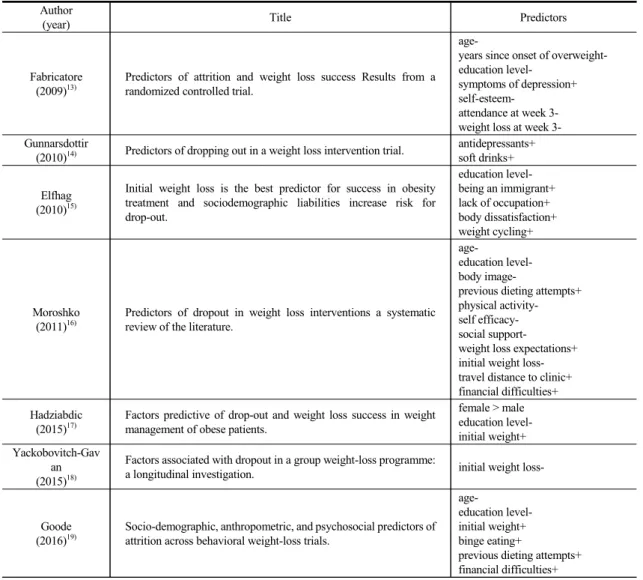
비만치료의 중도탈락에 영향을 주는 요인에 관한 연구(Table 1)
Fabricatore
13)는 약물 요법과 행동수정 요법을 병행하는 임상 시험에서 체중감량과 중도탈락의 예측인자를 조사하였다. 이를 위해 224명의 비만환 자들을 대상으로 sibutramine, lifestyle modification, sibutramine 투여 및 lifestyle modification 병행, sibutramine 및 brief therapy 병행 4그룹으로 나누 어 52주간 치료를 시행하였다. 측정도구는 Weight and Lifestyle Inventory (WALI; 2006)와 Beck Depression Inventory, Second Edition (BDI-II;
1996)을 사용하였다. 연구결과 전체 중도 탈락률은 17.4%, 체중감량 성공률(≥5% reduction in bodyweight) 은 52.2%였으며, sibutramine 투여 및 lifestyle modification 병행 그룹이 다른 그룹들에 비해 5%
이상 높은 체중 감량률을 보였다 . 나이가 젊을수
Study on Predictors of weight loss maintenance and dropout Records after duplicates removed
Search word:
RISS ; 전체 : 비만치료<AND> 전체 : 요인, 전체 : 비만치료 <AND> 전체 : 인자, 전체 : 비만치료 <AND> 전체 : 효과, 전체 : 체중감량 <AND> 전체 : 요인, 전체 : 체중감량 <AND> 전체 : 인자, 전체 : 체중감량 <AND> 전체 : 효과 KISS ; 전체 = 비만치료 AND 전체 = 요인, 전체 = 비만치료 AND 전체 = 인자, 전체 = 비만치료 AND 전체 = 효과, 전체 = 체중감량 AND 전체 = 요인, 전체 = 체중감량 AND 전체 = 인자, 전체 = 체중감량 AND 전체 = 효과, PubMed ; ("obesity treatment") AND (factor OR factors),
("obesity treatment") AND (predictor OR predictors), ("weight loss") AND (factor OR factors),
("weight loss") AND (predictor OR predictors) Scopus ; ALL ( "obesity treatment" ) AND ALL ( factor ), ALL ( "obesity treatment" ) AND ALL ( predictor ), ALL ( "weight loss" ) AND ALL ( factor ), ALL ( "weight loss" ) AND ALL ( predictor )
Search word:
RISS ; 제목 : 비만치료 <AND> 전체 : 요인, 제목 : 비만치료 <AND> 전체 : 인자, 제목 : 비만치료 <AND> 전체 : 효과, 제목 : 체중감량 <AND> 전체 : 요인, 제목 : 체중감량 <AND> 전체 : 인자, 제목 : 체중감량 <AND> 전체 : 효과 KISS ; 제목 = 비만치료 AND 전체 = 요인, 제목 = 비만치료 AND 전체 = 인자, 제목 = 비만치료 AND 전체 = 효과, 제목 = 체중감량 AND 전체 = 요인, 제목 = 체중감량 AND 전체 = 인자, 제목 = 체중감량 AND 전체 = 효과,
Pubmed ; ("obesity treatment"[Title]) AND (factor[Title/Abstract] OR factors[Title/Abstract]), ("obesity treatment"[Title]) AND (predictor[Title/Abstract] OR predictors[Title/Abstract]), ("weight loss"[Title]) AND (factor[Title/Abstract] OR factors[Title/Abstract]),
("weight loss"[Title]) AND (predictor[Title/Abstract] OR predictors[Title/Abstract]) Scopus ; TITLE ( "obesity treatment" ) AND ABS ( factor ),
TITLE ( "obesity treatment" ) AND ABS ( predictor ), TITLE ( "weight loss" ) AND ABS ( factor ), TITLE ( "weight loss" ) AND ABS ( predictor )
RISS(n=174), KISS(n=41), PubMed(n=1,811), Scopus(n=1,375)
RISS(n=133), KISS(n=37), PubMed(n=1,067), Scopus(n=790)
RISS(n=8), KISS(n=7), PubMed(n=64), Scopus(n=64) DATABASE: RISS, KISS, Pubmed, Scopus
RISS(n=2,067), KISS(n=40), PubMed(n=14,449), Scopus(n=105,213)
Full text Articles(n=19):
Korean Articles(n=1), International articles(n=18)
Articles screened on basis on title and abstract Removed records: Did not meet inclusion criteria Articles on adults, written in English or Korean
Fig. 1. A Review of predictors of drop out and weight loss maintenance.
Table 1. Study on Predictors of Dropout during Weight Loss Treatment.
Author
(year) Title Predictors
Fabricatore (2009)13)
Predictors of attrition and weight loss success Results from a randomized controlled trial.
age-
years since onset of overweight- education level-
symptoms of depression+
self-esteem- attendance at week 3- weight loss at week 3- Gunnarsdottir
(2010)14) Predictors of dropping out in a weight loss intervention trial. antidepressants+
soft drinks+
Elfhag (2010)15)
Initial weight loss is the best predictor for success in obesity treatment and sociodemographic liabilities increase risk for drop-out.
education level- being an immigrant+
lack of occupation+
body dissatisfaction+
weight cycling+
Moroshko (2011)16)
Predictors of dropout in weight loss interventions a systematic review of the literature.
age-
education level- body image-
previous dieting attempts+
physical activity- self efficacy- social support-
weight loss expectations+
initial weight loss- travel distance to clinic+
financial difficulties+
Hadziabdic (2015)17)
Factors predictive of drop-out and weight loss success in weight management of obese patients.
female > male education level- initial weight+
Yackobovitch-Gav an (2015)18)
Factors associated with dropout in a group weight-loss programme:
a longitudinal investigation. initial weight loss-
Goode (2016)19)
Socio-demographic, anthropometric, and psychosocial predictors of attrition across behavioral weight-loss trials.
age-
education level- initial weight+
binge eating+
previous dieting attempts+
financial difficulties+
(+; positive correlation, -; negative correlation, < >; the sign of inequality)
록 , 비만 년 수가 짧을수록, 교육 수준이 낮을수록, 자존감이 낮고 우울도가 높을수록 중도 탈락률이 증가하였으며 , 초기 3주 동안의 체중 감량률과 참 석률이 높을수록 탈락률이 확연히 감소하였다 .
Gunnarsdóttir
14)는 체중감량을 위한 식이 중재 프로그램에서의 중도탈락과 관련된 예측인자를 연 구하였다 . 이를 위해 8주 동안 140명의 비만 참가 자들을 총 에너지섭취의 30%는 지방, 50%는 탄수 화물 , 20%는 단백질과 식이섬유에서 공급받도록
설계하여 , 남성은 평균 1,706 kcal/day, 여성은 평 균 1,354 kcal/day를 섭취하는 칼로리 제한 식이를 시행하였다 . 실험 전 신체계측, lifestyle 설문, 음식 섭취성향과의 연관성을 조사한 결과 , 전체 중도 탈 락률은 18.4%로 나타났으며, 평소 항우울제를 복 용하거나 청량음료를 자주 섭취할수록 중도 탈락 률이 높았다 .
Elfhag
15)은 247명의 비만 환자를 대상으로 6개
월간의 행동수정요법 후 체중감량 및 중도탈락과
관련된 요인을 분석하였다 . 연구 결과, 전체 중도 탈락률은 63%이었으며, 중도탈락의 가장 중요한 예측인자는 교육수준이었다 . 그 외에도 이민자, 무 직 상태 , 신체 불만족, 과거 체중감량 시도가 적었 던 것이 중도탈락 예측인자로 보고되었다 .
Moroshko
16)는 60년대 중반부터 2011년 5월 이 전까지 출판된 비만치료관련 논문 중 , 중도탈락과 관련된 요인들을 다룬 61개의 논문들을 분석하였 다 . 그 결과, 고령, 고학력일수록 탈락률이 낮았으 며 , 비만상태에 대한 불만족, 장기간 체중감량시도, 낮은 신체 활동성 , 취약한 사회적 지원(social support), 높은 감량 기대감 , 초기 저조한 감량 결과 및 경제 적 부담 시 탈락률이 높았다 .
Hadžiabdić
17)은 중도탈락 관련 예측 인자들을 연구하기 위해 비만 환자 124명을 대상으로 지중 해식 및 표준 저지방 식이요법을 1년간 시행하였 다 . 이와 함께 하루 30분 걷기의 행동 수정요법을 실시한 후 , 사회 인구학적, 신체계측적, 임상적 특 징을 조사하였다 . 연구 결과, 전체적인 체중감량 성공률 (≥5% reduction in the initial weight)은 33.1%, 중도 탈락률은 32.3%였으며, 남성보다 여 성에서 , 교육수준이 낮을수록, 초기 비만도가 높을 수록 중도탈락률이 높은 것으로 나타났다 .
Yackobovitch‐Gavan
18)은 비만환자 587명을 대상 으로 10주간 체중감량 치료 프로그램을 시행한 후 중도탈락과 관련된 요인을 분석하였다 . 연구결과, 초기 2주 동안의 저조한 체중 감량 결과가 중도탈 락의 가장 강력한 (strongest) 예측인자였다. 초기 2 주 동안 평균 체중감량은 치료완수 군에서 0.45-0.50 BMI units, 중도탈락 군에서 0.25-0.30 BMI units으로 나타났다.
Goode
19)는 식이 및 신체활동 수정 중재 시험에 참가한 비만환자 504명을 대상으로, 중도탈락의 인 구통계학적 , 신체계측적, 심리사회적 예측인자를 연구하였다 . 연구 결과, 전체 중도탈락률은 19.4%
였으며 , 예측인자로는 높은 초기 비만도, 폭식 습 관 , 잦은 체중감량 시도, 젊은 나이, 낮은 교육 수 준 , 경제적인 부담으로 나타났다.
2.
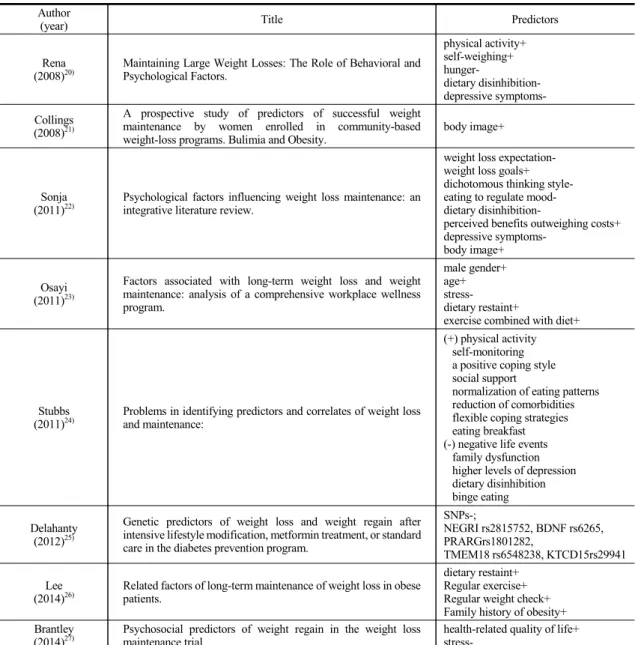
체중감량 후 유지에 영향을 주는 요인에 관한 연구(Table 2)
Wing
20)은 감량 후 체중유지와 관련된 행동, 심 리 요인들에 대하여 연구하였다 . 이를 위해 최근에 체중의 10%이상을 감량했던 비만 환자 261명을 대상으로 18개월간 체중 변화와 신체 활동, 식이 규제, 자가 체중 측정 관리, 우울 정도와의 상관성 을 조사하였다 . 참가자들을 face-to-face, Internet, 대 조군의 3 그룹으로 나눈 후 Paffenbarger Questionnaire, Block Food Frequency Questionnaire, Eating Inventory, Frequency of weighing를 사용하여 평가하였다. 연 구 결과 , 신체 활동량과 자가 체중 측정 관리가 감 량 후 체중유지와 강하게 관련된 것으로 나타났으 며 , 우울 증상, 식이 규제와도 유의한 연관성이 있 는 것으로 나타났다. 특히, face-to-face 그룹이 internet 그룹과 대조군 그룹에 비하여 신체 활동, 자가 체중 측정 관리, 식이 규제가 확연히 잘 지속 되었으며 , 체중유지도 잘 되었다는 것이 중요한 발 견이라는 결론을 얻었다.
A. S. Collings
21)는 감량 후 체중유지의 심리적 예측인자 특히 신체 이미지, 우울 증상, 자존감을 조사하였다 . 이를 위해 73명의 여성 비만환자들을 대상으로 비만치료 프로그램에 참여 하기 전, 참여 후 3 개월, 12 개월에 각각 우울증, 자존감 및 신체 이미지를 측정 하였다. 측정도구는 Multidimensional Body Self-Relations Questionnaire (MBSRQ), Body Image Assessment for Obesity (BIA-O), Body Image Avoidance Questionnaire (BIAQ), Center for Epidemiologic Studies Depression Scale (CES-D)를 사용하였다. 연구결과 평소 부정적인 신체이미지 즉, 자신을 현실보다 더욱 비만한 것으 로 인식할수록 감량 후 체중유지가 잘 되지 않는 것으로 나타났으며, 우울 증상과 자존감은 이 연구 에서는 유의한 연관성이 나타나지 않았다 .
Sonja
22)는 감량 후 체중유지에 영향을 미치는
심리 요인들에 대해 2003년에서 2009년 사이에 연
구된 논문 25편을 조사하였다. 연구 결과, 비현실
적인 체중 감량 기대치 , 감량 목표치 도달에의 실 패 , 이분법적인 사고방식, 감정에 따른 식사, 탈억 제성 식이는 감량 후 체중유지 실패와 관련되어 있으며 , 식이의 꾸준한 규제와 높은 비용대비효과 만족도 , 안정적이고 낮은 수준의 우울 증상, 긍정 적인 신체이미지가 체중유지 성공과 관련되어 있 었다 .
Osayi
23)는 89,746명의 비만 환자를 대상으로 장 기적인 체중감량 및
체중유지와 관련된 요인들을 연구하기 위해 인구통계자료 , 개선된 영양, 개선된 운동 및 감소된 스트레스와 체중감량 및 1년 후속 기간 동안의 체중유지와의 연관성을 조사하였다 . 연구결과 , 성공적인 체중유지와 관련된 요인으로는 남성 , 높은 연령(57+>48-56>39-47), 감소된 스트레 스 , 개선된 영양이 있었으며 운동의 증가는 개선된 영양과 병행되었을 때 연관성이 있는 것으로 나타 났다 .
Stubbs
24)는 체중감량 및 감량 후 체중유지와 관 련된 연구 문헌들을 토대로 긍정적 요인과 부정적 요인으로 나누어 분석하였다 . 체중유지에 있어서 긍정적인 예측인자는 신체활동 , 자가 모니터링, 긍 정적인 대처 스타일 , 사회적 지지, 절제된 식이, 동 반 질환의 감소가 있었으며 , 부정적인 예측인자는 부정적인 사건이나 가족의 기능상실 등의 정신적 스트레스 , 높은 수준의 우울 증상, 탈억제성 식이, 폭식 등이 있었다 .
Delahanty
25)는 감량 후 체중재증가와 관련된 유 전적 요인을 조사하기 위해 3,234명의 비만 환자 를 대상으로 16개의 비만 성향 단일 염기 유전자 다형성과의 연관성을 시험하였다 . 연구결과, NEGRl rs2815752, BDNF rs6265, PPARG rsl801282 보유 환자는 치료 방법에 상관없이 , TMEM18 rs6548238 및 KTCD15 rs29941 보유 환자는 치료방법에 따 라 , 감량 후 체중재증가와 연관성이 있는 것으로 나타났다 .
이
26)는 비만환자 104명을 대상으로 체중감량 및 감량 후 장기간의 체중유지에 관련된 요인을 조사 하였다 . 연구 결과, 식습관 개선, 규칙적인 운동,
주기적인 자가 체중 측정 , 비만의 가족력이 감량 후 체중유지와 관련된 요인으로 나타났다 .
Brantley
27)는 감량 후 체중유지의 심리사회적 예 측인자를 연구하였다 . 이를 위해 참가자 1025명을 Personal Contact group, Interactive Technology group, Self-Directed group으로 나누어 평가하였다.
연구결과 , 건강 관련 삶의 질 점수가 높을수록 감 량 후 체중유지가 잘 되었으며 , 스트레스, 운동 및 식사에 대한 격려 점수가 높을수록 유지가 잘 되지 않은 것으로 나타났다 . 3그룹 중 Personal Contact group이 Interactive Technology group과 Self-Directed groups 모두에 비하여 체중유지가 잘 된 것으로 나타나 대면 접촉 관리가 감량 후 체중 유지에 중 요한 영향을 준다는 결론을 얻었다 .
Abilso
28)는 감량 후 체중유지에 영향을 주는 행 동 요인들을 연구하기 위해 체중관리 프로그램에 참여했던 450명의 비만환자들을 대상으로 설문조 사를 시행했다 . 연구결과, 매주 규칙적인 자가 체 중 측정 , 야식 제한, 한 끼 식사분량의 제한, 매일 충분한 신체 활동이 체중 감량유지와 관련된 요인 으로 나타났다 .
Nikolić
29)은 비만 수술을 받은 환자들의 초기 체 중감량이 이후의 체중 유지를 예측할 수 있는지 연구하였다 . 이를 위해 비만 수술을 받은 총 80명 의 비만환자를 대상으로 연구한 결과 , 초기 1-3개 월간의 체중감량 결과가 1년 후의 체중 유지를 예 측하는 인자로 나타났다 .
Santos
30)는 감량 후 체중유지의 심리 , 행동 예측 인자를 연구하였다 . 이를 위해 1년 간 체중감량 시 험에 참여하고 , 2년 간 추적 검사를 받은 154명의 여성 비만환자를 대상으로 운동의욕 , 정신적 건강 도 , 식이 행동 및 식습관, 신체 활동 등의 행동, 심 리 변수들을 조사하였다 . 연구 결과, 신체 이미지 (body image)가 좋을수록, 자발적인 운동 의욕이 높을수록 감량 후 장기간의 체중유지가 잘 되는 것으로 나타났다 .
Ross
31)는 감량 후 체중유지와 일주기 유형 및
수면의 질과의 연관성을 조사하기 위해 아침형 -저
Table 2. Study on Predictors of Weight Loss Maintenance after Successful Weight Loss Author
(year) Title Predictors
Rena
(2008)20) Maintaining Large Weight Losses: The Role of Behavioral and Psychological Factors.
physical activity+
self-weighing+
hunger-
dietary disinhibition- depressive symptoms- Collings
(2008)21)
A prospective study of predictors of successful weight maintenance by women enrolled in community-based
weight-loss programs. Bulimia and Obesity. body image+
Sonja
(2011)22) Psychological factors influencing weight loss maintenance: an integrative literature review.
weight loss expectation- weight loss goals+
dichotomous thinking style- eating to regulate mood- dietary disinhibition-
perceived benefits outweighing costs+
depressive symptoms- body image+
Osayi (2011)23)
Factors associated with long-term weight loss and weight maintenance: analysis of a comprehensive workplace wellness program.
male gender+
age+
stress- dietary restaint+
exercise combined with diet+
Stubbs
(2011)24) Problems in identifying predictors and correlates of weight loss and maintenance:
(+) physical activity self-monitoring a positive coping style social support
normalization of eating patterns reduction of comorbidities flexible coping strategies eating breakfast (-) negative life events family dysfunction higher levels of depression dietary disinhibition binge eating
Delahanty (2012)25)
Genetic predictors of weight loss and weight regain after intensive lifestyle modification, metformin treatment, or standard care in the diabetes prevention program.
SNPs-;
NEGRI rs2815752, BDNF rs6265, PRARGrs1801282,
TMEM18 rs6548238, KTCD15rs29941
Lee
(2014)26) Related factors of long-term maintenance of weight loss in obese patients.
dietary restaint+
Regular exercise+
Regular weight check+
Family history of obesity+
Brantley (2014)27)
Psychosocial predictors of weight regain in the weight loss maintenance trial
health-related quality of life+
stress- Abildso
(2014)28) Predictors of weight loss maintenance following an insurance -sponsored weight management program.
Self-weighing+
dietary restaint+
physical activity+
Nikolić (2015)29)
Initial weight loss after restrictive bariatric procedures may predict mid-term weight maintenance: Results from a 12-month
pilot trial. Initial weight loss+
Santos
(2015)30) Predicting long-term weight loss maintenance in previously
overweight women: A signal detection approach. body image+
exercise autonomous motivation+
Ross
(2016)31) Successful weight loss maintenance associated with morning
chronotype and better sleep quality. morning chronotype+
sleep quality+
(+; positive correlation, -; negative correlation, < >; the sign of inequality)
Table 3. Predictors of Drop-out and Weight loss Maintenance.
Process Changeable predictors Unchangeable predictors
drop out
Initial weight loss-13)16)18) depressive symptoms+13)14)16) body image-13)15)16) binge eating+19) soft drink+14) physical activity+16) weight loss expectation+16) social support-16) Initial attendance-13)
education level-13)15)16)17)19)
age-13)16)19)
finantial difficulties+15)16)19) previous weight loss attempts+16)19)-15) Initial weight+17)19)
female > male17)
weight maint- enance
Regular exercise·physical activity+20)23)24)26)28)30)
hunger20)dietary restraint+20)22)23)24)26)28)
self-weighing·self-monitoring+20)24)26)28)
depressive symptoms20)22)24) stress+23)24)27)
body image+21)22)30)
health-related quality of life+24)27) positive coping strategies+22)24) morning chronotype+32) sleep quality+31) weight loss expectation-22) Initial weight loss+29) social support+24) weight loss goal+22) benefits outweighing costs+22)
age+23) male > female23)
Family history of obesity+26) SNPs-25)
(+; positive correlation, -; negative correlation, < >; the sign of inequality)
녁형 설문지(Morningness–Eveningness Questionnaire:
MEQ) 및 피츠 버그 수면 질 지수 점수를 평가하였 다 . 연구 결과, 아침형 유형(일찍 자고 일찍 일어 남 )을 가지면서 수면 시간이 충분하고 수면의 질이 좋은 경우 감량 후 체중유지가 더 잘 되는 것으로 나타났다 .
3.
비만치료에 있어서 중도 탈락 및 감량 후 체중 유지에 영향을 주는 불변,
가변 요인(Table 3) 비만치료에 있어서 중도탈락 및 감량 후 체중 유지와 관련된 요인에는 각각 유전적 요인, 생리적 요인 , 심리적 요인, 식이 행동 요인, 사회 인구학적 요인, 치료 관련 요인 등의 다양한 요인들이 있었 다 . 이것을 다시 크게 두 가지 종류 즉, 체중감량 및 감량 후 체중유지 시 적극적으로 활용함으로써 치료 효과를 높일 수 있는 가변요인과 환자 개인 특성에 맞는 적절한 치료 기간과 감량 목표를 제
시하는 예후 설정의 근거가 될 수 있는 불변요인 으로 분류하였다 .
비만치료에 있어서 중도 탈락에 영향을 주는 주
요 요인에는 초기의 저조한 체중 감량 결과 , 우울
증후 , 부정적인 신체 이미지 등의 가변요인과 낮은
교육수준 , 젊은 연령, 경제적 부담감 등의 불변요
인이 있었다 . 그 중 초기의 저조한 체중 감량 결과
가 중도 탈락의 가장 강력한 예측 요인이었다 .
Fabricatore
13)는 초기 3주 동안의 성공적인 체중감
량 결과가 중도탈락을 막고 지속적으로 비만치료
에 동기를 부여하는 중요 요인이라고 보고하였다 .
Moroshko
16)는 1960년대에서 2011년까지의 중도탈
락 관련요인에 대한 문헌연구를 통해 , 초기의 저조
한 체중감량이 중도 탈락의 예측인자였다고 제시
하였다 . Yackobovitch‐Gavan
18)역시 초기 3주 동안
의 체중 감량이 전체 10주간의 비만치료에 있어서
매 주마다의 중도탈락을 예측하는 가장 강력하고
(strongest) 독립적인(independent) 예측 인자라고
보고하였다 .
교육 수준은 대학교육을 기준으로 나누어 분석 했으며 , 대졸이상에서 중도탈락률이 유의하게 낮았 다 . Fabricatore
13)는 고등 졸업 이하 , 대학 중퇴, 대 학교 졸업 , 석사 학위 이상으로 분류하여 분석하였 으며 , 대학중퇴 또는 대학졸업과 고등 졸업 이하간 의 유의한 차이가 나타났고 대학교육과 석사 사이 에는 유의한 차이가 없었다 . Elfhag
15)은 치료를 완 수한 사람들 중 대학 교육을 받은 사람의 비율은 39%인데 비해 중도 탈락한 사람들 중의 비율은 19%로 나타났다. Hadziabdic
17)도 대학 교육을 받 은 사람들이 치료를 완수한 사람들 중의 41.0%였 던 반면 , 중도 탈락한 사람들 중의 21.1%를 차지 하여 상대적으로 낮게 나타났다 .
연령과의 연관성에 대한 연구 결과는 공통적으 로 30대에서 50대까지의 비만환자들을 대상으로 하여 연령에 따른 탈락률의 유의한 차이가 있었다 는 결론을 얻었다 . Fabricatore
13)의 연구에서는 연 령 (43.8±10.2)이 증가할 때마다 탈락률이 5% 감소 한다는 결과를 얻었다 . Goode
19)의 연구에서는 치 료완수 그룹에서의 연령 (48.20±9.23)이 중도탈락 그룹의 연령 (43.89±11.04)보다 유의하게 높았다.
체중 감량 후 유지에 영향을 주는 주요 요인으 로 규칙적인 운동과 지속적인 식이 규제 , 주기적인 자가 체중 측정이 있었으며 그 다음으로 낮은 우 울 증후 , 낮은 스트레스, 긍정적인 신체 이미지 등 의 가변 요인이 있었다 . 그 외 불변 요인으로 높은 연령 , 남성, 비만의 가족력 등이 있었다.
그 중 규칙적인 운동 및 신체 활동이 감량 후 체중 유지의 중요 요인이라는 연구 결과가 가장 많았다 . Wing
20)은 계단 오르기 , 걷기, 스포츠 활동 등 일주일간 소비한 신체 에너지를 평가한 후 , 신 체 활동량이 체중 감량 후 유지의 중요한 예측 요 인이라는 결과를 얻었다 . Osayi
23)는 식이 개선과 규칙적인 운동의 병행이 감량 후 체중 유지의 예 측인자라고 제시하였다 . 이
26)는 규칙적인 운동을 한다는 경우가 체중을 유지한 그룹의 63%, 체중이 다시 증가한 그룹의 30.2%로 유의한 차이를 보였
으며 , 체중을 유지한 그룹의 운동 빈도는 주당 평 균 4.3회, 총 운동 시간은 주당 평균 254.1분인 반 면 체중이 다시 증가한 그룹의 운동 빈도는 주당 평균 2.9회, 총 운동 시간은 주당 평균 173.1분 이 었다 . Santos
30)의 연구에서는 자발적 운동의욕이 높을수록 감량 후 체중유지가 유의하게 잘 된 것 으로 나타났다 .
지속적인 식이규제는 아침식사를 포함한 규칙적 인 식사 , 하루 섭취 총 칼로리의 제한, 한 끼 식사 분량의 제한 , 야식 및 간식 횟수 제한, 지방 섭취 제한 등이 있었다 .
환자 관리 방식 또한 감량 후 체중유지에 중요 한 요소로 나타났는데 , Wing
20)과 Brantley
27)의 연 구에서 공통적으로 치료자와 직접적인 대면 접촉 관리 (face-to-face) 그룹이 인터넷, 또는 전화 상담 과 같은 간접적인 관리 그룹에 비해 규칙적인 운 동 , 꾸준한 식이 관리, 주기적인 체중 측정이 잘 지속되었으며 감량 후 체중유지가 잘 되었다 .
이상의 결과를 바탕으로 비만치료 시 중도탈락 과 감량 후 체중재증가에 영향을 주는 공통 요인 은 초기의 저조한 체중 감량 결과 , 우울 증후, 부 정적인 신체 이미지 , 식이 규제와 신체 활동량의 감소 , 비현실적인 체중 감량 기대치, 사회적 지지 부족 , 낮은 연령, 여성의 경우로 요약될 수 있다.
이러한 요인들은 체중감량 단계에서부터 감량 후 체중유지까지 영향을 주므로 지속적으로 예의 주시 하여야 할 주요한 요인이라고 볼 수 있다 .
결 론
비만치료의 중도탈락에 영향을 주는 주요 요인 으로 치료 초기의 저조한 체중감량 결과 , 우울 증 후 , 신체불만족과 관련된 부정적인 신체상 등의 가 변요인과 , 낮은 교육수준, 젊은 연령, 경제적 부담 등의 불변 요인이 있었다 .
감량 후 성공적인 체중유지를 위해서는 주당 평
균 4회, 평균 250분 이상의 규칙적인 운동과 아침
식사를 포함한 규칙적인 식사 , 야식 및 간식 제한,
하루 총 섭취 칼로리 제한 , 한 끼 식사량의 적절한 제한과 같은 지속적인 식이 규제 및 주기적인 자 가 체중 측정 관리가 중요하며 특히 우울 증후 또 는 스트레스도가 높을수록 , 연령이 낮을수록, 여성 일수록 치료자와 직접적인 대면 접촉 관리를 통해 운동과 식이 , 자가 체중 측정 관리를 꾸준히 지속 하도록 관리하는 것이 중요하다는 결론을 얻을 수 있었다 .
이상의 결과를 바탕으로 비만치료 시 중도탈락 과 감량 후 체중재증가에 영향을 주는 공통 요인 은 초기의 저조한 체중 감량 결과 , 우울 증후, 부 정적인 신체 이미지 , 식이 규제와 신체 활동량의 감소 , 비현실적인 체중 감량 기대치, 사회적지지 부족 , 낮은 연령, 여성의 경우로 요약될 수 있다.
이러한 요인들은 체중감량 단계에서부터 감량 후 체중 유지까지 영향을 주므로 지속적으로 예의 주 시 하여야 할 주요한 요인이라고 볼 수 있다 .
이러한 가변요인들과 불변요인들에 대한 연구결 과를 이론적 근거 기반으로 하여 향후 개인의 특 성에 맞는 효과적인 맞춤형 비만 치료 프로그램 개발을 위한 임상 연구가 이루어져야 할 것으로 사료된다 .
참고문헌