Original Article: Bioactive Materials
Cissus quadrangularis Extracts Decreases Body Fat Through Regulation of Fatty acid Synthesis in High-fat Diet-induced Obese Mice
Hae Jin Lee · Dong-Ryung Lee · Bong-Keun Choi · Sung-Bum Park · Ying-Yu Jin · Seung Hwan Yang* · Joo-Won Suh*
Received: 20 November 2015 / Accepted: 27 November 2015 / Published Online: 31 March 2016
© The Korean Society for Applied Biological Chemistry 2016
Abstract The current study investigated the anti-obesity effect of Cissus quadrangularsis extracts (CQR-300) and its molecular action mechanism on obese mice induced high-fat diet (HFD). To induce the obesity, mice were fed a HFD for 6 weeks and then fed HFD only or HFD with CQR-300 at 50 and 200 mg/kg. Then, body weight gain and white adipose tissue weights were measured.
We investigated the reduction in body fat and the regulation of fatty acid synthesis was measured by dual energy X-ray absorptiometry and real-time PCR with Western blot, respectively. In vitro study, CQR-300 inhibited pancreatic lipase activity. The CQR-300 treatment was significantly decreased the body weight gain and adipocytes size as well as white adipose tissues weights in HFD-induced obese mice. Furthermore, CQR-300 reduced the body fat and fat mass with regulating of adipose tissue hormones as leptin. Treatment with 50 mg/kg CQR-300 showed effectively lower expression levels of adipogenesis/lipogenesis related genes and proteins such as CCAAT/enhancer binding protein α (C/EBPα), peroxisome proliferator-activated receptor γ (PPARγ), Sterol regulatory element binding protein-1c (SREBP-1c), and fatty acid synthase (FAS) in white adipose tissue (WAT) as compared with the HFD
fed only mice. These results suggest that the CQR-300 has an anti-obesity effect via inhibition of lipase activity, decrease the body fat mass by regulating the adipogenesis and lipogenesis related genes and proteins in epididymal adipose tissue with evaluate body fat reduce in the HFD-induced obese mice.
Keywords Adipogenesis · Body fat · Cissus quadragularis extracts · Dual energy X-ray absorptiometry · High-fat diet- induced obese mice
Introduction
Obesity has become a serious worldwide health problem in recent decades and obese are constantly increased all over the worlds. It causes life-threating disease such as diabetes mellitus, coronary heart disease, cancer, hypertension, and hyperlipidemia (Kopelman, 2000). Therefore, it is important that prevention and treatment of obesity for healthy life. Obesity is caused as increased body fat associated with imbalance between energy intake and expenditure.
Excess energy are stored the form of triglyceride (TG) in adipose tissue and increase the number and size of adipocytes including structural changes which related with the increased expression levels of adipogenesis and lipogenesis related genes. For reducing body fat mass, it’s important to regulate of TG accumulation and adipo/lipogenesis.
High-fat diet (HFD) triggered to a high frequency of obesity and it was associated with increase of adipose tissue mass that was caused from adipocyte hyperplasia and hypertrophy (Otto and Lane, 2005). Adipocytes play a critical role in the energy balance in the form of triglycerol and break down form of fatty acid (Spiegelman and Flier, 2001). So, adipose tissue has a major impact on plasma lipid levels and energy flux in the obesity.
Proliferation and differentiation of preadipocytes to adipocyte regulates the adipose tissue is an energy deposit, regulates endocrine, and fatty acid metabolism through a complex interplay H. J. Lee and D.-R. Lee contributed equally.
H. J. Lee · S.-B. Park · S. H. Yang
Interdisciplinary Program of Biomodulation, Myongji University, Yongin, Gyeonggi, Republic of Korea
D.-R. Lee · B.-K. Choi
NutraPharm Tech, Giheung-gu, Yongin, Gyeonggi, Republic of Korea S. H. Yang · Y.-Y. Jin · J.-W. Suh
Center for Nutraceutical and Pharmaceutical Materials, Myongji University, Yongin, Gyeonggi, Republic of Korea
*Corresponding authors (S. H. Yang: [email protected];
J.-W. Suh: [email protected])
This is an Open Access article distributed under the terms of the Creative Commons Attribution Non-Commercial License (http://creativecommons.
org/licenses/by-nc/3.0/) which permits unrestricted non-commercial use, distribution, and reproduction in any medium, provided the original work is properly cited.
with adipogenesis, finally makes white adipose tissues (WATs) (Gregoire, 2001). Therefore, it is necessary to manage the obesity by investigate the regulation of adipogenesis and adipose tissue.
There are many researches to prevent and treat obesity, but they have various limitations as side effects. The approach on using natural products that it would be anti-obesity effects without long- term side effects such as fruits, vegetables and plants (Mayer et al., 2009; Derosa and Maffioli, 2012). Cissus quadrangularis is an ancient medical plant prescribed as ayurvedic medicine in Africa and south Asia for more than a century (Sidney and Sidhartha, 2013). The plant generally has been used in India for promoting the fracture healing process and there are many researches of the effects in animals and humans (Chopra et al., 1975; Anoop and Jagdeesan, 2002; Chidambara et al., 2003). Also, there are several reports on the use of C. quadrangularis in the management of obesity and complications associated with metabolic syndrome (Oben et al., 2008; Jiji et al., 2009; Chidambaram and Carani Venkatraman, 2010). Although anti-obesity effects of C. quadrangularis have been invested, the molecular mechanism and weight loss with reduction of body fat in the HFD model is still unidentified.
In this study, we investigated the effect of Cissus quadrangularis extracts (CQR-300) on obesity and analyzed the underlying mechanism in HFD-induced obese mice.
Materials and Methods
Chemicals. Isopropanol, Oil Red O, TRI reagent, and protease inhibitor cocktail were purchased from Sigma-Aldrich (St. Louis, MO, USA). Polyclonal antibodies against FAS, SREBP-1c, PPARγ, C/EBPα, AMP-activated protein kinase (AMPK), phospho- AMPK, PPARα, and β-actin were purchased from Santa Cruz Biotechnology (Dallas, CA, USA). Horseradish peroxidase-linked anti rabbit IgG and HRP-linked anti mouse IgG were purchased from Bio rad (Hercules, CA, USA). SYBR Green reaction buffer was purchased from Takara (Shiga, Japan).
Preparation of Cissus quadrangularis extracts (CQR-300). The CQR-300 were provided from Gateway Health Alliances, INC (Fairfield, CA, USA). CQR-300 was dissolved in saline for in vivo study.
Pancreatic lipase inhibition assay. The porcine pancreatic lipase assay was conducted according to the modified method of Zheng et al. (2010) and Kim et al. (2010). Briefly, the lipase activity was measured through the released p-nitrophenol. The pancreatic lipase stock solution (1 mg/mL) was prepared in 0.1 M potassium phosphate buffer (pH 6.8). The 10 mM of p-nitrophenyl butyrate (p-NPB) was prepared in dimethyl formamide as a substrate solution. Subsequently, 12µL of enzyme buffer was added to 162 µL of potassium phosphate buffer (0.1 mM, pH 7.2, combined with 0.1 mL of Tween 80). Sixteen microliter of CQR-300 or orlistat as a positive control at various concentrations were pre- incubated with enzyme for 30 min at 37oC. Then, 10 µL of substrate solution was mixed and the lipase activity was proceeded for another 30 min at 37oC. The hydrolyzed p-
nitrophenol from p-NPB in the reaction was measured at 405 nm using microplate reader (Tecan, Mannedorf, Switzerland).
Animal studies. Male C57BL/6J mice (5 weeks of age) were obtained from DaeHan Biolink (Chungbuk, Korea). The mice were housed individually in stainless steel cages and maintained under temperature 23±3oC and humidity-controlled conditions with a 12:12 h light-dark cycle with free access to water and food throughout the experiment. The experimental procedures were approved by Ethics Committee of the Wonkwang University (Iksan, Korea) and the mice were maintained in accordance with the guidelines. After acclimatization for 1 week, they were fed either the normal diet (n =8, Certified irradiated global 18% protein diet, 2918C, Harlan Laboratories Inc., (Indianopolis, Indiana, USA) or High-fat diet (HFD, n =24, Rodent diet with 60% Kcal Fat, #101556; Research Diets, (New Brunswick, NJ, USA) for 8 weeks to induce obesity. After obesity induction, based on their body weight, HFD-fed mice were divided into 3 experimental groups (n =8/group) and treated without (HFD control) or with 50, 200 mg/kg CQR-300. CQR-300 was mixed with distilled water and administered by oral gavage once daily for 6 weeks while continuing the HFD. The body weight of the mice was measured twice per week for 6 weeks. Food intake was measured every 3 days on a per-cage basis throughout the study. At the end of 6- week treatment period, the mice were anesthetized and blood samples were taken for biochemical analysis. Liver and WAT were excised immediately, and each tissue were rinsed, weighed, frozen in liquid nitrogen, and stored at −80oC until analysis.
Histological analysis. Liver and Adipose tissues were dissected and fixed immediately in 10% neutral buffered formalin phosphate solution and embedded in paraffin. Tissue sections (4µm) were cut and stained with hematoxylin and eosin (H&E). The sections were viewed with a light microscope (Olympus, Tokyo, Japan) and photographed under at ×200 magnification.
Plasma biochemical analysis. At the end of the experiment period, 4 h-fasted mice were anesthetized with ether and blood was collected. Plasma was obtained from the collected blood by centrifugation at 2,500×g for 15 min at 4oC for biochemical analyses of plasma parameters. The separated plasma was stored at −80oC until analysis. The levels of serum glucose, total cholesterol (T-CHO), TG, low-density lipoprotein (LDL)- cholesterol, high-density lipoprotein (HDL)-cholesterol, alanine transaminase (ALT), aspartate transaminase (AST), leptin, and adiponectin were measured using commercial assay kits (Sigma- Aldrich, USA) according to the manufacturer’s instructions.
Evaluation of total body fat by using Dual energy X-ray Absorptiometry (DXA) system. DXA measurement was used to analysis of radiographic body fat between C57BL/6J mice on high-fat induced and treated with administration of CQR-300.
DXA measurements were performed after 6 weeks of administration using a total-body scanner (InAlyzer dual X-ray absorptiometry, Medikors, Gyeonggi, Korea). It provides measurements that uses a Dual X-Ray instead of a general X-Ray; measures 1 time with low energy and 1 time with high energy to separate the images into bones and tissues; and tissues in units of gram by separating
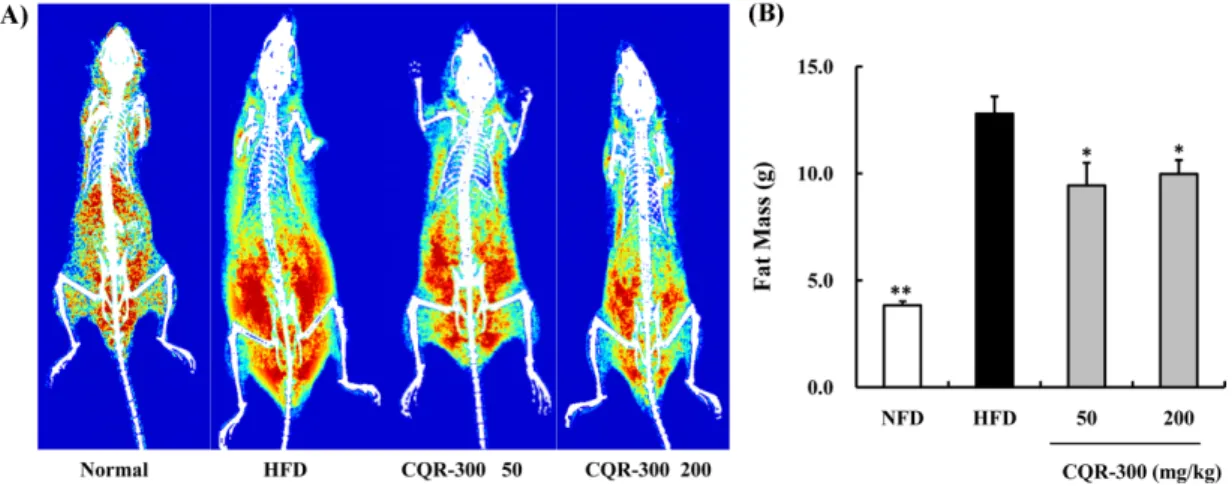
them into fat before analyzing them. Fat tissue information was revealed by three modes into low density (blue color), middle density (yellow color), and high density (red color) fat depending on fat mass. Also, fat mass was calculated and displayed as units of gram.
Isolation of total RNA and quantitative real-time PCR. Total RNA was extracted from epididymal adipose tissue with the RNeasy mini kit (Qiagen, Velno, Netherlands) according to the manufacturer’s protocol. The extracted RNA was synthesized into cDNA using Primescript 1st strand cDNA synthesis kit (Takara, Shiga, Japan). Then the mRNA expression levels of adipogenesis- related genes were quantified by real-time PCR LightCycler 96 system (Roche, Basel, Switzerland) using a SYBR Green Master Mix kit (Takara, Shiga, Japan) according to the manufacturer’s instruction. Primers sequences used in the experiments were as follows (forward and reverse, respectively): β-actin, TGT CCA CCT TCC AGC AGA TGT and AGC TCA GTA ACA GTC CGC CTA GA; SREBP-1c, GGC ACT AAG TGC CCT CAA CCT and GCCACA TAG ATC TCT GCC AGT GT; FAS, TGG TGG GTT TGG TGA ATT GTC and GCT TGT CCT GCT CTA ACT GGA; PPARγ, TCA CAA GAG GTG ACC CAA TG and CCA TCC TTC ACA AGC ATG AA. The real-time PCR cycling conditions were as follow: 2 min at 95oC, 45 cycles of 20 s at 95oC, 20 s at 60oC, 40 s at 72oC, and 30 s at 72oC, and a final extension for 5 min at 72oC followed by a melting curve. The mRNA levels of the target genes were normalized to the values of β-actin and the results were presented as the fold changes relative to the HFD group.
Protein extraction and Western blot analysis. Epididymal adipose tissue were washed with cold PBS and homogenized in RIPA buffer (50 mM Tris-HCl pH7.4, 150 mM NaCl, 1 mM EDTA, 1% Triton X-100, 1% sodium deoxycholate, 0.1% SDS, 1mM PMSE) and 1% of protease inhibitor. The homogenates were centrifuged 8000×g for 20 min at 4oC and the supernatants were collected. Total protein concentration was calculated by BCA protein assay (Thermo Fisher Scientific Inc., Waltham, IL, USA). Proteins were separated on 10% SDS polyacrylamide gel and transferred to polyvinylidene difluoride membranes (Bio-Rad Laboratories, Hercules, CA, USA). The membranes were blocked with 5% nonfat dried skim milk in Tris-buffered saline containing 0.1% Tween 20 (TBS-T) and were incubated overnight at 4oC with appropriate antibodies. The membrane was washed with TBS-T and incubated with anti-mouse or anti-rabbit horseradish peroxidase-conjugated secondary antibodies for 1 h. The bands were enhanced by chemi-luminescence reagents and detected by chemi-luminometer (CLINX Science Instruments Co. Ltd, Shanghai, China).
Statistical analysis. Statistical evaluations of the data were expressed as the mean ± standard error of the mean (SEM). The statistical significance of differences between the mean values for the treatment groups was analyzed by Student’s t-tests and one- way analysis of variance (ANOVA) using the software Origin 7 (Microcal Software, USA). Values of p <0.05 and p <0.01 were considered as statistical significance.
Results
Lipase inhibitory activity of CQR-300. We evaluated in vitro pancreatic lipase inhibition activity of CQR-300 to investigate the potential efficacy for anti-obesity. Lipase inhibitory activity was measured by the amount of hydrolyzed p-nitrophenol release during the enzyme reaction and it was expressed as the percentage of control (Fig. 1). The CQR-300 showed the lipase inhibition activities were ranged from 16.7±1.2% to 75.5±2.0% with increasing concentration at 1 to 100µg/mL. The IC50 value was found to be 10.8µg/mL.
Effects of CQR-300 on body weight gain and Food intake.
Body weight gain and food intakes are shown in Fig. 2. The final body weight gain of mice fed the HFD was significantly increased than mice fed the normal diet group. After 6 weeks of administration, 50 and 200 mg/kg CQR-300 supplements with HFD groups significantly reduced body weight gain compared to the HFD group by 48 and 61%, respectively (Fig. 2A). But, food intake did not observe significant differences among the four groups (Fig. 2B).
Effects of CQR-300 on liver and WAT weights. The relative weight of liver, perirenal, retroperitoneal, and epididymal WAT were compared to the HFD group (Fig. 3). Supplementation with CQR-300 presented a tendency to decreased liver weight in mice fed with HFD (Fig. 3A). The perirenal, retroperitoneal, epididymal, and total WAT weights in the normal diet group were significantly lower than those of the HFD group. Consistently, CQR-300 significantly decreased WAT weights in HFD plus CQR-300 50 and 200 mg/kg fed mice when compared to the HFD fed group, respectively (Fig. 3B).
Effects of CQR-300 on plasma biochemical levels. The effect of CQR-300 on plasma biochemical parameters in HFD-fed mice are presented in Table 1. In the plasma biochemical analysis, glucose, T-CHO, TG, and LDL cholesterol levels in the HFD group were increased, as compared to the normal diet fed mice group. In HFD plus CQR-300 groups, significantly decreased HFD induced plasma glucose, T-CHO and LDL cholesterol levels. TG level in Fig. 1 Effects of CQR-300 on pancreatic lipase activity. Results represent the average of three replicates (n =3). The data are presented as means ± SEM. *p <0 .05 and **p <0.01, when compared to the untreated control.
the HFD+CQR-300 50 group was significantly decreased compared with the HFD group, but did not decreased in the HFD+CQR-300 200 group. HDL cholesterol level in HFD with CQR-300 groups was promoted, especially showed statistically significance in the HFD+CQR-300 50 group as compare with the HFD group.
However, there were no significant differences in the ALT and AST levels, among the HFD and CQR-300 treated groups, but the CQR-300 fed groups presented a tendency towards decreased
levels. Leptin levels in the HFD group presented higher than normal group, the HFD+CQR-300 50 and 200 mg/kg exhibited decreased leptin statistically significant differences, as compared to HFD group. In the level of adiponectin, mice fed HFD with CQR-300 revealed increased slightly than the group of mice fed HFD only.
Effects of CQR-300 on liver and epididymal adipose tissue morphology. Histological observations of liver and epididymal Fig. 2 Effects of CQR-300 on body weight gain, food intake, and tissue weight in high-fat diet-induced-obese mice for 6 weeks. (A) Body weight gain.
(B) Food intake rate. The data are presented as means ± SEM. *p <0.05 and **p <0.01, when compared to the HFD group (n =8 per group).
Fig. 3 Effects of CQR-300 on organ weights in HFD-induced obese mice during 6 weeks. (A) Liver weight. (B) White adipose tissue weight. The data are presented as means ± SEM. *p <0.05 and **p <0.01, when compared to the HFD group (n =8 per group).
adipose tissue in mice fed the experimental diets were as shown in Fig. 4. Sections of liver and adipose tissues were stained with hematoxylin and eosin to confirm the multiple lipid droplets and cellular morphology. In the histological analysis of the liver, HFD induced lipid droplets were decreased without change of cellular morphology in HFD with CQR-300 groups. In WAT, adipocytes size of HFD group was larger than those of the normal diet group;
however, the sizes of adipocytes were considerably decreased in HFD+CQR-300 50 and 200 groups as compared to the HFD group.
Effects of CQR-300 on body fat mass. To evaluate the effect of CQR-300 on HFD induced body fat composition, the radiography analysis was presented with DXA. The representative images of the body fat indicated that total, visceral and subcutaneous fat accumulation with three modes of blue, yellow, and red color each represented low, medium, and high density fat, respectively (Fig.
5). The relative distribution of fat mass as large red color area was larger in the HFD induced obese mice compared to the normal diet fed group in Fig. 5A. But, CQR-300 supplemented mice were reduced high density fat with reduction of visceral fat content, compared to the HFD group. Furthermore the calculated body fat mass in HFD with CQR-300 groups displayed statistically significant reduction than HFD group (Fig. 5B).
Effects of CQR-300 on expression levels of adipogenesis- related genes and proteins. To investigate how CQR-300 affects lipid metabolism, we measured expression levels of the adipogenesis and lipogenesis-related genes and proteins in epididymal adipose tissues, using the quantitative real-time PCR and Western blot. As shown in Fig. 6A, the mRNA expression levels of SREBP-1c, FAS, and PPARγ in WAT were increased in the HFD group than those of the normal group with the significant difference. However, administration of CQR-300 showed a significant reduction of these genes expression levels compared with HFD group only.
Consistently, we demonstrated the protein expression levels in epididymal adipose tissue to determine the mechanism of CQR-300 on HFD induced obesity. The SREBP-1c and FAS protein, the lipogenic related protein, expression levels were statistically significant reduction in mice fed HFD with CQR-300 group as compared to the HFD group (Fig. 6B). Additionally, C/EBPα and PPARγ protein expression levels in the CQR-300 group were significantly decreased. We also investigated phosphorylation of AMPK protein expression in WAT. In the HFD group, the expression of pAMPK protein expression was markedly decreased compared to the normal diet group (Fig. 6B). In contrast, CQR-300 group was significantly increased pAMPK expression at 2 times higher than HFD group, in the same time.
Fig. 4 Histological observation of liver section and epididymal adipose tissue. Liver and epididymal adipose tissue were stained with hematoxylin and eosin, and were viewed under a microscope (×200). Representative sections are from 3 mice of each treated group.
Fig. 5 Image for body fat of each group mice by using dual X-ray absorptiometry and calculation of fat mass on normal, HFD, HFD with CQR-300 50 and 200 mg/kg. (A) The radiography of body fat was shown by three modes according to density of fat. (B) The fat mass was calculated by manufacturer’s system. The data are presented as means ± SEM. *p <0.05 and **p <0.01, when compared to the HFD group (n =8 per group).
Discussion
Obesity and Obesity-related diseases became a major health problem that caused increasing the severity throughout the world (Kopelman, 1994; Campos et al., 2005). In these days there are a lot of efforts to solve this problem, unfortunately, drug treatment for obesity has short-term benefits, potential of drug abuse, rebound weight gain after quit the drug, and several side effects with efficacy (Hasani-Ranjbar et al., 2009). Recently, herbal weight-loss supplements as natural supplements are focused with their effective, safe, and promising positive effects.
Cissus quadrangularis is a succulent vine, belong to the family of Vitaceae native to West Asia and Africa. C. quadrangularis has a traditional therapeutic value and used for various ailment including bone fracture, digestive, eye and ear diseases, and asthma in Ayurvedic medicine for more than a century (Kritikar and Basu, 2000). Although researches have reported several properties for management of weight loss and metabolic disease, the anti-obesity mechanism of CQR-300 has not yet been clear
(Oben et al., 2008; Jiji et al., 2009; Chidambaram and Carani Venkatraman, 2010). In the present study we have used CQR-300 that the same plant material used in clinical study (Kuate et al., 2015) to investigate potential mechanism on obese mice.
Inhibitory effect of CQR-300 on pancreatic lipase enzyme is studied for determination of potent efficacy for treatment of obesity that can possibly be developed. The pancreatic lipase is a major regulatory enzyme of excess calories through digestion and absorption. In the gastrointestinal mechanisms, digestion of fat to free fatty acid will be further synthesize and accumulate in the adipocytes (Birari and Bhutani, 2007; Lim et al., 2014). So, lipase inhibitory activity of CQR-300 means that can involve inhibition of dietary triglyceride absorption in small intestine (Fig. 1). This result suggests that CQR-300 may have anti-obesity activity by limiting the fat absorption and accumulation in adipocytes.
Obesity is caused by an imbalance of energy intake and expenditure and the excess energy accumulates in the form of TG in adipose tissue (Greenberg and Obin, 2006). To investigate the anti-obesity effect of CQR-300, we used HFD-induced obese Fig. 6 Effects of CQR-300 on the expression levels of gene and protein related to adipogenesis/lipogenesis in epididymal adipose tissue. The mRNA expression levels of (A) SREBP-1c, FAS, PPARγ were determined using real-time PCR. The expression levels were normalized to β-actin mRNA expression level. The protein expression levels were measured using (B) Western blot analysis. Adipogenesis/Lipogenesis-related protein levels were expressed as the fold increased relative to the control group after normalization to the α-tubulin protein expression level. The data are presented as means ± SEM. *p <0.05 and **p <0.01, when compared to the HFD group.
mice. It has been reported that HFD is a suitable for inducing obesity and express an increases of body weight, adipose tissue weight and hyperlipidemia in mice (Kim et al., 2000). We confirmed that CQR-300 treatment for 6 weeks decreased the body weight gain in 50, 200 mg/kg without changing food intake (Fig. 2) and that is in accordance with previous reports that CQR- 300 has anti-obesity effects (Jiji et al., 2009). Also, CQR-300 plus HFD fed mice significantly decreased the perirenal, retroperitoneal, and epididymal adipose tissue weights compared with HFD fed group (Fig. 3). These results suggest that CQR-300 treatment affect decrease of body weight gain and it is likely to be related with reduced WATs weight.
Our results also presented that CQR-300 supplement significantly lowered plasma T-CHO, TG, LDL-C, ALT, and AST levels while CQR-300 treatment increased plasma HDL-C level in the mice fed HFD (Table 1). These results suggest that CQR-300 could reduce HFD induced hyperlipidemia. Adipose tissue is an endocrine organ to regulate traditional hormone system. Leptin is secreted from adipose tissue, and positively related with adipose tissue mass (Kershaw and Flier, 2004). The leptin regulates metabolic signal of energy sufficiency by regulates appetite and energy expenditure (Flier, 1998). In the adipocytes, the leptin and adiponectin regulate lipolysis through opposite activity that regulates insulin sensitive, glucose uptake, and fatty acid oxidation with hormone-stimulated lipolysis (Susan et al., 2000; Qiao et al., 2011; Wedellová et al., 2011). The concentration of adipose tissues endocrine hormones revealed that CQR-300 treatment markedly reduced leptin concentration and inversely increased adiponectin, in a dose dependent manner (Table 1). In our histological observation in liver and adipocytes, HFD induced obese mice has larger adipocyte size than normal diet supplemented mice. Yet, CQR-300 treatment showed smaller adipocytes sizes and number than HFD group (Fig. 4). These results indicated that CQR-300 could associate with adipocytes which demonstrated lipid accumulation and lipolysis.
To examine epidemiological activity of CQR-300 that reduces body fat, we measured whole body fat composition by using Dual energy X-ray (DXA) Absorptiometry system. DXA quantifies the excess adiposity using an imaging technique with high accuracy
by measurement of fat distribution (Chen et al., 2012). Obesity is generally defined as an excess amount of body fat and it may negative effects on their health. Therefore, treatment for obesity, it is fundamental solution to reduce the body fat. HFD fed mice are significantly higher the density of fat than normal diet fed mice and it is accordance with an increased fat mass. Notably, CQR- 300 with HFD fed mice exhibited reduced distribution of high density fat and total body fat mass in 50, 200 mg/kg respectively compared with HFD fed mice (Fig. 5). We confirmed that CQR- 300 decreased the body weight gain, WATs weight as well as body fat mass. This observation suggests that the decreased fat mass may be attributed to reduce body weight gain and WATs weight.
To clarify the mechanism of the decrease in body fat by CQR- 300, we measured the expression levels of related to adipogenesis and lipogenesis genes and proteins in epididymal adipose tissue in HFD-induced obese mice. Adipogenesis shows dramatic changes which is related with etiology of obesity (Spiegelman et al., 1993).
PPARγ is a ligand-activated transcription factor which is mediating expression of fat-specific genes and activates of adipocyte differentiation and adipogenesis (Vidal-Puig et al., 1996). Furthermore, C/EBPα is expressed in the late stage of adipogenesis and plays a role in regulating of adipocytes differentiation cooperated with PPARγ for differentiation process in a cooperative and synergistic manner (Farmer, 2005). Also, PPARγ can be activated by SREBP-1c which is stimulating production and expression of PPARγ ligand production. SREBP-1c, a transcription factor, regulates fatty acid and cholesterol as well as LDL receptor, that synthesis and activates lipogenesis related genes and proteins such as FAS, acetyl-CoA carboxylase (ACC) in liver and WATs (Farmer, 2005).
CQR-300 treatment decreases mRNA expression of SREBP-1c, FAS, and PPARγ that indicate CQR-300 down-regulate adipogenesis and lipid accumulation in adipose tissues of HFD-induced obesity.
AMPK is a regulator of cellular energy level and regulates of lipid and glucose metabolism especially in lipolysis and lipogenesis mechanism. Activated AMPK inhibits the ATP-consuming process such as lipogenesis directly by regulating protein expression (Daval et al., 2006). Of the adipogenesis-related protein expression in the adipose tissue, we determined that CQR-300 treatment significantly reduced the adipogenesis-related protein Table 1 Effects of CQR-300 supplementation on serum profile in C57BL/6J mice
Normal HFD HFD+CQR-300 50 HFD+CQR-300 200
Glucose (mg/dL) 139.57±3.48** 0163.6±3.97 0152.4±8.66 149.00±3.90*
T-CHO (mg/dL) 0108.5±1.41** 168.88±4.63 150.40±7.34* 147.00±6.34*
TG (mg/dL) 061.83±2.15* 082.43±4.89 066.20±4.22* 082.50±1.50
LDL (mg/dL) 009.00±0.73** 026.44±1.74 020.17±2.32* 019.17±1.82*
HDL (mg/dL) 130.00±1.96 129.25±5.31 148.00±4.79* 153.80±6.46
ALT (U/L) 020.60±1.69 022.20±2.18 021.33±0.99 019.00±0.68
AST (U/L) 121.75±5.72** 136.33±9.16 128.00±2.51 127.20±6.24
Leptin (mg/mL) 007.01±0.18** 034.56±3.78 021.51±4.67** 019.15±4.77**
Adiponectin (mg/mL) 009.13±0.03 09.00±0.24 009.67±0.09 009.81±0.23
HFD: high-fat diet; CQR-300: Cissus quadrangularis extracts. T-CHO: total cholesterol; TG: triglyceride; LDL: low density lipoprotein; HDL: high density lipoprotein; ALT: alanine aminotransferase; AST: aspartate aminotransferase. The data are presented as means ± SEM. *p <0.05 and **p <0.01, when compared to the HFD group (n =8 per group).
expression levels such as PPARγ, C/EBPα and also decreased SREBP-1c and FAS protein expression levels in WAT of HFD fed obese mice. Furthermore, phosphorylated AMPK expression level is increased by treatment of CQR-300. These results suggest that CQR-300 treatment affects the adipocytes proliferation and anabolic stages of fatty acid by regulation of gene and protein expression and it may be caused by reduction of body fat.
In conclusion, the CQR-300 may prevent the high-fat diet induced obesity that increases in body fat accumulation and significantly reduced the body weight gain, WATs weight, adipocytes sizes, and inhibits the key transcription factors in HFD-induced obese mice in a dose-dependent manner. These effects are due to inhibit intestinal absorption of dietary fat with inhibition of pancreatic lipase activity and regulate of protein expression levels related with lipid adipogenesis and lipogenesis. Taken together, CQR-300 prevents the development of obesity and effectively reduces body fat.
Previous clinical trial (Kuate et al., 2015) have reported that the use of C. quadrangularis product (CQR-300) was effective in reducing body weight, as well as improving blood parameters associated metabolic syndrome and obese. Our results revealed that CQR-300 have anti-obesity effects that was previously study evidenced confirmed, but also find regulation of adipogenesis and lipid metabolism with directly presents of distribution of fat mass.
Based on these finding, it could be developed for the prevention of obesity and obesity-related diseases.
Acknowledgments This work was carried out with the support of
“Cooperative Research Program for Agriculture Science &Technology Development (Project No. PJ01134802)” Rural Development Administration, Republic of Korea.
References
Anoop A and Jagdeesan M (2002) Gastric and duodenal antiulcer and cytoprotective effect of Cissus quadrangularis Linn. Variant II in rats.
Nigerian J Nat Prod Med 6, 1–7.
Birari RB and Bhutani KK (2007) Pancreatic lipase inhibitors from natural sources: unexplored potential. Drug Discovery Today 12, 879–89.
Campos P, Saquy A, Ernsberger P, Oliver E, and Gaesser G (2005) The epidemiology of overweight and obesity: public health crisis or moral panic? Int J Epidemiol 35, 55–60.
Chen W, Wilson JL, Khaksari M, Cowley MA, and Enriori PJ (2012) Abdominal fat analyzed by DEXA scan reflects visceral body fat and improves the phonotype description and the assessment of metabolic risk in mice. Am J Physiol Endocrinol Metab 303, E635–43.
Chidambara Murthy KN, Vanitha A, Mahadeva Swany M, and Ravishanker GA (2003) Antioxidant and antimicrobial activity of Cissus Quadrangularis Linn. J Med Foods 6, 99–105.
Chidambaram J and Carani Venkatraman A (2010) Cissus quadrangularis stem alleviates insulin resistance, oxidative injury and fatty liver disease in rats fed high fat plus fructose diet. Food Chem Toxicol 48, 2021–9.
Chopra SS, Patel MR, Gupta LP, and Datta IC (1975) Studies on Cissus quadrangularis in experimental fracture repair: effect on chemical parameters in blood. Indian J Med Res 63, 824–8.
Daval M, Foufelle F, and Ferre P (2006) Function of AMP-activated protein kinase in adipose tissue. J Physiol 574, 55–62.
Derosa G and Maffioli P (2012) Anti-obesity drugs: A review about their effects and their safety. Expert Opin Drug Saf 11, 459–71.
Farmer SR (2005) Regulation of PPARγ activity during adipogenesis.
International J Obes 29, S13–6.
Flier JS (1998) Clinical review 94: what’s in a name? In search of leptin’s physiological role. J Clin Endocrinol Metab 83, 1407–13.
Fried K, Ricci MR, Russell CD, and Laferrère (2000) Regulation of leptin production in humans. J Nutr 130, 3127–31S.
Greenberg AS and Obin MS (2006) Obesity and the role of adipose tissue in inflammation and metabolism. Am J Clin Nutr 83, 461–5.
Gregoire FM (2001) Adipocyte differentiation: from fibroblast to endocrine cell. Exp Biol Med 226, 997–1002.
Hasani-Ranjbar S, Nayebi N, Larijani B, and Abdollahi M (2009) A systematic review of the efficacy and safety of herbal medicines used in the treatment of obesity. World J Gastroenterol 15, 3073–85.
Jiji MJ, Visalakshi S, Meenakshi P, Rathi MA, Thirumoorthi L, Chinna Guravaiah D et al. (2009) Antilipidemic acitivity of Cissu quadrangularis and Tribulus terrestris on obesity in high fat fed rats. Pharmacologyonline 2, 1250–8.
Kershaw EE and Flier JS (2004) Adipose tissue as an endocrine organ. J Clin Endocrinol Metab 89, 2548–56.
Kim JY, Nolte LA, Hansen PA, Han DH, Ferguson K, Thompson PA et al.
(2000) High-fat diet-induced muscle insulin resistance relationship to visceral fat mass. Am J Physiol Regul Integr Comp Physiol 279, R2057–
65.
Kim YS, Lee YM, Kim H, Kim J, Jang DS, Kim JH et al. (2010) Anti-obesity effect of Morus bombycis root extract: Anti-lipase activity and lipolytic effect. J Ethnopharmacol 130, 621–4.
Kirtikar KR and Basu BD (2000) In Indian Medicinal Plants, Bsu LM (3rd ed.). Lalit Mohan Basu Publisher, India.
Kopelman PG (1994) Causes and consedquences of obesity. Med Int 22, 385–
8.
Kopelman PG (2000) Obesity as a medical problem. Nature 404, 635–43.
Kuate D, Nash RJ, Bartholomew B, and Penkova Y (2015) The use of Cissu quadrangularis (CQR-300) in the management of compoment of metabolic syndrome in overweight and obese participants. Nat Prod Commun 10, 1281–6.
Lim SM, Goh YM, Kuan WB, and Loh SP (2014) Effect of germinated brown rice extracts on pancreatic lipase, adipogenesis and lipolysis in 3T3-L1 adipocytes. Lipids Health Dis 13, doi: 10.1186/1476-511X-13- 169.
Mayer MA, Hocht CL, Puyo A, and Taira C (2009) Recent advances in obesity pharmacotherphy. Curr Clin Pharmaco 4, 53–61.
Oben JN, Ngondi JL, Momo CN, Agbor GA, and Sobgui CS (2008) The use of Cissus quadrangularis/Irvingia gabonensis combination in the management of weight loss: a double-blind placebo-controlled study.
Lipids Health Dis, doi:10.1186/1476-511X7-12.
Otto TC and Lane MD (2005) Adipose development: from stem cell to adipocyte. Crit Rev Biochem Mol Biol 40, 229–42.
Qiao L, Kinney B, Schaack J, and Shao J (2011) Adiponectin inhibits lipolysis in mouse adipocytes. Diabetes 60, 1519–27.
Spiegelman BM and Flier JS (2001) Obesity and the regulation of energy balance. Cell 104, 531–43.
Spiegelman BM, Choy L, Hotamisliqil GS, Graves RA, and Tontonoz P (1993) Regulation of adipocyte gene expression in differentiation and syndroms of obesity/diabetes. The Journal of Biological Chemistry 268, 6823–6.
Stohs SJ and Ray SD (2013) A review and evaluation of the efficacy and safety and Cissus quadrangularis extracts. Phytotherapy research 27, 1107–14.
Vidal-Puig A, Jimenez-Linan M, BB lowell, Hamann A, Hu E, Spiegelman B et al. (1996) Regulation of PPAR gamma gene expression by nutrition and obesity in rodents. J Clin Invest 97, 2553–61.
Wedellová Z1, Dietrich J, Siklová-Vítková M, Kološtová K, Kováèiková M, Dušková M et al. (2011) Adiponectin inhibits spontaneous and catecholamine-induced lipolysis in human adipocytes of non-obese subjects through AMPK-dependent mechanisms. Physiol Res 60, 139–
48.
Zheng CD, Duan YQ, Gao JM, and Ruan ZG (2010) Screening for anti-lipase properties of 37 traditional Chinese medicinal herbs. J Chin Med Assoc 73, 319–24.