Vol. 71, No. 9, September 2021, pp. 747∼758 http://dx.doi.org/10.3938/NPSM.71.747
An Exploration of Students’ Conceptual Resource in Learning Heat and Temperature
Ahmad Suryadi · Lia Yuliati
∗· Hari Wisodo
Department of Physics, Faculty of Mathematics and Natural Sciences, Universitas Negeri Malang 65145, Indonesia (Received 20 May 2021 : revised 05 July 2021 : accepted 18 August 2021)
We report the exploration of students’ conceptual resources before and after obtaining a learning sequence on the topics of heat and temperature. This study was conducted in three phases:
before instruction, during instruction and after instruction. This study was conducted in MAN 1 Kota Malang, Indonesia. In general, four conceptual resources were activated by the students:
namely, 1) students associate insulators with poor conductors of heat, 2) students correlate material characteristics with their perceptions of heat/cold, 3) students associate both phase change and temperature change with the process of heat flow and energy transfer, and 4) students equate temperature and heat. Our data confirmed that conceptual resource activation was highly context-dependent. For example, students thought that conductors were cooler than insulator materials and that conductors were hotter than insulator materials activated in an appropriate context and an inappropriate context. The results of this study can be used in designing the details of learning about temperature and heat the future.
Keywords: Conceptual change, Conceptual resources, Temperature and heat concept, Knowledge in pieces
I. INTRODUCTION
In recent years, studies have found that students tend to experience difficulties in understanding the concept of heat and temperature although they observe the phe- nomenon of heat and temperature in their daily life [1]. Most of the student difficulties ascribed to intuitive knowledge gained from everyday life [2,3]. For example, there are still many students who think that tempera- ture and heat are the same things [4]. Many students also understand that objects can be kept warm by wrap- ping them in wool, but students do not understand that wool can also be used to keep things cool [5]. Mathe- matically, students also still have difficulty understand- ing the heat equation/formula [6]. Even though, based on constructivism theory, prior knowledge should not be a constraint but can be a starting point for students in
∗E-mail: [email protected]
understanding science concepts including the concepts of temperature and heat [7].
Inventory of forms of student difficulties in the topic of temperature and heat is still being carried out. Scientists believe that by revealing various problems students can become the basis for improving learning [8]. Researchers have developed various ways and frameworks in observ- ing how students understand a concept. A fairly popular framework and widely used to investigate student learn- ing difficulties is a misconception [9–11]. Nevertheless, according to neuroscience theory, this misconception is challenging to overcome. When students are given the correct concepts, old concepts (misconceptions) are not entirely lost and new concepts naturally form the new schema in student cognition [12]. On the other hand, there is another framework that has become a hot topic in physics education research (PER) forums, namely, re- source views or knowledge in pieces (KiP). The resource
This is an Open Access article distributed under the terms of the Creative Commons Attribution Non-Commercial License (http://creativecommons.org/licenses/by-nc/3.0) which permits unrestricted non-commercial use, distribution, and reproduction in any medium, provided the original work is properly cited.
framework does not intend to remove students’ miscon- ceptions but instead adjust their activation to the ap- propriate problem context [13]. diSessa [14] elucidated that students’ misconceptions could pronounce a solid and scientific understanding if students properly config- ured them. Besides, the resource term itself is a term first put forward by Hammer [15] and inspired by the in- tuitive thinking (p-prims) of diSessa [16]. The resource is a term for cognitive elements activated at any time with fine grain size [17]. Other studies have confirmed that resource frameworks are more productive in explaining students’ learning difficulties [18]. Recently, Richards et al. [19] grouped resources into three kinds of resources namely p-prim, conceptual resources, and epistemologi- cal resources. This study presents research results that focus on exploring resources at the conceptual level.
Several studies have been conducted to characterize students’ learning difficulties with a resource framework.
Hammer [15] provides a simple case where students are given a problem regarding the minimum mirror height so that the entire body can be seen. One student named Sherry showed that one resource can be activated in one context but in another concept, it is not activated. The same results were found in a study by Loverude [20]. By analyzing interview transcripts from studies conducted by Watts [21], Harrer et al. [22] confirmed that the resource lens can be used to analyze students’ alterna- tive conceptions with more detailed results. Young and Meredith [23] used the resource framework in identify- ing, improving, and assessing changes in students’ con- ceptions of fluid topics. diSessa [24] examined the topic of thermal equilibrium and explained how causal schemes involve p-prim resources in some students through a mi- crogenetic study. These studies showed that the research framework could provide a more detailed picture of stu- dents’ understanding of a concept. However, these stud- ies were carried out by survey technique or by case study at one time. Studies that use a resource framework in observing students’ conceptual change in a certain period are still rarely disclosed. This research was conducted to answer the following three research questions.
1. What conceptual resources are activated by stu- dents before instruction?
2. What conceptual resources are activated by stu- dents after instruction?
3. How does the activation of students’ conceptual resources change through instruction
II. METHOD
This study was conducted in three phases. The first phase was carried out before the instruction where data was obtained by conducting interviews to find out stu- dents’ learning difficulties related to the concepts of heat and temperature empirically. Chiou and Anderson’s in- terview protocols were used to conduct pre-instructional interviews with five students who had received tempera- ture and heat concept material [25]. Furthermore, based on the results of interviews and literature review, a rubric and coding guide were created to be used in the next phase. The second phase is an instruction stage. At this stage, integrated STEM learning was implemented. Be- fore instruction, students were given a pre-test and after instruction, students were given a post-test. Pre-test and post-test were given to find out the cognitive resources of students before and after the learning sequence. During the learning process, the researcher observes the learning event and the activation of student resources. The third phase is carried out after the post-test by conducting in- terviews to confirm the findings of the previous phase by adapting Chiou and Anderson [25] interview guide and heat problem from Baser [5]; and Yeo and Zadnik [26].
1. Site
This study was conducted at Madrasah Aliyah Negeri 1 Kota Malang, a public school in Malang city, East Java Province (Indonesia). It is a school held by the Min- istry of Religious and Affairs (MORA). Two different ministries manage the curriculum for all K-12 schools in Indonesia, The Ministry of Religious Affairs (MORA) is responsible for all religious schools (madrasah) and the Islamic University system, and the Ministry of Education and Culture (MOEC) is responsible for public schools, including both general and vocational schools [27]. There are four levels of education in Indonesia, namely early childhood education, primary education, secondary edu- cation, and higher education. Primary education is car- ried out for 6 years (6 – 12 years old) secondary education is divided into two levels, namely junior high school for three years (12 – 15 years old) and senior high school for three years (15 – 18 years old). Students begin study- ing general science at the elementary school level and
continue at the junior high school level. At the senior high school level, students can choose several majors such as natural science, social science, language, or religion.
For natural science major, students study physics, chem- istry, and biology as different subject. Madrasah Aliyah Negeri 1 Kota Malang is an equivalent degree with an- other senior high school. In Madrasah, the student not only learns the common subjects like mathematics, biol- ogy, physics, social, civics, and others but also learns an Islamic subject like Fiqh, Al-Quran, Hadith, and other Islamic religion subject.
2. Participant
This research was involved the senior high school stu- dents in the odd semester of the 2019/2020 school year.
In the first phase, five participants who have learned temperature and heat concept were involved. Besides, in the second phase, convenience sampling was done at the stage of selecting one class at the school in eleventh grade. The class consists of 35 students but only 25 (8 male and 17 female) students followed the entire learning process, and the other ten students did not take part in the entire learning process. All students have not studied the material temperature and heat in the previous les- son. Although the selection of one class causes the gen- eralization decrease, the researcher can observe and ex- tract information comprehensively. Purposive sampling utilized when selecting the participant that would be in- terviewed in the third phase. In total, 16 students were interviewed. The participants were selected based on the results of the pre-test and post-test analysis. They are representing of a group of participants whose learning progress is high, medium, and low.
3. Instructional design
There were four instructional meetings on heat and temperature topics in this study. Each unit took 90 min- utes class periods to complete by STEM activity. In the first meeting, the students observed the use of the rivets.
The students explained that phenomenon by conduct- ing an expansion experiment. The students also had to
complete the task by designing an engineering solution about using rivets in fuselage connection. In the second meeting, students analyzed the melting of ice in the po- lar regions. After that, they experimented by heating a block of ice. The students plotted the result of their ex- periment to the graph and analyzed it by mathematical reasoning. In the third meeting, the student discussed a mixing of coffee and ice. Students had to understand Black’s principles in this classroom meeting. By using Black’s principle, students were generating a recipe of ice coffee considering the final temperature.
At the end of the third meeting, students were in- formed to make a thermos of water by applying the prin- ciples of temperature and heat that they had learned.
Guidelines are provided and discussed in online forums.
This guide contains problems and materials for mak- ing thermos that can be used along with price estimates made by the teacher. In groups, they make designs and then consult with the teacher. In addition to making de- signs, like an engineer, students also estimate the cost of making a thermos. We hope that they can make a ther- mos that can hold the heat flow rate well at a low cost.
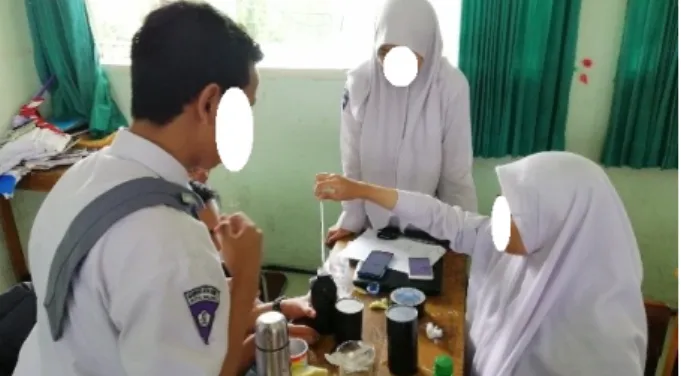
Ideally, this activity is carried out iteratively until the desired prototype is obtained. However, due to time con- straints, they were asked to make two designs to be able to analyze the strengths and weaknesses of each design by involving the skills of controlling variables. The pro- cess of designing and making raw prototypes is carried out outside class hours during the week. In the fourth meeting in class, students did the finishing and testing by measuring the decrease in the temperature of the hot water in the thermos (Fig. 1). Students analyze various findings obtained and discuss them classically.
4. Data Collection and Analysis
Data collection was done by pre-test, post-test, and semi-structured interviews. There were two items used to determine students’ conceptual resources. The two questions are as follows.
1. A child conducts an experiment using two small blocks of ice with a similar size and shape. One ice is left in the air, while the other ice is wrapped in cloth.
Story Version:
Fig. 1. (Color online) Heat Loss Test for The Students’
Thermos.
Which ice melts first? Make a short essay (3-4 sen- tences) that explains your answer?
Diagram:
a. Make a diagram related to the process of heat trans- fer in both situations?
b. Show evidence that there is a transfer or transfer of energy!
c. Explain the transfer mechanism (with what process this transfer or change occurred) and prove the choice of the mechanism you chose!
2. In a park, there are two identical chairs (the same shape and size). The two chairs differ only in material construction. One chair is made of iron while one is made of wood. Both chairs are under the sun, and Aldi is looking for a place to sit for a short break.
Story Version:
Which chair should be occupied by Aldi? Make a short essay explaining your answers?
Diagram:
a. Draw a picture of the heat transfer process at the event!
b. Explain your evidence that there is a transfer or change in energy!
c. Explain the transfer mechanism that occurred (with what process this transfer occurs) and prove the mecha- nism you chose!
The first problem was related to the effect of heat and conductivity of materials on the rate of melting ice; it was adapted from the study of Başer [5]. The second problem was related to the effect of heat and conductivity of the materials (wood and iron material) on the rate of heat flow in the materials under the hot sunlight. The format of these two questions follows the measurement of con- ceptual resources made by Sabo et al. [13]. Before being
used, the instrument was validated by an expert and then revised. After being revised, the instrument was tested on 40 high school students who had studied temperature and heat. The results of the empirical test show that the instrument is valid with the reliability of the instrument with Cornbach’s alpha of 0.871. The questions were de- livered in the pre-test and the post-test. Interviews were also conducted in this study both before and after learn- ing. The interview was conducted in Bahasa. All of the interviews were recorded and transcribed verbatim.
Students’ conceptual resources were analyzed from students pretest answer, posttest answer, and interview transcript. Analysis of student answers and interview data was done with the help of Nvivo software 12 Plus.
The coding technique used is priori coding. Priori cod- ing is a qualitative data analysis technique where a list of codes is made prior to conducting the analysis [28].
Data analysis was carried out in several stages. First, a coding guide was created by analyzing the transcripts of the phase 1 interviews complemented by a literature re- view. This manual contains coding procedures and lists of conceptual resources that may appear on the topic of temperature and heat. The coding guide was validated by three experts. Second, with the help of Nvivo soft- ware, the first author did the coding independently. Not all conceptual resources that have been listed were found in the phase 2 and phase 3 studies. Furthermore, the first, second, and third authors conducted focus group discussions to analyze the findings until mutual agree- ment was reached. For example, resources related to in- sulating properties are of two types, namely “blocking”
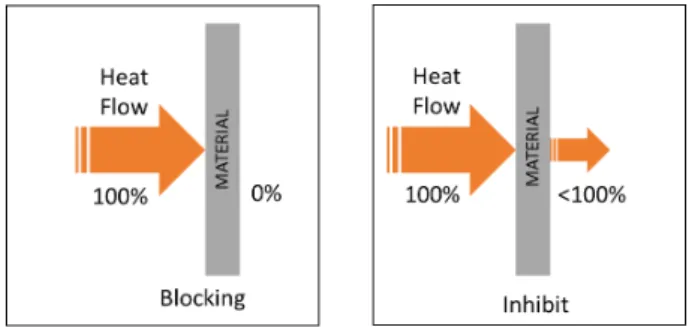
and “inhibit.” The two are different in that ”blocking”
means the heat is completely blocked or even completely reflected by the insulator. Meanwhile, “inhibit” resources are defined as resources that perceive that the insulator reduces the “quantity” of heat (Fig.2). As an effort to increase the trustworthiness of the data [29], we discuss the results with two experts in the field of physics edu- cation and confirmed each of our interpretations to the participants.
III. RESULTS
Students’ conceptual resources were measured before and after a learning sequence. We describe how students
Fig. 2. (Color online) Illustration of the difference be- tween blocking and inhibit.
activated each resource in the problem context given in four sections. In each section, the resource variation would be explained and also describe the changes in the activation of resources before and after the instruction.
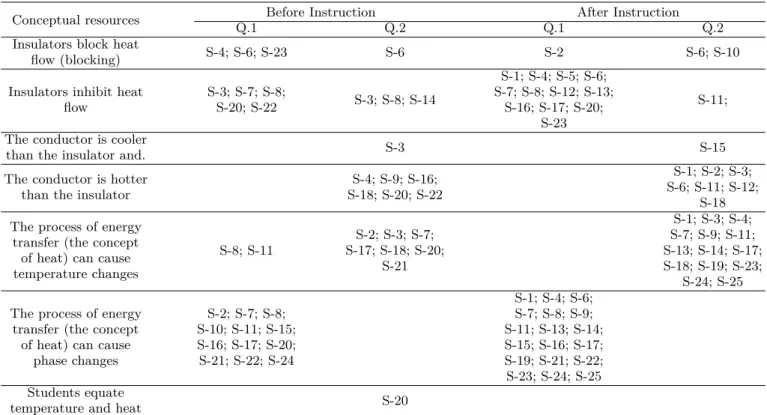
In addition, at the end of each statement, we wrote the encoding with the form ”(participant, type of test).” Par- ticipants were coded with the letter ”S” which represents the word ”student,” and followed by ”numbers” repre- senting student serial number. The “I” symbol referred to the Interviewer. Conceptual resources identified for each student are presented in Table 1.
Based on the data analysis, there are seven resources used by students in solving the two given temperature and heat problems. We then categorize these resources into four conceptual resource groups, namely, as follows.
(1) Students associate insulators not as a good con- ductor of heat.
(2) Students connect the material characteristics with the perception of heat/cold.
(3) Students associate both phase change and temper- ature change with the heat flow or energy transfer.
(4) Students equate temperature and heat.
1. Students Associate Insulator Not as Good Heat Conductor
This resource referred to the response of the students associate with the insulating material concept. There were two variations of students’ resources related to in- sulator characteristics, namely (i) blocking and (ii) insu- lators inhibit heat flow. The insulator mentioned in this context was cloth. The different between “blocking” and
“inhibit” presents in Fig. 2.
1) Resource Description
The first conceptual resource is blocking resources.
Students associated that the insulator could block heat transfer. In previous research, blocking resources was a resource related to the material that has the nature of dispelling heat [16]. In particular, resource blocking referred to the understanding that an insulator cannot conduct heat at all.
The second resource is about the insulator was inhibit- ing the heat flow. In this second resource, students as- sumed that heat could still be delivered heat through the insulator but was slightly hampered by the insula- tor. Table 2 shows the variety of students’ answers on the three types of resources related to the concept of the insulator.
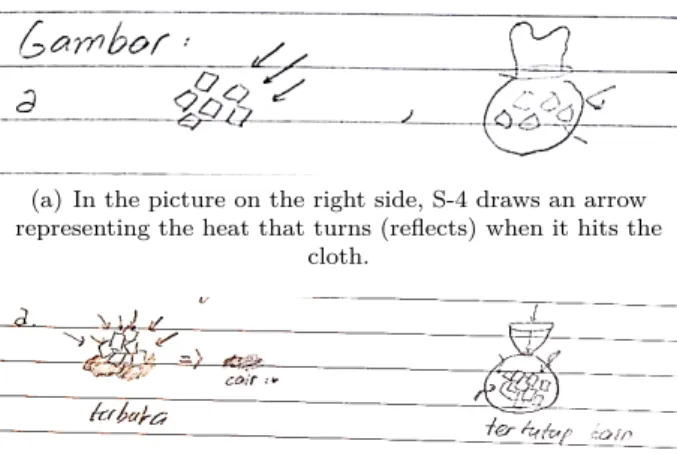
Table 2 shows that the students describe as the in- sulator material (i) may hinder heat (blocking) and (ii) inhibited the heat flow. The S-4 and S-10 answers were categorized as a result of the activation of blocking re- sources. The picture given by S-4 during the pre-test can be seen in Fig. 3 part a. S-4 depicted arrows reflected by cloth. Meanwhile, the S-10 explicitly stated that the insulator could not conduct heat so it was decided that the S-10 activated the blocking resource. Furthermore, students who activated the insulators to inhibit heat flow were identified from the students’ sentences by consider- ing some keywords such as slowing down, taking longer, delayed while the coder still paying attention to the con- text of the students’ answers.
2) Change in Resources Activation
There was no difference in the number of students who activated blocking resources during the instruction.
They were three students (12%). However, only one stu- dent (S-6) consistently used the resource. The other two students did not provide answers during the pre- test. The results of the analysis also showed that there were differences in the number of students activating the insulator inhibiting the heat flow resource during the in- struction. At the pre-test, there were eight students, or around 32% who used the resource about the insulator was inhibiting the heat flow. At the post-test, there was
Table 1. Students’ Conceptual resources before and after instruction.
Conceptual resources Before Instruction After Instruction
Q.1 Q.2 Q.1 Q.2
Insulators block heat
flow (blocking) S-4; S-6; S-23 S-6 S-2 S-6; S-10
Insulators inhibit heat flow
S-3; S-7; S-8;
S-20; S-22 S-3; S-8; S-14
S-1; S-4; S-5; S-6;
S-7; S-8; S-12; S-13;
S-16; S-17; S-20;
S-23
S-11;
The conductor is cooler
than the insulator and. S-3 S-15
The conductor is hotter than the insulator
S-4; S-9; S-16;
S-18; S-20; S-22
S-1; S-2; S-3;
S-6; S-11; S-12;
S-18 The process of energy
transfer (the concept of heat) can cause temperature changes
S-8; S-11
S-2; S-3; S-7;
S-17; S-18; S-20;
S-21
S-1; S-3; S-4;
S-7; S-9; S-11;
S-13; S-14; S-17;
S-18; S-19; S-23;
S-24; S-25 The process of energy
transfer (the concept of heat) can cause
phase changes
S-2; S-7; S-8;
S-10; S-11; S-15;
S-16; S-17; S-20;
S-21; S-22; S-24
S-1; S-4; S-6;
S-7; S-8; S-9;
S-11; S-13; S-14;
S-15; S-16; S-17;
S-19; S-21; S-22;
S-23; S-24; S-25 Students equate
temperature and heat S-20
Q=Question
Table 2. Conceptual Resources Related to Insulator.
Resource Examples of Student Answers
Blocking
Ice that melts first is ice that is left in the air. The ice will absorb more heat because of the open state (without a barrier) while the ice wrapped in cloth is blocked by cloth so that the required heat is less. (S-4, Pre-test)
Insulating wood cannot conduct heat. (S-10, Post-test)
Insulator inhibits heat flow
The ice which is placed in the cloth will melt longer because the heat absorption process is slower. After all, it is blocked by the cloth. (S-7, Pre-test)
While the ice wrapped in heat cloth received will be hampered by the cloth so it will melt longer.
(S-4, Post-test)
an increase to 15 students or about 60% using insulators that inhibit heat flow. However, only one student (S- 17) attributed the cause of heat flow constraints due to differences in material conductivity. Most students do not associate the characteristics of thermal conductivity with the heat flow rate. In general, there has been a sig- nificant change in inactivation resources related to the insulator concept.
The following were some examples of changes in inac- tivation conceptual resources related to the concept of the insulator. Figure 2 shows the change of resource in- activation by S-4.
Figure 3 showed the change in the heat picture by S-4.
S-4 activated the heat “blocking” where the heat was re- flected by the cloth at the beginning of the instruction.
In contrast, after experienced the instruction, S-4 acti- vated the resource that the insulator inhibits the heat flow represented in Fig. 3 part b. Another result is S- 4 also explained that heat would be ”blocked” by the cloth at the beginning. Meanwhile, when the post-test was conducted, S-4 changed his answer to be ”delayed”
by the cloth. The differences in diction usage indicated that there was a change in the activation of students’
resources related to the concept of the insulator after
(a) In the picture on the right side, S-4 draws an arrow representing the heat that turns (reflects) when it hits the
cloth.
(b) In the picture on the right side, S-4 draws an arrow that pierces the cloth (not reflected).
Fig. 3. (Color online) The Change of S-4 Answers (a) Before The Instruction; (b) After The Instruction.
experienced STEM instruction. The comprehensive re- sults showed that the change occurred in three students namely S-4, S-6, and S-23.
2. Students Connecting Characteristics Material with Perception of Hot/Cold
This resource referred to the efforts of students to ex- plain the link between the material characteristics and the cold/heat perception. There were two resources used by students whose activation was very dependent on the context, namely (i) the conductor is cooler than the insu- lator and (ii) the conductor is hotter than the insulator.
1) Resource Description
This resource was activated by students when they were answering question number 2. The context of prob- lem number 2 is the perception of heat and cold when the wooden chairs and iron chairs were under the hot sunlight. Table 3 shows the examples of student answers and the categories of resources used.
Table 3 illustrates the two resources activated by stu- dents when explaining heat and cold phenomena. S-3 stated that iron felt cold when occupied. Likewise, the S- 15 stated that the iron chair was cooler than the wooden chair. Both S-3 and S-15 were the example that indicated the students thought that conductors were cooler than
insulators. In contrast, S-16 and S-18 understood that an iron chair would feel hotter than a wooden chair when they were put under the hot sunlight. They thought conductors are hotter than insulators. Those resources were still raw. We need more investigation to inference how students think about insulators. An initial step was done when students answer a similar topic but in dif- ferent contexts. This description would explain in the following section.
2) Changes in resource activation
The activation of these resources in different contexts was observed by giving another question during the pre- test and post-test, namely the concept of heat and cold when the wooden chair and the iron chair were put in a cold room. As a result, some students activated different resources in these two different contexts, but some still activate similar resources in two different contexts. Af- ter experienced the instruction, the result of this study showed that 24 students activated different resources in different contexts. However, there was one student who used similar resources in two different contexts. Resource activation inappropriate and inappropriate contexts are presented in Table 4.
Table 4 showed the activation of appropriate and in- appropriate resource activation. This table is intended to show that students may be right in one condition but wrong in a different condition. For example, S-4 acti- vated resources that the righties the conductor was hot- ter than the insulator in the context of a chair placed under the hot sunlight before the instruction. The re- source was reactivated when answering problems when a chair was placed in a cold room so it was not scientifically appropriate. The opposite was done by S-21 in which he applied the resource that the conductor is cooler than the insulator in two different contexts. S-21 was correct in explaining that an iron chair was cooler than a wooden chair when both were in a cold environment. S-21 ac- tivated inappropriate resources when explaining that an iron chair would still be cooler than a wooden chair even in an environment where the temperature was relatively high. It should be underlined in this section, the re- search focuses on the perception of heat and cold not on the temperature ratio of the two chairs with different materials.
Table 3. Students’ Conceptual Resources Related to the Concept of Heat and Cold.
Resource Examples of Student Answers
Conductors are cooler than insulators
Iron chairs are better be occupied by Aldi because they are not too hot. (S-3, Pre-test)
iron chairs because iron chairs are cooler / cooler than wooden chairs. Wood absorbs heat, iron does not. (S-15, Post-test)
Conductors are hotter than an insulator.
Aldi should sit on a chair made of wood so that he does not feel too hot because if he sits on an iron chair he will feel uncomfortable. After all, the iron easily absorbs heat and if Aldi sits he will feel hot.
(S-16, Pre-test)
Because iron is a good conductor of heat, it gets hot. (S-18, Post-test)
Table 4. Appropriate and Inappropriate Resource Activation.
Resources Appropriate context Inappropriate Context
Conductors are hotter than insulators
Aldi should sit on a wooden chair.
This is because wood with iron is better at absorbing heat iron (good conductor). This makes the wooden chair has a cooler
temperature than iron.
(context: wooden and iron chairs under the sun)
* S-4 pre-test answer
The wooden chair feels cold and the temperature is lower because the conductor wood is weak while the iron conductor is strong.
(context: wooden chairs and iron chairs are in a cold room)
* S-4 Pre-test answer
Conductors are cooler than insulators
Because iron is a conductor (conducts heat) while wood is an insulator (absorbs heat) and occurs by conduction cooler iron chairs.
(context: wooden chairs and iron chairs are in a cold room)
* S-21 post-test answer
Iron will feel cooler than wood because iron is a conductor (conducts heat), while wood is an insulator (absorbs heat).
(context: wood and iron chairs under the blazing sun)
* S-21 post-test answer
3. Students Associate Phase Changes and Tem- perature Changes with the Process of Heat Flow or Energy Transfer (The Concept of Heat)
1) Resource Description
The first resource in this theme is the students asso- ciate heat with changes in the temperature of objects.
This resource was identified during the instruction.
This resource was activated by students when answering problem number 2 part b (see Fig. 2). It was about the question to explain the evidence of energy transfer when the ice was melting. This depicted in their remarks:
Changes in temperature on the chair happened.
(S-17, Pre-test)
Because there is heat affecting the chair which makes the temperature of the chair increase and can cause the
chair to feel hot. (S-3, Post-test)
The second resource in this theme is the students’
associate phase changes to heat flow. This resource was activated when students give answers to story questions on number 1 part b (see Fig. 2). This problem was related to evidence of energy transfer. They shared that:
Ice will transfer energy to the environment so that the ice will melt into liquid form. (S-22, Pre-test)
Ice that initially freezes to melt due to energy transfer (S-4, Post-test)
Examples of student answers above showed that students illustrated that heat could (i) change the temperature and (ii) change the phase. The answer of S-3 at the post-test added another statement related to the relationship between high temperature and heat
perception with the term ”feels hot.” S-3 understood that higher temperatures would feel hotter than lower temperatures. These results indicated that students equate the temperature term and heat term. The results of the S-3 interview after the post-test showed that S-3 resources related to “high temperatures felt hot and vice versa” were productive. This resource was confirmed through interviews when S-3 was asked the question ”is there a difference between the temperature of the bag and the iron chair?” S-3 then holds the two objects and shared that:
I : For example, there are objects. (Shown by 2 differ- ent objects namely an iron chair and a bag) which one was felt hot?
S-3 : bag hotter than a chair I : Is the temperature different?
S-3 : different
I : Which one was higher?
S-3 : the bag
The conversation above showed that a student activat- ing resources that high temperatures would be hot and vice versa in various contexts. Not only S-3, but some students also understood that temperature was closely related to heat and cold perception. The relationship between material characteristics and heat and cold per- ception will be discussed in the next section.
Similar to S-3, S-22 also added several statements when he wrote his answer. The answer given by S-22 during the pre-test indicated that the S-22 activated re- sources that ice transferred energy to the environment.
The resource was also activated on several other stu- dents. The answer was very intuitive because the ice that released heat did not freeze but factually melted.
2) Changes in resource activation
There were a different number of students who associ- ated heat with temperature change during pre-test and post-test. There were nine students (36%) who associ- ated the temperature change of objects with the process of energy transfer at the beginning of this study. At the end of the instruction, there was an increase of students
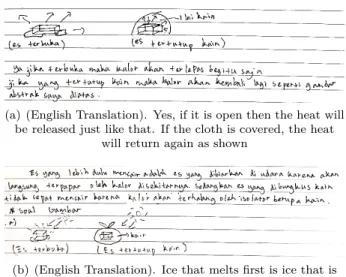
(a) (English Translation). Yes, if it is open then the heat will be released just like that. If the cloth is covered, the heat
will return again as shown
(b) (English Translation). Ice that melts first is ice that is left in the air because it will be directly exposed to the heat
around it while ice wrapped in cloth does not melt quickly because heat will be blocked by
Fig. 4. The Change of S-6 Answers (a) Before The In- struction; (b) After The Instruction
who used the resource that the temperature change was related to the process of heat flow and energy transfer (14 out of 25 students).
There were also differences in the number of students who associated heat with phase changes of objects before and after the instruction. At the beginning of this study, there were 12 students (48%) who related the heat with the phase change. In the post-test, 17 students, or about 68% used the resource.
Related to the resources used by S-22 that ice trans- ferred energy to the environment was also experienced by S-6. The difference was S-22 still used the resource at the post-test but the S-6 resource was no longer acti- vated at the post-test. The changes in the activation of resources from S-6 during the pre-test and post-test can be seen in Fig. 4.
Figure 4 shows that S-6 activated the resource about the insulator makes heat accessible between ice and cloth trapped so that it cannot escape. Meanwhile, after the instruction, S-6 activated different resources namely heat flows from the environment to the ice.
4. Students Equate Temperature and Heat This conceptual resource referred to the responses of the students who was stating that the temperature and
heat were the same stuff. Students’ answers to problem number 2 showed that students consider temperature and heat to be the same thing. For instance, S-20 contended that:
Aldi is better to sit on a wooden chair because it will be more comfortable. The iron chair absorbs heat faster/ambient temperature. (S-20, Pre-test)
Although it did not directly state that temperature and heat were the same, the language conveyed showed that students understand temperature and heat are in- terchangeable terms. However, this resource was only shown by S-20. Furthermore, this resource was also no longer activated by all students including S-20 after ex- perience the instruction.
IV. DISCUSSION AND CONCLUSSION
The results of this current study showed that stu- dents activated several resources following the context of the given problem. In general, there were several conceptual resources activated by students, namely 1) students associate insulators not as good conductors of heat, 2) students correlate between material character- istics and the perception of heat/cold, 3) students asso- ciate both phase change and temperature change with the process of heat flow and energy transfer, and 4) stu- dents equate temperature and heat term. We examined that the activation of all the resources was depends on the problem context. An interesting finding in this study is related to students’ conceptual resources on insula- tor traits. In many reports, the resource that students use regarding this concept is blocking. However, in this study, the results of tests and interviews confirmed two types of blocking, namely complete blocking and par- tially blocking. The first type of blocking in this study we use the term “blocking” and the second type we re- fer to as “inhibit.” Another interesting finding is the second conceptual resource. By the same student, the resource about “conductors are hotter than insulators”
and “conductors are cooler than insulators” can be used in two conditions, the appropriated condition, and the unappropriated condition. Without using the resource
view, students’ understanding of heat perception will be deleted even though this understanding is still productive if it is used to explain phenomena in different contexts.
Students tend to associate changes in form and changes in temperature as an effect of heat. This result seems to be in harmony with the assertation of Wong et al. [30] that the way that students define heat was through the effects that were given. The effect of heat could be divided into two, namely temperature change and phase change. The instruction does not explicitly lead students to the definition of heat. Students were more directed to observe real phenomena [31]. Through observing the process of melting ice cubes, students take measurements of the temperature of ice cubes every minute. These activities helped students to see how the heat affected the change in form and temperature changes from ice to water. One group found a differ- ent graph where at zero degrees the temperature of the ice cubes did not change. Most of the students curious about that. The findings of this group were discussed classically to understand the concepts of heat and latent heat. Another resource related to the effects of heat was the resource that students described that ice releases en- ergy during the melting process. This resource was rep- resented by students both in verbal and in pictures. This finding was slightly different from the results of Chu et al.
[32] where it was found that while students still had some difficulties, students’ concepts related to the process of freezing and melting were better than other phenomena of temperature and heat. Nonetheless, the results were also found by Schnittka and Bell [3] that before learn- ing, students understood that cold could be transferred from a cold to a warm. It is also possible that students who activated the resource represent that the smoke re- leased by ice when melting was a form of energy flow.
This result in line with Clark [33] study who found that students changed their conceptions in a different order.
This claim needs to be investigated further.
Furthermore, students activated two types of resources related to the concept of insulators, namely blocking and insulator inhibiting the process of heat transfer. Some students thought that cloth could block heat transfer, so the ice does not melt quickly. These results were con- sistent with diSessa [16], stating that one of the student resources related to insulators is blocking. The second
resource was related to the understanding that insulators inhibit the energy transfer process. Even so, most stu- dents did not mention the conductivity of the material implicitly. This is in line with Nurjannah et al. [34] who found that students’ critical thinking skills on the topic of transcribed conductivity were still low.
The context highly influenced resource activation by students in solving a problem. Some students in this study activated the conductor resource hotter than the insulator if the two materials were placed in an environ- ment where the temperature was relatively high. The students then activated a different resource about the conductor that was cooler than the insulator when the two materials were placed at a lower temperature. This result also echoes Richards et al. [19] study that con- ceptual resources were activated based on different con- texts. Using resource views, Philip [35] found that a teacher thinks that student activity in class is really im- portant rather than just doing homework. Factors of personal experience and STEM learning that were un- dertaken might help students used these resources ac- cording to context. Personal experience when holding the iron in cold and hot places helps to activate this re- source. In addition, students were trained to analyze heat phenomena comprehensively with the STEM prin- ciple during the instruction. For example, students were asked to make thermos with diverse materials such as glass, sand, aluminum foil, cotton, foam, and plastic. In a STEM environment, students will try to improve their scientific literacy [36]. The activity trained students to observe how differences in materials caused differences in temperature reduction in the students’ thermos project.
This result supported a finding by Schnittka and Bell [3] who described that learning with engineering design needs to target demonstrations that help students ex- plained concepts scientifically.
One of the concepts in temperature and heat most mentioned in the literature was to regard temperature and heat as the same thing [3,30,32]. This result was also found in this study but it was only found in one person and no more at the time of the post-test. In the learning process discussion by some students and a teacher, researchers found that some students still have difficulty distinguishing between temperature and heat.
It is possible that aspects of language differences between
scientific languages and everyday languages as explained by Georgiou and Sharma [37]. It should be emphasized again that in English, the word ”heat” is used both in science textbooks and in everyday life. Meanwhile, in Indonesian, the word used in the textbook is ”Kalor”
while in everyday life it uses the word ”Panas.” There- fore, students are even confused by distinguishing the words ”Kalor (Heat: scientific term),” ”Panas (Heat:
daily term),” and ”Suhu (temperature: daily and scien- tific term).” Explicitly, the teacher and students discuss differences in the three terms in learning.
This study provides an indication of how each student has a unique way of thinking that teachers sometimes do not think of before. This reasoning is very context- dependent so it must be anticipated by the teacher so that students’ understanding becomes correct. There- fore, it is very important for learning to present rich- context learning. This study conducted in Indonesia which is tropical country. Based on the results in this study, it is possible that the conceptual resources of stu- dents in each country are different from each other be- cause their experiences in everyday life are different. Stu- dents’ experiences in interacting with the environment related to the concepts of temperature and heat may differ between tropical countries and subtropical coun- tries such as Korea. How the differences in conceptual resources owned by students in tropical and subtropi- cal countries is interesting to be explored in the future.
Furthermore, implied that conceptual resources obtained could be a consideration as part of learning and the type of instruction responsible to the students’ concep- tual change. The investigation about how to associate students’ conceptual resource with appropriate context is still challenging.
Although this study has shown some interesting find- ings regarding students’ conceptual resources, this cur- rent study just involved relatively small number of sam- ples. Therefore, this study had low generalization. Nev- ertheless, this small sample helps researchers to examine the problem in depth. A comparison of data between stu- dents was also easier to do, so the results were more com- prehensive. Another limitation was that the implemen- tation of learning had not been maximized. Although efforts had been made to direct student resource activa- tion in the appropriate context, there were still activated
some resources in the inappropriate context. Effective learning design in supporting student concept changes is still interesting to continue to explore.
ACKNOWLEDGEMENTS
This study was supported by Directorate General of Higher Education, The Ministry of Research, Technol- ogy and Higher Education the Republic of Indonesia Re- search Grant (project no. 10.3.23/UN32.14.1/LT/2020).
REFERENCES
[1] F. B. Fernandez, Asia Pac. Sci. Educ. 18, 3 (2017).
[2] A. M. Hitt and J. S. Townsend, Science Activi- ties: Classroom Projects and Curriculum Ideas 52, 45 (2015).
[3] C. Schnittka and R. Bell, Int. J. of Sci. Edu. 33, 1861 (2011).
[4] D. M. Coca, J. Baltic Sci. Educ. 12, 59 (2013).
[5] M. Başer, Eurasia J. Math. Sci. Technol. Educ. 2, 96 (2006).
[6] S. N. W. Silung, S. Kusairi, and S. Zulaikah, Jurnal Pendidikan Fisika dan Teknologi 2, 95 (2017).
[7] D. H. Schunk, Learning Theories: An Educational Perspective, 6th ed, p.296-239 (Pearson, Boston, 2012).
[8] P. Potvin et al., Stud. in Sci. Edu. 56, 157 (2020).
[9] A. A. Alwan, Procedia - Soc. & Behav. Sci. 12, 600 (2011).
[10] H. O. Arslan, C. Cigdemoglu, and C. Moseley, Int.
J. Sci. Educ. 34, 1667 (2012).
[11] M. Prince, M. Vigeant, and K. Nottis, J. Eng. Educ.
101, 412 (2012).
[12] J. E. Zull, The Art of Changing the Brain: Enriching Teaching by Exploring the Biology of Learning, 1st ed (Stylus Pub, Sterling, Va, 2002).
[13] H. C. Sabo, L. M. Goodhew, and A. D. Robertson, Phys. Rev. Phy. Edu. Res. 12, (2016).
[14] A. A. diSessa, in Invited Lectures from the 13th International Congress on Mathematical Education, edited by G. Kaiser, H. Forgasz, M. Graven, A. Kuz- niak, E. Simmt, and B. Xu (Springer International Publishing, Cham, 2018), pp. 65–84.
[15] D. Hammer, Am. J. Phy. 68, S52 (2000).
[16] A. A. diSessa, Taylor & Francis Ltd 10, 105 (1993).
[17] D. Hammer, A. Elby, R. E. Scherr, and E. F. Re- dish, Transfer of Learning from a Modern Multidis- ciplinary Perspective 89 (2005).
[18] L. Ivanjek et al., Phys. Rev. Phys. Educ. Res. 12, 010106 (2016).
[19] A. J. Richards, D. C. Jones, and E. Etkina, Res Sci Educ (2018).
[20] M. Loverude, Phys. Rev. ST Phys. Educ. Res. 11, 020118 (2015).
[21] D. M. Watts, Phys. Educ. 18, 213 (1983).
[22] B. W. Harrer, V. J. Flood, and M. C. Wittmann, Phys. Rev. ST Phys. Educ. Res. 9, (2013).
[23] D. E. Young and D. C. Meredith, Phys. Rev. Phys.
Educ. Res. 13, 010125 (2017).
[24] A. A. diSessa, Cogn Sci 38, 795 (2014).
[25] G.-L. Chiou and O. R. Anderson, Sci. Ed. 94, 825 (2010).
[26] S. Yeo and M. Zadnik, The Phy. Teach. 39, 496 (2001).
[27] Faisal and S. N. Martin, Asia Pac. Sci. Educ. 5, (2019).
[28] J. Lazar, Research Methods in Human Computer Interaction, 2nd edition (Elsevier, Cambridge, MA, 2017) p.303-314
[29] S. B. Merriam and E. J. Tisdell, Qualitative Re- search: A Guide to Design and Implementation (John Wiley & Sons, San Francisco, CA, 2016) p.259 [30] C. L. Wong, H.-E. Chu, and K. C. Yap, Int. J. Sci.
Math. Educ. 14, 499 (2016).
[31] P. Mattila and P. Silander, How to Create The Fu- ture: Revolutionary Thinking and Design from Fin- land (University of Oulu Center for Internet Excel- lence, Oulu, 2015).
[32] H.-E. Chu, D. F. Treagust, S. Yeo, and M. Zadnik, Int. J. Sci. Educ. 34, 1509 (2012).
[33] D. B. Clark, Cog. Instr. 24, 467 (2006).
[34] N. Nurjannah, A. Setiawan, D. Rusdiana, and M.
Muslim, J. Phys.: Conf. Ser. 1157, 032053 (2019).
[35] T. M. Philip, Cogn. Instr 29, 297 (2011).
[36] L. Yuliati, Parno, F. Yogismawati, and I. K. Nisa, J. Phys.: Conf. Ser. 1097, 012022 (2018).
[37] H. Georgiou and M. D. Sharma, Int. J. Sci. Math.
Educ. 10, 1119 (2012).