Influenza Vaccination Coverage Rate according to the Pulmonary Function of Korean Adults Aged 40 Years and Over: Analysis of the Fifth Korean National Health and Nutrition Examination Survey
Influenza vaccination is an effective strategy to reduce morbidity and mortality, particularly for those who have decreased lung functions. This study was to identify the factors that affect vaccination coverage according to the results of pulmonary function tests depending on the age. In this cross-sectional study, data were obtained from 3,224 adults over the age of 40 who participated in the fifth National Health and Nutrition Examination Survey and underwent pulmonary function testing in 2012. To identify the factors that affect vaccination rate, logistic regression analysis was conducted after dividing the subjects into two groups based on the age of 65. Influenza vaccination coverage of the entire subjects was 45.2%, and 76.8% for those aged 65 and over. The group with abnormal pulmonary function had a higher vaccination rate than the normal group, but any pulmonary dysfunction or history of COPD did not affect the vaccination coverage in the multivariate analysis. The subjects who were 40-64 years-old had higher vaccination coverage when they were less educated or with restricted activity level, received health screenings, and had chronic diseases. Those aged 65 and over had significantly higher vaccination coverage only when they received regular health
screenings. Any pulmonary dysfunction or having COPD showed no significant correlation with the vaccination coverage in the Korean adult population.
Keywords: Influenza; Vaccination; Respiratory Function Test; Respiratory Disease, Chronic Obstructive
Seung-Hyun Cha,1 Jeong-Hun Paik,1 Mi-Ra Lee,1 Huiho Yang,1 Seung-Guk Park,1 Young-Jee Jeon,2 and Sunmi Yoo1
1Department of Family Medicine, Inje University Haeundae Paik Hospital, Busan, Korea; 2Department of Family Medicine, Ulsan University Hospital, Ulsan, Korea
Received: 12 August 2015 Accepted: 16 February 2016 Address for Correspondence:
Sunmi Yoo, MD
Department of Family Medicine, Inje University Haeundae Paik Hospital, 875 Haeun-daero, Haeundae-gu, Busan 48108, Korea E-mail: [email protected]
http://dx.doi.org/10.3346/jkms.2016.31.5.709 • J Korean Med Sci 2016; 31: 709-714
INTRODUCTION
Influenza infection increases the incidence of complications and mortality in people with a weak immune system or chronic diseases. However, the coverage of influenza vaccine at the time of influenza spreading significantly reduced morbidity and mor- tality due to influenza infection (1). Influenza vaccination is cost- effective (2) and safe (3), and is known to reduce unnecessary hospitalization due to influenza infection in the elderly and car- diopulmonary disease patients (4,5). Vaccination is strongly rec- ommended for the patients with emphysema, chronic bronchi- tis and asthma, who can experience acute exacerbation of symp- toms.
To increase influenza vaccination coverage for the people with decreased pulmonary function due to respiratory diseases or smoking, it is essential to research on the actual vaccination status and factors affecting it. In Korea, influenza vaccination is provided free of charge for adults age 65 or higher. This strategy can affect vaccination coverage according to age groups, but
has never been considered as a relevant factor in the past. Pre- vious studies were on influenza vaccination status only in el- derly over 65 years of age (6), and factors affecting influenza vaccination coverage in adults over 18 years (7). A recent study analyzed what affects influenza vaccination coverage in adults under 65 years of age based on national health and nutrition survey (8), but there was no study comparing the vaccination coverage in relation to pulmonary functions. Therefore, the pur- pose of this study was to analyze the actual vaccination status of the people with decreased pulmonary functions who are vul- nerable to influenza infection, among Korean adults over the age of 40, according to the type of their lung dysfunction. In ad- dition, we compared the factors that affect vaccination uptake in different age groups that are divided by the age of 65.
MATERIALS AND METHODS Study participants
We used data from the Korean National Health and Nutrition Infectious Diseases, Microbiology & Parasitology
Survey (KNHANES) in 2012. The KNHANES is an annual sur- vey to assess health conditions, health related behaviors, and the nutritional status of Korean people. Multi-stage stratified sampling method was used to make it represent Korean peo- ple’s health and nutrition level in the survey. The data needed for this study was analyzed after getting the approval to use the raw data through the National Health and Nutrition Survey web- site (9).
Among the 8,058 subjects in the 2012 KNHANES, we selected adults over the age of 40 who underwent pulmonary function test. Those whose results of pulmonary function test were miss- ing (n = 1,109) and those whose results showed to be undeter- minable including mixed pulmonary dysfunction (n = 68) were excluded. When variables on influenza vaccination were miss- ing (n = 62) and the subjects did not know whether they had been vaccinated (n = 39), their data were also excluded from the study; finally 3,224 subjects (1,347 males, 1,877 females) were selected for this study.
Variable measurement
Influenza vaccination was assessed by the question ‘Have you ever received the influenza vaccination for last 12 months?’ If the answer was ‘yes’, they were considered to have received the influenza vaccination. The results of pulmonary function test, and chronic obstructive pulmonary disease diagnosis were in- cluded as independent variables. Pulmonary dysfunction was classified into normal, restrictive, and obstructive pattern ac- cording to the Global Initiative for Chronic Obstructive Lung Disease (GOLD) classification (10).
Socio-demographic characteristics such as gender, age, resi- dential neighborhoods, administrative area, marital status, ed- ucation level, and income level were included as covariates.
Health behaviors, such as smoking and regular health screen- ing were selected. Presence of comorbid conditions including hypertension, diabetes, dyslipidemia, myocardial infarction or angina, tuberculosis, asthma, chronic renal failure and cancer, self-perceived health status recognition, and activity limitation were also selected as covariates.
Residential neighborhoods were divided into major cities in- cluding Seoul and 6 major metropolitan areas and others. Ad- ministrative district was divided into dong and eup/myeon. Lev- el of education was classified into less than middle school, high school graduates, and more than college graduates. Total house- hold income was categorized into quartiles (low, mid-low, mid- high, and high). Smoking status was classified as smoker (both current and past smoker) and non-smoker. Self-perceived health status was classified into two levels according to the responses to the question “How do you assess your own health status?”
One included those who answered as very good, good, or aver- age; the other included those who responded as poor or very poor. Chronic diseases including hypertension, diabetes, dys-
lipidemia, ischemic heart disease, pulmonary tuberculosis, asth- ma, chronic renal failure and any cancers diagnosed by physi- cians were questioned. If a participant said ‘yes’ to any kinds of chronic disease, he or she was regarded as having the chronic disease. KNHANES was conducted after receiving approval by the institutional review board of Korean Centers for Disease Control and Prevention (2012-01EXP-01-2C).
Statistical analysis
We performed the descriptive analysis for influenza vaccina- tion coverage considering sample weighting (wt_pft) to mini- mize selection errors. χ2 test was used to compare the vaccina- tion coverage in each variable. Logistic regression analysis was used to analyze the vaccination coverage adjusting for socio- demographic variables, health behavior variables, co-morbidi- ties status, screening results and diagnosis of chronic obstruc- tive pulmonary disease. Unadjusted and adjusted odds ratios (OR) and 95% confidence intervals (CI) were presented. As adults aged 65 and over receive free influenza vaccination through the national immunization program for elderly every year, the vac- cination coverage was expected to differ from other age groups;
subjects were divided into two groups based on the age of 65, and the results were compared. SAS Enterprise Guide Version 5.1 (SAS Institute Inc., Cary, NC, USA) was used for all statistical analysis. It was determined that there was a statistically signifi- cant difference when the P value was < 0.05.
Ethics statement
This study was conducted under approval by the institutional review board of Korean Centers for Disease Control and Pre- vention for KNHANES (2012-01EXP-01-2C). Informed consent was exempted by the board.
RESULTS
General characteristics and vaccination coverage
There were 1,347 males and 1,877 females among the subjects, and 1,013 elderly (31.4%) were in the age 65 years or older. In- fluenza vaccination coverage was 40.2% in the whole subjects and 78.3% among the elderly in the age 65 years or older group.
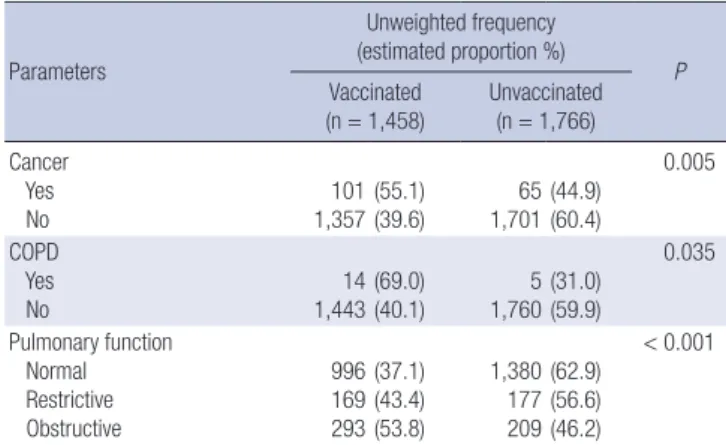
When we compared the vaccinated and the unvaccinated, a significant difference in all characteristics except for marital status and tuberculosis history were noted. For those who were females, over 65 years of age, living in the areas other than me- tropolis, living in eup/myeon, with the lower the level of educa- tion or household income, non-smokers, with recognition of self-perceived health status as poor, receiving regular health checkup, with activity restricted, with history of chronic diseas- es except tuberculosis, influenza vaccination coverage was sig- nificantly higher. Influenza vaccination rate was also higher among those who had abnormal lung function and had COPD
(Table 1). Notably, those who had COPD were only 0.6% of the subjects, although nearly a quarter of the subjects had abnor- mal lung function either restrictive or obstructive.
Influenza vaccination coverage according to the pulmonary function and COPD diagnosis
Because there were few subjects who were diagnosed with CO- PD by doctors, they were combined with those who had abnor- mal lung function and analyzed. Influenza vaccination cover- age was not related to having COPD or abnormal lung function in both younger (40-64 years old) and elderly (65 years or older) population. Multiple logistic regression analysis showed similar results (Table 2).
Other factors that affect vaccination coverage
In logistic regression analysis, factors affecting influenza vacci- nation rate were remarkably different according to age groups.
In the group with ages between 40 and 65, those with less than middle school graduation were more likely to get vaccination than college graduates (aOR = 1.94; 95% CI 1.40-2.69). In addi- tion, those who received regular health checkup (aOR = 1.60;
95% CI 1.21-2.12), and those who had restricted activity (aOR = 1.74; 95% CI 1.13-2.70) had significantly higher vaccination cov- erage. Those who had a history of dyslipidemia (aOR = 1.38;
95% CI 1.01-1.90), myocardial infarction or angina (aOR = 2.29;
95% CI 1.09-4.82), and chronic renal failure (aOR = 3.64; 95% CI 1.18-11.22) had higher vaccination coverage than those who had no such diseases. Interestingly, those who had pulmonary tuberculosis history (aOR = 0.50; 95% CI 0.29-0.87) were less likely to get vaccinated than those who had not. For those aged 65 years or older, any covariates including socio-demographic, health behavior, co-morbidities status, or screening results did not affect the vaccination coverage except among those who received regular health checkup (aOR = 1.51; 95% CI 1.01-2.26) (Table 2).
Table 1. Influenza vaccination coverage rates according to the characteristics of re- spondents in 2012 KNHANES
Parameters
Unweighted frequency (estimated proportion %) Vaccinated P
(n = 1,458)
Unvaccinated (n = 1,766) Gender
Male
Female 560
898(35.3)
(44.7) 787
979(64.7) (55.3)
< 0.001
Age 40-64
≥ 65 680
778(28.0)
(78.3) 1,531 235(72.0)
(21.7)
< 0.001
Residential neighborhood Metropolis
Others 633
825(36.1)
(43.7) 848
918(63.9) (56.3)
0.005
Administrative areas Dong
Eup/Myeon 1,097
361(38.0) (47.6) 1,420
346(62.0) (52.4)
0.016
Marital status Married Unmarried
1,447 10
(40.6) (22.6)
1,737 29
(59.4) (77.4)
0.075
Education level ≤ Middle school High school ≥ College
902 351 202
(55.7) (30.1) (24.9)
627 638 496
(44.3) (69.9) (75.1)
< 0.001
Household income level Low
Middle low Middle high High
431 402 296 312
(62.5) (44.3) (32.7) (28.2)
223 419 477 624
(37.5) (55.7) (67.3) (71.8)
< 0.001
Smoking
Current or former smokers Nonsmokers
528 930
(35.6) (44.1)
737 1,029
(64.4) (55.9)
< 0.001
Self-perceived health status Average or better
Poor 1,086
371(37.4)
(51.8) 1,485 281(62.6)
(48.2)
< 0.001
Regular health check-up Yes
No 1,100
357(43.1)
(34.5) 1,177 589(56.9)
(65.5)
0.001
Restricted activity Yes
No 210
1,245(58.4)
(38.1) 122
1,643(41.6) (61.9)
< 0.001
Chronic diseases Hypertension Yes
No 627
831(57.8)
(33.4) 394
1,372(42.2) (66.6)
< 0.001
Diabetes Yes
No 214
1,244(57.9)
(38.4) 134
1,632(42.1) (61.6)
< 0.001
Dyslipidemia Yes
No 348
1,110(57.0)
(37.4) 204
1,562(43.0) (62.6)
< 0.001
Myocardial infarction or angina Yes
No 95
1,363(68.2)
(39.2) 41
1,725(31.8) (60.8)
< 0.001
Pulmonary tuberculosis Yes
No
77 1,381
(33.7) (40.6)
101 1,665
(66.3) (59.4)
0.188
Asthma Yes No
80 1,378
(50.9) (39.8)
53 1,713
(49.1) (60.2)
0.042
Chronic renal failure Yes
No
18 1,440
(64.3) (40.1)
10 1,756
(35.7) (59.9)
0.033
(Continued to the next)
Parameters
Unweighted frequency (estimated proportion %) Vaccinated P
(n = 1,458) Unvaccinated (n = 1,766) Cancer
Yes No
101 1,357
(55.1) (39.6)
65 1,701
(44.9) (60.4)
0.005
COPD Yes No
14 1,443
(69.0) (40.1)
5 1,760
(31.0) (59.9)
0.035
Pulmonary function Normal Restrictive Obstructive
996 169 293
(37.1) (43.4) (53.8)
1,380 177 209
(62.9) (56.6) (46.2)
< 0.001
KNHANES, Korean National Health and Nutrition Survey; COPD, chronic obstructive pulmonary diseases.
Table 1. Continued
DISCUSSION
This study aimed to identify the influenza vaccination status of the people with decreased pulmonary functions or having CO- PD, a high risk population for influenza infection and its com- plications. Generally, subjects with normal pulmonary function were less likely to get vaccinated and those who had obstructive pulmonary dysfunction were more likely to get vaccinated.
However, any pulmonary dysfunction or history of COPD did not affect the vaccination coverage in the multivariate analysis.
Factors affecting influenza vaccination rate were remarkably different for younger population and elderly. For example, those with chronic diseases such as dyslipidemia, ischemic heart dis- eases and chronic renal failure had significantly higher vaccina- tion coverage only in younger population. This is the first study, to the best of our knowledge, to investigate influenza vaccina- tion coverage related to pulmonary function among Korean adults after age stratification.
People with pulmonary dysfunction are more likely to have symptoms and use health care services regularly, thereby have more chance to get vaccinated (1,11-14). Previous research show- ed that asthma patients had significantly higher vaccination coverage than healthy people (8) or that there had been no sig- nificant correlations between lung disease and vaccination cov-
erage (6,7). The current research observed that influenza vacci- nation was higher among those with impaired lung function and diagnosed as COPD by doctors than subjects with normal pulmonary function. However, having COPD or pulmonary dysfunction was not a significant determinant for vaccination coverage in the multivariate analysis. This finding may be attrib- utable to under-diagnosis of COPD (15,16). It was also notable that only a few subjects from people with abnormal lung func- tion were diagnosed with COPD by doctors in the current study.
Without performing spirometry, physicians were likely to un- derestimate their patients’ disease severity or inadequately rec- ommend their patients’ treatment options (17). If diagnosis of COPD using breathing test can increase vaccination rates as in the study abroad (18), more spirometry should be implement- ed in primary care setting to increase the vaccination uptake as well as to confirm the diagnosis.
Our vaccination coverage rate among adults aged 65 or older (76.8%) was comparable to vaccination rate of 77.2% among adults aged 65 and over from the previous research using na- tional sample in 2009 (6). Prevalence of influenza vaccination increased with age as in the previous studies (6-8,19), which is partly because adults aged 65 and over can receive free influen- za vaccination through national immunization program for el- derly, and partly because they have more utilization for medical Table 2. Unadjusted and adjusted odds ratios and 95% confidence intervals for influenza vaccination during the past 1 year in the 2012 KNHANES
Variables 40-64 yr old ≥ 65 yr old
UOR (95% CI) AOR (95% CI) UOR (95% CI) AOR (95% CI)
Having COPD or abnormal PFT 1.13 (0.84-1.51) 1.08 (0.79-1.46) 0.85 (0.61-1.19) 0.88 (0.60-1.30)
Gender
Male Reference Reference Reference Reference
Female 1.41 (1.12-1.77) 1.29 (0.86-1.94) 1.19 (0.85-1.67) 1.29 (0.71-2.35)
Education level
More than college Reference Reference Reference Reference
High school 1.24 (0.91-1.68) 1.18 (0.85-1.63) 1.31 (0.60-2.89) 1.24 (0.55-2.82)
Less than middle school 2.33 (1.70-3.18) 1.94 (1.40-2.69) 1.43 (0.79-2.59) 1.40 (0.75-2.60)
Residential area
Other area Reference Reference Reference Reference
Metropolis 0.82 (0.64-1.04) 0.92 (0.72-1.17) 0.78 (0.52-1.17) 0.77 (0.52-1.16)
Restricted activity 2.18 (1.43-3.33) 1.74 (1.13-2.70) 0.86 (0.51-1.44) 0.82 (0.48-1.39)
Regular health check-up 1.58 (1.20-2.10) 1.60 (1.21-2.12) 1.51 (1.03-2.22) 1.51 (1.01-2.26)
Smoking
Nonsmoker Reference Reference Reference Reference
Current or past smoker 0.74 (0.59-0.93) 0.93 (0.61-1.41) 1.04 (0.74-1.46) 1.35 (0.78-2.35)
Chronic diseases
Hypertension 1.53 (1.17-2.01) 1.11 (0.81-1.51) 1.46 (1.03-2.08) 1.39 (0.98-1.96)
Dyslipidemia 1.80 (1.33-2.43) 1.38 (1.01-1.90) 1.65 (0.97-2.81) 1.45 (0.83-2.54)
Myocardial infarction or angina 2.82 (1.30-6.13) 2.29 (1.09-4.82) 1.24 (0.58-2.65) 1.17 (0.54-2.51)
Pulmonary tuberculosis 0.53 (0.31-0.90) 0.50 (0.29-0.87) 0.77 (0.42-1.43) 0.87 (0.46-1.66)
Asthma 1.56 (0.85-2.84) 1.39 (0.78-2.49) 1.17 (0.50-2.70) 1.31 (0.56-3.10)
Diabetes 1.66 (1.09-2.53) 1.17 (0.74-1.85) 1.25 (0.77-2.02) 1.07 (0.65-1.76)
Chronic renal failure 4.92 (1.46-16.50) 3.64 (1.18-11.22) 0.45 (0.11-1.81) 0.45 (0.09-2.19)
Cancer 1.16 (0.69-1.94) 0.99 (0.58-1.69) 1.72 (0.80-3.66) 1.99 (0.90-4.40)
KNHANES, Korean National Health and Nutrition Survey; UOR, unadjusted odds ratio; CI, confidence interval; AOR, adjusted OR; COPD, chronic obstructive pulmonary diseases;
PFT, pulmonary function test.
services. The vaccination coverage rate is price sensitive and free or reimbursed vaccination has been reported as one of the strongest incentives to increase the vaccination of the young adults in Hong Kong (20). A study for influenza vaccination of cancer survivors also revealed that younger population had sig- nificantly lower vaccination coverage than elderly patients who had greater accessibility to vaccination by no cost (21). National health insurance coverage for vaccination regardless of age may be an effective strategy to increase the influenza vaccination uptake among high risk population of influenza such as people with chronic lung diseases or cancer survivors.
Vaccination rate was also higher among those who received regular health checkups regardless of age. People who receive regular health checkups are more likely to take care for their health, thereby get more information about vaccination from health professionals or have the chance to get vaccinated. Reg- ular health checkups can be used as a chance to recommend or implement the influenza vaccination for high risk populations, because both are effective health promotion strategies.
Different characteristics were noted that affect vaccination coverage according to age groups in this study. For those aged 65 years and over, there was no significant difference among the vaccinated and the unvaccinated except regular health check- ups, as in the previous study (6). However, there were some dis- parities in influenza vaccination coverage for young adults. Low- er education level was associated with more vaccination among group with ages between 40 and 65. Some explanations include the fact that national free vaccination policy targets vulnerable social groups with lower education level. Or those who had low- er education tend to assess themselves as relatively unhealthy and are more likely to get vaccination. This finding may be re- lated with the fact that young adults who reported their activity level as restricted due to any cause or who had chronic diseases such as dyslipidemia, heart disease, and chronic renal disease got more vaccination in the present study. Previous reports on the relation between education and vaccination coverage show- ed conflicting results. Several studies from Korea (6,8) and Chi- na (22) revealed that lower education level was associated with higher vaccination coverage. In a multi-center study, there was no difference in the vaccination rate according to education level among patients with chronic kidney disease and asthma, but lower education was related to more influenza vaccination for diabetics (23). The effect of education on vaccination cover- age was differently expressed among the European countries and could not be explained solely on the basis of economic char- acteristics of these countries (24,25). Further studies are needed to investigate the reasons why persons with high education lev- el in relatively young ages refrain from getting immunization. It is notable that history of tuberculosis was associated with low vaccination rate, unlike other chronic disease which is an im- portant attribute for vaccination receipt. Little has been studied
about influenza vaccination coverage among patients with his- tory of pulmonary tuberculosis. Those who have past history of tuberculosis may not feel any need for immunization because they do not perceive themselves as sick people. Further studies are needed to investigate the specific reasons why they do not get immunized against influenza.
There are several limitations to be considered in our study.
Although we used data from a nationwide representative sur- vey, it is difficult to establish causal and sequential relationships because of the nature of the cross-sectional design of the study.
Since vaccination receipt and history of morbidity were based on self-report, these information can be vulnerable to recall bias. As we did not include the subjects aged below 40 years, we cannot broaden our interpretation to them. We could not esti- mate the impact of an active promotion for influenza vaccina- tion and government’s education campaign since influenza pandemic in 2009-2010 which could have been a great influ- ence on vaccination receipt (26).
Despite these limitations, we found that pulmonary dysfunc- tion or having COPD did not significantly affect influenza vac- cination coverage using the data of the 5th National Health and Nutrition Survey. Influenza vaccination coverage was consider- ably different when people were divided into groups, based on the age of 65. More recommendation of influenza vaccination needs to be encouraged for people with decreased pulmonary function due to smoking or chronic pulmonary diseases.
DISCLOSURE
The authors have no potential conflicts of interest to declare.
AUTHOR CONTRIBUTION
Conception and design: Cha SH, Yoo S. Analysis and interpre- tation of data: Cha SH, Paik JH, Jeon YJ. Writing or revision of the manuscript: Cha SH, Lee MR, Yang H, Yoo S. Study supervi- sion: Park SG, Yoo S. Approval of final manuscript: all authors.
ORCID
Seung-Hyun Cha http://orcid.org/0000-0003-2723-853X Jeong-Hun Paik http://orcid.org/0000-0002-3468-7600 Mi-Ra Lee http://orcid.org/0000-0002-4371-3022 Huiho Yang http://orcid.org/0000-0003-3563-9376 Seung-Guk Park http://orcid.org/0000-0002-2986-3729 Young-Jee Jeon http://orcid.org/0000-0002-8070-2453 Sunmi Yoo http://orcid.org/0000-0001-7407-8423 REFERENCES
1. Nichol KL, Nordin JD, Nelson DB, Mullooly JP, Hak E. Effectiveness of in-
fluenza vaccine in the community-dwelling elderly. N Engl J Med 2007;
357: 1373-81.
2. Rothberg MB, Rose DN. Vaccination versus treatment of influenza in work- ing adults: a cost-effectiveness analysis. Am J Med 2005; 118: 68-77.
3. Ting SC, Crooks SW, South G. The effect of influenza vaccination on the incidence of chronic obstructive pulmonary disease exacerbations in the immediate postvaccination period. J Epidemiol Community Health 2011;
65: 157-9.
4. Simonsen L, Viboud C, Taylor R. Influenza vaccination in elderly people.
Lancet 2005; 366: 2086.
5. Park SC, Cheong HJ, Sohn JW, Choi SJ, Eom JS, Woo HJ, Chun BC, Kim WJ. Efficacy of influenza vaccination among chronic ill patients: retro- spective case control study. Infect Chemother 2004; 36: 207-12.
6. Lim J, Eom CS, Kim KH, Kim S, Cho B. Coverage of influenza vaccination among elderly in South Korea: a population based cross sectional analy- sis of the season 2004-2005. J Korean Geriatr Soc 2009; 13: 215-21.
7. Kee SY, Lee JS, Cheong HJ, Chun BC, Song JY, Choi WS, Jo YM, Seo YB, Kim WJ. Influenza vaccine coverage rates and perceptions on vaccina- tion in South Korea. J Infect 2007; 55: 273-81.
8. Park MB, Kim CB, Joo HS. Factors influencing on influenza vaccination coverage. J Korea Contents Assoc 2013; 13: 300-11.
9. Ministry of Health and Welfare (KR). Korea National Health and Nutri- tion Examination Survey. Available at http://knhanes.cdc.go.kr [accessed on day month year].
10. Global Initiative for Chronic Obstructive Lung Disease. Global strategy for the diagnosis, management, and prevention of chronic obstructive pulmonary disease: update 2013. Available at http://www.goldcopd.org [accessed on day month year].
11. Kroneman M, van Essen GA, John Paget W. Influenza vaccination cover- age and reasons to refrain among high-risk persons in four European countries. Vaccine 2006; 24: 622-8.
12. Blank PR, Schwenkglenks M, Szucs TD. Influenza vaccination coverage rates in five European countries during season 2006/07 and trends over six consecutive seasons. BMC Public Health 2008; 8: 272-82.
13. Blank PR, Schwenkglenks M, Szucs TD. Disparities in influenza vaccina- tion coverage rates by target group in five European countries: trends over seven consecutive seasons. Infection 2009; 37: 390-400.
14. Linn ST, Guralnik JM, Patel KV. Disparities in influenza vaccine coverage in the United States, 2008. J Am Geriatr Soc 2010; 58: 1333-40.
15. Yoo KH, Kim YS, Sheen SS, Park JH, Hwang YI, Kim SH, Yoon HI, Lim SC,
Park JY, Park SJ, et al. Prevalence of chronic obstructive pulmonary dis- ease in Korea: the fourth Korean National Health and Nutrition Examina- tion Survey, 2008. Respirology 2011; 16: 659-65.
16. Hill K, Goldstein RS, Guyatt GH, Blouin M, Tan WC, Davis LL, Heels-Ans- dell DM, Erak M, Bragaglia PJ, Tamari IE, et al. Prevalence and underdi- agnosis of chronic obstructive pulmonary disease among patients at risk in primary care. CMAJ 2010; 182: 673-8.
17. Mapel DW, Dalal AA, Johnson P, Becker L, Hunter AG. A clinical study of COPD severity assessment by primary care physicians and their patients compared with spirometry. Am J Med 2015; 128: 629-37.
18. Mowls DS, Cheruvu VK, Zullo MD. Influenza vaccination in adults with chronic obstructive pulmonary disease: the impact of a diagnostic breath- ing test on vaccination rates. PLoS One 2013; 8: e67600.
19. Dower J, Donald M, Begum N, Vlack S, Ozolins I. Patterns and determi- nants of influenza and pneumococcal immunisation among adults with chronic disease living in Queensland, Australia. Vaccine 2011; 29: 3031-7.
20. Yeung MP, Ng SK, Tong ET, Chan SS, Coker R. Factors associated with up- take of influenza vaccine in people aged 50 to 64 years in Hong Kong: a case-control study. BMC Public Health 2015; 15: 617.
21. Choi KH, Park SM, Lee K, Lee JH, Park JS. Influenza vaccination and as- sociated factors among Korean cancer survivors: a cross-sectional analy- sis of the Fourth & Fifth Korea National Health and Nutrition Examina- tion Surveys. J Korean Med Sci 2014; 29: 1061-8.
22. Zheng Y, Yang P, Wu S, Ma C, Seale H, Macintyre CR, Wang Q. A cross- sectional study of factors associated with uptake of vaccination against influenza among older residents in the postpandemic season in Beijing, China. BMJ Open 2013; 3: e003662.
23. Kee SY, Cheong HJ, Chun BC, Kim WJ. Influenza vaccination coverage rate and factors associated with vaccination in people with chronic dis- ease. Infect Chemother 2011; 43: 406-11.
24. Damiani G, Federico B, Visca M, Agostini F, Ricciardi W. The impact of socioeconomic level on influenza vaccination among Italian adults and elderly: a cross-sectional study. Prev Med 2007; 45: 373-9.
25. Endrich MM, Blank PR, Szucs TD. Influenza vaccination uptake and so- cioeconomic determinants in 11 European countries. Vaccine 2009; 27:
4018-24.
26. Sevencan F, Ertem M, Özçullu N, Dorman V, Kubat NK. The evaluation of the opinions and attitudes of healthcare personnel of the province Diyar- bakir against influenza A (H1N1) and the vaccination. Hum Vaccin 2011;
7: 945-51.