Clinical Features of Drug-induced Liver Injury According to Etiology
Drug-induced liver injury (DILI) is an increasingly common cause of acute hepatitis. We examined clinical features and types of liver injury of 65 affected patients who underwent liver biopsy according DILI etiology. The major causes of DILI were the use of herbal medications (43.2%), prescribed medications (21.6%), and traditional therapeutic preparations and dietary supplements (35%). DILI from herbal medications, traditional therapeutic preparations, and dietary supplements was associated with higher elevations in aspartate aminotransferase (AST) and alanine aminotransferase (ALT) levels than was DILI from prescription medications. The types of liver injury based on the R ratio were hepatocellular (67.7%), mixed (10.8%), and cholestatic (21.5%). Herbal medications and traditional therapeutic preparations were more commonly associated with hepatocellular liver injury than were prescription medications (P = 0.002). Herbal medications and traditional therapeutic preparations induce more hepatocellular DILI and increased elevations in AST and ALT than prescribed medications.
Keywords: Drug-induced Liver Injury; Hepatotoxicity; Etiology; Plants, Medicinal;
Traditional Therapy; Prescribed Medicines Byoung Moo Lee,1 Woong Cheul Lee,1
Jae Young Jang,1 Pyoung Ahn,1 Jin Nyoung Kim,1 Soung Won Jeong,1 Eui Ju Park,1 Sae Hwan Lee,2 Sang Gyune Kim,3 Sang-Woo Cha,1 Young Seok Kim,3 Young Deok Cho,1 Hong Soo Kim,2 and Boo Sung Kim1
1Institute for Digestive Research, Digestive Disease Center, Department of Internal Medicine, College of Medicine, Soonchunhyang University, Seoul;
2Department of Internal Medicine, College of Medicine, Soonchunhyang University, Cheonan;
3Department of Internal Medicine, College of Medicine, Soonchunhyang University, Bucheon, Korea
Received: 21 April 2015 Accepted: 19 August 2015 Address for Correspondence:
Jae Young Jang, MD
Institute for Digestive Research, Digestive Disease Center, Department of Internal Medicine, College of Medicine, Soonchunhyang University, 53 Daesagwan-ro, Yongsan-gu, Seoul 04401, Korea
Tel: +82.2-2258-2900, Fax: +82.2-2258-6917 E-mail: [email protected]
Funding: Soonchunhyang University Research Fund.
http://dx.doi.org/10.3346/jkms.2015.30.12.1815 • J Korean Med Sci 2015; 30: 1815-1820
INTRODUCTION
Drug-induced liver injury (DILI) is caused by various prescribed medications, herbs, or other substances that lead to liver dys- function in the absence of other etiologies (1). In Western coun- tries, DILI accounts for 1.2%-6.6% of the cases of acute liver dis- ease seen at tertiary referral centers and is one of the leading cau- ses of acute liver failure, accounting for 13% of all cases (2). In Korea, the annual extrapolated incidence of DILI in hospitalized patients at a university hospital was calculated as 12/100,000 persons/year, and DILI is the most common cause of acute hep- atitis (3). DILI can be classified into hepatocellular, cholestatic, and mixed patterns based on the ratio of serum alanine amino- transferase (ALT) to alkaline phosphatase (ALP) (4).
The types of liver injury in DILI and the common causative agents have been documented in Western countries (5,6). How- ever, most of these studies have been limited to assessing pre- scribed medications, such as antibiotics and anti-tuberculosis and the central nervous system (CNS) agents. The acceptance in Korea of oriental medicine and other traditional folk reme-
dies as alternatives to modern medicine creates unique circum- stances for studying DILI (7). These remedies, commonly called herbal medicines in Korea, are regarded as safe by many people and are often used to treat various conditions in the absence of regulation or expert advice. The number of individuals exposed to herbal medications is greater in Korea than in Western coun- tries, suggesting that the causative agents that lead to DILI and the types of liver injury with which it is associated may differ from those in Western countries and resemble those in other Asian countries, such as China and Japan. The aim of this study was to investigate the clinical features and types of liver injury of affected patients who underwent liver biopsy according to DILI etiology.
MATERIALS AND METHODS
A retrospective analysis was performed on the medical records of 163 patients who visited Soonchunhyang University Hospital (Seoul, Korea) with acute hepatitis diagnosed as DILI from July 2003 to February 2013. DILI was defined as aspartate amino-
transferase (AST) or ALT ≥ 3 × upper normal limit (UNL) or to- tal bilirubin (TB) ≥ 2 × UNL (8). We identified 65 cases of DILI that met the following inclusion criteria: 1) modified Roussel Uclaf Causality Assessment Method (RUCAM) score ≥ 7; 2)
> 18 yr of age; and 3) DILI confirmed by biopsy. Histopatholog- ic evaluation was performed by a single, experienced patholo- gist. History taking, radiologic tests including abdominal ultra- sonography, and computed tomography (CT), and laboratory tests were performed to exclude etiologies other than DILI. All 65 patients underwent liver biopsy, and their baseline charac- teristics, etiology, chief complaints, comorbidities, laboratory findings, and histopathologic findings were analyzed. All pa- tients with liver biopsy manifested moderate to severe liver dis- ease. There was no patient who transferred for liver transplan- tation. Clinical mild hepatitis such as transient elevation of aminotransferase was excluded to do liver biopsy. During the study period, the number of mild hepatitis was a few.
Definitions of DILI
DILI was defined as a liver injury that was caused by various medications, herbs, or other substances that led to liver dysfunc- tion in the absence of other etiologies. In terms of the clinical characterization of DILI, the ratio of serum ALT to ALP was used as the R value ([ALT value/ALT UNL]/[ALP value/ALP UNL]).
All DILI patients were classified into three groups by R value:
hepatocellular DILI was defined as R ≥ 5, cholestatic as R ≤ 2, and mixed as 2 < R < 5 (9).
Patient classification
DILI was classified according to etiologic agent using these cat- egories: medications, herbs, health foods or dietary supple- ments, and folk remedies. Medications were defined as medi- cations prescribed by a medical doctor. Herbs were defined as herbal medications prescribed and compounded by a doctor of oriental medicine. Other traditional remedies that did not fit into the category of herbal medications were classified as folk remedies. Preparations intended to enhance the diet and pro- vide nutrients, such as vitamins, minerals, fiber, fatty acids, and amino acids, were classified as health foods or dietary supple- ments. We combined the latter two classes into the category of health foods or dietary supplements and folk remedies. Factors associated with the etiology and pathologic findings of DILI, particularly the type of liver injury of each patient, his/her symptoms, and laboratory findings, were analyzed.
Statistical analysis
Basic descriptive statistics, including means, standard devia- tions (SDs), and ranges were used to characterize the partici- pants. The number of patients with each etiology was tabulated, and percentages were calculated to reflect proportions of the to- tal cohort. Modified RUCAM scores were used to determine the
offending drug in each case of suspected idiosyncratic DILI. We used one-way analysis of variance (ANOVA) for data that were normally distributed and the Kruskal-Wallis non-parametric test for data that were not normally distributed. When the latter was used, we performed multiple-comparison testing using the Mann-Whitney test (Bonferroni’s method) if the data from each group differed. For the evaluation of differences between the continuous variables among the groups, post-hoc analysis was done. For categorical variables, associations with outcome were assessed via the person chi-square test. Results were considered statistically significant when the P value was < 0.05. All statisti- cal analyses were performed with statistical software (SPSS, ver.
17.0, SPSS, Chicago, IL, USA).
Ethics statement
The study design was approved by the institutional review board at Soonchunhyang University Hospital, Seoul, Korea (IRB No.
SCHUH-2014-10-022). Because the study design was retrospec- tive, informed consent was exempted by the board.
RESULTS
A total of 163 patients were suspected to have DILI. We exclud- ed 98 patients who were < 18 yr old, had a modified RUCAM score < 7, or who did not undergo a liver biopsy. After exclud- ing these 98 patients, the medical records of 65 eligible patients were reviewed retrospectively (Fig. 1).
Baseline characteristics
Table 1 shows baseline characteristics of enrolled patients. The incidence of DILI was higher in females (n = 41) than in males (n = 24), and the mean age of the patients was 48.2 ± 13.1 yr.
The major causes of DILI were the use of herbal medications (43.2%), prescription medications (21.6%), and traditional ther-
Fig. 1. Flow chart of the enrolled patients.
Hospitalized patients with suspected DILI after excluding other etiologies (ALT >3 × UNL or TB > 2 × UNL)
(n = 163)
Patients with age > 18 and RUCAM score ≥ 7 and
biopsy proven (n = 65)
Excluded because RUCAM score < 7 or age < 18 or not underwent liver biopsy
(n = 98)
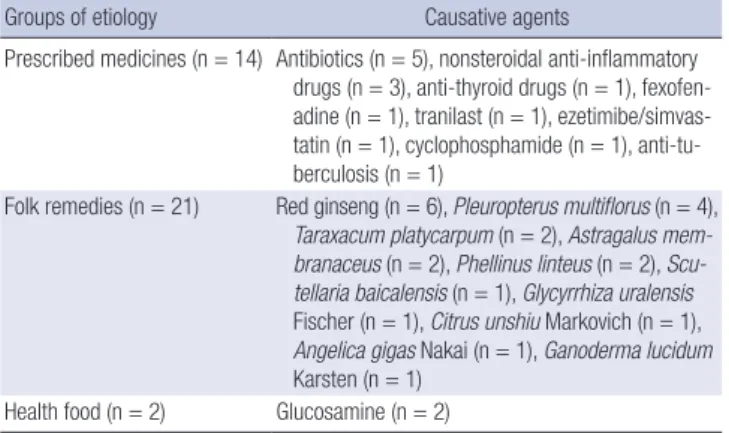
apeutic preparations and dietary supplements (35%). At the time of admission, patients presented with various symptoms, such as anorexia and abdominal discomfort (46.2%), jaundice and itching (40%), myalgia and fatigue (32.3%), fever and chills (16.9%), as well as headache and dizziness (6.2%). The mean modified RUCAM score of all enrolled patients was 8.01 ± 0.75 (Table 1). The causative agents in each etiological group are pre- sented in Table 2.
Laboratory findings
The following peak laboratory findings were recorded in the study patients: AST, 488 (150-919) IU/L; ALT, 552 (190-1,511) IU/L; total bilirubin, 8 (2-13) mg/dL; ALP, 219 (161-484) IU/L;
and γ-glutamyl transpeptidase 195 (111-289) IU/L (Table 1).
The mean AST level of each causative agent were as follows:
764.64 ± 560.96 IU/L for herbal medications, 223.61 ± 210.10 IU/L for prescribed medications, and 702.18 ± 546.59 IU/L for traditional therapeutic preparations and dietary supplements.
The mean ALT level was 950.36 ± 659.53 IU/L for those taking herbal medications, 263.00 ± 176.36 IU/L for those taking pre- scription medications, and 1,271.46 ± 931.84 IU/L for those taking traditional therapeutic preparations and dietary supple- ments (Table 3). These results demonstrate that DILI from herbal medications and traditional therapeutic preparations and dietary supplements shows higher AST (P = 0.009) and ALT (P = 0.001) level than that from prescription medications (Fig. 2). However, we found no significant differences in ALP (P = 0.304), the AST/ALT ratio (P = 0.407), prothrombin time (P = 0.184), total bilirubin (P = 0.521), and γ-GPT (P = 0.630) (Table 3). Patients with AST > 600 IU/L accounted for 7.7%
(1/13) of the group receiving prescribed medications group, 64% (16/25) of the group receiving herbal medications, and 48% (13/27) of the group receiving traditional therapeutic prep- arations and dietary supplements (P = 0.001). Patients with ALT > 600 IU/L accounted for 7.7% (1/13) of those taking pre- scribed medications, 60% (15/25) of those taking herbal medi- cations, and 56% (15/27) of those taking traditional therapeutic preparations and dietary supplements (P = 0.005) (Table 3).
Types of liver injury
The types of liver injury based on the R ratio ([ALT/UNL]/[ALP/
UNL]) were hepatocellular (67.7%), mixed (10.8%), and choles- Table 1. Baseline characteristics of the enrolled patients
Characteristics Value
Number (M:F) of patients 65 (24:41)
Age (yr, mean ± SD) 48.2 ± 13.1
Major causes, No. (%) Prescribed medicines 14 (21.5)
Herbal medications 28 (43.1)
Health foods & dietary supplement
& folk remedies 23 (35.4) Initial Symptoms,* No. (%) Anorexia, abdominal discomfort 30 (46.2)
Jaundice, itching 26 (40)
Myalgia, fatigue 21 (32.3)
Fever, chills 11 (16.9)
Headache, dizziness 4 (6.2)
Peak level, median (range) AST (IU/L) 488 (150-919)
ALT (IU/L) 552 (190-1,511)
Total bilirubin (mg/dL) 8 (2-13)
ALP (IU/L) 219 (161-484)
γ-GTP (IU/L) 195 (111-289)
Modified RUCAM score (mean ± SD) 8.01 ± 0.75
*One patient can have one or more initial symptoms. AST, aspartate aminotransfer- ase; ALT, alanine aminotransferase; ALP, alkaline phosphatase; γ-GTP, gamma-glu- tamyl transpeptidase.
Table 2. Causative agents according to each group of etiology
Groups of etiology Causative agents
Prescribed medicines (n = 14) Antibiotics (n = 5), nonsteroidal anti-inflammatory drugs (n = 3), anti-thyroid drugs (n = 1), fexofen- adine (n = 1), tranilast (n = 1), ezetimibe/simvas- tatin (n = 1), cyclophosphamide (n = 1), anti-tu- berculosis (n = 1)
Folk remedies (n = 21) Red ginseng (n = 6), Pleuropterus multiflorus (n = 4), Taraxacum platycarpum (n = 2), Astragalus mem- branaceus (n = 2), Phellinus linteus (n = 2), Scu- tellaria baicalensis (n = 1), Glycyrrhiza uralensis Fischer (n = 1), Citrus unshiu Markovich (n = 1), Angelica gigas Nakai (n = 1), Ganoderma lucidum Karsten (n = 1)
Health food (n = 2) Glucosamine (n = 2)
Table 3. Laboratory values of each patient group with the 3 major causative agents
Values Prescribed medicines Herbal medications Health foods, dietary supplement
& folk remedies P value
Number (M:F) 13 (5:8) 25 (8:17) 27 (11:6)
Peak AST (IU/L)† 149 (99-277) 741 (157-1,024) 646 (295-984) 0.009
Peak ALT (IU/lL)* 263.00 ± 176.36 950.36 ± 659.53 1,271.46 ± 931.84 0.001
Peak ALP (IU/L)† 360 (264-613) 207 (165-511) 253 (123-371) 0.304
AST†/ALT 0.95 (0.45-1.40) 0.75 (0.58-0.89) 0.67 (0.40-1.27) 0.407
AST‡ over 600 IU/L, No. (%) 1/13 (7.7) 16/25 (64) 13/27 (48) 0.001*
ALT‡ over 600 IU/L, No. (%) 1/13 (7.7) 15/25 (60) 15/27 (56) 0.005*
Prothrombin time† 5.80 (0.89-14.43) 6.11 (1.01-13.45) 1.17 (1.03-12.40) 0.184
Total bilirubin† 10.90 (0.73-25.33) 8.30 (2.63-16.05) 5.40 (2.00-10.10) 0.521
γ-GPT† 229 (66-542) 218 (114-279) 165 (114-288) 0.630
*Oneway ANOVA, mean ± SD; †Kruskal-Wallis test, median (interquartile range); ‡Chi-square test.
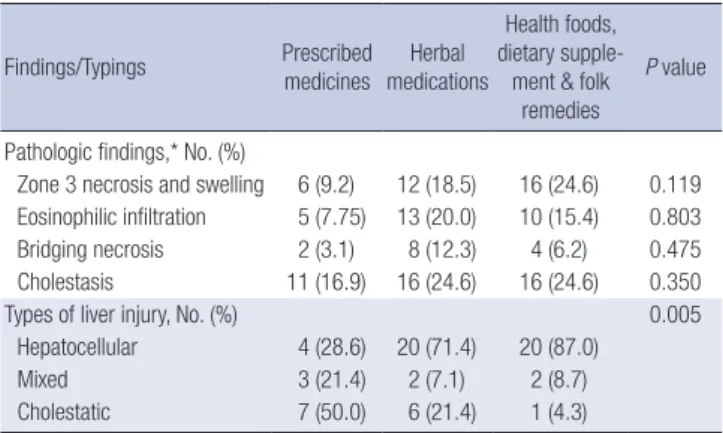
tatic (21.5%). Among patients whose DILI was due to herbal medication, the most common type of liver injury was hepato- cellular (20/28, 71.4%) and the same result was observed with
health foods or dietary supplements and folk remedies group (20/23, 87.0%). Among those receiving prescription medica- tions, there was an even distribution of the types of liver injury:
hepatocellular 28.6%, mixed 21.4%, cholestatic 50.0%. So, high- er incidence of hepatocellular type was observed in herbal medication and health foods or dietary supplements and folk remedies groups than in prescription medication group (P = 0.005) (Table 4). The main pathologic findings were cho- lestasis (66.2%), zone 3 necrosis and swelling (53.8%), increased eosinophilic infiltration (43.1%), and bridging necrosis (21.5%).
A correlation between pathologic findings and etiology was not found in this study (Table 4). Main pathologic findings of drug induced liver injury are demonstrated in Fig. 2. However, high- er incidence of hepatocellular type liver injury was observed in herbal medications and health foods or dietary supplements and folk remedies groups than in prescription medication group (P = 0.005). All patients were recovered without compli- cation after conservative treatment.
Fig. 2. Main pathologic findings of drug induced liver injury. (A) There are several centrilobular confluent necrosis at the acinar zone III with bridging necrosis connected to the adjacent vascular structure (H&E stain, × 40). (B) Trichrome stain showed enlarged portal tract with minimal portal fibrosis (Trichrome stain, × 40). (C) The necrotic acinar zone III areas are mostly infiltrated by lipofusin pigment laden histiocytes. There is also surrounding chronic inflammatory cell infiltration (H&E stain, × 100). (D) Focal necrosis and ac- idophilic body formation of the hepatocytes with Kupffer cell hyperplasia are also present (H&E stain, × 200).
Table 4. Pathologic findings and types of liver injury according to the causative agents
Findings/Typings Prescribed medicines
Herbal medications
Health foods, dietary supple- ment & folk
remedies
P value
Pathologic findings,* No. (%)
Zone 3 necrosis and swelling 6 (9.2) 12 (18.5) 16 (24.6) 0.119 Eosinophilic infiltration 5 (7.75) 13 (20.0) 10 (15.4) 0.803
Bridging necrosis 2 (3.1) 8 (12.3) 4 (6.2) 0.475
Cholestasis 11 (16.9) 16 (24.6) 16 (24.6) 0.350
Types of liver injury, No. (%) 0.005
Hepatocellular 4 (28.6) 20 (71.4) 20 (87.0)
Mixed 3 (21.4) 2 (7.1) 2 (8.7)
Cholestatic 7 (50.0) 6 (21.4) 1 (4.3)
*One patient can have one or more pathologic findings.
A B
C D
DISCUSSION
The incidence of drug-induced liver injury was recently report- ed in a nationwide multicenter Korean study (10). In our study, we analyzed the relationship between etiology and type of liver injury. Our results indicated that prescription medications ac- counted for 27.3% of DILI cases, herbs (including herbal medi- cations) accounted for 40.1% of cases, and folk remedies and dietary supplements accounted for 22.3% of cases. The patterns of liver injury associated with each type of etiology differed somewhat from those found in a previous nationwide Korean study. Suk et al. (10) reported the most common pattern of liver injury associated with herbs was hepatocellular and that the most common pattern associated with folk remedies and di- etary supplements was cholestatic. However, in our study, the most common pattern of liver injury for herbs and folk reme- dies and dietary supplements was hepatocellular. The etiology of DILI in Western countries differs from that in Asian coun- tries, especially Korea and China. The causative agents of DILI in Western countries are primarily prescription medications, such as antibiotics, analgesics, and CNS agents, and only 0%- 9% of cases had etiologies other than prescription medications (11,12). The components of prescription medications are gen- erally well known (13), whereas the exact ingredients of the herbs and folk remedies used in oriental medicine are more difficult to identify. Thus, the widely-used method of DILI clas- sification that relies on R-values would not be a useful standard in Asian compared with in Western countries, which we believe accounts for differences between our study and the recent na- tionwide DILI study in Korea (10). A standard classification will require cooperation among the government, physicians, and doctors of oriental medicine in the service of identifying the specific ingredients of herbs and folk remedies.
In our study, the increase in aminotransferase levels in DILI significantly differed according to causative agent. The type of liver injury caused by herbal medications and traditional thera- peutic preparations and dietary supplements was predomi- nantly hepatocellular, and these were more likely to cause this type of injury than were prescription medications. A hepatocel- lular pattern indicates a greater aminotransferase elevation be- cause, by definition, ALT is elevated five-fold compared with ALP (14,15). The incidence of aminotransferase elevation may be greater with herbal medications and traditional therapeutic preparations and dietary supplements than with prescription medications because the R value is defined by ALT. However, data from our study indicate that both ALT and AST can be use- ful for predicting the pattern of livery injury.
Our study has several limitations. First, it used a single-cen- ter, retrospective design. However, due to the nature of DILI, it would be difficult to design a prospective study with a design that substantially differed from our retrospective design. Addi-
tionally, the number of patients in our study was sufficient to derive a conclusion from the data. Second, because all of our patients recovered completely, we could not compare the prog- nosis of the patients according to causative agents or types of liver injury. Third, the hospital stay of each patient was not same because patients who were diagnosed with DILI due to prescribed medication were admitted to the hospital earlier in the course of DILI than those due to herbal medications or tra- ditional therapeutic preparations and dietary supplements.
They generally did not visit the hospital until visible jaundice or detectable symptoms occurred. In the last, in our study, all en- rolled patients took liver biopsy which confirmed moderate to severe liver disease in all patients. No patients were transferred for liver transplantation. Clinically mild hepatitis patients with transient elevation of aminotransferase were excluded to do liver biopsy. During the study period, the number of mild hepa- titis was a few. Therefore, we think the selection bias might be minimal.
In conclusion, the etiology of DILI in Korea was quite differ- ent from that in western countries. The pathologic findings of the patients included in this study differed from that of another Korean DILI study. We presume that the complexity of the in- gredients of causative agents is responsible for the conclusion as aminotransferase levels are higher among those receiving herbal medications and traditional therapeutic preparations and dietary supplements than among those receiving pre- scribed medications. And this could account for the increased incidence of hepatocellular liver injury.
DISCLOSURE
The authors have no potential conflicts of interest to disclose.
AUTHOR CONTRIBUTION
Study design: Jang JY. Patients enroll and data collection: Jang JY, Lee WC, Ahn P, Kim JN, Park EJ. Data analysis & writing: Lee BM. Revision of manuscript and accept submission: all authors.
ORCID
Jae Young Jang http://orcid.org/0000-0001-6238-5151 REFERENCES
1. Vuppalanchi R, Liangpunsakul S, Chalasani N. Etiology of new-onset jaundice: how often is it caused by idiosyncratic drug-induced liver inju- ry in the United States? Am J Gastroenterol 2007; 102: 558-62.
2. Ostapowicz G, Fontana RJ, Schiødt FV, Larson A, Davern TJ, Han SH, McCashland TM, Shakil AO, Hay JE, Hynan L, et al. Results of a prospec- tive study of acute liver failure at 17 tertiary care centers in the United
States. Ann Intern Med 2002; 137: 947-54.
3. Suk KT, Kim DJ. Drug-induced liver injury: present and future. Clin Mol Hepatol 2012; 18: 249-57.
4. Au JS, Navarro VJ, Rossi S. Review article: Drug-induced liver injury--its pathophysiology and evolving diagnostic tools. Aliment Pharmacol Ther 2011; 34: 11-20.
5. Andrade RJ, Lucena MI, Fernández MC, Pelaez G, Pachkoria K, Garcia- Ruiz E, García-Muñoz B, González-Grande R, Pizarro A, Durán JA, et al. Drug-induced liver injury: an analysis of 461 incidences submitted to the Spanish registry over a 10-year period. Gastroenterology 2005; 129:
512-21.
6. Chalasani N, Fontana RJ, Bonkovsky HL, Watkins PB, Davern T, Serra- no J, Yang H, Rochon J; Drug Induced Liver Injury Network (DILIN).
Causes, clinical features, and outcomes from a prospective study of drug- induced liver injury in the United States. Gastroenterology 2008; 135:
1924-34, 1934.e1-4.
7. Ju HY, Jang JY, Jeong SW, Woo SA, Kong MG, Jang HY, Lee SH, Kim SG, Cha SW, Kim YS, et al. The clinical features of drug-induced liver injury observed through liver biopsy: focus on relevancy to autoimmune hepa- titis. Clin Mol Hepatol 2012; 18: 213-8.
8. Reuben A. Hy’s law. Hepatology 2004; 39: 574-8.
9. Fontana RJ, Seeff LB, Andrade RJ, Björnsson E, Day CP, Serrano J, Hoof-
nagle JH. Standardization of nomenclature and causality assessment in drug-induced liver injury: summary of a clinical research workshop.
Hepatology 2010; 52: 730-42.
10. Suk KT, Kim DJ, Kim CH, Park SH, Yoon JH, Kim YS, Baik GH, Kim JB, Kweon YO, Kim BI, et al. A prospective nationwide study of drug-in- duced liver injury in Korea. Am J Gastroenterol 2012; 107: 1380-7.
11. De Valle MB, Av Klinteberg V, Alem N, Olsson R, Björnsson E. Drug-in- duced liver injury in a Swedish University hospital out-patient hepatolo- gy clinic. Aliment Pharmacol Ther 2006; 24: 1187-95.
12. Teschke R, Schulze J, Schwarzenboeck A, Eickhoff A, Frenzel C. Herbal hepatotoxicity: suspected cases assessed for alternative causes. Eur J Gas- troenterol Hepatol 2013; 25: 1093-8.
13. Bunchorntavakul C, Reddy KR. Review article: herbal and dietary sup- plement hepatotoxicity. Aliment Pharmacol Ther 2013; 37: 3-17.
14. Xu HM, Chen Y, Xu J, Zhou Q. Drug-induced liver injury in hospitalized patients with notably elevated alanine aminotransferase. World J Gas- troenterol 2012; 18: 5972-8.
15. Devarbhavi H, Dierkhising R, Kremers WK, Sandeep MS, Karanth D, Adarsh CK. Single-center experience with drug-induced liver injury from India: causes, outcome, prognosis, and predictors of mortality. Am J Gastroenterol 2010; 105: 2396-404.