Present Condition Analysis of Physician Assistant in Korea
This study intended to identify the need for the legalization and development of
a systematic program for physician assistants (PAs) by understanding the actual state of PA operation in hospitals. In 114 hospitals assigned as resident training hospitals for surgery, a survey was conducted on the personnel working as PAs in those hospitals; the survey included general personal information, working conditions, training time, and satisfaction.
A total of 192 PAs in surgery at 35 hospitals responded to the survey. The types of PAs are Surgical Assistant, Clinical Physician Assistant, Wound Ostomy Care Nurse, Coordinator, and Clinical Research Coordinator. Types of work PAs preformed are surgical assistance, wound dressing, educating patients, overlooking consultation, doing paper works, writing operation records, and confirming examination results which were ordered. The
satisfaction level for the position which PAs hold were 29.1% and and satisfaction level which doctors see towards PA was 15%. The role and the job descriptions of PAs are not clear cut, there are many discrepancies among hospitals we studied. As a result, legalization and the implementation of standardized role of PAs will lead to increase level of satisfactions in the work force and the quality of work which PAs perform will be greater.
Key Words: Physician Assistants; General Surgery Yong Hwa Eom1, Gilbert Young Jin Kim1,
Sang Seol Jung1, Kil Yeon Lee2, Sung-Bum Kang3, Ja Seong Bae1, Hoon Hur4, Yong-Seong Jang5, Hyuk-Joon Lee6, Dong-Sup Yoon7, Wonshik Han7, and In Kyu Lee1
1Department of Surgery, The Catholic University of Korea College of Medicine, Seoul; 2Department of Surgery, Kyung Hee University School of Medicine, Seoul; 3Department of Surgery, Seoul National University College of Medicine, Seoul National University Bundang Hospital, Seongnam;
4Department of Surgery, Ajou University School of Medicine, Suwon; 5Dr. Jang’s Surgical Clinic, Seoul;
6Department of Surgery and Cancer Research Institute, Seoul National University College of Medicine, Seoul; 7Department of Surgery, Gangnam Severance Hospital, Yonsei University Health System, Seoul, Korea
Received: 10 February 2012 Accepted: 17 May 2012 Address for Correspondence:
In Kyu Lee, MD
Department of Surgery, St. Mary’s Hospital, The Catholic University of Korea College of Medicine, 10 63 (yuksam)-ro, Yeongdeungpo-gu, Seoul 150-713, Korea
Tel: +82.2-3779-2235, Fax: +82.2-786-0802 E-mail: [email protected]
This work was supported by a grant from the Korean Surgical Society in 2011.
http://dx.doi.org/10.3346/jkms.2012.27.9.981 • J Korean Med Sci 2012; 27: 981-986 Medicine General & Social Medicine
INTRODUCTION
Recently in the field of medicine, an increasing number of de- partments that have a shortage of resident trainees have been using physician assistants (PAs) to prescribe already set prescrip- tion and to assist during operations and perform some medical procedures. The PA system has been introduced in other coun- tries for different purposes. In other countries such as the Unit- ed States, the background of the establishment of the PA posi- tion was as an alternative plan for the health care of residents in farming and fishing villages, where the availability of medical services is restricted.
Since, the first PA graduated from Duke University in 1965, currently more than 79,000 PA graduates have been trained and educated in the field of medicine (1). However, in Korea, some hospitals without any legalization, began to use some nurses or nurse assistants to assist physicians and play the role of a PA as stated above.
While Nurse practitioner (NP) and nurse system has a sys- tematic educational course and defined regulations followed by liabilities and duties, the PA system operating in Korea did not abide by the law arrangement resulting from a distorted medical system and has no actual structure, including regula- tions and training courses. In addition, the PAs are used as al- ternative personnel for doctors in university hospitals and in some general hospitals or clinics, although there are no concrete data regarding the last two examples.
In 2010, a government survey recognized a large number of uncertified PAs in the workforce. The survey indicated urgent need to educate, train and certify the PAs in the Department of Surgery.
Since the Department of Surgery has the greatest overall need for PAs, analyzing and recognizing the current status and situa- tion of the PA is important. Therefore, the present survey was designed to study followings: general overview of current PAs in the workforce, working conditions, hours of training, level of sat-
isfaction and the standardization of the job description for a PA.
MATERIALS AND METHODS Survey method
Questionnaires were sent via email to the head of each depart- ment and to PAs at 114 recognized surgical training hospitals in the format of an Excel file. The emails were sent twice. A total of 35 hospitals (30 university-affiliated hospitals and 5 general hos- pitals) replied. Within this result, 32 department chairs and 192 general surgery PAs replied.
Survey contents
The following questions were asked to the department chairs:
current status of PAs, responsibility and supervision of the PAs, education, role, freedom to work independently, working hours, the need for the legalization of the PA system, and satisfaction with the work of the PAs in the eyes of the surgeons and residents.
The following questions were asked to PAs: current level at work with any qualification, salary, role and responsibilities, education, freedom to work independently, working hours, sat- isfaction, relationship with co-workers, and the desire to keep current PA system.
Statistical analysis and definition
Chi-square tests and t-tests were used to compare the percent- ages and means, respectively. The differences between the groups were considered statistically significant if the P value was less than 0.05. The statistical analyses were performed us- ing SPSS 12.0 for Windows (Microsoft, Chicago, IL, USA).
PAs were defined as Surgical Assistant (SA), Clinical PA, Wound Ostomy Care Nurse (WOCN), Coordinator, and Clinical Research Coordinator (CRC). SAs are PAs who were involved with surgical work where as clinical PAs were those involve clin- ical aspect of work in their workforce.
Ethics statement
The study proposal was approved by the institutional review board of The Catholic University of Korea, Yeouido St. Mary’s Hospital (SC12QISI0068). Written consents were announced to those who were involved in this survey that informed consent was waived by the board.
RESULTS Status of PAs
A total of 192 PAs from 35 hospitals and department chairs from 32 hospitals replied. The first PA started to work in 1997, and the number of PAs has been rapidly increasing since 2007. Current- ly, there are 399 PAs and 89 SAs. Overall, 32 hospitals have PAs in the Department of General Surgery, 22 in Chest Surgery, 11
in Obstetric and Gynecology, 9 in Orothopedic Surgery, 8 in Neurosurgery, 6 in Internal Medicine, 4 in Plastic Surgery, 3 in Anesthesiology, 2 each in Pediatric, Urology and Opthalomol- gy, and 1 each in the trauma center and Otorhinolaryngology.
From vacant training spots for surgical trainees, only 57.6% of the General Surgery residents fulfilled the program.
General overview (Table 1, 2)
The male to female ratio of PAs was 1:3.92, with a mean age of 31.4 yr. The duration of previous clinical work experience was 6.2 yr, with an 1.7 yr of experience was set aside for the job of Registered nurse (RN). The majority (98.4%) had a background as nurses, whereas only 2 (1.1%) and 1 PAs had been paramed- ics and military medical personnel, respectively. Most of our surveys were completed in the environment of university-affili- ated hospitals; thus, there may be different results when our sur- vey group is expanded into general and local medium-sized hospitals. With respect to the education level, 52.7% of the PAs had a bachelor’s degree, and 11.7% obtained a master’s degree.
The PAs were involved in the following areas: SA 42.9%, clinical PA 42.3%, WOCN 9.5%, coordinator 3.2%, and CRC 2.1%. 66.5%
and 28.7% of the PAs were under the departments of nursing and medical care, respectively. Overall, 80.3% of the PAs were full-time employees, and their salary was 93.5% of that of an av- erage nurse, with 23.3% receiving a special allowance.
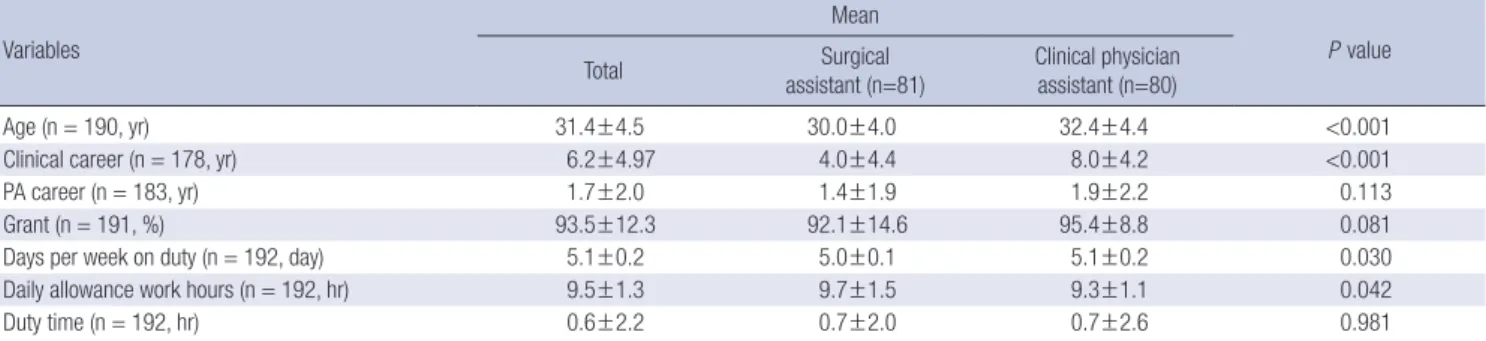
A further investigation of 81 SAs and 80 clinical PAs revealed that the male to female ratio was 43.2% male, with 3.8% male clinical PAs (P < 0.001). The education levels of the SAs were a specialized diploma for 56.8%, bachelor’s degree for 42.0%, and master’s degree for 1.2%, whereas the education levels of the clinical PAs were a specialized diploma for 21.2%, bachelor’s degree for 58.8%, and master’s degree for 20.0%; thus, the clini- cal PAs tended to have a higher education level (P < 0.001). In addition, the satisfaction level was lower in the SA group com- pared with that of the clinical PA group. The age, years of expe- rience, and working days per week were slightly higher in the SA group (P < 0.05). However, the clinical PAs had shorter working hours than the SAs (9.3 vs 9.7 hr; P = 0.042).
Analysis of work (Table 2, 3)
The duties that the most of PAs performed were assisting with operations, which was the highest at 23.4%, followed by dress- ing at 11.5%. In addition, they provided counseling during ad- mission, wrote admission, progress, and operation reports, and checked tested laboratory results. Some PAs prescribed tests, drugs and clinical pathway (CP) prescriptions. The types of work that involved more independence and freedom of choice were dressing, participation in the rounds, checking results, educat- ing the OPD patients and writing admission note of patients, which altogether accounted for more than 50%. Further investi- gations of the SAs and clinical PAs revealed that the duties per-
formed by the SAs included assisting with operations (46.3%), performed surgical procedures (11.1%), and dressing (7.1%). In
contrast, the clinical PAs were involved in dressing (15.8%), writ- ing admission, progress, and operation reports (11.1%), educat- Table 1. General overview of physician assistants
Variables
Frequency (%)
P value Total Surgical assistant
(n = 81) Clinical physician assistant (n = 80) Gender (n = 192)
Male
Female 39 (20.3)
153 (79.7) 35 (43.2)
46 (56.8) 3 (3.8)
77 (96.2)
< 0.001
Education level (n = 188) Diploma
Bachelors Masters
67 (35.6) 99 (52.7) 22 (11.7)
46 (56.8) 34 (42.0) 1 (1.2)
17 (21.2) 47 (58.8) 16 (20)
< 0.001
Background (n = 188) Nurse
Lab technicians Paramedics Others
185 (98.4) 0
2 (1.1) 1 (0.5)
78 (96.3) 2 (2.5) 1 (1.2)
80 (100) 0.221
Work status (n = 188) Full time Part time
151 (80.3) 37 (19.7)
62 (76.5) 19 (23.5)
68 (85) 12 (15)
0.230
Department (n = 188) Medical department Nursing department Other
54 (28.7) 125 (66.5) 9 (4.8)
25 (30.9) 52 (64.2) 4 (4.9)
23 (28.8) 52 (65.0) 5 (6.2)
0.910
Type of PA (n = 189) CRC
SA WOCN Coordinator Clinical PA
4 (2.1) 81 (42.9) 18 (9.5)
6 (3.2) 80 (42.3) Special allowance (n = 189)
Yes
No 44 (23.3)
145 (76.7)
21 (25.9) 60 (74.1)
20 (25) 60 (75)
0.893
Supervisor (n = 186) Specialist Fellow Resident Head nurse Other
109 (58.6) 8 (4.3) 29 (15.6)
4 (2.2) 9 (4.8)
n = 80 54 (67.5)
6 (7.5) 3 (3.8) 2 (2.5)
39 (48.8) 5 (6.2) 21 (26.2)
7 (8.8) Non specialized doctor
Doctor and nurse 25 (13.4)
2 (1.1) 14 (17.5)
1 (1.2) 8 (10)
Relationship between education and works (n = 141) Very high
High Average Low Very low
34 (24.1) 66 (46.8) 34 (24.1) 6 (4.3) 1 (0.7)
n = 69 14 (20.3) 33 (47.8) 19 (27.5) 2 (2.9) 1 (1.4)
n = 58 14 (24.1) 27 (46.6) 13 (22.4) 4 (6.9) On call (n = 192)
Yes No
22 (11.5) 170 (88.5)
12 (14.8) 69 (85.2)
9 (11.2) 71 (88.8)
0.502
Need for legalization (n = 189) Yes
No
187 (98.9) 2 (1.1)
n = 80 79 (97.5)
1 (1.2)
n = 79
79 (100) 1.000
Satisfaction of PA works (n = 189) Very unsatisfied
Unsatisfied Usual Satisfied
1 (0.7) 13 (6.9) 120 (63.5)
55 (29.1)
1 (1.2) 11 (13.6) 47 (58.0) 22 (27.2)
1 (1.2) 56 (70) 23 (28.8)
0.017
Continuation of PA (n = 183) Yes
No
137 (74.9) 46 (25.1)
n = 78 56 (71.8) 22 (28.2)
n = 79 61 (77.2) 18 (22.8)
0.436
CRC, clinical research coordinator; SA, surgical assistant; WOCN, wound ostomy care nurse; PA, physician assistant.
ing patients (11.0%), and participating in rounds (8.6%). Com- pared with the SAs, the clinical PAs were involved in most of the tasks performed by PAs in general. Most of the supervisory doc- tors felt that the types of work in which the PAs were involved are evenly distributed. In being given the freedom of choice with respect to their duties, the SAs were involved in assisting with operations dressing and participating in conferences; whereas the clinical PAs were involved in dressing, education, participat- ing in conferences and rounds, prescribing drugs, tests, and CP, obtaining permission for operations, writing progress reports, and performing physical examination under physician’s super- vision.
The mean work hours were 5.1 days per week with 9.5 hr per day. With respect to being on call, 88.5% were not on call. With respect to supervision, 58.6% were supervised by a specialist, 15.6% by a resident, 13.4% by a doctor, and 2.2% by a head nurse who were also under physician’s control.
Education of PAs (Table 4)
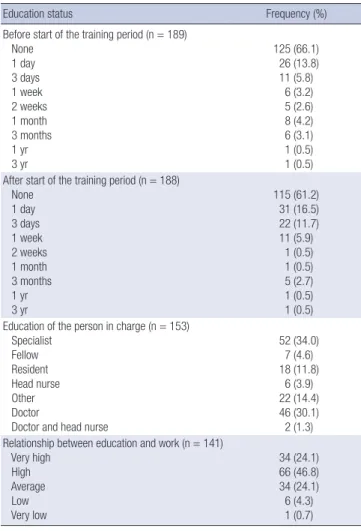
With respect to training, 66.1% of the PAs did not receive any prior education, and 61.2% did not receive any education even after starting their work. Based on this report, no education is being provided before and after the start of the PA’s practice.
When education is given, 13.8% of PAs received 1 day of educa- tion prior to their work, whereas 16.5% received 1 day of educa- tion after their training started. For those PAs who received 3 months of training, 4.1% were trained prior to their work, and 3.7% after their work.
The education was provided by a department specialist for 34% of the PAs, by a resident 11.8% and by other staff non-spe- cialized doctors 30.1%. The appropriate relationship in between the work of a Physician Assistant and their education is 46.8%.
The educational content included the outpatient department (OPD), ward training, surgical training, preoperative prepara- tion, wound management, colostomy management, and par- ticipation in conferences and meetings. Small number of PAs Table 2. Career and work hours of the physician assistants
Variables
Mean
P value
Total Surgical
assistant (n=81) Clinical physician assistant (n=80)
Age (n = 190, yr) 31.4±4.5 30.0±4.0 32.4±4.4 <0.001
Clinical career (n = 178, yr) 6.2±4.97 4.0±4.4 8.0±4.2 <0.001
PA career (n = 183, yr) 1.7±2.0 1.4±1.9 1.9±2.2 0.113
Grant (n = 191, %) 93.5±12.3 92.1±14.6 95.4±8.8 0.081
Days per week on duty (n = 192, day) 5.1±0.2 5.0±0.1 5.1±0.2 0.030
Daily allowance work hours (n = 192, hr) 9.5±1.3 9.7±1.5 9.3±1.1 0.042
Duty time (n = 192, hr) 0.6±2.2 0.7±2.0 0.7±2.6 0.981
Table 3. Analysis of work
Type of work (n = 191)
Composition ratio of work (%) Work at their discretion (%) Total Surgical
assistant
Clinical physician
assistant Doctor Total Surgical
assistant
Clinical physician assistant Doctor
Assisting operations 23.38 46.3 7.8 26.5 46.40 70.5 29 62.5
Dressing 11.48 7.1 15.8 11.2 67.70 59.7 83.1 62.5
Education and counseling of OPD or admission 9.59 4.6 11.0 6.1 55.00 30.7 74.6 59.4
Writing admission, progress, and operation reports 6.75 2.2 11.1 5.7 37.70 23.6 54.4 28.1
Checking results of exams 5.93 4.1 7.5 5.5 59.60 39.2 87 62.5
Procedures (suturing, etc.) 5.82 11.1 1.9 4.3 39.00 55.8 26.2 34.4
Participation in rounds 5.70 3.0 8.6 8.0 51.20 33.3 74.6 59.4
Participation in conferences 5.68 5.7 6.0 8.0 62.40 58.4 75.0 75.0
Data collection 4.06 2.6 4.6 5.2 34.30 25.7 43.3 43.8
Work regulation 3.29 1.7 4.4 4.3 40.40 28.8 50 40.6
Prescribing laboratory test 3.00 2.2 3.6 3.0 26.30 21.9 28.8 18.8
Other 2.93 0.1 2.6 2.7 12.20 2.9 18.2 6.2
Permission for operation or procedure 2.55 1.3 4.0 2.0 29.30 28.2 38.5 18.8
Meeting attendance 2.45 2.6 2.5 4.3 38.20 35.1 40.9 50.0
Prescribing drugs 2.24 0.9 3.4 2.2 26.70 20.5 31.8 15.6
Physical exams 1.83 1.4 2.3 0.9 25.90 16.7 39.7 18.8
Assisting with clinical exams 1.46 1.0 1.1 2.1 19.90 15.5 19.0 2.05
Prescribing CP 1.24 0.6 1.6 1.3 16.00 11.0 20.3 15.6
CP, Clinical pathway.
received some intern work and anatomy and physiology edu- cation. After the start of the PA work, education was provided through participation in conferences and meetings, and many PAs want to receive practical, specific and relevant continuous education.
Satisfaction level of PAs and Surgeons regarding PA system
The satisfaction levels of PAs were not very high, with only 29.1%
being satisfied. In addition, 74.9% agree that this PA system should be continued, and 98.9% agree that the PA system needs to be legalized. When there were more than 3 areas rated as satisfac- tory, 63.3% were happy with the freedom at work, 18.4% with the lack of rotation, and 18.4% with the accompanying sense of accomplishment and having a job worth doing. The reasons for dissatisfaction were an ambiguous job description, conflicts with the medical doctors, other nurses and other departments, and a lack of knowledge regarding the PA system. The reasons for continuing the PA works were as follow; satisfaction with the role (28.7%), the vision (11.5%), the specialization (25.3%), and being permanent job (34.5%).
The satisfaction levels of the doctors toward PAs were: 15%
Table 4. Education of physician assistants
Education status Frequency (%)
Before start of the training period (n = 189) None
1 day 3 days 1 week 2 weeks 1 month 3 months 1 yr 3 yr
125 (66.1) 26 (13.8) 11 (5.8)
6 (3.2) 5 (2.6) 8 (4.2) 6 (3.1) 1 (0.5) 1 (0.5) After start of the training period (n = 188)
None 1 day 3 days 1 week 2 weeks 1 month 3 months 1 yr 3 yr
115 (61.2) 31 (16.5) 22 (11.7) 11 (5.9)
1 (0.5) 1 (0.5) 5 (2.7) 1 (0.5) 1 (0.5) Education of the person in charge (n = 153)
Specialist Fellow Resident Head nurse Other Doctor
Doctor and head nurse
52 (34.0) 7 (4.6) 18 (11.8)
6 (3.9) 22 (14.4) 46 (30.1) 2 (1.3) Relationship between education and work (n = 141)
Very high High Average Low Very low
34 (24.1) 66 (46.8) 34 (24.1) 6 (4.3) 1 (0.7)
satisfied, 56.2% average, 25% dissatisfied, and 3.1% very dissat- isfied. The 3 reasons for the highest satisfaction were the filling or replacement of unfilled position by residents, increases in the satisfaction of customers or patients, the decreased work load, the ability to focus on surgery, standardization of the operations, and highly experienced. Overall, 89.7% of the doctors felt the need for the legalization of the PA system.
As for the residents satisfaction level regarding PAs: 3.1% were satisfied, 62.5% average, 31% dissatisfied, and 3.1% very dissat- isfied. The 3 most satisfactory reasons were a decreased work load, absence of miscellaneous work, ability to focus and con- centrate on clinical training and ability to study more.
DISCUSSION
In Korea, due to high mental and physical loads, low expected income and high risk bearing, the number of residents who ap- plied to the Departments of Thoracic Surgery, Gynecology, and General Surgery has decreased seriously. Therefore there are many difficulties in care of patients (2). Accordingly, these cir- cumstances have inspired the following efforts by the Korean Surgical Society and the government: regular capacity adjust- ment of residents, provision of a training subsidy for residents, adjustment of health insurance charges, smoothing out the dif- ferentials of the resident qualitative grade securing rate and hos- pital selection, and utilizing PAs for alternative personnel. In con- trast, in the United States, the PA was established as an alterna- tive plan to provide health care to the residents in farming and fishing villages, where the approach to medical services is lim- ited (3).
At present, nurse specialists are being utilized in large hospi- tals located in municipal regions due to reasons similar to the medical circumstances in Korea. In the United States, however, the term PA refers to assistant personnel for doctors acting with- in a medical model and is distinguished from NP in both name and legal responsibility (4). A difference between an NP and a PA is that while the NP plays a role in patient cure and care, the PA only plays a role in the cure. The role of the NP mainly includes taking the patient’s medical history, performing a physical ex- amination, medical prescription, and providing a supportive role in the operating room (4).
The United States has more than 50 thousand NPs at present since the NP system was first introduced in the 1960s and cur- rently has more than 134 educational programs. In addition, the PA system is used in India, the Netherlands, the United King- dom and Canada (5). In the United Kingdom, in which the PA system has not yet been established, a systematic educational program was initiated early by a joining of the PA training in the United States with the UK PMS practice in 2003. The PAs in the UK differ from the NPs in the United States in that they cannot prescribe medicines (4).
This survey was performed only in some university hospitals, and the actual situation in small and medium sized hospitals was not evaluated. Because the survey was given to several types of PAs in the Department of Surgery, there were some limita- tions with respect to representing the whole field of PAs. In ad- dition, there were some problems involving the personnel and the time to study the entire field of PAs, such as PAs having mul- tiple names (e.g. SA and clinical nurse specialist). Thus, because the term ‘PA’ was not established, there were some difficulties in objective classification.
As shown in these results, in Korea, many PAs actually per- form the work of doctors under supervision, but the absence of a systematic educational course and sufficient training time causes a significant problem because they perform works which are accompanied by important liabilities, such as prescribing medicines. In addition to this, legal support of their activity is required.
Even if an insufficient number of residents is unavoidable in some departments, another problem may be caused by the in- troduction of a system of PAs without a systematic educational system. In addition, the creation of an informal system employ- ing a doctor with several PAs, which has been established in some hospitals, will apparently initiate a vicious circle and cause a decline in the quality of some departments. In particular, the fact that the PAs are managed practically under the department of nursing in each hospital and not under the medical associa- tion may cause serious social problems in the future.
Therefore, correcting the wrong circumstances that the use of PAs is unavoidable should be set forth beforehand, and a suf- ficient review and establishment of an educational system for the legalization of the PA system and an exact description of their duties should be performed.
ACKNOWLEDGMENTS
This work was supported by a grant from the Korean Surgical Society in 2011. The authors would like to acknowledge RN. Young Moon, the assistance of Dr. In Kyu Lee (The Catholic University of Korea) in the distribution and collection of questionnaires.
We owe a debt of gratitude to those who participated in our sur- vey: Ajou University Hospital, Chonnam National University Hospital, Chung Ang University Healthcare System, Chungnam National University Hospital, Daegu Fatima Hospital, Dankook
University Hospital, Dongguk University Gyeongju Hospital, Eulji University Hospital, Gachon University Gil Hospital, Gang- nam Severance Hospital, Hallym University Medical Center, Hanyang University Guri Hospital, Inha University Hospital, Inje University Busan Paik Hospital, Inje University, Haeundae Paik Hospital, Kangbuk Samsung Hospital, Konyang University Hospital, Korea Cancer Center Hospital, Korea University Ansan Hospital, Kyung Hee University Medical Center, National Medi- cal Center, Pusan National University Hospital, Pusan National University Yangsan Hospital, Samsung Medical Center, Seoul Medical Center, Seoul National University Bundang Hospital, Seoul National University Bundang Hospital, Seoul National University Hospital, SMG - SNU Boramae Medical Center, Soon Chun Hyang University Hospital, The Catholic University of Ko- rea Bucheon St. Mary’s Hospital, The Catholic University of Ko- rea Incheon St. Mary’s Hospital, The Catholic University of Ko- rea Seoul St. Mary’s Hospital, The Catholic University of Korea Yeouido St. Mary’s Hospital, and Yeungnam University Medical Center.
REFERENCES
1. Heinrich JJ, Fichandler BC, Beinfield M, Frazier W, Krizek TJ, Baue AE.
The physician’s assistant as resident on surgical service. An example of creative problem solving in surgical manpower. Arch Surg 1980; 115:
310-4.
2. Kim SS, Kwak WH, Moon SM, Sung YH. Development of a role model for physician assistant in Korea. Clin Nurs Res 2006; 12: 67-80.
3. Hutchinson L, Marks T, Pittilo M. The physician assistant: would the US model meet the needs of the NHS? BMJ 2001; 323: 1244-7.
4. Zwijnenberg NC, Bours GJ. Nurse practitioners and physician assistants in Dutch hospitals: their role, extent of substitution ad facilitators and barriers experienced in the reallocation of tasks. J Adv Nurs 2012; 68:
1235-46.
5. Stewart A, Catanzaro R. Can physician assistants be effective in the UK?
Clin Med 2005; 5: 344-8.
6. Berg GM, Crowe RE, Budke G, Norman J, Swick V, Nyberg S, Lee F. Kan- sas physician assistants’ attitudes and beliefs regarding spirituality and religiosity in patients care. J Relig Health 2011 doi: 10.1007/s10943-011- 9532-2.
7. Gavin M, Esmail A. Solving the recruitment crisis in UK general practice:
time to consider physicians assistants? Soc Policy Admin 2002; 36: 76-8.
8. Cox CL. PA practitioners and physician assistants: what is the difference?
Comparing the USA and UK. Hosp Med 2001; 62: 169-71.