INTRODUCTION
The leading causes of death in Korea have shifted from infectious diseases to chronic degenerative illnesses since the end of the 1960s. Malignant neoplasms have become an important cause of death, next to cerebro-vascular accidents (1). Cancers were third or fourth until the 1970s but have become the second cause of death in the 1980s. In 1999, can- cer became the primary cause of death in Korea. During that year, approximately 54,000 of the total number of 246,000 deaths were attributed to cancer, with a crude death rate of 114.7 per 100,000.
MAGNITUDE OF THE PROBLEM OF BREAST CANCER IN KOREA
Breast cancer ranks second or third to uterine cervix and stomach cancer in Korea as a common site of primary cancer and as a cause of death in women, based on the National Can- cer Registry (2). A nation-wide survey estimated that the age- adjusted incidence rate for breast cancer in women was 10.9 per 100,000 in 1992 (3). It was estimated that approximately 4,000 new cases of female breast cancer were diagnosed and about 1,000 women died of breast cancer in a year (1).
Relative frequency of the primary site of cancer
Breast cancer was the second frequently occurring cancer in Korean women in 1999, according to the Central Cancer Registry Program (4). Breast cancer is in the third position at Seoul Cancer Registry Program (5), and the sixth at a rural area Kangwha Cancer Registry (4). Table 1 presents the rel- ative frequencies of cancers diagnosed in Korea.
Age-specific incidence rates of breast cancer
Breast cancer is rarely found in Korean girls who are younger than 20 yr old. Practically no case occurs prior to menarche.
Keun-Young Yoo, Daehee Kang, Sue Kyung Park*, Sook-Un Kim, Aesun Shin, Hachung Yoon, Se-Hyun Ahn�, Dong-Young Noh�, Kuk-Jin Choe�
Department of Preventive Medicine and Surgery�, Seoul National University College of Medicine, Seoul; Department of Preventive Medicine*, Dongguk University College of Medicine, Kyungju;
Department of Surgery�, University of Ulsan College of Medicine, Seoul, Korea
Received : 18 October 2001 Accepted : 22 December 2001
Address for correspondence Keun-Young Yoo, M.D.
Department of Preventive Medicine Seoul National University College of Medicine, 28 Yongon-dong, Chongno-gu, Seoul 110-799, Korea
Tel : +82.2-740-8324, Fax : +82.2-3673-3540 E-mail : [email protected]
1
Epidemiology of Breast Cancer in Korea
: Occurrence, High-Risk Groups, and Prevention
Breast cancer ranks second or third to uterine cervix cancer and stomach cancer as a cause of death in women, and as a common site of primary cancer. The large difference in its incidence between Westernized and non-Westernized coun- tries is remarkable. There is a linear increase with age that is observed in West- ern countries, which are high-incidence areas, on the contrary to the inverted V- shape curve seen in Asian countries. Epidemiologic studies conducted in Korea have shown that an older age, a family history of breast cancer, early menarche, late menopause, late full-term pregnancy, and never-having had a breast-fed child are primary risk factors in the development of breast cancer. The estrogen- augmented-by-progesterone hypothesis explains the roles of these factors to some extent. On the other hand, recent molecular studies have revealed the existence of novel gene-environmental interactions. Epidemiological features suggest that the breast cancer incidence rate in Korea will increase, but the age- specific curve would not be changed in keeping with what is observed in Western countries. Strategies aimed at controlling breast cancer that include the screen- ing guidelines and the identification of individual predispositions may give us fur- ther insights into both the etiology and the prevention of breast cancer.
Key Words : Breast Neoplasms; Epidemiology; Risk Factors; Sex Hormones; Genes
Order
National Cancer Registry (Nationwide, 1999)
Seoul Cancer Registry (Seoul, 1993-1997)
Male Female Male Female
1 Stomach Stomach Stomach Stomach
2 Liver Breast Liver Uterine Cervix
3 Lung Uterine Cervix Lung Breast
4 Colo-rectum Colo-rectum Colo-rectum Colo-rectum 5 Urinary Bladder Thyroid Urinary Bladder Liver Table 1.Relative frequencies of the primary site of cancer in Korea
REVIEW
The incidence rate starts to increase from the time of puber- ty and steeply increases until the late forties. Then there is a slow decrease during the rest of their lives. The peak of the incidence is seen in women aged 45-49 yr (Table 2 and Fig.
1) (3). In 1999, 2.8% of breast cancer patients were in their 20s or younger, 22.5% were in their 30s, 37.3% were 40s, 23.5% were 50s, and only 13.9% were over 60 yr of age.
Mortalities of breast cancer
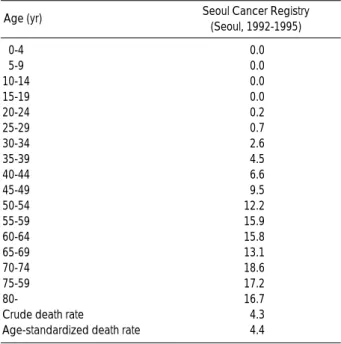
In 1998, 975 deaths from breast cancers were reported in Korea (1). Between 1992 and 1995, the crude mortality from breast cancer in Seoul was 4.3 per 100,000 and the age-stan- dardized mortality was 4.4 per 100,000 (6). Table 3 shows
the mortality for breast cancer in Seoul by age.
International comparisons
One of the most dramatic features of breast cancer is that there is a large difference in the incidence between Western and non-Western countries. For many years, the breast can- cer incidence and death rates were highest in North Ameri- ca and Northern Europe, were intermediate in Southern Europe and were Latin America, and lowest in Asia and Africa (Fig. 2) (7, 8). In recent years, a steep increase in the breast cancer incidence and death rates has been reported in several Asian and Central European countries. Thus, the differences in the incidence rates of countries such as Korea or Japan and the United States are becoming less than they were previously. Environmental changes within a country
Age (yr) Seoul Cancer Registry
(Seoul, 1992-1995)
0-4 0.0
5-9 0.0
10-14 0.0
15-19 0.0
20-24 0.2
25-29 0.7
30-34 2.6
35-39 4.5
40-44 6.6
45-49 9.5
50-54 12.2
55-59 15.9
60-64 15.8
65-69 13.1
70-74 18.6
75-59 17.2
80- 16.7
Crude death rate 4.3
Age-standardized death rate 4.4
Table 3.Age-specific death rate for breast cancer in Korea (per 100,000 persons)
Age (yr)
Korean Medical Insurance Corporation (beneficiaries, nationwide, 1988-1989)
Local Cancer Registry (Seoul, 1993-1997)
0-4 - 0.2
5-9 - 0.1
10-14 - 0.0
15-19 0.0 0.2
20-24 0.6 1.2
25-29 4.0 5.1
30-34 12.8 17.2
35-39 20.4 30.8
40-44 30.8 48.3
45-49 33.5 66.5
50-54 36.2 64.0
55-59 27.0 61.8
60-64 24.5 49.2
65-69 13.5 46.6
70-74 14.8 41.5
75-79 6.2 35.0
80- - 23.1
CIR 9.92 22.2
ASIR 10.91 20.8
Table 2.Age-specific incidence rates for breast cancer in Korea (per 100,000 persons)
CIR: Crude incidence rate. ASIR: Age-standardized incidence rate.
Fig. 1.Age-specific incidence rates for breast cancer in Seoul during 1992-1995.
70.0 60.0 50.0 40.0 30.0 20.0 10.0
0.0 20- 25- 30- 35- 40- 45- 50- 55- 60- 65- 70- 75- 80+
24 29 34 39 44 49 54 59 64 69 74 79
Fig. 2.International comparison of age-standardized incidence rates of female breast cancer.
0 20 40 60 80 100
US, SEER White (1983-87) ltaly, Florence (1985-87) France, Doubs (1983-87) Germany, Saarland (1983-87) Brazil, Goiania (1988-89) Poland, Opole (1985-87) Japan, Miyagi (1983-87) China, Shanghai (1983-87) Korea, nationwide (1988-89)
Age (year)
Per 100,000
may be the central factors in the different risk levels found in the United States and in the Asian countries.
Studies on immigrants to the United States
Studies of immigrants to the United States suggest that environmental factors rather than genetic factors are mainly responsible for the variability of breast cancer rates in women from different countries (9). The speed with which the inci- dence rates of immigrants and their offspring, who were potentially exposed to a new environment and culture at an early age, has varied considerably from one ethnic group to another.
Table 4 shows that both Japanese and Chinese immigrants have fundamentally higher incidence rates than the women in their mother countries, and that these rates approach those of their adopted country. The women of Japanese origin who were born and reared in the United States have at least a 2.5-fold higher risk of developing breast cancer than those who were born and reared in Japan. Korean immigrants to Los Angeles have slightly higher breast cancer incidence rates than women in their mother country, but they still retain a relatively lower level of breast cancer incidence (7, 10). These facts suggest that either there is some protective factor that is in effect in their former cultures which is car- ried over into the second generation or that these immigrants have successfully avoided some risk factors.
RISK FACTORS OF BREAST CANCER IN KOREA
The key epidemiological risk factors for breast cancer are all explicable in terms of the estrogen-augmented-by pro- gesterone hypothesis (11). During the follicular phase, the proliferation of terminal ductal lobular units is relatively slow as it is controlled by estrogen alone. However, during the mid to terminal luteolar phase, an enhanced prolifera- tion is observed, which is caused by the additional action of progesterone. Considering the fact that proliferation itself can induce mutation or carcinogenesis in breast cells, expo- sure to estrogen and progesterone may be the most impor-
tant factors in breast cancer development (11).
High-risk groups for breast cancer in Korea
Older age, a family history of breast cancer, early menarche, late menopause, a late full-term delivery, and never-having a breast-fed child are the primary risk factors for breast cancer, which have been identified by epidemiologic studies in Korea (12). Women whose mother and/or sister has (have) been diagnosed as having breast cancer have a 2- to 3-fold higher risk than those without family history of breast cancer (13).
Retrospective studies show that the risk increases 2 and 2.5 times in women who had their first menstruation when they were younger than 14 yr, in comparison with those who had their menarche at 15-16 yr and at 17 yr or older, respective- ly. However, no relationship has been shown to the regulari- ty of the menstruation. A 2- to 4-fold higher risk was found for women who experienced menopause after 50 yr of age.
Meanwhile, the time from menarche to menopause is an interesting factor in considering its relation to the mechanism of breast carcinogenesis. The mean duration was found to be between 30 to 32 yr for the control group, but it was some- what longer in breast cancer patients, with 32.2 yr in these (14). In women who had not experienced a full term preg- nancy, the risk of breast cancer was 1.5- to 2.5-fold higher than in women who experienced at least one full term preg- nancy. However, a higher risk is found if the age of women in their first full term pregnancy was older than the control group. A decreased risk was observed if there was an increased number of children, born after a full term pregnancy (14).
In postmenopausal women who have experienced a full term pregnancy and breast-feeding, a 4- to 7-fold reduction in risk was observed. Moreover, the risk was negatively associated with the duration of the breast-feeding. Similar to the find- ings in Japan, this decrease of risk was more evident in women who had a prolonged period of breast-feeding for their eldest child (15, 16).
A case-control study revealed that postmenopausal obesi- ty is an important risk factor for the development of breast cancer in Korea, which is relevant to the estrogen-augment- ed-by-progesterone hypothesis (17). In addition, we found that obesity is closely related to the early menarche, and with late menopause (18). An earlier menarche and later menopause is observed in relation to the increase of body weight, sizes of the waist and hip, the weight at age 20, and the maxi- mum weight that they had reached in the past (18). There- fore, a serial change in hormone-related factors seems to be closely associated with the physical condition (obesity) of the women when they were juveniles (19).
A Korean ecological correlation study noted that age- adjusted mortality for breast cancer positively correlated with protein and lipids intakes, but were inversely associat- ed with vegetable and cereal intakes (20). Other studies on associations between diet and breast cancer risk showed that
Population groups Age-standardized incidence rate (per 100,000 persons)
Japanese, L.A. (1983-1987) 72.2
Japanese, Miyagi (1983-1987) 27.8
Japanese, Osaka (1983-1987) 21.9
Chinese, L.A. (1983-1987) 48.7
Chinese, Shanghai (1983-1987) 21.2
Korean, L.A. (1983-1987) 16.9
Korean, Seoul (1991-1992) 17.0
Korean, nationwide (1988-1989) 10.9
Table 4.Age-standardized incidence rates for breast cancer by ethnic groups
there was a positive correlation with foods of animal origin and a negative correlation with those of vegetable origin. It is assumed that the intake of a high fat diet may greatly contribute, perhaps indirectly, to the development of breast cancer in Korea (20). However, it is difficult to come to a concrete conclusion because of the interactions with other covariates. Improvements in nutritional status also brought an improvement in the physical condition of women. The mean height and weight were 164 cm and 47.1 kg, respec- tively, in 1988 for the 14 yr old girls, whereas they were 157 cm and 40.3 kg, respectively, in 1970. The direct influ- ence of diet on breast cancer development appears more evi- dent of this physical change (21).
Table 5 lists the high-risk groups for breast cancer devel- opment on the basis of Korean epidemiological findings. In spite of the lower level of breast cancer incidence in Korean women, these findings suggest that there is no difference in the breast cancer risk factors between Korea and Western countries.
Serum levels of female sex hormones
In spite of there being no differences in the risk factors in the case-control comparisons, the breast cancer rates in the United States are still approximately 6- to 8-fold higher than those in Korea. Some innate biological facts may be the key factors in the different risk levels of breast cancer around the world.
Two risk factors that were previously used in an attempt to explain the substantial difference in the incidence rates were the age at menarche and the postmenopausal weight.
It has been reported that the predicted breast cancer incidence in U.S.A. women who had a 2-yr delay in menarche and a low postmenopausal weight was 2.5-fold higher than that in Japanese women (11). Mean age at menarche has been steadily decreasing in Korean girls, reaching 12.2 yr in age in 1999. For reasons not fully understood, Chinese women reach menarche at an average age of 17, while U.S.A. women do so at 12.8 yr. However, 200 yr ago, North American women were like the Chinese, reaching menarche at age 17 (22).
The other biological factor that can be used to explain this difference is the level of female sex hormones, since the ovarian hormones, estradiol and progesterone, play impor- tant roles in increasing the breast cancer risk. A cross-section- al survey reported on the estradiol, progesterone, and sex hormone binding globulin concentrations among healthy adolescent girls and postmenopausal women in Korea (23).
The authors observed that estradiol levels in Korean post- menopausal women were similar to those of Japanese women, and these were much lower than those found in American women (23, 24). These results, along with the difference in the ages at menarche, could be an important part of the expla- nation why Asian and American breast cancer rates differ.
Differences in genetic susceptibility
A large proportion of the breast cancer cases cannot be fully explained by the above risk factors. Inherited differences in the capacity to metabolize environmental carcinogens have been suggested to have the ability to modify an individual’s susceptibility to develop cancer. The identification of the susceptibility factors that predispose individuals to cancer could possibly give further insights into both the etiology and the prevention of this malignancy when the persons are exposed to particular environmental agents.
The inherited metabolic capacity of glutathione S-trans- ferases (GSTs), for example, has been implied to an individ- ual’s breast cancer risk. These GSTs play an important role in the detoxification of endogenous and exogenous toxicants, and may also have a role in the metabolism of lipids and the DNA products of oxidative stress.
Recent molecular epidemiologic investigations that were conducted in our laboratory revealed that both the GSTM1 and GSTT1 enzyme activities were absent in approximately half of the study patients because of a homozygous deletion of the respective genes. These findings are also relevant to those from other Asian studies. More specifically, both GSTM1- and GSTT1-null genotypes are significantly asso- ciated with breast cancer risk in Korea, particularly in high- risk postmenopausal women, e.g., nulliparous women or women who experienced pregnancy at a later age. These results suggest that there is a novel gene-environmental interaction which plays an important role in an individual’s susceptibility to breast cancer (25).
Other types of enzymes, such as N-acetyltransferase (NAT1, NAT2) and catechol-O methyltransferase (COMT) are cur- rently under investigations to explore a new type of gene- environment interaction in breast carcinogenesis in Korean women. Recent results of these studies of the genetic poly- morphism of COMT, which is possibly involved in estrogen metabolism, suggest that women who have a genotype of low-activity COMT might have an increased risk of breast cancer (26). Moreover, a gene-gene interaction between GSTs and COMT leading to the breast cancer development was
Risk factors High-risk group
Age Women with age over 50
Family history Women who have a family history of breast cancer among first-degree relatives
Menarche Women with age at menarche before 14 Menopause Women with age at menopause after 50 Pregnancy Nulliparous women
Women with age at first full-term pregnancy after 35 Breast feeding Women who have never experienced breast feeding Obesity Women with body mass index over 25 kg/m2or
with body weight more than 64 kg
Table 5.High-risk groups for female breast cancer in Korea
recently demonstrated to occur in premenopausal Korean women.
CLINICAL CHARACTERISTICS OF BREAST CANCER IN KOREA
Almost 90% of all breast cancers that have been diagnosed in Korea are invasive ductal carcinomas (Table 6). Over half of the patients (52.8%) were diagnosed at the stage II of the AJCC classification and a quarter (25.3%) were at stage I.
Diagnosis at 0 showed a frequency as low as 6.2%. The over- all five-year survival rate reached an average of 80-83%; i.e., 95% for stage I; 86% for stage II; 59-60% for stage III; and 3-21% for stage IV (Table 7). Breast cancer tends to be diag- nosed at relatively later stages, so that the expected survival is not as high as that diagnosed at an earlier stage.
PREVENTION OF BREAST CANCER
Guidelines for breast cancer screening can be obtained through a prospective study after a long enough follow-up period that would enable us to understand the breast cancer incidence pattern by adopting a systematic and rational dis- ease surveillance protocol. This cohort must be constructed on the basis of the local health care system after having con- ducted a thorough baseline survey. Alternatively, the effec- tiveness of methods for early detection can be determined by estimating the reduction in mortality or the prolonga- tion of survival in patients with breast cancer by establish- ing a National Cancer Registry Project.
Guidelines for screening of the Korean population must be based on the epidemiological characteristics of breast cancer incidence pattern in Korea. Two assumptions must be made (27, 28): 1) the breast cancer incidence in Korea will continue to increase in a straight line; 2) and the age-specific incidence rate curve will maintain an inverted V-shape, even when the incidence rate exceeds 50 per 100,000 persons. Given this likely scenario, control strategies that include screening guide- lines against breast cancer should be established, considering the age and the level of risk factors. If these assumptions are not true, the guidelines must be totally revised.
CONCLUSIONS
Knowledge of the descriptive epidemiology of breast can- cer is important both in suggesting the etiologic hypothesis and in the delineating high-risk groups that should be target- ed in preventive efforts. The incidence of female breast can- cer is still low in Korea, in a manner similar to most other Asian countries. However, in recent years, there has been a rapid increase in the incidence rate and this is the most no- table feature of recent descriptive epidemiology of breast can- cer in Korea. The identification of the reasons for this aug- mentation pattern would contribute substantially to our ability to predict the magnitude of the problem that may occur in the future.
Although the estimated female sex hormone levels are much lower in Korean women than those in American women, there is no substantial difference in the risk factors for breast cancer between Korea and Western countries. Epidemiolog- ical features, e.g., trends in mortality and morbidity for female breast cancer, and incidence patterns of breast cancer in other Asian immigrants to the United States, suggest that the inci- dence of breast cancer should increase in Korea in the future.
However, the age-specific incidence curve is not expected to change in a manner similar to those of Western countries.
Actual control strategies against breast cancer have been estab- lished under the assumptions that have been cited previously.
Finally, identification of the susceptibility factors that pre- dispose individuals to breast cancer may give us further insights into both the etiology and the prevention of this malignancy.
REFERENCES
1. National Statistical Office. Annual report on the cause of death statis- tics (based on vital registration), Seoul, Republic of Korea, 1998.
2. Ministry of Health and Welfare. Yearbook of Health and Welfare Statistics, Seoul, Republic of Korea, 1999.
3. Ahn YO, Park BJ, Yoo KY, Lee MS, Kim H, Noh DY, Park JS. Inci- dence estimation of female breast cancer among Koreans. J Korean Med Sci 1994; 9: 328-34.
4. Central Cancer Registry Center in Korea. Annual report of the central cancer registry in Korea (1991. 1-1999. 12). Based on registered data from 128 hospitals. Seoul, Ministry of Health and Welfare, 2001.
5. Seoul Cancer registry. Population-based cancer registry in Seoul, Histological diagnosis 1996 (%) 1998 (%) 2000 (%)
Ductal carcinoma in situ 4.2 5.6 6.3
Invasive ductal carcinoma 89.7 89.2 90.3
Lobular carcinoma in situ 0.4 0.1 0.2
Invasive lobular carcinoma 3.8 2.7 2.1
Paget’s Disease 0.8 0.3 0.3
Others 1.1 2.1 0.8
Table 6.Histological types of breast cancer in Korea, 1996-2000
AJCC stage 0 I II III IV Total
Number of patients 273 1,118 2,329 596 96 4,412 (%) (6.2) (25.3) (52.8) (13.5) (2.2) (100) Five-year survival (%)
Asan Medical Center 100 95 86 59 3 83
Seoul National University
96 95 86 60 21 80
Hospital
Table 7.Survival rates of breast cancer patients in Korea, 2000
Republic of Korea in 1999, Seoul, 2001.
6. Seoul Cancer Registry Project. Report on cancer registry project from 1992 to 1995, Seoul, 1998.
7. Parkin DM, Whelan SL, Ferlay J, Raymond L, Young J, eds. Cancer incidence in five continents. Vol. VII, IARC, Lyon, 1997.
8. World Health Organization. 1996 World Health Statistics, Geneva, 1998.
9. Kelsey JL, Horn-Ross PL. Breast cancer: magnitude of the problem and descriptive epidemiology. Epidemiol Rev 1993; 15: 7-16.
10. American Cancer Society. Breast cancer facts & figures. Atlanta, GA, American Cancer Society, 1995.
11. Pike MC, Spicer DV, Dahmoush L, Press MF. Estrogens, proges- terones, normal breast cancer cell proliferation, and breast cancer risk. Epidemiol Rev 1993; 15: 17-35.
12. Yoo KY, Park SK, Sung JH, Kang D, Kim YC, Kang HS, Suh JS, Kim JS, Yun IJ, Han S. High risk group for female breast cancer in Korea. J Korean Cancer Assoc 1998; 30: 435-9.
13. Yoo KY, Noh DY, Choe KJ. Epidemiology of breast cancer in Korea.
Korean J Epidemiol 1995; 17: 30-47.
14. Suh JS, Yoo KY, Kwon OJ, Yun IJ, Han SH, Noh DY, Choe KJ.
Menstrual and reproductive factors related to the risk of breast can- cer in Korea. Ovarian hormone effect on breast cancer. J Korean Med Sci 1996; 11: 501-8.
15. Yoo KY, Tajima K, Kuroishi T, Hirose K, Yoshida M, Miura S, Murai H. Independent protective effect of lactation against breast cancer: a case-control study in Japan. Am J Epidemiol 1992; 135:
726-33.
16. Yoo KY, Noh DY, Choe KJ. A case-control study on protective effect of breast feeding against breast cancer among postmenopausal women in Korea. J Korean Cancer Assoc 1993; 25: 202-12.
17. Joo JS, Yoo KY, Shin MH, Noh DY, Choe KJ. Overweight related to the risk of breast cancer by menopausal status in Korea. J Korean Surg Soc 1994; 46: 937-48.
18. Yoo KY, Bae JM, Park ES, Ha MN, Suh JS, Noh DY, Choe KJ, Park
YS, Lee HY, Lee KS, Lim CY, Kim YI, Shin YS. Obesity as a deter- minant of age at menarche and age at menopause in a cross-sectional survey in Yonchon County, Korea. Seoul J Med 1995; 36: 137-54.
19. Yoo KY, Kim DH. Trends in mortality and morbidity of uterine cervix, female breast, and ovarian cancer in Korea. Seoul J Med 1992; 33:
175-81.
20. Yoo KY, Kim DH, Shin MH, Noh DY, Choe KJ. Ecological corre- lation study on nutrients/foods intake and mortality for female breast cancer in Korea. Seoul J Med 1993; 34: 17-25.
21. Yoo KY. Changes in life-style related to female breast cancer in Korea. Proceedings in the 1st Japan-Russia Medical Exchange Con- ference. Niigata, June 10-11, 1993.
22. Marshall E. Search for a killer: focus shifts from fat to hormones.
Science 1993; 259: 618-21.
23. Yoo KY, Kim H, Shin HR, Kang D, Ha M, Park SK, Lee BO, Choe SH. Female sex hormones and body mass in adolescent and post- menopausal Korean women. J Korean Med Sci 1998; 13: 241-6.
24. Shimizu H, Ross RK, Bernstein L, Yatani R, Henderson BE, Mack TM. Cancers of the prostate and breast among Japanese and white immigrants in Los Angeles County. Br J Cancer 1991; 63: 963-6.
25. Park SK, Yoo KY, Lee SJ, Kim SU, Ahn SH, Noh DY, Choe KJ, Strickland PT, Hirvonen A, Kang D. Alcohol consumption glutathione S-transferase M1 and T1 genetic polymorphisms and breast cancer risk. Pharmacogenetics 2000; 10: 301-9.
26. Yim DS, Park SK, Yoo KY, Yoon KS, Chung HH, Kang HJ, Ahn SH, Noh DY, Choe KJ, Jang IJ, Shin SG, Strickland PT, Hirovonen A, Kang D. Relationship between the Val158Met polymorphism of catechol O-methyl transferase and breast cancer. Pharmacogenet- ics 2001; 11: 279-86.
27. Park SK, Lim YK, Yoo KY. Prediction of future breast cancer mor- tality in Korea. Korean J Epidemiol 1998; 20: 267-74.
28. Yoo KY, Park SK, Lim YK. High risk group and screening strategy for breast cancer in Korea. J Korean Assoc Cancer 1998; 3: 1-23.