INTRODUCTION
Although osteoporosis is more generally considered as a dis- ease that afflicts women, it is also prevalent in men. The inci- dence of osteoporotic fractures in men is about half of that in women (1). Furthermore, the mortality associated with hip fracture in elderly men is considerably higher than in women (2). However, the cellular and molecular basis underlying male osteoporosis is still poorly understood due to the emphasis on osteoporosis in women (3).
Peak bone mass, which is recognized as an important deter- minant in development of osteoporosis (4), is under strong genetic control, and genetic influences have been estimated to account for about 75% of the inter-individual variability in peak bone mass (5). Although many genes have been exam- ined for their association with bone mass, most studies were carried out in either women or populations of older subjects of an age when accretion of bone mass has ceased and bone loss has begun (6). Genetic studies in men with peak bone mass are relatively rare (3).
LDL receptor-related protein 5 (LRP5) has emerged as a key regulator of osteoblast proliferation and bone formation (7, 8). Loss-of-function mutations of the LRP5 gene cause the autosomal recessive osteoporosis pseudoglioma syndrome (OPPG), a disorder causing both congenital osteoporosis and eye abnormalities (7), while autosomal dominant high bone mass (HBM) traits result from a gain-of-function mutation of the gene that causes a glycine-to-valine amino acid change (G171V) (9-11). Collectively, these studies suggest that the LRP5 gene is an important regulator of peak bone mass in vertebrates, although genetic mutations causing OPPG syn- drome or HBM phenotype are very rare in the general pop- ulation (7, 11).
It has been suggested that a common polymorphism in the LRP5 gene might contribute to genetic variations in bone mass in the general community (12). Torus palatinus, which was observed in subjects with the G171V mutation of the LRP5 gene, is commonly detected in the general population (13, 14), and this was reported to serve as a physical marker of high bone mineral density (BMD) in Caucasians (13) and
Jung-Min Koh, Min Hui Jung*, Jeong Soo Hong*, Hyung Joo Park, Jae Suk Chang�, Hyoung Doo Shin‖, Shin-Yoon Kim�, Ghi Su Kim
Department of Internal Medicine and �Orthopedic Surgery, *Asan Medical Center, University of Ulsan College of Medicine, and ‖Asan Institute for Life Sciences, Seoul; Department of Genetic Epidemiology SNP Genetics, Seoul;�Department of Orthopedic Surgery, Kyungpook National University, Taegu, Republic of Korea
Address for correspondence Ghi Su Kim, M.D.
Department of Internal Medicine, Asan Medical Center, University of Ulsan College of Medicine, 388-1 Poongnap-dong, Songpa-gu, Seoul 138-736, Korea Tel : +82.2-3010-3242, Fax : +82.2-3010-6962 E-mail : [email protected]
*This work was supported by a grant from the Korea Health 21 R & D Project, Ministry of Health & Welfare, Republic of Korea (Project No. 01-PJ3-PG6-01GN11- 0002).
407
Association between Bone Mineral Density and LDL Receptor-Related Protein 5 Gene Polymorphisms in Young Korean Men
Recently, It has been reported that the LDL receptor-related protein 5 (LRP5) reg- ulates bone formation, and that mutations of the gene cause osteoporosis-pseudo- glioma syndrome or high bone mass phenotypes. However, the mutations cannot explain a genetic trait for osteoporosis in the general population because of their rarity. From 219 Korean men aged 20-34 yr, we looked for six known polymorphisms causing amino acid changes in the LRP5 coding region, and investigated their asso- ciation with bone mineral density (BMD) at the following anatomical sites: lumbar spine (L2-L4) and the left proximal femur (femoral neck, Ward’s triangle, trochanter and shaft). We found that the Q89R polymorphism was significantly associated with BMD at the femoral neck and Ward’s triangle (p=0.004 and <0.001, respectively).
However, after adjusting for age, weight and height, a statistically significant associa- tion only occurred at the Ward’s triangle (p=0.043), and a marginal association was observed at the femoral neck (p=0.098). No A400V, V667M, R1036Q and A1525V polymorphisms were found, and no statistically significant association was found between the A1330V polymorphism and BMD at any sites. Although we failed to demonstrate a clear association between the LRP5 polymorphism and peak bone mass in young men, the present study suggests that larger-scale studies on the Q89R polymorphism need to be performed.
Key Words : LDL-Receptor Related Proteins; Polymorphism (Genetic); Osteoporosis; Bone Density; Men
Received : 15 December 2003 Accepted : 27 February 2004
Japanese (15). More importantly, several quantitative trait locus (QTL) analyses reported that the region 11q12-13, which contains the LRP5 gene, strongly contributes to the normal variation of BMD in the general population (16, 17). How- ever, there is no information on whether LRP5 polymorphisms are associated with BMD in the general community.
Recently, two mutation analyses reported seven and forty- two LRP5 gene polymorphisms in Japanese (18) and Cau- casians (19), respectively. In the present study, we examined LRP5 gene coding region polymorphisms in young Korean men. We determined the frequency of occurrence of six poly- morphisms causing amino acid changes, and investigated whether these polymorphisms were associated with BMD.
MATERIALS AND METHODS Subjects
The study population comprised 219 healthy young men who were medical students of University of Ulsan or residents at a university hospital (Asan Medical Center (AMC)) in Seoul, Korea. All subjects were Korean and volunteered for the study.
The study was approved by the AMC ethics review commit- tee and written informed consent was obtained from all sub- jects. Subjects completed a self-administered questionnaire concerning demographic characteristics, general health status, medication, weekly duration of weight-bearing physical activ- ity, and smoking and alcohol drinking habits. Daily dietary calcium intake was assessed using a food frequency question- naire (20, 21). All subjects were free from drugs and diseases known to affect bone metabolism.
Bone mineral densitometry
All BMD (g/cm2) measurements of the lumbar spine (L2- L4, A-P) and the left proximal femur (femoral neck, Ward’s triangle, trochanter and shaft) were measured by the same trained technician using a Lunar Corp. Expert XL (Lunar, Madison, WI, U.S.A.) dual energy radiography absorptiome- ter (software version 1.90). The in vivo precision of the machine was 0.82% for the lumbar spine, 1.12% for the femoral neck and 2.17% for Ward’s triangle.
Genotype analysis with polymerase chain reaction and restriction fragment length polymorphism analysis
Genomic DNA was extracted from peripheral blood leuko- cytes using a commercial kit (Wizard Genomic DNA purifi- cation kit, Promega, Madison, WI, U.S.A.). Genotyping of DNA sequence variants in the Q89R and A1330V sites was carried out by restriction enzyme analysis of polymerase chain reaction (PCR)-amplified DNA using specific pairs of oligonu- cleotide primers, as described previously (18). The PCR pri-
mers were sequence-specific and/or mutated for convenience.
Amplification of polymorphisms was carried out using a ther- mocycler (Perkin-Elmer, Boston, MA, U.S.A.) using a method described previously with some modifications (18). After am- plification, PCR products were digested with restriction en- donucleases AvaII and DraIII (New England Biolabs Inc., Beverly, MA, U.S.A.) for the Q89R and A1330V polymor- phisms, respectively. The DNA fragments were then elec- trophoresed on 2% and 3% agarose gels for the Q89R and A1330V polymorphisms, respectively.
Because previously reported restriction enzyme analyses of polymerase chain reaction (PCR) were not available, genotyp- ing for A400V, V667M, R1036Q and A1525V polymorphi- sms was performed by SNP-ITTMassays using the SNP stream 25KTMSystem (Orchid Biosciences, New Jersey, U.S.A.) (22).
Briefly, the genomic DNA region spanning the polymorphic site was PCR-amplified using one phosphothiolated primer and one regular PCR primer. The amplified PCR products were then digested with exonuclease, with the 5′phosphoth- iolates protecting one strand of the PCR product from diges- tion. The single-strand PCR template generated by exonucle- ase digestion was overlaid onto a 384-well plate that was pre- coated covalently with the primer extension SNP-ITTMpri- mers. These SNP-ITTMprimers were designed to hybridize immediately adjacent to the polymorphic site. The PCR pri- mer sequences are listed in Table 1. After hybridization of
Polymorphism Primers Sequence
SNP-ITTMassays
A400V Forward 5′-GCTAGAGGGCTATGTCTACTGG-3′ Reverse 5′-TTGATCTCGGTGTTGACCA-3′ SNP-ITTM 5′-CTGCGCCCCAGACCCGTCCAG-
GTAC-3′
V667M Forward 5′-AGAGCCGCCATCCACAGG-3′ Reverse 5′-ATCAAAGTCCAGGGCTGAG-3′ SNP-ITTM 5′-CTCCCTCGAGACCAATAACAAC-
GAC-3′
R1036Q Forward 5′-AAAACCCAGACAGGCAGC-3′ Reverse 5′-GACGTTGATGGTATTGGTGG-3′ SNP-ITTM 5′-GACCTCAGCATCGACATCTACAG-
CC-3′
A1525V Forward 5′-ACGGACCCCTCCCTGTAC-3′ Reverse 5′-TGGCCATGGAGGGCTGCA-3′ SNP-ITTM 5′-GGGGATGTCCTACCTGTACGGTC-
TC-3′ Direct sequencing
A400V Forward 5′-CCTGGCTGAGTATTTCC-3′ Reverse 5′-TCAATCTCCCTCTCGCC-3′ V667M Forward 5′-CTGTGCACATTGGAGCT-3′
Reverse 5′-CAAGGTTTTCCCATAAAGG-3′ R1036Q Forward 5′-TGGGATTTGACTTTCAGG-3′
Reverse 5′-CCTGTGAGAGGCTGGCA-3′ A1525V Forward 5′-AACATGCAGTGCCCGCT-3′ Reverse 5′-CTTCGGGGCAGGTGGCT-3′ Table 1.Primer sequences for SNP-ITTMassays and for direct sequencing within the LDL receptor-related protein 5 gene
template strands, SNP-ITTMprimers were then extended by a single base with DNA polymerase at the polymorphic site of interest. The extension mixtures contained two labeled terminating nucleotides (one FITC, one biotin) and two unla- beled terminating nucleotides. The final single base incorpo- rated was identified with serial colorimetric reactions with anti-FITC-AP or streptavidin-HRP. The results of blue and/or yellow color developments were analyzed using an ELISA reader, and the final genotyping (allele) calls were made using the QCReviewTMprogram. To confirm polymorphisms iden- tified using SNP-ITTMassays, direct DNA sequencing was performed on 20 samples using a fluorescence-based automat- ed DNA sequencer, as previously described (19). The PCR primer sequences used for direct sequencing are listed in Table 1. The PCR products were directly sequenced on both strands using an ABI Prism 377 DNA sequencer (Perkin Elmer, CA, U.S.A.). No discrepancies were found between direct sequenc- ing data and SNP-ITTMdata (data not shown).
Statistical analysis
Descriptive characteristics are expressed as mean and stan- dard deviation. The independent contribution of the clinical characteristics to BMD was determined using multiple linear regression analysis. Linkage disequilibrium between genotypes and significance of deviation from the Hardy-Weinberg equi- librium were analyzed by the 2test. Haplotypes were con- structed using the E-M algorithm (Arlequin, http://anthro.
unige.ch/arlequin/). The effect of single or combined geno- types on BMD was evaluated using either unpaired t-tests or one-way analyses of variance. Multiple linear regression analy- ses were performed to adjust for risk factors, with BMD as a dependent variable, and genotypes, age, weight and height each being independent variables. Unless indicated otherwise, p values less than 0.05 were considered significant. The SPSS 10.0 program (SPSS Inc., Chicago, IL, U.S.A.) was used for statistical procedures.
RESULTS Subject characteristics
The mean age of participants was 25.6±3.7 yr (range 20- 34 yr). Body mass index was 22.9±2.8 kg/m2(range 17.2- 32.1 kg/m2). Multiple linear regression analysis showed a posi- tive association between body weight and BMD at all anatom- ical sites: =0.275, p=0.001 at the lumbar spine; =0.253, p=0.001 at the femoral neck; =0.216, p=0.004 at the Ward’s triangle; =0.329, p<0.001 at the trochanter; =0.299, p<
0.001 at the femoral shaft. Age was negatively correlated with BMD at the proximal femur, with regression analysis show- ing =-0.312, p<0.001 at the femoral neck; =-0.349, p<
0.001 at the Ward’s triangle; =-0.192, p=0.010 at the tro-
chanter; and =-0.223, p=0.003 at the femoral shaft. There was no association between BMD and height, calcium intake, smoking, alcohol consumption or exercise (data not shown).
Genotype frequencies
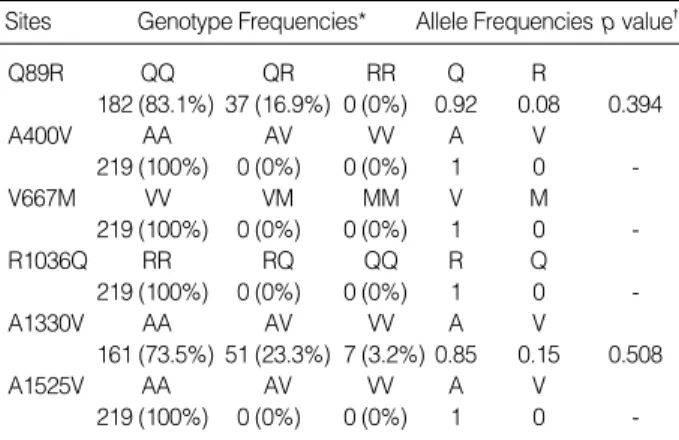
The genotype distributions and allele frequencies for LRP5 gene polymorphisms are presented in Table 2. No polymor- phisms of the A400V, V667M, R1036Q or A1525V type were observed. These data differ from those obtained from Caucasian subjects (19). We detected Q89R and A1330V polymorphisms, and these occurred at allelic frequencies com- parable to those previously reported in Japanese studies (18).
The Q89R and A1330V polymorphisms were in Hardy-Wein- berg equilibrium. Because the number of subjects bearing the VV genotype of the A1330V polymorphism was so small (n=7), we compared those carrying the V allele (AV or VV) with those that did not (AA). Contradictory to the previous result suggesting that the two polymorphisms were in another linkage disequilibrium blocks in European (23), the distribu- tion of combination genotypes indicated that the two poly- morphisms were in linkage disequilibrium in our subjects ( 2=19.526, p<0.001). The haplotype frequencies were: QA, 357 (81.5%); QV, 44 (10.0%); RA, 16 (3.7%); RV, 21 (4.8%).
Combined genotypes were constructed from the haplotypes and their frequencies were: QA-QA, 145 (66.2%); QA-QV, 32 (14.6%); QA-RA, 16 (7.3%); QA-RV, 19 (8.7%); QV- QV, 5 (2.3%); QV-RV, 2 (0.9%).
Association between LRP5 gene polymorphisms and BMD
The study population data were separated into two cate- gories on the basis of Q89R or A1330V polymorphisms in the LRP5 gene. No significant differences in any clinical para- meters were observed between the two groups (Table 3). How-
Sites Genotype Frequencies* Allele Frequenciesp value�
Q89R QQ QR RR Q R
182 (83.1%) 37 (16.9%) 0 (0%) 0.92 0.08 0.394
A400V AA AV VV A V
219 (100%) 0 (0%) 0 (0%) 1 0 -
V667M VV VM MM V M
219 (100%) 0 (0%) 0 (0%) 1 0 -
R1036Q RR RQ QQ R Q
219 (100%) 0 (0%) 0 (0%) 1 0 -
A1330V AA AV VV A V
161 (73.5%) 51 (23.3%) 7 (3.2%) 0.85 0.15 0.508
A1525V AA AV VV A V
219 (100%) 0 (0%) 0 (0%) 1 0 -
Table 2.Genotype distribution and allele frequencies of polymor- phisms of the LDL receptor-related protein 5 gene
*Values represent number of times the allele was detected (% of all sub- jects).�Deviation from the Hardy-Weinberg equilibrium as determined by
2test. A p value >0.05 indicates the genotypes are in Hardy-Weinberg equilibrium.
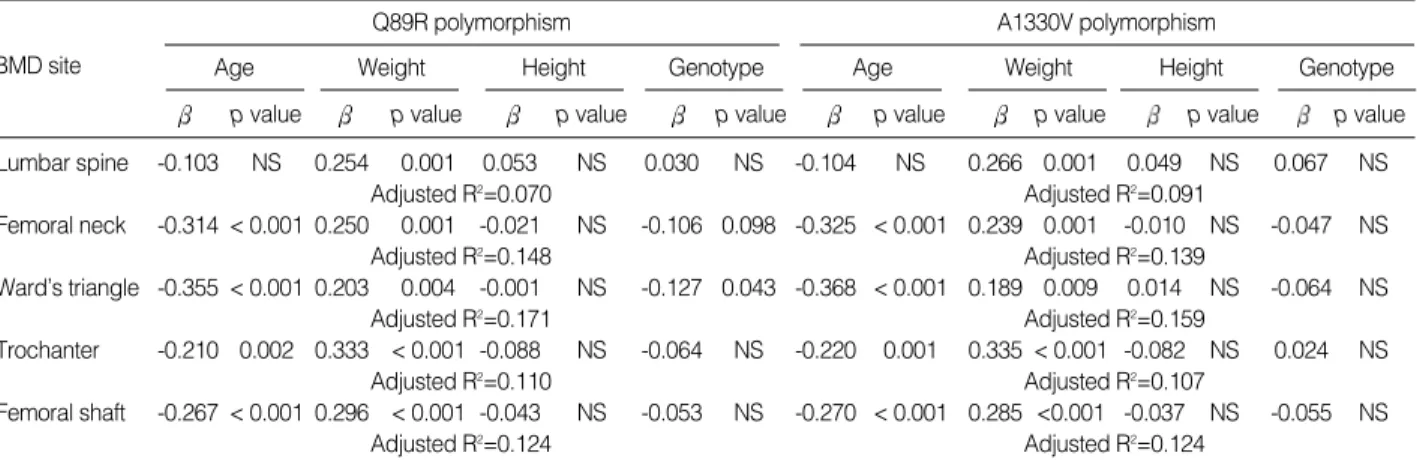
ever, subjects with the QQ genotype had significantly higher BMD at the femoral neck and Ward’s triangle, compared with those with the QR genotype (p=0.004 and p<0.001, respec- tively). Lumbar BMD was not different between the two groups. Multiple linear regression analyses were undertaken in order to adjust confounding variables such as age, weight and height. The Q89R polymorphism was significantly asso- ciated with BMD at the Ward’s triangle (p=0.043), and mar- ginally associated at the femoral neck (p=0.098) (Table 4).
When the study subjects were divided into two groups according to the presence of the V allele of the A1330V poly- morphism, those with the V allele (AV or VV genotype) had lower body weight than those without (AA genotype) (p=
0.035, Table 3). Other clinical parameters were similar be- tween the two groups (data not shown). No differences in BMD values at any sites were noted between these two groups
both before (Table 3) and after (Table 4) adjusting for con- founding variables.
We also examined effects of the combined genotypes on BMD. The subjects were divided into three groups according to the number of QA haplotypes: (QA haplotype=2)=(1, 1), (QA haplotype=1)=(1, 0), and (QA haplotype=0)=(0, 0). No associations between the combined genotypes and BMD were noted at any sites before or after adjusting for confounding variables (data not shown).
DISCUSSION
To our knowledge, this is the first study examining the association between LRP5 gene polymorphisms and BMD in the general population. We observed a statistically signif-
Age p value BMD site
Q89R polymorphism Weight
p value
Height p value
Genotype p value
Age p value
A1330V polymorphism Weight
p value
Height p value
Genotype p value Lumbar spine -0.103 NS 0.254 0.001 0.053 NS 0.030 NS -0.104 NS 0.266 0.001 0.049 NS 0.067 NS
Adjusted R2=0.070 Adjusted R2=0.091
Femoral neck -0.314 < 0.001 0.250 0.001 -0.021 NS -0.106 0.098 -0.325 < 0.001 0.239 0.001 -0.010 NS -0.047 NS
Adjusted R2=0.148 Adjusted R2=0.139
Ward’s triangle -0.355 < 0.001 0.203 0.004 -0.001 NS -0.127 0.043 -0.368 < 0.001 0.189 0.009 0.014 NS -0.064 NS
Adjusted R2=0.171 Adjusted R2=0.159
Trochanter -0.210 0.002 0.333 < 0.001 -0.088 NS -0.064 NS -0.220 0.001 0.335 < 0.001 -0.082 NS 0.024 NS
Adjusted R2=0.110 Adjusted R2=0.107
Femoral shaft -0.267 < 0.001 0.296 < 0.001 -0.043 NS -0.053 NS -0.270 < 0.001 0.285 <0.001 -0.037 NS -0.055 NS
Adjusted R2=0.124 Adjusted R2=0.124
Table 4.Multiple linear regression analysis with BMD as the dependent variable, and age, weight, height and genotypes as the inde- pendent variables
*NS denotes not significant.
QQ (n=182) QR (n=37)
Q89R polymorphism
AA (n=161) AV/VV (n=58) A1330V polymorphism
Age (yr) 25.4±3.9 25.9±4.8 25.3±3.6 25.8±3.4
Weight (kg) 69.1±8.9 68.9±8.1 69.8±8.5 67.0±9.3�
Height (cm) 174.3±5.1 172.9±5.4 174.3±5.2 173.6±4.9
BMI (kg/m2) 22.7±2.6 23.1±2.5 23.0±2.5 22.2±2.8
Calcium intake (mg/day) 590±74 595±70 594±75 580±65
Smoking (pack/yr) 2.31±0.87 2.17±0.92 2.35±0.87 2.14±0.90
Alcohol consumption (g/day) 16.7±27.2 16.1±15.2 17.0±26.6 15.5±22.9
Exercise (hr/day) 1.5±1.5 1.5±1.8 1.5±1.6 1.4±1.5
BMD (g/cm2)
Lumbar spine 1.200±0.175 1.202±0.119 1.198±0.179 1.206±0.125
Femoral neck 1.069±0.160 1.006±0.108* 1.067±0.154 1.032±0.154
Ward’ triangle 1.002±0.179 0.918±0.109� 0.999±0.173 0.956±0.164
Trochanter 0.853±0.181 0.811±0.131 0.849±0.173 0.837±0.178
Femoral shaft 1.354±0.177 1.312±0.132 1.358±0.174 1.316±0.160
Table 3.Comparison of clinical characteristics and BMD (g/cm2). The study population was separated into two groups on the basis of having either the Q89R or A1330V polymorphism in the LDL receptor-related protein 5 gene
All values are mean±SD. Differences in clinical characteristics between the two groups were tested using unpaired t-tests, where: *p<0.005 vs. QQ;
�p<0.001 vs. QQ; �p<0.05 vs. AA.
icant association between the Q89R polymorphism and BMD at Ward’s triangle after adjusting for confounding variables.
This association may have to be viewed with circumspection.
The precision error for Ward’s triangle measurement is con- siderably higher than for other regions of interest (24, 25).
Further, the association was not noted at the lumbar spine, which has similar compositions of cortical and trabecular bone to the Ward’s triangle. These suggest that the significant asso- ciation may result from false positive one. However, the asso- ciation was suggested at the femoral neck, albeit marginal (p=0.098). Therefore, we cannot exclude a possibility that this somewhat weak association is due to the small sample size providing insufficient statistical power to show modest but statistically significant associations.
The association of the Q89R polymorphism with BMD appears to be further supported by the position at which this polymorphism is situated in the LRP5 gene. The LRP5 gene contains 23 exons and spans >100 kb (26). The LRP5 protein consists of a distinct ensemble of five structural motifs-four structures resembling a propeller with six blades containing YWTD spacer repeat domains, epidermal growth factor-like repeats, an LDL receptor-like ligand-binding domain, a sin- gle transmembrane domain, and a short cytoplasmic tail (27, 28). The Q89R polymorphism is located in exon 2 encoding the first of four propellers, while the A1330V polymorphism is in exon 18 encoding the LDL receptor-like domain. Alth- ough the precise function of each region is uncertain, the four propellers are of structural importance. It has been suggested that mutation in the first propeller region can alter the local hydrophobic environment, thus possibly affecting the inter- action of LRP5 with other proteins (11). In addition, a num- ber of mutations in this region in the LDL receptor propeller module can cause familial hypercholesterolemia (28), confirm- ing that this domain is important for protein function. These suggest a possibility that the Q89R or related linked poly- morphisms coding the region might alter LRP5 protein func- tion and might be associated with BMD, suggesting need for further studies on functional differences of these polymor- phisms in relation to bone metabolism.
In the present study we observed different genetic back- grounds between Koreans and Caucasians with respect to allele frequencies of LRP5 gene polymorphisms. The allele frequencies of the A400V, V667M, R1036Q and A1525V polymorphisms in Caucasians were 2-8% (19), whereas no such polymorphisms were found in our subjects. More impor- tantly, the Q89R polymorphism was very rare in Caucasians (19, 29), whereas the polymorphism was prevalent in Japanese (18) and our Korean subjects. These data suggest that the Q89R polymorphism would not be a useful marker for bone mass in Caucasians.
In conclusion, we failed to demonstrate a clear association between the LRP5 polymorphism and peak bone mass in young men. However, the present study suggests that larger- scale studies on the Q89R polymorphism are needed.
REFERENCES
1. Cooper C, Atkinson EJ, O’Fallon WM, Melton LJ 3rd. Incidence of clinically diagnosed vertebral fractures: a population-based study in Rochester, Minnesota, 1985-1989. J Bone Miner Res 1992; 7: 221-7.
2. Myers AH, Robinson EG, Van Natta ML, Michelson JD, Collins K, Baker SP. Hip fractures among the elderly: factors associated with in-hospital mortality. Am J Epidemiol 1991; 134: 1128-37.
3. Byers RJ, Hoyland JA, Braidman IP. Osteoporosis in men: a cellular endocrine perspective of an increasingly common clinical problem.
J Endocrinol 2001; 168: 353-62.
4. Newton-John HF, Morgan DB. The loss of bone with age, osteoporo- sis, and fractures. Clin Orthop 1970; 71: 229-52.
5. Heaney RP, Abrams S, Dawson-Hughes B, Looker A, Marcus R, Matkovic V, Weaver C. Peak bone mass. Osteoporos Int 2000; 11:
985-1009.
6. Ralston SH. Genetic control of susceptibility to osteoporosis. J Clin Endocrinol Metab 2002; 87: 2460-6.
7. Gong Y, Slee RB, Fukai N, Rawadi G, Roman-Roman S, Reginato AM, Wang H, Cundy T, Glorieux FH, Lev D, Zacharin M, Oexle K, Marcelino J, Suwairi W, Heeger S, Sabatakos G, Apte S, Adkins WN, Allgrove J, Arslan-Kirchner M, Batch JA, Beighton P, Black GC, Boles RG, Boon LM, Borrone C, Brunner HG, Carle GF, Dallapic- cola B, De Paepe A, Floege B, Halfhide ML, Hall B, Hennekam RC, Hirose T, Jans A, Juppner H, Kim CA, Keppler-Noreuil K, Kohlsch- uetter A, LaCombe D, Lambert M, Lemyre E, Letteboer T, Peltonen L, Ramesar RS, Romanengo M, Somer H, Steichen-Gersdorf E, Stein- mann B, Sullivan B, Superti-Furga A, Swoboda W, Van den Boogaard MJ, Van Hul W, Vikkula M, Votruba M, Zabel B, Garcia T, Baron R, Olsen BR, Warman ML; Osteoporosis-Pseudoglioma Syndrome Collaborative Group. LDL receptor-related protein 5 (LRP5) affects bone accrual and eye development. Cell 2001; 107: 513-23.
8. Kato M, Patel MS, Levasseur R, Lobov I, Chang BH, Glass DA 2nd, Hartmann C, Li L, Hwang TH, Brayton CF, Lang RA, Karsenty G, Chan L. Cbfa1-independent decrease in osteoblast proliferation, os- teopenia, and persistent embryonic eye vascularization in mice defi- cient in Lrp5, a Wnt coreceptor. J Cell Biol 2002; 157: 303-14.
9. Babij P, Zhao W, Small C, Kharode Y, Yaworsky PJ, Bouxsein ML, Reddy PS, Bodine PV, Robinson JA, Bhat B, Marzolf J, Moran RA, Bex F. High bone mass in mice expressing a mutant LRP5 gene. J Bone Miner Res 2003; 18: 960-74.
10. Boyden LM, Mao J, Belsky J, Mitzner L, Farhi A, Mitnick MA, Wu D, Insogna K, Lifton RP. High bone density due to a mutation in LDL- receptor-related protein 5. N Engl J Med 2002; 346: 1513-21.
11. Little RD, Carulli JP, Del Mastro RG, Dupuis J, Osborne M, Folz C, Manning SP, Swain PM, Zhao SC, Eustace B, Lappe MM, Spitzer L, Zweier S, Braunschweiger K, Benchekroun Y, Hu X, Adair R, Chee L, FitzGerald MG, Tulig C, Caruso A, Tzellas N, Bawa A, Franklin B, McGuire S, Nogues X, Gong G, Allen KM, Anisowicz A, Morales AJ, Lomedico PT, Recker SM, Van Eerdewegh P, Recker RR, John- son ML. A mutation in the LDL receptor-related protein 5 gene results in the autosomal dominant high-bone-mass trait. Am J Hum Genet 2002; 70: 11-9.
12. Patel MS, Karsenty G. Regulation of bone formation and vision by
LRP5. N Engl J Med 2002; 346: 1572-4.
13. Belsky JL, Hamer JS, Hubert JE, Insogna K, Johns W. Torus palat- inus: a new anatomical correlation with bone density in postmenopa- usal women. J Clin Endocrinol Metab 2003; 88: 2081-6.
14. Kolas S, Halperin V, Jerreris K, Huddleston S, Robinson HB. The occurrence of torus palatinus and torus mandibularis in 2,478 den- tal patients. J Oral Surg 1953; 6: 1134-41.
15. Hosoi T, Yoda T, Yamaguchi M, Amano H, Orimo H. Elderly women with oral exostoses had higher bone mineral density. J Bone Miner Metab 2003; 21: 120-2.
16. Koller DL, Rodriguez LA, Christian JC, Slemenda CW, Econs MJ, Hui SL, Morin P, Conneally PM, Joslyn G, Curran ME, Peacock M, Johnston CC, Foroud T. Linkage of a QTL contributing to normal variation in bone mineral density to chromosome 11q12-13. J Bone Miner Res 1998; 13: 1903-8.
17. Koller DL, Econs MJ, Morin PA, Christian JC, Hui SL, Parry P, Cur- ran ME, Rodriguez LA, Conneally PM, Joslyn G, Peacock M, John- ston CC, Foroud T. Genome screen for QTLs contributing to normal variation in bone mineral density and osteoporosis. J Clin Endocrinol Metab 2000; 85: 3116-20.
18. Okubo M, Horinishi A, Kim DH, Yamamoto TT, Murase T. Seven novel sequence variants in the human low density lipoprotein recep- tor related protein 5 (LRP5) gene. Hum Mutat 2002; 19: 186-8.
19. Allen KM, Anisowicz A, FitzGerald MG, Van Eerdewegh P, Little RD, Keith T, Recker RR, Johnson ML. Polymorphism analysis of LDL receptor-related protein 5 (LRP5). J Bone Miner Res 2002; 17:
S424.
20. Willett WC, Sampson L, Stampfer MJ, Rosner B, Bain C, Witschi J, Hennekens CH, Speizer FE. Reproducibility and validity of a semi- quantitative food frequency questionnaire. Am J Epidemiol 1985; 122:
51-65.
21. Won HS, Kim WY. Development and validation of a semi-quanti- tative food frequency questionnaire to evaluate nutritional status of Korean elderly. Korean J Nutr 2000; 33: 314-23 (in Korean).
22. Lee JK, Kim HT, Cho SM, Kim KH, Jin HJ, Ryu GM, Oh B, Park C, Kimm K, Jo SA, Jung SC, Kim S, In SM, Lee JE, Jo I. Characteri- zation of 458 single nucleotide polymorphisms of disease candidate genes in the Korean population. J Hum Genet 2003; 48: 213-6.
23. Twells RC, Mein CA, Phillips MS, Hess JF, Veijola R, Gilbey M, Bright M, Metzker M, Lie BA, Kingsnorth A, Gregory E, Nakagawa Y, Snook H, Wang WY, Masters J, Johnson G, Eaves I, Howson JM, Clayton D, Cordell HJ, Nutland S, Rance H, Carr P, Todd JA. Hap- lotype structure, LD blocks, and uneven recombination within the LRP5 gene. Genome Res 2003; 13: 845-55.
24. Mazess RB, Barden H, Ettinger M, Schultz E. Bone density of the radius, spine, and proximal femur in osteoporosis. J Bone Miner Res 1988; 3: 13-8.
25. Pouilles JM, Tremollieres F, Todorovsky N, Ribot C. Precision and sensitivity of dual-energy x-ray absorptiometry in spinal osteoporo- sis. J Bone Miner Res 1991; 6: 997-1002.
26. Hey PJ, Twells RC, Phillips MS, Nakagawa Y, Brown SD, Kawaguchi Y, Cox R, Xie G, Dugan V, Hammond H, Metzker ML, Todd JA, Hess JF. Cloning of a novel member of the low-density lipoprotein receptor family. Gene 1998; 216: 103-11.
27. Springer TA. An extracellular beta-propeller module predicted in lipoprotein and scavenger receptors, tyrosine kinases, epidermal growth factor precursor, and extracellular matrix components. J Mol Biol 1998; 283: 837-62.
28. Jeon H, Meng W, Takagi J, Eck MJ, Springer TA, Blacklow SC. Impli- cations for familial hypercholesterolemia from the structure of the LDL receptor YWTD-EGF domain pair. Nat Struct Biol 2001; 8: 499-504.
29. Van Wesenbeeck L, Cleiren E, Gram J, Beals RK, Benichou O, Sco- pelliti D, Key L, Renton T, Bartels C, Gong Y, Warman ML, De Ve- rnejoul MC, Bollerslev J, Van Hul W. Six novel missense mutations in the LDL receptor-related protein 5 (LRP5) gene in different con- ditions with an increased bone density. Am J Hum Genet 2003; 72:
763-71.