Chapter 11. Phase Transformations ( 상변태)
Material properties depend on microstructures produced as a result of phase transformations.
* Classifications of phase transformations
1) Simple diffusion-dependent transformation (no change in the number or composition)
ex) solidification of a pure metal & recrystallization 2) Diffusion-dependent transformation
(change in the number or composition) ex) eutectoid reaction
3) Diffusionless transformation (metastable phase)
ex) martensitic transformation in steel alloys
Materials Science & Engineering Chapter 11. Phase Transformations
Transformation Rate vs. Temperature ( 온도에 따른 변태 속도 )
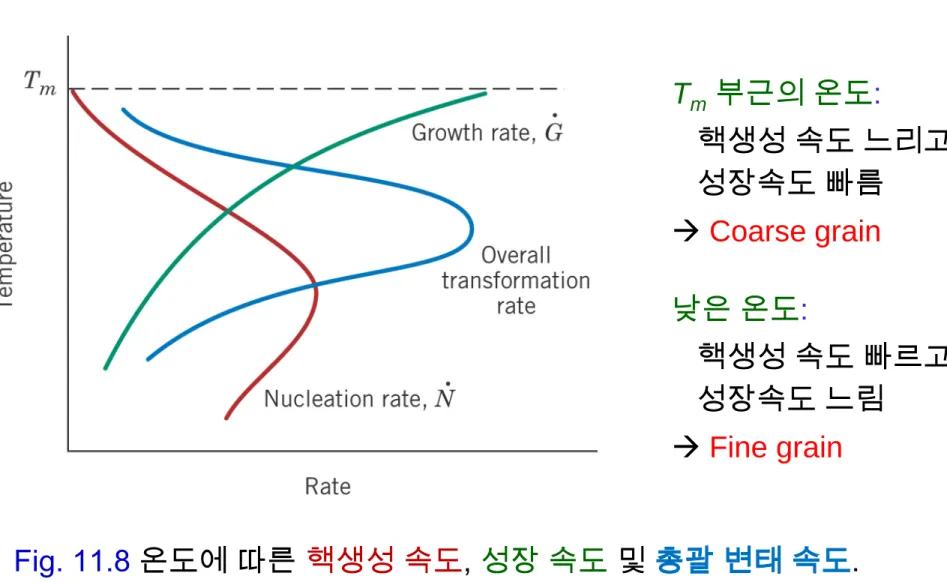
Fig. 11.8 온도에 따른
핵생성 속도, 성장 속도및
총괄 변태 속도.T
m부근의 온도 :
핵생성 속도 느리고 성장속도 빠름
Coarse grain 낮은 온도 :
핵생성 속도 빠르고 성장속도 느림
Fine grain
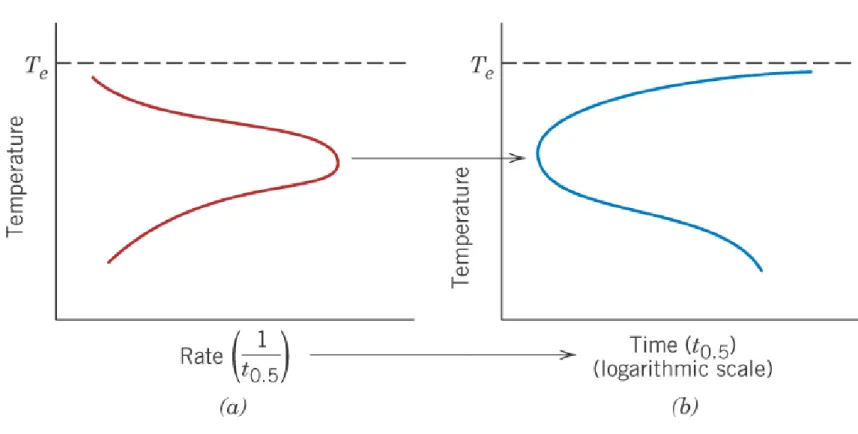
Transformation Rate vs. Time ( 온도에 따른 변태 시간 )
Fig. 11.9 (a) 온도에 따른
변태 속도,(b) 온도에 따른
변태 시간그래프 개형.
Materials Science & Engineering Chapter 11. Phase Transformations
Kinetics of Phase Transformation ( 상변태 속도론 )
“Time dependence of rate”
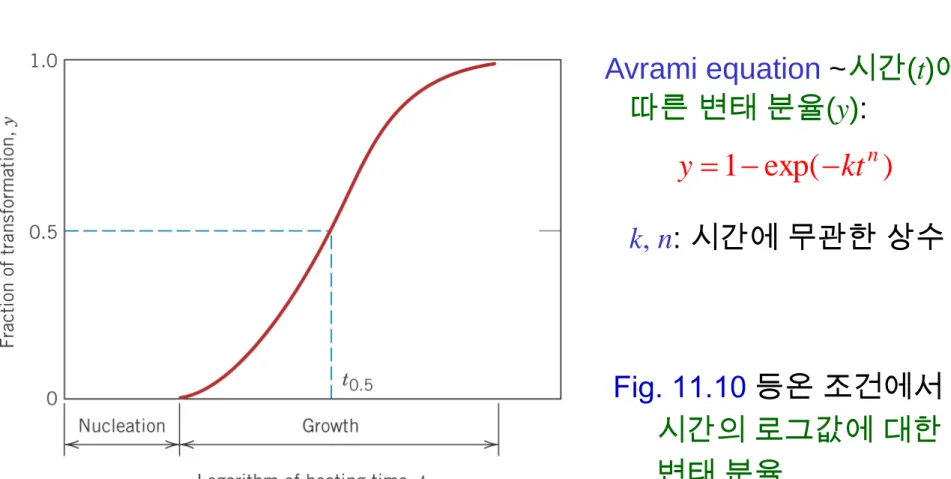
Fig. 11.10 등온 조건에서 시간의 로그값에 대한 변태 분율.
) exp(
1 k t
ny = − −
Avrami equation ~ 시간(t)에 따른 변태 분율(y) :
k, n: 시간에 무관한 상수
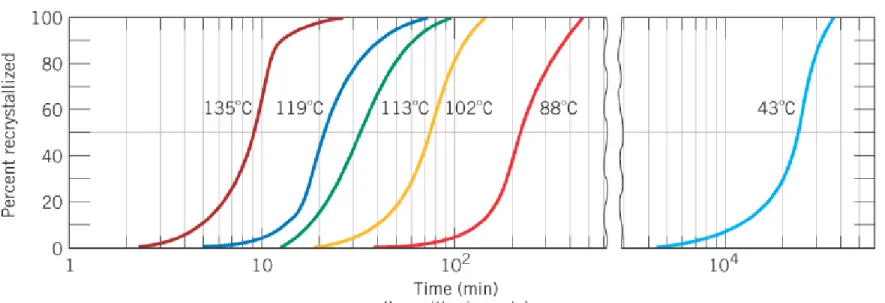
Fig. 11.11 Cu에 대한 시간의 로그값에 대한 재결정 백분율.
5 . 0
rate 1
= t Transformation rate ( 변태 속도 )
~ 변태 분율이 0.5까지 도달한 시간의 역수:
Materials Science & Engineering Chapter 11. Phase Transformations
Isothermal Transformation Diagrams ( 등온 변태도)
Eutectoid reaction for Fe-Fe
3C system:
Microstructural & Property Changes in Fe-C Alloys ( 철-탄소 합금계에서 미세구조 및 성질의 변화 )
Pearlite (펄라이트)
γ (0.76 wt% C) α (0.022 wt% C) + Fe
3C(6.70 wt% C)
Austenite Ferrite Cementite
Pearlite
Iron-Iron Carbide (Fe-Fe
3C) Phase Diagram
Fig. 10.28 Fe-Fe
3C 계의 상평형도.
Peritectic point
Eutectoid point
Eutectic point
Materials Science & Engineering Chapter 11. Phase Transformations
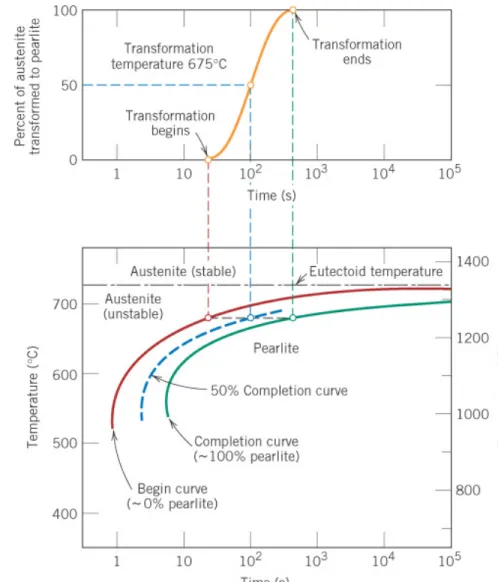
Fig. 11.12 공석 조성에서 austenite
pearlite 변태에 대한 시간에 대한 변태 백분율.
Fig. 11.13 시간에 대한 변태 백분율(위)로부터 등온변태도(아래)의 작성 예.
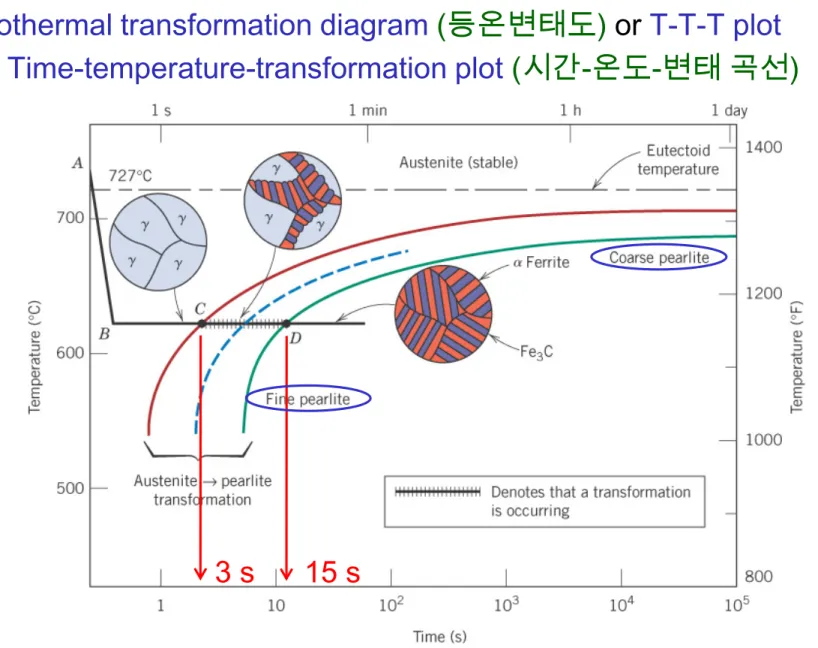
Fig. 11.14 공석 Fe-C 합금의 등온변태도와 열처리에 따른 미세구조.
Isothermal transformation diagram (등온변태도) or T-T-T plot or Time-temperature-transformation plot (시간-온도-변태 곡선)
3 s 15 s
Materials Science & Engineering Chapter 11. Phase Transformations
Fig. 11.15 (a) coarse pearlite (조대 펄라이트), (b) fine pearlite (미세
펄라이트) 현미경 사진.
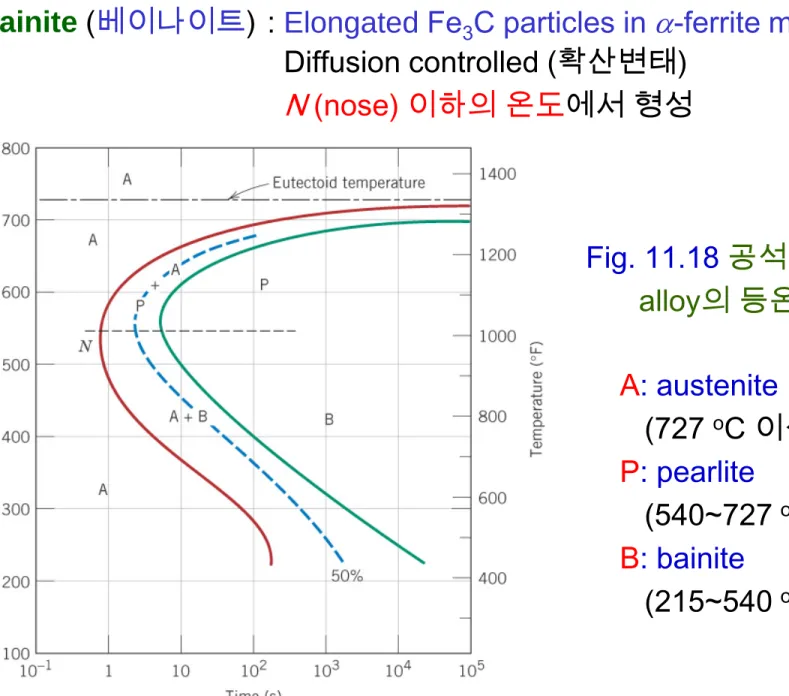
Fig. 11.18 공석조성 Fe-C
alloy의 등온변태도.Bainite (베이나이트) : Elongated Fe
3C particles in α -ferrite matrix Diffusion controlled (확산변태)
N (nose) 이하의 온도에서 형성
A: austenite
(727
oC 이상의 고용체) P: pearlite
(540~727
oC에서 형성) B: bainite
(215~540
oC에서 형성).
Materials Science & Engineering Chapter 11. Phase Transformations
Fig. 11.17 Bainite 미세구조 현미경 사진.
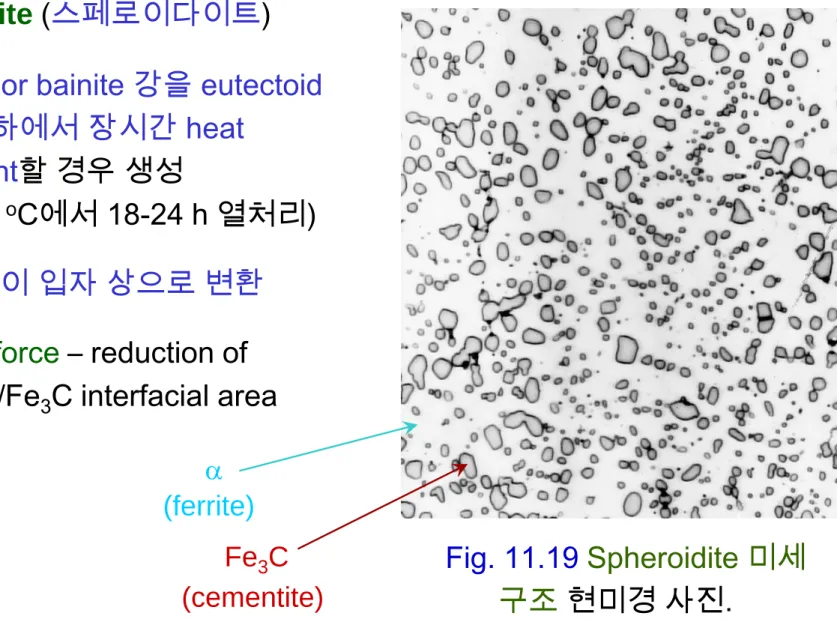
Fig. 11.19 Spheroidite 미세
구조현미경 사진.
Spheroidite (스페로이다이트)
Pearlite or bainite 강을 eutectoid 온도 이하에서 장시간 heat
treatment할 경우 생성
(예, 700
oC에서 18-24 h 열처리) Fe
3C 상이 입자 상으로 변환
Driving force – reduction of α -ferrite/Fe
3C interfacial area
α (ferrite)
(cementite)
Fe
3C
Materials Science & Engineering Chapter 11. Phase Transformations
Fig. 11.21 Martensite의 unit cell (BCT: body-centered tetragonal).
Martensite (마텐자이트)
Austenite 합금을 상온 근처로 quenching할 경우 생성
Diffusionless transformation (무확산 변태)로 생긴 단일 상 FCC 구조의 austenite가
급랭될 때 Fe와 C의 원자가 재배열되어 BCT 구조로 순간적으로 바뀌어 생성 (시간에 무관)
Fe C
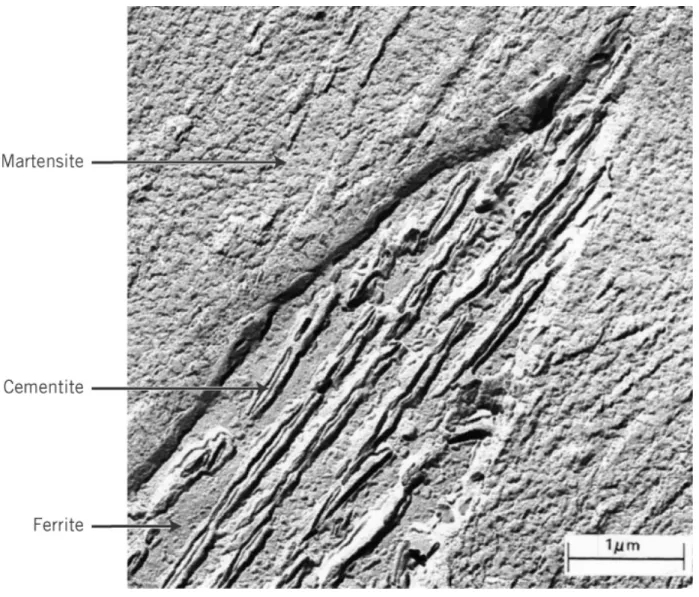
Fig. 11.22 Martensite 미세구조
현미경 사진. Fig. 11.23 공석조성 Fe-C 합금의 등온변태도.
Materials Science & Engineering Chapter 11. Phase Transformations
Ex. 11.2) 세 가지
경우의 등온 열처
리에 따른 미세구
조 변화
Fig. 11.26 공석 조성에서의
등온 변태도및
연속냉각변태도. Curves are shifted to longer times and lower temperatures.
Fig. 11.27 연속냉각변태도 위에
그린
급랭과 서랭.Materials Science & Engineering Chapter 11. Phase Transformations
Mechanical Behavior of Fe-C Alloys ( 철-탄소 합금계의 기계적 성질 )
Pearlite
Cementite: harder but more brittle than ferrite
Fine pearlite: harder and stronger than coarse pearlite Spheroidite
Softest and weakest in steel alloys
Extremely ductile, much more than either fine or coarse pearlite
Fig. 11.30 순탄소강의 탄소 농도에 따른
기계적 성질.Materials Science & Engineering Chapter 11. Phase Transformations
Fig. 11.31 순탄소강의 미세구조에 따른 기계적 성질: (a)
경도,(b)
연성.Bainite
Fine structure,
stronger and harder than pearlite
Desirable combination of strength and
ductility
Fig. 11.32 공석조성의 Fe-C 합금에서 등온
변태온도에 따른 경도 및 인장강도.
Materials Science & Engineering Chapter 11. Phase Transformations
Martensite
Hardest and strongest in steel alloys,but most brittle
interstitial C atom 이 dislocation motion을 막아주며 BCT 구조는 slip system이 적기 때문
0.5 wt% C 이상에서 급랭한 경우 internal stress 심각하여 crack 발생 Tempered martensite (템퍼링된 마텐자이트)
Tempering: 잔류응력 제거 및 연성 증가 위해 열처리 하는 것 단단하지만 취성인 martensite의 연성과 인성 증가 목적
보통 250~300
oC 에서 열처리 후 200
oC 에서 응력 제거
Martensite (BCT, 1 phase) tempered martensite ( α + Fe
3C phases)
Fig. 11.33 Martensite, tempered martensite 및 pearlite의 탄소 농도에 따른 경도.
Fig. 11.34 Tempered martensite 의 현미경 사진.
cementite
ferriteMaterials Science & Engineering Chapter 11. Phase Transformations
Fig. 11.37 Austenite에서 변태과정에 따른
미세구조 (점선은 무확산 변태).
Materials Science & Engineering Chapter 11. Phase Transformations
S tr ength D uc ti lity
martensite
tempered martensite bainite
fine pearlite coarse pearlite
spheroidite
General Trends of Mechanical Properties
Crystallization
Crystallization, Melting & Glass Transition Phenomena in Polymers ( 고분자재료에서의 결정화, 용융 및 유리전이 현상 )
Fig. 11.46 Polypropylene의 시간에 따른 등온 결정화 분율.
) exp(
1 k t
ny = − −
Avrami equation:
5 . 0
rate 1
= t
Transformation rate:
Materials Science & Engineering Chapter 11. Phase Transformations
Melting & Glass Transition Temperatures ( 용융 온도 및 유리전이 온도 )
Fig. 11.47 비결정질(A), 반결정질 (B), 결정질(C) 고분자의 온도 에 따른 비체적 거동.
Melting Temperature, T
m~ 결정성 고체 고분자가 점성 액 체로 바뀌는 온도
Glass Transition Temperature, T
g~ 비정질 또는 반결정성 유리상
고분자가 고무상 고분자로 바뀌
는 온도
Materials Science & Engineering Chapter 11. Phase Transformations
Factors Affecting T
m& T
g(T
m및 T
g에 영향을 미치는 요소 )
Both T
m& T
gincrease with increasing chain stiffness.
Chain stiffness increases by the presence of Bulky side groups (ex., PP vs. PS) Polar groups (ex., PP vs. PVC)
Double bonds & aromatic groups in the backbone
T
glies somewhere between 0.5 and 0.8 T
m(in Kelvin).
Fig. 11.48 분자량이 용융 온도 T
m, 유리전이 온도 T
g및
고분자 성질에 미치는 영향.
Materials Science & Engineering Chapter 11. Phase Transformations