Thermal Aging Behaviors of Weather Resistant Rubber Composites of EPDM, IIR, and BIIR
Sung-Seen Choi † and Jong-Chul Kim
Department of Chemistry, Sejong University, 98 Gunja-dong, Gwangjin-gu, Seoul 143-747, Korea
(Received March 21, 2012, Revised April 27, 2012, May 30, Accepted May 31, 2012)
EPDM, IIR, 그리고 BIIR 내후성 고무 복합체의 열노화 거동
최성신
† ․ 김종철
세종대학교 화학과
접수일(2012년 3월 21일), 수정일(1차 : 2012년 4월 27일, 2차 : 5월 30일), 게재확정일(2012년 5월 31일)
ABSTRACT:EPDM, IIR, and BIIR composites were thermally aged and the crosslink density changes were investigated.
Crosslink densities of the EPDM composite increased with increasing the aging time and temperature, whereas those of IIR and BIIR composites for long-term aging at high temperatures tended to decrease. Activation energies for the crosslink density changes of the EPDM composite were higher than those of the BIIR one. The experimental results were explained with the number of allylic hydrogens, activation of the zinc complex, the steric hindrance effect, and oxidation of rubber chain.
요 약:EPDM, IIR, 그리고 BIIR 복합체를 열노화시켜 가교밀도 변화를 조사하였다. 노화 시간이 증가하거나 노화 온도가 올라갈수록 EPDM 복합체의 가교밀도는 증가하였으나, 고온에서 장기간 노화된 IIR과 BIIR 복합체의 가교밀도 는 감소하는 경향을 보였다. EPDM 복합체의 가교밀도 변화에 대한 활성화 에너지는 BIIR 복합체보다 높았다. 실험 결과는 알릴 수소의 수, 아연 복합체의 활성화, 입체 가리움 효과, 그리고 고무 사슬의 산화로 설명하였다.
Keywords:thermal aging; EPDM; IIR; BIIR; crosslink density change; activation energy
†
Corresponding Author. E-mail: [email protected]
Ⅰ. Introduction
R group rubbers such as natural rubber (NR), butadiene rub- ber (BR), styrene-butadiene rubber (SBR), and acrylonitrile- butadiene rubber (NBR) have unsaturated hydrocarbon (C=C double bond) backbones. Due to the C=C double bond back- bones, they have lots of allylic hydrogens which participate in sulfur crosslinking reaction. 1 Hence, degrees of crosslink density changes of the R group rubber composites by themal aging are relatively high, and their physical and chemical prop- erties are also changed. 2-10 Of R group rubbers, isobutene-iso- prene rubber (butyl rubber, IIR) has relatively good thermal resistance properties since it has only isoprene content with less than 3 wt%. 11,12
Crosslink type and degree of crosslink density of a rubber vulcanizate determine the physical properties such as modulus, hardness, resilience, elongation at break, heat build-up, and so forth. 13 Sulfide linkages, especially polysulfides, are dis-
sociated by heating 14,15 and this brings about decrease of the crosslink density. Curatives, especially sulfur, in rubber vul- canizates make new crosslinks 16 and this results in increase of the crosslink density. Crosslink density of a rubber vulcan- izate is changed by thermal aging. 4,17-20 In general, when sul- fur-cured rubber vulcanizates are thermally aged, the crosslink densities increase and the degree also increases as the aging temperature and time increase. 21-23 Crosslink density change by thermal aging is also one of reasons about permanent de- formation of a rubber vulcanizate. 21-23
Brown and coworkers reported physical property changes of rubber composites after natural aging for 40 years and com- pared with the accelerated heat aging results. 24,25 Relative devi- ations for the physical property changes of naturally aged rub- ber vulcanizates were very big but the results were valuable.
The big deviation of the physical property may be due to the
difference in the initial states of the samples. A number of
samples are needed to measure physical properties and to per-
form thermal aging for a long time. Sample size should be
small to minimize the experimental errors, but relatively large
sample size for measurement of the physical properties should
be required. Sample dimension for measurement of the cross- link density is less than 1 cm × 1 cm. Thus, experimental errors for thermal aging behaviors of a rubber article can be reduced by measuring the crosslink density changes not the physical property changes.
In this work, we studied thermal aging behaviors of weath- er-resistant rubber composites such as ethylene-propylene-diene rubber (EPDM), IIR, and brominated isobutene-isoprene rub- ber (bromobutyl rubber, BIIR) by measuring their crosslink density changes. Thermal aging was performed for 2 - 185 days in a convection oven and the thermal aging behaviors were investigated by dividing into short- and long-term aging results. Activation energy for the crosslink density change by thermal aging was obtained from Arrhenius plot and the varia- tion with the aging time was also investigated to characterize their thermal aging behaviors. EPDM grade is determined by the contents of ethylene, propylene, and diene as well as the kind of diene. IIR and BIIR grades are determined depending on the isoprene content. Scheme 1 shows general chemical structures of EPDM, IIR, and BIIR. EPDM has outstanding properties for heat, ozone, and weather resistances as well as resistance to polar substances. Since it has also excellent elec-
Br EPDM
m
n m
m
n n
IIR
BIIR
Scheme 1. Chemical structures of EPDM, IIR, and BIIR.
trical properties, it is widely used in electrical insulations. IIR has some properties similar to those of EPDM, such as good weather resistance 5,26 and good mineral acid and base resis- tance. Since IIR has also excellent resistance to permeability by gases, it is significantly used in curing bladders and inner tubes for tires. If a halogen (chlorine or bromine) is introduced into IIR, it becomes halobutyl rubbers such as CIIR or BIIR, respectively.
Ⅱ . Experimental
Carbon black-reinforced EPDM, IIR, and BIIR compounds were made of rubber (EPDM, IIR, or BIIR 100.0 phr), carbon black (N220 50.0 phr), antidegradants (N-phenyl-N'-(1,3-dime- thylbutyl)-p-phenylenediamine (HPPD) 2.0 phr and wax 2.0 phr), cure activators (stearic acid 2.0 phr and ZnO 2.0 phr), N-tert-butyl-2-benzothiazole sulfenamide (TBBS, 1.4 phr), and sulfur (1.4 phr). KEP 350 (ethylidene norbornene (ENB) con- tent = 8 wt%) of Kumho Polychemical Co., Butyl 268 (isoprene content = 1.7 mol%) of Exxon Chemical Co., and Bromobutyl 2222 (functional bromine content = 1.03 mol%) of Exxon Chemical Co. were employed as EPDM, IIR, and BIIR, respectively. Mixing was performed in a Banbury type mixer at a rotor speed of 45 and 30 rpm for master batch (MB) and final mixing (FM) stages, respectively. The initial temperatures of the mixer were 110 and 80 ℃ for MB and FM stages, respectively. The MB compounds were prepared as follow. (1) The rubber was loaded into the mixer and pre- heated for 0.5 min. (2) The carbon black was compounded into the rubber for 2.0 min. (3) The antidegradants and cure activators were mixed for 2.0 min and the compounds were discharged. The FM compounds were prepared by mixing the sulfur and TBBS with the MB compounds for 2.0 min. The vulcanizates were prepared by curing at 160 ℃ for 30 min in a compression mold (140 mm × 140 mm × 2 mm).
The sample dimension for the thermal aging experiment was 3 cm × 6 cm. Thermal aging was performed at 60, 70, 80, and 90 ℃ for 2 - 185 days in a convection oven. Crosslink densities of the samples before and after the thermal aging were measured by swelling method. Organic additives in the samples were removed by extracting with THF and n-hexane for 3 and 2 days, respectively, and they were dried for 2 days at room temperature. The weights of the organic materials-ex- tracted samples were measured. They were soaked in toluene for 2 days and the weights of the swollen samples were measured. The swelling ratio (Q) was calculated by the equa- tion (1) 12
Q = (W
s- W
u) / W
u(1)
where W s and W u are weights of the swollen and unswollen
samples. In general, the reciprocal swelling ratio (1/Q) was used as the apparent crosslink density. Experiments were car- ried out three times and were then averaged.
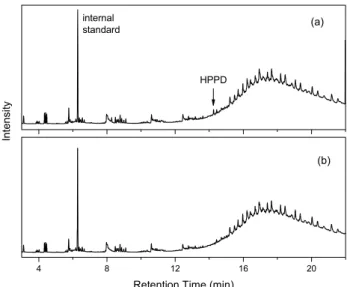
Organic materials remained in the aged samples were ex- tracted with THF and analyzed with gas chromatography/mass spectrometry (GC/MS). GC/MS chromatograms and mass spec- tra of the extracted materials were acquired with 6890N/5987 GC/MS of Agilent Co. DP-5MS capillary column (length 30 m) was used. Injector temperature of the GC was 250 ℃. The GC oven temperature program was as follows. (1) The initial temperature was 70 ℃ and kept for 3 min. (2) The temperature was increased from 70 to 300 ℃ at a rate of 10 ℃/min.
Ⅲ. Results and discussion
KEP 350 (EPDM) has ethylidene norbornene (ENB) as di- ene of 8 wt% (2.3 mol%) and 56.5 wt% of ethylene content.
Isoprene content of Butyl 268 (IIR) is 2.1 wt% (1.7 mol%), while functional bromine (C 5 H 7 Br) content of Bromobutyl 2222 (BIIR) is 2.7 wt% (1.03 mol%). Thus, Butyl 268 has more isoprene units than Bromobutyl 2222. Ethylene and pro- pylene units of EPDM and isobutene units of IIR and BIIR do not have any allylic hydrogens to participate in sulfur cross- linking reactions. The numbers of allylic hydrogens of one ENB, isoprene, and brominated isoprene units are 6, 7, and 6, respectively, as shown in Scheme 1. By multiplying them by the mole fraction, the ratios of allylic hydrogens of EPDM, IIR, and BIIR were calculated. The ratios are 13.8, 11.9, and 6.2 for EPDM, IIR, and BIIR, respectively.
Crosslink denisty change (ΔX c ) was calculated by the equa- tion (2)
ΔX
c= 100 × {(1/Q
f) - (1/Q
i)} / (1/Q
i) (2)
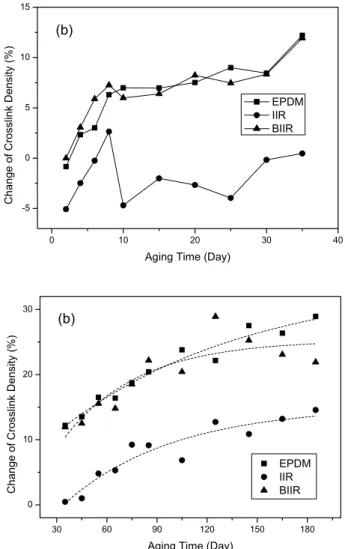
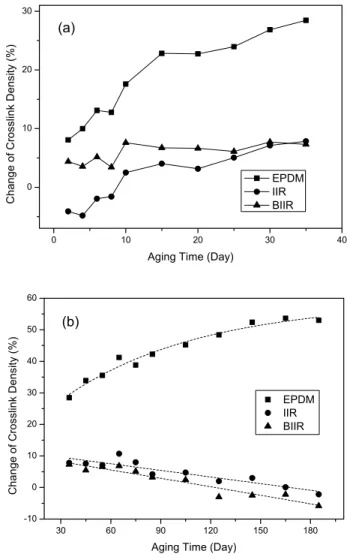
where (1/Q i ) and (1/Q f ) are the apparent crosslink densities of the specimens before and after the thermal aging. The ex- perimental results were arranged by dividing the results with short- and long-term agings as shown in Figures 1 - 4. The maximum crosslink density changes for the aging time of 185 days were less than 25, 30, 40, and 60% for the aging temper- ature of 60,70, 80, 90 ℃, respectively. The values are rela- tively much lower than those of general R group rubbers such as NR, BR, SBR, and NBR. 2-10 The crosslink densities of the EPDM composite increased after thermal aging irrespective of the aging temperatures and the aging times. The crosslink densities of the BIIR composite also increased after thermal aging except the long-term thermal aging at high temperatures.
The increased crosslink densities of sulfur-cured rubber vul- canizates by thermal aging can be explained with the for- mations of new crosslinks by free curative residues such as elemental sulfur, cure accelerator residues, and zinc complexes
remained in a sample. 4,6,27,28 Especially, free sulfur remained in a vulcanizate reacts well with rubber chains and makes new crosslinks. 4 Combination reactions between pendent sulfide groups terminated by an accelerator residue also enhance the crosslink density. 6,27,28 Zinc complex, which is cosisted of zinc oxide, fatty acids, cure accelerators, and sulfur, activates cross- linking reactions, and it makes the cure rate faster and enhan- ces the crosslink density.
The crosslink densities of the IIR composite decreased for the initial aging period and then increased as shown in Figures 1 - 4. These decreased crosslink densities of the IIR composite were observed for the thermal aging at relatively low temper- atures of 60 and 70 ℃. The decreased crosslink density signi- fies that dissociation of the existing crosslinks overcame for- mation of new crosslinks. In order to make new crosslinks, isoprene units of different two rubber chains of IIR should be neighbored. However, since the IIR only has 1.7 mol%
isoprene units, the chance to meet the two isoprene units may be very low. In addition, the isoprene unit of IIR can be steri- cally hindered by two methyl groups of the isobutene unit.
On the other hand, polysulfides can be easily dissociated by heating. Thus, the crosslink density of the IIR composite can be decreased by thermal aging. As the aging time elapses, crosslinking-related chemicals such as zinc complexes, cura- tive residues, and sulfur can gather around the isoprene units and participate in crosslinking reactions because diene units (C=C) and the crosslinking-related chemicals are relatively polar. Gathering of the crosslinking-related chemicals and crosslinking reactions by them will be more activated by in- creasing the temperature. For the EPDM and BIIR composites, the crosslink densities were not decreased by the thermal aging. This can be explained with the side diene group of EPDM and the role of bromine as a ligand in a zinc complex of BIIR. Since the dienes (ENB) of EPDM are not a backbone of the polymer and are the side groups, they will not be steri- cally hindered. In addition, the allylic hydrogen content ratio of the EPDM is higher than that of the IIR as discussed above.
Thus, for the initial aging period, the crosslink density of the EPDM composite will increase by formation of new crosslinks.
For the BIIR composite, bromaine of BIIR can play a role of a ligand in a zinc complex as shown in Scheme 2. When zinc complexes are activated by bromine, the activation energy for crossinking reactions decreases. Thus, formation of new crosslinks will be activated although the allylic hydrogen con- tent ratio of the BIIR is lower than that of the IIR as discussed previously.
For the short-term thermal aging, the ΔX c s of the EPDM
and BIIR composites were larger than those of the IIR one
irrespective of the aging temperatures. This may be also due
to the role of bromine as a ligand in a zinc complex of BIIR
and the side diene group of EPDM. The relative order of the
N
S S
yZn S
xS
N Br
Ligand BIIR
Scheme 2. Structures of zinc complex including bromine of BIIR.
0 10 20 30 40
-8 -4 0 4 8
C ha nge o f C rossl in k De nsi ty (% )
Aging Time (Day)
EPDM IIR BIIR
(a)
30 60 90 120 150 180
-5 0 5 10 15 20 25
EPDM IIR BIIR
Change o f Cr oss link Den sity (%)
Aging Time (Day)
(b)
Figure 1. Variations of the crosslink density changes of the rubber composites by short‐term (a) and long‐term (b) thermal aging at 60 ℃ with the aging time. The squares, circles, and triangles indicate the EPDM, IIR, and BIIR specimens, res- pectively.
Δ X c s of the BIIR composite aged for a short time notably varied with the aging temperature. For the short-term thermal aging at 60 ℃, the ΔX c s of the BIIR composite were larger than those of the EPDM one as well as those of the IIR one as shown in Figure 1(a). The ΔX c s of the BIIR and EPDM composites aged at 70 ℃ for a short time were nearly the same as shown in Figure 2(a). For the short-term thermal aging at 80 and 90 ℃, the ΔX c s of the BIIR composite were smaller than those of the EPDM one and the difference became bigger as shown in Figures 3(a) and 4(a). This can be explained with the reduction of the favorability of the role of bromine as a ligand in a zinc complex of BIIR and the enhancement of the crosslinking reaction of the side diene group of EPDM by increasing the aging temperature. The zinc complexes can be activated by binding of bromine (Br) to zinc ion (Zn 2+ )
0 10 20 30 40
-5 0 5 10 15
Ch ange of Crossli nk D ensit y (% )
Aging Time (Day)
EPDM IIR BIIR
(b)
30 60 90 120 150 180
0 10 20 30
EPDM IIR BIIR
Ch ange of Crossli nk D ensit y (% )
Aging Time (Day)
(b)
Figure 2. Variations of the crosslink density changes of the
rubber composites by short‐term (a) and long‐term (b) thermal
aging at 70 ℃ with the aging time. The squares, circles, and
triangles indicate the EPDM, IIR, and BIIR specimens, res-
pectively.
0 10 20 30 40 0
5 10 15 20
Ch ange o f Cross link Densi ty (%)
Aging Time (Day)
EPDM IIR BIIR
(a)
30 60 90 120 150 180
4 8 12 16 20 24 28 32 36 40
EPDM IIR BIIR
Chan ge of Cros sl ink De ns ity (% )
Aging Time (Day)
(b)
Figure 3. Variations of the crosslink density changes of the rubber composites by short‐term (a) and long‐term (b) thermal aging at 80 ℃ with the aging time. The squares, circles, and triangles indicate the EPDM, IIR, and BIIR specimens, res- pectively.
and the activation energy for crossinking reactions decreases.
Thus, the crossinking reactions will be more activated by bind- ing of Zn---Br. However, if the temperature becomes higher, the binding strength of Zn---Br will be weaken. Hence, at high temperatures, the role of bromine as a ligand in a zinc complex of BIIR will be reduced. On the contrary, the sulfur-cross- linking reactions of the side diene groups of EPDM will be more activated by increasing the temperature.
For the themal aging at 60 ℃ (Figure 1), the ΔX c s of BIIR composite were larger than those of the EPDM and IIR ones.
For the themal aging at 70 ℃ (Figure 2), the ΔX c s of the BIIR composite were larger than those of the IIR, while the Δ X c s of the BIIR and EPDM composites were nearly the same. For the themal aging at 80 an 90 ℃ (Figures 3 and 4), the ΔX c s of the BIIR composite were smaller than those
0 10 20 30 40
0 10 20 30
C h ang e of C rossl in k D ens ity (%)
Aging Time (Day)
EPDM IIR BIIR
(a)
30 60 90 120 150 180
-10 0 10 20 30 40 50 60
EPDM IIR BIIR
C hange of C ros slin k Den sity (%)
Aging Time (Day)
(b)
Figure 4. Variations of the crosslink density changes of the rubber composites by short‐term (a) and long‐term (b) thermal aging at 90 ℃ with the aging time. The squares, circles, and triangles indicate the EPDM, IIR, and BIIR specimens, res- pectively.
of the EPDM one. The larger ΔX c s of BIIR composite at low temperature of 60 ℃ were very interesting because the allylic hydrogen content ratio of BIIR is lower than those of EPDM and IIR. This implies that zinc complexes by binding of bromine remarkably reduced activation energies for cross- linking reactions. However, by increasing the aging temper- ature, the binding strength of Zn---Br will be weakened and the effect on the activation energy reduction will be decreased.
Due to the weakening of Zn---Br binding strength, degree of
the ΔX c s of the BIIR composite at high temperatures was
small. For the long-term thermal aging at 90 ℃, the ΔX c s
of the BIIR composite were even smaller than those of the
IIR one. Another reason about the smaller ΔX c s of the BIIR
composite is the steric hindrance by bromine atom besides
of the weakening of Zn---Br binding strength. Atomic radius
4 8 12 16 20
Inten si ty
Retention Time (min)
(b)
internal standard
HPPD (a)
Figure 5. GC/MS TIC chromatograms of the organic materials extracted with THF from the EPDM composite aged at 90
℃ for 5 (a) and 35 (b) days.
4 8 12 16 20
In te n si ty
Retention Time (min)
(b)
internal
standard HPPD (a)
Figure 6. GC/MS TIC chromatograms of the organic materials extracted with THF from the IIR composite aged at 90 ℃ for 5 (a) and 35 (b) days.
of bromine atom is much bigger than those of hydrogen and carbon atoms. Atomic radii of hydrogen, carbon, and bromine atoms are 37, 77, and 114 pm, respectively. Since Br atom in BIIR is neighbored around allylic hydrogens and is rela- tively much bigger than hydrogen and carbon atoms, allylic hydrogens will be sterically hindered by Br atom and for- mation of new crosslinks will be prevented. By increasing the temperature, rotation of the Br atom and the steric hindrance might be more activated.
For the long-term themal aging of the IIR and BIIR compo-
4 8 12 16 20
In te n si ty
Retention Time (min)
(b) internal (a)
standard
HPPD
Figure 7. GC/MS TIC chromatograms of the organic materials extracted with THF from the BIIR composite aged at 90 ℃ for 5 (a) and 35 (b) days.
0 50 100 150 200
-150 -100 -50 0 50 100 150 200