Vol. 22, No. 6, pp.834-843(2020) https://doi.org/10.5805/SFTI.2020.22.6.834
834
3D 아바타를 이용한 드레이핑용 1/2 드레스폼 개발
이예리 · 장정아1)†
부산대학교 의류학과
1)부산대학교 의류학과/부산대학교 생활환경연구소
Development of 1/2 Dress Form for Draping using 3D Avatars
Ye-Ri Lee and Jeong-Ah Jang1)†
Dept. of Clothing & Textiles, Pusan National University; Busan, Korea
1)Dept. of Clothing & Textiles/Research Institute of Ecology, Pusan National University; Busan, Korea
Abstract: This study develops 1/2 dress forms for draping. This study investigated the production status of domestic and foreign products in order to model their shape using CLO 3D. In addition, it developed torso-type and torso-crotch-type prod- ucts that allowed for draping using a 3D printer. This study analyzed shape and size compared to developed ones after refer- ring to the Size Korea 7th Survey data as well as seven domestic and foreign company websites. The results are follows.
First, an investigation of the production status of the products for the size of most of the domestic ones (except K-4) indicated that the waist circumference was slimmer than Size Korea. Bust, waist, and hip circumferences ranged from 42.0 cm, 32.0 cm, and 45.0 cm - 49.0 cm, respectively, in Chinese products; 42.0 cm - 43.0 cm, 30.5 cm - 31.5 cm, and 46.0 cm - 46.5 cm in Japanese products; 43.0 cm, 35.0cm, and 46.5 cm in American products (Japanese body shape applied). Second, an avatar was produced on a 3D software with the average size of 20-24year-old women, and its file modified as a dress form for 3D printing with PLA filament to produce dress forms for draping, workable with pins, using quilting cotton and cotton cloth.
Third, the comparisons of the form and flattening between the developed dress forms and the selling ones indicated that flat- tening was bigger in the waist part of the former than the latter. The waist is produced too slim in the existing dress forms;
therefore, it is necessary to correct the waist circumference. Unlike existing dress forms, the developed ones were produced in proximity to the average size of 20-24 year-old women in the Size Korea 7th Survey.
Key words: 1/2 dress form(1/2 드레스폼), draping(드레이핑), torso-type(토르소형), torso-crotch-type(토르소-크로치형), 3D printing(3D 프린팅)
1. 서 론
최근 시대 변화에 따른 서구화된 체형변화로 인해 개인의 특 성을 정확하게 파악해 작은 디테일까지 섬세하게 배려한 맞춤 형 의류가 각광을 받고 있으며(Choi, 2020), 국내 의류 브랜드
‘르베이지(LEBEIGE)’에서는 입체패턴으로 곡선의 미를 표현한 제품을 출시하는 등 국내 패션업체에서의 입체패턴 활용도가 증가하는 추세이다(Lee, 2020). 또한 의류 업체나 디자이너의 패션쇼를 위한 의상 제작의 경우와 대학 교육기관에서의 졸업 작품 패션쇼를 위한 의상 제작 시에는 보다 복잡한 응용을 요 구하는 다양한 형태의 디자인들이 많이 선보여 지고 있는데, 이
러한 실험적, 독창적 스타일이 가미된 디자인을 효과적으로 표 현하기 위한 방법으로 평면재단 방식 보다는 인대를 사용하는 입체재단 방식이 더욱 선호되어지고 있으며(Park, 2015), 국내 대학의 의류/패션 관련 105개 학과 중 드레이핑 교과 개설학과 는 86%(Ranking web of universities 국내 대학 2020년 1월 기준)로 많은 비중을 차지하고 있어 추후 한국인 인체적합성에 맞는 교육용 드레이핑 드레스폼이 필요할 것으로 사료된다. 현 재 코로나19 상황으로 인해 패션위크가 취소되거나 온라인으 로 대체되고 있는 실정이며, ‘디올(Dior)’에서는 2020년 7월 온 라인에서 열린 파리 오트쿠튀르 패션위크에서 55cm 크기로 만 들어진 드레스폼을 이용한 미니어처 드레스 컬렉션을 영상미가 돋보이는 패션 필름으로 보여주는 방식을 택하는 등(Heo, 2020), 언택트(Untact) 시대가 지속될 경우 의류 업체 및 의류/
패션 관련 학과에서의 미니 드레스폼의 활용도가 높아질 것으 로 기대된다.
반면에 국내 드레스폼 제조업체의 경우, 드레스폼 제작에 필 요한 부위별 인체치수 및 체형 분석에 대한 충분한 정보를 가 지고 있지 않기 때문에 실제 인체의 형태를 반영하지 못한 채
†Corresponding author; Jeong-Ah Jang Tel. +82-51-510-2835, Fax. +82-51-583-5975 E-mail: [email protected]
© 2020 (by) the authors. This article is an open access article distributed under the terms and conditions of the Creative Commons Attribution license (http://creativecommons.org/licenses/by/3.0/), which permits unre- stricted use, distribution, and reproduction in any medium, provided the original work is properly cited.
시각적으로 보기 좋은 형태 위주로 드레스폼을 제작하고 있으 며(Oh, 2016), 근래 드레스폼 제작을 위한 인체 체형 및 특성 파악 등 한국인의 체형에 맞는 드레스폼 제작을 위한 연구가 행해지고 있지만, 아직까지 국내 드레스폼 제작 업체들의 영세 한 운영을 면치 못하는 가운데 드레스폼 개발에 소요되는 노력, 비용으로 발생하는 문제점으로 인해 연구결과가 제작단계까지 이용되지 못하고 있는 실정이다. 현재 국내 의류 업체에서 사 용되고 있는 드레스폼은 국내에서 인체의 형태적합성을 만족시 킬 만한 드레스폼이 생산 되고 있지 않아 국외 드레스폼 사용 하는 경우가 많았고, 국외 드레스폼을 사용하는 이유로는 패턴 사, 디자이너 모두 사이즈의 정확성 때문인 경우가 대부분 이 였다(Shin & Rha, 2003). 따라서 의복 제작용 드레스폼은 다 양한 체형을 가진 사람들을 대표하는 인체 대용품으로 활용되 므로 인체의 실제 형태 및 비율을 그대로 적용시켜 제작할 필 요성이 있다(Chang, 2016).
드레스폼 개발에 관한 선행연구로는 3D 프린터를 이용한 드 레스폼 개발 연구(Chang & Sohn, 2009; Kim & Choi, 2010;
Suh & oh, 2012), 스티로폼 보드를 이용한 드레스폼 개발 연 구(Choi & Nam, 2008), 석고를 이용한 드레스폼 개발 연구 (Im, 1994) 등이 있으며, 실제 사이즈 드레스폼 개발에 관한 연구는 진행되어왔으나, 1/2 드레스폼 개발에 관한 연구는 전 무한 실정이다.
본 연구는 1/2사이즈 20대 성인여성 드레이핑용 드레스폼 개 발에 목적을 두고 있으며, 이를 위한 조사로써 국내 · 외 1/2 드 레스폼 제품 생산실태를 조사하고, 사이즈코리아 제 7차 인체 치수조사 사업 자료(KATS, 2015) 중 20~24세 성인여성의 평 균치수를 이용하여 3D 프린팅을 활용한 1/2 드레이핑용 드레 스폼을 제작하고자 한다.
2. 연구방법
2.1. 국내 · 외 1/2 드레스폼 제품 생산실태
2020년 9~10월에 걸쳐 각 업체의 온라인 사이트 또는 시중 에서 구할 수 있는 국내 · 외 성인여성 1/2 드레스폼의 치수항목 을 수집하였다. 본 연구에서 수집한 국내·외 드레스폼 업체는 한국 3개 업체(코코디피, 마다메이드, 핏앤바디), 국외 업체인 중국 7개 업체(Beifu form, chinapnp3MP20, Hongduleimeng, Qjanzi form, 教学小人台, 去业版人台, 山木小人台), 일본 2개 업체(문화학원사업국, Kiiya), 미국 1개 업체(Alvanon)로 총 13 개 드레스폼 제작업체 및 판매업체를 대상으로 하였다.
2.2. 1/2 드레스폼 3D 모델링
본 연구에서는 20~24세 국내 성인여성 체형을 반영한 드레 이핑용 드레스폼을 제작하고자 하였으며, 먼저 가상 피팅 프로 그램인 CLO 3D 5.2v를 이용하여 동양 성인여성 아바타(Feifei) 의 바르게 서 있는 3종류 자세(차렷 자세, 팔을 약 30° 벌린 자 세, 팔을 약 45° 벌린 자세)중 팔을 약 45° 벌린 아바타를 불
러온 뒤 사이즈 편집창에서 사이즈코리아 7차 의 20~24세 성 인여성의 평균 치수 자료 중 키와 가슴둘레 항목을 우선 설정 하고, 둘레 12항목, 길이 3항목, 높이 2항목을 편집창 순서대로 설정하였으며, 사이즈코리아 7차에 제시되어있지 않은 치수는 프로그램 내에서 자동조절 되도록 본 실험에서는 제어하지 않 았다(Table 1). 생성된 3D 아바타는 확장자명 .obj로 저장하였다.
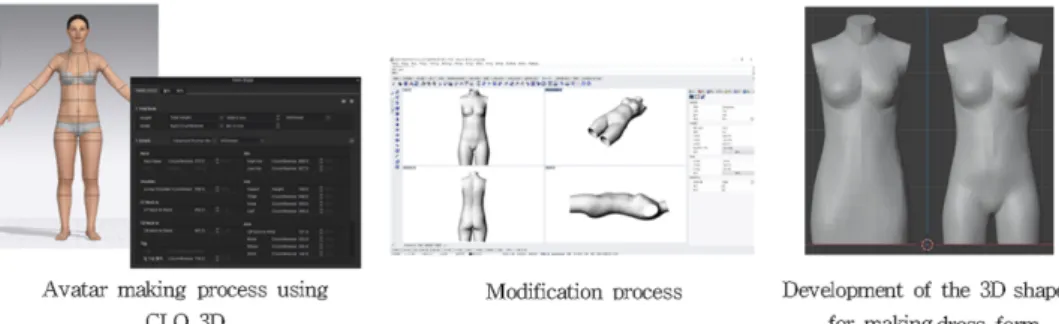
3D 형상 모델링 과정의 세부내용은 다음과 같다(Fig. 1). 먼 저, CLO 3D에서 제작한 아바타 파일(.obj)을 Rhinoceros 6.0v 프로그램을 이용하여 불러온 후 ‘메쉬’ 형태를 ‘개체를 Nurbs 로 변환’ 기능을 이용하여 ‘폴리서피스’ 형태로 변환하고 전체 크기를 50%로 축소하였다. 그 후 머리, 팔, 다리 부위를 제거 하고 정중선을 기준으로 절개한 뒤 오른쪽 면을 ‘미러’ 기능으 로 Y축 기준 대칭복사 하였다. 불필요한 부위를 제거하고 생 긴 홀(hole)은 ‘평면형 구멍 끝막음’기능을 실행하여 평면 형태 로 막아준 후 확장자명 .stl 파일로 저장하였다. ‘.stl’ 파일을 Blender 2.83v 프로그램을 이용하여 드레스폼 형태로 모델링하 는 과정은 총 2차에 걸쳐 진행되었으며, 1차 모델링에서는 쇄 골과 배꼽 등 불필요한 부위를 제거하고, 20~24세 성인여성 평 균 치수의 표준편차 이내의 사이즈를 유지한 채로 토르소-크로 치형 드레스폼의 샅 형태를 메꾸어 토르소형 드레스폼 형태를 완성하였다. 2차 모델링에서는 토르소형 드레스폼의 하반신 형 Table 1. Measurement parts of CLO 3D 5.2v and Size Korea
CLO 3D Size korea
Circumference
Bust circumference Bust circumference Neck base Neck base circumference Under bust circumference Underbust circumference
Waist circumference Waist circumference
High hip circumference -
Low hip circumference Hip circumference Thigh circumference Thigh circumference Knee circumference Knee circumference Calf circumference Calf circumference Ankle circumference Minimum leg circumference Bicep circumference Upper arm circumference Elbow circumference Elbow circumference
Wrist circumference Wrist circumference
Height
Total Stature
HPS height -
Bust height -
Waist height Waist height Inseam height Crotch height
Length
Across shoulder Biacromion length Apex to apex Bust point-bust point
HPS to apex Neck point to breast point
Arm Arm length
Etc. Shoulder drop -
태를 단순화 하고, 어깨 너비를 수정하였으며, 사이즈코리아에 서 제공하는 인체형상 자료 중 표준체형의 형태를 반영하기 위 하여 Kim et al.(2016)의 논문을 참고하여 간접측정항목인 각 도 항목(등돌출상부각, 등돌출하부각, 가슴상부각, 가슴하부각, 어깨경사각도)을 비교 점검한 뒤 표준체형의 형태와 차이가 많 은 항목을 보정하여 완성하였다(Table 2).
2.3. 성인여성 1/2 드레스폼 제작
3D 프린터 출력을 위해 Ultimaker Cura 3.6v 프로그램을 활용하여 모델링 파일을 불러온 후 출력물의 적층위치, 노즐온 도, 출력속도 등 출력조건을 설정하여 확장자명 .gcode로 슬라이 싱 파일을 생성하였다. 출력에 사용된 소재는 PLA이며, 3D 프 린터는 Stealth delta 250으로 프린터의 사양은 Table 3과 같다.
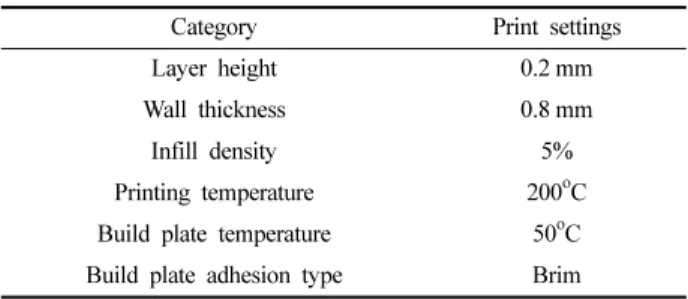
3D 프린팅 과정에서 출력물의 크기가 3D 프린터의 최대 출 력 크기250 × 250 × 250(W × D × H)mm를 초과하므로 허리둘레 선을 기준으로 상반신과 하반신을 분할 한 후 출력을 진행하여 3D 프린팅 과정에서 출력물의 치수가 클수록 오차의 범위가 커 지는 점과 출력 시간이 길어질수록 히팅 베드에 먼저 적층된 부분의 변형이 발생하는(Do & Choi, 2018) 문제를 최소화 하 였으며, 출력조건은 Table 4와 같다. 드레이핑용 드레스폼을 제 작하기 위하여 3D 출력물 외부에 1.6 mm(3oz) 퀼팅솜을 내부 충전재로 입힌 후 광목으로 외부 커버를 제작하여 드레스폼을 완성하였으며, 사용된 재료 및 작업순서는 Table 5와 같다. 완 성된 개발드레스폼의 적합성을 분석하기 위해 시판드레스폼과 앞면 옆면의 실루엣 형태, 가슴둘레, 허리둘레, 엉덩이둘레 치 수 및 편평률을 비교하였다.
3. 결과 및 고찰
3.1. 국내 외 1/2 드레스폼 제품 생산 실태
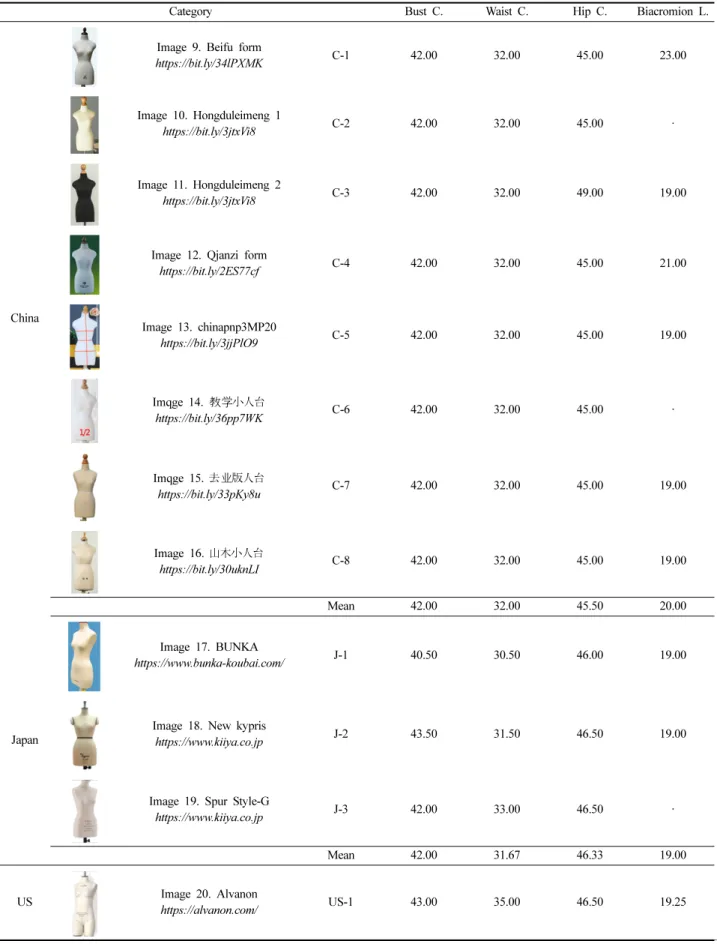
국내 · 외 시판되고 있는 1/2 드레스폼 16개의 제품 생산 실태 를 조사한 결과, 공통적으로 표기되어있는 제품치수는 가슴둘 레, 허리둘레, 엉덩이둘레 3항목 이였으며, 몇몇 제품의 경우 어 Fig. 1. Modeling process of the 3D shape for making dress form.
Table 2. Items and methods for measuring the angles
Items of measurement Methods for measuring the angles 6th Size Korea*
Angle of the side upper back The angle formed by the straight line connecting back neck point (b.n.p.) and back protrusion with the vertical line dropped from b.n.p. 28°
Angle of the side lower back The angle formed by the straight line connecting back protrusion and posterior waist with the vertical line raised from posterior waist 12°
Angle of the side upper bust The angle formed by anterior neck and bust point 27°
Angle of the side lower bust The angle formed by bust point and anterior waist 3°
Angle of the right shoulder The angle formed by right side neck point and shoulder point 20°
*: The angle measured from the standard body shape data of the 6th Size Korea(KATS, 2010) 20s adult female Table 3. Specification of 3D printer
Category Specification
Image
Image 1. Stealth delta 250 http://s3d.co.kr/3d-printer-2/
Model Stealth delta 250
Printing technology FFF(fused filament fabrication)
Filament type ABS, PLA, etc.
Filament diameter 1.75 mm
Nozzle diameter 0.5 mm
Slicing software Mattercontrol, Cura, Kisslicer Inputted 3D design file type .gcode, .stl, .obj
Formation size (W×D×H) 250 × 250 × 250 mm Nozzle maximum temperature 260oC
깨사이길이도 표기되어 있었다. 국내 제품의 경우 가슴둘레 43.0~44.0 cm, 허리둘레 31.5~34. 0cm, 엉덩이둘레 44.5~46.0 cm 로 생산되고 있었다. 허리둘레의 경우 K-4제품을 제외한 나머 지 국내 드레스폼이 사이즈코리아 7차 자료와 적게는 1.5 cm에
서 3.5 cm까지 차이를 보여 허리둘레의 치수가 대체적으로 작 게 생산되고 있는 것을 알 수 있었으며, 실제사이즈 드레스폼 과 성인여성 인체 측정치를 비교한 논문(Lee & Jang, 2019)에 서도 드레스폼의 허리둘레가 작게 생산 되고 있는 결과와 일치 하는 것으로 보아, 시중의 실제사이즈 드레스폼의 형태를 참고 로 축소하여 제작하고 있는 것으로 사료된다. 국외 제품을 살 펴보면, 중국의 경우 전체적인 제품의 형태가 비슷하고, 어깨사 이길이를 제외한 가슴둘레(42.0 cm), 허리둘레(32.0 cm), 엉덩이 둘레(45.0 cm)가 대부분의 제품에서 유사하게 나타났다. 일본 제품의 경우 가슴둘레 40.5~43.5cm, 허리둘레 30.5~33.0 cm, 엉덩이둘레 46.0~46.5 cm로 생산되고 있었으며, 미국 제품의 경 우 일본 성인여성의 체형을 기준으로 생산되고 있는 제품으로 가슴둘레 43.0 cm, 허리둘레 35.0 cm, 엉덩이둘레 46.5 cm로 생 산되고 있었다(Table 6).
3.2. 1/2 드레스폼 개발 3.2.1. 1/2 드레스폼 3D 모델링
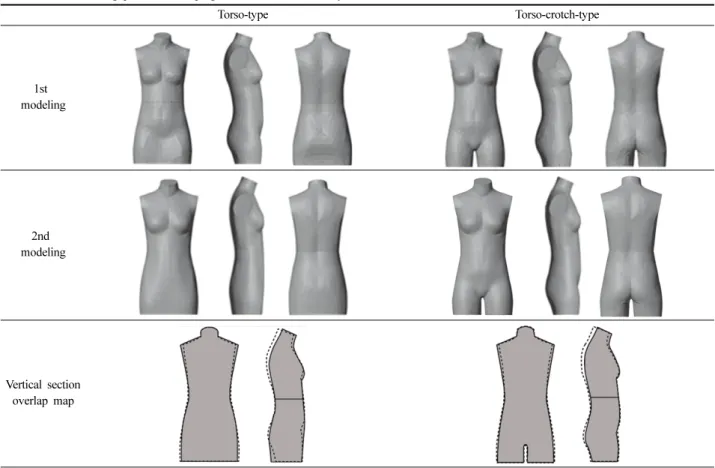
1/2 드레스폼 모델링은 총 2차에 걸쳐 진행되었다(Table 7).
1차 모델링은 사이즈코리아 7차 20~24세 성인여성 평균치수 ± 표준편차 범위 내에서 제작하였으며, 표준체형의 형태를 반영 하기 위해 사이즈코리아 표준체형 형상과 개발드레스폼의 간접 측정항목을 측정하였다. 그 결과 표준체형은 등돌출상부각 28o, 등돌출하부각 12o, 가슴상부각 27o, 가슴하부각 3o, 어깨경사각 20o로 측정되었으며, 1차 모델링 파일은 등돌출상부각 31o, 등 돌출하부각 16o, 가슴상부각 27o, 가슴하부각 3o, 어깨경사각 21o로 등돌출상부각과 등돌출하부각에서 표준체형과 차이를 보 였다. 따라서 2차 드레스폼 모델링의 등돌출상부각, 등돌출하부 각 항목을 각각 29o, 13o로 수정하여 표준체형 형태를 반영하였 Table 4. The print settings for 3D printing of dress form
Category Print settings
Layer height 0.2 mm
Wall thickness 0.8 mm
Infill density 5%
Printing temperature 200oC
Build plate temperature 50oC
Build plate adhesion type Brim
Table 5. The working process of the dress form and the materials used Working process
3D printing Internal filling cover work
External cover work and finishing
Image 2. PLA filament https://bit.ly/3eLmelt
Image 3. Quilting cotton https://bit.ly/33vEoCk
Image 4. Cotton https://
bit.ly/2FDgpc1
Table 6. Size details of domestic and foreign 1/2 dress form (Unit : cm)
Category Bust C. Waist C. Hip C. Biacromion L.
7th Sizekorea (50%) Mean (S.D.) 42.00 (3.50) 35.50 (3.55) 46.40 (3.11) 19.75 (0.97)
Korea
Image 5. Kokodp
https://bit.ly/30o6gHS K-1 43.00 32.00 45.00 19.00
Image 6. Madamade1
https://bit.ly/3l8j2Cc K-2 44.00 31.50 44.50 20.00
Image 7. Madamade2
https://bit.ly/3cVPzbN K-3 43.00 32.00 45.00 18.50
Image 8. Fitenbody K-4 43.00 34.00 46.00 19.30
Mean 43.25 32.38 45.13 19.20
Table 6. Continued. (Unit : cm)
Category Bust C. Waist C. Hip C. Biacromion L.
China
Image 9. Beifu form
https://bit.ly/34lPXMK C-1 42.00 32.00 45.00 23.00
Image 10. Hongduleimeng 1
https://bit.ly/3jtxVi8 C-2 42.00 32.00 45.00 ·
Image 11. Hongduleimeng 2
https://bit.ly/3jtxVi8 C-3 42.00 32.00 49.00 19.00
Image 12. Qjanzi form
https://bit.ly/2ES77cf C-4 42.00 32.00 45.00 21.00
Image 13. chinapnp3MP20
https://bit.ly/3jjPlO9 C-5 42.00 32.00 45.00 19.00
Imqge 14. 教学小人台
https://bit.ly/36pp7WK C-6 42.00 32.00 45.00 ·
Imqge 15. 去业版人台
https://bit.ly/33pKy8u C-7 42.00 32.00 45.00 19.00
Image 16. 山木小人台
https://bit.ly/30uknLI C-8 42.00 32.00 45.00 19.00
Mean 42.00 32.00 45.50 20.00
Japan
Image 17. BUNKA
https://www.bunka-koubai.com/ J-1 40.50 30.50 46.00 19.00
Image 18. New kypris
https://www.kiiya.co.jp J-2 43.50 31.50 46.50 19.00
Image 19. Spur Style-G
https://www.kiiya.co.jp J-3 42.00 33.00 46.50 ·
Mean 42.00 31.67 46.33 19.00
US Image 20. Alvanon
https://alvanon.com/ US-1 43.00 35.00 46.50 19.25
으며, 모델링 완성 치수는 가슴둘레 42.75 cm 가슴두께 10.59 cm, 가슴너비 14.13 cm, 허리둘레 34.98 cm, 허리두께 8.95 cm, 허 리 너비 12.72 cm, 토르소형 엉덩이둘레 45.61 cm 엉덩이두께 10.86 cm, 엉덩이너비 17.13 cm, 토르소-크로치형 엉덩이둘레 46.79 cm, 엉덩이두께 9.96 cm, 엉덩이너비 16.92 cm로 제작하 였다(Fig. 2).
3.2.2. 1/2 드레스폼 제작
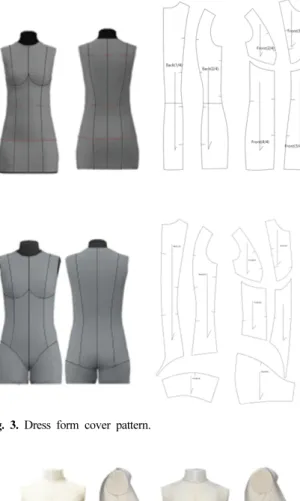
CLO 5.2v에서 다각형 패턴 툴, 재봉 툴 등을 이용하여 1차
모델링 파일에 여유 없이 타이트 피팅된 커버 패턴을 제작한 후, 1차 모델링 파일을 3D프린팅 하여 커버 작업을 진행하였 다(Fig. 3). 1차 3D 출력물은 20~24세 성인여성 평균치수 체형 의 50% 크기로 출력하였으며, 3D 출력물의 치수와 외부 커버 작업 후의 둘레 치수를 측정하여 차이를 비교해 본 결과, 약 2.24%의 차이를 보였다. 이 결과를 바탕으로 2차 모델링부터 충전재의 두께를 고려한 드레스폼 제작을 위해 모델링 상에서 Z축(높이)항목을 제외한 X축, Y축을 각각 둘레 치수의 평균치 인 2.24%씩 축소하여 출력하였고, 2.24% 축소한 최종 드레스 폼 모델링 치수는 가슴둘레 41.79 cm, 허리둘레 34.20 cm, 엉덩이 둘레 44.59 cm이다. 최종 드레스폼 모델링 파일을 3D 프린팅하여 외부 커버 작업 후 개발드레스폼을 완성하였다(Fig. 4).
3.2.3. 개발드레스폼과 국내 시판드레스폼의 형태 비교
개발드레스폼과 시판드레스폼의 형태, 치수, 편평률을 비교한 결과는 다음과 같으며, 비교에 사용된 제품은 국내 제품 4종 (K-1, K-2, K-3, K-4)이다(Table 8). 형태 비교를 위해 토르소 형 개발드레스폼은 토르소형인 K-1, K-2, K-3제품, 토르소-크 로치형 개발드레스폼은 같은 토르소-크로치형인 K-4제품과 비 교하였으며, 앞면, 옆면 실루엣을 중합하여 비교해본 결과 차이 를 보인 부분은 앞면중합도에서 어깨경사, 허리, 헴라인, 옆면 Table 7. The modeling process of draping dress form for 20∼24-year-old women
Torso-type Torso-crotch-type
1st modeling
2nd modeling
Vertical section overlap map
: 1st modeling : 2nd modeling
Fig. 2. The sectional view of 2nd modeling.
중합도에서 상체 기울기, 젖가슴아래-허리, 엉덩이-헴라인이다.
어깨경사의 경우 개발드레스폼, K-4는 약 21o, K-2는 약 23o, K-1, K-3의 경우 약 25o이상으로 K-1, K-3제품이 다른 제품 에 비해 어깨경사가 크게 나타난 것을 알 수 있었다. 또한, 앞 면중합도에서 보았을 때 개발드레스폼의 허리와 헴라인 부분이 시판드레스폼에 비해 가로 너비가 굵게 나타난 것을 알 수 있 었고 이는 개발드레스폼이 시판드레스폼에 비해 허리둘레 부위 가 편평하게 제작된 것을 알 수 있었으며, 시판드레스폼이 사 이즈코리아 7차 치수에 비해 허리둘레 치수가 작게 생산되고 있는 점을 알 수 있었다. 이는 실제 인체에 비해 가슴둘레-허 리둘레-엉덩이둘레의 비율이 더 좋아 보일 수 있도록 생산되고 있는 것으로 사료된다. K-2는 다른 드레스폼에 비해 스커트 부 분의 길이가 길어, 타이트한 스커트의 제작에 용이할 것으로 사
료된다. 옆면중합도에서 보았을 때 상체 기울기의 경우 K-2가 다른 드레스폼에 비해 상체 기울기가 뒤로 젖혀진형 이였으며, 젖가슴아래-허리 부위에서 개발드레스폼, K-4 경우 가슴둘레 하컵의 형태를 살려 제작되었고, 드레스 또는 언더웨어 패턴 제 작 시 용이할 것으로 사료된다. 개발드레스폼의 토르소-크로치 형과, K-4의 경우 바지 착장을 위해 엉덩이-헴라인의 형태가 인체의 형태와 유사하게 제작되었다.
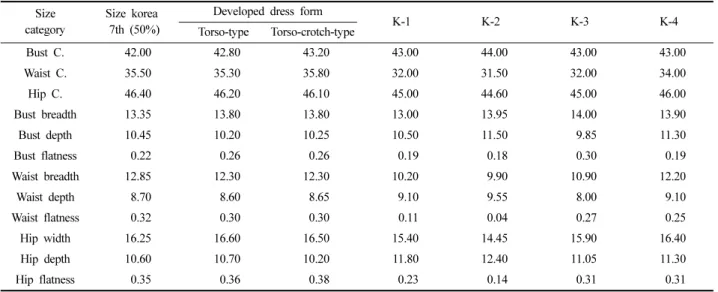
개발드레스폼과 시판드레스폼의 치수를 비교한 결과, 두드러 지게 차이를 보인 부분은 허리둘레였으며, 개발드레스폼의 경 우 사이즈코리아 7차 치수와 유사하게 제작 되었고, 시판드레 스폼은 대부분 허리둘레가 작게 제작되고 있었다. 구체적인 치 수를 살펴보면 K-4의 경우 1.5 cm, K-1, K-2, K-3의 경우는 2.5~4.0 cm 작게 제작되었음을 알 수 있었다(Table 9).
개발드레스폼과 시판드레스폼의 가슴, 허리, 엉덩이부위 편 평률을 비교해 본 결과는 Fig. 5와 같다. 드레스폼별로 가장 많은 차이를 보인 항목은 허리둘레 편평률과 엉덩이둘레 편평 Table 8. Silhouette overlap map of the developed dress form and the existing dress forms
K-1 K-2 K-3 K-4
Front
Side Fig. 3. Dress form cover pattern.
Fig. 4. The developed dress form Torso-type(L), Torso-crotch-type(R).
률 이였으며, 가슴둘레 편평률의 경우 개발드레스폼 2종(토르 소형, 토르소-크로치형)과 K-3가 0.25이상으로 다른 드레스폼과 비교해 크게 나타났고, 허리둘레 편평률의 경우 사이즈코리아 제 7차 자료, 개발드레스폼 2종(토르소형, 토르소-크로치형)이 0.30~0.35 범위를 보였고, K-3과 K-4의 경우 0.25~0.27, K-1, K-2가 0.11이하로 가장 낮은 편평률을 보였다. 엉덩이둘레 편 평률의 경우 사이즈코리아 제 7차 자료, 개발드레스폼 2종(토 르소형, 토르소-크로치형)이 0.35~0.41의 범위에서 생산되고 있 었고, K-3, K-4가 0.31의 편평률을 보였으며, K-1(0.23), K- 2(0.14)의 경우 다른 드레스폼과 비교하여 가장 낮은 편평률을 보였다. 전체적으로 보아 개발드레스폼(토르소형, 토르소-크로 치형)이 사이즈코리아 제 7차 자료와 근접한 편평률을 보이고 있었으며, K-1, K-2의 경우 다른 드레스폼과 비교해 가슴둘레, 허리둘레, 엉덩이둘레 모두 편평률이 낮게 나타나 단면의 형상 이 원형에 가까운 것을 알 수 있었으며, 20~24세 성인여성의 평균 체형 형태를 반영하고 있지 못함을 알 수 있었다.
4. 결 론
본 연구는 드레이핑을 위한 1/2 드레스폼 개발을 목표로 하
였으며 이를 위해 먼저, 국내 · 외 1/2 드레스폼 제품 생산 실태 를 조사하고, 가상 피팅 프로그램인 CLO 3D 이용하여 드레스 폼 형태를 모델링 한 후 3D 프린터를 활용하여 드레이핑이 가 능한 토르소형과 토르소-크로치형 드레스폼을 개발하였다. 개 발드레스폼의 적합성을 분석하기 위하여 사이즈코리아 제 7차 자료와 국내 4개 업체의 제품의 형태와 치수를 비교하였다. 연 구의 결과는 다음과 같다.
첫째, 국내 · 외 1/2 드레스폼 제품 생산 실태를 조사한 결과, 국내 제품의 경우 가슴둘레 43.0~44.0 cm, 허리둘레 31.5~
44.0 cm, 엉덩이둘레 44.5~46.0 cm 범위로 생산되고 있었으며, K- 1, K-2, K-3, K-4 제품이 사이즈코리아 제 7차 치수와 비교하 여 허리둘레의 치수가 작게 생산되고 있는 것을 알 수 있었다.
국외 제품의 경우 중국 제품은 가슴둘레 42.0 cm, 허리둘레 32.0 cm, 엉덩이둘레 45.0~49.0 cm 범위로 생산되고 있었으며, 대부분의 제품 치수가 비슷하였고, 일본 제품의 경우 가슴둘레 42.0~43.0 cm, 허리둘레 30.5~31.5 cm, 엉덩이둘레 46.0~
46.5 cm 범위로 생산되고 있었으며, 미국 제품(일본 성인여성 체형 반영)의 경우 가슴둘레 43.0 cm, 허리둘레 35.0 cm, 엉덩 이둘레 46.5 cm로 생산되고 있는 것을 알 수 있었다.
둘째, 1/2 드레스폼 제작을 위해 CLO 3D에서 사이즈코리아 7차 20~24세 성인여성의 평균치수를 이용하여 아바타를 제작 한 후, 아바타 파일을 토르소형, 토르소-크로치형 드레스폼의 형태로 모델링하였으며, 완성된 드레스폼 모델링 치수는 가슴둘 레 42.8 cm, 허리둘레 35.0 cm, 토르소형 엉덩이둘레 45.6 cm, 토르소-크로치형 엉덩이둘레 47.0 cm이다. 완성된 드레스폼 모 델링을 외부 커버 두께를 고려하여 2.24% 축소하여 3D 프린 팅 하였으며, 퀼팅솜, 광목을 이용하여 핀 작업이 가능한 드레 이핑용 드레스폼을 개발하였다.
셋째, 개발드레스폼과 국내 시판드레스폼의 형태를 비교한 결과, 앞면 중합도에서는 어깨경사, 허리너비, 헴라인 너비, 드 레스폼 길이에서 차이를 보였으며, 옆면 중합도에서는 상체 기
Table 9. Comparison of body size between developed and existing dress form (Unit : cm)
Size category
Size korea 7th (50%)
Developed dress form
K-1 K-2 K-3 K-4
Torso-type Torso-crotch-type
Bust C. 42.00 42.80 43.20 43.00 44.00 43.00 43.00
Waist C. 35.50 35.30 35.80 32.00 31.50 32.00 34.00
Hip C. 46.40 46.20 46.10 45.00 44.60 45.00 46.00
Bust breadth 13.35 13.80 13.80 13.00 13.95 14.00 13.90
Bust depth 10.45 10.20 10.25 10.50 11.50 9.85 11.30
Bust flatness 0.22 0.26 0.26 0.19 0.18 0.30 0.19
Waist breadth 12.85 12.30 12.30 10.20 9.90 10.90 12.20
Waist depth 8.70 8.60 8.65 9.10 9.55 8.00 9.10
Waist flatness 0.32 0.30 0.30 0.11 0.04 0.27 0.25
Hip width 16.25 16.60 16.50 15.40 14.45 15.90 16.40
Hip depth 10.60 10.70 10.20 11.80 12.40 11.05 11.30
Hip flatness 0.35 0.36 0.38 0.23 0.14 0.31 0.31
Fig. 5. The flatness of bust, waist, and hip circumference of developed and existing dress forms.
울기, 젖가슴아래-허리, 엉덩이-헴라인에서 차이를 보였다. 개발 드레스폼의 경우 허리 부위에서 앞면이 다른 드레스폼에 비해 두껍고, 옆면이 다른 드레스폼과 비슷하게 나타난 것을 보아 허 리둘레가 다른 드레스폼에 비해 편평하게 제작되었으며, 가슴 둘레 하컵의 형태와 엉덩이-헴라인의 형태가 인체의 형태와 유 사하게 제작되어 드레스 또는 언더웨어 패턴 제작 시 용이할 것으로 사료된다. 가슴둘레, 허리둘레, 엉덩이둘레 편평률의 경 우, 개발드레스폼(토르소형, 토르소-크로치형)이 사이즈코리아 7차와 유사하게 나타났고, K-1, K-2의 경우 다른 드레스폼에 비해 비교적 작게 나타나 단면의 형상이 원형에 가까운 것을 알 수 있었으며, 개발드레스폼이 20~24세 성인여성의 평균 체 형 형태를 가장 잘 반영하고 있음을 알 수 있었다.
본 연구의 제한점으로는 제품생산실태 조사에 사용된 드레 스폼 선정에 있어 온·오프라인 상에서 판매되고 있는 드레스폼 을 전수 조사한 것이 아닌 웹사이트에서 확인 가능한 제품을 조사하였으며, 개발드레스폼과의 비교제품 선정은 국내 시판드 레스폼을 대상으로 하였음을 밝힌다.
Reference
‘Alvanon’. (n. d.). Alvanon. Retrieved September 15, 2020, from https:/
/alvanon.com
‘Beifu form’. (n. d.). Beifu form. Retrieved September 15, 2020, from https://bit.ly/34lPXMK
‘BUNKA’. (n. d.). Bunka gakuen shop. Retrieved September 15, 2020, from https://www.bunka-koubai.com/
‘Cotton’. (n. d.). SUNQUILT. Retrived October 6, 2020, from https://
www.sunquilt.com/m/product/product_detail2.php?productID
=157315
‘Chinapnp3MP20’. (n. d.). Chinapnp3MP20. Retrieved September 15, 2020, from https://bit.ly/3jjPlO9
Chang, H. K. (2016). The need of draping dress forms for fashion design. Fashion Information and Technology, 13, 81-85.
Chang, H. K., & Shon, H. S. (2009). A comparative analysis of torso measurements and types of the chinese and korean women in their 20’s. Journal of Fashion Business, 13(2). 17-29.
Choi, S. H. (2020. February 10). Custom suits and clothing brand
‘Laviella’ Gwangju head office specializing in various designs.
Issue maker. Retrived September 23, 2020, From http://www.
issuemaker.kr/news/articleView.html?idxno=30552
Choi, Y. L., & Nam, Y. J. (2008). A study of methodology developing reconstructed body using styrofoam boards. Fashion & Textile Research Journal, 10(5), 713-720.
Do, W.H., & Choi, E. H. (2018). A study of senior men's dress form development 3d digital technology. Fashion & Textile Research Journal, 20(6), 722-732. doi:10.5805/SFTI.2018.20.6.722
Heo, Y. E. (2020. July 16). Dior 2020-21 F/W Otcouture completed in a 55cm miniature dress. Designpress. Retrived September 23, 2020, From https://m.blog.naver.com/designpress2016/222032458467
‘Hongduleimeng 1’. (n. d.). Hongduleimeng. Retrieved September 15, 2020, from https://bit.ly/3jtxVi8
‘Hongduleimeng 2’. (n. d.). Hongduleimeng. Retrieved September 15,
2020, from https://bit.ly/3jtxVi8
Im, S. (1994). A study of improving the human body for Koran women - Centering around body production. The Research Journal of the Costume Culture, 2(1), 29-38.
Kim, K. S., Nam, Y. J., & Han, H. S. (2016). A study on the automatic measurement of 3D body angle for apparel. Korea Society of Basic Design & Art, 17(5), 73-81.
Kim, S. A., & Choi, H. S. (2010). Development of dress forms for the aged women based on their body shapes applying 3D body scan data. The Research Journal of the Costume Culture, 18(1), 80-92.
Korean Agency for Technology and Standards. (2010). The 6th Size Korea 3D scan & measurement technology report. Seoul: Government Printing Office.
Korean Agency for Technology and Standards. (2015). The 7th Size Korea 3D scan & measurement technology report. Seoul: Government Printing Office.
‘Kokodp’. (n. d.). Kokodp. Retrieved September 15, 2020, From https:/
/bit.ly/30o6gHS
Lee, C. J. (2020, March 5). Patterns are classic, colours are lovely...2020 S/S keywords for women's wear. Sports kyunghyang. Retrieved September 23, 2020, From https://n.news.naver.com/article/144/
0000659998
Lee, Y. R., & Jang, J. A. (2019). Production condition of dress form for women's wear making. Fashion & Textile Research Journal, 21(4), 452-458. doi:10.5805/SFTI.2019.21.4.452
‘Madamade1’. (n. d.). Madamade. Retrieved September 15, 2020, from https://bit.ly/3l8j2Cc
‘Madamade2’. (n. d.). Madamade. Retrieved September 15, 2020, from https://bit.ly/3cVPzbN
‘New kypris’. (n. d.). kiiya. Retrieved September 15, 2020, from https:/
/www.kiiya.co.jp/shop/products/detail/29
Oh, S. Y. (2016) A study of making a dress form for women using a 3D printer. The Research Journal of the Costume Culture, 24(6), 725-742. doi:10.7741/rjcc.2016.24.6.725
‘PLA filament’. (n. d.). ICTkorea. Retrived October 6, 2020, from https://smartstore.naver.com/ink-sidae/profile?cp=1
Park, J. A. (2015). The analysis on the torso type dress form developed through the 3-D virtual body modeling of the korean female fashion models. Jounal of the Korean Society of Costume, 65(2), 157-175. doi:10.7233/jksc.2015.65.2.157
‘Qjanzi form’. (n. d.). Qjanzi form. Retrieved September 16, 2020, from https://bit.ly/2ES77cf
‘Quilting cotton’. (n. d.). 3 oz pincushion quilted cotton. Retrieved October 6, 2020, from https://bit.ly/33vEoCk
Shin, J. H., & Rha, S. I. (2003). An analysis of pattern-related works of designer's brand in Korea - For draping. The Research Journal of the Costume Culture, 11(2), 208-218.
‘Spur Style-G’. (n. d.). kiiya. Retrieved September 15, 2020, from https://www.kiiya.co.jp/shop/products/detail/56
‘Stealth delta 250’. (n. d.). S3D. Retrived October 6, 2020, from http:/
/s3d.co.kr/3d-printer-2/
Suh, D. A., & Oh, S. Y. (2012). Development of bodice dress forms by body types for women in thirties applying 3D body scan data.
The Korea Contents Society, 12(9), 136-145. doi:10.5392/
JKCA.2012.12.09.136
‘教学小人台’. (n. d.). 教学小人台. Retrieved September 16, 2020, from https://bit.ly/36pp7WK
‘去业版人台’. (n. d.). 去业版人台. Retrieved September 16, 2020, from https://bit.ly/33pKy8u
‘山木小人台’. (n. d.). 山木小人台. Retrieved September 16, 2020, from https://bit.ly/30uknLI
(Received 11 November, 2020; 1st Revised 30 November, 2020;
2nd Revised 16 December, 2020; Accepted 18 December, 2020)