Ann Hepatobiliary Pancreat Surg 2018;22:79-82
https://doi.org/10.14701/ahbps.2018.22.1.79
Case Report
Laparoscopic splenectomy for splenic rupture secondary to metastatic choriocarcinoma
Tan Ming Ngan Aloysius, and Vishalkumar G Shelat
Department of General Surgery, Tan Tock Seng Hospital, Singapore
Gestational choriocarcinoma is a rare and aggressive type of gestational trophoblastic neoplasia, which is characterized by early vascular invasion and widespread metastases. Choriocarcinoma metastasizes hematogenously, and bleeding from metastases is common. Splenic rupture from a metastatic tumour is exceedingly rare, with only a few reports.
We report a case of a 41-year-old female presenting with acute abdomen and haemorrhagic shock secondary to splenic rupture from metastatic choriocarcinoma, which was managed with emergency laparoscopic splenectomy. (Ann Hepatobiliary Pancreat Surg 2018;22:79-82)
Key Words: Choriocarcinoma; Laparoscopy; Splenic rupture
Received: May 10, 2017; Revised: August 1, 2017; Accepted: August 7, 2017 Corresponding author: Tan Ming Ngan Aloysius
Department of General Surgery, Tan Tock Seng Hospital, 11 Jalan Tan Tock Seng, Annex 1 Level 4, Singapore 308433 Tel: +65-635-77807, Fax: +65-635-77809, E-mail: [email protected]
Copyright Ⓒ 2018 by The Korean Association of Hepato-Biliary-Pancreatic Surgery
This is an Open Access article distributed under the terms of the Creative Commons Attribution Non-Commercial License (http://creativecommons.org/
licenses/by-nc/4.0) which permits unrestricted non-commercial use, distribution, and reproduction in any medium, provided the original work is properly cited.
Annals of Hepato-Biliary-Pancreatic Surgery ∙ pISSN: 2508-5778ㆍeISSN: 2508-5859
INTRODUCTION
Metastatic choriocarcinoma is an aggressive disease with a high mortality rate. Metastases from choriocarcino- ma are highly vascular and they present with bleeding in the affected area. However, splenic metastases are still very uncommonly observed. This patient presented with features suggestive of a ruptured ectopic pregnancy, ne- cessitating a diagnostic laparoscopy and washout. A com- puted tomography scan was performed only when she be- came haemodynamically unstable again, and it revealed ruptured splenic metastases with haemoperitoneum. This is a rare presentation of the disease that was managed suc- cessfully with a minimally invasive approach.
CASE
A 41-year-old lady presented with sudden onset lower abdominal pain. She had a single episode of vomiting.
There was no significant past medical history except for mild intermittent abdominal discomfort. She was married with two children and her last menstrual period was three weeks ago. She was afebrile with systolic blood pressure
of 120 mmHg and heart rate of 113 beats per minute. She appeared pale and lethargic. Her abdomen revealed gener- alised tenderness with guarding over the suprapubic region. A bedside ultrasound revealed free fluid in the abdomen. Blood tests revealed a hemoglobin level of 5.5 g/dl with a normal platelet count, renal function, liver function, amylase and coagulation screen. Her serum hu- man chorionic gonadotropin (hCG) level was 508,017 mIU/ml.
In view of the anemia, tachycardia, abdominal pain, free fluid and raised β-hCG, a ruptured ectopic pregnancy was suspected and an emergency diagnostic laparoscopy with evacuation of the uterus was planned. Intraoperatively, he- moperitoneum and a bleeding left corpus luteum cyst were evident. There was no ectopic pregnancy. Bilateral fallo- pian tubes appeared normal but were ligated as per the patient’s request. The uterus was evacuated and had mini- mal tissue. Postoperatively, her hemodynamic parameters did not return to normal, and hence, a computed tomog- raphy (CT) scan of the thorax, abdomen and pelvis was performed. It showed subcapsular lesions in the spleen with intraperitoneal rupture and hemoperitoneum. CT scan also revealed metastatic nodules in both lungs and liver.
80 Ann Hepatobiliary Pancreat Surg Vol. 22, No. 1, February 2018
Fig. 1. Splenectomy specimen showing splenic metastases with blood clot.
Fig. 2. Medium power view showing spleen affected by syn- cytiotrophoblasts and cytotrophoblasts suggestive of meta- static choriocarcinoma (Haematoxylin and Eosin stain, origi- nal magnification ×100).
Fig. 3. Endoscopic image showing duodenal lesion with intra luminal bleeding.
Pulmonary embolism was also noted in the right anterior segmental pulmonary artery. An emergency laparoscopic splenectomy was performed (Fig. 1). Histology confirmed splenic metastases secondary to choriocarcinoma (Fig. 2).
The tumour infiltrated through the splenic capsule, and im- munohistochemistry showed positive stains for cytokeratin (AE1/AE3), hCG and human placental lactogen.
Postoperative day 1 and day 3 drain amylase levels were normal and the abdominal drain was removed on the third day. She was stable and had an uneventful recovery until she suddenly developed melena on the fifth post-op- erative day. An urgent gastroscopy revealed bleeding from a tumour in the 3rd part of the duodenum, and endoscopic haemostasis was performed (Fig. 3). An urgent CT mesen- teric angiogram did not reveal any active bleeding or in- tra-abdominal collection. CT scan showed a new enhancing mass in the duodenum, proximal jejunum, multiple new liver and lung lesions and right portal vein thrombosis. She
was stabilised and transferred to the gynecology-oncology unit for emergency systemic chemotherapy. Her future clinical course was complicated by intraabdominal and in- tracranial bleeds. Aggressive interventions including mul- tiple endoscopies and CT angioembolization, two ex- ploratory laparotomies including jejunal segmental re- section and craniotomy for clot evacuation could not save her.
Ethics Committee approval was not required as the case report included only one case, without any patient identifiers. Informed consent was obtained from the patient.
DISCUSSION
Choriocarcinoma is gestational trophoblastic neoplasia (GTN) following either a hydatidiform mole or a non-mo- lar pregnancy. It is the most aggressive form of GTN and is associated with a high mortality rate.1 Risk factors in- clude previous molar pregnancy, maternal age more than 40 years and Asian/African descent.1 The incidence of GTN is 5-15% for hydatidiform mole and 5 to 200 per 100,000 normal non-molar pregnancies.2 Choriocarcinoma is associated with early vascular invasion and widespread metastases. Choriocarcinoma frequently metastasizes to the lungs, vagina, central nervous system, liver, kidney, gastrointestinal tract and spleen. The vascular nature of metastatic lesions is due to the angiogenesis stimulated by localised high levels of hCG.3 GTN should be suspected
Tan Ming Ngan Aloysius and Vishalkumar G Shelat. Splenic rupture from choriocarcinoma: report of a case 81
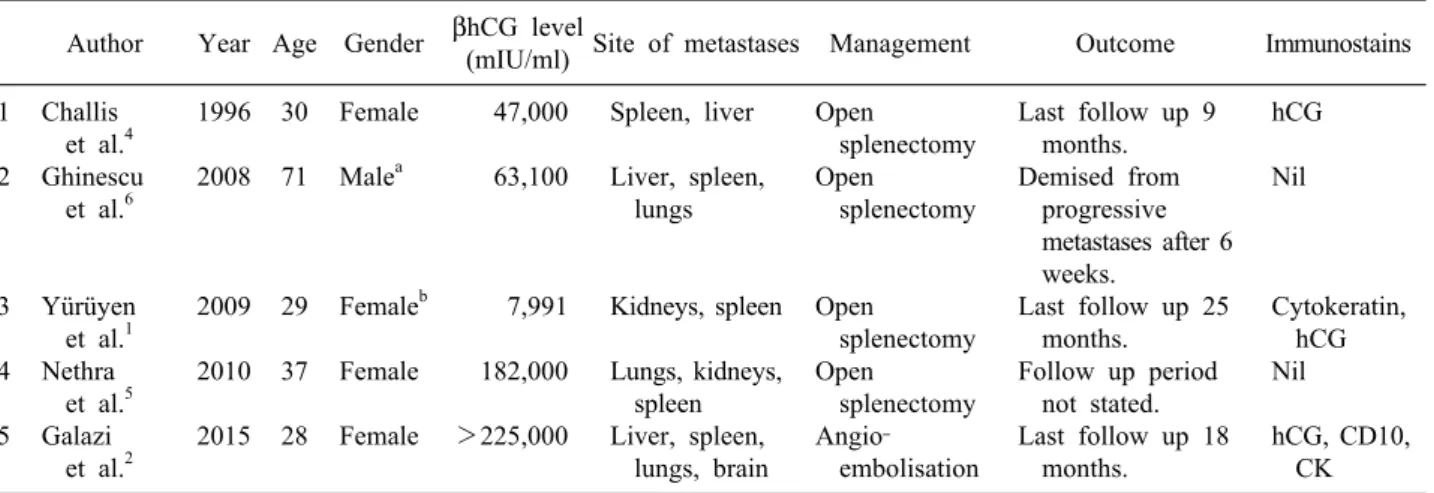
Table 1. Summary of case reports of ruptured splenic metastases secondary to choriocarcinoma Author Year Age Gender βhCG level
(mIU/ml) Site of metastases Management Outcome Immunostains 1
2
3 4 5
Challis et al.4 Ghinescu
et al.6
Yürüyen et al.1 Nethra
et al.5 Galazi
et al.2
1996 2008
2009 2010 2015
30 71
29 37 28
Female Malea
Femaleb Female Female
47,000 63,100
7,991 182,000
>225,000
Spleen, liver Liver, spleen,
lungs
Kidneys, spleen Lungs, kidneys,
spleen Liver, spleen,
lungs, brain
Open splenectomy Open
splenectomy
Open splenectomy Open
splenectomy Angio‐
embolisation
Last follow up 9 months.
Demised from progressive metastases after 6 weeks.
Last follow up 25 months.
Follow up period not stated.
Last follow up 18 months.
hCG Nil
Cytokeratin, hCG Nil
hCG, CD10, CK
aOrigin from the testis, brecent in vitro fertilization
in patients with a larger than gestational age uterus size and hCG level >100,000 mIU/ml. Once GTN is sus- pected, a staging CT scan should be performed to look for metastatic lesions. A uterine curettage can be per- formed for histology. Biopsy of metastatic lesions is asso- ciated with a risk of bleeding and is not advised.
Chemotherapy is the mainstay of treatment with cure rates in excess of 90%.2 The FIGO (The International Federation of Gynecology and Obstetrics): WHO (World Health Organisation) classification is a combination of staging and risk score assigned to predict the potential for devel- oping chemoresistance. According to this classification, our patient would have had a Stage IV:13 choriocarcino- ma, predicting a high risk for chemoresistance and mortality.
The spleen is an infrequent site of secondary visceral metastases and an uncommon site of metastatic choriocarcinoma. Spontaneous rupture of splenic meta- stases with hemoperitoneum is rare and there are only five case reports.1,2,4-6 Table 1 provides a summary of all five case reports. All patients presented with abdominal pain, and only one patient had per vaginal bleeding.5 Four pa- tients achieved remission after chemotherapy. One patient died due to progression of the disease,6 as he could not tolerate chemotherapy due to his poor physical condition.
This patient was similar to our patient as she also was unable to tolerate chemotherapy due to her poor clinical condition after recurrent intra-abdominal and intracranial bleeding, thus illustrating the poor prognosis for such pa- tients who cannot be stabilised adequately for initiating
chemotherapy. In general, splenic rupture commonly oc- curs due to blunt splenic injury and non-operative man- agement is widely established as a therapeutic choice. In patients with splenic rupture due to metastatic lesions, splenectomy not only cures the patient, but it also reduces future risk of rupture and establishes the histological diagnosis. Galazi et al.2 reported successful trans-catheter embolization for bleeding splenic metastasis from chorio- carcinoma in a patient undergoing chemotherapy but the patient experienced persistent intraperitoneal hemorrhage.
In patients with spontaneous splenic rupture with hemo- peritoneum in a background of metastatic disease, sple- nectomy is undisputed.7 In a stable patient, if expertise is available, minimal access surgery can potentially improve short term outcomes.8 As we had expertise available9,10 for laparoscopic elective and acute care surgery, we per- formed a laparoscopic splenectomy successfully in this patient.
Choriocarcinoma with splenic metastases presenting with hemoperitoneum and haemorrhagic shock is rare.
Spontaneous splenic rupture secondary to metastatic dis- ease is a rare surgical oncologic emergency and splenec- tomy is indicated. This is the first reported case of suc- cessful management with emergency laparoscopic sple- nectomy for metastatic choriocarcinoma.
ACKNOWLEDGEMENTS
We would like to thank Dr Chuah Khoon Leong from the Department of Pathology (Tan Tock Seng Hospital,
82 Ann Hepatobiliary Pancreat Surg Vol. 22, No. 1, February 2018
Singapore) for his contribution of the pathology slide and report for this case.
REFERENCES
1. Yürüyen M, Yildiz O, Papila C, Tuzuner N. Gestational chorio- carcinoma diagnosed with spontaneous splenic rupture after pregnancy induced by in vitro fertilization: a case report. Cases J 2009;2:7518.
2. Galazi M, Tait P, Seckl M, Savage P. Successful embolization of a life threatening bleeding splenic metastasis in a patient with gestational choriocarcinoma. Clin Obstet Gynecol Reprod Med 2015;1:16-18.
3. Lam KY, Tang V. Metastatic tumors to the spleen: a 25-year clinicopathologic study. Arch Pathol Lab Med 2000;124:526-530.
4. Challis DE, Rew KJ, Steigrad SJ. Choriocarcinoma complicated by splenic rupture: an unusual presentation. J Obstet Gynaecol
Res 1996;22:395-400.
5. Nethra S, Hawe J, Elder J. Splenic rupture: a rare presentation of metastatic choriocarcinoma. Gynecol Surg 2011;8:435-437.
6. Ghinescu C, Sallami Z, Jackson D. Choriocarcinoma of the spleen--a rare cause of atraumatic rupture. Ann R Coll Surg Engl 2008;90:W12-W14.
7. Shelat VG, Tan EK, Teo LT, Vijayan A, Chiu MT. Outcomes of non-operative management of blunt splenic injury - An Asian experience. Int Surg 2015;100:1281-1286.
8. Musallam KM, Khalife M, Sfeir PM, Faraj W, Safadi B, Abi Saad GS, et al. Postoperative outcomes after laparoscopic sple- nectomy compared with open splenectomy. Ann Surg 2013;257:
1116-1123.
9. Shelat VG, Chan CY, Liau KH, Ho CK. Laparoscopic explora- tion can salvage failed endoscopic bile duct stone extraction.
Singapore Med J 2012;53:313-317.
10. Shelat VG, Serin K, Samim M, Besselink MG, Al Saati H, Gioia PD, et al. Outcomes of repeat laparoscopic liver resection com- pared to the primary resection. World J Surg 2014;38:3175-3180.