Vitamin D and Hypertension
Hye Yun Jeong1, Kyung Mi Park1, Mi Jung Lee1, Dong Ho Yang1, Sang Hoon Kim2, So-Young Lee1
1Division of Nephrology, 2Division of Cardiology, Department of Internal Medicine, CHA Bundang Medical Center, CHA University, Seongnam, Korea
Received: April 4, 2017 Accepted: April 11, 2017
Corresponding Author: So-Young Lee, M.D., Ph.D., Division of Nephrology, Department of Internal Medicine CHA University School of Medicine, CHA Bundang Medical Center, 59 Yatap-ro, Bundang-gu, Seongnam-si 13496, Korea
Tel: +82-31-780-5025, Fax: +82-31-780-5219 E-mail: [email protected]
Vitamin D has the pleiotropic effects in multiple organ systems, and vitamin D deficiency was suggested to be associated with high blood pressure accord- ing to previous reports. Several interventional studies have examined the effect of vitamin D supplementation on high blood pressure patients, but the results have been inconsistent. In this article, we examined the literature that have proposed a mechanism involving vitamin D in the regulation of blood pressure and review previous observational and interventional studies that have shown the relationship between vitamin D and hypertension among various popula- tions.
Key Words: Hypertension, Mechanism, Physiology, Supplement, Vitamin D This is an Open Access article distributed under the terms of the Creative Commons Attribution Non-Commercial License(http://creativecommons.org/licenses/by-nc/4.0/) which permits unrestricted non-commercial use, distribution, and reproduction in any medium, provided the original work is properly cited.
Introduction
Primarily, vitamin D is known as a group of fat-soluble steroids and responsible for prevention of rickets or oste- omalacia through increasing intestinal absorption of cal- cium, iron, magnesium, phosphate, and zinc1). However, there has been a significant improvement in our under- standing of the pleiotropic effects of vitamin D in multi- ple organ systems besides skeletal homeostasis in recent years2). Indeed, receptors for 1, 25-dihydroxyvitamin D, which is the active form of vitamin D have been identified in most human tissues2).
Hypertension, also known as raised blood pressure, is a very common chronic disease and considered as a silent killer because it rarely causes symptoms3). Interestingly, many animal model and observational studies suggested that the vitamin D deficiency closely correlated with car- diovascular disease, especially hypertension4-9). Moreover, several interventional studies examined the effect of vita- min D supplementation on high blood pressure in pa- tients although the results were inconsistent4,10-45).
Generally, older age, lower incomes and higher body mass index are proposed as the associated factors with the risk of hypertension46). Accordingly, people having high blood pressure would increase in the condition of population ageing and prevalent westernized diet in Korean society46). Therefore, it is very important to look into the evidences and results about vitamin D in regards with its roles in controlling blood pressure at this point.
In this article, we examine the literatures that proposed mechanism of vitamin D on the regulation of blood pres- sure and review previous observational and interventional studies showing the relationship between vitamin D and hypertension among various populations.
The Physiology of Vitamin D
There are two important compounds among the vitamin D groups in humans, which are vitamin D3 (also known as cholecalciferol) and vitamin D2 (ergocalciferol)1). Cho- lecalciferol and ergocalciferol are found in few types of foods, so sunlight exposure is the main source of vitamin D for humans, other than supplements1,2,47,48). Solar ultra-
violet B radiation (wavelength, 290 to 315 nm) penetrates the skin and converts 7-dehydrocholesterol to previtamin D3, which is spontaneously isomerized into vitamin D3 (cholecalciferol). Vitamin D from photosynthesis or food ingestion is metabolized in the liver to 25-hydroxyvitamin and subsequently hydroxylated in the renal proximal tu- bules by the enzyme 1α-hydroxylase to 1, 25-dihydroxy- vitamin D(1,25 (OH)2D, calcitriol), the biologically active form. 1,25 (OH)2D promotes intestinal calcium absorp- tion2). When vitamin D deficiency decreases the absorp- tion of dietary calcium and phosphorus, the level of para- thyroid hormone (PTH) increases2,49-51). Sufficient vitamin D stimulates calcium and phosphorus absorption by 30- 40% and 80% respectively. Without vitamin D, no more than 10-15% of dietary calcium and approximately 60%
of phosphorus are absorbed49,52).
Vitamin D-Binding proteins (DBP) are synthesized in hepatocytes and helps vitamin D to transport to target organs. Because DBP is the primary transporter of vita- min D and its metabolites, it has a role in maintaining the total levels of vitamin D for the organism and in regu- lating the amounts of free vitamin D available for specific tissues and cell types to utilize53). DBP linked vitamin D is actively transported by megalin mediated endocytosis in the various target cells54), and intracellular vitamin D binding proteins (IDBPs) help to regulate the intracellular metabolism of vitamin D thereafter55).
The renal production of 1,25 (OH)2D is tightly regu- lated by 1, 25-dihydroxyvitamin D itself, plasma PTH levels as a signal of calcium homeostasis, and fibroblast growth factor 23 (FGF 23) as a signal of phosphate sta- tus56,57). Free 1,25 (OH)2D can form a complex with vita- min D receptor, the VDR, and reduce transcription of CYP27B1 (1α-hydroxylase)58). PTH is a hormone secreted by the parathyroid glands which regulates serum calcium through its effects on bone, kidney, and the intestine59). When the level of serum calcium decrease, the production of PTH in parathyroid gland increase and lead to calcium resorption from bone and the renal tubular fluid60,61). In addition, PTH up-regulates 1α-hydroxylase enzyme, which converts inactive vitamin D into 1,25 (OH)2D60). FGF 23
is secreted by osteocytes in response to elevated 1,25 (OH) 2D and increased plasma levels of phosphorous62). FGF23 has three types of effect. First, FGF23 impairs sodium- phosphate cotransporters on the kidneys and small intes- tines, through internalization of the transporters by the cells and consequently, phosphate loss occurs62). FGF23 also inhibits production of 1,25 (OH)2D and promotes breakdown of 1,25 (OH)2D2,57). Lastly, FGF 23 Inhibits production and secretion of parathyroid62). All three roles of FGF 23 contribute to decrease lowering the level of serum phosphate.
The Mechanisms of Vitamin D in Regulation of Blood Pressure
Vitamin D receptor (VDR) is present in thirty-six tissues and also at least 10 tissues possess 1α-hydroxlyase besides the renal proximal tubule47). These facts mean the cells in various tissues need vitamin D during their biological actions63). Several mechanisms have been suggested to be involved in the pathogenesis of hypertension64,65).
Inappropriate activation of renin-angiotensin-aldoster- one system (RAAS) has been widely known as the impor- tant factor contributing to the development of hyperten- sion66). For that reason, blockers of the RAAS, such as renin inhibitors, angiotensin-converting enzyme inhibi- tors, angiotensin II type 1 receptor antagonists, and mine- ralocorticoid receptor antagonist are very important drugs in the treatment of hypertension66). Surprisingly, vitamin D, the sunshine hormone was shown to regulate the RAAS at the clinical, pathophysiological and molecular levels in animals and human studies67,68).
The first epidemiological studies proposed an inverse correlation between vitamin D and renin levels were publi- shed more than two decades ago69). Recently, this rela- tionship was confirmed in 184 normotensive individuals by Forman et al.67). They reported that the individuals with suboptimal vitamin D levels had higher circulating angiotensin II levels and blunted renal plasma flow respon- ses to infused angiotensin II suggesting activation of the RAAS in the setting of lower plasma 25 (OH)D67). Li et
al. documented that absence of vitamin D signaling caused an increase in renin gene expression and plasma angiotensin II in mice lacking the VDR70). Consequently, VDR null mice showed high blood pressure, cardiac hy- pertrophy and increased water intake70). Likewise, other animal study using mice lacking 1-α hydroxylase showed similar phenotypes with VDR null mice71). That suppre- ssive action of vitamin D on renin was independent of extracellular calcium or phosphorus70,71). Mechanistic study using the mouse Ren-1c gene promoter indicated that 1,25(OH)2D3 binds to the VDR, and subsequently liganded VDR blocks formation of the cAMP-response element-binding protein complexes in the promoter region of the renin gene, leading to down-regulation of gene expression72).
Immunologic basis is also mediated with common hy- pertension and recent studies have strengthened the con- cept73-75). In the experimental studies using mice which lack T or B cells, the degree of hypertension induced by angiotensin II or norepinephrine infusion was markedly blunted74,75). Moreover, cytokines released from T cells and other inflammatory cells may be connected with the development of prominent hypertension73). Actually, eta- nercept, the TNFα antagonist has been shown to have effects on relieving hypertension in the mice fed on fruc- tose76). Interleukins such as IL-6, IL-17, and IL 10 were also reported as involved in hypertension in several stud- ies77-79). Intriguingly, immune cells including macropha- ges, T and B cells are known to have VDRs and several studies have confirmed that vitamin D plays a crucial role in modulating innate and adaptive immune response in various disease47,80). Vitamin D acts to modulate toll like receptor (TLR) signaling, which results in reduces the gene expression and protein release of proinflammatory medi- ators, such as TNFα, IL-6, and MCP-180). From these perspectives, it sounds plausible that anti-inflammatory effects of vitamin D could mitigate the development of hypertension.
Endothelial cells were reported to contain VDRs, and vitamin D supplement has been shown to improve endo- thelial functions in previous reports15,81). Sugden JA et al.
examined whether vitamin D2 can improve endothelial function in type 2 diabetes patients with low serum 25(OH)D level15). They found that a single dose supple- ment of 100,000U ergocalciferol (vitamin D2) signifi- cantly improved flow mediated vasodilation (FMD) of the brachial artery by 2.3% and decreased systolic blood pre- ssure by 14 mmHg compared with placebo15). In another study, FMD measurements were significantly lower in the asymptomatic people with vitamin D deficiency but it in- creased after three month-replacement of vitamin D381). The patients with chronic kidney disease (CKD) are re- ported to have a high prevalence of vitamin D deficiency due to loss of vitamin D binding proteins in the urine, ineffective vitamin D photosynthesis in the skin, low level of 1α-hydroxylase activity, elevated FGF23 levels, and malnutrition etc.82,83). Several observational studies identi- fied positive relationship between the level of 25(OH)D and FMD in CKD patients84,85). Additionally, animal study found that absence of vitamin D activities caused reduced expression of endothelial nitric oxide synthase resulting in increased arterial stiffness86).
The Effects of Vitamin D Supplement on Hypertension
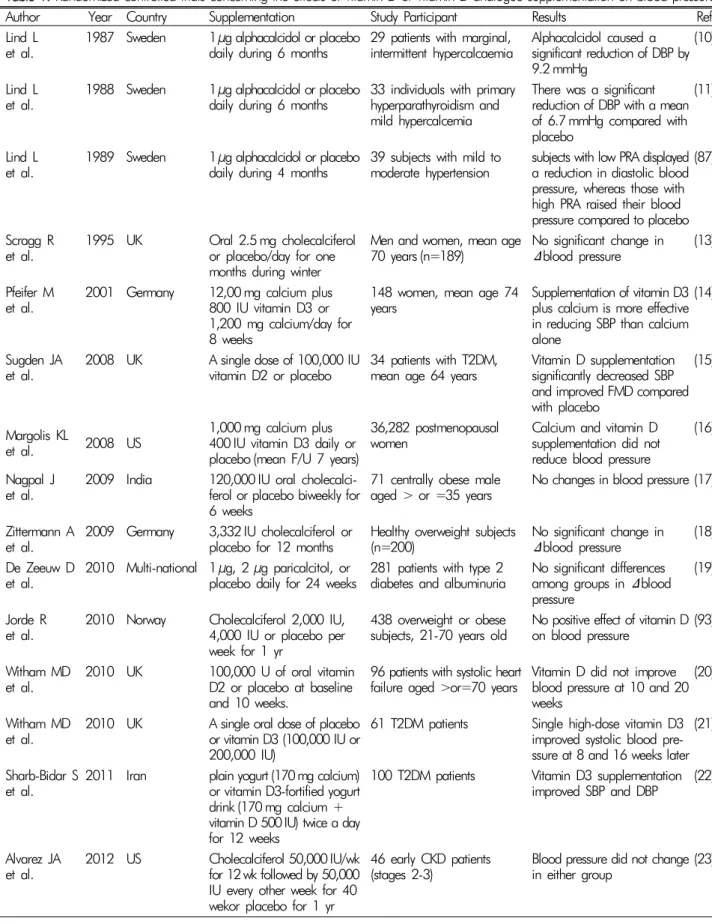
Although lots of interventional studies have been con- ducted to date, the effect of vitamin D supplement on blood pressure lowering in human is still controver- sial4,10-45)(Table 1).
Lind L et al. showed reduction of diastolic blood pres- sure by treatment of 1 μg alphacalcidol, a synthetic ana- logue of active vitamin D during a six-month, double- blind, placebo-controlled trials in the subjects with hyper- calcemia (n=29) or primary hyperparathyroidism (n=33) in the late 1900s10,11). However, they failed to prove the effect of alphacalcidol on hypertension in the subjects with impaired glucose tolerance (n=16) around the same time87). In 1998, Krause R et al. reported that short term ultraviolet B exposure had an effect on blood pressure lowering in patients with untreated mild hypertension with increase of plasma 25(OH)D concentration88).
Table 1. Randomized controlled trials concerning the effects of vitamin D or vitamin D analogue supplementation on blood pressure
Author Year Country Supplementation Study Participant Results Ref
Lind L
et al. 1987 Sweden 1μg alphacalcidol or placebo
daily during 6 months 29 patients with marginal,
intermittent hypercalcaemia Alphacalcidol caused a significant reduction of DBP by 9.2 mmHg
(10)
Lind L
et al. 1988 Sweden 1μg alphacalcidol or placebo
daily during 6 months 33 individuals with primary hyperparathyroidism and mild hypercalcemia
There was a significant reduction of DBP with a mean of 6.7 mmHg compared with placebo
(11)
Lind L
et al. 1989 Sweden 1μg alphacalcidol or placebo
daily during 4 months 39 subjects with mild to
moderate hypertension subjects with low PRA displayed a reduction in diastolic blood pressure, whereas those with high PRA raised their blood pressure compared to placebo
(87)
Scragg R
et al. 1995 UK Oral 2.5 mg cholecalciferol or placebo/day for one months during winter
Men and women, mean age
70 years (n=189) No significant change in Δblood pressure (13) Pfeifer M
et al. 2001 Germany 12,00 mg calcium plus 800 IU vitamin D3 or 1,200 mg calcium/day for 8 weeks
148 women, mean age 74
years Supplementation of vitamin D3 plus calcium is more effective in reducing SBP than calcium alone
(14)
Sugden JA
et al. 2008 UK A single dose of 100,000 IU
vitamin D2 or placebo 34 patients with T2DM,
mean age 64 years Vitamin D supplementation significantly decreased SBP and improved FMD compared with placebo
(15)
Margolis KL
et al. 2008 US 1,000 mg calcium plus 400 IU vitamin D3 daily or placebo (mean F/U 7 years)
36,282 postmenopausal
women Calcium and vitamin D
supplementation did not reduce blood pressure
(16)
Nagpal J
et al. 2009 India 120,000 IU oral cholecalci- ferol or placebo biweekly for 6 weeks
71 centrally obese male
aged > or =35 years No changes in blood pressure (17) Zittermann A
et al. 2009 Germany 3,332 IU cholecalciferol or
placebo for 12 months Healthy overweight subjects
(n=200) No significant change in Δblood pressure (18) De Zeeuw D
et al. 2010 Multi-national 1 μg, 2 μg paricalcitol, or
placebo daily for 24 weeks 281 patients with type 2
diabetes and albuminuria No significant differences among groups in Δblood pressure
(19)
Jorde R
et al. 2010 Norway Cholecalciferol 2,000 IU, 4,000 IU or placebo per week for 1 yr
438 overweight or obese
subjects, 21-70 years old No positive effect of vitamin D on blood pressure (93) Witham MD
et al. 2010 UK 100,000 U of oral vitamin D2 or placebo at baseline and 10 weeks.
96 patients with systolic heart
failure aged >or=70 years Vitamin D did not improve blood pressure at 10 and 20 weeks
(20)
Witham MD
et al. 2010 UK A single oral dose of placebo or vitamin D3 (100,000 IU or 200,000 IU)
61 T2DM patients Single high-dose vitamin D3 improved systolic blood pre- ssure at 8 and 16 weeks later
(21)
Sharb-Bidar S
et al. 2011 Iran plain yogurt (170mg calcium) or vitamin D3-fortified yogurt drink (170 mg calcium + vitamin D 500IU) twice a day for 12 weeks
100 T2DM patients Vitamin D3 supplementation improved SBP and DBP (22)
Alvarez JA
et al. 2012 US Cholecalciferol 50,000 IU/wk for 12wk followed by 50,000 IU every other week for 40 wekor placebo for 1 yr
46 early CKD patients
(stages 2-3) Blood pressure did not change in either group (23)
(Countinue)
Author Year Country Supplementation Study Participant Results Ref
Gepner AD
et al. 2012 US Vitamin D3 2,500 IU or
placebo, daily for 4 months 114 post-menopausal women Vitamin D supplementation did not reduce blood pressure(24) Hershmat R
et al. 2012 Iran single 300,000 IU of vitamin
D3 or placebo injection (IM) 42 T2DM patients No significant differences among groups in Δblood pressure after 3 months of study
(25)
Muldowney S
et al. 2012 Ireland Incremental vitamin D3 up to 600 IU or placebo daily during wintertime
394 adults in the south and
north of Ireland There were no significant effects of supplementation on blood pressure
(26)
Salehpour A
et al. 2012 Iran Cholecalciferol 25 μg or the
placebo daily for 12 weeks 77 healthy premenopausal
overweight and obese women No significant effect on blood pressure (27) Stricker H
et al. 2012 Switzerland A single, oral, high-dose vitamin D supplementation(100,000IU cholecalciferol) or placebo
62 patients with PAD and
vitamin D deficiency No significant effect on blood pressure (28) Witham MD
et al. 2012 UK 100,000 IU vitamin D2 or
placebo 58 patients with a history of
stroke and low 25(OH)D High dose oral vitamin D supplementation did not improve blood pressure
(29)
Wood AD
et al. 2012 UK Oral 400, 1,000IU vitamin D3
or placebo per day for I year 265 healthy postmenopausal
women aged 60-70 years No effect on blood pressure (30) Breslavsky
et al. 2013 Israel 1,000IU vitamin D3 or placebo
weekly for 1 year 47 T2DM patients Blood pressure did not differ significantly between the groups
(31)
Chai W
et al. 2013 US Placebo, calcium 2 g, vitamin D3 800 IU, or calcium 2g plus vitamin D3 800 IU daily for 6 months
92 colorectal adenoma
patients No significant differences between groups on blood pressure
(32)
Forman JP
et al. 2013 US Placebo, 1,000, 2,000, or 4,000 IU vitamin D3 daily for 3 months
280 black adults Vitamin D(3) supplementa- tion significantly lowered SBP(33) Larsen T
et al. 2013 Denmark Oral paricalcitol 2 μg or
placebo daily for 6 weeks 26 patients with non diabetic
albuminuric stage III-IV CKD Ambulatory BP was not affected by paricalcitol (34) Toxqui L
et al. 2013 Spain Vitamin D3 200 IU/day or
placebo for 16 weeks 109 Young women SBP and DBP were reduced in vitamin D (3) group (35) Wamberg L
et al. 2013 Denmark Vitamin D(3) 7,000 IU daily or
placebo for 26 weeks 52 obese adults (BMI>30 kg/m2) with plasma 25 (OH)D <50 nmol/L
Treatment did not affect blood pressure (36) Witham MD
et al. 2013 UK 100,000 U vitamin D3 or placebo every 3 months for 1 year
159 elderly patients (≥70 years) with isolated systolic hypertension and low 25(OH)D levels (<30 ng/mL)
No improvement of blood
pressure (94)
Witham MD
et al. 2013 UK A single dose of 100,000 IU
vitamin D3 or placebo 50 healthy South Asian
women No improvement of blood
pressure at 4 and 8 weeks (37) Witham MD
et al. 2013 UK 100,000 IU vitamin D3 or placebo at baseline, 2 months and 4 months
75 patiehts with a history of
myocardial infarction SBP and DBP showed no between-group difference at 6 months
(38)
Yiu YF
et al. 2013 Hong Kong 5,000 IU vitamin D3 or
placebo daily for 12 weeks 100 T2DM patients No effect on blood pressure (39) Dalbeni A
et al. 2014 Italy 4,000 IU vitamin D3 or
placebo daily for 6 months 23 elderly patients with heart failure and low 25(OH)D (<30 ng/mL)
SBP was lower after 6 months of vitamin D group (from 129.6 to 122.7 mmHg, p <
0.05)
(40)
(Countinue)
Author Year Country Supplementation Study Participant Results Ref
Scragg R
et al. 2014 New Zealand 200,000 IU vitamin D3 or
placebo monthly for 18 months 322 healthy adults (European
ancestry 94%) No effect on blood pressure in white healthy adults (41) Strobel F
et al. 2014 Germany 1,904IU vitamin D3 or placebo
as a daily dose for 6 months 82 T2DM patients No effect on blood pressure (42) Sollid St
et al. 2014 Norway 20,000 IU/week vitamin D3 or
placebo for 1 yr 511 individuals with IFG
and/or IGT No differences in blood pressure between groups (43) Wang
et al. 2014 Hong Kong Oral paricalcitol 1 μg or
placebo daily for 52 weeks 60 patients with CKD III-V By 52 weeks, SBP reduced by
− 4.49 mmHg in the paricalcitol group versus
− 3.03 mmHg in the placebo group.
(44)
Witham MD
et al. 2014 UK 100,000 IU vitamin D3 or placebo every 2 months for 6 months
68 patients with resistant
hypertension Vitamin D3 did not reduce blood pressure (45) Abbreviations: CKD, chronic kidney disease; DBP, diastolic blood pressure; FMD, flow mediated dilatation; GDM, gestational diabetic mellitus; IFG, impaired fasting glucose; IGT, impaired glucose tolerance; PAD, peripheral artery disease; PRA, plasma renin activity; RCT, randomized controlled trial; SBP, systolic blood pressure; T2DM, type 2 diabetes mellitus.
In several studies, a single high dose of active vitamin D (100,000 IU) showed improvement in SBP among type 2 diabetes patients15,21). On the other hands, the highest single dose of vitamin D3 (300,000 IU) did not reduce blood pressure in the patients with type 2 diabetes25). Daily supplementation of vitamin D3 (1,000-5,000 IU) have failed to prove the effect on blood pressure31,39,42). However, Sharb-Bidar S et al. reported that combination of vitamin D3 plus calcium supplementation had an effect on SBP and DBP in 100 patients with type 2 diabetes22).
Eight week vitamin D3 plus calcium improved blood pressure in elderly women14). However, the Women’s Health Initiative Calcium/Vitamin D Trial16) which was a randomized double blind fashion and conducted in 36,282 postmenopausal women showed vitamin D3 (400 IU) plus calcium(1,000 mg) daily supplementation was in- effective on either decrease of blood pressure or the risk of developing hypertension over a median follow-up time of 7 years.
It is possible that vitamin D could lower BP in other specific race/ethnic groups. Skin color is a factor of circu- lating levels of 25(OH)D, and African-Americans are ge- nerally known to have significantly higher rates of hyper- tension than whites33). Forman JP reported that SBP was reduced after the supplementation of vitamin D3 for 3
months compared to placebo in normotensive African- Americans33). Interestingly, the more SBP lowering was ob- served in the individuals with low vitamin D levels (<20 nM/mL). In comparison, Scragg R et al. found no effe- cts of high dose vitamin D3 during 18 months on blood pressure control in healthy adults who were predominantly Whites41). However, other short-term studies of nonwhite populations failed to prove the effect of vitamin D on BP, although this could be a result of their low statistical power because of their small sample sizes (n≤100)17,89,90).
Recently, several meta-analysis were reported about the effect of vitamin D supplementation on hyperten- sion64,65,91). In a meta-analysis by Wu including four dou- ble-blind randomized controlled trials (RCTs) of oral vita- min D supplementation in normotensive or hypertensive individuals (429 participants), vitamin D significantly de- creased SBP by 2.44 mmHg but not DBP91). They also suggested that the change of blood pressure was not in- fluenced due to the dose of vitamin D supplementation, study length, or additional calcium supplementation in subgroup analysis91). However, other meta-analyses indi- cated that vitamin D supplementation was not beneficial for blood pressure control64,65,92). Kunter SK et al. exami- ned 16 RCTs of oral vitamin D (vitamin D2 or D3) and concluded that there was no significant effect of vitamin
D on blood pressure lowering92). Meanwhile, subgroup analysis showed significant reduction in DBP among the participants with cardiometabolic disease87). Beveridge KA et al. included 46 RCTs (4,541 participants) in the trial-level meta-analysis and individual data from 27 RCTs (3,092 participants) that used active or inactive forms of vitamin D or vitamin D analogues for more than 4 weeks64). No effect of vitamin D treatment on BP was observed at the trial level and individual data64). Total 917 individuals from eight RCTs using active vitamin D for more than 3 months were analyzed by Qi D et al.65). Their meta-analysis found a slight but not significant re- duction on blood pressure65).
Conclusion
To date, the results of RCTs and meta-analysis of them do not support the use of vitamin D or its analogues as an individual patient treatment for hypertension or as a population-level intervention to lower BP. Those discrep- ancies might be due to heterogeneity of patient baseline characteristics, differences in sample size and follow-up periods, and different vitamin D doses. However, many experimental and epidemiologic studies showed possible roles of vitamin D in controlling BP in various ways64,65). Further RCTs are required to confirm the real effect of vitamin D on blood pressure reduction and define the optimum dose, dosing interval, and type of vitamin D to administer.
Acknowledgements
All the authors declare no conflicts of interest.
References
1. Holick MF: High prevalence of vitamin D inadequacy and implications for health. Mayo Clin Proc 81:353-373, 2006
2. Holick MF: Vitamin D deficiency. N Engl J Med 357:
266-281, 2007
3. Lackland DT, Weber MA: Global burden of cardiovas-
cular disease and stroke: hypertension at the core. Can J Cardiol 31:569-571, 2015
4. Forman JP, Giovannucci E, Holmes MD, et al.: Plasma 25-hydroxyvitamin D levels and risk of incident hyper- tension. Hypertension 49:1063-1069, 2007
5. Wang TJ, Pencina MJ, Booth SL, et al.: Vitamin D defi- ciency and risk of cardiovascular disease. Circulation 117:
503-511, 2008
6. Forman JP, Curhan GC, Taylor EN: Plasma 25-hydroxy- vitamin D levels and risk of incident hypertension among young women. Hypertension 52:828-832, 2008 7. Judd SE, Nanes MS, Ziegler TR, Wilson PW, Tangpricha
V: Optimal vitamin D status attenuates the age-associated increase in systolic blood pressure in white Americans:
results from the third National Health and Nutrition Examination Survey. Am J Clin Nutr 87:136-141, 2008 8. Scragg R, Sowers M, Bell C: Serum 25-hydroxyvitamin
D, ethnicity, and blood pressure in the Third National Health and Nutrition Examination Survey. Am J Hyper- tens 20:713-719, 2007
9. Sypniewska G, Pollak J, Strozecki P, et al.: 25-hydroxy- vitamin D, biomarkers of endothelial dysfunction and subclinical organ damage in adults with hypertension.
Am J Hypertens 27:114-121, 2014
10. Lind L, Wengle B, Ljunghall S: Blood pressure is lowered by vitamin D (alphacalcidol) during long-term treatment of patients with intermittent hypercalcaemia. A double- blind, placebo-controlled study. Acta Med Scand 222:
423-427, 1987
11. Lind L, Wengle B, Wide L, Sorensen OH, Ljunghall S:
Hypertension in primary hyperparathyroidism--reduc- tion of blood pressure by long-term treatment with vita- min D (alphacalcidol). A double-blind, placebo-controlled study. Am J Hypertens 1:397-402, 1988
12. Lind L, Wengle B, Wide L, Ljunghall S: Reduction of blood pressure during long-term treatment with active vitamin D (alphacalcidol) is dependent on plasma renin activity and calcium status. A double-blind, placebo-con- trolled study. Am J Hypertens 2:20-25, 1989
13. Scragg R, Khaw KT, Murphy S: Effect of winter oral vitamin D3 supplementation on cardiovascular risk fac- tors in elderly adults. Eur J Clin Nutr 49:640-646, 1995 14. Pfeifer M, Begerow B, Minne HW, Nachtigall D, Hansen
C: Effects of a short-term vitamin D(3) and calcium sup- plementation on blood pressure and parathyroid hor- mone levels in elderly women. J Clin Endocrinol Metab 86:1633-1637, 2001
15. Sugden JA, Davies JI, Witham MD, Morris AD, Struthers AD: Vitamin D improves endothelial function in patients with Type 2 diabetes mellitus and low vitamin D levels.
Diabet Med 25:320-325, 2008
16. Margolis KL, Ray RM, Van Horn L, et al.: Effect of calcium and vitamin D supplementation on blood pres- sure: the Women's Health Initiative Randomized Trial.
Hypertension 52:847-855, 2008
17. Nagpal J, Pande JN, Bhartia A: A double-blind, rando- mized, placebo-controlled trial of the short-term effect of vitamin D3 supplementation on insulin sensitivity in apparently healthy, middle-aged, centrally obese men.
Diabet Med 26:19-27, 2009
18. Zittermann A, Frisch S, Berthold HK, et al.: Vitamin D supplementation enhances the beneficial effects of weight loss on cardiovascular disease risk markers. Am J Clin Nutr 89:1321-1327, 2009
19. de Zeeuw D, Agarwal R, Amdahl M, et al.: Selective vita- min D receptor activation with paricalcitol for reduction of albuminuria in patients with type 2 diabetes (VITAL study): a randomised controlled trial. Lancet 376:1543- 1551, 2010
20. Witham MD, Crighton LJ, Gillespie ND, Struthers AD, McMurdo ME: The effects of vitamin D supplementa- tion on physical function and quality of life in older pati- ents with heart failure: a randomized controlled trial.
Circ Heart Fail 3:195-201, 2010
21. Witham MD, Dove FJ, Dryburgh M, et al.: The effect of different doses of vitamin D(3) on markers of vascular health in patients with type 2 diabetes: a randomised controlled trial. Diabetologia 53:2112-2119, 2010 22. Shab-Bidar S, Neyestani TR, Djazayery A, et al.: Regular
consumption of vitamin D-fortified yogurt drink (Doogh) improved endothelial biomarkers in subjects with type 2 diabetes: a randomized double-blind clinical trial. BMC Med 9:125, 2011
23. Alvarez JA, Law J, Coakley KE, et al.: High-dose chol- ecalciferol reduces parathyroid hormone in patients with early chronic kidney disease: a pilot, randomized, dou- ble-blind, placebo-controlled trial. Am J Clin Nutr 96:
672-679, 2012
24. Gepner AD, Ramamurthy R, Krueger DC, et al.: A pro- spective randomized controlled trial of the effects of vita- min D supplementation on cardiovascular disease risk.
PLoS One 7:e36617, 2012
25. Heshmat R, Tabatabaei-Malazy O, Abbaszadeh-Ahranjani S, et al.: Effect of vitamin D on insulin resistance and
anthropometric parameters in Type 2 diabetes; a rando- mized double-blind clinical trial. Daru 20:10, 2012 26. Muldowney S, Lucey AJ, Hill TR, et al.: Incremental
cholecalciferol supplementation up to 15 mug/d through- out winter at 51-55 degrees N has no effect on biomar- kers of cardiovascular risk in healthy young and older adults. J Nutr 142:1519-1525, 2012
27. Salehpour A, Shidfar F, Hosseinpanah F, et al.: Vitamin D3 and the risk of CVD in overweight and obese women:
a randomised controlled trial. Br J Nutr 108:1866-1873, 2012
28. Stricker H, Tosi Bianda F, Guidicelli-Nicolosi S, Limoni C, Colucci G: Effect of a single, oral, high-dose vitamin D supplementation on endothelial function in patients with peripheral arterial disease: a randomised controlled pilot study. Eur J Vasc Endovasc Surg 44:307-312, 2012 29. Witham MD, Dove FJ, Sugden JA, Doney AS, Struthers
AD: The effect of vitamin D replacement on markers of vascular health in stroke patients - a randomised contro- lled trial. Nutr Metab Cardiovasc Dis 22:864-870, 2012 30. Wood AD, Secombes KR, Thies F, et al.: Vitamin D3
supplementation has no effect on conventional cardio- vascular risk factors: a parallel-group, double-blind, pla- cebo-controlled RCT. J Clin Endocrinol Metab 97:3557- 3568, 2012
31. Breslavsky A, Frand J, Matas Z, et al.: Effect of high doses of vitamin D on arterial properties, adiponectin, leptin and glucose homeostasis in type 2 diabetic pati- ents. Clin Nutr 32:970-975, 2013
32. Chai W, Cooney RV, Franke AA, Bostick RM: Effects of calcium and vitamin D supplementation on blood pressure and serum lipids and carotenoids: a randomi- zed, double-blind, placebo-controlled, clinical trial. Ann Epidemiol 23:564-570, 2013
33. Forman JP, Scott JB, Ng K, et al.: Effect of vitamin D supplementation on blood pressure in blacks. Hyperten- sion 61:779-785, 2013
34. Larsen T, Mose FH, Bech JN, Pedersen EB: Effect of paricalcitol on renin and albuminuria in non-diabetic stage III-IV chronic kidney disease: a randomized place- bo-controlled trial. BMC Nephrol 14:163, 2013 35. Toxqui L, Blanco-Rojo R, Wright I, Perez-Granados AM,
Vaquero MP: Changes in blood pressure and lipid levels in young women consuming a vitamin D-fortified skim- med milk: a randomised controlled trial. Nutrients 5:
4966-4977, 2013
36. Wamberg L, Kampmann U, Stodkilde-Jorgensen H, et
al.: Effects of vitamin D supplementation on body fat accumulation, inflammation, and metabolic risk factors in obese adults with low vitamin D levels - results from a randomized trial. Eur J Intern Med 24:644-649, 2013 37. Witham MD, Adams F, Kabir G, et al.: Effect of short-
term vitamin D supplementation on markers of vascular health in South Asian women living in the UK--a rando- mised controlled trial. Atherosclerosis 230:293-299, 2013 38. Witham MD, Dove FJ, Khan F, et al.: Effects of vitamin
D supplementation on markers of vascular function after myocardial infarction--a randomised controlled trial. Int J Cardiol 167:745-749, 2013
39. Yiu YF, Yiu KH, Siu CW, et al.: Randomized controlled trial of vitamin D supplement on endothelial function in patients with type 2 diabetes. Atherosclerosis 227:140- 146, 2013
40. Dalbeni A, Scaturro G, Degan M, Minuz P, Delva P: Ef- fects of six months of vitamin D supplementation in pa- tients with heart failure: a randomized double-blind con- trolled trial. Nutr Metab Cardiovasc Dis 24:861-868, 2014
41. Scragg R, Slow S, Stewart AW, et al.: Long-term high- dose vitamin D3 supplementation and blood pressure in healthy adults: a randomized controlled trial. Hyperten- sion 64:725-730, 2014
42. Strobel F, Reusch J, Penna-Martinez M, et al.: Effect of a randomised controlled vitamin D trial on insulin resistance and glucose metabolism in patients with type 2 diabetes mellitus. Horm Metab Res 46:54-58, 2014 43. Sollid ST, Hutchinson MY, Fuskevag OM, et al.: No ef- fect of high-dose vitamin D supplementation on glycemic status or cardiovascular risk factors in subjects with pre- diabetes. Diabetes Care 37:2123-2131, 2014
44. Wang AY, Fang F, Chan J, et al.: Effect of paricalcitol on left ventricular mass and function in CKD--the OPERA trial. J Am Soc Nephrol 25:175-186, 2014
45. Witham MD, Ireland S, Houston JG, et al.: Vitamin D therapy to reduce blood pressure and left ventricular hy- pertrophy in resistant hypertension: randomized, con- trolled trial. Hypertension 63:706-712, 2014
46. Jo I, Ahn Y, Lee J, et al.: Prevalence, awareness, treat- ment, control and risk factors of hypertension in Korea:
the Ansan study. J Hypertens 19:1523-1532, 2001 47. Norman AW: From vitamin D to hormone D: fundamen-
tals of the vitamin D endocrine system essential for good health. Am J Clin Nutr 88:491s-499s, 2008
48. Calvo MS, Whiting SJ, Barton CN: Vitamin D intake:
a global perspective of current status. J Nutr 135:310- 316, 2005
49. Lips P, Hosking D, Lippuner K, et al.: The prevalence of vitamin D inadequacy amongst women with osteopo- rosis: an international epidemiological investigation. J Intern Med 260:245-254, 2006
50. Heaney RP: Functional indices of vitamin D status and ramifications of vitamin D deficiency. Am J Clin Nutr 80:1706s-1709s, 2004
51. Holick MF, Siris ES, Binkley N, et al.: Prevalence of Vitamin D inadequacy among postmenopausal North American women receiving osteoporosis therapy. J Clin Endocrinol Metab 90:3215-3224, 2005
52. Lappe JM, Travers-Gustafson D, Davies KM, Recker RR, Heaney RP: Vitamin D and calcium supplementation re- duces cancer risk: results of a randomized trial. Am J Clin Nutr 85:1586-1591, 2007
53. Chun RF: New perspectives on the vitamin D binding protein. Cell Biochem Funct 30:445-456, 2012 54. Cooke NE, Haddad JG: Vitamin D binding protein (Gc-
globulin). Endocr Rev 10:294-307, 1989
55. Tanaka Y, Deluca HF: The control of 25-hydroxyvitamin D metabolism by inorganic phosphorus. Arch Biochem Biophys 154:566-574, 1973
56. Holick MF: Resurrection of vitamin D deficiency and rickets. J Clin Invest 116:2062-2072, 2006
57. DeLuca HF: Overview of general physiologic features and functions of vitamin D. Am J Clin Nutr 80:1689s- 1696s, 2004
58. Henry HL: Regulation of vitamin D metabolism. Best Pract Res Clin Endocrinol Metab 25:531-541, 2011 59. Coetzee M, Kruger MC: Osteoprotegerin-receptor acti-
vator of nuclear factor-kappaB ligand ratio: a new appro- ach to osteoporosis treatment? South Med J 97:506-511, 2004
60. Poole KE, Reeve J: Parathyroid hormone - a bone ana- bolic and catabolic agent. Curr Opin Pharmacol 5:612- 617, 2005
61. Blaine J, Chonchol M, Levi M: Renal control of calcium, phosphate, and magnesium homeostasis. Clin J Am Soc Nephrol 10:1257-1272, 2015
62. Juppner H: Phosphate and FGF-23. Kidney Int Suppl:
S24-27, 2011
63. Nair R, Maseeh A: Vitamin D: The “sunshine” vitamin.
J Pharmacol Pharmacother 3:118-126, 2012
64. Beveridge LA, Struthers AD, Khan F, et al.: Effect of Vitamin D Supplementation on Blood Pressure: A Sys-
tematic Review and Meta-analysis Incorporating Indivi- dual Patient Data. JAMA Intern Med 175:745-754, 2015 65. Qi D, Nie X, Cai J: The effect of vitamin D supplementa- tion on hypertension in non-CKD populations: A sys- temic review and meta-analysis. Int J Cardiol 227:177- 186, 2017
66. Te Riet L, van Esch JH, Roks AJ, van den Meiracker AH, Danser AH: Hypertension: renin-angiotensin-aldo- sterone system alterations. Circ Res 116:960-975, 2015 67. Forman JP, Williams JS, Fisher ND: Plasma 25-hydroxy-
vitamin D and regulation of the renin-angiotensin system in humans. Hypertension 55:1283-1288, 2010 68. Santoro D, Caccamo D, Lucisano S, et al.: Interplay of
vitamin D, erythropoiesis, and the renin-angiotensin sys- tem. Biomed Res Int 2015:145828, 2015
69. Burgess ED, Hawkins RG, Watanabe M: Interaction of 1,25-dihydroxyvitamin D and plasma renin activity in high renin essential hypertension. Am J Hypertens 3:903- 905, 1990
70. Li YC, Kong J, Wei M, et al.: 1,25-Dihydroxyvitamin D(3) is a negative endocrine regulator of the renin-angio- tensin system. J Clin Invest 110:229-238, 2002 71. Zhou C, Lu F, Cao K, et al.: Calcium-independent and
1,25(OH)2D3-dependent regulation of the renin-angio- tensin system in 1α-hydroxylase knockout mice. Kidney Int 74:170-179, 2008
72. Yuan W, Pan W, Kong J, et al.: 1,25-dihydroxyvitamin D3 suppresses renin gene transcription by blocking the activity of the cyclic AMP response element in the renin gene promoter. J Biol Chem 282:29821-29830, 2007 73. Harrison DG, Guzik TJ, Lob HE, et al.: Inflammation,
immunity, and hypertension. Hypertension 57:132-140, 2011
74. Guzik TJ, Hoch NE, Brown KA, et al.: Role of the T cell in the genesis of angiotensin II induced hypertension and vascular dysfunction. J Exp Med 204:2449-2460, 2007
75. Crowley SD, Song YS, Lin EE, et al.: Lymphocyte res- ponses exacerbate angiotensin II-dependent hyperten- sion. Am J Physiol Regul Integr Comp Physiol 298: R1089- 1097, 2010
76. Tran LT, MacLeod KM, McNeill JH: Chronic etanercept treatment prevents the development of hypertension in fructose-fed rats. Mol Cell Biochem 330:219-228, 2009 77. Schrader LI, Kinzenbaw DA, Johnson AW, Faraci FM,
Didion SP: IL-6 deficiency protects against angiotensin II induced endothelial dysfunction and hypertrophy.
Arterioscler Thromb Vasc Biol 27:2576-2581, 2007 78. Hartupee J, Liu C, Novotny M, Li X, Hamilton T: IL-17
enhances chemokine gene expression through mRNA stabilization. J Immunol 179:4135-4141, 2007
79. Sakaguchi S, Ono M, Setoguchi R, et al.: Foxp3+CD25+
CD4+ natural regulatory T cells in dominant self-toler- ance and autoimmune disease. Immunol Rev 212:8-27, 2006
80. Yin K, Agrawal DK: Vitamin D and inflammatory dis- eases. J Inflamm Res 7:69-87, 2014
81. Tarcin O, Yavuz DG, Ozben B, et al.: Effect of vitamin D deficiency and replacement on endothelial function in asymptomatic subjects. J Clin Endocrinol Metab 94:
4023-4030, 2009
82. Lee SY, Kim HY, Gu SW, Kim HJ, Yang DH: 25-hydroxy- vitamin D levels and vascular calcification in predialysis and dialysis patients with chronic kidney disease. Kidney Blood Press Res 35:349-354, 2012
83. Ko EJ, Kim BH, Jeong HY, et al.: Serum 25-hydroxyvita- min D as a predictor of hospitalization-free survival in predialysis and dialysis patients with chronic kidney dis- ease: a single-center prospective observational analysis.
Kidney Res Clin Pract 35:22-28, 2016
84. Chitalia N, Recio-Mayoral A, Kaski JC, Banerjee D: Vita- min D deficiency and endothelial dysfunction in non-di- alysis chronic kidney disease patients. Atherosclerosis 220:265-268, 2012
85. Zhang QY, Jiang CM, Sun C, et al.: Hypovitaminosis D is associated with endothelial dysfunction in patients with non-dialysis chronic kidney disease. J Nephrol 28:
471-476, 2015
86. Andrukhova O, Slavic S, Zeitz U, et al.: Vitamin D is a regulator of endothelial nitric oxide synthase and arte- rial stiffness in mice. Mol Endocrinol 28:53-64, 2014 87. Lind L, Pollare T, Hvarfner A, et al.: Long-term treat- ment with active vitamin D (alphacalcidol) in middle- aged men with impaired glucose tolerance. Effects on insulin secretion and sensitivity, glucose tolerance and blood pressure. Diabetes Res 11:141-147, 1989 88. Krause R, Buhring M, Hopfenmuller W, Holick MF,
Sharma AM: Ultraviolet B and blood pressure. Lancet 352:709-710, 1998
89. Pan WH, Wang CY, Li LA, Kao LS, Yeh SH: No signifi- cant effect of calcium and vitamin D supplementation on blood pressure and calcium metabolism in elderly Chi- nese. Chin J Physiol 36:85-94, 1993
90. Salehpour A, Hosseinpanah F, Shidfar F, et al.: A 12-
week double-blind randomized clinical trial of vitamin D(3) supplementation on body fat mass in healthy over- weight and obese women. Nutr J 11:78, 2012 91. Wu SH, Ho SC, Zhong L: Effects of vitamin D supple-
mentation on blood pressure. South Med J 103:729-737, 2010
92. Kunutsor SK, Burgess S, Munroe PB, Khan H: Vitamin D and high blood pressure: causal association or epiphe- nomenon? Eur J Epidemiol 29:1-14, 2014
93. Jorde R, Sneve M, Torjesen P, Figenschau Y: No impro- vement in cardiovascular risk factors in overweight and obese subjects after supplementation with vitamin D3 for 1 year. J Intern Med 267:462-472, 2010
94. Witham MD, Price RJ, Struthers AD, et al.: Cholecalcife- rol treatment to reduce blood pressure in older patients with isolated systolic hypertension: the VitDISH rando- mized controlled trial. JAMA Intern Med 173:1672- 1679, 2013